When it comes to professional UAV education, having the right aircraft for repeated practice can make a significant difference. A training platform needs to be practical, reliable, and easy for instructors and students to operate without spending excessive time on installation and troubleshooting.
 https://substackcdn.com/image/fetch/$s_!yDB8!,w_848,c_limit,f_auto,q_auto:good,fl_progressive:steep/https%3A%2F%2Fsubstack-post-media.s3.amazonaws.com%2Fpublic%2Fimages%2F44ebc503-a9f9-4153-8466-e2e7278e047c_1080x1440.jpeg 848w, https://substackcdn.com/image/fetch/$s_!yDB8!,w_1272,c_limit,f_auto,q_auto:good,fl_progressive:steep/https%3A%2F%2Fsubstack-post-media.s3.amazonaws.com%2Fpublic%2Fimages%2F44ebc503-a9f9-4153-8466-e2e7278e047c_1080x1440.jpeg 1272w, https://substackcdn.com/image/fetch/$s_!yDB8!,w_1456,c_limit,f_auto,q_auto:good,fl_progressive:steep/https%3A%2F%2Fsubstack-post-media.s3.amazonaws.com%2Fpublic%2Fimages%2F44ebc503-a9f9-4153-8466-e2e7278e047c_1080x1440.jpeg 1456w" alt="" width="321" height="428" data-attrs="{"src":"https://substack-post-media.s3.amazonaws.com/public/images/44ebc503-a9f9-4153-8466-e2e7278e047c_1080x1440.jpeg","srcNoWatermark":null,"fullscreen":null,"imageSize":null,"height":1440,"width":1080,"resizeWidth":null,"bytes":null,"alt":null,"title":null,"type":null,"href":null,"belowTheFold":false,"topImage":false,"internalRedirect":null,"isProcessing":false,"align":null,"offset":false}" />
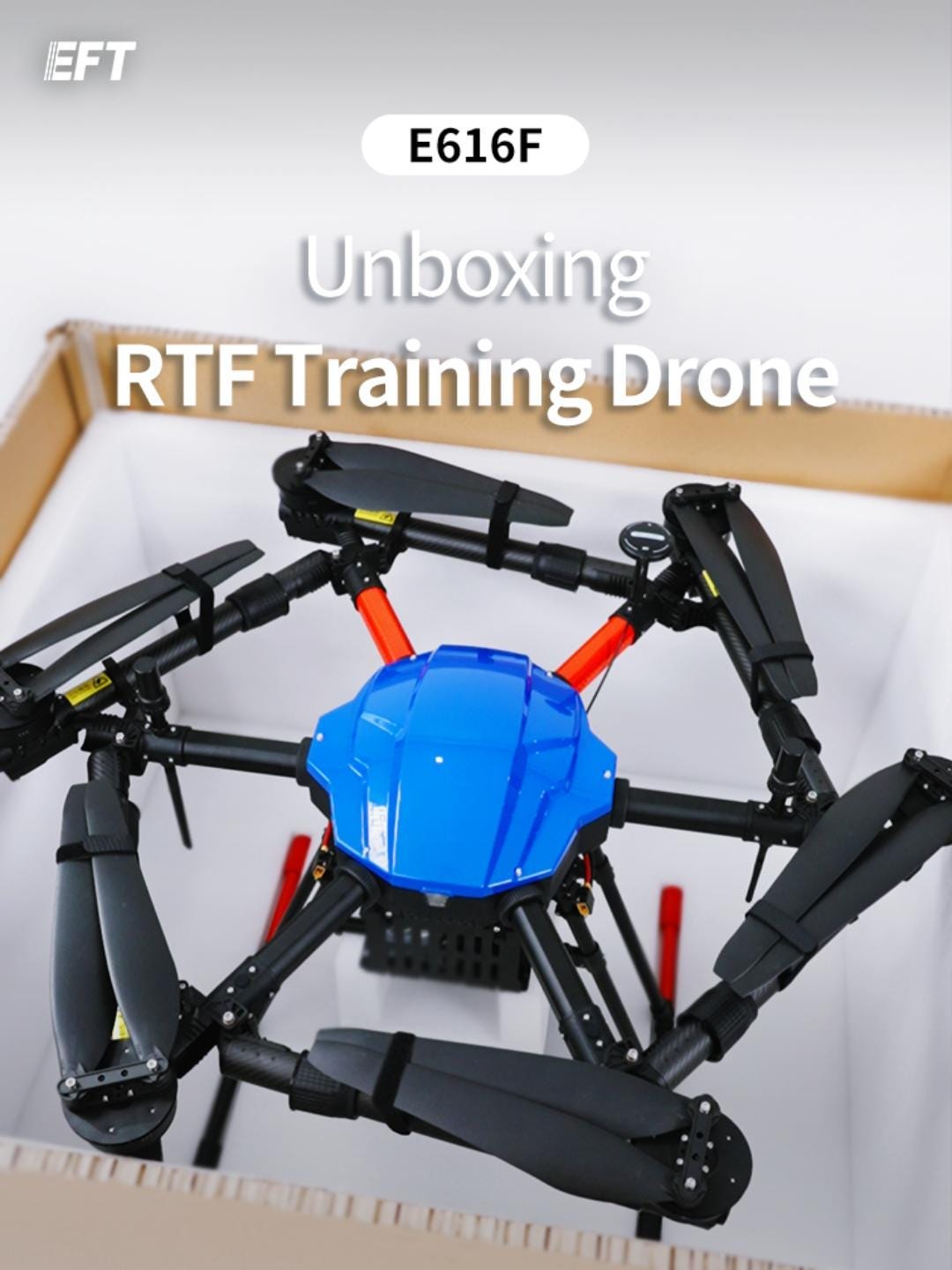
The EFT E616F Training Drone takes a different approach with an RTF (Ready-to-Fly) configuration designed specifically for training environments.
In the unboxing video, the E616F arrives as a complete system rather than simply a collection of individual drone components. The package includes the drone frame, motors, flight controller, RID, RTK, radar, dual remote controllers, and ground station. This gives training organizations a much more complete starting point for building a structured UAV training program.
Why an RTF Training Drone Matters
For a university, UAV academy, or professional training center, assembling a drone from individual components can be useful for engineering education, but it is not always the most efficient solution for pilot training.
When the objective is to teach flight operation, mission planning, situational awareness, and practical UAV skills, instructors generally want students to spend more time flying and less time troubleshooting hardware.
This is where a dedicated drone for training can be valuable.
The E616F is presented as an RTF solution, meaning the major components are already integrated into the system. According to the unboxing demonstration, there is no complicated installation or debugging process required before getting started.
That can simplify deployment for organizations that need multiple aircraft for classroom and field training.
More Than Just Learning the Controls
Modern UAV education is moving beyond basic stick control.
A professional pilot may eventually need to understand RTK positioning, radar-assisted sensing, ground-station operation, route planning, and autonomous flight functions. Introducing these concepts during training can help students develop a better understanding of how professional UAV systems actually operate.
The E616F package is interesting in this regard because it combines several of these elements into one training platform.
The inclusion of dual remote controllers is particularly useful for teaching environments. It can allow instructors and students to participate in the same training process, depending on the operational configuration being used. This provides a more controlled environment for demonstrations, supervised practice, and pilot development.
Building a Realistic Training Environment
A good drone flight training program should gradually move students from basic aircraft control toward more complex operational scenarios.
For example, students can first learn takeoff, hovering, directional control, and landing. Once these fundamentals are established, instructors can introduce waypoint missions, ground-station operation, positioning systems, route replanning, and emergency procedures.
This progression helps turn individual flying skills into practical operational capability.
The advantage of using a standardized platform is that instructors can create repeatable exercises. Students can work with the same aircraft configuration and learn the same procedures, making it easier to evaluate their progress.
What Makes a Good Training Drone?
There is no single aircraft that is automatically the best training drone for every organization.
The right choice depends on the training objective, student level, operating environment, and curriculum.
For basic pilot education, simplicity and durability may be the priority. For advanced UAV programs, however, students may benefit from exposure to technologies such as RTK, radar, remote-control systems, and ground stations.
This is where the E616F concept becomes particularly interesting. Instead of treating training as simply “learning to fly,” it provides a platform that can introduce students to a broader professional UAV workflow.
From Training Room to Real-World Operations
The ultimate goal of UAV training is not simply to make someone comfortable with a remote controller. It is to develop pilots who understand the aircraft, recognize operational risks, follow procedures, and make informed decisions.
EFT’s broader UAV product portfolio and engineering background support this approach. The company develops drone platforms for different operational and training requirements, giving institutions more flexibility when building UAV education programs.
For schools, drone academies, and organizations entering the low-altitude economy, an RTF training platform like the E616F can provide a practical bridge between classroom learning and real-world drone operations.
A professional pilot is built through practice, structured instruction, and the right equipment. And sometimes, the best place to start is simply opening the box and getting familiar with the complete system.

Replies