Assembly Dronenthusiast's Posts (40)

Sort by


31301919292?profile=RESIZE_710x

Agricultural spraying drones are changing how farmers and professional application teams manage crop protection, fertilization, and field operations. Compared with conventional ground-based spraying equipment, multirotor drones can access difficult terrain, follow planned flight routes, and apply liquids over crops without requiring machinery to travel directly through the field.

However, not all agricultural spraying drones are designed for the same operating conditions. Tank capacity, spray flow rate, effective spray width, droplet control, flight planning, battery logistics, and local service support all influence which platform is suitable for a particular operation.

This guide compares four current multirotor agricultural platforms: the DJI Agras T70P, DJI Agras T100, XAG P150, and EFT Z80. It examines their published specifications, application capabilities, and theoretical coverage based on a consistent spray-volume assumption. The goal is to help operators narrow options using transparent criteria rather than to declare a single overall winner.

Important methodology note: This is a specification-based comparison, not a controlled field-test ranking. Manufacturer-reported figures may use different configurations, test conditions, and measurement methods. The theoretical coverage calculations below use a common application-volume assumption (2 US gallons per acre) and should not be interpreted as measured field productivity. Always reconfirm specifications against the current model version and your intended operating conditions.
 
Table of Contents

Quick Comparison: Key Specifications


Alt text: “Comparison of four agricultural spraying drones in 2026 showing spray tank capacities”
Drone ModelSpray Tank CapacityPublished Maximum Spray Flow RatePublished Spray WidthKey Application Consideration
DJI Agras T70P70 L30 L/min (2 nozzles)
40 L/min (4 nozzles optional)
4–11 mBalanced capacity with integrated spraying, spreading & lifting
DJI Agras T100100 L30 L/min (2 nozzles)
40 L/min (4 nozzles optional)
5–13 mFlagship high-capacity platform for large-area operations
XAG P15070 L (max / smart tank)Up to 30 L/min5–10 mHigh-speed spraying with intelligent liquid management
EFT Z8080 LUp to 36 L/min5–10 mHeavy-load modular platform for spraying, spreading & lifting

Specifications should be reconfirmed against the current model version and configuration before purchase. Maximum flow rates and spray widths are not necessarily achieved simultaneously. Local regulations, battery systems, and service availability can be decisive factors beyond the numbers above.


1. DJI Agras T70P: Balanced High-Capacity Platform

The DJI Agras T70P is positioned as a flexible mid-to-large capacity agricultural drone. It offers a 70 L spray tank, a 100 L spreading system, and lifting capability, aiming to balance payload with operational practicality for medium and large fields.

Key Specifications

  • Spray tank capacity: 70 L (operating payload up to 70 kg)
  • Maximum spray flow rate: 30 L/min with two nozzles; up to 40 L/min with optional four nozzles
  • Published spray width: 4–11 m
  • Droplet size range: 50–500 μm
  • Spreading tank volume: 100 L (up to ~70 kg payload)
  • Maximum spreading output: Up to 400 kg/min (compound fertilizer, material-dependent)
  • Lifting capacity: Approximately 65 kg (configuration-dependent)

What Stands Out

The T70P sits between smaller legacy models and the flagship T100. It retains DJI’s integrated ecosystem for flight planning, RTK positioning, and safety sensing while delivering substantially higher liquid capacity than earlier 40 L platforms. Dual magnetic-drive impeller pumps and dual-atomizing nozzles support consistent flow control across a wide droplet range.

For operators who need more than a mid-size tank but do not require the full size and weight of the T100, the T70P offers a practical middle ground with established service networks in many markets.

What to Consider

Tank capacity and maximum flow rate do not establish actual field productivity. Battery choice (DB1580 vs DB2160), local terrain, and refill logistics affect daily output. The 70 L tank provides solid theoretical coverage but remains lower than the T100 and EFT Z80 in nominal liquid volume.

Best suited for: Operators seeking a balanced DJI platform with strong ecosystem support for medium-to-large fields that need both spraying and spreading capability.


2. DJI Agras T100: Flagship High-Capacity Platform

The DJI Agras T100 is DJI’s largest agricultural multirotor in the current lineup. With a 100 L spray tank, 150 L spreading system, and up to 100 kg lifting capacity, it is designed for large-area operations and multi-role agricultural work.

Key Specifications

  • Spray tank capacity: 100 L (operating payload up to 100 kg)
  • Maximum spray flow rate: 30 L/min with two nozzles; up to 40 L/min with optional four nozzles
  • Published spray width: 5–13 m
  • Droplet size range: 50–500 μm
  • Spreading tank volume: 150 L (up to ~100 kg payload)
  • Maximum spreading output: Up to 400 kg/min (compound fertilizer, material-dependent)
  • Lifting capacity: Up to 100 kg (configuration-dependent)

What Stands Out

The T100 delivers the highest nominal spray tank capacity among the four models in this comparison. Combined with a wider published spray width range and a larger spreading hopper, it is aimed at operators who prioritize maximum liquid volume per flight and multi-task flexibility (spraying + spreading + lifting).

Advanced sensing (LiDAR + millimeter-wave radar + multi-vision) and the mature DJI agriculture software ecosystem are important practical advantages for teams already invested in DJI workflows.

What to Consider

Higher capacity comes with greater aircraft weight and logistical requirements. Operators should evaluate battery turnaround, field access, and whether the full 100 L capacity is routinely usable under local weight and regulatory limits. Maximum flow and spray width figures are not achieved simultaneously under all conditions.

Best suited for: Large-scale operators and service providers who need maximum tank capacity and multi-role capability within the DJI ecosystem.


3. XAG P150: High-Speed Intelligent Spraying Platform

The XAG P150 is designed around high operating speed and intelligent liquid management. Its smart liquid tank is commonly listed with a maximum capacity of 70 L and a maximum flow rate of 30 L/min, paired with centrifugal atomizing nozzles and real-time liquid-level sensing.

Key Specifications

  • Spray tank capacity: Rated ~60 L / maximum 70 L (smart liquid tank)
  • Maximum spray flow rate: Up to 30 L/min (dual pumps)
  • Published spray width: 5–10 m (subject to height, dosage, and environment)
  • Droplet size range: Approximately 60–500 μm (configuration- and condition-dependent)
  • Spreading container capacity: 115 L (rated payload around 70 kg)
  • Maximum spreading output: Up to ~280 kg/min (material-dependent; tested with urea/compound fertilizer in published data)

What Stands Out

XAG emphasizes high flight speed (published up to 18 m/s in some materials), intelligent tank sensing that reduces foam interference, and efficient refill design. The platform is frequently positioned for operators who value speed and consistent application quality on larger open fields.

The modular RevoSpray / RevoCast approach allows switching between liquid and granular work. Actual usable capacity and performance depend on the exact spray or spread module installed.

What to Consider

Published maximum tank volume is 70 L, placing it in the same nominal liquid class as the T70P. Flow rate peaks at 30 L/min in standard dual-pump configuration. Operators should confirm the exact tank and nozzle configuration offered in their region and verify local service coverage.

Best suited for: Operators prioritizing high operating speed and intelligent liquid management on medium-to-large open fields, especially where XAG support is strong.


4. EFT Z80: Heavy-Load Modular Platform

The EFT Z80 is a heavy-load agricultural drone designed for spraying, granular spreading, and aerial lifting through a modular configuration. Its 80 L spray tank and 120 L spreading container provide competitive nominal capacity, while the platform supports quick configuration changes.

Key Specifications

  • Spray tank capacity: 80 L
  • Maximum spray flow rate: 36 L/min
  • Published effective spray width: 5–10 m
  • Droplet size range: 50–500 μm
  • Spreading container capacity: 120 L
  • Maximum spreading output: Up to 400 kg/min when tested with compound fertilizer (material-dependent)
  • Maximum lifting payload: 80 kg
  • Maximum takeoff weight: 149.9 kg
  • Protection rating: IP65

What Stands Out

High-capacity spraying system. Dual flexible-impeller pumps and four centrifugal nozzles support a published maximum flow of 36 L/min with an adjustable droplet range of 50–500 μm. Actual performance depends on selected flow, droplet size, flight speed, crop canopy, and required application volume.

Large-capacity spreading system. The 120 L container with interchangeable augers handles a range of granular materials. The 400 kg/min figure is material-dependent and should not be treated as universal.

Modular design. The platform supports spraying, spreading, and lifting configurations. Quick-swap design allows adaptation to different tasks, subject to equipment and payload limits.

Flight-planning functions. Published information describes app-based work-mode recognition, route planning, and KML import. Optional radar supports terrain prediction under specified conditions.

What to Consider

The 80 L tank offers higher nominal liquid capacity than the T70P and XAG P150, and sits below the T100. A larger tank can reduce refill frequency at the same application rate, but must be weighed against aircraft weight, battery endurance, and field logistics. Parts availability and local technical support should be confirmed for the intended market.

Best suited for: Agricultural operators, spraying contractors, and UAV businesses evaluating a heavy-load modular platform for spraying, spreading, and lifting tasks.


Theoretical Spray Coverage: How Much Area Can a Full Tank Cover?

Tank capacity is a useful starting point when comparing agricultural spraying drones. However, theoretical coverage per tank is not the same as actual field productivity.

To compare nominal spray capacity using a consistent assumption, the calculations below use an application rate of 2 US gallons per acre (approximately 7.57 L per acre or 18.7 L per hectare).

Calculation formula:
Theoretical coverage per full tank = Spray tank capacity ÷ Application rate per acre

Example: An 80 L spray tank ÷ 7.57 L per acre ≈ 10.6 acres of theoretical coverage.

Estimated Coverage at 2 US gal/acre

Drone ModelNominal Spray Tank CapacityTheoretical Coverage per Full TankFull-Tank Equivalents for 100 Acres
DJI Agras T70P70 L≈ 9.2 acres≈ 10.8
DJI Agras T100100 L≈ 13.2 acres≈ 7.6
XAG P15070 L≈ 9.2 acres≈ 10.8
EFT Z8080 L≈ 10.6 acres≈ 9.5

These are theoretical liquid-capacity calculations, not measured field productivity or exact refill counts. Values are rounded. Actual usable volume, residual liquid, and operational factors will differ.

How Should These Figures Be Interpreted?

Under the same assumed application volume, larger tanks (T100 at 100 L, followed by Z80 at 80 L) can theoretically cover more acreage per full tank and may reduce the number of refills. This advantage must be balanced against battery endurance, aircraft weight, refill logistics, and field layout.

Actual productivity also depends on:

  • Flight speed and effective spray width
  • The required application rate for the crop and treatment
  • Battery endurance and battery-change time
  • Refill and mixing logistics
  • Field shape, obstacles, and travel distance
  • Weather, wind drift, and operating restrictions
  • Setup, cleaning, and maintenance time

For a meaningful productivity comparison, operators should evaluate each model under comparable conditions and measure completed acreage per hour, liquid application accuracy, battery turnaround, and total operational time.


How to Choose the Right Agricultural Spraying Drone

The most suitable spraying drone depends on the operation, not just one specification. Use the following decision factors as a practical checklist.

1. Match Tank Capacity to the Application

A larger tank may reduce refill frequency, but the appropriate capacity depends on the crop, required application rate, field layout, aircraft operating limits, and battery performance under load. For large continuous areas, the 100 L T100 and 80 L Z80 offer higher theoretical coverage per fill; for many medium-to-large jobs the 70 L class (T70P / P150) remains highly practical.

2. Compare the Complete Spray System

Review maximum flow rate, nozzle type, droplet-size range, spray width, and flow-control functions together. No single specification establishes overall spraying quality. Match droplet size and application volume to the target crop and product label requirements.

3. Consider Spraying, Spreading, and Lifting Requirements

If an operation includes both liquid and granular applications (or occasional material lifting), check whether the aircraft supports the required configurations, what equipment changes are needed, and what payload limits apply. All four platforms offer spraying and spreading options; lifting capability and payload differ by model.

4. Evaluate Flight Planning and Positioning

RTK positioning, route planning, route resumption, and terrain-following functions can improve consistency on repeatable agricultural tasks. Confirm which functions are included in the exact configuration being considered and under what environmental conditions they are validated.

5. Assess Parts Availability and Technical Support

Parts supply, training, troubleshooting resources, and local service arrangements strongly influence long-term usability—especially during time-sensitive spraying windows. Ask distributors about typical spare-parts lead times, warranty coverage, and available operator training.

6. Verify Local Operating Requirements

Agricultural drone operations may be subject to aviation rules, pesticide application licensing, and other local regulations. Requirements vary by jurisdiction, aircraft, operation type, and substances being applied. Confirm the rules applicable to your intended operation before purchase or deployment.


Additional Perspective: Operator Discussions on Brand Comparison

Choosing an agricultural drone involves more than comparing published specifications. Product quality, operating requirements, parts availability, after-sales support, and day-to-day usability can all influence a buyer’s decision.

Some operators share informal comparisons of platforms (including discussions involving EFT and DJI systems) on social media. One example is an Instagram Reel in which a user discusses practical considerations when comparing agricultural drones:

Instagram Reel – Agricultural drone brand comparison discussion

Note: User-generated social media content reflects individual experience and perspective. It is not an independent laboratory test or formal product review. Viewers should consider the context, potential biases, and how the described conditions relate to their own crops, fields, and support environment.


Frequently Asked Questions

What is the best agricultural spraying drone?

There is no single best agricultural spraying drone for every operator. The right choice depends on tank capacity needs, spray-system requirements, crop and field conditions, flight-control functions, technical support availability, total cost of ownership, and local operating regulations.

Is a 100 L or 80 L agricultural drone better than a 70 L model?

Larger tanks provide greater nominal liquid capacity. At the same application volume per acre they offer greater theoretical coverage per full tank and may reduce refill frequency. However, tank capacity alone does not determine overall spraying performance or daily productivity. Application rate, spray quality, flight speed, battery endurance, weight, and operating conditions also matter.

Does a higher spray flow rate mean better spraying performance?

Not necessarily. Maximum flow rate describes the system’s liquid-delivery capacity under specified conditions. Effective application also depends on droplet size, nozzle configuration, crop canopy, flight altitude, speed, and the required application rate. Matching the system to the crop and product label is more important than peak flow numbers.

Can one agricultural drone handle spraying, spreading, and lifting?

Yes. All four platforms in this comparison support spraying and spreading configurations. Lifting capability is available on the DJI T70P, T100, and EFT Z80 (with different maximum payloads). Operators should confirm equipment requirements, payload limits, and operating procedures for each intended application.

How can agricultural drone productivity be compared fairly?

Use the same application rate and comparable crop and field conditions wherever possible. Compare actual treated area, liquid consumption accuracy, battery changes, refill time, downtime, and application quality rather than relying solely on tank capacity or maximum advertised coverage figures.


Conclusion: Choose According to Your Operating Needs

The DJI Agras T70P, DJI Agras T100, XAG P150, and EFT Z80 represent four current multirotor agricultural spraying platforms with different tank capacities, application systems, and operating characteristics.

  • DJI Agras T70P — Balanced 70 L platform with integrated spraying, spreading, and lifting; strong ecosystem support.
  • DJI Agras T100 — Flagship 100 L capacity with wider spray width range and multi-role capability for large-area work.
  • XAG P150 — 70 L smart tank focused on high operating speed and intelligent liquid management.
  • EFT Z80 — 80 L modular heavy-load platform supporting spraying, spreading, and lifting with competitive flow rate.

Published specifications and standardized calculations help operators narrow options, but they should not be mistaken for independently verified field-performance results. The final decision should account for the intended application, operating conditions, equipment configuration, maintenance, battery logistics, and technical support in your region.

Operators who prioritize maximum liquid capacity within a mature ecosystem may look first at the T100. Those seeking a balance of capacity and maneuverability may prefer the T70P or XAG P150. Teams that need modular multi-role flexibility with an 80 L tank will naturally evaluate the EFT Z80. In all cases, request current configuration details, demonstrate the aircraft if possible, and verify local regulatory and support conditions before committing.

Disclaimer: All intellectual property rights concerning the exterior designs of the drone models mentioned in this article—including those from brands such as DJI, XAG, and EFT—belong to their respective owners. This content is provided solely for the purpose of general education and information exchange within the agricultural plant-protection drone industry and does not constitute a commercial recommendation for any specific product. Please contact us if any content infringes upon your rights, so that we may make necessary adjustments or remove it. All specifications are based on the latest information publicly released by the manufacturers and are subject to change at any time. Before making any operational or purchasing decisions, please verify the most current official specifications, local aviation and pesticide regulations, and actual performance capabilities with qualified suppliers or operators.
Read more…


Last updated: November 2026

Type of review: Specification-based comparison (not a controlled field test)

Scope: Published tank capacity, spray flow, spray width, and related application features of five multirotor agricultural platforms. Operators should verify current model configurations, local regulations, and real-world performance before purchase or deployment.

Agricultural spraying drones are changing how farmers and professional application teams manage crop protection, fertilization, and field operations. Compared with conventional ground-based spraying equipment, multirotor drones can access difficult terrain, follow planned flight routes, and apply liquids over crops without requiring machinery to travel directly through the field.

However, not all agricultural spraying drones are designed for the same operating conditions. Tank capacity, spray flow rate, effective spray width, droplet control, flight planning, battery logistics, and local service support all influence which platform is suitable for a particular operation.

This guide compares five agricultural multirotor platforms from DJI, XAG, EFT, Hylio, and EAVISION. It examines their published specifications, application capabilities, and theoretical coverage based on a consistent spray-volume assumption. The goal is to help operators narrow options using transparent criteria rather than to declare a single overall winner.

Important methodology note: This is a specification-based comparison, not a controlled field-test ranking. Manufacturer-reported figures may use different configurations, test conditions, and measurement methods. The theoretical coverage calculations below use a common application-volume assumption (2 US gallons per acre) and should not be interpreted as measured field productivity. Always reconfirm specifications against the current model version and your intended operating conditions.
Table of Contents

Quick Comparison: Key Specifications

[Suggested image: Side-by-side comparison graphic of the five drone models with tank capacity callouts]
Alt text example: “Comparison of five agricultural spraying drones in 2026 showing spray tank capacities”
Drone ModelSpray Tank CapacityPublished Maximum Spray Flow RatePublished Spray WidthKey Application Consideration
DJI Agras T5040 L16 L/min with two sprinklers
(up to 24 L/min with four)
4–11 mIntegrated spraying and spreading functions
XAG P100 Pro50 LUp to 22 L/min5–10 mHigh-capacity spraying system
EFT Z8080 LUp to 36 L/min5–10 mHeavy-load spraying, spreading, and lifting
Hylio ARESApprox. 49.2 LVerify current configurationUp to 12 mProfessional agricultural operations
EAVISION EA-J15070 L (rated)
73 L full-load
40 L/min (±5%)4–15 mHigher-capacity multirotor spraying

Specifications should be reconfirmed against the current model version and configuration before purchase. Maximum flow rates and spray widths are not necessarily achieved simultaneously. Local regulations, battery systems, and service availability can be decisive factors beyond the numbers above.

1. DJI Agras T50: Integrated Agricultural Drone Platform

The DJI Agras T50 is designed for professional agricultural operations, combining a 40 L spray tank with automated flight functions and integrated spraying and spreading systems.

[Suggested image: DJI Agras T50 in field spraying operation]
Alt text: “DJI Agras T50 agricultural spraying drone applying crop protection”

Key Specifications

  • Spray tank capacity: 40 L
  • Maximum spray flow rate: 16 L/min with two sprinklers; up to 24 L/min with four sprinklers
  • Published spray width: 4–11 m
  • Spreading tank volume: 75 L
  • Maximum spreading payload: Up to 50 kg, depending on configuration

What Stands Out

The Agras T50 integrates spraying, spreading, and flight-planning functions into an agricultural drone ecosystem. For operators already familiar with DJI agricultural equipment, existing workflows, operator training, spare-parts networks, and local service arrangements may reduce the learning curve and downtime risk.

Its integrated application system is designed to support different crop-treatment tasks. Buyers should evaluate the aircraft together with its application equipment, operating software, battery system, and available local support rather than tank size alone.

What to Consider

Tank capacity and maximum flow rate do not establish actual field productivity. Operators should also evaluate application settings, crop conditions, battery endurance, maintenance requirements, and local technical support. The 40 L tank offers lower theoretical coverage per fill than several larger platforms in this comparison, which may increase refill frequency on large jobs.

Best suited for: Operators looking for an integrated agricultural drone platform with established ecosystem support for spraying and spreading applications.

2. XAG P100 Pro: High-Capacity Crop-Protection Platform

The XAG P100 Pro is designed for professional spraying and spreading applications. Its 50 L spray tank offers greater nominal liquid capacity than the DJI Agras T50’s 40 L tank.

[Suggested image: XAG P100 Pro agricultural drone]
Alt text: “XAG P100 Pro high-capacity agricultural spraying drone”

Key Specifications

  • Spray tank capacity: 50 L
  • Published maximum spray flow rate: Up to 22 L/min
  • Published spray width: 5–10 m
  • Granule container capacity: 80 L, depending on configuration

What Stands Out

The P100 Pro combines a high-capacity spray tank with a system designed for professional crop-protection work. Its published specifications make it relevant to operators comparing tank capacity, spray-system output, and integrated agricultural functions.

Its spraying and spreading capabilities may be useful for agricultural operations that require different application methods. The appropriate configuration depends on crop type, application requirements, and operating conditions.

What to Consider

Maximum flow rate is only one part of spraying performance. Droplet size, application rate, nozzle configuration, crop canopy, wind conditions, and flight settings all affect application quality. A higher maximum flow rate does not automatically mean better spray coverage or lower chemical consumption.

Best suited for: Agricultural operators comparing higher-capacity multirotor platforms for spraying and spreading operations who value a balance between tank size and established product maturity.

3. EFT Z80: Heavy-Load Platform for Spraying, Spreading & Lifting

The EFT Z80 is positioned as a heavy-load agricultural drone platform designed to support spraying, granular spreading, and aerial lifting through a modular configuration. Its 80 L spray tank and 120 L spreading container provide greater nominal capacity than the 40–70 L spray tanks of the other models in this comparison.

[Suggested image: EFT Z80 with spray system and optional modules]
Alt text: “EFT Z80 heavy-load agricultural drone configured for spraying”

Key Specifications

  • Spray tank capacity: 80 L
  • Maximum spray flow rate: 36 L/min
  • Published effective spray width: 5–10 m
  • Droplet size range: 50–500 μm
  • Spreading container capacity: 120 L
  • Maximum spreading output: Up to 400 kg/min when tested with compound fertilizer (material-dependent)
  • Maximum lifting payload: 80 kg
  • Maximum takeoff weight: 149.9 kg
  • Protection rating: IP65

What Stands Out

High-capacity spraying system. The Z80 features an 80 L spray tank, dual flexible-impeller pumps, and four centrifugal nozzles. Its published maximum flow rate is 36 L/min, with an effective spray width of 5–10 m and an adjustable droplet size range of 50–500 μm. Actual application performance depends on the selected flow rate, droplet size, flight speed, crop canopy, and required application volume.

Large-capacity spreading system. The platform uses a 120 L spreading container with interchangeable augers for different granular materials. The listed maximum spreading output of 400 kg/min is material-dependent and should not be treated as a universal rate for all seeds, fertilizers, or granular products.

Modular design. The Z80 supports spraying, spreading, and lifting configurations. Quick-swap design allows the platform to be adapted to different agricultural tasks, subject to applicable equipment and payload limits. Buyers should evaluate the required accessories, configuration changes, operating procedures, and service needs for each application.

Flight-planning functions. Published product information describes app-based work-mode recognition, route planning, and KML file import. Optional radar functions support terrain prediction and automatic slope ascent under the manufacturer’s specified conditions. Availability and performance depend on the selected configuration and operating environment.

What to Consider

The 80 L spray tank provides greater nominal liquid capacity than the 40 L, 49.2 L, 50 L, and 70 L tanks in this comparison. At the same application rate this can increase theoretical coverage per full tank and potentially reduce refill frequency. However, a larger tank must be weighed against aircraft weight, battery endurance, field layout, and refill logistics. Maximum spray flow rate should not be interpreted as a guarantee of higher acreage per hour.

Operators should also distinguish between the platform’s spraying, spreading, and lifting configurations. Payload limits and operating requirements differ by application. Parts availability, training, and local technical support should be confirmed for the intended market.

Best suited for: Agricultural operators, spraying contractors, and UAV businesses evaluating a heavy-load multirotor platform that can be configured for spraying, spreading, and lifting tasks.

4. Hylio ARES: Professional Agricultural Operations Platform

Hylio’s ARES is an agricultural UAV platform designed for spraying and spreading applications. Its specifications distinguish between the liquid-spraying and granular-spreading configurations.

[Suggested image: Hylio ARES agricultural drone]
Alt text: “Hylio ARES professional agricultural spraying drone”

Key Specifications

  • Spray tank capacity: Approximately 13 US gallons (≈ 49.2 L)
  • Published maximum spray width: Up to 12 m
  • Spreading configuration: Different container and payload specifications from the spraying configuration

What Stands Out

ARES is worth evaluating for operators considering professional agricultural drone platforms and the associated training, service, and technical-support arrangements. Hylio provides application equipment and software intended for agricultural treatment operations. Suitability depends on the target crops, required application method, selected configuration, and the support available in the operating region.

What to Consider

Confirm the current model configuration, spray-system specifications, payload limits, and local support arrangements before comparing it directly with other platforms. The manufacturer’s maximum spray width should be interpreted in context: crop canopy, wind, droplet size, flight altitude, and application rate can all affect the effective working width.

Best suited for: Professional agricultural operators evaluating configurable UAV spraying and spreading systems, particularly where regional support and training are important selection factors.

5. EAVISION EA-J150: High-Capacity Multirotor for Agricultural Operations

The EAVISION EA-J150 is a heavy-duty agricultural multirotor designed for spraying, spreading, and related agricultural operations. Its 70 L rated spray tank and published maximum flow rate of 40 L/min place it in a higher-capacity category than the 40–50 L spray tanks of several other models in this comparison.

[Suggested image: EAVISION EA-J150 agricultural drone in operation]
Alt text: “EAVISION EA-J150 high-capacity agricultural spraying drone”

Key Specifications

  • Rated spray tank capacity: 70 L
  • Full-load tank capacity: 73 L
  • Maximum spray flow rate: 40 L/min (±5%)
  • Published effective spray width: 4–15 m
  • Droplet size range: 10–300 μm
  • Number of spray nozzles: Two or four, depending on configuration
  • Spreading container capacity: 100 L

What Stands Out

The EA-J150 features EAVISION’s CCMS® bimodal mist nozzle technology and an application system designed to support different droplet sizes. The manufacturer also describes airflow-assisted spraying intended to improve droplet distribution within crop canopies. Its larger tank can reduce the theoretical number of refills required for a given liquid application volume. The actual benefit depends on the target application rate, field layout, travel distance, refill logistics, and usable tank volume.

What to Consider

The maximum published flow rate and spray width should not be interpreted as performance values achieved simultaneously in every operating condition. Buyers should confirm the appropriate nozzle configuration, application settings, and field performance for their intended crops, and verify local service and parts support.

Best suited for: Agricultural operators and service providers evaluating a higher-capacity multirotor for large fields, demanding spray applications, and varied crop environments.

Theoretical Spray Coverage: How Much Area Can a Full Tank Cover?

Tank capacity is a useful starting point when comparing agricultural spraying drones. However, theoretical coverage per tank is not the same as actual field productivity.

To compare nominal spray capacity using a consistent assumption, the calculations below use an application rate of 2 US gallons per acre (approximately 7.57 L per acre or 18.7 L per hectare).

Calculation formula:
Theoretical coverage per full tank = Spray tank capacity ÷ Application rate per acre

Example: An 80 L spray tank ÷ 7.57 L per acre ≈ 10.6 acres of theoretical coverage.

Estimated Coverage at 2 US gal/acre

Drone ModelNominal Spray Tank CapacityTheoretical Coverage per Full TankFull-Tank Equivalents for 100 Acres
DJI Agras T5040 L≈ 5.3 acres≈ 18.9
XAG P100 Pro50 L≈ 6.6 acres≈ 15.1
EFT Z8080 L≈ 10.6 acres≈ 9.5
Hylio ARES49.2 L≈ 6.5 acres≈ 15.4
EAVISION EA-J15070 L≈ 9.2 acres≈ 10.8

These are theoretical liquid-capacity calculations, not measured field productivity or exact refill counts. Values are rounded. Actual usable volume, residual liquid, and operational factors will differ.

How Should These Figures Be Interpreted?

Under the same assumed application volume, larger tanks (such as the 80 L and 70 L options) can theoretically cover more acreage per full tank and may reduce the number of refills required for a given total volume. This advantage must be balanced against battery endurance, aircraft weight, refill logistics, and field layout.

Actual productivity also depends on:

  • Flight speed and effective spray width
  • The required application rate for the crop and treatment
  • Battery endurance and battery-change time
  • Refill and mixing logistics
  • Field shape, obstacles, and travel distance
  • Weather, wind drift, and operating restrictions
  • Setup, cleaning, and maintenance time

For a meaningful productivity comparison, operators should evaluate each model under comparable conditions and measure completed acreage per hour, liquid application accuracy, battery turnaround, and total operational time.

How to Choose the Right Agricultural Spraying Drone

The most suitable agricultural drone depends on the operation, not just one specification. Use the following decision factors as a practical checklist.

1. Match Tank Capacity to the Application

A larger tank may reduce refill frequency, but the appropriate capacity depends on the crop, required application rate, field layout, aircraft operating limits, and battery performance under load. For large continuous areas, higher-capacity platforms (70–80 L) can reduce the number of cycles; for smaller or fragmented fields the benefit may be smaller.

2. Compare the Complete Spray System

Review maximum flow rate, nozzle type, droplet-size range, spray width, and flow-control functions together. No single specification establishes overall spraying quality. Match droplet size and application volume to the target crop and product label requirements.

3. Consider Spraying, Spreading, and Lifting Requirements

If an operation includes both liquid and granular applications (or occasional material lifting), check whether the aircraft supports the required configurations, what equipment changes are needed, and what payload limits apply. Modular platforms can consolidate equipment but require clear procedures for reconfiguration and safety.

4. Evaluate Flight Planning and Positioning

RTK positioning, route planning, route resumption, and terrain-following functions can improve consistency on repeatable agricultural tasks. Confirm which functions are included in the exact configuration being considered and under what environmental conditions they are validated.

5. Assess Parts Availability and Technical Support

Parts supply, training, troubleshooting resources, and local service arrangements strongly influence long-term usability—especially during time-sensitive spraying windows. Ask distributors about typical spare-parts lead times, warranty coverage, and available operator training.

6. Verify Local Operating Requirements

Agricultural drone operations may be subject to aviation rules, pesticide application licensing, and other local regulations. Requirements vary by jurisdiction, aircraft, operation type, and substances being applied. Confirm the rules applicable to your intended operation before purchase or deployment.

Frequently Asked Questions

What is the best agricultural spraying drone in 2026?

There is no single best agricultural spraying drone for every operator. The right choice depends on tank capacity needs, spray-system requirements, crop and field conditions, flight-control functions, technical support availability, total cost of ownership, and local operating regulations.

Is an 80 L agricultural drone better than a 50 L model?

An 80 L tank provides greater nominal liquid capacity than a 50 L tank. At the same application volume per acre it offers greater theoretical coverage per full tank and may reduce refill frequency. However, tank capacity alone does not determine overall spraying performance or daily productivity. Application rate, spray quality, flight speed, battery endurance, weight, and operating conditions also matter.

Does a higher spray flow rate mean better spraying performance?

Not necessarily. Maximum flow rate describes the system’s liquid-delivery capacity under specified conditions. Effective application also depends on droplet size, nozzle configuration, crop canopy, flight altitude, speed, and the required application rate. Matching the system to the crop and product label is more important than peak flow numbers.

Can one agricultural drone handle spraying, spreading, and lifting?

Some agricultural platforms support multiple applications through interchangeable equipment. Several models in this comparison offer both spraying and spreading configurations; a smaller number also support lifting within defined payload limits. Operators should confirm equipment requirements, payload limits, and operating procedures for each intended application.

How can agricultural drone productivity be compared fairly?

Use the same application rate and comparable crop and field conditions wherever possible. Compare actual treated area, liquid consumption accuracy, battery changes, refill time, downtime, and application quality rather than relying solely on tank capacity or maximum advertised coverage figures.

Conclusion: Choose According to Your Operating Needs

The DJI Agras T50, XAG P100 Pro, EFT Z80, Hylio ARES, and EAVISION EA-J150 represent five multirotor agricultural spraying platforms with different tank capacities, application systems, and operating characteristics.

  • DJI Agras T50 — Integrated agricultural platform with established ecosystem support; 40 L spray tank.
  • XAG P100 Pro — 50 L spraying configuration aimed at professional crop-protection work.
  • EFT Z80 — Highest nominal spray tank capacity in this group (80 L) plus 120 L spreading and lifting options for multi-task operations.
  • Hylio ARES — Configurable professional platform (≈ 49.2 L) where regional support and training are key considerations.
  • EAVISION EA-J150 — Higher-capacity option with 70 L rated tank and wide published spray width range.

Published specifications and standardized calculations help operators narrow options, but they should not be mistaken for independently verified field-performance results. The final decision should account for the intended application, operating conditions, equipment configuration, maintenance, battery logistics, and technical support in your region.

Operators who primarily need integrated ecosystem support may lean toward platforms with mature service networks. Those prioritizing maximum liquid capacity and multi-role flexibility (spraying + spreading + lifting) will naturally look more closely at the higher-capacity modular options. In all cases, request current configuration details, demonstrate the aircraft if possible, and verify local regulatory and support conditions before committing.

Disclaimer: All specifications are based on publicly available manufacturer information current as of the last update date and may change. This article is for informational purposes only and does not constitute a product endorsement, performance guarantee, or recommendation for any specific commercial purchase. Always verify the latest official specifications, local aviation and pesticide regulations, and real-world performance with qualified suppliers and operators before making operational or purchasing decisions.

Read more…

As the drone industry continues to expand into agriculture, industrial inspection, logistics, surveying, and other professional applications, the demand for practical UAV engineering skills is growing alongside it. For vocational colleges and universities, this creates a new challenge: students need more than basic piloting experience. They need to understand how a drone is built, how its flight control system works, and how to configure and maintain the aircraft.

The EFT N680 UAV Assembly & Tuning Kit is designed to support this kind of hands-on learning. With a modular airframe, an open-source flight control architecture, and dedicated tuning software, the N680 provides an accessible UAV development platform for students, instructors, and drone technology enthusiasts.

Rather than treating a drone as a ready-made device, the N680 gives learners the opportunity to explore the complete aircraft system—from individual components to actual flight testing.

Why UAV Assembly Training Matters in Vocational Education

Drone education is evolving beyond basic flight operation. As commercial UAV applications become more specialized, technical training increasingly needs to cover several interconnected areas:

  • Aircraft structure and assembly: Understanding airframe design, propulsion components, and mechanical connections.

  • Electronic systems: Learning how motors, ESCs, power distribution, batteries, and flight controllers work together.

  • Flight controller configuration: Setting up sensors, radio channels, flight modes, and essential parameters.

  • Maintenance and troubleshooting: Identifying component issues, replacing modules, and checking system conditions.

  • Software and development: Exploring open-source firmware, communication protocols, and autonomous flight concepts.

A practical UAV training kit can bring these topics together in one learning environment. Students can move from component recognition and aircraft assembly to configuration, testing, and more advanced development projects.

For institutions building vocational drone training programs, this approach helps connect theoretical knowledge with practical engineering tasks.

Meet the EFT N680: A Modular UAV Development Platform

The EFT N680 is a 680 mm wheelbase quadcopter designed for hands-on drone assembly, flight control training, and open-source development.

Its modular structure makes individual components easier to inspect, replace, and maintain. The main frame uses a high-strength, one-piece injection-molded nylon structure, combined with carbon-fiber arms and landing gear.

Key components, including the arms, motors, ESC/PDB, propellers, battery compartment, and flight controller, can be handled as separate modules. This allows students to learn how different parts contribute to the complete aircraft system rather than relying on an enclosed, difficult-to-modify platform.

The airframe also provides internal space and mounting provisions for additional equipment. Depending on the project requirements, students and developers can explore payload integration and experiments involving aerial imaging, sensing, and visual navigation.

This modular design offers practical advantages in teaching environments. When a component requires inspection or replacement, students can focus on the relevant module instead of treating the entire aircraft as a sealed unit.

Key N680 platform specifications:

ItemSpecification
Wheelbase680 mm
Frame Weight2.5 kg
Maximum Takeoff Weight4.7 kg
Unfolded Dimensions867 × 860 × 316 mm
Propeller Size15 inches
Rotor ConfigurationQuadrotor
Power System6S
ESC4–6S / 30A

From Aircraft Assembly to Flight Control Configuration

One of the key benefits of an UAV assembly and tuning training kit is that it creates a structured learning process. The N680 can support practical exercises at different technical levels.

1. Understanding Drone Components and Airframe Assembly

Students begin by identifying the aircraft's main structural and electronic components. They can examine the frame, carbon-fiber arms, motors, ESCs, propellers, battery compartment, and flight control system.

Through assembly exercises, learners gain a better understanding of component positioning, mechanical connections, and the relationship between the airframe and propulsion system.

This provides a practical foundation for further study in UAV engineering and maintenance.

2. Flight Controller Setup and Parameter Tuning

After assembly, students can move on to flight controller configuration and system calibration.

The N680's N1 mini flight controller is built around an STM32H743 processor and provides interfaces for motors, servos, and peripheral expansion. Its architecture supports a range of flight control and development applications.

The accompanying EFT N1 Assistant software helps make initial configuration and debugging more approachable. It provides access to information such as attitude data, EKF status, GPS signals, and RC channel data, while supporting parameter configuration and flight log playback.

These functions give students and instructors a more practical way to understand system status, review configuration results, and analyze flight data.

3. Learning Open-Source Flight Control with ArduPilot and MAVLink

For students progressing beyond basic assembly, the N680 offers access to an open-source development environment.

The N1 mini flight controller natively supports ArduPilot open-source firmware and the MAVLink communication protocol. This provides a foundation for learning flight modes, parameter configuration, waypoint missions, and communication between drone systems.

ArduPilot's official documentation also provides technical references for initial setup, sensor calibration, radio configuration, and other flight controller procedures.

For learners, this means the N680 can serve as more than a basic training aircraft. It can become a practical platform for understanding how open-source autopilot software interacts with real drone hardware.

Reference resources:

4. Exploring Advanced UAV Development

The N680 can also support more advanced academic and engineering projects.

With an optional external onboard computer, developers can explore ROS-based algorithm deployment and projects involving machine vision, autonomous navigation, and sensor integration.

The onboard computer is not included with the standard N680 kit and should be selected separately according to the project's computing and integration requirements.

This flexibility allows institutions to introduce more advanced UAV development exercises as students build experience with the aircraft and its flight control architecture.

A Practical UAV Training Platform for Different Learning Environments

The N680 is suitable for institutions and users looking for a hands-on approach to drone technology education.

Vocational and Technical Colleges

Students can practice aircraft assembly, electronic component identification, flight controller setup, basic maintenance, and flight testing. These exercises help connect classroom knowledge with practical UAV skills.

University Engineering Laboratories

The open-source flight control architecture and expansion interfaces provide opportunities for research projects involving flight control, sensor integration, autonomous navigation, and UAV system development.

STEM and Drone Technology Programs

For more advanced STEM courses, the N680 offers a way to introduce aircraft structures, propulsion systems, embedded control, and programming concepts through a physical drone platform. It is better suited to advanced practical learning than to simple entry-level flying demonstrations.

Drone Developers and DIY Enthusiasts

The modular airframe and open-source ecosystem make the N680 a practical starting point for learning aircraft configuration, testing, maintenance, and further development.

Choosing the Right EFT N680 Kit Configuration

Different laboratories and training programs may have different requirements for their existing equipment. The N680 is available in three configurations:

ConfigurationMain Included ComponentsSuitable For
PNP KitFrame, 4 E4 motors, 4 × 30A ESCs, and 4 × 15-inch folding propellersLabs with compatible flight controllers and remote control equipment
RTF Kit (Unassembled)PNP components, N1 mini flight controller, GPS module, RC Lite remote controller, 6S 8000 mAh battery, and 300W chargerInstitutions looking for a more complete hardware package
RTF Kit with Flight Case (Unassembled)All RTF kit components plus an aviation transport caseTraining programs that regularly move equipment between classrooms and outdoor test locations

An important point for educational buyers: the N680 kits are delivered as unassembled components. Users must complete aircraft assembly, calibration, and parameter tuning before the first flight. The RTF configuration refers to the included system components, not an aircraft that is ready to fly immediately after unpacking.

This is also part of the intended hands-on training process. Institutions should select the configuration according to their existing equipment, course objectives, and teaching arrangements.

Building More Practical UAV Education Solutions with EFT

As a drone manufacturer and solution provider, EFT develops products for agricultural, industrial, and educational UAV applications. Its product portfolio covers complete drone systems, modular flight platforms, frames, payload components, and training-oriented products.

By combining modular hardware, supporting software, and different aircraft configurations, EFT aims to make practical UAV learning more accessible to educational institutions and technical training organizations.

Start Building Your UAV Training Program with the EFT N680

A strong drone education program should help students understand not only how to operate an aircraft, but also how its hardware and software work together.

The EFT N680 provides a practical platform for learning aircraft assembly, flight controller configuration, open-source firmware, basic flight testing, and further UAV development.

Whether you are planning a vocational drone training course, establishing a university UAV laboratory, or looking for an open-source drone development kit, the N680 offers a modular starting point for hands-on learning.

Contact EFT to discuss N680 configurations, institutional procurement, and UAV training project requirements.


Frequently Asked Questions

Is the EFT N680 suitable for vocational drone training?

Yes. The N680 is designed to support practical learning in aircraft assembly, component identification, flight controller configuration, calibration, and basic flight testing. It can be used in vocational colleges, university laboratories, and advanced STEM programs.

Does the EFT N680 come fully assembled and ready to fly?

No. N680 kits are delivered as unassembled components. Users need to complete aircraft assembly, calibration, and parameter tuning before flight. The RTF version includes the major flight control and power system components, but it is not ready to fly immediately after unpacking.

Does the N680 support ArduPilot?

Yes. The N680's N1 mini flight controller supports ArduPilot open-source firmware and the MAVLink communication protocol, providing a foundation for flight control learning and development.

Can the N680 be used for ROS development?

Yes, with additional hardware. ROS algorithm nodes need to run on an external onboard computer, which is not included with the standard kit. The N680 provides an expansion foundation for projects involving machine vision and autonomous navigation.

Can institutions purchase spare parts separately?

Yes. Key components, including arms, motors, ESC boards, propellers, batteries, flight controllers, and GPS modules, are available separately. This supports ongoing maintenance and repeated use in educational environments.


Read more…

EFT N680: Entry Level DIY Drone Platform

Published: 9, 24, 2026 , | Written by Louis, Technical Department Manager

Programmable drones on the market generally fall into two categories. The first includes block based programming toys that are affordable and well suited for short term, hands on experiences. However, these systems are essentially closed “black boxes.” Once students want to explore the underlying logic behind flight control decisions, they offer limited opportunities for deeper technical learning. 


The second category consists of high performance, open source research platforms. While these platforms provide extensive development capabilities, they are often expensive, delivered as bare bone kits, and require a relatively high level of technical knowledge. This creates a steep learning curve for students who are just beginning to explore drone development. coding drone

The EFT N680 is designed to bridge this gap.

As an entry level open source drone development platform, the N680 enables new students to progress from basic hands on training to real flight testing, while giving graduate students and advanced learners a practical platform for algorithm research and academic projects. Its flight control architecture is open at the core, while its modular design allows students to inspect, maintain, and replace individual components themselves.

With comprehensive technical documentation and supporting software, instructors can integrate the N680 into existing courses without having to redesign the entire curriculum.

 31268874897?profile=RESIZE_710x

What Is the EFT N680?

The EFT N680 is a 680 mm wheelbase quadcopter open source drone development platform. Unlike closed educational drones that rely primarily on simplified demonstration applications, the N680 is a professional experimental platform designed to combine stable flight performance with hands on, in depth learning.

Its unified airframe and open source flight control system make it particularly suitable for universities, vocational schools, STEM program leaders, and drone developers. education drone The platform is open and easy to maintain, allowing for repeated use in teaching across academic years. 


Design and Configuration

The N680 adopts a fully modular architecture. Its main frame uses a high strength, one piece injection molded nylon structure, combined with carbon fiber arms and landing gear. The fuselage provides ample internal space and reserved mounting points for payloads and peripherals, allowing students to integrate cameras and other equipment for experiments such as aerial imaging and visual navigation.

Featuring a modular design, components such as the arms, motors, ESC/PDB, propellers, snap-fit sealed battery compartment, and flight controller can be replaced independently, facilitating assembly, setup, and maintenance. entry level drone

This modular approach is particularly valuable in classroom environments. If a component is damaged during a test flight, students can replace the affected module instead of replacing the entire aircraft. This helps minimize downtime and keeps practical training on schedule. 

A single N680 can support multiple educational experiments covering flight principles, propulsion systems, embedded control, and complete aircraft assembly.

Open Source Flight Control and Development

The aircraft is equipped with the N1 mini open source flight controller, built around a high performance STM32H7 processor.

It features a built in high precision magnetic compass and can be paired with an external GPS compass to provide redundant heading sensing and improve positioning stability.

The flight controller provides a broad range of peripheral interfaces, including 8 motor output channels and 4 servo channels, with reserved expansion buses for CAN, serial, and I2C devices.

The N680 natively supports ArduPilot open source firmware and the MAVLink communication protocol, allowing students and developers to work within a mature open source ecosystem supported by extensive documentation and community resources.

A Progressive Learning Path

The N680 is designed around a progressive learning path.

At the beginner level, students can use ArduPilot to configure and test flight modes, parameters, and waypoint missions. This allows them to understand fundamental drone control concepts through direct interaction with a real aircraft rather than relying solely on simulation or block based programming.

At the advanced level, users can connect an onboard computer and deploy ROS nodes, with access to attitude, position, and velocity control commands. This creates opportunities for projects involving machine vision, autonomous navigation, and other advanced drone applications.

The onboard computer is an optional accessory, while the flight controller includes reserved expansion interfaces for integration.

EFT N1 Assistant Software

The N680 is supported by EFT N1 Assistant, a lightweight parameter tuning application designed to make configuration and debugging more approachable for beginners.

The software provides real time access to attitude data, EKF status, GPS signals, and RC channel data. It also supports flight parameter configuration and log playback, giving students and instructors the ability to review flight data after class.

This makes the same software suitable for both introductory training and more advanced secondary development.

RC Lite Remote Controller

The N680 comes standard with the RC Lite remote controller, featuring an industrial, minimalist design and high precision Hall effect joysticks for smooth and responsive control.

It uses two removable 18650 batteries, supporting direct charging and quick battery replacement.

With 16 output channels, the controller provides the basic channels required for flight control while leaving additional channels available for customized control of expansion payloads such as cameras and deployment devices. This makes the system suitable for a wide range of student innovation and engineering projects.


Flight Performance and Power Characteristics

The N680's flight performance specifications are calibrated by EFT's inhouse R&D team rather than being theoretical figures intended only for product display.

Its power reserves allow the platform to maintain stable and controllable flight while carrying payloads. The airframe can directly accommodate gimbals, thermal imaging modules, and customized sensor kits without requiring structural modifications.

The platform is equipped with a 6S 8000 mAh lithium ion battery, providing approximately 18-27 minutes of flight time under standard operating conditions. Exact performance depends on payload weight and flight mode settings.

The battery supports quick installation and removal. When paired with the included 300 W high power charger, it takes approximately 45 minutes to recharge from empty to full, helping reduce charging downtime during classroom experiments effectively.


Application Scenarios

Drone Beginners

The kit includes the essential hardware required to build the aircraft. Its modular architecture helps reduce the learning curve and allows students to develop a practical understanding of the complete drone system through hands on assembly and training. 

DIY Development Enthusiasts

The N680 combines high quality hardware with a proven industrial grade structure, providing a stable and reliable flight platform while giving users the opportunity to learn through assembly, configuration, testing, and debugging.

College Students and Research Developers

Native compatibility with the ArduPilot, MAVLink, and ROS ecosystems makes the N680 suitable for university courses, laboratory experiments, and research projects involving flight control algorithms, machine vision, autonomous navigation, and related technologies.

Industry Innovators

With extensive expansion interfaces and available payload capacity, the N680 can also serve as a practical platform for rapidly validating prototypes for applications such as aerial imaging, surveying, and inspection.

 colleague education drone

31268875272?profile=RESIZE_710x

What's Included in the Kit

The N680 is available in three configurations to meet different laboratory and training requirements:

  1. PNP Kit Includes the N680 frame, 4 E4 motors, 4 30A ESCs, and 4 15 inch folding propellers. This configuration is suitable for laboratories that already have compatible flight controllers and remote control equipment.
  2. RTF Kit Includes all components of the PNP kit, plus an N1 mini flight controller, GPS module, RC Lite remote controller, EB608 6S 8000 mAh battery, and 300W charger.
  3. RTF Flight Case Kit Includes everything in the RTF kit, plus an aviation transport case for moving equipment between classrooms and outdoor flight test locations.

All components are also available separately as replacement parts. Importantly, all kits are delivered as unassembled components. Users are required to complete the aircraft assembly and parameter tuning themselves. The EFT N1 Assistant tuning software provides guided tutorials, while the assembly and tuning process itself forms an important part of the handson training experience.  beginner friendly drone


Specifications

N680 Drone Platform

Item

Specification

Wheelbase

680 mm

Frame Weight

2.5 kg

Maximum Takeoff Weight

4.7 kg

Unfolded Dimensions

867 × 860 × 316 mm

Propeller Size

15 inch

Rotor Count

4

Motor Model

4214

Supply Voltage

6S

KV Rating

380 rpm/V

ESC Model

4-6S/30A

N1mini Flight Controller

Processor

STM32H743

Accelerometer & Gyroscope

ICM-42670-P

Electronic Compass

QMC5883P

Barometer

SPA06-003

Operating Voltage

5V

Dimensions

45 x57.1 mm

RC Lite Remote Controller

Dimensions

275.05 x 178.1x 98.65 mm

Battery

2 x 18650 Batteries

Operating Frequency Band

2.4GHz

Control Range

1km

Charging Port

USB-C

Weight

1.5kg

Battery Runtime

5-7h

RF Output Power

20 dBm

Operating Temperature

-10°C to 55°C

External Ports

USB-C, Headphone Jack

Battery

Specifications

6S 8000 mAh

Weight

1.2kg


Charger

Input Voltage

110/220V

Output Voltage

1-30VDC

Charging Current

16 Ax 2 Channels

Max. Combined Output

23 A

Charging Voltage

6S

Weight

530g


Frequently Asked Questions

Can I test fly the N680 right out of the box? 

No. The N680 cannot be flown immediately after unpacking. The kit includes the required hardware—including the flight controller, GPS, radio link, and power system—but users must complete the aircraft assembly, calibration, and parameter tuning themselves. This process is also an integral part of the practical training experience.

Do I need programming experience to use the N680? 

No. The learning path starts with manual flight and simple waypoint missions. EFT N1 Assistant guides users through initial setup and parameter tuning before they progress to ArduPilot configuration and ROS development.

What software and firmware can the N680 run? 

The included N1mini flight controller runs ArduPilot opensource firmware and natively supports the MAVLink protocol. ROS algorithm nodes need to be deployed on an external onboard computer. The onboard computer is not included with the kit and must be purchased separately.

Is the N680 suitable as a STEM drone for middle school students? 

The N680 is better suited for upper grade middle school STEM courses. It is a laboratory grade development platform rather than a small educational toy. With a 680 mm wheelbase and a 2.5 kg frame weight, it is designed for more advanced practical training in aerospace engineering and drone systems. With the accompanying technical documentation and EFT N1 Assistant software, students can independently complete practical exercises such as aircraft assembly and parameter tuning.

Is the N680 suitable for research as well as teaching? 

Yes. The platform can be used for research involving autonomous navigation and sensing technologies. It supports a payload of up to 1 kg and features an open architecture computing module, providing a practical, cost-effective flight platform.However, it is not intended to replace heavy load industrial grade flight platforms.

Can spare parts be purchased separately? 

Yes. The arms, motors, ESC boards, propellers, batteries, flight controllers, and GPS modules can all be purchased separately. This allows the platform to remain in service across different student cohorts and academic years.

Which N680 configuration should I choose? 

If you wish to select compatible flight controller, remote controller, charging equipment, choose the PNP version. If you want the flight control system and major electronic components included so that the platform can be assembled and configured upon arrival, choose the RTF version. If the drone needs to be transported frequently between classrooms and outdoor flight test locations, the RTF Kit with Flight Case provides a practical transport solution. 

If you haven’t found the information you’re looking for, or if you need to review the syllabus, selection recommendations, or bulk purchase quotes, please feel free to contact EFT team.


Read more…

Operating agricultural drones across scattered small plots has long been a major headache for professional pilots. Traditional workflows often require frequent takeoffs and landings, leading to massive amounts of wasted transit time, higher battery depletion, and sharply reduced overall efficiency. If you are struggling with fragmented farmland, there is a smarter way to work.

The Solution: EFT Multi-block Work

31251496269?profile=RESIZE_710x

https://www.youtube.com/shorts/74s3Qppvt3g

By tapping the Multi-block Work feature in the EFT Flight Assistant App, operators can seamlessly link multiple distinct plots into a single automated mission. This eliminates redundant manual interventions, drastically reduces transit downtime, and significantly boosts operational efficiency across complex landscapes.

Step-by-Step Guide to Multi-block Operations

To get started and maximize your spraying efficiency, follow this detailed workflow directly from your app interface:

  1. Plan & Save Blocks: First, map out and save each target plot individually within the app boundary settings.

  2. Mark Obstacles: Pay close attention to surrounding barriers or obstacles between plots. Be sure to mark them in advance during the planning stage for safe navigation.

  3. Enable Multi-block Work: Once block editing is complete, toggle on the Multi-block Work option in the block list or on the main map. You can select up to 10 blocks per mission.

  4. Preflight Route & Parameters: Tap preflight to edit flight routes for each block in sequence. Configure block parameters (such as application rate, speed, and height) either individually or uniformly across all selected blocks.

  5. Autonomous Execution: Upload your customized flight routes, slide to start the task, and watch your drone operate automatically. The drone will seamlessly fly to the next block upon finishing the previous one.

Ready to scale up your agricultural efficiency? Follow us for more professional drone training guides and tips: https://www.store.effort-tech.com/

#EFTDrone #flightassistantapp #agriculturaldrone #agriculturalUAV #multiplotoperation #CropProtection #precisionaguav #sprayingdrone #agtech #agdrone #AgriculturalProtection #dronepilot #LowAltitudeEconomy #AerialProtection

Read more…

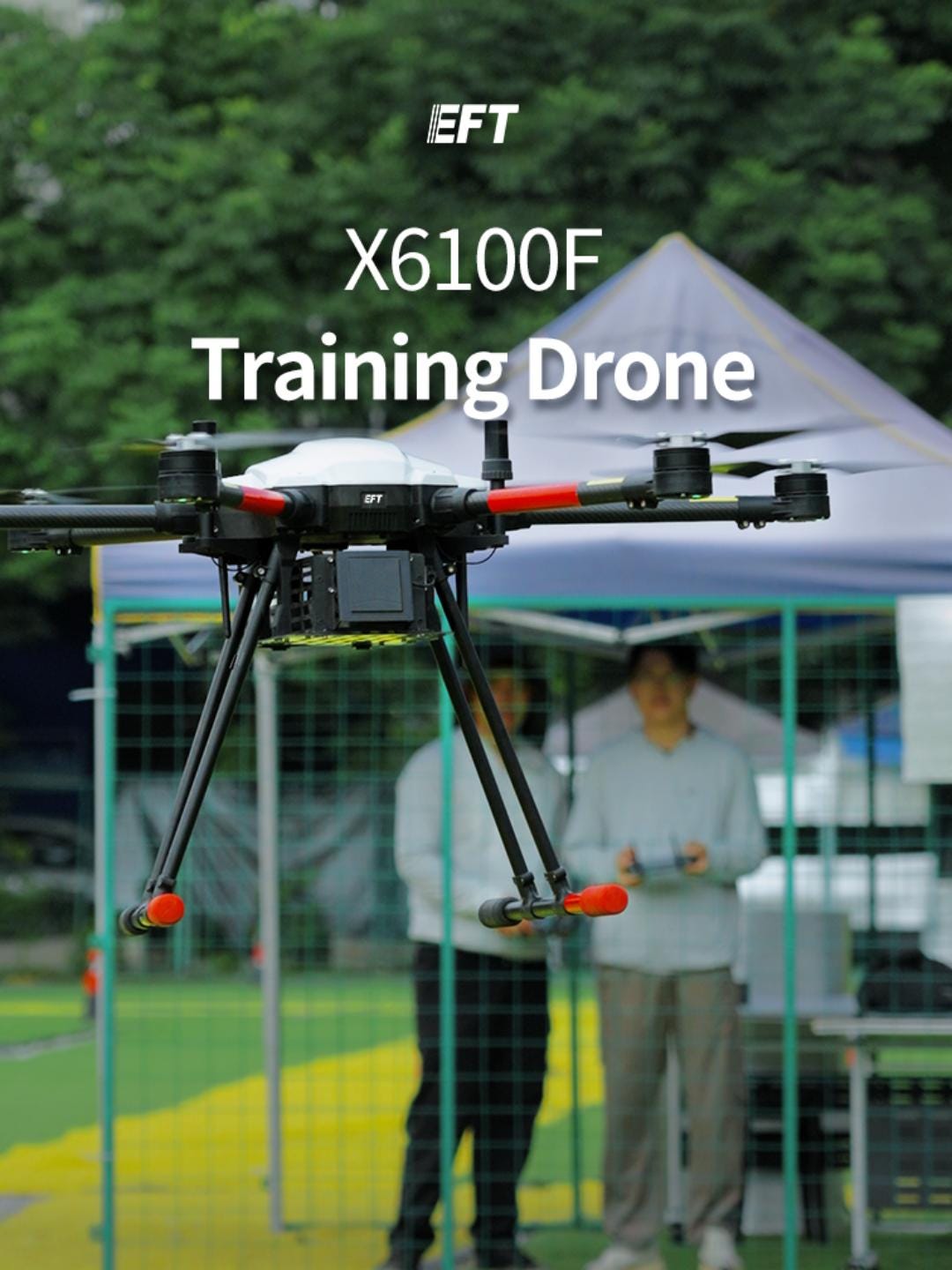
When 14 m/s Winds Hit, the X6100F Doesn’t Blink

Most training drones look great in a calm parking lot. The real question is what happens when the wind picks up mid-lesson — because on a real training field, it always does. That’s exactly why we put the EFT X6100F through full wind-tunnel testing before it ever reached a trainee’s hands.

https://www.youtube.com/shorts/XY-QPz1Q0qM

Inside the tunnel, the numbers tell the story. The minimum safe wind-resistance benchmark was set at a steady 7.9 m/s (Level 4 wind) — the point at which an inexperienced pilot, without a stabilized platform, would already start losing confidence and control. The X6100F didn’t just meet that bar; testing pushed the aircraft all the way to 14 m/s, Level 7 wind, with the drone holding a stable hover in front of the tunnel gate the entire time. That’s the kind of margin you want between “textbook conditions” and “the actual weather on training day.”

What makes that possible isn’t luck — it’s the hardware underneath. The X6100F is built around our brand-new N1 flight controller, tuned specifically for fast, precise stability corrections in gusting conditions, paired with the powerful E5 motor system that delivers the thrust reserve needed to fight crosswinds without sacrificing control response. Together, they turn wind resistance from a spec on a page into something a trainee can actually feel — a platform that stays predictable exactly when it matters most.

Why does this matter so much for training specifically? Because a training drone has one job above all else: build good habits under realistic conditions, safely. A airframe that panics or drifts the moment a breeze picks up doesn’t just slow down the lesson — it teaches the wrong instincts. Instructors need a platform that behaves consistently flight after flight, student after student, so every hour in the air is actually building skill rather than fighting the machine. That’s the standard the X6100F was engineered to hit, and the wind tunnel data backs it up rather than just claiming it.

It’s also worth saying plainly: rock-solid engineering doesn’t have to come with a rock-solid price tag. For flight schools and training academies running fleets across multiple students and multiple sessions a day, the X6100F is built to be one of the best cheap drone options in its class — validated performance without the premium markup, so scaling up a training program doesn’t mean stretching the budget thin.

This kind of testing rigor isn’t a one-off for us. As an industrial drone manufacturer, every airframe we release — whether it’s built for agricultural spraying, industrial inspection, or pilot training — goes through the same demanding validation process before it’s approved to leave the factory. We’d rather find the limits in a controlled wind tunnel than have a customer find them in the field. That commitment to real, verifiable testing is part of why operators and training academies looking for the best drone company to partner with keep coming back to us: not for marketing claims, but for data they can actually check.

For flight academies, agricultural service providers, or enterprise operators building out a training pipeline, the X6100F offers exactly what that first stage of pilot development needs — predictable handling, strong wind tolerance, and hardware tough enough to handle repeated training cycles without performance drop-off. It’s a platform instructors can trust and trainees can learn on with confidence, wind or no wind.

Ready to see the full spec sheet or get a quotation for your training fleet? Send us a message — we’re happy to walk you through configurations that fit your program size and budget.

📩 Message us for full specifications & quotation.

#EFTDrone #X6100F #DroneTraining #PilotAcademy #IndustrialDrone #TrainingDrone #EnterpriseDrone #InspectionDrone #WindTunnelTesting #WindResistance #BestCheapDrone #BestDroneCompany

Read more…

Hey everyone! If you’re a drone instructor, run a UAV flight school, or are just getting into commercial drone operations, you know how hard it is to find equipment that can withstand the rigors of student pilots while providing a professional experience.📦

https://www.youtube.com/shorts/Y3QVeYWgYmw

We just unboxed the EFT X6100F, and it is engineered specifically for training. Here is a quick look at what makes this kit stand out straight out of the box.

What’s in the Box?

As seen in our latest unboxing video, EFT doesn’t cut corners on the presentation and practicality of their training setups.🛠️

  • Ready-to-Assemble Frame: The X6100F features a robust, foldable hexacopter design with striking red and black arms. The folding mechanism makes transport to and from the flying field an absolute breeze.
  • Dual RC MINI Controllers: This is the game-changer for flight schools. The package includes RC MINI controllers, perfect for dual-operator setups (Instructor/Student mode), allowing the trainer to instantly take control if things go sideways.
  • Quality Assurance: Every unit comes with a rigorous product qualification certificate directly from EFT.

Press enter or click to view image in full size

💡 Why Choose EFT for Drone Education?

Finding the right hardware for your curriculum can be tricky. You want something reliable, but you also need to manage your school’s budget. While many beginners might be tempted to start with a cheap training drone, investing in a purpose-built industrial frame saves you money on constant repairs in the long run.

Whether you are looking for a standard training drone for flight simulation, or you need a heavy-duty drone to teach students about payload management, EFT’s modular ecosystem has you covered.

Many instructors in the commercial UAV space consider the EFT ecosystem to provide the best training drone experience because of how closely the flight dynamics mimic heavy industrial rigs. Upgrading your fleet with a versatile training drone means your students are learning on the exact same platforms they will use in the field. Plus, keeping your fleet in the air is simple because replacing parts on your training drone is straightforward and highly accessible.

Hardware. Software. Everything included. Built for learning.

Let us know what you think of the X6100F! What features do you look for most when choosing hardware for your flight school?

#eftdrone #dronetraining #DroneEducation #droneoperator #dronehardware #DroneSoftware #unboxing #droneinstructor #droneschool #commercialdrone

Read more…


1*Mp-BJgeb6DyIHoaGukZ-Wg.jpeg

https://www.youtube.com/shorts/w8-huwFp16g

Looking for a reliable, rock-solid, and hassle-free drone built specifically for pilot training and flight schools? Look no further than the EFT X6100F, engineered by a leading training drone manufacturer dedicated to advancing professional aviation education!

Unlike modified consumer drones, every single detail of the X6100F — from the flight controller and ground station to the dedicated remote control — is fully in-house developed and engineered strictly for training purposes. If you are searching for a high-performance training drone that delivers unmatched reliability in the field, this is the definitive choice.

🔧 Key Features Shown in Action:

  • Quick & Easy Deployment: As seen in the setup process, the X6100F features a portable, foldable design with secure arm locks and fast propeller installation, making field setup a breeze for instructors and students.
  • Rock-Solid Stability: Engineered with a balanced multi-rotor setup (featuring robust motors and clear CCW/CW markings like the E5 system) to ensure stable hovering and predictable handling.
  • High-Visibility Flight Orientation: Designed with contrasting color accents (sleek black body with high-visibility red arm highlights) to help students easily track orientation during line-of-sight training.
  • Dedicated Remote Control: Comes with a custom-designed, ergonomic remote control featuring responsive joysticks and clearly labeled switches for effortless, fatigue-free flying during long training sessions.
  • Precision Control & Agility: Whether executing tight maneuvers between cones or performing steady aerial positioning, the flight controller delivers smooth and responsive flight dynamics.

🌐 Why Choose the EFT X6100F?

  • 100% In-House Ecosystem: Seamless integration between the drone, flight controller, and ground station from an experienced training drone manufacturer.
  • Built for Endurance: Lightweight yet durable structure designed to withstand the rigorous demands of daily flight school operations.
  • Safe & Beginner-Friendly: Predictable flight behavior helps boost student confidence quickly, making it widely recognized as a hot sale training drone in global markets and consistently rated by instructors as the best training drone for academy environments.

Are you a flight school owner, instructor, or drone training provider looking to upgrade your fleet? Let’s connect in the comments below, or reach out to us to learn more about how the X6100F can elevate your training programs!

#EFTDrone #X6100F #TrainingDrone #DroneCourse #LightweightDrone #DroneManufacturer #DroneFactory #AsiaHotsaleDrone #DroneTraining #FlightSchool

Read more…

https://www.youtube.com/watch?v=DJKyTlXO-wQ

If you’ve ever been curious about what makes an agricultural drone strong enough to handle thousands of hectares of spraying missions, a complete teardown is one of the best ways to understand its engineering.

In this video, EFT’s in-house R&D technicians walk through a complete disassembly of the Z80, removing each major component step by step — from the spraying system and landing gear to the structural modules and internal connections — revealing how a modern agricultural drone is built for strength, maintenance, and long-term reliability. This process isn’t just about taking a drone apart; it’s an opportunity to learn about the design philosophy behind professional agricultural drones.

Disclaimer: This video shows professional maintenance procedures carried out by experienced technicians. It is for educational purposes only. Never try to disassemble a drone while it is in operation without having received professional training and safety measures.

One of the first things that becomes clear during the teardown is the use of modular construction. Instead of having components that are permanently fixed, the Z80’s aluminum metal truss frame — engineered with a triple safety factor to handle full-load flight stress — is made up of separate structural sections that can be removed individually via a quick-release module system. This approach greatly reduces maintenance time and allows for damaged parts to be replaced without rebuilding the entire aircraft.

As the disassembly continues, viewers can clearly see how the agricultural drone frame serves as the main structure of the entire aircraft. Every mounting position, support bracket, and fastening point is engineered to hold heavy loads while keeping the drone balanced during flight. Pulling the 80-liter spray tank reveals the internal baffle structure built into its anti-surge design — the feature responsible for reducing liquid sloshing mid-flight, which is one of the more common causes of unstable handling in lower-quality spraying drones. Spraying drones often work in environments with vibration, dust, humidity, and chemical exposure, so structural stability is as important as flight performance.

Another interesting feature is how the wiring, spray components, and power modules are arranged inside the drone frame. Disassembling the spraying system exposes the dual flexible-impeller pumps and centrifugal nozzles that drive the Z80’s 36L/min flow rate — components chosen specifically for their resistance to wear and chemical corrosion after repeated exposure to fertilizers and pesticides. Instead of making things more complicated, the internal layout keeps essential systems easy to inspect and service. This practical design helps reduce downtime for commercial users and simplifies routine maintenance after a busy spraying season.

The video also shows the removal of structural arms, landing gear, mounting brackets, and spray systems, giving viewers a better understanding of how professional drone manufacturers design for easy field serviceability. Every bolt, connector, and joint has a purpose, balancing weight reduction with mechanical strength.

For engineers, drone enthusiasts, and maintenance technicians, watching a full teardown offers valuable insight. Agricultural drones need to carry much heavier loads, withstand repeated takeoffs and landings, and stay stable during low-altitude precision spraying. These demanding applications require reinforced materials, optimized load distribution, and highly rigid structural designs.

Many people who are interested in building their own agricultural drones often ask if it’s practical to create their own platform. Studying professional designs is a great starting point. Understanding how commercial DIY drone frames are reinforced, assembled, and serviced can help builders avoid common structural mistakes and improve safety and reliability.

The teardown also highlights several characteristics common among experienced drone frame manufacturers. Quality manufacturers don’t only focus on looks — they prioritize corrosion resistance, modular maintenance, vibration reduction, structural rigidity, and long service life. These engineering details may not be obvious from the outside, but they become clear once the aircraft is completely disassembled.

As agricultural operations continue to grow globally, there is increasing demand for reliable large-sized drone frame solutions that can carry larger tanks, wider spraying systems, and more powerful propulsion setups. Modern frame design is moving toward lighter materials, better structural efficiency, and faster maintenance cycles, helping operators reduce downtime during busy farming seasons.

Whether you’re an agricultural drone operator, UAV technician, distributor, or simply interested in drone engineering, a complete teardown offers knowledge that you can’t learn from product photos alone. Seeing how every structural component fits together gives a deeper appreciation of the engineering behind today’s professional agricultural drones.

🔥 Watch the full teardown and explore the internal engineering of a professional agricultural drone.

Have questions about frame structure, maintenance, or drone manufacturing? Check out the full Z80 specifications or reach out directly — we’re always happy to discuss agricultural drone technology with fellow UAV enthusiasts.

Follow for more professional drone knowledge and engineering insights:
https://www.effort-tech.com/en/z80

Read more…

From June 16-18, 2026, DroneShow Robotics—Latin America's largest drone industry conference—opened at Expo Center Norte in São Paulo, Brazil. The event showcases four integrated thematic exhibitions: MundoGEO Geospatial Summit, SpaceBR Space Conference, and Expo eVTOL, bringing together a comprehensive ecosystem of global low-altitude industry leaders and innovators across the entire value chain.

31180456066?profile=RESIZE_710x

EFT Drone presented a comprehensive range of agricultural and industrial drone solutions at the exhibition. The showcase emphasized the company's end-to-end capabilities in OEM/ODM component manufacturing and customized full-system production designed for the Latin American market.

 31180457460?profile=RESIZE_710x

Featured Products

Tailored Solutions Across Market Segments

Z80 Agricultural Drone

Built for large-scale farming operations across Brazil's soybean, corn, and sugarcane crops, the Z80 integrates advanced spraying and spreading capabilities in one platform. Equipped with a quad-nozzle high-capacity spraying system, it delivers efficient and uniform coverage across expansive fields. The integrated auger spreading ensures smooth, high-volume dispensing for both fertilizer and seed application. Combined with the intuitive 4.0 Intelligent Control System, the Z80 dramatically simplifies operation and significantly enhances field performance efficiency.

 31180457655?profile=RESIZE_710x


X950 Industrial Drone Platform

The industrial drone market continues to experience explosive growth across diverse applications—power line inspection, urban surveillance, high-altitude cleaning—where demand for lightweight, highly expandable, and extended-endurance solutions is rapidly rising. The X950 addresses these needs with an open modular architecture that seamlessly accommodates a wide range of industrial payloads and integrations. This design empowers system integrators to rapidly develop custom solutions and conduct secondary development for specific use cases, including cleaning, utility inspection, and beyond. The result is a platform perfectly positioned to support Brazil's diverse and demanding low-altitude application ecosystem.

 31180457473?profile=RESIZE_710x


Exhibition Spotlight

Generating Deep Customer Engagement and Technical Dialogue

At the exhibition, EFT Drone's diverse solutions attracted significant attention from industry professionals across Latin America and neighboring markets. Notably, today's sophisticated buyers—large-scale agricultural enterprises, systems integrators, and specialized industrial operators—demonstrated markedly different purchasing priorities than their predecessors. Rather than focusing on single-function capabilities, these decision-makers increasingly prioritize multi-scenario applicability and operational flexibility.

Numerous Brazilian customers engaged in detailed technical inquiries regarding the Z80's actual flight endurance and operational performance in large-field agricultural applications. Simultaneously, the X950's exceptional scalability and modular architecture captured the interest of professional integrators, who recognized significant opportunities to reduce development timelines and costs associated with custom solution engineering.


31180457862?profile=RESIZE_710x


Strategic Partnership Agreement Signed

Establishing Deepened Collaboration Framework

During the exhibition, EFT Drone officially signed a Strategic Partnership Memorandum of Understanding (MOU) with SkyDrones, a leading Brazilian aviation technology company. Built on more than five years of stable collaboration, this agreement marks a significant milestone in the evolution of their partnership. The partnership represents a key strategic initiative in EFT's long-term expansion across Brazil and Latin America. Moving forward, both companies will collaborate on market development initiatives, technical training programs, and localized service delivery, working together to capture and grow the unmanned systems market throughout Brazil and the broader Latin American region.

 
31180458461?profile=RESIZE_710x


Innovation-Driven Expansion

Serving Broader Low-Altitude Applications

From efficient agricultural spraying to emerging infrastructure inspection, facility maintenance, and specialized industrial applications, the Latin American market continues to articulate increasingly specific requirements for advanced drone platforms and customized solutions. EFT's participation in DroneShow Robotics represents a strategic and in-depth technical dialogue with the regional market. We remain steadfastly committed to technological innovation and localized support excellence. Through reliable, adaptable, and purpose-built drone solutions, we partner with global collaborators to unlock the full spectrum of possibilities in low-altitude applications and drive the region's digital transformation.


Read more…

https://www.youtube.com/shorts/mJTV8JpM1V4

New drone? Calibrate your weight sensors for precision flights! ⚖
Real-time weight monitoring & intelligent feedback system
Achieve accurate operations, full control, and maximum efficiency 🚀
Follow for more:https://www.effort-tech.com/
#EFTDrone #agriculturaldrone #weightcalibration #PrecisionFarmhttps://www.youtube.com/shorts/mJTV8JpM1V4ing #dronespray #maintenancetips #LowAltitudeEconomy #SmartFarming

Read more…


The EPD100 pellet dropper is designed for precise and efficient deployment of agricultural pellets such as Trichogramma, rodenticides, and tree seeds. It is ideal for field applications in both agricultural and forestry environments.

[Dual Dropping Modes]

Supports two operating modes:

Manual Single-Drop Mode – Trigger one pellet drop per click for precise, on-demand application.

Continuous Mode – Enables automatic, uninterrupted release aligned with flight speed.

Operators can switch between modes as needed for different field conditions.

[Tool-Free Installation]

Features a universal mounting interface compatible with EFT E, G, and Z series spreading tanks. Installation is quick and convenient using hand-locking nuts — no tools required.

[Multiple Interchangeable Plates]

Equipped with three replaceable drop plates to handle pellet sizes from 20mm to 40mm. A wide outlet design ensures smooth, jam-free operation across a variety of pellet types.

[LED Indicator Feedback]

Built-in LED lights provide clear operational status in real time:

Green flash: Drop confirmed in manual mode

Yellow solid: Continuous mode active

Red light: Low or empty tank alert

This real-time feedback system helps ensure stable and uninterrupted operation during fieldwork.

Read more…

When flying in Auto mode, you might run into obstacles like poles or trees. If that happens, you can manually fly around them using the Flight Assistant app.

The drone will automatically stop and hover when it detects something ahead.

It’ll switch to Projection Point Mode, and you’ll see three options on the app:

Breakpoint, Return Point 1, and Return Point 2.

What to do next depends on the situation:

If you accidentally move the sticks, just tap Breakpoint. The drone will go back to where it stopped and keep flying along the original route.

If it’s just a small obstacle, you can fly around it manually, then tap Return Point 1. The drone will slide back to the route at that point and continue spraying.

If there are too many obstacles ahead and it’s not safe to keep going, tap Return Point 2. The drone will move over to that point on the route, adjust its heading, and then continue the job from there.

Super simple—and really helpful when flying in tricky environments.

Read more…

The application of smart agricultural drones for spraying and spreading has boosted farming efficiency,which vividly shows that modern agricultural technology is revolutionizing the way of agricultural protection in Colombia.

Compared to traditional pest control methods, drone spraying significantly enhances efficiency and precision. The Z50P agricultural drone, equipped with a large payload tank, can easily spray orange orchards with a high flow rate. The fine atomizing tech enables the fluid to cover each leaf of the trees, achieving precise and even spraying while reducing pesticide waste. Moreover, this application is beneficial to the environment and promotes green and sustainable agriculture.

Besides, the drone plays more crucial roles than that.According to the pilot team in the video, a Z50P can spray over 100 hectares per day. This high efficiency enables an easier way for farming management and even increases incomes by serving other farms.


Read more…

Hi there,

Agri drone spraying not only reduces the usage of pesticide, but also protects the crops from trampling by big machines.

For example, the vast field farming in Romania usually employs heavy agri machines to carry out land preparation, sowing and harvest.

And the introduction of agri drones drives precision agriculture to a new level. Equipped with advanced aerial spraying technology, it delivers precise, measured applications, protecting the soil and promoting sustainable crop growth.It ensures that the fertilizer is absorbed precisely by leaves and safeguards healthier growth.

Tap the pics and see Z50P working in maize field.

13051730473?profile=RESIZE_584x

13051732299?profile=RESIZE_710x

13051733465?profile=RESIZE_710x

Read more…

As we know, Turkey is one of important international grain exporter. To enhance agricultural productivity and promote green farming, it is actively adopting agricultural drone technology and supporting local production. EFT, as a global drone solution provider, develop with local Turkish drone companies, offering comprehensive agri drone solutions and component support to advance agricultural drone technology and promotes the drone applications for local fields. 


Read more…