To ensure your flight safety, it is neccessary to check your drone before every flight. Here is a detailed checklist, take a time, and follow the guide to check your drone now !
dronecheck (1)
Real-time obstacle avoidance is a tricky problem for small autonomous drones. Onboard computing power is limited, but the aircraft still needs to detect obstacles and react quickly enough to avoid them.
Depth cameras are one way to approach the problem. They provide detailed spatial information that can be used for obstacle detection and environmental perception. But acquiring depth data is only part of the process. The system also needs to process that information and turn it into flight control decisions.
On a small drone running perception algorithms on something like a Raspberry Pi, that processing overhead matters.
A recent Nature paper, Efficient robot navigation inspired by honeybee learning flights, includes an interesting change in the researchers' obstacle avoidance hardware.
The team initially used an Intel RealSense D435i depth camera to detect obstacles. In later experiments, they switched to three Benewake TF-Nova LiDAR rangefinders, positioned to monitor the left, center, and right directions ahead of the drone.
The paper primarily focuses on a navigation method inspired by honeybee learning flights, rather than a direct comparison between depth cameras and LiDAR. Still, the change raises an interesting question:
If an obstacle avoidance algorithm only needs to know whether something is blocking a particular direction, does it really need to process an entire depth image?
1. What Actually Changed When the Researchers Switched to LiDAR?
The researchers built a custom quadcopter using a Pixhawk 6C Mini running PX4 firmware for flight control, with a Raspberry Pi 4 handling onboard perception and higher-level navigation.
The platform also included an omnidirectional camera, an optical flow sensor, and a Benewake TFmini-S LiDAR rangefinder.
The TFmini-S provided altitude measurements to support motion estimation alongside optical flow and other sensor inputs. The omnidirectional camera supplied images for the visual homing system.
Obstacle avoidance was handled separately.
In the initial configuration, the researchers used an Intel RealSense D435i depth camera. The depth image was divided into three regions: left, center, and right.
The system calculated the average depth in each region to determine whether an obstacle was present and which direction appeared more open.
This is a fairly straightforward approach, but it still requires processing depth image data to extract the measurements used by the avoidance algorithm.
In later experiments, the team replaced this setup with three TF-Nova LiDAR rangefinders, each covering a 1° × 14° field of view.
One sensor monitored the left, another looked straight ahead, and the third covered the right.
Instead of extracting distances from different parts of a depth image, the avoidance algorithm could read directional distance measurements directly from the sensors.
That changes the type of information available to the controller.
A depth camera provides a much richer representation of the space ahead. Three directional LiDAR sensors provide considerably less information, but that may be sufficient when the algorithm only needs a few distance measurements.
Of course, this doesn't mean three LiDAR sensors are always more computationally efficient than a depth camera. Processing requirements depend on the camera hardware, how depth data is generated, the software implementation, and the overall system architecture.
In this particular reactive avoidance setup, however, direct range measurements eliminated the need to extract those distances from depth images.
2. How Can a Drone Avoid Obstacles with Just Three Distance Measurements?
The researchers used a finite-state machine (FSM) for reactive obstacle avoidance rather than building a detailed 3D map and planning a complete path around every obstacle.
The three TF-Nova sensors continuously measured distances in different directions ahead of the drone.
During normal flight, the system checked the forward distance against a predefined stopping threshold.
If an obstacle was detected within that threshold, the current navigation routine was interrupted and the avoidance controller took over.
The drone then used the left and right distance measurements to determine which direction offered a possible route around the obstacle.
For example, if the forward direction was blocked, the aircraft could rotate toward a clearer side and perform an avoidance maneuver.
If all three directions were blocked, the controller attempted a larger directional change to find another way through.
None of this required a complete 3D reconstruction of the surrounding environment.
The LiDAR sensors were not being used for mapping. Their job was to provide obstacle distance measurements that the controller could use to trigger specific avoidance actions.
There are obvious limitations to this approach.
Three directional sensors only cover a small portion of the space ahead. An obstacle located between the sensing regions could be missed entirely.
The stopping threshold also needs to be considered alongside the drone's actual flight dynamics.
At higher speeds, detecting an obstacle is not enough. The aircraft still needs sufficient time and distance to decelerate, stop, or change direction.
Sensor range, mounting angles, field of view, flight speed, and controller response time all affect how well the system performs.
For a relatively slow-moving drone operating in a controlled environment, directional range sensing may be sufficient for a simple avoidance strategy.
For faster flight or environments containing thin obstacles, dense vegetation, or irregular structures, three narrow sensing regions would leave significant gaps in coverage.
3. What Happens to Navigation After the Drone Avoids an Obstacle?
Another detail worth looking at is how the obstacle avoidance system interacts with the drone's higher-level navigation.
Bee-Nav was developed to investigate autonomous navigation and homing inspired by honeybee learning flights, without relying on a detailed global environment map.
The researchers implemented several flight phases, including learning flights, outbound navigation, inbound navigation, and final visual homing.
The basic obstacle detection and avoidance logic remained similar across these phases, but the way the drone resumed navigation after an avoidance maneuver was different.
During outbound and inbound navigation, the aircraft generally attempted to realign with its previous navigation target after avoiding an obstacle.
The goal was to continue the original route rather than treat obstacle avoidance as a separate mission.
During final visual homing, things worked differently.
Instead of simply returning to the previous heading, the drone captured a new image from its current position and passed it to the visual homing network to estimate an updated flight direction.
This matters because an avoidance maneuver can change both the drone's position and orientation.
During visual homing, the next movement needs to be determined from what the aircraft currently sees, not necessarily from the direction it was following before the obstacle appeared.
Obstacle detection and autonomous navigation are closely connected, but they solve different problems.
A LiDAR rangefinder can tell the controller that an obstacle is present at a certain distance. It does not determine where the drone ultimately needs to go.
In this architecture, the reactive controller deals with immediate obstacles, while the higher-level navigation algorithm decides how the aircraft should continue toward its destination.
4. Is This a Useful Approach for Small UAV Developers?
For developers working with Pixhawk, PX4, or Raspberry Pi-based autonomous drones, this setup offers a practical example of matching sensor inputs to the actual requirements of a control algorithm.
If an avoidance algorithm doesn't need a complete environment map, it's worth asking what information it really needs.
Consider a small experimental drone flying at relatively low speeds.
If the main requirement is to detect obstacles ahead and make simple left-or-right avoidance decisions, using direct range measurements may be easier to implement than building an entire depth-image processing pipeline.
But the requirements change when the aircraft needs to navigate through narrow openings, detect complex obstacle boundaries, or plan continuous trajectories at higher speeds.
In those situations, a few directional distance measurements may not provide enough information.
The sensor configuration used in the Bee-Nav study is also interesting because the researchers didn't try to make one sensor handle every perception task.
Different components served different purposes:
- Three Benewake TF-Nova LiDAR rangefinders: Measured obstacle distances in the left, center, and right directions for reactive avoidance.
- Benewake TFmini-S: Provided altitude measurements to support onboard motion estimation.
- PMW3901 optical flow sensor: Supplied observations of the drone's movement relative to the ground.
- IMU and extended Kalman filter (EKF): Combined sensor measurements to estimate the aircraft's motion and state.
- Omnidirectional camera: Captured visual information for the learned homing system.
The distinction between TFmini-S and TF-Nova is worth making. Both are LiDAR rangefinders, but they served different purposes in this experiment.
The TFmini-S was used for altitude measurement.
Optical flow provides information about apparent ground movement, but converting that image motion into useful horizontal velocity estimates requires knowledge of the drone's distance from the ground.
That's where altitude measurements become important.
The three TF-Nova sensors, meanwhile, were dedicated to detecting obstacles ahead of the aircraft.
Separating these functions makes it easier to understand what each sensor contributes and allows developers to work on individual parts of the perception system.
That doesn't necessarily make the overall hardware integration simpler.
Multiple independent rangefinders still introduce practical considerations such as mounting space, power distribution, communication interfaces, sensing coverage, and data synchronization.
Whether this approach makes sense depends on the aircraft and what it's expected to do.
5. Does Drone Obstacle Avoidance Really Need More Sensor Data?
Coming back to the original hardware change, replacing a depth camera with three directional LiDAR sensors doesn't suggest that depth perception is unnecessary.
Nor does it establish that LiDAR is inherently better than a camera-based solution.
The two approaches simply provide different kinds of information.
A depth camera is useful when an application needs a more detailed understanding of the surrounding space, such as analyzing obstacle geometry, identifying traversable regions, or supporting local path planning.
Directional LiDAR measurements are more limited, but also more direct.
If the control algorithm only needs to know whether the forward path is blocked and which side has more clearance, a handful of range measurements may be enough.
That's essentially the approach used in the Bee-Nav experiments.
The researchers didn't build a separate 3D map for obstacle avoidance. Instead, they used directional range measurements to trigger predefined control responses through a finite-state machine.
Visual homing, motion estimation, and obstacle detection were handled by different parts of the system.
For small UAVs, where payload capacity, onboard computing power, and energy consumption are all constrained, this is a useful design choice to examine.
The real question isn't how much environmental data a sensor can produce, but how much of that data the flight controller actually needs.
Of course, more demanding environments may justify wider sensing coverage, depth cameras, 3D LiDAR, or more sophisticated local planning algorithms.
The appropriate sensing architecture ultimately depends on the mission.
What I'd be interested to hear from other UAV developers is where you draw the line between simple range-based obstacle avoidance and more complete spatial perception.
If you're building a small autonomous drone, when would you choose multiple directional LiDAR rangefinders over a depth camera?
And which factor would influence your decision most: flight speed, obstacle density, or available onboard computing power?
Research Reference
Ou, D. et al. Efficient robot navigation inspired by honeybee learning flights. Nature 653, 1039–1046 (2026).
Open-Source Project
Agricultural spraying drones are changing how farmers and professional application teams manage crop protection, fertilization, and field operations. Compared with conventional ground-based spraying equipment, multirotor drones can access difficult terrain, follow planned flight routes, and apply liquids over crops without requiring machinery to travel directly through the field.
However, not all agricultural spraying drones are designed for the same operating conditions. Tank capacity, spray flow rate, effective spray width, droplet control, flight planning, battery logistics, and local service support all influence which platform is suitable for a particular operation.
This guide compares four current multirotor agricultural platforms: the DJI Agras T70P, DJI Agras T100, XAG P150, and EFT Z80. It examines their published specifications, application capabilities, and theoretical coverage based on a consistent spray-volume assumption. The goal is to help operators narrow options using transparent criteria rather than to declare a single overall winner.
Important methodology note: This is a specification-based comparison, not a controlled field-test ranking. Manufacturer-reported figures may use different configurations, test conditions, and measurement methods. The theoretical coverage calculations below use a common application-volume assumption (2 US gallons per acre) and should not be interpreted as measured field productivity. Always reconfirm specifications against the current model version and your intended operating conditions.
- Quick Comparison: Key Specifications
- 1. DJI Agras T70P
- 2. DJI Agras T100
- 3. XAG P150
- 4. EFT Z80
- Theoretical Spray Coverage
- How to Choose the Right Agricultural Spraying Drone
- Additional Perspective: Operator Discussions
- Frequently Asked Questions
- Conclusion
Quick Comparison: Key Specifications
Alt text: “Comparison of four agricultural spraying drones in 2026 showing spray tank capacities”
| Drone Model | Spray Tank Capacity | Published Maximum Spray Flow Rate | Published Spray Width | Key Application Consideration |
|---|---|---|---|---|
| DJI Agras T70P | 70 L | 30 L/min (2 nozzles) 40 L/min (4 nozzles optional) | 4–11 m | Balanced capacity with integrated spraying, spreading & lifting |
| DJI Agras T100 | 100 L | 30 L/min (2 nozzles) 40 L/min (4 nozzles optional) | 5–13 m | Flagship high-capacity platform for large-area operations |
| XAG P150 | 70 L (max / smart tank) | Up to 30 L/min | 5–10 m | High-speed spraying with intelligent liquid management |
| EFT Z80 | 80 L | Up to 36 L/min | 5–10 m | Heavy-load modular platform for spraying, spreading & lifting |
Specifications should be reconfirmed against the current model version and configuration before purchase. Maximum flow rates and spray widths are not necessarily achieved simultaneously. Local regulations, battery systems, and service availability can be decisive factors beyond the numbers above.
1. DJI Agras T70P: Balanced High-Capacity Platform
The DJI Agras T70P is positioned as a flexible mid-to-large capacity agricultural drone. It offers a 70 L spray tank, a 100 L spreading system, and lifting capability, aiming to balance payload with operational practicality for medium and large fields.
Key Specifications
- Spray tank capacity: 70 L (operating payload up to 70 kg)
- Maximum spray flow rate: 30 L/min with two nozzles; up to 40 L/min with optional four nozzles
- Published spray width: 4–11 m
- Droplet size range: 50–500 μm
- Spreading tank volume: 100 L (up to ~70 kg payload)
- Maximum spreading output: Up to 400 kg/min (compound fertilizer, material-dependent)
- Lifting capacity: Approximately 65 kg (configuration-dependent)
What Stands Out
The T70P sits between smaller legacy models and the flagship T100. It retains DJI’s integrated ecosystem for flight planning, RTK positioning, and safety sensing while delivering substantially higher liquid capacity than earlier 40 L platforms. Dual magnetic-drive impeller pumps and dual-atomizing nozzles support consistent flow control across a wide droplet range.
For operators who need more than a mid-size tank but do not require the full size and weight of the T100, the T70P offers a practical middle ground with established service networks in many markets.
What to Consider
Tank capacity and maximum flow rate do not establish actual field productivity. Battery choice (DB1580 vs DB2160), local terrain, and refill logistics affect daily output. The 70 L tank provides solid theoretical coverage but remains lower than the T100 and EFT Z80 in nominal liquid volume.
Best suited for: Operators seeking a balanced DJI platform with strong ecosystem support for medium-to-large fields that need both spraying and spreading capability.
2. DJI Agras T100: Flagship High-Capacity Platform
The DJI Agras T100 is DJI’s largest agricultural multirotor in the current lineup. With a 100 L spray tank, 150 L spreading system, and up to 100 kg lifting capacity, it is designed for large-area operations and multi-role agricultural work.
Key Specifications
- Spray tank capacity: 100 L (operating payload up to 100 kg)
- Maximum spray flow rate: 30 L/min with two nozzles; up to 40 L/min with optional four nozzles
- Published spray width: 5–13 m
- Droplet size range: 50–500 μm
- Spreading tank volume: 150 L (up to ~100 kg payload)
- Maximum spreading output: Up to 400 kg/min (compound fertilizer, material-dependent)
- Lifting capacity: Up to 100 kg (configuration-dependent)
What Stands Out
The T100 delivers the highest nominal spray tank capacity among the four models in this comparison. Combined with a wider published spray width range and a larger spreading hopper, it is aimed at operators who prioritize maximum liquid volume per flight and multi-task flexibility (spraying + spreading + lifting).
Advanced sensing (LiDAR + millimeter-wave radar + multi-vision) and the mature DJI agriculture software ecosystem are important practical advantages for teams already invested in DJI workflows.
What to Consider
Higher capacity comes with greater aircraft weight and logistical requirements. Operators should evaluate battery turnaround, field access, and whether the full 100 L capacity is routinely usable under local weight and regulatory limits. Maximum flow and spray width figures are not achieved simultaneously under all conditions.
Best suited for: Large-scale operators and service providers who need maximum tank capacity and multi-role capability within the DJI ecosystem.
3. XAG P150: High-Speed Intelligent Spraying Platform
The XAG P150 is designed around high operating speed and intelligent liquid management. Its smart liquid tank is commonly listed with a maximum capacity of 70 L and a maximum flow rate of 30 L/min, paired with centrifugal atomizing nozzles and real-time liquid-level sensing.
Key Specifications
- Spray tank capacity: Rated ~60 L / maximum 70 L (smart liquid tank)
- Maximum spray flow rate: Up to 30 L/min (dual pumps)
- Published spray width: 5–10 m (subject to height, dosage, and environment)
- Droplet size range: Approximately 60–500 μm (configuration- and condition-dependent)
- Spreading container capacity: 115 L (rated payload around 70 kg)
- Maximum spreading output: Up to ~280 kg/min (material-dependent; tested with urea/compound fertilizer in published data)
What Stands Out
XAG emphasizes high flight speed (published up to 18 m/s in some materials), intelligent tank sensing that reduces foam interference, and efficient refill design. The platform is frequently positioned for operators who value speed and consistent application quality on larger open fields.
The modular RevoSpray / RevoCast approach allows switching between liquid and granular work. Actual usable capacity and performance depend on the exact spray or spread module installed.
What to Consider
Published maximum tank volume is 70 L, placing it in the same nominal liquid class as the T70P. Flow rate peaks at 30 L/min in standard dual-pump configuration. Operators should confirm the exact tank and nozzle configuration offered in their region and verify local service coverage.
Best suited for: Operators prioritizing high operating speed and intelligent liquid management on medium-to-large open fields, especially where XAG support is strong.
4. EFT Z80: Heavy-Load Modular Platform
The EFT Z80 is a heavy-load agricultural drone designed for spraying, granular spreading, and aerial lifting through a modular configuration. Its 80 L spray tank and 120 L spreading container provide competitive nominal capacity, while the platform supports quick configuration changes.
Key Specifications
- Spray tank capacity: 80 L
- Maximum spray flow rate: 36 L/min
- Published effective spray width: 5–10 m
- Droplet size range: 50–500 μm
- Spreading container capacity: 120 L
- Maximum spreading output: Up to 400 kg/min when tested with compound fertilizer (material-dependent)
- Maximum lifting payload: 80 kg
- Maximum takeoff weight: 149.9 kg
- Protection rating: IP65
What Stands Out
High-capacity spraying system. Dual flexible-impeller pumps and four centrifugal nozzles support a published maximum flow of 36 L/min with an adjustable droplet range of 50–500 μm. Actual performance depends on selected flow, droplet size, flight speed, crop canopy, and required application volume.
Large-capacity spreading system. The 120 L container with interchangeable augers handles a range of granular materials. The 400 kg/min figure is material-dependent and should not be treated as universal.
Modular design. The platform supports spraying, spreading, and lifting configurations. Quick-swap design allows adaptation to different tasks, subject to equipment and payload limits.
Flight-planning functions. Published information describes app-based work-mode recognition, route planning, and KML import. Optional radar supports terrain prediction under specified conditions.
What to Consider
The 80 L tank offers higher nominal liquid capacity than the T70P and XAG P150, and sits below the T100. A larger tank can reduce refill frequency at the same application rate, but must be weighed against aircraft weight, battery endurance, and field logistics. Parts availability and local technical support should be confirmed for the intended market.
Best suited for: Agricultural operators, spraying contractors, and UAV businesses evaluating a heavy-load modular platform for spraying, spreading, and lifting tasks.
Theoretical Spray Coverage: How Much Area Can a Full Tank Cover?
Tank capacity is a useful starting point when comparing agricultural spraying drones. However, theoretical coverage per tank is not the same as actual field productivity.
To compare nominal spray capacity using a consistent assumption, the calculations below use an application rate of 2 US gallons per acre (approximately 7.57 L per acre or 18.7 L per hectare).
Calculation formula:
Theoretical coverage per full tank = Spray tank capacity ÷ Application rate per acre
Example: An 80 L spray tank ÷ 7.57 L per acre ≈ 10.6 acres of theoretical coverage.
Estimated Coverage at 2 US gal/acre
| Drone Model | Nominal Spray Tank Capacity | Theoretical Coverage per Full Tank | Full-Tank Equivalents for 100 Acres |
|---|---|---|---|
| DJI Agras T70P | 70 L | ≈ 9.2 acres | ≈ 10.8 |
| DJI Agras T100 | 100 L | ≈ 13.2 acres | ≈ 7.6 |
| XAG P150 | 70 L | ≈ 9.2 acres | ≈ 10.8 |
| EFT Z80 | 80 L | ≈ 10.6 acres | ≈ 9.5 |
These are theoretical liquid-capacity calculations, not measured field productivity or exact refill counts. Values are rounded. Actual usable volume, residual liquid, and operational factors will differ.
How Should These Figures Be Interpreted?
Under the same assumed application volume, larger tanks (T100 at 100 L, followed by Z80 at 80 L) can theoretically cover more acreage per full tank and may reduce the number of refills. This advantage must be balanced against battery endurance, aircraft weight, refill logistics, and field layout.
Actual productivity also depends on:
- Flight speed and effective spray width
- The required application rate for the crop and treatment
- Battery endurance and battery-change time
- Refill and mixing logistics
- Field shape, obstacles, and travel distance
- Weather, wind drift, and operating restrictions
- Setup, cleaning, and maintenance time
For a meaningful productivity comparison, operators should evaluate each model under comparable conditions and measure completed acreage per hour, liquid application accuracy, battery turnaround, and total operational time.
How to Choose the Right Agricultural Spraying Drone
The most suitable spraying drone depends on the operation, not just one specification. Use the following decision factors as a practical checklist.
1. Match Tank Capacity to the Application
A larger tank may reduce refill frequency, but the appropriate capacity depends on the crop, required application rate, field layout, aircraft operating limits, and battery performance under load. For large continuous areas, the 100 L T100 and 80 L Z80 offer higher theoretical coverage per fill; for many medium-to-large jobs the 70 L class (T70P / P150) remains highly practical.
2. Compare the Complete Spray System
Review maximum flow rate, nozzle type, droplet-size range, spray width, and flow-control functions together. No single specification establishes overall spraying quality. Match droplet size and application volume to the target crop and product label requirements.
3. Consider Spraying, Spreading, and Lifting Requirements
If an operation includes both liquid and granular applications (or occasional material lifting), check whether the aircraft supports the required configurations, what equipment changes are needed, and what payload limits apply. All four platforms offer spraying and spreading options; lifting capability and payload differ by model.
4. Evaluate Flight Planning and Positioning
RTK positioning, route planning, route resumption, and terrain-following functions can improve consistency on repeatable agricultural tasks. Confirm which functions are included in the exact configuration being considered and under what environmental conditions they are validated.
5. Assess Parts Availability and Technical Support
Parts supply, training, troubleshooting resources, and local service arrangements strongly influence long-term usability—especially during time-sensitive spraying windows. Ask distributors about typical spare-parts lead times, warranty coverage, and available operator training.
6. Verify Local Operating Requirements
Agricultural drone operations may be subject to aviation rules, pesticide application licensing, and other local regulations. Requirements vary by jurisdiction, aircraft, operation type, and substances being applied. Confirm the rules applicable to your intended operation before purchase or deployment.
Additional Perspective: Operator Discussions on Brand Comparison
Choosing an agricultural drone involves more than comparing published specifications. Product quality, operating requirements, parts availability, after-sales support, and day-to-day usability can all influence a buyer’s decision.
Some operators share informal comparisons of platforms (including discussions involving EFT and DJI systems) on social media. One example is an Instagram Reel in which a user discusses practical considerations when comparing agricultural drones:
Instagram Reel – Agricultural drone brand comparison discussion
Note: User-generated social media content reflects individual experience and perspective. It is not an independent laboratory test or formal product review. Viewers should consider the context, potential biases, and how the described conditions relate to their own crops, fields, and support environment.
Frequently Asked Questions
What is the best agricultural spraying drone?
There is no single best agricultural spraying drone for every operator. The right choice depends on tank capacity needs, spray-system requirements, crop and field conditions, flight-control functions, technical support availability, total cost of ownership, and local operating regulations.
Is a 100 L or 80 L agricultural drone better than a 70 L model?
Larger tanks provide greater nominal liquid capacity. At the same application volume per acre they offer greater theoretical coverage per full tank and may reduce refill frequency. However, tank capacity alone does not determine overall spraying performance or daily productivity. Application rate, spray quality, flight speed, battery endurance, weight, and operating conditions also matter.
Does a higher spray flow rate mean better spraying performance?
Not necessarily. Maximum flow rate describes the system’s liquid-delivery capacity under specified conditions. Effective application also depends on droplet size, nozzle configuration, crop canopy, flight altitude, speed, and the required application rate. Matching the system to the crop and product label is more important than peak flow numbers.
Can one agricultural drone handle spraying, spreading, and lifting?
Yes. All four platforms in this comparison support spraying and spreading configurations. Lifting capability is available on the DJI T70P, T100, and EFT Z80 (with different maximum payloads). Operators should confirm equipment requirements, payload limits, and operating procedures for each intended application.
How can agricultural drone productivity be compared fairly?
Use the same application rate and comparable crop and field conditions wherever possible. Compare actual treated area, liquid consumption accuracy, battery changes, refill time, downtime, and application quality rather than relying solely on tank capacity or maximum advertised coverage figures.
Conclusion: Choose According to Your Operating Needs
The DJI Agras T70P, DJI Agras T100, XAG P150, and EFT Z80 represent four current multirotor agricultural spraying platforms with different tank capacities, application systems, and operating characteristics.
- DJI Agras T70P — Balanced 70 L platform with integrated spraying, spreading, and lifting; strong ecosystem support.
- DJI Agras T100 — Flagship 100 L capacity with wider spray width range and multi-role capability for large-area work.
- XAG P150 — 70 L smart tank focused on high operating speed and intelligent liquid management.
- EFT Z80 — 80 L modular heavy-load platform supporting spraying, spreading, and lifting with competitive flow rate.
Published specifications and standardized calculations help operators narrow options, but they should not be mistaken for independently verified field-performance results. The final decision should account for the intended application, operating conditions, equipment configuration, maintenance, battery logistics, and technical support in your region.
Operators who prioritize maximum liquid capacity within a mature ecosystem may look first at the T100. Those seeking a balance of capacity and maneuverability may prefer the T70P or XAG P150. Teams that need modular multi-role flexibility with an 80 L tank will naturally evaluate the EFT Z80. In all cases, request current configuration details, demonstrate the aircraft if possible, and verify local regulatory and support conditions before committing.
Disclaimer: All intellectual property rights concerning the exterior designs of the drone models mentioned in this article—including those from brands such as DJI, XAG, and EFT—belong to their respective owners. This content is provided solely for the purpose of general education and information exchange within the agricultural plant-protection drone industry and does not constitute a commercial recommendation for any specific product. Please contact us if any content infringes upon your rights, so that we may make necessary adjustments or remove it. All specifications are based on the latest information publicly released by the manufacturers and are subject to change at any time. Before making any operational or purchasing decisions, please verify the most current official specifications, local aviation and pesticide regulations, and actual performance capabilities with qualified suppliers or operators.
Agricultural spraying drones are changing how farmers and professional application teams manage crop protection, fertilization, and field operations. Compared with conventional ground-based spraying equipment, multirotor drones can access difficult terrain, follow planned flight routes, and apply liquids over crops without requiring machinery to travel directly through the field.
However, not all agricultural spraying drones are designed for the same operating conditions. Tank capacity, spray flow rate, effective spray width, droplet control, flight planning, battery logistics, and local service support all influence which platform is suitable for a particular operation.
This guide compares five agricultural multirotor platforms from DJI, XAG, EFT, Hylio, and EAVISION. It examines their published specifications, application capabilities, and theoretical coverage based on a consistent spray-volume assumption. The goal is to help operators narrow options using transparent criteria rather than to declare a single overall winner.
Important methodology note: This is a specification-based comparison, not a controlled field-test ranking. Manufacturer-reported figures may use different configurations, test conditions, and measurement methods. The theoretical coverage calculations below use a common application-volume assumption (2 US gallons per acre) and should not be interpreted as measured field productivity. Always reconfirm specifications against the current model version and your intended operating conditions.
Table of Contents- Quick Comparison: Key Specifications
- 1. DJI Agras T50
- 2. XAG P100 Pro
- 3. EFT Z80
- 4. Hylio ARES
- 5. EAVISION EA-J150
- Theoretical Spray Coverage
- How to Choose the Right Agricultural Spraying Drone
- Frequently Asked Questions
- Conclusion
Quick Comparison: Key Specifications
[Suggested image: Side-by-side comparison graphic of the five drone models with tank capacity callouts]
Alt text example: “Comparison of five agricultural spraying drones in 2026 showing spray tank capacities”
Alt text example: “Comparison of five agricultural spraying drones in 2026 showing spray tank capacities”
| Drone Model | Spray Tank Capacity | Published Maximum Spray Flow Rate | Published Spray Width | Key Application Consideration |
|---|---|---|---|---|
| DJI Agras T50 | 40 L | 16 L/min with two sprinklers (up to 24 L/min with four) | 4–11 m | Integrated spraying and spreading functions |
| XAG P100 Pro | 50 L | Up to 22 L/min | 5–10 m | High-capacity spraying system |
| EFT Z80 | 80 L | Up to 36 L/min | 5–10 m | Heavy-load spraying, spreading, and lifting |
| Hylio ARES | Approx. 49.2 L | Verify current configuration | Up to 12 m | Professional agricultural operations |
| EAVISION EA-J150 | 70 L (rated) 73 L full-load | 40 L/min (±5%) | 4–15 m | Higher-capacity multirotor spraying |
Specifications should be reconfirmed against the current model version and configuration before purchase. Maximum flow rates and spray widths are not necessarily achieved simultaneously. Local regulations, battery systems, and service availability can be decisive factors beyond the numbers above.
1. DJI Agras T50: Integrated Agricultural Drone Platform
The DJI Agras T50 is designed for professional agricultural operations, combining a 40 L spray tank with automated flight functions and integrated spraying and spreading systems.
[Suggested image: DJI Agras T50 in field spraying operation]
Alt text: “DJI Agras T50 agricultural spraying drone applying crop protection”
Alt text: “DJI Agras T50 agricultural spraying drone applying crop protection”
Key Specifications
- Spray tank capacity: 40 L
- Maximum spray flow rate: 16 L/min with two sprinklers; up to 24 L/min with four sprinklers
- Published spray width: 4–11 m
- Spreading tank volume: 75 L
- Maximum spreading payload: Up to 50 kg, depending on configuration
What Stands Out
The Agras T50 integrates spraying, spreading, and flight-planning functions into an agricultural drone ecosystem. For operators already familiar with DJI agricultural equipment, existing workflows, operator training, spare-parts networks, and local service arrangements may reduce the learning curve and downtime risk.
Its integrated application system is designed to support different crop-treatment tasks. Buyers should evaluate the aircraft together with its application equipment, operating software, battery system, and available local support rather than tank size alone.
What to Consider
Tank capacity and maximum flow rate do not establish actual field productivity. Operators should also evaluate application settings, crop conditions, battery endurance, maintenance requirements, and local technical support. The 40 L tank offers lower theoretical coverage per fill than several larger platforms in this comparison, which may increase refill frequency on large jobs.
Best suited for: Operators looking for an integrated agricultural drone platform with established ecosystem support for spraying and spreading applications.
2. XAG P100 Pro: High-Capacity Crop-Protection Platform
The XAG P100 Pro is designed for professional spraying and spreading applications. Its 50 L spray tank offers greater nominal liquid capacity than the DJI Agras T50’s 40 L tank.
[Suggested image: XAG P100 Pro agricultural drone]
Alt text: “XAG P100 Pro high-capacity agricultural spraying drone”
Alt text: “XAG P100 Pro high-capacity agricultural spraying drone”
Key Specifications
- Spray tank capacity: 50 L
- Published maximum spray flow rate: Up to 22 L/min
- Published spray width: 5–10 m
- Granule container capacity: 80 L, depending on configuration
What Stands Out
The P100 Pro combines a high-capacity spray tank with a system designed for professional crop-protection work. Its published specifications make it relevant to operators comparing tank capacity, spray-system output, and integrated agricultural functions.
Its spraying and spreading capabilities may be useful for agricultural operations that require different application methods. The appropriate configuration depends on crop type, application requirements, and operating conditions.
What to Consider
Maximum flow rate is only one part of spraying performance. Droplet size, application rate, nozzle configuration, crop canopy, wind conditions, and flight settings all affect application quality. A higher maximum flow rate does not automatically mean better spray coverage or lower chemical consumption.
Best suited for: Agricultural operators comparing higher-capacity multirotor platforms for spraying and spreading operations who value a balance between tank size and established product maturity.
3. EFT Z80: Heavy-Load Platform for Spraying, Spreading & Lifting
The EFT Z80 is positioned as a heavy-load agricultural drone platform designed to support spraying, granular spreading, and aerial lifting through a modular configuration. Its 80 L spray tank and 120 L spreading container provide greater nominal capacity than the 40–70 L spray tanks of the other models in this comparison.
[Suggested image: EFT Z80 with spray system and optional modules]
Alt text: “EFT Z80 heavy-load agricultural drone configured for spraying”
Alt text: “EFT Z80 heavy-load agricultural drone configured for spraying”
Key Specifications
- Spray tank capacity: 80 L
- Maximum spray flow rate: 36 L/min
- Published effective spray width: 5–10 m
- Droplet size range: 50–500 μm
- Spreading container capacity: 120 L
- Maximum spreading output: Up to 400 kg/min when tested with compound fertilizer (material-dependent)
- Maximum lifting payload: 80 kg
- Maximum takeoff weight: 149.9 kg
- Protection rating: IP65
What Stands Out
High-capacity spraying system. The Z80 features an 80 L spray tank, dual flexible-impeller pumps, and four centrifugal nozzles. Its published maximum flow rate is 36 L/min, with an effective spray width of 5–10 m and an adjustable droplet size range of 50–500 μm. Actual application performance depends on the selected flow rate, droplet size, flight speed, crop canopy, and required application volume.
Large-capacity spreading system. The platform uses a 120 L spreading container with interchangeable augers for different granular materials. The listed maximum spreading output of 400 kg/min is material-dependent and should not be treated as a universal rate for all seeds, fertilizers, or granular products.
Modular design. The Z80 supports spraying, spreading, and lifting configurations. Quick-swap design allows the platform to be adapted to different agricultural tasks, subject to applicable equipment and payload limits. Buyers should evaluate the required accessories, configuration changes, operating procedures, and service needs for each application.
Flight-planning functions. Published product information describes app-based work-mode recognition, route planning, and KML file import. Optional radar functions support terrain prediction and automatic slope ascent under the manufacturer’s specified conditions. Availability and performance depend on the selected configuration and operating environment.
What to Consider
The 80 L spray tank provides greater nominal liquid capacity than the 40 L, 49.2 L, 50 L, and 70 L tanks in this comparison. At the same application rate this can increase theoretical coverage per full tank and potentially reduce refill frequency. However, a larger tank must be weighed against aircraft weight, battery endurance, field layout, and refill logistics. Maximum spray flow rate should not be interpreted as a guarantee of higher acreage per hour.
Operators should also distinguish between the platform’s spraying, spreading, and lifting configurations. Payload limits and operating requirements differ by application. Parts availability, training, and local technical support should be confirmed for the intended market.
Best suited for: Agricultural operators, spraying contractors, and UAV businesses evaluating a heavy-load multirotor platform that can be configured for spraying, spreading, and lifting tasks.
4. Hylio ARES: Professional Agricultural Operations Platform
Hylio’s ARES is an agricultural UAV platform designed for spraying and spreading applications. Its specifications distinguish between the liquid-spraying and granular-spreading configurations.
[Suggested image: Hylio ARES agricultural drone]
Alt text: “Hylio ARES professional agricultural spraying drone”
Alt text: “Hylio ARES professional agricultural spraying drone”
Key Specifications
- Spray tank capacity: Approximately 13 US gallons (≈ 49.2 L)
- Published maximum spray width: Up to 12 m
- Spreading configuration: Different container and payload specifications from the spraying configuration
What Stands Out
ARES is worth evaluating for operators considering professional agricultural drone platforms and the associated training, service, and technical-support arrangements. Hylio provides application equipment and software intended for agricultural treatment operations. Suitability depends on the target crops, required application method, selected configuration, and the support available in the operating region.
What to Consider
Confirm the current model configuration, spray-system specifications, payload limits, and local support arrangements before comparing it directly with other platforms. The manufacturer’s maximum spray width should be interpreted in context: crop canopy, wind, droplet size, flight altitude, and application rate can all affect the effective working width.
Best suited for: Professional agricultural operators evaluating configurable UAV spraying and spreading systems, particularly where regional support and training are important selection factors.
5. EAVISION EA-J150: High-Capacity Multirotor for Agricultural Operations
The EAVISION EA-J150 is a heavy-duty agricultural multirotor designed for spraying, spreading, and related agricultural operations. Its 70 L rated spray tank and published maximum flow rate of 40 L/min place it in a higher-capacity category than the 40–50 L spray tanks of several other models in this comparison.
[Suggested image: EAVISION EA-J150 agricultural drone in operation]
Alt text: “EAVISION EA-J150 high-capacity agricultural spraying drone”
Alt text: “EAVISION EA-J150 high-capacity agricultural spraying drone”
Key Specifications
- Rated spray tank capacity: 70 L
- Full-load tank capacity: 73 L
- Maximum spray flow rate: 40 L/min (±5%)
- Published effective spray width: 4–15 m
- Droplet size range: 10–300 μm
- Number of spray nozzles: Two or four, depending on configuration
- Spreading container capacity: 100 L
What Stands Out
The EA-J150 features EAVISION’s CCMS® bimodal mist nozzle technology and an application system designed to support different droplet sizes. The manufacturer also describes airflow-assisted spraying intended to improve droplet distribution within crop canopies. Its larger tank can reduce the theoretical number of refills required for a given liquid application volume. The actual benefit depends on the target application rate, field layout, travel distance, refill logistics, and usable tank volume.
What to Consider
The maximum published flow rate and spray width should not be interpreted as performance values achieved simultaneously in every operating condition. Buyers should confirm the appropriate nozzle configuration, application settings, and field performance for their intended crops, and verify local service and parts support.
Best suited for: Agricultural operators and service providers evaluating a higher-capacity multirotor for large fields, demanding spray applications, and varied crop environments.
Theoretical Spray Coverage: How Much Area Can a Full Tank Cover?
Tank capacity is a useful starting point when comparing agricultural spraying drones. However, theoretical coverage per tank is not the same as actual field productivity.
To compare nominal spray capacity using a consistent assumption, the calculations below use an application rate of 2 US gallons per acre (approximately 7.57 L per acre or 18.7 L per hectare).
Calculation formula:
Theoretical coverage per full tank = Spray tank capacity ÷ Application rate per acre
Example: An 80 L spray tank ÷ 7.57 L per acre ≈ 10.6 acres of theoretical coverage.
Estimated Coverage at 2 US gal/acre
| Drone Model | Nominal Spray Tank Capacity | Theoretical Coverage per Full Tank | Full-Tank Equivalents for 100 Acres |
|---|---|---|---|
| DJI Agras T50 | 40 L | ≈ 5.3 acres | ≈ 18.9 |
| XAG P100 Pro | 50 L | ≈ 6.6 acres | ≈ 15.1 |
| EFT Z80 | 80 L | ≈ 10.6 acres | ≈ 9.5 |
| Hylio ARES | 49.2 L | ≈ 6.5 acres | ≈ 15.4 |
| EAVISION EA-J150 | 70 L | ≈ 9.2 acres | ≈ 10.8 |
These are theoretical liquid-capacity calculations, not measured field productivity or exact refill counts. Values are rounded. Actual usable volume, residual liquid, and operational factors will differ.
How Should These Figures Be Interpreted?
Under the same assumed application volume, larger tanks (such as the 80 L and 70 L options) can theoretically cover more acreage per full tank and may reduce the number of refills required for a given total volume. This advantage must be balanced against battery endurance, aircraft weight, refill logistics, and field layout.
Actual productivity also depends on:
- Flight speed and effective spray width
- The required application rate for the crop and treatment
- Battery endurance and battery-change time
- Refill and mixing logistics
- Field shape, obstacles, and travel distance
- Weather, wind drift, and operating restrictions
- Setup, cleaning, and maintenance time
For a meaningful productivity comparison, operators should evaluate each model under comparable conditions and measure completed acreage per hour, liquid application accuracy, battery turnaround, and total operational time.
How to Choose the Right Agricultural Spraying Drone
The most suitable agricultural drone depends on the operation, not just one specification. Use the following decision factors as a practical checklist.
1. Match Tank Capacity to the Application
A larger tank may reduce refill frequency, but the appropriate capacity depends on the crop, required application rate, field layout, aircraft operating limits, and battery performance under load. For large continuous areas, higher-capacity platforms (70–80 L) can reduce the number of cycles; for smaller or fragmented fields the benefit may be smaller.
2. Compare the Complete Spray System
Review maximum flow rate, nozzle type, droplet-size range, spray width, and flow-control functions together. No single specification establishes overall spraying quality. Match droplet size and application volume to the target crop and product label requirements.
3. Consider Spraying, Spreading, and Lifting Requirements
If an operation includes both liquid and granular applications (or occasional material lifting), check whether the aircraft supports the required configurations, what equipment changes are needed, and what payload limits apply. Modular platforms can consolidate equipment but require clear procedures for reconfiguration and safety.
4. Evaluate Flight Planning and Positioning
RTK positioning, route planning, route resumption, and terrain-following functions can improve consistency on repeatable agricultural tasks. Confirm which functions are included in the exact configuration being considered and under what environmental conditions they are validated.
5. Assess Parts Availability and Technical Support
Parts supply, training, troubleshooting resources, and local service arrangements strongly influence long-term usability—especially during time-sensitive spraying windows. Ask distributors about typical spare-parts lead times, warranty coverage, and available operator training.
6. Verify Local Operating Requirements
Agricultural drone operations may be subject to aviation rules, pesticide application licensing, and other local regulations. Requirements vary by jurisdiction, aircraft, operation type, and substances being applied. Confirm the rules applicable to your intended operation before purchase or deployment.
Frequently Asked Questions
What is the best agricultural spraying drone in 2026?
There is no single best agricultural spraying drone for every operator. The right choice depends on tank capacity needs, spray-system requirements, crop and field conditions, flight-control functions, technical support availability, total cost of ownership, and local operating regulations.
Is an 80 L agricultural drone better than a 50 L model?
An 80 L tank provides greater nominal liquid capacity than a 50 L tank. At the same application volume per acre it offers greater theoretical coverage per full tank and may reduce refill frequency. However, tank capacity alone does not determine overall spraying performance or daily productivity. Application rate, spray quality, flight speed, battery endurance, weight, and operating conditions also matter.
Does a higher spray flow rate mean better spraying performance?
Not necessarily. Maximum flow rate describes the system’s liquid-delivery capacity under specified conditions. Effective application also depends on droplet size, nozzle configuration, crop canopy, flight altitude, speed, and the required application rate. Matching the system to the crop and product label is more important than peak flow numbers.
Can one agricultural drone handle spraying, spreading, and lifting?
Some agricultural platforms support multiple applications through interchangeable equipment. Several models in this comparison offer both spraying and spreading configurations; a smaller number also support lifting within defined payload limits. Operators should confirm equipment requirements, payload limits, and operating procedures for each intended application.
How can agricultural drone productivity be compared fairly?
Use the same application rate and comparable crop and field conditions wherever possible. Compare actual treated area, liquid consumption accuracy, battery changes, refill time, downtime, and application quality rather than relying solely on tank capacity or maximum advertised coverage figures.
Conclusion: Choose According to Your Operating Needs
The DJI Agras T50, XAG P100 Pro, EFT Z80, Hylio ARES, and EAVISION EA-J150 represent five multirotor agricultural spraying platforms with different tank capacities, application systems, and operating characteristics.
- DJI Agras T50 — Integrated agricultural platform with established ecosystem support; 40 L spray tank.
- XAG P100 Pro — 50 L spraying configuration aimed at professional crop-protection work.
- EFT Z80 — Highest nominal spray tank capacity in this group (80 L) plus 120 L spreading and lifting options for multi-task operations.
- Hylio ARES — Configurable professional platform (≈ 49.2 L) where regional support and training are key considerations.
- EAVISION EA-J150 — Higher-capacity option with 70 L rated tank and wide published spray width range.
Published specifications and standardized calculations help operators narrow options, but they should not be mistaken for independently verified field-performance results. The final decision should account for the intended application, operating conditions, equipment configuration, maintenance, battery logistics, and technical support in your region.
Operators who primarily need integrated ecosystem support may lean toward platforms with mature service networks. Those prioritizing maximum liquid capacity and multi-role flexibility (spraying + spreading + lifting) will naturally look more closely at the higher-capacity modular options. In all cases, request current configuration details, demonstrate the aircraft if possible, and verify local regulatory and support conditions before committing.
Disclaimer: All specifications are based on publicly available manufacturer information current as of the last update date and may change. This article is for informational purposes only and does not constitute a product endorsement, performance guarantee, or recommendation for any specific commercial purchase. Always verify the latest official specifications, local aviation and pesticide regulations, and real-world performance with qualified suppliers and operators before making operational or purchasing decisions.
As the drone industry continues to expand into agriculture, industrial inspection, logistics, surveying, and other professional applications, the demand for practical UAV engineering skills is growing alongside it. For vocational colleges and universities, this creates a new challenge: students need more than basic piloting experience. They need to understand how a drone is built, how its flight control system works, and how to configure and maintain the aircraft.
The EFT N680 UAV Assembly & Tuning Kit is designed to support this kind of hands-on learning. With a modular airframe, an open-source flight control architecture, and dedicated tuning software, the N680 provides an accessible UAV development platform for students, instructors, and drone technology enthusiasts.
Rather than treating a drone as a ready-made device, the N680 gives learners the opportunity to explore the complete aircraft system—from individual components to actual flight testing.
Why UAV Assembly Training Matters in Vocational Education
Drone education is evolving beyond basic flight operation. As commercial UAV applications become more specialized, technical training increasingly needs to cover several interconnected areas:
Aircraft structure and assembly: Understanding airframe design, propulsion components, and mechanical connections.
Electronic systems: Learning how motors, ESCs, power distribution, batteries, and flight controllers work together.
Flight controller configuration: Setting up sensors, radio channels, flight modes, and essential parameters.
Maintenance and troubleshooting: Identifying component issues, replacing modules, and checking system conditions.
Software and development: Exploring open-source firmware, communication protocols, and autonomous flight concepts.
A practical UAV training kit can bring these topics together in one learning environment. Students can move from component recognition and aircraft assembly to configuration, testing, and more advanced development projects.
For institutions building vocational drone training programs, this approach helps connect theoretical knowledge with practical engineering tasks.
Meet the EFT N680: A Modular UAV Development Platform
The EFT N680 is a 680 mm wheelbase quadcopter designed for hands-on drone assembly, flight control training, and open-source development.
Its modular structure makes individual components easier to inspect, replace, and maintain. The main frame uses a high-strength, one-piece injection-molded nylon structure, combined with carbon-fiber arms and landing gear.
Key components, including the arms, motors, ESC/PDB, propellers, battery compartment, and flight controller, can be handled as separate modules. This allows students to learn how different parts contribute to the complete aircraft system rather than relying on an enclosed, difficult-to-modify platform.
The airframe also provides internal space and mounting provisions for additional equipment. Depending on the project requirements, students and developers can explore payload integration and experiments involving aerial imaging, sensing, and visual navigation.
This modular design offers practical advantages in teaching environments. When a component requires inspection or replacement, students can focus on the relevant module instead of treating the entire aircraft as a sealed unit.
Key N680 platform specifications:
| Item | Specification |
|---|---|
| Wheelbase | 680 mm |
| Frame Weight | 2.5 kg |
| Maximum Takeoff Weight | 4.7 kg |
| Unfolded Dimensions | 867 × 860 × 316 mm |
| Propeller Size | 15 inches |
| Rotor Configuration | Quadrotor |
| Power System | 6S |
| ESC | 4–6S / 30A |
From Aircraft Assembly to Flight Control Configuration
One of the key benefits of an UAV assembly and tuning training kit is that it creates a structured learning process. The N680 can support practical exercises at different technical levels.
1. Understanding Drone Components and Airframe Assembly
Students begin by identifying the aircraft's main structural and electronic components. They can examine the frame, carbon-fiber arms, motors, ESCs, propellers, battery compartment, and flight control system.
Through assembly exercises, learners gain a better understanding of component positioning, mechanical connections, and the relationship between the airframe and propulsion system.
This provides a practical foundation for further study in UAV engineering and maintenance.
2. Flight Controller Setup and Parameter Tuning
After assembly, students can move on to flight controller configuration and system calibration.
The N680's N1 mini flight controller is built around an STM32H743 processor and provides interfaces for motors, servos, and peripheral expansion. Its architecture supports a range of flight control and development applications.
The accompanying EFT N1 Assistant software helps make initial configuration and debugging more approachable. It provides access to information such as attitude data, EKF status, GPS signals, and RC channel data, while supporting parameter configuration and flight log playback.
These functions give students and instructors a more practical way to understand system status, review configuration results, and analyze flight data.
3. Learning Open-Source Flight Control with ArduPilot and MAVLink
For students progressing beyond basic assembly, the N680 offers access to an open-source development environment.
The N1 mini flight controller natively supports ArduPilot open-source firmware and the MAVLink communication protocol. This provides a foundation for learning flight modes, parameter configuration, waypoint missions, and communication between drone systems.
ArduPilot's official documentation also provides technical references for initial setup, sensor calibration, radio configuration, and other flight controller procedures.
For learners, this means the N680 can serve as more than a basic training aircraft. It can become a practical platform for understanding how open-source autopilot software interacts with real drone hardware.
Reference resources:
4. Exploring Advanced UAV Development
The N680 can also support more advanced academic and engineering projects.
With an optional external onboard computer, developers can explore ROS-based algorithm deployment and projects involving machine vision, autonomous navigation, and sensor integration.
The onboard computer is not included with the standard N680 kit and should be selected separately according to the project's computing and integration requirements.
This flexibility allows institutions to introduce more advanced UAV development exercises as students build experience with the aircraft and its flight control architecture.
A Practical UAV Training Platform for Different Learning Environments
The N680 is suitable for institutions and users looking for a hands-on approach to drone technology education.
Vocational and Technical Colleges
Students can practice aircraft assembly, electronic component identification, flight controller setup, basic maintenance, and flight testing. These exercises help connect classroom knowledge with practical UAV skills.
University Engineering Laboratories
The open-source flight control architecture and expansion interfaces provide opportunities for research projects involving flight control, sensor integration, autonomous navigation, and UAV system development.
STEM and Drone Technology Programs
For more advanced STEM courses, the N680 offers a way to introduce aircraft structures, propulsion systems, embedded control, and programming concepts through a physical drone platform. It is better suited to advanced practical learning than to simple entry-level flying demonstrations.
Drone Developers and DIY Enthusiasts
The modular airframe and open-source ecosystem make the N680 a practical starting point for learning aircraft configuration, testing, maintenance, and further development.
Choosing the Right EFT N680 Kit Configuration
Different laboratories and training programs may have different requirements for their existing equipment. The N680 is available in three configurations:
| Configuration | Main Included Components | Suitable For |
|---|---|---|
| PNP Kit | Frame, 4 E4 motors, 4 × 30A ESCs, and 4 × 15-inch folding propellers | Labs with compatible flight controllers and remote control equipment |
| RTF Kit (Unassembled) | PNP components, N1 mini flight controller, GPS module, RC Lite remote controller, 6S 8000 mAh battery, and 300W charger | Institutions looking for a more complete hardware package |
| RTF Kit with Flight Case (Unassembled) | All RTF kit components plus an aviation transport case | Training programs that regularly move equipment between classrooms and outdoor test locations |
An important point for educational buyers: the N680 kits are delivered as unassembled components. Users must complete aircraft assembly, calibration, and parameter tuning before the first flight. The RTF configuration refers to the included system components, not an aircraft that is ready to fly immediately after unpacking.
This is also part of the intended hands-on training process. Institutions should select the configuration according to their existing equipment, course objectives, and teaching arrangements.
Building More Practical UAV Education Solutions with EFT
As a drone manufacturer and solution provider, EFT develops products for agricultural, industrial, and educational UAV applications. Its product portfolio covers complete drone systems, modular flight platforms, frames, payload components, and training-oriented products.
By combining modular hardware, supporting software, and different aircraft configurations, EFT aims to make practical UAV learning more accessible to educational institutions and technical training organizations.
Start Building Your UAV Training Program with the EFT N680
A strong drone education program should help students understand not only how to operate an aircraft, but also how its hardware and software work together.
The EFT N680 provides a practical platform for learning aircraft assembly, flight controller configuration, open-source firmware, basic flight testing, and further UAV development.
Whether you are planning a vocational drone training course, establishing a university UAV laboratory, or looking for an open-source drone development kit, the N680 offers a modular starting point for hands-on learning.
Contact EFT to discuss N680 configurations, institutional procurement, and UAV training project requirements.
Frequently Asked Questions
Is the EFT N680 suitable for vocational drone training?
Yes. The N680 is designed to support practical learning in aircraft assembly, component identification, flight controller configuration, calibration, and basic flight testing. It can be used in vocational colleges, university laboratories, and advanced STEM programs.
Does the EFT N680 come fully assembled and ready to fly?
No. N680 kits are delivered as unassembled components. Users need to complete aircraft assembly, calibration, and parameter tuning before flight. The RTF version includes the major flight control and power system components, but it is not ready to fly immediately after unpacking.
Does the N680 support ArduPilot?
Yes. The N680's N1 mini flight controller supports ArduPilot open-source firmware and the MAVLink communication protocol, providing a foundation for flight control learning and development.
Can the N680 be used for ROS development?
Yes, with additional hardware. ROS algorithm nodes need to run on an external onboard computer, which is not included with the standard kit. The N680 provides an expansion foundation for projects involving machine vision and autonomous navigation.
Can institutions purchase spare parts separately?
Yes. Key components, including arms, motors, ESC boards, propellers, batteries, flight controllers, and GPS modules, are available separately. This supports ongoing maintenance and repeated use in educational environments.
It's workshop clearing out time! I've got a bunch of drones and RC planes to give away, free to anyone who can pick them up in the SF Bay Area (ideally Berkeley). Details here
Small drones face a fundamental challenge: autonomous navigation often demands significant computing power, yet onboard processing capacity, memory, and energy are extremely limited.
A recent study, Efficient Robot Navigation Inspired by Honeybee Learning Flights, explores an interesting alternative.
The researchers developed Bee-Nav, a navigation strategy that combines path integration with a lightweight visual homing neural network, reducing the need for detailed environmental maps.
How Can a Drone Find Its Way Home Without a Detailed Map?
The approach takes inspiration from honeybees, which perform short learning flights to familiarize themselves with their surroundings before traveling farther from the hive.
Similarly, the drone first performs a short learning flight around its starting location, capturing omnidirectional images along the way. Meanwhile, path integration provides estimated home vectors that serve as training labels for a small neural network.
Once trained, the system relies on two complementary navigation mechanisms:
- Path Integration: Estimates the direction and distance back to the starting point using accumulated motion information, allowing the drone to follow a relatively direct return path.
- Visual Homing: Uses learned visual information from the home environment to correct errors that accumulate during path integration.
What makes this approach particularly interesting is that the neural network does not need to build or store a detailed map of the entire flight area.
However, this raises another important question: Path integration depends on continuous motion estimation. Where does that motion information come from?
Why Did the Researchers Combine Optical Flow and LiDAR?
In small-drone navigation, optical flow sensors can detect the apparent movement of ground textures. However, there is a fundamental limitation: optical flow alone cannot directly determine the drone's true horizontal velocity without additional information about distance to the observed surface.
Consider a drone flying at the same horizontal speed but at different altitudes.
When flying close to the ground, surface textures move rapidly across the sensor's field of view. At higher altitudes, the same horizontal motion produces slower apparent image movement.
This is where LiDAR rangefinding becomes important.
In this study, the researchers used the Benewake TFmini-S LiDAR to measure the drone's distance to the ground.
By combining this distance measurement with optical flow observations, the system gains the scale information needed to support horizontal motion estimation.
In simpler terms, optical flow tells the system how the ground image is moving, while LiDAR provides the distance reference needed to relate that image motion to real-world movement.
Meanwhile, the IMU supplies acceleration and angular velocity measurements. These complementary sensor inputs are fused through state estimation to support the drone's motion and position estimates.
This sensor configuration illustrates a practical approach to navigation on resource-constrained platforms: combining optical flow, LiDAR, and inertial sensing to support motion estimation without relying entirely on computationally intensive vision processing.
What Does This Sensor Combination Mean for Small-Drone Development?
For engineers developing compact autonomous drones, the study highlights several useful design considerations.
First, LiDAR range measurements help address the scale ambiguity of optical flow.
Optical flow describes relative image motion, while LiDAR provides a distance reference that helps translate those observations into meaningful motion estimates.
This is particularly relevant when estimating horizontal velocity and displacement.
Second, independent range measurements provide additional information for vertical position estimation.
When reliable GPS altitude information is unavailable, a downward-facing rangefinder can measure the drone's distance above the ground and provide an additional input for state estimation.
However, this measurement has limitations. It depends on valid ground returns and should not be confused with absolute altitude. Uneven terrain, vehicle tilt, and operation beyond the sensor's effective range may require additional compensation or filtering.
Finally, lightweight navigation algorithms still depend on reliable low-level motion estimation.
Bee-Nav reduces the need for large environmental maps and computationally expensive visual processing, but that does not eliminate the importance of onboard sensors.
For resource-constrained drones, carefully distributing perception tasks across optical flow, LiDAR, inertial sensing, and visual learning may be more practical than simply increasing onboard computing power.
What Did the Experiments Demonstrate?
The researchers demonstrated autonomous flight in real-world environments using neural networks as small as 3.4 KB and 42 KB.
In the reported flight experiments covering distances of 30–110 meters, the drones successfully returned to within 0.5 meters of their starting positions in all reported tests.
However, longer outdoor flights remain challenging, particularly under strong winds and changing visual conditions.
These results suggest that practical autonomous navigation does not necessarily require large neural networks or computationally expensive mapping systems.
One important distinction is worth emphasizing: LiDAR was used primarily for ground-distance measurement, not for visual homing or environmental mapping. The reported navigation performance reflects the complete system rather than the contribution of any single sensor.
The broader engineering question is an interesting one:
For small autonomous drones, could a well-designed combination of lightweight sensors and efficient algorithms be more valuable than adding more computing power?
Freewing Eurofighter Typhoon V2 8S 90mm EDF Jet is one of the most capable multirole combat aircraft ever built. Developed through a partnership of European aerospace manufacturers, the Typhoon combines supercruise performance, advanced fly-by-wire flight control, and exceptional agility to serve as a front-line fighter for air forces across Europe and beyond. Its distinctive canard-delta configuration, sharply sculpted fuselage, and powerful twin-engine layout give the Typhoon one of the most aggressive silhouettes in modern military aviation.https://freewing-model.com/freewing-eurofighter-typhoon-v2-8s-high-performance-90mm-edf-jet-with-gyro-pnp-fj31923pg-rc-airplane.html
The Freewing Eurofighter Typhoon 8S High Performance 90mm EDF Jet V2 builds on the acclaimed 2023 Freewing Eurofighter platform with a focused set of V2 upgrades — and pairs them with the power of an 8S system designed to push the Typhoon to its performance ceiling. The 8S power system — built around a 4075-1350Kv brushless inrunner motor, 12-blade 90mm EDF, and 120A ESC with thrust reversing — delivers top-end EDF performance with the turbine-like sound and serious speed that define this version of the aircraft.
The V2 release introduces quick-disconnect wings for faster, tool-free assembly and breakdown at the field, along with formation lights integrated into the existing scale LED package for enhanced visual presence during flight. The center of gravity range has been extended to allow a more aft CG setting, with CG reference marks now located on the wing for faster, easier field setup. The V2 also debuts an all-new livery: the striking XI(F) Squadron RAF 100th Anniversary scheme of ZJ925, with a medium grey airframe, black spine and a dramatic black tail bearing the DXI eagle. A factory-installed EG01 gyro stabilization system rounds out the update, adding confidence on approach and during precision maneuvering without removing any of the aircraft's high-performance character.
All the hallmarks of the 2023 Freewing Eurofighter carry forward into the V2: scale CNC shock-absorbing landing gear with painted struts, sequenced gear doors, a functioning linear-actuated airbrake, spring-loaded auxiliary air inlets, and a scale weapon set with ten pylons. For pilots who want the fastest, most aggressive version of this iconic jet, the 8S High Performance V2 is the definitive choice.
A Livery That Steals The Show The Eurofighter doesn't just get an upgrade — it gets a whole new look. The 100th Anniversary scheme of ZJ925 flown by XI(F) Squadron RAF is one of the most visually arresting liveries ever applied to this airframe: medium grey fuselage, black spine, and a bold black tail dominated by the DXI eagle. It looks incredible in the air and even better on the ground. |
Quick-Disconnect Wings Getting to the flight line just got faster. The V2 Eurofighter's quick-disconnect wings make assembly and breakdown easier than ever. Tool-free and straightforward — spend less time setting up and more time flying. |
Factory EG01 Gyro — Right Out of the Box The factory-installed EG01 6-axis gyro stabilizes the flight envelope and adds precision on approach — making the Eurofighter more locked in without dulling any of its high-performance character. |
Scale Lighting Package When the sun goes down, the Eurofighter lights up. Navigation, landing, and formation lights are integrated across the airframe — scale placement, serious visual impact, and the kind of presence on the flight line that makes every pass worth watching. |
Scale Details That Deliver CNC shock-absorbing struts, sequenced gear doors, a functioning linear-actuated airbrake, and a full ten-pylon ordnance load — the kind of details that make you stop and look twice before it even leaves the ground. |
The Eurofighter Silhouette Few combat aircraft have a more commanding presence in the sky. The canard-delta configuration, sculpted twin-engine fuselage, and aggressive stance of the Typhoon are captured faithfully in this model — a jet that turns heads from the moment it rolls onto the runway. |
Features:
- NEW V2! Quick-disconnect wings allow fast, tool-free assembly and disassembly for convenient transport and field setup,made in Freewing model
- NEW V2! Formation lights integrated into the scale LED package for enhanced visual presence in flight
- NEW V2! Factory-installed EG01 6-axis gyro for a more refined, confidence-inspiring flight experience
- NEW V2! Wing-mounted CG reference marks and an extended aft CG range make dialing in the optimal CG faster and easier than ever
- NEW V2! Updated XI(F) Squadron RAF 100th Anniversary livery — ZJ925 scheme with black spine and dramatic black tail with DXI eagle
- 8S power system with 3668-1980Kv brushless inrunner motor and 12-blade 90mm EDF delivers strong performance and realistic turbine sound
- 120A ESC with thrust reversing function for shorter landing rollouts
- Functioning scale airbrake on linear electric actuator for high-alpha maneuvers and post-landing deceleration
- Scale CNC shock-absorbing retractable landing gear with grey-painted struts and metal trunnions
- Scale sequenced gear doors for added realism and improved aerodynamics
- Spring-loaded auxiliary air inlets open and close automatically to feed the EDF based on air pressure differential
- Scale LED landing and navigation lights for enhanced realism
- Scale weapon set and pylons (10 total) included
- 9g and 17g digital metal gear servos for precise, reliable control response
- Nylon hinges on all control surfaces
- Upgraded pushrod clevis and metal ball head connectors throughout
Package Includes:
- Freewing Eurofighter Typhoon 8S High Performance 90mm EDF Jet V2 with Gyro — PNP
- Factory-installed 4075-1350Kv brushless inrunner motor with 12-blade 90mm EDF unit
- Factory-installed 120A ESC with 8A UBEC and thrust reversing
- Factory-installed EG01 6-axis gyro
- Scale electric retractable landing gear with CNC struts and sequenced gear doors (installed)
- Factory-installed digital metal gear servos
- Scale LED navigation, landing, and formation lighting system (installed)
- Scale weapon set and pylons (10 total)
- Instruction manual
Requires:
- 7 Channel radio
- 7 Channel receiver -
- TWO 4 Cell 14.8V 5000 mAh LiPo batteries with EC5 connector
- 6 Cell compatible battery charger
SPECIFICATIONS:
Model Scale | 1/10.6 |
Wingspan | 1030mm / 40.5in |
Length | 1450mm / 57in |
Empty Weight | 3230g (approx.) |
CG (Center of Gravity) | 215mm from the leading edge of the wing's root |
Power System | 4075-1350Kv Brushless Inrunner Motor (included) |
Electronic Speed Control | 120A with 8A UBEC and thrust reversing (included) |
Propeller / EDF | 12-Blade 90mm EDF (included) |
Servos |
|
Landing Gear | CNC shock-absorbing retractable scale gear with metal trunnions (included) |
Required Battery | 6 Cell 22.2V 5000-6000mAh LiPo Battery with EC5 connector (required) |
Required Radio | 7+ Channel (required) |
Ailerons | Elevons |
Elevator | Elevons |
Rudder | Yes |
Flaps | No |
Lights | Yes — Nav, Landing, Formation |
Hinge Type | Nylon |
Material | EPO Foam |
Skill Level | Advanced/Expert |
Build Time | 3+ Hours |
Recommended Environment | Outdoors |
Recommended Runway Surface | Hard surfaces and short, well-manicured grass surfaces |
Avanti S Green Ultra Performance 8S 90mm EDF Sport PNP Jet –SKU ID: FJ32512PG
The Avanti S 90mm EDF Jet is one of the most popular RC sport jets in the hobby, and now it’s bigger, faster and more capable than ever! The new Freewing Avanti S 90mm grows the popular Avanti S airframe to a 1380mm (54.3 in) wingspan and a 1460mm (57.5 in) length. That gives it more presence on the flight line and in the sky, plus the planted, locked-in feel that comes with a jet this size.
Track Flights
Power comes from a 12-blade 90mm EDF driven by a 4075-1350Kv brushless inrunner motor and an 8S LiPo setup. The system produces approximately 4700g (10.4 lb) of thrust, with the turbine-like sound 90mm EDF pilots love. Firewall the throttle and the Avanti S can be off the ground in as little as 15m (49 ft), with top speeds reaching 200 km/h (124 mph). Fast passes are crisp and precise, and the rolls are axial. When it’s time to slow down, the Avanti S has good stall manners and holds a smooth line on low, slow approaches. The 120A ESC with thrust reversing shortens landing rollouts, and the factory-installed EG01 6-axis gyro keeps the jet steady through gusty conditions and on final.
Under the foam, the Avanti S is engineered for strength and rigidity. The hollow main wing is built around a carbon fiber square tube and a wooden rib beam, and the horizontal stabilizers carry their own carbon reinforcement. Want to take it further? The bolt-on rear fuselage section accepts an optional thrust vectoring unit (FJ32511022), which turns the Avanti S into a 3D machine capable of flat spins, tight tumbles and pendulums.
Getting to the air is just as quick. The screw-less quick-release wing system slides each wing onto the carbon spar and locks it in place, and the wing’s electrical connections plug in automatically. The tail goes on with a few screws and a single wiring connection, so the jet goes from box to flight line in no time. Once it’s up, the fully painted green and white livery stands out in any sky, with LED lights at five positions and four sets of formation lights on the tail and fuselage sides. When it comes back down, the electric retracts ride on CNC aluminum shock-absorbing struts with sealed springs and damping grease that soak up firm landings.
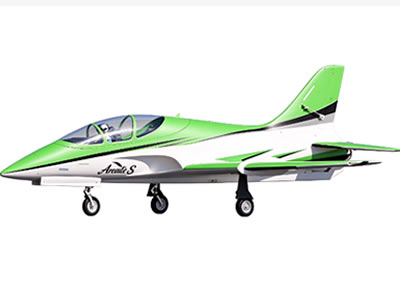 | The Best Got Bigger The beloved Avanti S grows to a 1380mm / 54.3in wingspan and a 1460mm / 57.5in length. More size means more presence on the flight line, easier flying at a distance, and the planted, locked-in feel that only comes with a bigger jet. |
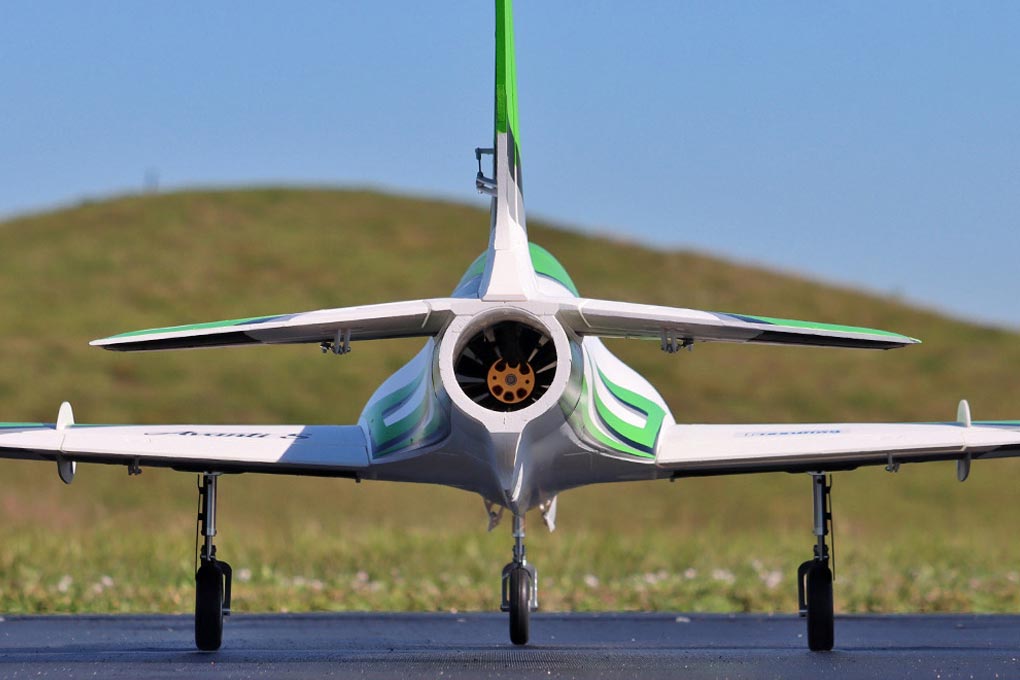 | Serious 90mm EDF Power A 12-blade 90mm EDF and a 4075-1350KV inrunner on 8S produce approximately 4700g / 10.4lb of thrust and top speeds of 200 km/h / 124 mph. You get the turbine-like sound 90mm pilots love, with plenty of vertical to go with it. |
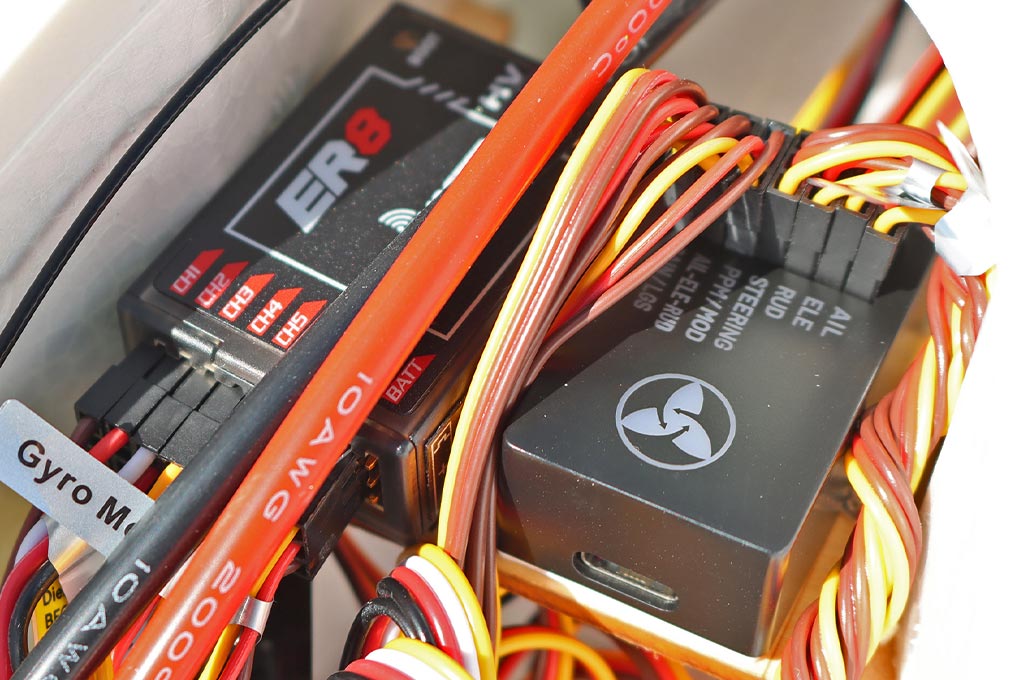 | Factory EG01 Gyro The factory-installed EG01 6-axis gyro smooths out gusty days and steadies the jet on final. Select modes from your transmitter and fly with more confidence from takeoff to touchdown. |
 | Lit Up from Nose to Tail LED lights at five positions and four sets of formation lights on the tail and fuselage sides keep the Avanti S visible against bright skies, overcast days and evening sessions. |
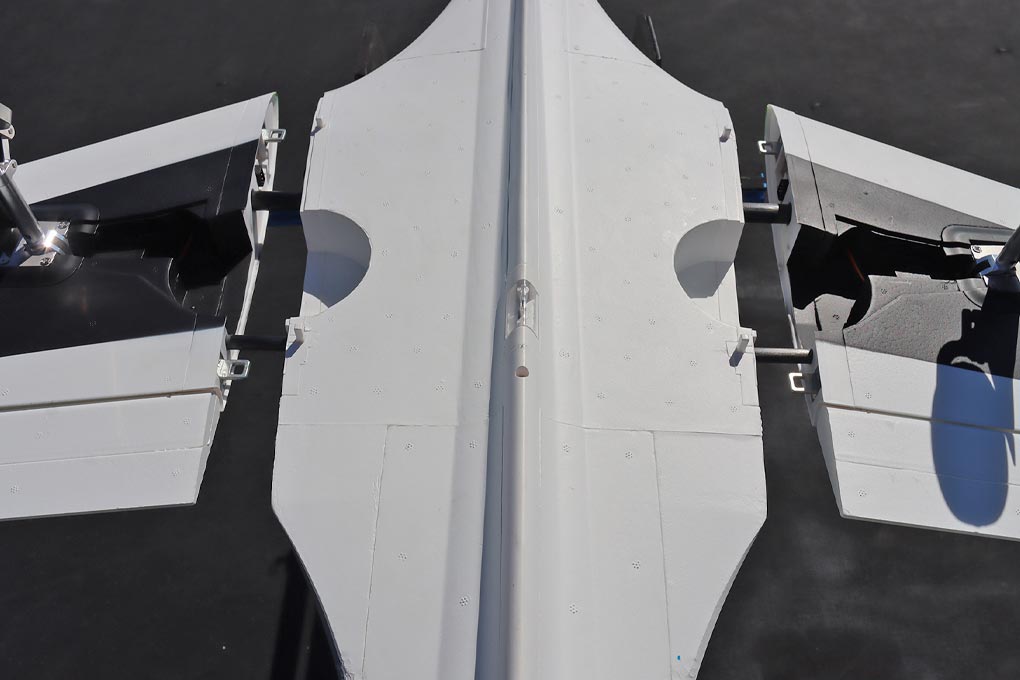 | Screw-Less Quick-Release Wings Discover more Track Defense News Radio control Remote Control Planes Slide the wings onto the carbon spar, lock them in, and the electrical connections plug in automatically. No screws or loose wires to deal with, just less time on the bench and more time in the air. |
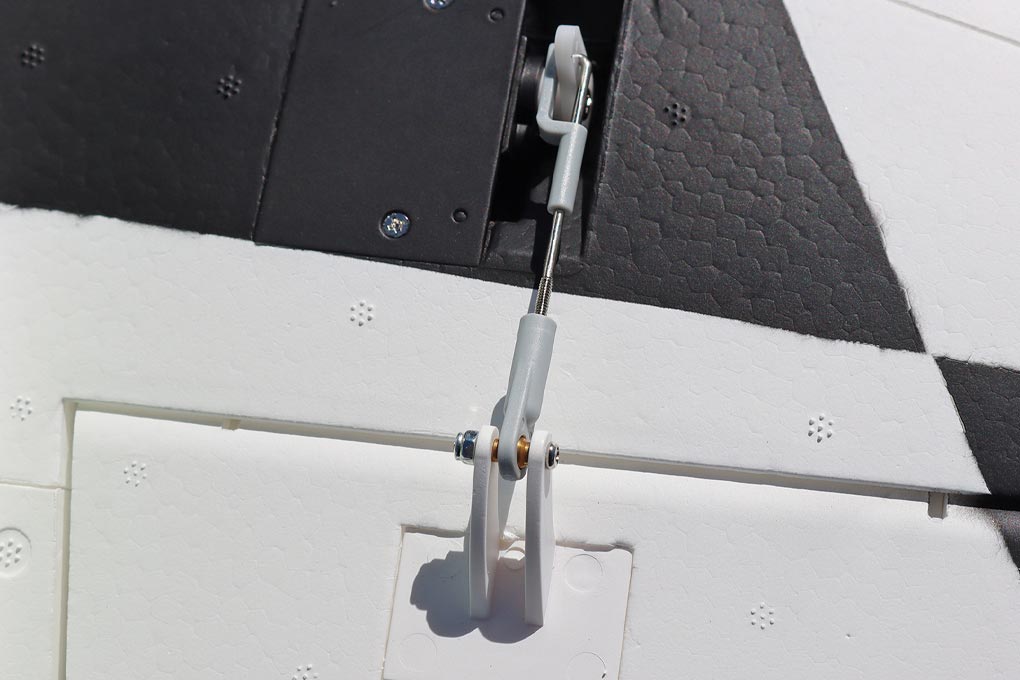 | Hardware That Holds Up A captured ball link sits centered between dual control horns, spreading the servo load evenly for sharp response and long-lasting durability. The horns are bonded and screwed into enlarged bases, and an L-bend pushrod with a keeper at the servo makes adjustments and maintenance quick and easy. Hidden hinges finish it off with clean, precise surfaces. |
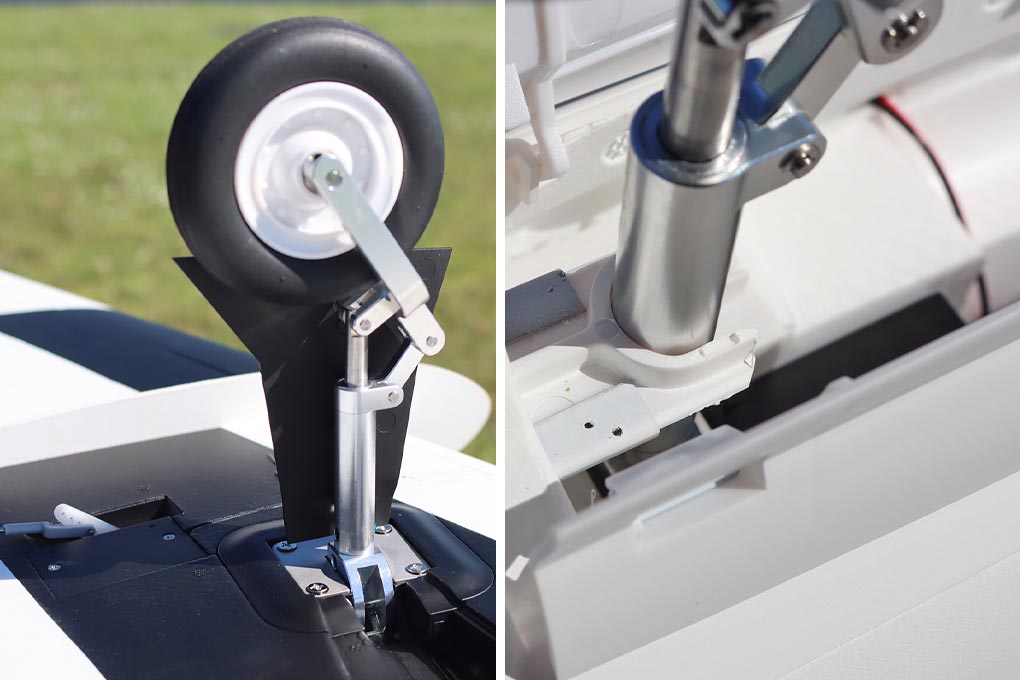 | Landing Gear That Takes the Hit The electric retracts ride on CNC aluminum shock-absorbing struts with a fully enclosed design, so the springs and damping grease are sealed inside with nothing exposed. A built-in brace reinforces the nose strut, and full nose gear doors and main gear strut doors give the gear a clean, finished look. |
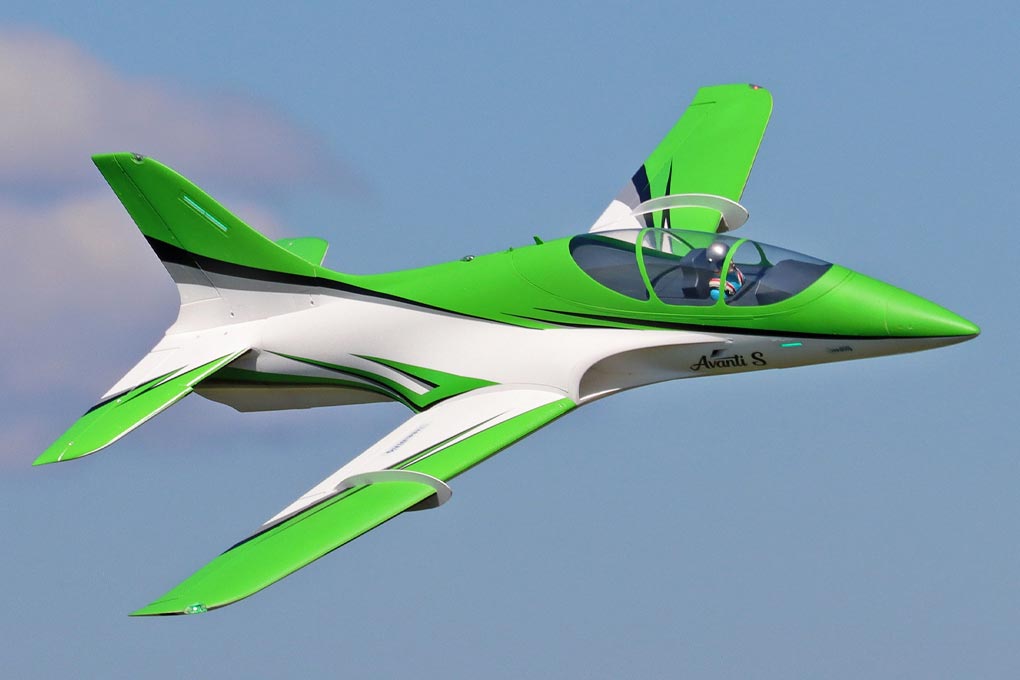 | A Livery That Pops The high-contrast green and white scheme is fully painted with no bare foam, so it looks sharp on the ground and makes orientation easy in the air. You always know which way the Avanti S is pointed. It’s also available in red and white. |
Features:
- Officially licensed by SebArt International, the original designer of the Avanti S
- Larger 90mm platform with a 1380mm (54.3 in) wingspan and a 1460mm (57.5 in) length
- 12-blade 90mm EDF driven by a 4075-1350Kv brushless inrunner motor and an 8S LiPo setup, producing approximately 4700g (10.4 lb) of thrust and top speeds of 200 km/h (124 mph)
- 120A ESC with 8A UBEC and thrust reversing for shorter landing rollouts
- Factory-installed EG01 6-axis gyro for that extra locked-in feel and added stability on approach and in gusty conditions
- Screw-less quick-release wing system with plug-in wing connections for fast field assembly
- Hollow main wing built around a carbon fiber square tube and wooden rib beam, plus carbon-reinforced horizontal stabilizers
- Bolt-on rear fuselage section accepts the optional thrust vectoring unit (FJ32511022, sold separately) for 3D maneuvers
- Electric retractable landing gear with fully enclosed CNC aluminum shock-absorbing struts (no exposed springs), damping grease and a built-in nose strut brace
- Servo-driven nose gear doors and main gear strut doors
- Flaps for slower, more controlled approaches
- Striking high-contrast green and white livery for clear orientation in the air
- Fully painted airframe with no exposed bare foam for a clean, finished look
- LED lights at five positions, plus four sets of formation lights on the tail and fuselage sides
- Cooling airways on both sides of the nose keep the battery and electronics cool in flight
- 17g digital metal gear servos on all primary control surfaces and flaps
- Hidden hinges and dual control horns with a centered captured ball link, mounted on enlarged, bonded-and-screwed bases for added strength
- CG reference marks on the bottom of the wing for quick setup
- Removable magnetic nose cone
- Clear canopy with pilot figure
- Large canopy hatch opens to a 280 x 83 x 70mm (11.0 x 3.3 x 2.8 in) battery bay for easy access to large packs
Includes:
- Freewing Avanti S Green Ultra Performance 8S 90mm EDF Sport Jet with Gyro - PNP
- Factory-installed 4075-1350KV brushless inrunner motor with 12-blade 90mm EDF
- Factory-installed 120A ESC with 8A UBEC and thrust reversing
- Factory-installed EG01 6-axis gyro
- Electric retractable landing gear with CNC aluminum shock-absorbing struts (installed)
- Nose gear doors and main gear strut doors (installed)
- Digital servos (installed)
- LED lights and formation lights (installed)
- Removable magnetic nose cone
- Instruction manual
- Freewing 90mm Avanti S Red Green Jet manual(2026 new)
Requires:
- 6-8 Channel radio (7 required for reverse thrust, 8 required for gyro mode selection) -
- 6-8 Channel receiver (7 required for reverse thrust, 8 required for gyro mode selection) -
- 8 Cell (8S) 29.6V 5000mAh LiPo setup with EC5 connectors
- OR ONE 6 Cell 22.2V 5000mAh AND ONE 2 Cell 7.4V 5000mAh battery
- 6 Cell compatible battery charger depending on battery selection
Specifications:
Build RC Models
Model Scale | N/A |
Wingspan | 1380mm / 54.3in |
Length | 1460mm / 57.5in |
Weight | 3125g / 110.2oz (without battery) |
CG (Center of Gravity) | 148–153mm / 5.8–6.0in measured from the leading edge of the wing at the fuselage (reference mark at 153mm / 6.0in on the bottom of the wing) |
Power System | 4075-1350KV inrunner motor (included) |
Electronic Speed Control | 120A with 8A UBEC and thrust reversing (included) |
Propeller / EDF | 90mm EDF, 12-blade (included) |
Servos |
|
Landing Gear | CNC-machined aluminum, shock absorbing, retractable landing gear (included) |
Required Battery | 2x 4 Cell 14.8V 5000mAh LiPo, OR 1x 6 Cell 22.2V 5000mAh + 1x 2 Cell 7.4V 5000mAh LiPo, for 8S operation (required) |
Required Radio | 6-8 Channel minimum (7 required for reverse thrust, 8 required for gyro mode selection) |
Ailerons | Yes |
Elevator | Yes |
Rudder | Yes |
Flaps | Yes |
Lights | Yes (LED/Formation) |
Brakes | Thrust Reversing |
Gyro | Yes (Freewing EG01) |
Hinge Type | Nylon |
Material | EPO Foam with carbon fiber reinforcement |
Skill Level | Intermediate to Advanced |
Build Time | 1+ Hours |
Recommended Environment | Outdoors |
Recommended Runway Surface | Hard surfaces and short, well-manicured grass surfaces |
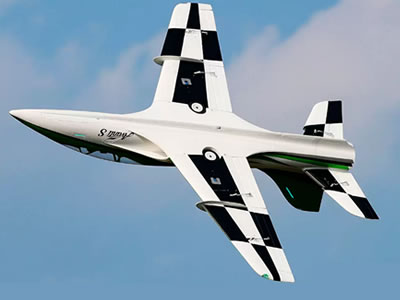
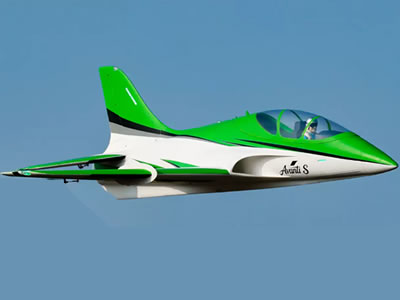
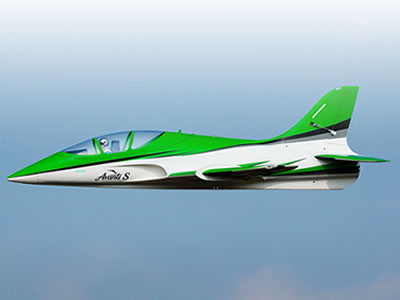
Freewing Avanti S Green Ultra Performance 8S 90mm Sport PNP Je
For UAV developers, adding a distance sensor is not just about measuring how far away an object is. The sensor also needs to deliver usable data at the right rate, communicate reliably with the onboard electronics, and perform consistently under real operating conditions.
One option worth exploring for custom measurement payloads is a phase-based laser distance sensor such as the LDJU, which uses indirect Time-of-Flight (iToF) technology.
Why Does Measurement Frequency Matter?
When a UAV is moving, the distance to a target can change continuously. Depending on the application, a low measurement rate may provide enough information for occasional inspection, while a higher rate can offer more frequent updates for dynamic measurement experiments.
The LDJU version discussed here supports continuous measurement frequencies of up to 10 kHz under specified operating conditions. Its stated measurement range is 0.2–30 m, with a measurement resolution of 1 mm.
These specifications may make it worth evaluating for custom UAV payload prototypes that require frequent distance readings over short to medium distances.
However, a high measurement frequency does not automatically guarantee better results in flight. Target reflectivity, ambient light, vibration, sensor alignment, data processing, and timestamp synchronization can all affect the usefulness of the measurements.
Potential UAV Development Applications
Depending on the payload design and field-test results, a high-rate distance sensor could be explored for applications such as:
Inspection payloads: collecting distance readings while a camera observes structures or equipment.
Proximity measurement experiments: evaluating how distance data behaves as a UAV approaches a target.
Motion and measurement research: comparing sensor readings with UAV position and payload orientation.
Custom robotic systems: integrating laser distance data into an onboard controller or companion computer.
These are potential development applications, not pre-validated LDJU integrations. The appropriate configuration depends on the required range, target surface, environmental conditions, and system-level testing.
Interface and Integration Considerations
The LDJU interface depends on the specific version. Available options include USB 2.0 or USART, while RS232 and RS485 communication may be supported through an external level-conversion module.
Before integrating the sensor into a UAV, developers should verify the exact interface and electrical requirements of their unit. They should also confirm that the onboard controller can receive and process data at the intended measurement rate.
A practical evaluation could begin with a bench test:
Connect the sensor to a suitable power supply and host controller.
Record continuous distance readings at several known target distances.
Check data continuity and measurement stability at the intended update rate.
Repeat the test with different target surfaces and lighting conditions.
If the sensor is mounted on a moving payload, test the effects of vibration and orientation changes.
For applications requiring synchronized measurements, recording timestamps alongside distance data is also important.
Resolution Is Not the Same as Accuracy
The LDJU specification lists a measurement resolution of 1 mm. Resolution describes the size of the measurement increments; it should not be interpreted as a guarantee that every reading is accurate to within 1 mm.
The manual specifies accuracy separately as ±(3 mm + D × 1/10000), where D is the measured distance. Actual performance can also depend on the operating environment and target characteristics.
For UAV applications, it is therefore important to evaluate both the specified accuracy and the repeatability of readings under representative test conditions.
A Starting Point for Custom Payload Development
The LDJU provides a measurement range of 0.2–30 m and continuous measurement frequencies of up to 10 kHz for the version discussed here. These characteristics offer a starting point for developers investigating high-rate distance measurement in custom embedded systems.
As with any sensor intended for use on a moving platform, suitability should be confirmed through mechanical, electrical, and field testing rather than inferred from the datasheet alone.
For more information about Meskernel's laser distance measurement solutions, visit Meskernel or contact us.
When evaluating a high-rate distance sensor for a moving UAV payload, which factor has the greatest impact on your design: measurement frequency, accuracy, interface bandwidth, or stability under vibration?

Real-time obstacle avoidance is a tricky problem for small autonomous drones. Onboard computing power is limited, but the aircraft still needs to detect obstacles and react quickly enough to avoid them.Depth cameras are one way to approach the…
Hi, friends,I joined this forum to share a project I’ve been working on for a few months now—a system for in-flight assistance and autonomous flight for fixed-wing aircraft that I’ve named “Talos,” after the giant bronze automaton in mythology that…
Agricultural spraying drones are changing how farmers and professional application teams manage crop protection, fertilization, and field operations. Compared with conventional ground-based spraying equipment, multirotor drones can access difficult…
Last updated: November 2026Type of review: Specification-based comparison (not a controlled field test)Scope: Published tank capacity, spray flow, spray width, and related application features of five multirotor agricultural platforms. Operators…
As the drone industry continues to expand into agriculture, industrial inspection, logistics, surveying, and other professional applications, the demand for practical UAV engineering skills is growing alongside it. For vocational colleges and…
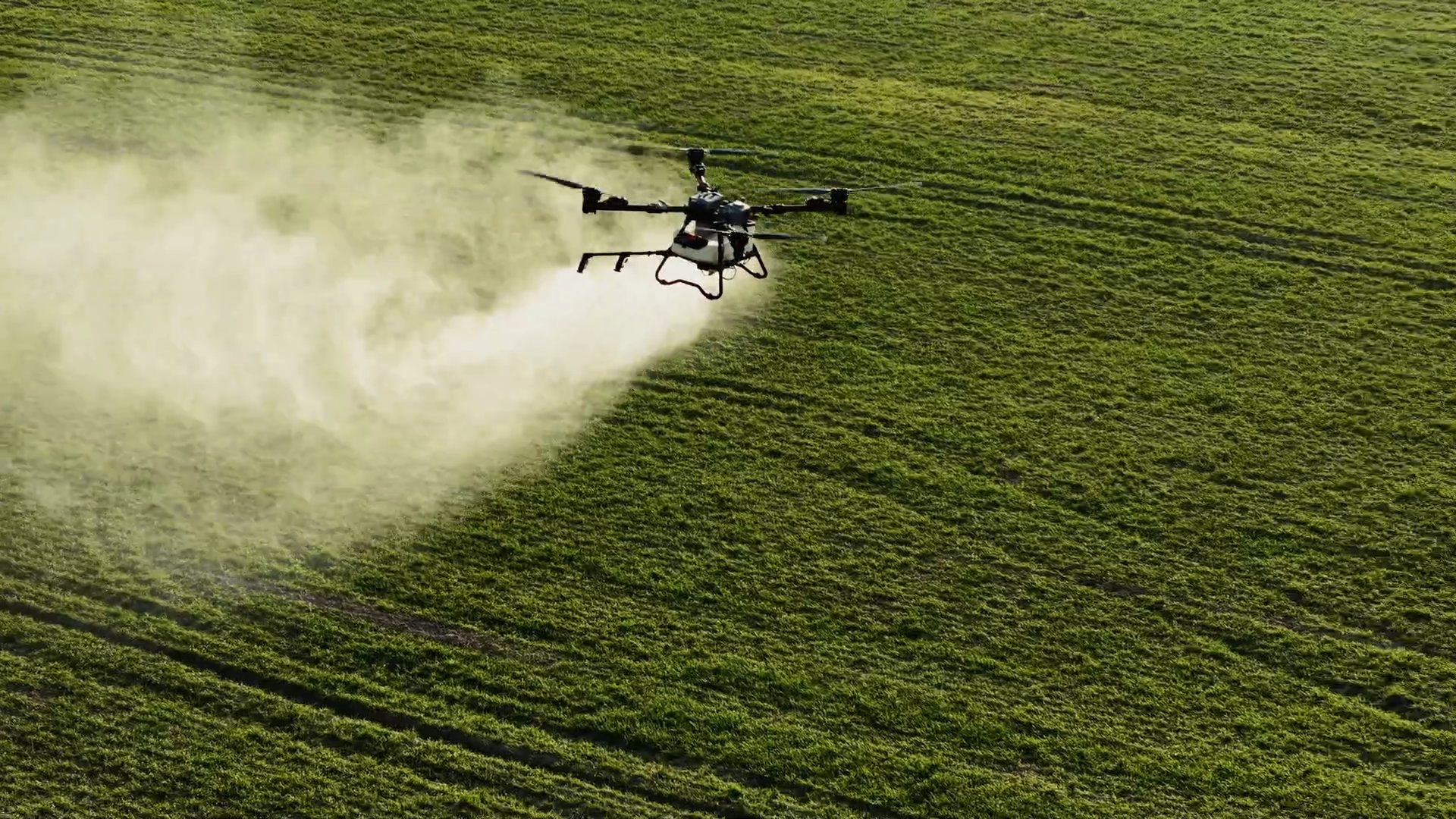
For large-scale farmland and plantations,yield, labor costs, and time efficiency directly determine farmers’ returns. With the development of drone technology, drones are taking on more operational tasks throughout the entire agricultural…
It's workshop clearing out time! I've got a bunch of drones and RC planes to give away, free to anyone who can pick them up in the SF Bay Area (ideally Berkeley). Details here
"How do you see these technologies evolving for urban applications, particularly in complex environments like cityscapes? Any specific use cases you envision? https://street-view.io"
I recently came across an analysis by a well-known industry publication featuring a ranking of the top unmanned helicopters. It was interesting to explore the different solutions, and some of the products featured in the list were a real eye-opener…
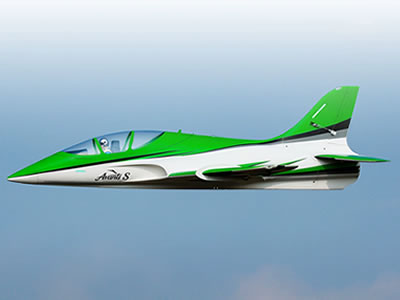
Freewing avanti 90mm Jet unboxing review in 2026Hello Hobby friend:I am general technology engineer from Freewing model.we are happy to share technology with all hobby friend again today.The moment the package of Red Freewing avanti 90mm Jet…
Small drones face a fundamental challenge: autonomous navigation often demands significant computing power, yet onboard processing capacity, memory, and energy are extremely limited. A recent study, Efficient Robot Navigation Inspired by Honeybee…
TALOS Hub: Autonomous flight supervision and pilot assistance
Hi, friends,I joined this forum to share a project I’ve been working on for a few months now—a system for in-flight assistance and autonomous flight for fixed-wing aircraft that I’ve named “Talos,” after the giant bronze automaton in mythology that…
Read more…
0 Replies
EFT Z80 Agriculture Drone:New Flagship, All-in-One
For large-scale farmland and plantations,yield, labor costs, and time efficiency directly determine farmers’ returns. With the development of drone technology, drones are taking on more operational tasks throughout the entire agricultural…
Read more…Unmanned helicopters
I recently came across an analysis by a well-known industry publication featuring a ranking of the top unmanned helicopters. It was interesting to explore the different solutions, and some of the products featured in the list were a real eye-opener…
Read more…Pass Your Drone Test: Data-Driven Training Tips
Failing your drone flight test? Repeating mistakes without knowing the root cause only wastes time and money. If you want to pass without the detours, blind practice isn’t enough — you need smart, data-driven review.Common Pitfalls in…
Read more…