All Posts (11086)

Sort by

Quadcopter Workshop

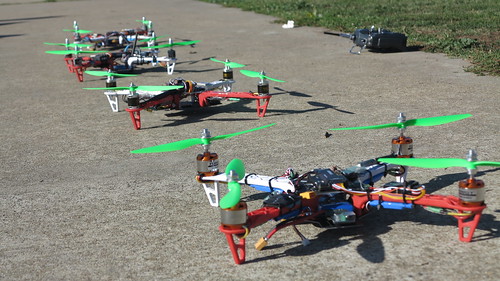
IMG_3249

Over the last 4 weeks in Canberra (Australia) I've been a running a build-and-fly-your-own-quadcopter workshop, based on the APM.

We had a dozen excited people attend the workshop and all were successfully able to build their quadcopters. The flying lessons were mostly successful - we only had a 25% crash rate (mostly broken arms, easily replaced).

Full documentation for the workshop is available at https://canberrauav.readthedocs.org/en/latest/lessons/quadcopter-workshop.html if others in the community want to run their own workshops, which I definitely encourage!

It's a great way to promote civilian usage and education of multicopters/drones. I've also found these workshops to be massively popular. I only had 12 spots available in this workshop, all of which filled up within 48 hours. I think this demonstrates the massive interest in multicopters.

Finally, a time lapse video of one of the workshop sessions:

Read more…

Concept Overview

Concept Drawing/Rough Draft Sketch

3689512427?profile=original                                http://www.airhogs.com/en/products/air-hogs-link

This is a concept idea that I want to share with you folks.  It's still very much a rough draft until I receive all the pieces and parts I ordered.  So please bear with me and my not so artistic drawings/sketches :)

Read more…
3D Robotics

Festo to fly "BionicOpter" at Hannover

From Design Engineering:

Building on the work of last year’s bionic creation, the Smart Bird, Festo announced that it will literally launch its latest creation, the BionicOpter, at Hannover Messe in April. With a wingspan of 63 cm and weighing in at 175 grams, the robotic dragonfly mimics all forms of flight as its natural counterpart, including hover, glide and manoeuvring in all directions.

This is made possible, the company says, by the BionicOpter’s ability to move each of its four wings independently, as well as control each wing’s amplitude, frequency and angle of attack. Including its actuated head and body, the robot exhibits 13 degrees of freedom, which allows it to rapidly accelerate, decelerate, turn and fly backwards.

“This unique way of flying is made possible by lightweight construction and the integration of functions: components such as sensors, actuators and mechanical components, together with open- and closed-loop control systems, which are installed in a very tight space and matched accurately to one another,” explained Dr. Heinrich Frontzek, Festo’s head of corporate communications and future concepts.

In total, the BionicOpter’s wings are actuated by nine servomotors. The first, positioned in the base of its main body housing, regulates the frequency of the wing beats, which can be varied between 900 to 1200 times per minute (15 to 20 hz). Additionally, four motors (one at each joint) independently control each wing’s amplitude—or how far it travels per beat—to anywhere between 80 to 130 degrees of deflection.

Each wing can also be rotated up to 90 degrees to control angle of attack and allow the BionicOpter to fly forward, backward or sideways. To save on weight, the robotic insect’s head and body actuation rely on four shape memory alloy structures that move the head side to side and the tail to move vertically.

To coordinate movement and provide flight stability, the BionicOpter is equipped with a series of inertial, positional and acceleration sensors that record wing position and orientation as well as the tilt, speed and direction of the dragonfly’s flight. That recorded flight data is then evaluated in real time by its on-board ARM microcontroller, which calculates all the parameters that can be adjusted mechanically.

According to the company, the robotic dragonfly’s wings are composed of carbon fibre rods reinforcing a polyester membrane while its main body is a combination of aluminium as well as sintered polyamide and ABS plastic. Two 7.6-volt lithium polymer batteries supply power and an integrated wireless receiver allows the dragonfly to be remotely piloted by smartphone.

Like all of Festo’s robotic creations, the BionicOpter is the product of the company’s Bionic Learning Network, a research partnership between the company, universities and development companies, that focuses on creating industrial technology based on design principles drawn from nature.
www.festo.com/bionic

Read more…
3D Robotics

3689512279?profile=original

Go Randy! (Japan Drones is a 3DR affiliate and Randy is the lead on the ArduCopter project)

From a press release from Guardtime today:

Guardtime Partners With Japan Drones Delivering Keyless Signature Infrastructure for Drone Security


Tokyo | Palo Alto – Mar 25, 2013 – Guardtime, the leading provider of Keyless Signature Infrastructure (KSI) technology for the authentication of electronic data, today announced it is partnering with Japan Drones, the leading developer of custom software for miniature Unmanned Aerial Vehicles (UAVs) selling into the Japanese market. Keyless Signatures provide proof of signing time, signing entity and data authentication while the verification of the signature can be done offline without reliance on keys, secrets, or the existence of a trusted third party.

Ensuring the absence of malware and confidence over the integrity and authenticity of software on UAVs is an absolute must. CEO Randy Mackay of Japan Drones said, “By using keyless signatures to sign source code stored in Github, but also access logs and compiled binaries, we have a completely mathematical and independent audit trail over the provenance of electronic data executing on our UAVs as well as the real time video and telemetry data that is being recorded.” “Guardtime’s KSI technology is completely unique in that there are no keys to be compromised, thereby vastly simplifying the cost and complexity relative to using key based cryptography,” added Mackay.

“The threat of malware is a huge issue for drone manufacturers and operators,” said Mike Gault, Guardtime CEO. “Being able to have mathematical certainty over the integrity and authenticity of executing software is a major step forward. With KSI it is possible to verify the provenance of the executable binaries independently from any human being.”

Ahto Buldas, Guardtime Chief Scientist, said: “Guardtime is thrilled to be partnering with Japan Drones and seeing KSI being used for such an important application. Recent events have shown that quantum computing is becoming a reality and the need for post-quantum cryptography such as KSI is clear.”

Most recently, Guardtime announced a partnership with the Estonian Government for securing records in select state registries. Guardtime also announced a partnership with the Philippines Government to validate physical document integrity and with China Telecom, the largest fixed line telecommunications service provider in the People’s Republic of China, establishing China Telecom as a Keyless Signature service provider via its Tianyi 3G platform.

About Japan Drones
Japan Drones (www.japandrones.com) specializes in custom software development for miniature UAVs primarily for the Japanese Market with applications including volcano research and surveying. Japan Drones CEO Randy Mackay is an executive board member of the Mini-Surveyor Consortium, which aims to complete development of a commercial use, safe and dependable multicopter platform for Japan within two years.

Read more…
3D Robotics

From Make, an experience trying the NeuroSky headset to control a copter with brain waves:

If launching virtual vehicles at people isn’t cool enough for you, Puzzlebox has developed a more physical manifestation of your mental might with their spherical helicopter Orbit. Through the power of concentration, the user can send the little drone into the air (or into a crowd of innocent bystanders as there isn’t any form of directional control).

As I learned in the short time I played with the Orbit (and throughout my years of formal education), trying really hard to concentrate is not effective at increasing your concentration levels. When I focused on listening to someone talk or reading a paragraph of text, however, the little guy jumped out of my hand. But then, the excitement of seeing it fly stole that concentration, sending it crashing to the ground. I’m sure with a little more practice I’ll be able to levitate it like a swamp-lodged X-Wing.

The Puzzlebox Orbit project is open source. They have an Instructable that shows you how to create and mind-control your own flyer. They launched a successful Kickstarter campaign the end of last year and from that has come this commercial product, which you can buy here.

Read more…
3D Robotics

3689512270?profile=original

The current issue of The Magazine, an excellent e-mag with long-form articles, has a thoughtful piece on domestic drones by Pulitizer Prize winning author Eli Sanders. 

The editors introduce it thusly:

We already live in a fishbowl, and we’re getting more gawkers, writes Eli Sanders in his article, “Ground Control,” told in three parts in this issue of The Magazine. Eli explains how crowded it is about to get, with throngs peering in through our glass walls, due to the near-term and long-term growth in the United States of the use of unmanned aerial vehicles (UAVs or “drones”) by both hobbyists and governmental agencies. The regulatory and legal framework hasn’t kept up. We’re in the infancy of this technology, which soon could be in the hands of every person — or law-enforcement body — who wants it.

This isn’t a blip on the horizon. Rather, surveillance drones are already multiplying at a staggering rate, and are part of an assault on our privacy and anonymity in public and private spaces. The previous debate, still ongoing, has been about personal, commercial, and governmental video monitoring and recording in public spaces and private venues — as well as about facial recognition technology employed alongside.

Drones take this a step further, with the current regulatory framework preventing us from expecting privacy from aerial observation even in our backyard, whether from a nosy neighbor or the police. Understanding the practical, technological, legal, and extralegal shape of our fishbowl is increasingly meaningful to every citizen — in every country. The United States is just the canary in the coal mine due to our early-adopter obsession with technology.


Here's a sample, where I'm quoted:


Calo had heard all of [the] concerns before, and more. “We can be excited about the upside and still try to mitigate the downside,” he told me some weeks before the hearing. “That’s a very human thing — to want and to fear.”

When we talked about his [own] fears, Anderson of DIY Drones told me he had a coincidence related to them that drew him up short not too long ago. “I was on a plane,” he said. “I had my laptop open, and I was programming. I was working on some of our code, and I was looking at some of our swarming algorithms.” Algorithms of this sort allow for multiple drones to act in concert — flying together in formation, for example.

“And then they came to serve the meal,” Anderson continued, “and I had to close the laptop to make room for my tray. And so I opened up the Kindle app on my iPad, and I opened up Daniel Suarez’s Kill Decision.” The book offers a dystopian view on swarming drone technology that ends up with a lot of people dying. “And then I finished my meal, and I close the iPad, and I open up my laptop again, and I start programming the swarming algorithm. And I say, ‘Wait. Is this how it happened?’”

Anderson doesn’t believe that we have the power to create drones that would have truly independent ability to act — there’s no Terminator in his vision of the future. “But even if we could,” he continued, “what should I do differently?”

I replied: Perhaps throw in a foolproof kill switch, like all the students at the competition were required to do for their machines?

“We’re an open-sourced project,” Anderson said. “How do we build in safeguards that someone else couldn’t take out? You can’t do it.”

In any case, there’s a more utopian project that better captures Anderson’s vision. It’s a foam plane his company’s currently designing that weighs “about two pounds, max,” intended for farmers in places like North Dakota. “They wake up in the morning, they unplug it, they throw it out the window, and then they go down to their office and they open up the crop report and they get this shot of what’s going on with the crops,” Anderson explained. “It goes up and down your crop, like a lawnmower. It goes click click click click click, and then all the imagery is uploaded onto a web service, which then stitches it together to make a composite, and then you get a Google Maps–quality image of your crop 10 minutes ago, at super high resolution.”

The Berkeley Peace and Justice Commission might actually like this drone, because it doesn’t take away human jobs. “This job isn’t being done at all,” Anderson said. “You know what it replaces?” he joked. “It replaces putting down twice as much herbicide as you need.” 

Both Anderson and I had recently seen Looper, and both of us had noticed the beat-up drone that Emily Blunt’s character uses in the year 2044 to tend her farm’s crops. Anderson particularly loved the way Blunt’s character casually started her drone up and sent it off to work in a quick moment so pedestrian it was entirely missable for the average viewer. “It was just so, sort of, matter of fact,” he said.

That, he hopes, is the future.


Read more…

Bringing up a PX4 on a FlameWheel F330

I recently got a PX4FMU plus PX4IO board kit and I am installing it on my little DJI Flamewheel F330 that I had been using previously with my APM 2.

3689512288?profile=original

The F330 is a perfect candidate for this because it is an excellent and sturdy test bed.

It flew very well with my APM 2.

Previously I was using An Oring suspension mount on the 4 standoffs you can see in the photo above.

This time I decided to try mounting the PX4 stack on a thin fiberglass plate plate which is mounted on some 1/2" pads of Kyosho Zeal anti vibration gel. 

3689512303?profile=original

The PX4 stack is already pretty high so I thought I'd try this before using both the Zeal and the O-ring mount I had planned.

3689512236?profile=original

The Zeal Gel which comes with double sided tape on both sides is almost a quarter inch thick and it seems appropriately flexible and vibration absorbent in this application with the four 1/2" square pads.

The Accel readings will tell the tale.

Note that the inter board connector on the left is about 2mm  shy of closing. 

3DR supplies 8mm M3 standoffs and I think that 6 mm ones would work better, although their would be a slight interference fit at the other end of the board.

3689512188?profile=original

Notice all the stuff still hanging off of it.

The GPS, the arming switch, the buzzer and the battery power leads for the PX4's built in power supply.

Still have to figure out where to stick all this stuff on my little Flamewheel.

I have already installed the firmware and bench tested this PX4FMU plus PX4IO stack. 

The PX4 stack is upside down from normal spec, but it makes the connectors easier to get at and it is easy to do with the new Mission Planner adjustable Board Orientation parameter.

I will also be attempting to use one of the little 3DR Receiver servo to PPM-Sum out converters, so this promises to be an interesting adventure.

I will keep everybody posted and new pics as this build - test continues.

Please feel free to post comments and questions.

Read more…

3DR at 2013 MultiRotor Challenge!

3689512206?profile=original

3D Robotics had a great weekend at the First Annual MultiRotor Challenge. We were there both Saturday and Sunday and competed in most of the events, including a fully autonomous demo mission with a Stock 3DR Hexacopter. In the Auto-Land Competition, APM powered Multi's got 2nd, 3rd, and 4th place! We also won 1st place in the Pilot's Choice event for the coolest looking MultiRotor with the X8 Octocopter (complete with a color FLIR Camera). One lucky fellow won a brand new 3DR RTF Quad kit in the Raffle!

3689512136?profile=original


We met a lot of great people out there, and it was a great chance for builders and pilots to show off their hard work. If you are a multirotor fan, experienced expert, or an aspiring multirotor pilot, this is the place to be! We look forward to next year's event, and judging by the response, this event will get bigger and bigger each year.  For more info, visit:


http://www.innov8tivedesigns.com/MR/index.htm


See you in 2014!3689512257?profile=original

Read more…
3D Robotics
From the European Space Agency (you can read more about the research at RoboHub):

SMARTPHONE APP TURNS HOME DRONE INTO SPACECRAFT

15 March 2013

A free ESA app released today turns a popular iPhone-controlled ‘home drone’ into a spacecraft. The augmented reality game lets owners of Parrot AR.Drone quadcopters attempt dockings with a simulated International Space Station while flying their drones for real – in the process helping to improve robotic rendezvous methods.

This new AstroDrone app is part of a scientific crowdsourcing project by ESA’s Advanced Concepts Team, gathering data to teach robots to navigate their environments.

“People intuitively assess their position and motion in relation to their surroundings in various ways, based on what they see before them,” explained team research fellow Guido de Croon.

“This new app lets us crowdsource examples of this process in practice, as a first step to reproducing it with artificial intelligence. 

“For ESA, the result could be much more autonomous spacecraft that can reliably manoeuvre, dock or land themselves.”

Remote-controlled drones were once the province of the military, but technology advances make them accessible now to everybody.

“For ESA, this development opens up completely new ways of involving the public in scientific experiments,” noted Leopold Summerer, head of the Advanced Concepts Team. “We can obtain real-life data to train our algorithms in large amounts that would practically be impossible to get in any other way.

Guido de Croon demonstrates AstroDrone

The AR.Drone is one example: around half a million have been sold since their introduction by France’s Parrot company in 2010. Equipped with two cameras, the midget drone flies on four rotors and can be steered by iPhone or any other iOS device.

 “We wanted to carry out robotic crowdsourcing, which meant selecting a robot that the public actually possesses in large numbers,” added Guido. “This is indeed a robot that people have at home and play games with, with the imaging capabilities we need.”

“In addition, the manufacturer has made the source code needed to communicate with the drone open to anyone to develop software.”

With AstroDrone, the controller places an augmented-reality marker on a real-world feature to serve as the Space Station docking port. The challenge is then to place the drone onto a graphical version of the Station in as rapid but controlled a manner as possible, with bonus points for correct orientation and low speed on final approach.

“Here at ESA’s ESTEC technical centre in the Netherlands we happen to have a ceiling-mounted scale model of the Space Station to manoeuvre around – not everyone is so lucky,” remarked Guido. “But with AstroDrone anyone can share the same experience.”

Players are invited to contribute to the experiment via the Internet as they log their scores on the high-score table.

Buzzing ISS

Their inputs will be anonymous, Guido explained: “We’re not interested in the places people are flying in. We will not receive any raw video images or GPS measurements, only the abstract mathematical image features that the drone itself perceives for navigation, along with velocity readings.”

A three-person team developed the app – Guido worked alongside with Paul Gerke and Ida Sprinkhuizen-Kuyper of Radboud University in the Netherlands.

Versions for other devices are planned as time permits, as well as future levels featuring other space rendezvous scenarios – such as ESA’s Rosetta probe rendezvousing with the 67P/Churyumov–Gerasimenko comet, which takes place for real next year. 

Read more…

3689512025?profile=original


 We have been conducting habitat mapping, and wildlife monitoring, as well as test flights. as part of our desire, we also conduct presentations so as to educate and inform the community and interested groups in UAS / UAV abilities and to confront misinformation and what people "think" about UAS / UAV systems.

As of late we have been hammered, and my in-box overflowing, with complaints and issues in reference to Quadcopters (multirotors) and helicopters. This seems to really brought to the forefront after the Kennedy Airport incident made it to the national news.

We follow a strict "go-no go" launch protocol, and as most of the people I deal with, I notice that they all abide by FAA AC 91-57, and either follow, or have incorporated, the AMA "Model Aircraft Safety Code" (as well as recognize AMA Doc. #550).

What has really grabbed my attention is the use of the word "drone" by both quadcopter (multirotors) and helicopter operators, and complainants. The interesting thing is that, so far, all the "drone" operators to whom I have spoken with, are flying camera platforms by control (hence not autonomous- a "drone").

People are seeing multirotor / helicopter systems flying over their houses and property (and then being approached by people to buy the aerial photo of their place, real estate agents are using, or hiring out to get multirotor / helicopter photos of property, and neighbors believe they are being spied on.

I was even sent an email forward of someone being "buzzed" at a ski event at Big Mountain resort during a ski event (I did find out that there was a quadcopter flying over people taking video / photos of a night ski event but unable to confirm the "buzz").

I guess the most striking contact that I have had so far, is a photo that was sent to me where a Columbia Falls company posted a photo of one of their quad systems flying over Bowman Lake, inside Glacier National Park (one system took the picture of the second - two quadcopers flying inside the National Park)

Now, I plead with you not to take this as a bitch, or a complaint, for all the multirotor / helicopter operators that I know, and deal directly with (and all those on DIY) are driven by a higher curiosity in development, and not by the "Ahhh" factor gained by buzzing someone on a bicycle.

But, if other areas are seeing (or hearing about) some of the same things we are hearing (and seeing in Montana....and the Internet - a squadron of quadcopters over London) this could come back and bite those of us who are really working on UAS / UAV systems, in the rear. All it is going to take, is one of these things to crash (into property or people) and the word / term "drone" be used and we are going to be regulated to flying in our garages.

I thank those of you who have taken the time to read this. I would really love any and all comments (and if you disagree, please keep it clean) on this issue. Again, if you operate a quadcopter (multirotor) or helicopter this is not an attack on you, only to bring to light what actions of a very small (I hope) group of people may mean to us all (here on DIY) and in your area.

Cheers to you all

Byron
Read more…
Moderator

Super_Bat.jpg?width=400

From the shameless plug department..

Join sUAS News podcast host Gene Robinson, technology permitting, live from a Texas controlled burn. Find out what his part in the trials has been. The show starts at 0800 Pacific on Wednesday the 27th of March. As always the shows will be available to listen again afterwards. A list of recent shows can be found on the Podcast Page . Gene will be flying the MLB Super Bat.

We are quite proud of the podcast even though sometimes it can be a little dry and technology often fails us! This will be show number 44 for Patrick and Gene. Running for 10 months now there have been more than 200,000 downloads to date.

Read more…
3D Robotics

3689511990?profile=original

From Hackaday:

Hackaday alum [Adam Munich] shot a tutorial video on using a rate gyroscope.

Here he’s showing off the really fancy piece of ancient (technologically speaking) hardware. It would have set you back about fifteen grand in the 1960′s (inflation adjusted) but can be had these days for around $30. What a deal! These are not small, or power efficient when compared to the components that go into smart phones or gaming controllers, but they’re a heck of a lot more accurate than the ubiquitous modern parts. That’s because a rate gyroscope — which is the gold cylinder on the left — actually incorporates a spinning motor and a way to monitor how it is affected by changes in gravity. The driver/interface circuitry for this gets hairy relatively fast, but [Adam] does a solid job of breaking down the concept into smaller parts that are easy to manage.

Wondering what is different about this compared to a MEMS accelerometer? We know they’re really not the same thing at all, but wanted a chance to mention [The Engineer Guy's]video on how those parts are made.

Read more…
3D Robotics

Rescue drone drops life preservers

8594249932_ae479842d9.jpg

From Robots.net:

Amin Rigi of the RTS Lab in Tehran, Iran let us know about a new rescue robotthey're working on. The robot is named Pars. it's a ship-based quadcopter that responds instantly when alerted to potential drowning victims in the ocean, locating them with FLIR, and dispensing life preservers directly over them. The current prototype carries one life preserver and they are working on a new model to carry three life preserver rings. Future models may dispense up to 15 self-inflating rings. A launching platform for use on ships has been designed but more intriguing is an idea for a stand-alone launching platform. From the website:

A sea platform has also been designed for the robot. This platform used satellite data for its control and it uses solar energy for its energy. It is always in the water and the robots are ready for action. When a marine incident occurs it quickly operates and sends the robots to the event to help.

In both cases, the launching platform also serves as a recharging station, keeping the robots in a continual ready state. This looks like a great project and we look forward to seeing future progress reports on the Pars robots. Read on to see some renderings of the robots in action as well as the designs for the launching platforms.

8593149875_b70d2b75f0.jpg
A solar powered launching platform for the Pars rescue robots

8594250064_80b1a114fd.jpg
Pars rescue robots taking off from a ship-based launching platform

8593149829_314ef062d8.jpg
Pars rescue robot dropping a life preserver

Read more…
Moderator

3689505415?profile=original

In last two months we are working to new special console for control our drone , gimbal , rc models ... we develop a special application on android and some hardware interface for interconnect different kind of tx radio module. Our idea is to virtualize the hardware interface and have a flexible enviroment for control different kind of application.

This is only a preview of our work in the picture above is possible to see the direct interface with Jeti radio tx module.

3689505342?profile=original


In this kind of configuration the VR Droid PAD connect directly by a custom hardware the Jeti Tx module.

So is possible to use same reciver on your drone without change it. 


3689505441?profile=original

3689505368?profile=original

3689505457?profile=original

Description

VR Droid RC is software that turns your Android smartphone or your pad into a powerful digital remote control for use with your radio model.
Is designed to be used on Rover or Drones or professional use. It 'sa project dynamic and evolving based on feedback from users of our community: www.virtualrobotix.com

The main features are:
- Ability to manage up to 8 channels.
- 4 Channel standard for management ROLL, PITCH, YAW and Throttle.

- Auto Repositioning of 2 main stick when you put the finger on the screen.

- 5 additional channels of digital or analog.
- Management of the minimum and maximum for each channel.
- Management Trim
- Management subtrim.
- Reverse channel management.
- Configuration management esponeziali on standard channels.
- Management of up to two simultaneous feedback with vibration and sound feedback to throttle on the second audio output.
- Management mode 1,2,3,4 as standard RC trasmitter.
PPMSUM standard output compatible with the most 'popular radio modules tx.
Manages two modes: configuration and live to allow the maximum fluidity of the commands and the maximum configurability by users.

The current version is a preview suitable only for beta testing use it carefully.

Check the forum for have more detail about the application development

If anyone want to share their experiences testing/using this app, or want to discuss anything in my blog post´s this forum thread can be used here we add also the schematics of op amp for interface VR Radio RC to your pad.

http://www.virtualrobotix.com/forum/topics/vrdroidrc


This is our facebook fan page : 

http://www.facebook.com/pages/VirtualRobotix-wwwvirtualrobotixcom/149125448465971


News on revision 1.4 27/03/2013

1) New name , we change the name to application the old was VR DROID RC Trasmitter , we change it in VR Radio RC , more simple , we change also the link in google play:) 

2) We deactivate the limit inside the application and add some special function for customize the widget available on main screen , we prefer mantain priority on control of drone . So on the scrreen you choose to have only virtual stick.

3) Add the configuration of radius of virtual stick it's customizable directly inside the option pannel.

4) Improve Option pannel its more simple and better organized.

5) Add the Expo control for the stick.

5) Add feeback on 3 channel : gas ( on 1 speaker channel) and pitch  (on vibro) is fixed and you can add 1 other feedback and decide if is on yaw or roll on vibro . 


This is the link at : Vr Radio RC rev 1.4 in  google play :


https://play.google.com/store/apps/details?id=com.laser.VrRadioRC&feature=nav_result#?t=W251bGwsMSwxLDMsImNvbS5sYXNlci5WclJhZGlvUkMiXQ..


Try it and send us some suggestions for improve the application and the interface.


Best

Roberto Navoni


Read more…

One of the faster UAV helicopter platform in the world

3689511776?profile=original


Gross Weight1480 lbs.Empty Weight920 lbs.Fuel 50 gal.310 lbs.Useful Load250 lbs.EngineA 250 C20B 420 shpTop Speed318 mphCruise280 mphRate of Climb at SL5200 fpmAt 10,000 ft.3850 fpmEndurance2.4 hrsRange670 milesPower/Mass.283 hp/lbs. At max gross wt.Hovering Ceiling OGE19,500 ft.Auto PilotMP2128heli


Show New model speed will 318 mph
http://www.challis-heliplane.com/v3/uav.php


Read more…
3D Robotics

APM 2.5 in Servo Magazine

3689511675?profile=original

Love the conclusion: "No other system offers this much control for so little cost"!

You can read the whole thing here, but suffice to say it's a great intro to APM 2.5 capability and setup. 

I'm a subscriber to Servo Magazine and this is a good example why: authoritative, clear and interesting guides to DIY robotics technology. Subscribe here. 

Read more…

Remember the video "A nice place to fly - Hexacopter in Cameroon / Africa" ? Two years later, it is now available as a director's cut with more than twice the length of the original movie, showing some additional scenes and longer sequences:

Available in HD on vimeo: http://vimeo.com/62600789

If you don't know the movie, I recommend to first have a look at the original version here: https://vimeo.com/18873955

Read more…

Deep Reaper Final Adventures (and crash)

An exciting, action-packed compilation of the best flights from the last few months of my FPV Deep Reaper's life, featuring lots of fun proximity flying at various locations around Colorado's Front Range. At the end is the video of my plane's unfortunate demise when I accidentally flew through the signal beam of a TV tower on Mt. Morrison, causing my elevon gyros to lock up, sending the plane into a death spiral straight into the top of an outlying rock formation at Red Rocks Park (it was in a closed area, so no one was around). Skip to 4:34 for the crash.

I recovered the plane the next day and while the airframe was a total loss, I was able to salvage all the electronics except the batteries and GoPro, which was so destroyed it had even lost its memory card (the only piece I never found). Thanks to my SquareTrade accidental damage warranty, the camera will be replaced with a Contour Roam2 which I think has better colors and contrast than the GoPro 3 White Edition I had before and has a better form factor for my next plane. I am currently building a Ritewing Zephyr II to replace my Deep Reaper.

Read more…

The Super Supercapacitor | Brian Golden Davis from Focus Forward Films on Vimeo.

Ric Kaner set out to find a new way to make graphene, the thinnest and strongest material on earth. What he found was a new way to power the world.

Source: http://io9.com/5987086/meet-the-scientific-accident-that-could-change-the-world

Last year, researchers at UCLA made a rather fantastic, if serendipitous, discovery. A team of scientists led by chemist Richard Kaner had just finished devising an efficient method for producing high-quality sheets of the Nobel-prize winning supermaterial known as graphene — with a consumer-grade DVD drive. That was groundbreaking in and of itself, but the real surprise came when Maher El-Kady, a researcher in Kaner's lab, wired a small square of their high quality carbon sheets up to a lightbulb. Then something incredible happened.

As the video above explains, Kaner and El-Kady had stumbled upon an energy storage medium with revolutionary potential. Imagine filling your smart phone with a long-lasting charge in just a couple seconds, or an electric car in a minute. Future applications, first described in a March 2012 issue of Science, looked very promising.

Fast forward one year, and Kaner and El-Kady are even closer to realizing a tomorrow rich with supercapacitor technology. In a paper published in a recent issue of Nature Communications, the researchers report that El-Kady's original fabrication process (highlighted in the video) can be made even more efficient. More efficient production of high quality graphene means it's scalable. And scalability, of course, can lead to manufacturing and wide-scale technological implementation. As the researchers note in the abstract to their paper [emphasis added]:

Here we demonstrate a scalable fabrication of graphene micro-supercapacitors over large areas by direct laser writing on graphite oxide films using a standard LightScribe DVD burner. More than 100 micro-supercapacitors can be produced on a single disc in 30 min or less... These micro-supercapacitors demonstrate a power density of ~200 W cm−3, which is among the highest values achieved for any supercapacitor.

The upshot? The supercapacitors that Kanery and El-Kady are producing with freaking DVD burners could find their way into consumer tech way sooner than many might have originally guessed. (While minute-charge electric cars may still be a ways off, the fact these sheets are as unobtrusive and flexible as they are bodes well for their incorporation into near-future technologies like roll-up displays and e-paper.) According to Kaner, his lab is already courting partners in industry. Color us excited.

Read more…