All Posts (11086)

Sort by

Getting Started


I have been interested in the world of UAVs and quadcopters for some time now, but have never moved much beyond my few single rotor RC helicopters. Back in December, I purchased my first quad, a HeliMax 1SQ to try my hand at flying something other than single rotor helicopters. It is a fun little quad, but very limiting in ability to carry anything. As I am wanting to do some aerial video, I decided to move up. But to what?

Not wanting to have too much invested in a quad which I could possibly ruin, due to my lack of flying skills, I decided to go for something cheap. And this is how I found the WLtoys V959 camera equipped quadcopter. For less than $70 it is an all-in-one RTF package, with a 60fps standard def camera built-in. I find the integrated camera, mounted against vibrations, and running at 60fps, really helps minimize the jello effect seen with the keychain cameras others have put on these micro-quads, although the lack of high definition, or even wide angle, is a little disappointing. But, for the cost, I can't complain, much.

I may add an 808 #16 keychain camera to try HD, and possibly attempt some FPV with this helicopter. I have done some tests, and find it should be able to lift at least fifty additional grams without much modification. While the WLtoys V959 is on the lower end of quadcopters, I personally think this was a good investment for me. To repeat an analogy a friend of mine used, this is the Cessna to a 747. Just as a pilot wouldn't buy a 747 to learn flying on, I felt it unnecessary to invest several hundred, or more, on a high-end quad, when all I really am wanting to do now is get the basics.

Read more…
3D Robotics

3689514327?profile=original

From the Southeast Farm Press (via sUASNews)

Welcome to the future of agriculture with remote-controlled helicopters and unmanned aircraft equipped with imaging sensors.

Farmers and technology experts from across the Southeast got a glimpse of the future recently at the Atlanta Chapter of the Association of Unmanned Vehicle Systems International’s Unmanned Systems in Agriculture Conference at the University of Georgia Tifton Campus Conference Center.

Unmanned vehicle developers hope the new technologies will make farming more cost effective, and better for society and the environment.

“This unmanned aerial systems conference is really important because it’s highlighting existing technology, which can have immediate impact on agriculture,” said Joe West, assistant dean of the UGA Tifton Campus.

“It’s demonstrating how unmanned aerial systems, which were developed with military applications, are transferring that technology over to agriculture where we’re essentially using those systems as platforms to carry technology to monitor crops and many other things; disease, drought, mineral deficiencies.”

Unmanned autonomous systems are becoming more common place as a tool for farmers, according to the Association of the Unmanned Vehicle Systems, also known as AUVSI.

Scientists are already using remote-controlled helicopters to detect diseases in farmers’ fields. Unmanned helicopters are also popular in Japan where more than 2,300 are used to spray rice fields and keep a close watch on the health of crops.

“Agriculture is very technology-oriented,” West said. “We’re very advanced from the science standpoint, technology standpoint, even business standpoint. It’s going to be another tool that lets us reach further, make decisions better and then respond quicker.”

One of the remote-controlled helicopters at the conference Thursday, the Aerobot 100, was designed to be used as an eye in the sky for the military, police or fire department. With a camera attached on its bottom, the Air Robot 100 allows its user to get a bird’s eye view of areas that are otherwise inaccessible.

For example, it would provide another set of eyes for the fire department to see how many people are trapped in a burning building.

Producers who farm large fields could use the machine to inspect crops for insect or disease damage. Using the Air Robot 100 could help farmers identify an emerging insect or disease problems before it’s spotted by crop scouts.

 “This is not specifically an agricultural UAV (unmanned aerial vehicle) but it has a lot of potential. I think it’s representative of the class of UAVs that people who may come to this conference wouldn’t have known about,” said David Price, a senior research technologist with Georgia Tech.

Price operated the Aerobot 100 with a remote control that also displayed video of what was being filmed.

More and more universities around the country are studying unmanned aerial vehicle technology in agriculture. Highlighted by AUVSI, Virginia Tech uses unmanned aerial vehicles to locate microbes in the atmosphere that could lead to plant diseases. The research conducted will be used to create an early warning system for pathogens.

As fewer people work on the farm, adopting these new technologies could play a key role in the success of farms everywhere.

“It makes our farms more efficient. It makes them more sustainable and environmentally friendly,” West said. “Change is difficult. Adopting new technologies is difficult, especially if you’re older and haven’t been exposed to technology as much …

 “Adoption is more difficult. However, there’s one thing that makes adoption easy, and that’s if it makes money.”

Read more…
3D Robotics

From TechCrunch:

If you’re into 3D printable stuff, or into remote-control cars, then the OpenRC Project is for you. A gentleman in Sweden named Daniel Norée is sharing his progress on a 3D-printed Truggy, as well as sharing the recipe with theOpenRC Project group that he created. A truggy is an off-road vehicle, in case you weren’t sure.

The cost of 3D printers is dropping both for at-home use and enterprise, so it’s a very real possibility that consumers all over the world could soon have these devices in their living rooms. Crazier things have happened. We’ve seen 3D-printed iPhone docks, violins, pottery and even a robotic hand for a child.

If you can print out your very own customized remote-control car with one, count me in. While not all of the parts are printable, such as the wheels, for really die-hard remote control car fans, those are parts that they probably have sitting around in the garage already.

Above is a video that Norée uploaded today that shows some of the schematics behind the parts, and the actual 3D-printing process using one of those fancy MakerBot Replicators:

The project has come a long way in the past few months; here’s a video of an earlier model breaking down:

I want one.

While this isn’t the only 3D-printed remote-control car out there, the advantage here is that you can follow the progress of the project on Google+ and join the discussion. If you’re ready to print one out, go here.

13 - 1 (1)

Read more…

3689514194?profile=originalOneDrone proudly present new copter platform developed by European copter experts SIS Hobby. More than a year of developement resulted in cool multicopter kit, capable of flying more than 20 min with standard 3S 5000 mAh battery - in almost all conditions - day and night. Copter is equipped with SIS developed RGB LED controller, which creates extraordinary effects and acts also as a video filter. Specially developed night camera (GoPro form factor) makes night flying simply plug-and-play.

We tested NightQuad with different flight controllers ... but APM2.5, with uBlock GPS and MinimOSD turned out as one of the best.

3689514437?profile=original

NightQuad is engineered for extreme FPV flight. You can fly it 24/7 almost any weather condition. Rigid and lightweight frame will offer you best performance in the acrobatic flying.  Over 20 minutes of flight time with standard packs. State of the art 8 x RGB LED strip driver with many light patterns that makes this quad amazing during night flight. Led strips can also show low voltage and current flight mode.  Frame made of CNC cut aluminum and G10 parts are easy and fast to assemble. Camera mount with built-in anti-vibration grommets for better video capture. Included canopy for great look and light snow & rain protection.

More on:

http://onedrone.com/store/top-brands/nightquad/sis-night-quad.html
http://onedrone.com/store/top-brands/nightquad
http://www.nightquad.com/

3689514316?profile=original

Read more…

Wire Legs for Multirotors

3689514300?profile=original
A really useful multirotor is big enough to carry a camera or FPV yet small enough to take with you everywhere. A quad or tri rotor can be made more compact by folding the arms but how about some legs that fold out of the way? As soon as I saw the Qube H-copter from Aerovironment, I knew I had my answer. I like the Qube's wire legs for several reasons:
  • they fold flat
  • they are strong & lightweight
  • they have a very small cross-section to the wind
  • they are reliable. There really isn't anything to break...bend maybe.
The Qube mounts folding wire legs to round arms using custom plastic collars. But I wanted to attach my wire legs to 1/2 inch square pine arms. The first two photos shows my solution. Two tie wraps hold each of two identical custom hinges to the wooden arm. No holes are drilled into the wooden arm itself so its structural integrity is not compromised. One hinge pivots a custom cross arm and the other hinge pivots the 5/32 inch diameter piano wire leg. The end of the legs have rubberized ball feet made from a bead of JB Weld surrounded by a 1/2 inch ball of OOGOO. You could also use Sugru.
You could make these legs a lot shorter. As it is, this tricopter will bounce like a ball on a hard landing. I have not broken any custom parts yet.
Where does the custom hinge and cross arm come from? From 3D printers at Shapeways.com. I drew both parts in the free version of Sketchup 8 in one night and spent another night preparing (debugging) the designs for 3D printers. The requirements for printing 3D objects are much more demanding than requirements for simply rendering a pretty picture. I used both MeshLab and NetFabb Studio. The Shapeways website has all the information you need to get and use free or open source 3D design software.
3689514365?profile=original3689514186?profile=original
A single set of 2 hinges and one cross arm will cost you about $14 in materials at my Shapeways store. I offer the design for free - I do not know if it is protected by any patents.
The $14 is not bad for a precision prototype but too expensive to use on a regular basis.  In my next post, I will show you how I made a silicon rubber mold from these 3D printed parts and knocked out strong epoxy parts for pennies.
Build log
3689514390?profile=originalA little background on this tricopter. I have an APM1 quad and a KK2 quad but this smaller 3DCC tricopter is great for sport flying because its yaw response is so good. It weighs - with an 800mAh 2S battery (but no camera) - 17 oz and flies for about 5 minutes. It flies faster, longer, and warmer with 1000mAh 3S battery but is still very lightweight. I keep my pockets filled with charged batteries.
The thing I like best about this tricopter is that it crashes into trees and falls out of the sky (a lot) but it rarely breaks anything more than a propeller (if that). I spend more time flying (aggressively) and less time repairing.  I fly HD video cameras and FPV with it.
Frame laser cut by Ponoko from Improved RC Explorer pattern by colorex.3689514413?profile=original
1/2 in. square pine arms, 10.5 in. long
3x 8045 slow fly propeller
OpenPilot 3DCC
Read more…

Groundstation shield

shield130405.pngProgress has been slow on my UxV Control Station project recently due to other obligations. However, I have decided to create an Arduino shield for that project to make it easier for interested people to recreate the UxV-CS. I'm not very experienced in hardware design, so things are going slow but steady.

I will not be selling any hardware but I will publish the design files under a CC license when ready.

Why a shield instead of a full custom PCB? That's pretty easy to answer - it's more flexible. The user can use a MEGA1280 or MEGA2560 or any pin-compatible clone. It's also more future-safe. My current design is just planned for 5V but with very little changes it could be made compatible e.g. with an Arduino DUE which has considerably more processing power.

Read more…
3D Robotics

3689514171?profile=original

From ABC News:

San Diego is joining forces with Tijuana to become the center of the burgeoning drone industry.

Business leaders hope that the already growing defense industry in the San Diego area, combined with the technical and manufacturing expertise in Baja California will attract business and make the region into the capital of the rapidly growing drone industry. Drones, also called unmanned aerial vehicles (UAV) are basically flying robots used primarily for military purposes but increasingly for commercial uses such as agriculture, infrastructure inspection, even archeology.

"The industry is projected to double in the next seven years and we see tremendous opportunities for the San Diego-Baja region," said Sean Barr of the San Diego Regional Economic Development Corporation.

Already more than 7,000 jobs in San Diego are dedicated to the unmanned vehicle industry, according to a report by the National University System Institute For Policy Research (NUSIPR). In 2011, $1.28 billion was spent in Southern California on drones – and analysts expect that to double by the end of the decade.

San Diego's defense industry has quadrupled in recent years. Following the September 11, 2001 terrorist attacks, the United States has increasing turned to drones for reconnaissence and attack missions. Defense spending in San Diego went from $2.8 billion in 2000 to $11.6 billion in 2010.

Even with expected cuts in defense spending, global demand for drones alone will reach $12 billion by 2019. Much of that growth is expected to come from commercial spending.

"We know the commercial potential is greater," Barr said in an interview.

Barr emphasized the broad land and maritime applications for the robotic technology. And under a recent law, the Federal Aviation Administration will open up airspace to commercial drones by 2015.

"Clearly these manufacturers are interested not only in unmanned vehicles for military use, but also in the civilian market," said Erik Bruvold, President of NUSIPR and co-author of its report. "They understand that's where there is growth potential."

He says business leaders are leveraging Baja's economic strengths to make it happen.

Tijuana is already a well-known manufacturing hub for the aerospace, automotive, electronic and medical industries.

"The development of a robust non-military marketplace is going to be an important part of the synergy between the two regions," Bruvold said.

See also: Jordi Muñoz, a 20-year-old at the Forefront of the Personal Drone Market

Jordi Muñoz, President of 3D Robotics, is already taking advantage of that synergy. The young Mexican entrepreneur, whose drone business caters to hobbyist and university researchers, has set up shop in San Diego, but has manufacturing take place in Tijuana. And nearly all of the engineers he's hired in San Diego to design and develop the technology are from Tijuana as well.

Representatives from Baja and Southern California will be jointly representing the region this summer at the Paris Air Show, a leading aerospace industry event, said Barr.

Read more…
3D Robotics

3689514224?profile=original

Technically, use over residential areas is already disallowed by the FAA and has been for decades, but some communities are hoping to take matters in their own hands.

From USA Today:

RANCHO MIRAGE, Calif. — City Council here is set to vote on a proposal Thursday to ban drones in residential areas, what could be the first law of its kind in California.

The proposed ordinance bans the flying of "unmanned aircraft that can fly under the control of a remote pilot or by a geographic positions system (GPS) guided autopilot mechanism" up to 400 feet above areas zoned residential. Anything flying higher is in Federal Aviation Administration jurisdiction.

A "drone permit" from the city would be required to make recordings of a single residence, along with written permission from the homeowner.

"Technically, people can use these things to tape people's homes and backyards and put it on YouTube," said Steve Quintanilla, city attorney in this Palm Springs, Calif., suburb of about 20,000.

Remote-controlled drones, capable of flying at low altitudes while equipped with cameras or even weapons, have raised fears of inescapable surveillance by law enforcement from civil liberties advocates. Some 30 states are considering laws curbing their use by authorities, generally by requiring them to first get a probable cause warrant.

In February in Charlottesville, Va., home of the University of Virginia, the council passed a resolution urging the state to limit the use of police spy drones but does not ban drones in the city's air space. St. Bonifaciuis, Minn., population 2,300, followed later in February with its version of an ordinance initiated by the Rutherford Institute civil-liberties group that also forbids operating a drone in the city except on an owner's land.

But the genesis of Rancho Mirage's proposal was a homeowner, annoyed at the buzz of his neighbor's hobby.

"It sounded like a weed-eater, or weed whacker, and I wondered, 'Who's out doing their landscaping on a Sunday afternoon?" said Steve Sonneville, who was trying to relax in his backyard about six weeks ago. "Then I heard it getting louder and louder, and I looked up and realized it was coming from overhead."

The airborne drone, held up by four rotors, was about 50 feet above him.

"It was slowly going back and forth over the backyard of my home," said the defense contractor who works out of the Marine Corps Air Ground Combat Center in Twentynine Palms, Calif. "I knew right away what it was and what was going on."

It took Sonneville a few minutes to find two men in the common area of his gated community piloting the drone remotely.

"I told them, 'I don't think you should be flying that in a subdivision, we have an expectation of privacy.' And they were very cooperative, and basically understood what I was trying to get at," Sonneville said.

The next day he emailed Rancho Mirage Mayor Scott Hines to voice his concerns.

Quintanilla said he never considered expanding the ban to cover the wider concerns. "Law enforcement is a whole different issue. This is an issue of privacy between neighbors."

“I think individuals should be able to use their own property and perhaps common areas of communities to enjoy the technology with their families. Where one crosses the line is by infringing on the privacy of others.”

— Scott Hines, mayor of Rancho Mirage, Calif.

Quintanilla said nothing in current law can halt bold invasions of privacy or stop a sex offender from using a drone to search for prey.

Hines, whose family gave him a drone for his birthday last year, said he has played with his iPad-controlled drone in his backyard and taken it to Joshua Tree National Park.

He believes the current language in the draft ordinance might be a little too broad.

"I think individuals should be able to use their own property and perhaps common areas of communities to enjoy the technology with their families. Where one crosses the line is by infringing on the privacy of others," he said.

Councilwoman Iris Smotrich said she's never had a personal encounter with a drone but has read up on the new technology and favors passing tougher regulations as well as the exemption for law enforcement.

"I think law enforcement should be able to use whatever technology is available to them to enforce our laws and make our citizens safe," she said.

Sonneville said he hopes the council will consider adding protections against excessive law enforcement surveillance, not in the proposal now.

Peter Bibring, a senior staff attorney for the American Civil Liberties Union of Southern California, said he's not aware of any proposed or passed laws clamping down on non-law-enforcement use of drones statewide.

A bill has been introduced in the California Senate to clarify that drones do fall under existing invasion of privacy laws, he said.

Use of commercial drones for everything from package delivery to crop dusting is expected to explode once the FAA, which now bans them, comes up with regulations allowing them in, expected to happen by 2015.

Read more…
Moderator

3689514102?profile=original

Here's a relatively good summary of the privacy issues raised in the recent Alameda County (Oakland, CA) public protection committee meeting where the issue of a drone purchase was discussed.

For a long time, drones - unmanned aircraft - were used only by the military. Now local law enforcement wants them for police work such as surveillance and search-and-rescue missions. That in turn has sparked a fierce debate over the balance between cutting-edge law enforcement technology and the privacy rights of citizens.

In February, Reason TV covered an Alameda County, California public protection committee meeting in which Sheriff Gregory Ahern announced that he planned on using a laptop-sized drone (he prefers to call it an "unmanned aerial system") for search and rescue. “It’s mission specific to search areas for lost children or elderly or Alzheimer’s patients to search an area that it would be very difficult for our personnel to get to,” said Sheriff Ahern.

http://reason.com/reasontv/2013/04/04/cops-with-drones-technology-vs-privacy

Read more…
3D Robotics

Faa-drone-applicants-map
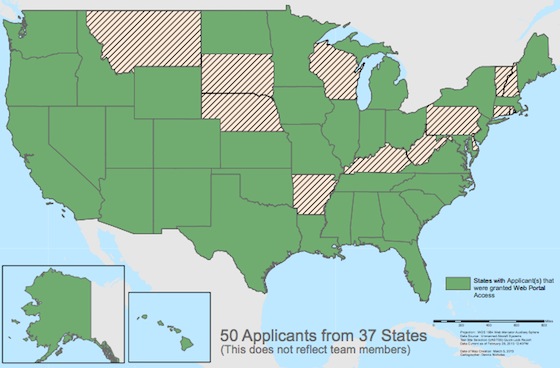
FAA map showing all the states where agencies have applied to be one of six drone test sites picked by end 2013.

Report on a FAA request for public comment on domestic UAV integration from The Verge:

Citizens sound off at FAA meeting Americans blast drone privacy policy in emotionally charged call for comments

When it comes to allowing drones to fly over US soil, Americans are of two minds: embrace domestic drones for such uses as crop dusting, high wire inspection, search and rescue, and border security, or run screaming and seek shelter from the surveillance state in the sky. Those dueling views were on display yesterday during a "public engagement session" hosted online by the US Federal Aviation Administration to gather input from citizens on the coming swarm.

IT QUICKLY DEVOLVED INTO A MASSIVE VENTING SESSION

The two-hour long livestreamed conference call was open to any member of the US public to participate, providing citizens another opportunity to comment on the agency's newly proposed privacy policy on drones. But it quickly devolved into a massive venting session for and against the FAA's proposed drone privacy policy, and drones themselves. Many callers complained they couldn't even find the draft privacy policy document online.

For the record, the policy is located right here, although it is not readily apparent how to find this link from the FAA's main page. Perhaps the confusion is the agency's use of the moniker "unmanned aerial systems (UAS)," its preferred term for drones, also the one favored by drone industry lobbyists.

"WHAT YOU'RE DOING HERE IS A SHAM."

"What you're doing here is a sham," said a woman from Prescott, Arizona, to the FAA, frustrated about being unable to locate the policy and what she deemed to be poor advance notice of the call. She said that if the FAA were serious about privacy, "you would not have placed tiny brief in our newspaper and devised this circuitous response scheme," later blasting the FAA's refusal to use the term "drone," to describe the aircraft. "A drone is a drone," she said.

Prescott is among the places around the country where local government officials havesubmitted applications to an FAA program to test commercial drones at six locations for a variety of uses, from police and agricultural surveillance to weather monitoring to firefighting. The FAA is aiming to finalize the sites by the end of the year, delaying the process by a year from its original timeline. In total, organizations from 37 states have applied, but the FAA hasn't released a list of all the applicants for the new sites. It has, however, published information online on a few of them thanks to Freedom of Information Act requests.

Another woman from a would-be drone test site near Brookesville, Florida, was concerned about potential drone crashes and surveillance in her "tight community." "Drones have crashed in other countries, and we're right in the middle of a populous area," she said, referring to military drones.

But the call brought out staunch drone proponents of these sites and of commercial drones, too. A self-identified lawyer from St. Louis, Missouri, made the (false) assertion that private drone ownership was protected under the US Constitution for the purposes of "self-defense."

"The right to deploy drones in your surrounds to protect yourself is a Constitutional right," the man said. "It will allow us to eliminate weapons of all other sorts." He also noted he was working on a "business model" for a commercial drone fleet that would fly over urban areas at night and monitor them for lights left on so the energy-inefficient buildings could be identified.

"[DRONES] WILL ALLOW US TO ELIMINATE WEAPONS OF ALL OTHER SORTS."

A representative from the drone lobbying group the Association of Unmanned Vehicle Systems International (AUVSI) touted the economic benefits of drones and said "we do not believe the FAA should govern UAS based on privacy concerns."

The FAA didn't answer any questions and didn't participate much in the call at all, except for a brief opening statement by deputy Transportation Department secretary John Porcari. "This is designed to be a forum to allow the FAA to hear form the public on this approach," Porcari said. After that, the call moderators tried to maintain order by giving each caller three minutes to speak their peace, and asked for them to remain polite. Still, many callers vocally shamed one another and the agency itself.

The reason the FAA found itself in this position is due entirely to Congress. In a bill last year, lawmakers specifically mandated that the FAA figure out a way by 2015 to allow drones to fly safely through US airspace higher than 400 feet above ground, the ceiling for model aircraft. The FAA has granted about 1,000 waivers to local agencies to fly drones underneath this height since 2009, but only about 300 are active today. In order to get drones into US airspace at higher altitudes, the FAA first needs to understand how they will communicate with other aircraft, avoid violating people's privacy, and minimize risk to other piloted aircraft and those on the ground.

"[DRONES] MUST OPERATE IN ACCORDANCE WITH FEDERAL, STATE AND OTHER LAWS" ON PRIVACY

The test sites program is designed to do just that, and the current draft privacy policy is supposed to be part of the FAA's legally binding contract with selected test site operators. But as it stands right right now, the privacy policy reads fairly broadly, with only four major points, including such common sense regulations as that the test sites must "operate in accordance with federal, state and other laws regarding the protection of an individual's right to privacy," and that they must "ensure that there are privacy policies governing all activities," on their site.

"MY CONCERN IS ABOUT SAFETY ISSUES."

Many of the callers questioned whether the FAA should be in charge of making privacy policies in the first place, a duty not spelled out in its official operating responsibilities. Instead, many callers — including many private pilots — said that the FAA should focus mainly on the safety issues posed by having drones of all sizes flying through airspace already crowded by manned aircraft.

As one pilot on the call put it: "my concern is about safety issues. How will they regulate or control safety around airports? We should be getting a flight briefing of any UAV activity in the area." The FAA will have to come up with answers to his and the other myriad questions about drones by the time it announces the first six test sites later this year, well before the swarm hits skies in 2015.
Read more…

DIY Drones at 37,000 Members!

3689513521?profile=original

(April 4th, 2011 - April 4th, 2013)^^^

***Special Announcement***

April is Safety Month on Diydrones.com to check out how you can help (Click Here!)

As is customary and traditional, we celebrate every new 1,000 members here and share the traffic stats. This time it's 37,000!

There were almost 2.1 million page views this month! (we get around 70,000 page views a day on average). It took us just 20 days to get this latest 1,000 members--we're averaging one new member every 30 minutes.

Thanks as always to all the community members who make this growth possible, and especially the moderators who approve membership applications and blog posts and otherwise answer questions and keep things ticking here.

(Over 700,000 Visits to the Site in the last Month) 

3689513753?profile=original

Read more…


In this video, I go over how to trigger a Canon s95 camera through an rc transmitter, without taping a servo on top to push the shutter button. Canon cameras use a firmware hack called CHDK that allows shutter control through the usb port. With a simple switch from Turnigy, we can trigger the camera from the transmitter.

Turnigy switch: http://hobbyking.com/hobbyking/store/__8833__Turnigy_Receiver_Controlled_Switch_.html

Canon CHDK download and info: http://chdk.wikia.com/wiki/CHDK

Read more…

NugePilot: Communication Timing Issue

3689513816?profile=original

Hi,

For the past year I have been engineering my own autopilot shield for the Arduino Mega(and unintentionally the Due). I hope to be finished by the time AVC rolls around, but I have run into an issue. I currently an using 3 separate Arduinos(Mega: autopilot, ArduIMU, and Atmega328: fail safe) and I am having trouble communicating with them efficiently.  Currently I have the Mega just waiting for a start data signal(at the beginning of a steam of data. Ex. "###") from the fail safe or ArduIMU, and then it decodes the data string following the start signal. But sometimes it can take upwards of 130ms per system to receive one string of data(because its waiting for the start signal. not because of excess data). 130ms for ArduIMU and 130ms for Fail safe. This isn't fast enough. The problem is that I am waiting for the two arduinos(Ex. arduIMU and mega) to be in sync but that doesn't happen very often. I have thought about using interrupts, but then I was afraid of interrupting crucial sections of the code. I have looked into MAVlink protocol because, If I understand it correctly, the heartbeat that it sends out is used for synchronization between devices? 

I was hoping someone could point me in a direction that would help me synchronize communications in a way that does not involve a lot of waiting.

Thanks in advance!

Daniel

If you are interested in reading more about the project, I have a blog.(Way out of Date and no pictures yet) 

(Sorry for posting on the main page, I didn't see a suitable place in the forums)

Read more…
3D Robotics

Agricultural drones for weed control

3689513811?profile=original

From Robots.net:

Precision Agriculture is a hot topic these days as researchers look for ways to reduce the massive amounts of chemicals that are currently sprayed on food crops. A new research paper describes one of the ways robots may help in Early Season Site-Specific Weed Management (ESSWM). In the study, a UAV equipped with a multispectral camera collected images of sunflower field infested with naturally occurring weeds. Similar imaging techniques using traditional satellite and aerial methods to adjust herbicide distribution have yielded up to 50% reduction in the total amounts of herbicides used. The researchers hope to replicate this process using the less expensive flying robot. From the paper:

Weeds are distributed in patches within crops and this spatial structure allows mapping infested-uninfested areas and herbicide treatments can be developed according to weed presence. The main objectives of this research were to deploy an UAV equipped with either, RBG or multispectral cameras, and to analyze the technical specifications and configuration of the UAV to generate images at different altitudes with the high spectral resolution required for the detection and location of weed seedlings in a sunflower field for further applications of ESSWM. Due to its flexibility and low flight altitude, the UAV showed ability to take ultra-high spatial resolution imagery and to operate on demand according to the flight mission planned.

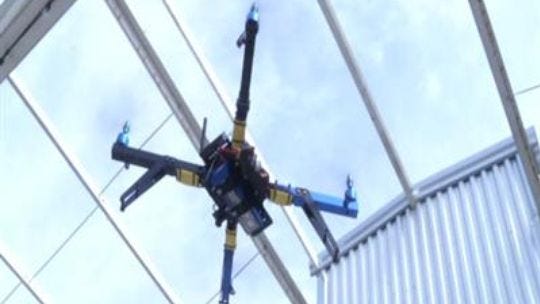
In the experiment, an MD4-1000 VTOL quadcopter from Microdrones GmbH was used (pictured above). The UAV was equipped with GPS, waypoint navigation software, telemetry logging, and two cameras: an Olympus PEN E-PM1 point-and-shoot digital camera and a Tetracam Mini-MCA-6 six-band multispectral camera. The immediate research goal in this project was to figure out what sensors and image processing techniques would work, so further improvements are quite likely. Now all they need to do is find a catchy name for this technology: weedbots? agridrones? herbidroids? For all the details, read the paper "Configuration and Specifications of an Unmanned Aerial Vehicle (UAV) for Early Site Specific Weed Management" by Jorge Torres-Sánchez, Francisca López-Granados, Ana Isabel De Castro, and José Manuel Peña-Barragán. Read on for some photos showing sample imaging data from the UAV and waypoint navigation paths over the test crop.

weedbot4
Ortho-mosaic of the experimental field. Assembled from individual images taken by UAV from altitude of 100 meters

weedbot3
Screen shot of UAV downlink during programmed flight.

weedbot2
UAV waypoint navigation path over experimental field.

weedbot5
Sample images from UAV: a) RGB camera at 30 meters b) RGB camera at 100 meters c) multispectral camera at 30 meters d) multispectral camera at 100 meters.

Read more…
3D Robotics

Optical flow for Sparkfun AVC rover

3689513649?profile=originalGood luck to him. I tried this a couple years ago and found it way too noisy to work. Perhaps he'll find a way.

From Hackaday:

[Tim] is getting his drone ready for SparkFun’s 2013 Autonomous Vehicle Competition on June 8th. He has a pretty good start, but was having some problems accurately measuring travel distance. The technique he chose for the task was to glue magnets onto the axles of the vehicle and monitor them with a hall effect sensor. Those sensors are finicky and a few problems during testing prompted him to look at a redundant system. Right now he’s experimenting with adding an optical mouse sensor to the autonomous vehicle.

Recently we saw the same concept used, but it was meant for tracking movement of a full-sized automobile. If it can work in that application it should be perfect here since the vehicle is much closer to the ground and will be used in ideal conditions (flat pavement with clear weather). [Tim] cracked open an old HP mouse he had lying around. Inside he found an Avago ADNS-5020 sensor. After grabbing the datasheet he discovered that it’s simply an I2C device. Above you can see the Arduino Leonardo he used for the first tests.

[Tim] coded functions to monitor the chip, including some interesting ones like measuring how in-focus the surface below the sensor is. This brings up a question, is there limit on how fast the vehicle can travel before the sensor fails to report back accurately?

Read more…

3689513679?profile=original

I've been working on the Ardustation 2 software since August 2011 and I've finally gotten around to adding a feature that has been asked for more than once: a buzzer warning when the received Mavlink aircraft battery voltage has dropped at or below a set value.  The buzzer is sounded  ( at LCD screen updates - 1 Hz) when the voltage is at or below the set warning value while the "flight data" screen is displayed (see below). 

3689513704?profile=original


Switching to another screen will silence the buzzer until the flight data screen is brought back up. I wanted a way to silence the buzzer if necessary and this mechanism turned out to be the simplest way to implement it - given the need for an interrupt driven buzzer timer. All other features of version 2.0.17 are intact (antenna tracking, parameter update). 


I had a chance to test fly 2.9.1 on my Arducopter over the Easter weekend and this worked pretty well to keep my 4000 mah 3S Lipos from exceeding  the use of 80%  of the batteries capacity. Using a HobbyKing 3S voltage warning was killing the life of my batteries. After 12 flights trying to slowly increase the flight times vs battery remaining capacity, I settled at a  warning at 10.6 volts (my quad's current drawn is about 20 amps at a hover) and that is the default in the software. I have another 2 minutes of flight time to land after the buzzer continously sounds and I'm happy that I'm not puffing my Lipos anymore.  This can be easily changed to other values in the source code before loading into the Ardustation. 


My Ardustation has served me well over the last 2 years and I don't anticipate adding any other features since RAM and screen real estate is very tight. Thanks to everyone who has downloaded the software and provided feature requests and comments and to the code contributors who have worked on Ardustation 2.  

As always, the software is available at this link. Be sure to test this with your aircraft on the ground to verify that you understand the behavior and its limitation. I've only tested the voltage monitor with my quad - although it should work with airplanes also.

Compile this code only with the library contained within the zip file. The libraries provided with APM or ACM source code have changes that will cause compilation errors. This code can be compiled with Arduino 1.0.1 or 1.0.3.

Read more…
3D Robotics

Ionic Thrusters for Drone Propulsion?

3689513599?profile=original

Ionic thrusters use high voltage to ionize air and create an airflow, which in the right configuation can create thrust with no moving parts. I've tried an experiment like the above, and barely generated enough lift to raise a little balsa and aluminum foil off a table, but MIT says they can do far better.

From The Verge:

Stealth drones and other aircraft of the future could be powered by engines that don't have any moving parts, can't be detected by infrared, and are more efficient than what we have today. A new study by MIT researchers demonstrated all of these capacities and more for ionic thrusters and now at least one major aerospace company, Lockheed Martin, has said it's investigating the technology.

"I think UAVs would be the most likely initial application if [ionic thrusters] work," said the lead researcher in the study, MIT aerospace professor Steven Barrett, in an email to The Verge. Ionic thrusters for aircraft work by generating a high-voltage electrical field that strips electrons from air molecules, "ionizing" them and pushing them away behind an aircraft as ionic wind, to move the craft forward. Scientists and hobbyists have been tinkering with small, lightweight model planes using these kinds of propulsion systems since the 1960s. The technology uses no moving parts and is almost completely silent. It hasn't come to full-size planes, though, due to power concerns.

But scientists at MIT's department of aeronautics have built a working prototype (pictured above) that suggests the technology is more feasible than previously assumed, generating far more thrust (110 newtons per kilowatt of power) than a comparable jet engine (2 newtons per kilowatt). "You could imagine all sorts of military or security benefits to having a silent propulsion system with no infrared signature," said Steven Barrett, the lead author of the study published today in the journal Proceedings of the Royal Society. Indeed, Lockheed Martin is already expressing an interest, with an executive telling MIT News "there are still unanswered questions, but because they seem so efficient, it’s definitely worth investigating further."

Barrett told The Verge there are still major hurdles to overcome before aircraft ionic thrusters are able to be commercialized, namely a large enough power supply for their electrical field, and a way to retain efficiency at higher speeds. "At reasonable flight speeds [about 560 miles per hour] the efficiency does decrease, but still looks promising," he wrote in an email. Also, because it uses air molecules, "this kind of propulsion only works in an atmosphere," Barrett said. "It need not be the Earth's atmosphere though – for example, it could be useful in exploration of other planets where fully electric propulsion without moving parts may be beneficial."

Read more…