All Posts (11086)

Sort by
Moderator

Reporting in the media

3689629675?profile=original

So this morning's visit to the BBC website was a little confusing. In the same section as they are reviling "drone" photography they post a link titled "Sky Menace" which links to an article explaining when you can and can't fly drones. I'm not sure the word "Menace" is warranted. Am I being paranoid? :)

Articles for those who are interested

http://www.bbc.co.uk/news/magazine-30387107

http://www.bbc.co.uk/news/technology-30415475 ;

Read more…
3D Robotics

3689629501?profile=original

Bravo, Canada! Read more here:

Think safety first

More and more people are using unmanned aircraft for work or pleasure. Transport Canada regulates their use to keep the public and our airspace safe.

Aircraft without a pilot on board go by many names—unmanned air vehicle (UAV), remotely piloted aircraft system, model aircraft, remote control aircraft, and drone.

Call it what you want, but always think safety first.

Safety guidelines

You are responsible to fly your aircraft safely and legally. In Canada, you must:

  • Follow the rules set out in the Canadian Aviation Regulations.

  • Respect the Criminal Code as well as all municipal, provincial, and territorial laws related to trespassing and privacy

Transport Canada expects you to follow these basic Do’s and Don’ts.

Do

  • Only fly your aircraft during daylight and in good weather (not in clouds or fog).

  • Always keep your aircraft in sight, where you can see it with your own eyes – not only through an on-board camera, monitor or smartphone.

  • Make sure your aircraft is safe for flight before take-off. Ask yourself, for example, are the batteries fully charged? Is it too cold to fly?

  • Know if you need permission to fly and when to apply for a Special Flight Operations Certificate

  • Respect the privacy of others – avoid flying over private property or taking photos or videos without permission.

Don’t fly:

  • Closer than 9 km from any airport, heliport, or aerodrome.

  • Higher than 90 metres from above the ground.

  • Closer than 150 metres from people, animals, buildings, structures, or vehicles.

  • In populated areas or near large groups of people, including sporting events, concerts, festivals, and firework shows.

  • Near moving vehicles, avoid highways, bridges, busy streets or anywhere you could endanger or distract drivers.

  • Within restricted airspace, including near or over military bases, prisons, and forest fires.

  • Anywhere you may interfere with first responders

Use this infographic to help you understand the Dos and Don’ts of flying safely:

Permission and safety requirements

To fly your unmanned aircraft legally, you may need to follow strict safety conditions outlined in an exemption or apply for permission from Transport Canada. It depends on the type of aircraft, its weight, as well as how and where you plan to use it.

If your aircraft:

  • Weighs 35 kg or more, you need to apply for a Special Flight Operations Certificate before you can use it.

  • Weighs less than 35 kg and is used for recreational purposes, you don’t need permission to fly.

Unmanned aircraft that weigh less than 25 kg may qualify for an exemption to the rules, which will allow you to fly without permission. 

If your aircraft: 

  • Weighs 2 kg or less and you can meet the safety conditions in the Transport Canada exemption for UAVs that weigh less than 2 kg or less, you don’t need to request permission to fly.

  • Weighs between 2.1 kg and 25 kg and you can meet the safety conditions in the Transport Canada exemption for UAVs that weigh between 2.1 kg and 25 kg, you don’t need to request permission to fly. However, you must email Transport Canada or by completing the submission form with: 

    1. Your name, address, and phone number
    2. UAV model and serial number
    3. A description of the operation
    4. The geographical boundaries of the operation
Provide your information to Transport Canada by filling out the submission form

If you cannot or choose not to meet the safety conditions in the UAV exemptions, you must apply for a Special Flight Operations Certificate. 

Use this infographic to help you understand the rules and find out if you need permission to fly.

Infographic (PDF)


Frequently Asked Questions

Question 1:

Do the exemptions for small UAVs apply to me?

Answer:

It depends on your type of aircraft, its weight, as well as how and where you plan to use it. Our infographic will help you understand if the exemptions apply to you or if you need permission to fly. 

If you qualify for an exemption, you must meet the safety conditions at all times. For more information, please read the General safety practices for model aircraft and unmanned air vehicle systems.

Question 2:

What training is required to fly a UAV under the exemptions?

Answer:

Each exemption contains different training requirements. For example, to fly a UAV that weighs between 2.1 kg and 25 kg UAV without permission, the operator must be trained to understand:

  • airspace classification and structure

  • weather and notice to airmen (NOTAM) reporting services

  • aeronautical charts and the Canada Flight Supplement

  • relevant sections of the Canadian Aviation Regulations.

Question 3:

What is the purpose of a Special Flight Operations Certificate?

Answer:

The Canadian Aviation Regulations require Special Flight Operations Certificates so that Transport Canada can verify that operators can use their UAV reliably and safely.

The Special Flight Operations Certificate contains conditions specific to the proposed use, such as maximum altitudes, minimum distances from people and property, operating areas, and coordination requirements with air traffic services.

Question 4:

How do I apply for a Special Flight Operations Certificate?

Answer:

You must email a detailed application to the nearest Transport Canada regional office. Your application must include your contact information and describe how, when and where you plan to use your UAV, as well as how you plan to deal with the safety risks. 

You can find detailed information on what you need to include in your application athttps://www.tc.gc.ca/eng/civilaviation/opssvs/managementservices-referencecentre-documents-600-623-001-972.htm.

If you have any questions about applying for a Special Flight Operations Certificate, please contact your regional Transport Canada office or services@tc.gc.ca.

Question 5:

How long does it take to get a Special Flight Operations Certificate?

Answer:

Transport Canada processes applications on a first-come-first-served basis, and aims to process them within 20 working days. This means:

  • It may take longer if we must contact you for more information or have received a large number of applications.

  • You should apply at least 20 working days before you intend to use your UAV.

Question 6:

How long is a Special Flight Operations Certificate valid?

Answer:

A Special Flight Operations Certificate is valid for a limited period of time.

If you have a proven track record of operating your UAV safely, Transport Canada may:

  • Approve longer-term validity periods

  • Approve larger geographic areas

  • Grant new applications more quickly

Question 7:

How does Transport Canada enforce the regulations?

Answer:

Transport Canada regulates the use of all aircraft, manned and unmanned, to keep the public and our airspace safe.

If the department receives a report of an incident, one of our inspectors will verify that the operator followed the rules and used the aircraft safely. Local police may also verify if other laws were broken, including the Criminal Code and privacy laws.

For example:

  • If an operator is flying for recreational purposes, it’s illegal to fly an aircraft in a way that puts aviation safety at risk. The courts would decide on the penalty.

  • If an operator doesn’t meet a condition in one of the exemptions, they will no longer qualify to fly without permission and must apply for a Special Flight Operations Certificate.

  • If an operator is flying an aircraft without a Special Flight Operations Certificate, and should have one, Transport Canada can issue fines up to $5,000 for an individual and up to $25,000 for a corporation.

  • If an operator does not follow the requirements of their Special Flight Operations Certificate, Transport Canada can issue fines of up to $3,000 for an individual and up to $15,000 for a corporation.

Question 8:

Does Transport Canada plan to review the current regulations for UAVs?

Answer:

Yes. Transport Canada introduced new exemptions for small UAVS in November 2014. The department continues to work with stakeholders and international partners to review and update safety regulations that will address developments in this growing sector and advancements in technology. Our goal is always to maintain the safety of those on the ground and in the sky.

Question 9:

What laws apply to unmanned aircraft?

Answer:

In aviation, you must always think safety first. In addition to respecting the Canadian Aviation Regulations, you must follow the rules in all acts and regulations—including the Criminal Code as well as all municipal, provincial, and territorial laws regarding issues such as trespassing and privacy.

If you think someone has committed a criminal offense, please contact your local police department.   

If you are concerned about the safe operation of an aircraft, you can report it to Transport Canada at services@tc.gc.ca.

Question 10:

Why are there so many different terms for unmanned aircraft?

Answer:

You may know them as “drones”, but the aviation community uses many different terms. The words to describe unmanned aircraft are changing almost as quickly as the technology itself.

In Canada, our laws use two terms:

  • Model aircraft describes those usually used by hobbyists for recreational purposes.

  • Unmanned air vehicle, or UAV, generally refers to more complex operations used for commercial purposes.

Other countries use the term “remotely piloted aircraft system”, or RPAS. The International Civil Aviation Organization uses this term as a catch-all for all unmanned aircraft.

Call your aircraft what you like—but Transport Canada expects you to operate it safely and legally!

Question 11:

How many Special Flight Operations Certificates has Transport Canada issued?

Answer:

Transport Canada issues more Special Flight Operations Certificates each year, as UAVs grow in popularity. Between 2010 and 2013, we issued 1,527 approvals for UAV operations.

Read more…
3D Robotics

3689629467?profile=originalFrom Hackaday:

Just a few years ago, palm sized radio controlled toys were nothing more than a dream. Today, you can find them at every mall, toy store, and hobby shop. [Alvaro] couldn’t resist the tiny Estes Proto X quadcopter. While he enjoyed flying the Proto X, he found that the tiny controller left quite a bit to be desired. Not a problem for [Alvaro], as he embarked on a project to reverse engineer the little quad.

Inside the quadcopter and its lilliputian radio, [Alvaro] found a STM8 based processor and an Amiccom A7105 2.4G FSK/GFSK Transceiver radio. The A7105 is well documented, with datasheets easily obtained on the internet.  The interface between the processor and the radio chip was the perfect place to start a reverse engineering effort.

With the help of his Saleae logic analyzer, [Alvaro] was able to capture SPI data from both the quadcopter and the transmitter as the two negotiated a connection. The resulting hex files weren’t very useful, so [Alvaro] wrote a couple of Python scripts to decode the data. By operating each control during his captures, [Alvaro] was able to reverse engineer the Proto X’s control protocol. He tested this by removing the microcontroller from the remote control unit and wiring the A7105 to a STM32F4 dev board. Connecting the STM32 to his computer via USB, [Alvaro] was able to command the quad to take off. It wasn’t a very graceful flight, but it did prove that his grafted control system worked. With basic controls covered, [Alvaro] knocked up a quick user interface on his computer. He’s now able to fly the quadcopter around using keyboard and mouse. Not only did this prove the control system worked, it also showed how hard it is to fly a real aircraft (even a tiny model) with FPS controls.

The Estes Proto X is actually manufactured by Hubsan, a China based manufacturer best known for the x4 series of mini quadcopters. Since the Proto X and the x4 share the same communication protocol, [Alvaro’s] work can be applied to both. With fully computer controlled quads available for under $30 USD, we’re only a few cameras (and a heck of a lot of coding) away from cooperative drone swarms akin to those found in the University of Pennsylvania GRASP Lab.

Read more…

HobbyKing ESC (and similar) calibration

3689629546?profile=original

I switched from a Multiwii based board to Arducopter and ESCs were working fine.  After months of tweeking and upgrades to my quad, motors seemed to go crazy.

I applied the methods (automatic and manual) documented by the Arducopter manual but neither worked.

The solution was found by applying the calibration documented here for ESC like Hobby King 20A ESC 3A UBEC and similars. To avoid a huge waste of time and patience all (4 in my case) ESCs were calibrated manually by cabling together their signal and sending it to the rc receiver (3rd column of pins top pin, i.e. throttle). From one ESC Vcc and GND cables also went to the rc receiver (following pins on 3rd column).

Make sure throttle stick on your radio transmitter is at its maximum (this ensures you enter in ESC calibration mode) and give power to your system.

Each ESC (more or less synchronized) will start emetting a sequence of bips and blurps according to the menu you can find on the link above. This (partial) picture gives you an idea:3689629386?profile=original

You may select on option (and thus set it) by bringing your throttle stick down while the sound sequence corresponding to what you need to set is playing. For a start, bring all ESCs to factory default (option/music 8) and afterwards select the options you want.

This may get very annoying if you need to set lots of options but you have the great advantage of calibrating the ESCs the exact way you want to. Also, by cabling the ESCs as mentioned above you need to do it once and for all.

I hope this will help someone out there. Rob

Read more…

SSH in DroidPlanner

3689629507?profile=original

Hi all!

I want to announce that ErleRobotics have integrated SSH in DroidPlanner. We are working with the BeagleBone+PXF we find this feature really interesting because we can launch, kill or do whatever we want with the autopilot directly in the core.

If you want to know more about this you can visit the following URL [1].

Thanks your time!

[1] http://erlerobotics.com/blog/ssh-connection-droidplanner/

Read more…

Holy subprime seasons.  While it was always possible for an entire neighborhood to synchronize its lights, it wasn't possible to actually see it until last year.  It's really a sight that cost a fortune until the rise of the quad, higher sensitivity cameras, & then the brushless gimbal.  Of course, flying a quad that high above a neighborhood is a very nerve wracking experience for someone who's done it long enough to experience a few crashes. It almost makes our taxes to support the house flipping industry seem worth it.  Now if only batteries lasted long enough to make timelapses.

Read more…

We received one of a few Sky Observer samples ZETA Science had available for testing a couple of weeks ago for evaluation before they go into production, assembled it and took it for a test flight.

3689629361?profile=original

The RTF model is very near completion with all electronics and cabling cleanly and accurately pre-installed. Apart from installing your own gear (cameras, receiver, LiPos, autopilot, etc.) only a few simple assembly steps need to be performed which include: freeing the pod door for access to the payload area, gluing the rudder/elevator in place, gluing the wing central wing joiner down.

Overall this looks like a very very well thought out and product with a high quality finish and has loads of room in the pod for all your UAV gear.

Specifications
Material: EPO foam 
Length: 78.71in (2000)mm 
Wingspan: 59.51in(1511)mm 
Flight weight (AUW): 2500-3000g

Radio: 2.4G 7ch TX /7ch RX 
Battery: Li-Po/ 3S 11.1V/5200-10000mAh/20C 
Balance Charger: 2-4S 
Propeller: 12*6 prop 
Motor: Out-runner brushless 4250 KV950 
ESC: Brushless 60A ESC 
Servos: (4pcs 9g + 4pcs 12g metal) 
- 12g Analog metal servo*2pcs (Aileron) 
- 12g Analog metal servo*1pcs (Elevator) 
- 9g Analog servo*1pcs (Pod’s door) 
- 9g Analog servo*1pcs (Rudder) 
- 9g Analog servo*2pcs (Flap) 
- 12g Digital metal servo*1pcs (Vertical landing/forced landing)

Here's a video of our first (manual only) flights on a cold foggy day. We'll follow up with some autonomous flights once we get a Pixhawk in there and hopefully with some better weather.

Some of the issues uncovered during the build and test flights have gone back to the manufacturer and will be corrected.

Read more…
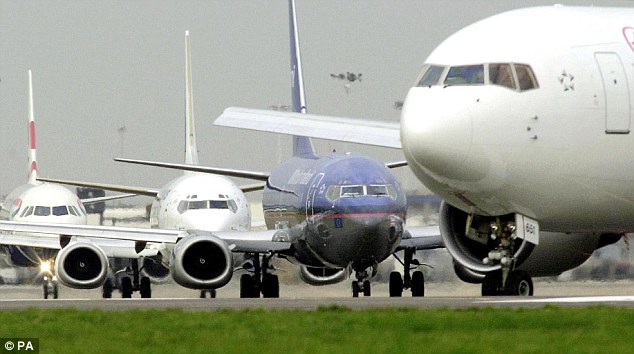
Close call: A passenger plane had a near miss with a drone as it landed at Heathrow on July 22, in the first such incident recorded at Britain’s biggest airport. Above, planes queue to take off at the airport

Close call: A passenger plane had a near miss with a drone as it landed at Heathrow on July 22, in the first such incident recorded at Britain’s biggest airport. Above, planes queue to take off at the airport

He reported the sighting and an inquiry was launched by the UK Airprox Board, which investigates all reported near-misses. Investigators, however, were unable to identify it.

It comes amid concern over the threat to aircraft from domestic drones flown by amateurs.

In May the pilot of a 74-seat ATR 72 reported a quadcopter drone within 80ft of his aircraft at about 1,500ft as he was approaching Southend Airport.

The official report into the incident at Heathrow is due to be published on Friday, but Ukab has initially recorded the incident rating as A – the highest of its five categories – in which serious risk of collision has existed.

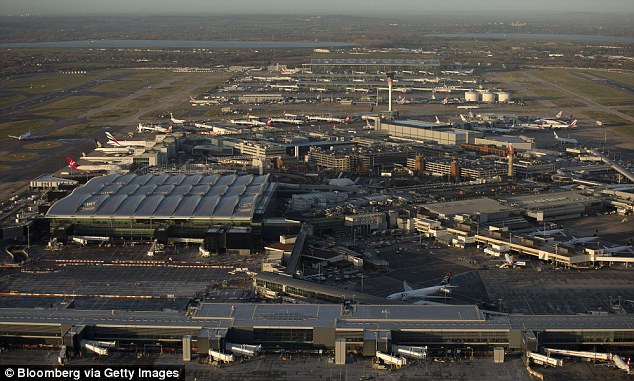
Airport: The official report into the incident at London Heathrow (pictured) is due to be published on Friday, but the UK Airprox Board has initially recorded the incident rating as A – the highest of its five categories

Airport: The official report into the incident at London Heathrow (pictured) is due to be published on Friday, but the UK Airprox Board has initially recorded the incident rating as A – the highest of its five categories

The revelation comes as it was revealed there was concern over domestic drones flown by amateurs threatening aircraft - especially as they are given as Christmas presents.

Drones cost from just £35 to £3,350 - and sales have jumped from the normal level of around 2,000 a month thanks to extra demand ahead of December 25, according to The Sunday Times.

Electronics retailer Maplin said drones were one of its biggest current sellers, while hundreds of different drones made by at least 15 manufacturers can be purchased from Amazon.

Last month, a conference on unmanned aerial systems in London heard that police were worried about injuries and other problems on Boxing Day when amateur ‘pilots’ try out their new drones.

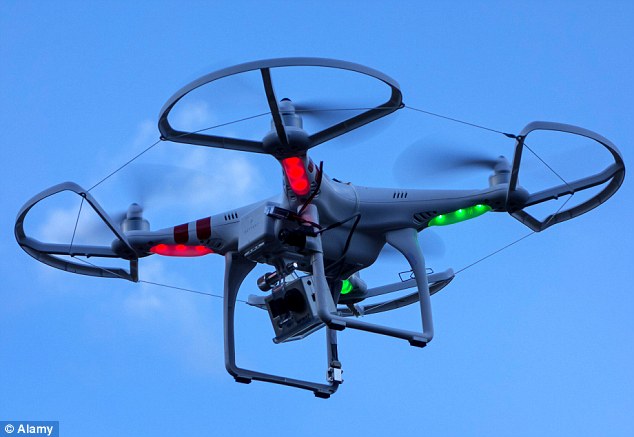
Drones (file pictured) cost from £35 to £3,350 - and sales have jumped from the normal level of around 2,000 a month thanks to extra pre-Christmas demand. It is unknown what type of drone was involved in the incident

Drones (file pictured) cost from £35 to £3,350 - and sales have jumped from the normal level of around 2,000 a month thanks to extra pre-Christmas demand. It is unknown what type of drone was involved in the incident

The Airbus A320 is commonly used by European airlines. Earlier this year airline pilots' association Balpa demanded better protection for the public against the risks of drones.

It wants drones, officially known as Remotely Piloted Aircraft Systems (Rpas), which share airspace with passenger and freight airliners, to meet the same safety standards as piloted aircraft.

It includes only being flown by operators with pilot-equivalent training.

Balpa general secretary Jim McAuslan said: ‘The UK should become a "safe drone zone" so we can make the most of the major business and leisure opportunities offered by remotely piloted aircraft, while protecting passengers, pilots and residents.

German army drone in collision scare with airliner (related)
video-undefined-1A1FDF8B000005DC-930_290x163.jpg

‘The technology is developing quickly and we could see remote aircraft the same size as a Boeing 737 being operated commercially in our skies within ten years.’

Research carried out by intelligence experts for the University of Birmingham Policy Commission Report published in October warned of the misuse of drones.

The commission called for ‘urgent’ measures to safeguard British airspace to cope with civil and commercial use, which is expected to be more widespread by 2035.

The report said the ‘hazards presented by inadvertent or accidental misuse of Rpas, or the consequences of their malfunctioning are becoming better understood’.

It added that small commercial aircraft, including for taking photographs, are already ‘clearly being flown’ and often in breach of the rules, the commission found.


Read more…
MR60

3689629267?profile=original

This is a continuation of my previous blog "how-to-write-set-a-pixhawk-parameter-using-the-mavlink-protocol"; where I fixed myself a little technical challenge to create an Excel sheet to set the failsafe parameters of my arducopters (Pixhawk fc).

As explained in the previous blog, on the Excel sheet I'd like to see a list of all of the failsafe parameters of my multirotor AND be able to change their values (by clicking on a write button on this Excel checklist). Indeed none of the available GCS software is practical to do just that : you have to click and navigate through dozens of screens to get to all of these parameters... Therefore I decided to try to build this in a typical DIY way.... It would also be a good Mavlink learning experience.

The first blog was an attempt, not being a developer at all (not even knowing what a python class meant) to understand how mavlink works and its various APIs/Libraries/Modules (Mavproxy, DronApi, PyMavlink, etc...).

This blog shows how the objective was reached succesfully (with a nerdgasm, I must admit).

The solution is an automated flow triggered by the big "Write to Pixhawk" button in the Excel sheet, after you have selected parameters's settings in drop down lists and set values in corresponding cells.

Better than words, a schematic below show what the processing flow does:

3689629098?profile=originalIn order for this Excel application to work, there are three pre-requisites:

-Install win Python

-Install MavProvy

-Unzip MavExcel.zip  in the directory where you have installed win Python (example : in my case that is : G:\APM\WinPython-64bit-2.7.6.4)

The last thing to do, is to indicate in the Excel file, where are your win python install directories and on which com port your telemetry mavlink is connected. That's it !

Cheers,

Hugues

Read more…
100KM

Techwing low and slow

To show just how stable the techwing is while flying slow, I made the following video.

Specs:

WS: 43 inches

all up weight:37 oz

motor: 370 watt 1100 kv

prop: 9*7

battery: 5000 mah 3s lipo

battery weight:14.8 oz

flight duration: 20  minutes

ma used: 1007

As you can see the techwing handles extremely well while flying slow, even with enough battery for a 1.4 hour flight. I am making a limited amount of techwing RTF alfa aircraft available to interested parties. I am putting 6 up for sale on my store at hobbyuav for $350 each. it includes a fully assemble techwing airframe with motor,ESC and servos fully installed. I hope to have the project ready for kickstarter after the first of the year.

Thank you for your support.

Read more…

Beast TX - The ultimate UAV Controller

First Previev of BeastTX - The ultimate UAV Controller

beasttx_preview_small.jpg?width=750http://www.luftfotos24.de/en/products/beast-tx

Features of the BeastTX:

  • 2x ARM Dual Core Processor
    • Main CPU 1 GHz/ 512MB RAM
    • Slave CPU 700 MHz/ 512MB RAM
  • Debian Linux
  • Open Source Linux for own applications
  • Standard PC desktop
  • integrated 2,4 GHz RC
  • 3 potentiometers, 6 switches
  • compatible to most systems like: Jeti, Graupner, Futaba, FRSky etc.
  • 5,8 GHz analogue video receiver
  • HD video receiver
  • GPS
  • Differential GPS via datalink
  • long lasting battery 23,8 Ah 7,4V
  • capacitive 7"-touchscreen
  • 500 cd/m2 brightness
  • USB/ WLAN/ Bluetooth/ UMTS
  • Datalink to UAV (XBEE/ Wi232/ High Performance WLAN)
  • Speech dispatcher
  • Motionsensor MPU9150
  • Barometer MS5611
  • Realtime-clock
  • integrated network switch for internal devices
  • Router with WLAN
  • sensing of battery voltage, consumption and temperature
  • Battery heater for the cold days of the year
  • No separate display for RC necessary
  • Functions available via GUI
  • Connector to flight simulator, trainer and video
  • Belt holder
  • Compatible to all common autopilots (Beast UAVs, APM, Pixhawk, Multiwii, Paparazzi)


The Groundstation BeastTX will be released in the 4th quarter of 2014.

Read more…

3DR IRIS+ Beginners Guide (Part 1 of 3)

With the IRIS+ quickly becoming the most popular quadcopter in the $1,000 and under price range, we're starting to see that a lot of new IRIS customers don't have the basic knowledge to operate this advanced technology.  We have created a 3 part video series to cover everything from the basics of unboxing and assembly to advanced features and autonomous flight.  This is part 1 in the series-

Read more…

3689629082?profile=original

I have worked hard in my sparse time to improve OpenFPV. I got a lot of mails from interested people around the world and can't wait to share the latest results with you. Your support is amazing, and my goal is to bring this project alive as soon as I can. Special thanks for all who donated a few bucks to the Project, every dollar helps me a lot.


A quick overview from the last month:

  • MinIMU-9 v2 Gyro, Accelerometer, and Compass test integration
  • Further latency optimisation
  • 160° Wide Angle Fish Eye Camera
  • 5 GHz transmission tests
  • Oculus Rift DK2 Support (experimental)
  • 720p at 40 FPS Tests
  • Source code re-structure
  • Optimised video rendering

Pro:

  • The gyro integration works pretty good so far
  • Telemetry overlay works well with the gyro
  • The gyro data transmission works even if the video feed is broken (separated data channels)
  • The latency is is now stable over hours and pretty promising
  • The wide-angle camera does the job pretty good, nothing else to say
  • The new 5 GHz (diversity) adapter gave me really good results and is affordable (20 € each)
  • The Oculus Rift was mind blowing - The image is that big that I'm not able to describe
  • The source code is now better structured and modularised
  • 720p (1280x720) works good on the ground, not tested in the air

Con:

  • The CPU Load is to high on the ground station (20% / 400%, 640x480 H264, 2.3 GHz I7, MacOS)
  • No hardware decoding for the video stream
  • No Telemetry data for the oculus at the moment
  • No Fragment shader for Oculus Rift distortion
  • Bad weather in Germany

The Roadmap for 2015:

3689629175?profile=original

  1. Between January and February I will release a first access to the project. This version should be stable enough for testing.
  2. Between May and June I will release a updated version with improvements from the community
  3. I target August 2015 as a first "release*".

* what means release:

  • Easy to install
  • Documentation
  • Download a Ready To Fly image for the raspberry
  • Maybe sell a complete setup online (amazon)

(Please note that all dates are in subject to change, depending on issues, bugs, time)

Some pictures from the lab:

3689629217?profile=original

Me holding a prototype with 5Ghz diversity, 160° fish eye camera. I can even write messages on my phone trough the oculus live feed with this setup. Can't show you how it looks like, but all who tested it in my lab are amazed.

3689629189?profile=original

Screenshot from the oculus mode. *Note the missing fragment shader for the rift distortion, this is not 3D (but possible in the future, you will see a huge 2D screen in front of you)

3689629239?profile=original

The prototype with attached 5Ghz adapter watching birds.

I have no in flight footage yet, the main reason is the bad weather here. But I will do some recordings, pictures if the weather is a bit better and I have enough time and a working drone / plane*, you have my word.

* My last plane crashed and destroyed one OpenFPV Setup while testing

TL;DR;

- First release for developers between January and February 2015

- First "consumer" release summer 2015 (maybe later)

If you have any questions, please leave a comment below or write me: contact@openfpv.org

Regards,

Tilman

Read more…
Moderator

Dear Friends, 

this is the first render of new Virtualrobotix enclosure design. Do you like it ? Suggestions about new design are welcome :)

3689628883?profile=original

3689628969?profile=original

3689629044?profile=original

3689629056?profile=original

3689628994?profile=original

The enclosure will be available on virtualrobotix shapeways shop until the molded version not be available . 

Here are available more info about the new products :

VR micro Brain 5 : http://www.virtualrobotix.it/index.php/en/shop/autopilot/vrbrainmic...

VR GPS 8 : http://www.virtualrobotix.it/index.php/en/shop/accessories/gps-ublo...

About VR Brain 5.2  http://www.virtualrobotix.it/index.php/en/shop/autopilot/vrbrain5-d...

Best

Roberto 

Read more…
3D Robotics

3689628723?profile=originalFrom the Washington Post:

Countless people tuned in to watch America’s next manned spacecraft return to Earth — live, in real-time, over the Internet! — and from an incredible bird’s-eye angle.

All of that was made possible by NASA’s Predator drone. Yes, since 2006 NASA has had its own unmanned aircraft, modified to do things like monitor wildfires and take measurements of the atmosphere. It doesn’t shoot Hellfire missiles, but the drone, named “Ikhana,” can fly as high as an airliner at cruising altitude and can carry more than 2,400 pounds of science gear on its wings and in its internal bay.

Ikhana — which in Choctaw — means “intelligent, conscious or aware,” according to NASA, is the same MQ-9 unmanned aerial vehicle that the U.S. military uses. NASA helped fund the development of the Predator-B, as it’s also known, in hopes that it could be used for research. According to the space agency, Ikhana has a wingspan of 66 feet and measures 36 feet in length. And it’s equipped with ADS-B, a next-generation aircraft tracking technology that you may remember from our coverage of the missing Malaysian Airlines flight.

NASA dispatched Ikhana this week to watch as the Orion spacecraft descended from orbit. Everything in the mission proceeded smoothly — including the drone footage stream. Ikhana offers a taste of what’s possible with unmanned aircraft in the commercial sector, although with the Federal Aviation Administration still dragging its feet on crucial regulations; drone industry officials aren’t optimistic about being able to fly their own missions anytime soon.

Read more…

3689628578?profile=originalIn working with autopilot systems like OpenPilot and Pixhawk I have frequently come across references to something called an Extended Kalman Filter (EKF). Googling this term led me to several different web pages and reference papers, most of which I found too difficult to follow. So I decided to create my own tutorial for teaching and learning about the EKF from first principles. This tutorial assumes only high-school-level math and introduces concepts from more advanced areas like linear algebra as needed, rather than assuming you already know them.

The tutorial is currently about 2/3 complete.  I still need to introduce linear algebra concepts for sensor fusion, and then nonlinearity for the EKF.  But in the open-source spirit of "release early, release often", I'm posting this now, in the hope that people will try it out and provide comments.  

Read more…

New materials to build moulded planes

P1030700.JPG

Hello ensemble,

It is sometime now I'm developing planes, mostly gliders, to suit my personal taste.

Out of curiosity I started to use some new materials to learn something new.

As a first attempt I did build two fuselages for a plank, called Trisel.

Those are respectively prototypes #5 and #6.

The first fuselage is done in Flax fabric (Eco_Trisel), two 220g/m² layers and a third one on the nose.

The result is a very stiff, hard and heavy fuselage, probably well suited for slope and hard use.

The material is thick and resin hungry, 1.5-2 times the amount needed for fiberglass.

I leaved the surface natural for show purpose, but a layer of transparent gelcoat revealed to be mandatory. The fabric is so hungry that it seems always dry and there are several pinholes.

P1030699.JPGP1030698.JPG

The second fuselage is done in basalt fabric (therefore the name: Volcanic_Trisel).

It is composed from a 110g/m² plain, 220g/m² twill and a third layer of 220g/m² on a 45° bias.

This one is very thin instead, the lighter of all six prototypes, stiff enough. Not comparable to Flax, but almost as fiberglass or even better, considering it is really thin and light.

This fabric wets very well and epoxy usage was about 2/3 of a fiberglass one and 1/3 of the Flax one.

Weight is 100g, vs. 120-130g of fiberglass and 160 (!) of Flax.

Next step could be using vegetal based epoxy =;D

P1030702.JPGP1030701.JPGP1030703.JPGBest regards,

Ric

Read more…
100KM

https://www.youtube.com/watch?v=_IroP01fY6o

Aljazeera has just broadcast a documentary : Conservation Drones Tackling deforestation and protecting orangutans with drones in Indonesia. in their Earthrise series. 

The documentary was produced by Banyak Film, an award winning documentary and film production company lead by two very talented young man. conservationdrones was invited by a local NGO to fly some mapping mission and deliver a new UAV system aka conservationdrones to them. We successfully accomplished the mission while Banyak Film took lot of great video footage during the mission. The drone has been flying lots of mission ever since and we was told it is still in flying condition right now. 

We hope you enjoy the documentary and feel free to share the original video. The above video is an edited version which focus on UAV and much shorter video clip so more bandwidth friendly. 

Read more…