All Posts (11086)

Sort by

Can you spell 2000mw at 5.8 Ghz!!!!!

3689549394?profile=original


Frequencies: 8 channels from 5.645 to 5.945 GHz
Channels: CH1 5705 CH2 5685 CH3 5665 CH4 5645 CH5 5885 CH6 5905 CH7 5925 CH8 5945
Power: 2000mW (33dB +-1dB) of certified output power
Input Voltage: 7-24V DC, 2-6 cells battery
Cooling System: whole body heat sink and cooling fan
Channel Switching: channel button and channel display
Antenna: RP-SMA female 50 ohm connector
Size: 62mm x 42mm x 20mm
Weight: 37g


Here is the product

Read more…
Developer

Advances in airspeed handling

3689549422?profile=originalWith the release of the 2.74 version of APM:Plane and the introduction of TECS, the ability of APM to take full advantage of an airspeed sensor for fixed wing aircraft was greatly enhanced. A lot more people are now buying and installing airspeed sensors. APM has had support for airspeed sensors for a long time, but tuning for good airspeed control was somewhat difficult and error prone. Now it is much easier.

The next APM:Plane release will be 2.75, and will come out soon. In that release airspeed sensing will be improved even more, with three key changes.

New Digital Airspeed Sensor

The first change is to add support for a new digital airspeed sensor from Measurement Specialities, the MS4525DO. The PX4 dev team announced this sensor recently, and I've been test flying it to ensure it works well with APM. It does! This new sensor is a huge advance over the analog sensors we've been using up to now.

The key difference is how low the thermal drift is in the reported differential pressure. A long standing problem with airspeed sensors has been the drift in the reading as the sensor warms up. This doesn't matter very much if you only need accurate airspeed readings at high speed as the contribution of thermal drift to airspeed drops rapidly with speed (as airspeed is proportional to the square root of the measured differential pressure). At lower speeds, such as when landing, it can matter, and having a sensor with low thermal drift is very nice. The I2C based MS4525D0 has internal temperature calibration to cope with thermal drift, which really helps.

The difference can be seen in the following graph

3689549299?profile=originalthe green line in the graph shows the airspeed from an analog sensor, and the red line shows the airspeed from a MS4525D0 digital sensor. The readings were taken on two Pixhawk boards side by side, started at the same time. You can see that the analog sensor drifted quite quickly to above 2 m/s average, whereas the digital sensor settled at around 0.5 m/s.

Right now we only have a driver for the MS4525D0 on the PX4 and Pixhawk. It would be possible to write a driver for the APM2, and we'd welcome a contributed driver.

Before we settled on the MS4525D0 we also tried the EagleTree I2C airspeed sensor but we found it suffered from thermal drift just as badly (and in some cases more badly) than the analog sensor. We still have the EagleTree driver in the tree, so if you have an ETS airspeed sensor it will work, but we don't recommend it if you can get the MS4525D0.

Automatic Airspeed Calibration

The 2nd big airspeed change in the 2.75 release will be the introduction of automatic airspeed ratio calibration. The airspeed ratio is the ratio between the calibrated airspeed and the square root of the differential pressure measured by the sensor. This ratio is normally around 2, and is controlled with the ARSPD_RATIO parameter in APM:Plane.As is described in the documentation, it is common that this ratio needs to be calibrated for different airframes. There are several reasons why the ratio may be different from 2.0:

  • positional error, caused by how the sensor is installed in the aircraft
  • sensor error, caused by small leaks or differences in sensor construction
  • pressure altitude differences, caused by changes in airspeed measurement with altitude

For previous releases of APM:Plane users wanting the best possible airspeed measurement needed to calibrate the sensor themselves, by flying the aircraft and looking at the logged airspeed compared to groundspeed. That worked, but it was not convenient.

For the 2.75 release Paul Riseborough has contributed a small 3 state Kalman filter which can automatically calibrate the airspeed ratio while flying. To enable it you need to set ARSPD_AUTOCAL to 1 and then just fly normally. The ARSPD_RATIO is automatically updated while you are flying. The following graph shows it working on my AcroWot:

3689549371?profile=originalI had deliberately set ARSPD_RATIO to 1.2 on takeoff to give the autocalibration code something to do. As you can see, the groundspeed and airspeed don't match at all well while the ratio stays low. After a few minutes of flying the autocalibration has raised the ratio to the right value of 2.0, and the airspeed nicely matches the average groundspeed.

Compensation for pressure altitude

The final major change in airspeed handling for the 2.75 release is the introduction of the EAS2TAS ratio throughout the code. The EAS2TAS is the estimated to true airspeed ratio, and reflects the fact that airspeed measured by an airspeed sensor drops relative to the true airspeed as altitude increases. This change is due to the lower air pressure, which means less air molecules hitting the sensor.

We already had compensation for EAS2TAS in the core navigation code in the 2.74 release, but for 2.75 we have propagated this ratio throughout the code. In particular the ratio is now used to adjust tuning parameters in the servo control loops, adjust the navigation code and even adjust the loiter radius with altitude. The idea is to make APM tuning parameters for an airframe be the same at sea level as it is at the top of a mountain, which will make it easier for users to share parameters, and also be a big advantage for anyone who flies at a wide variety of altitudes.

We have tested this code using the excellent JSBSim flight dynamics simulator, which allowed us to take a simulated aircraft up to altitudes far beyond what we could go to with a real R/C model. The EAS2TAS compensation worked well up to altitudes of around 30km.

Overall the upcoming 2.75 release should be a big improvement for anyone using an airspeed sensor. We hope you enjoy flying it!

Read more…
Developer

Another multicopter crash into a crowd..

3689549404?profile=original

So it happened again, and it will continue to happen until people realize this technology is far from mature enough to be used for such tasks.

Aside from endangering peoples lives, the public opinion created from such incidents will be very damaging and contribute to overly restrictive UAV laws in the future.

Do not fly over people, especially crowds!

Original article with crash video:

http://www.ara.cat/viacatalana/Via-Catalana-Sagrada-Familia-assistents_3_994130598.html

English translation:

http://translate.google.com/translate?sl=auto&tl=en&js=n&prev=_t&hl=en&ie=UTF-8&u=http%3A%2F%2Fwww.ara.cat%2Fviacatalana%2FVia-Catalana-Sagrada-Familia-assistents_0_994100859.html

Read more…
Moderator

Structure Sensor: Capture the World in 3D

http://www.kickstarter.com/projects/occipital/structure-sensor-capture-the-world-in-3d

Came across this Kickstarter project launched today which has already achieved its $100,000 target (within few hours). It seems the sensor is almost like a Kinect sensor. Most important plus points are
- Weight 99g
- Including built-in battery claims to have 3-4 hours of active usage.
- Open source product.
- Works on any device having USB, *not* limited to Apple iPads.
- OpenCV creator Dr. Gary Bradsky is also involved in this project (Board member of Occipital, Inc).

Overall, this seems to be a great product that can be used in an indoor Drone!

Already pledged of course :-).

Read more…

A Drone's View of the Colorado Floods

The recent Colorado floods are giving us a great look at how useful UAVs will be in disaster recovery and photography in the future.

While FEMA may have grounded Falcon UAV's aerial survey mission of the flooding around Boulder and Lyons, causing quite a buzz in the media, that hasn't prevented other local drone pilots and hobbyist FPVers from capturing some amazing aerial footage of the disaster. ABC News ran a report yesterday showing footage from a multicopter flying over

swollen rivers and flooded streets in one town affected by the flooding.

Meanwhile, local hobbyist FPVers have managed to capture some stunning footage of the flooding on the eastern plains in Weld County. The following videos and the video at the top of this post were filmed on Friday, September 13 during the height of the flooding, and are courtesy of YouTube user Neutography.


These videos were captured with a small FPV Slowstick fixed-wing RC plane. The flights to capture the footage were described in this post on RCGroups:

For Our side of the story: we flew on friday the 13th at I-25 / SH66 / 119/ and county road 20 1/2, me i was way nervous perty much the whole time because there was ALOT of air traffic even though more than half were news copters and Sightseer's ( not sayin there's anything wrong with that).
Kept it low and always had spotters as well as a good ears listening/watching out.
The main reason for my video's is that i wanted to see what everything looked like from the air, not selling or promoting sales, I'm sure one of these days FPV copters/planes will come in to there own for search/rescue/damage assesment type operations, kinda dread it at the same time because the "Regulations" usually fallow such things.

Since I live in southeast Denver, I've considered capturing some aerial video of the floods myself, but haven't so far mainly because of lack of time and worry about interfering with rescue aircraft. Still, I'm glad some other local FPVers were able to film this event, and I think it illustrates how useful SUAS will be in the future for filming natural disasters and assisting in relief efforts.

Read more…

3689549276?profile=original


Hello All


Our second episode is going to feature the Swedish design (SFP) team which created the Range Video RVJET Wednesday (17/09/2013) 11AM US Pacific Time.


You can sign into this interview anytime and by adding us (diydronestv@gmail.com)  to your circles in Google plus we can send you an invite for we are going to be streaming live via Google hangouts.

We will be starting the hangouts around 10:30 AM UPT and we will be sending out all the invites by then as well, so please come and join us in this discussion and get to learn about these interesting people and their great designs and technology first hand.


The interview will be on our YouTube channel for you to watch over and over.

3689549347?profile=original


Hope to see you

Christiaan

3689549354?profile=original

Read more…
Distributor

Powerful DIY Ground Station

3689549047?profile=original

Hi guys,

I would like to show a wonderful ground station solution achieved by Roberto Bonfim here in Brazil, he used a dual screen lap top Acer Iconia 6120, it is a dual screen monitor with a third extra video output, in this configuration you can arrange three different screens as shows the images bellow.

It could help a lot when you are developing a new system and would like to monitoring sensors, HUD, Map position or other parameter you need. Any possibilities... 

GREAT JOB ROBERTO!

Guto Santaella

Here showing three different  screen..

3689549069?profile=original

Here is the Acer Iconia 6120...

3689549170?profile=original

Read more…

PVC V-Tail Photos for DocWelch

3689548886?profile=original

Here's what I can do for photos this late in the game. I really should have taken build photos before everything got covered up with electrical tape and zip ties ;) The craft is crude, but I'm really happy with how it flies with modded 2.9.1b firmware. I'm working on 3.0.1, but tonight's weather got in the way of my test flight.

3689548901?profile=original

3689549022?profile=original

3689548940?profile=original

3689548975?profile=original


Read more…

Pixhawk Details #4: Audio adds Safety

This video illustrates a bit better why we believe the safety switch, buzzer and multicolor led help to greatly improve ground and air safety. The video just showcases a few new key safety features and is not a complete reference / mapping, as blink patterns might differ depending on the flight stack running and/or user settings.  Some details:

  • The safety pushbutton indicates safety on with a slow blink pulse and becomes solid when armed
  • The main led shows the breathe pattern if disarmed and becomes solid when armed
  • Arming is only possible after the safety has been disengaged. This is to prevent accidental arming via RC
  • On arming, the buzzer first emits the arming tune, and then the props are slowly spun up to (a configurable) idle speed after a short delay. User tests show that users can disarm fast enough if having accidentally armed.
  • There are two distinct low battery patterns for low and critically low battery. Since the buzzer is driven with 32V, it can be easily heard from a distance, so even when not looking at the GCS and battery voltage, there is now an intuitive warning, in time to land safely.

We believe that this will greatly help to improve situational awareness of the pilot and prevent a range of potential ground and air accidents.

Read more…
100KM

Magnetic encoder and brushless gimbal controller

- from my blog hobbyuav,com.

For the techpod 2.0, I want to have a high precision camera gimbal capable of continuous rotation in two axis. I have always likes the brushless gimbals that are so popular today. The control and drive systems are very nice but are not setup for continuous 360 degree rotation. furthermore the IMU algorithm is very CPU intensive and prone to needing the gyros calibrated frequently etc.

I decided to replace the IMU with a AS5048B  rotary magnetic  encoder for position feedback.  The  AS5048B outputs the 14 bit absolute position of a magnet rotated near the IC. After you include noise, it is good for about 0.06 degrees of accuracy.  Here is a short video of it going from 90.5 degrees to -90.5 degrees every 10 seconds.

Here is a quick hack of the brushless gimbal software.

_BruGi+AS5048

Read more…
3D Robotics

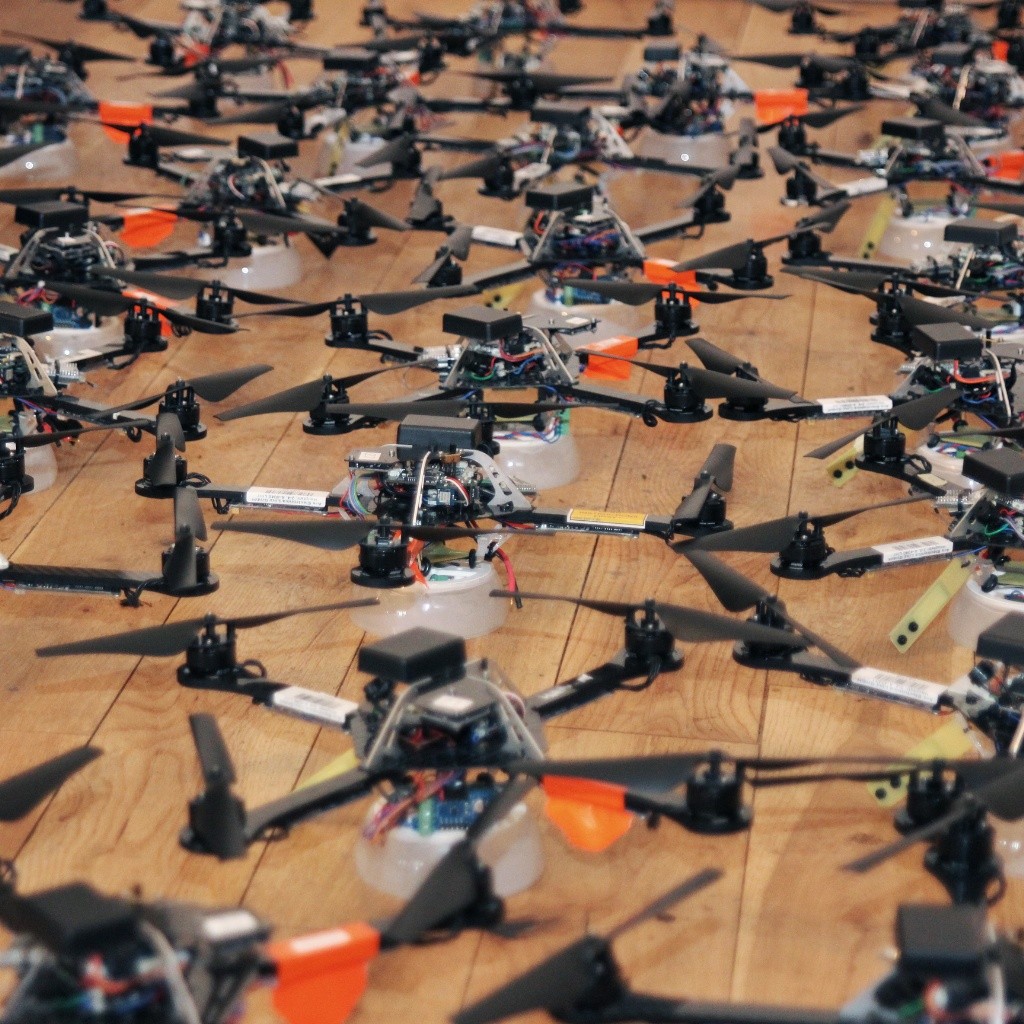
Quadcopter formation makes shapes in the sky

3689548881?profile=originalThat's a kangaroo, formed by formation-flying quadcopters at the Ars Electronica conference in Linz, Austria. (Before you get too excited, these are AscTec Hummingbirds and each one of those "pixels" in the picture cost $5,000). From sUASNews:

Twitter user Eva Shindling @evsccc recently posted a Kangaroo in the sky above Linz, Austria flown as part of the ARS Electronica 2013 festival.

The team from the Ars Electronica Futurelab are doing amazing things with multirotors what will they come up with next!

spaxelsinlondon

The show was carried out by AscTec Hummingbird quadrocopters produced by German manufacturer Ascending Technologies. The small electric helicopters, weigh less than 2kg. They have an on-board GPS module, with which they can autonomously find and hold their position. Software developed by Ars Electronica Futurelab commands formation changes. With their small LED bulbs as payload, the quadrocopters can form dynamically any figures in the night sky.

Read more…

Platypus update - packaging the electronics

3689548579?profile=original

So today I started working on the best layout for platypus, and come across some design problems. Nothing I can't fix in the next prototype though...


Ok, step 1.
PDB, SBEC and ESC's are in. The PDB is a Gryphon Octo, minus the BEC lid (it will fit, but I need to get some smaller risers to get it to fit, so a plain ol' 5.5V SBEC will have to do). The new hobbyking "big amp" PDB will go in here too.

ESC's are hobbyking multistars. And gawd, what a pain in the **** they are...they got the right idea for solderless builds - bullets at both ends - but both ends bullets are completely the wrong size, so need cut off and replaced anyway! I may fling them and throw in some 40A simonK's instead. They'll be lighter for a start, and that becomes important later on....


Anyway, this frame is designed so that the ESC's only really fit in one place. There are pro's and con's to this approach, but in the end, it makes a tider bay. The main disadvantage is the length of the power wires for 2 ESC's (or 4, of you go XY8). Noisy? Maybe...time will tell.

The next prototype has the standard PDB mounts, and the holes are closer to the ESC's, so hopefully keeping the cables sort and equal. One advantage of standard/longer lengths is the ability to twist them, and this frame was designed with that in mind.

3689548706?profile=original


Step 2:

Simple step - put the ESC plate on. This helps secure the ESC's, and their wires, while also providing a platform to add 4 more ESC's (for an XY8). FPV camera mounted as well.

3689548680?profile=original


Step 3:

The biggie. The main electronics desk. Wow, where to start...
- A solid plate of CF here, to help cut down on "noise" from the PDB and ESC's below.

- APM (and so to be pixhawk) mounted slightly to the side. Effects on flight should be minimal

- rx place beside. The concern is that with so much CF around, the signal will be weak. I will be placing the satellite on one of the landing legs in "diversity" mode. I will also be testing the orangerx r800 with two "carbon fiber" (long wire)satellites attached.

- spektrum telemetry tx moved as far away as my cable will allow.

- spektrum alt meter located...well...anywhere frankly. It's "rx". It's mainly the "tx's" you need to worry about.

- GPS/compass located right next to APM, with ideal being that elevation will be easier with the DJI GPS pole. It can certainly go higher than the standard 5cm now, even with the *stupid* 5/6 cable 3DR provide (seriously guys....why??? why not a 5/5 or a 6/6???)

- immersionrc OSD located....poorly, frankly. But there are some reasons to put it here - the main reason being easy access to the buttons.

- fatshark 250mw 5.8 tx located *way* out the back. BUT....I'm going to change that, and place it *underneath* the bottom plate for better signal, in the same way as the 3DR telem radio (see next slide).


With this layout, only 3 cables need disconnected to remove the top plate, and all the electronics can stay in place. This was by design - nothing worse than having to completely disassemble your airframe just to get to the internals...


3689548755?profile=original


Step 4:

Underneath. Ok, not happy with this.

- a 490mAh 3S is running the gimbal and the FPV system, but I'm not happy with this cable running. What a mess. I should really find a way to run the lot from the 6S.

- the 3DR telem is here

- the optiflow and sonar are in place too. Cables route straight up the APM deck in front the battery. (note: next prototype will have fitments for px4flow and - hopefully! - the lightware SF02 (once the dimensions of the bracket are in). These will be on the side though, to ensure battery cable routing is kept clear.

- I propose to add the immersion tx here on the other side; as well as upgrade it to 600mW.

3689548780?profile=original


And that's it! Just need to hook up the motors and maiden it.


Good news: This looks like it'll take 17" if required...and if you can find the motors to turn them! (I'll be running 15", as seen here).

3689548732?profile=original


Bad news: Holy **** it's heavy. Too heavy. With all the FPV stuff onboard, and the 2nd battery circuit, it's coming to 3.5kg. And that's WITHOUT motors. 4 x MT3515 on there and this will weight 4.5kg - 300g over my planned budget, and still 150g over budget if I remove the FPV stuff. (though in that case I would be able to power the gimbal with a 12V bec, saving more weight).


Also, I've noticed a bit of flex nose to aft, if you lift it from the gimbal plate and the rear. Which means I'll need to rethink moving some parts to 1.5mm CF, and even add a strengthening spar!


PS - does anyone know where I can get *good* m2.5 x 37mm screws? Mine are garbage.
Read more…
Developer

LOHAN and Vulture 2 will be using APM2.6

lohan_logo_360.png?width=360

The Registers Special Projects Bureau are going to be using an APM2.6 for Vulture 2 on their Low Orbit Helium Assisted Navigator The project outline is summarized below. (more details here http://www.theregister.co.uk/2013/09/09/vulture_2_autopilot/)


From the Reg's SPB:

As you can imagine, it's all go here at the Special Projects Bureau


Blokes in white vans have been bowling up to the door for the past month, their couriers' chariots disgorging boxes packed with kit, as we prepare for the landing of our Vulture 2 spaceplane.'s mountaintop headquarters ahead of the imminent arrival of the Low Orbit Helium Assisted Navigator (LOHAN) team.

Among the geekgasmic gadgets to emerge from the bubble wrap is our spaceplane's autopilot – the Ardupilot Mega 2.6 – known to its mates as the APM 2.6, and described as "a complete open-source autopilot system and the bestselling technology that won the prestigious 2012 Outback Challenge UAV competition".

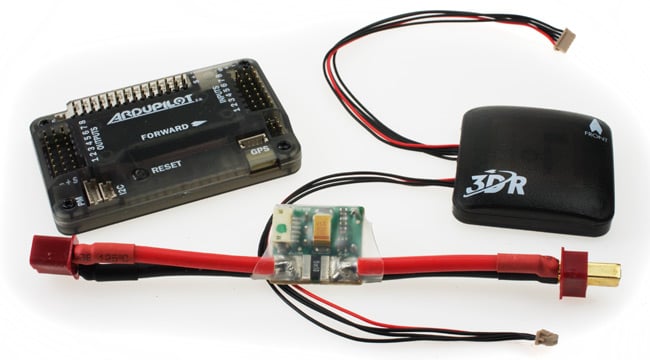
And here it is, complete with the external 3DR GPS uBlox LEA-6 and compass unit, and power module. Sexy stuff:

The Ardupilot Mega 2.6, with GPS unit and power supply

3689548633?profile=original

See http://www.theregister.co.uk/2013/09/09/vulture_2_autopilot/

Read more…

Long Endurance multirotors

This is a compressed little story of an endurance test today with a new hexa multirotor. Some time ago I noticed a post from Ecosynth made here, which attracted my attention. It outlined the use of an octocopter with 30 minutes of flight time for the purposes of ecological analysis and 3D modeling. On the same website I found a concept design that someone specified for a hexa which was cheaper, lighter and offered slightly more endurance. This hexa is almost a 1:1 realization of that design.

The result above shows it easily achieves 30m30s in hover with 168g payload, reducing the battery from full to nominal voltage. Running the battery flat to 3.4V per cell or so I guess I could have taken out some extra 5-9 minutes. The calculations show it should be possible slapping another battery on for 53 minutes total, but in practice I'm noticing the signal going to 3 motors is getting a bit high already, so I'm not sure if there really are power reserves to do that. With 500g payload the duration is reduced by some 6 minutes or so (theoretically).

Next thing to do is see how endurance keeps up when the vehicle is in actual flight. At slow speeds like 5 m/s I don't expect too much reduction in endurance, it may actually improve slightly.

I dove into the subject of multirotor endurance and found some really good information here: http://www.rcgroups.com/forums/showthread.php?t=1880665

There are three main design pillars for multirotors: agility, weight and endurance. Optimizing towards one or two will definitely remove capabilities in the other. The choices for propellers, motors, frame, battery should be made on the basis of this understanding. There's a tool called e-calc , which was instrumental in verifying the design.

The objective of this vehicle is to map areas up to 1km2 for 2D and 3D modeling and perhaps some video surveillance assistance. All the electronics are 3DR, drive system from rctimer.

Read more…
3D Robotics

Interesting news from our friends at Falcon UAV in Colorado:

In the wake of the recent floods in Colorado, Falcon UAV has spent the last three days providing volunteer aerial services to the Boulder County Emergency Operations Center (EOC) and the Incident Management Team (IMT).  On Thursday afternoon while all National Guard aircraft were grounded due to weather Falcon UAV was proud to have been the only aircraft that was able to take flight to support the flood efforts in Lyons.

Friday saw a reprieve in the weather and we are able to get a perfect flight off in the town of Longmont to capture aerial imagery for damage assesment at the intersection of the overflowing St Vrain river and equally inundated Left Hand Creek.   In less than an hour the imagery was processed and provided to the Boulder EOC.  Just as Falcon UAV was off to another damage assessment in Lyons, Colorado we were requested to standdown for National Guard helicopters now supporting evacuation efforts.

Composite Image of Intersection of Flooded St Vrain and Left Hand Creek

Link to Flooded St Vrain and Left Hand Creek Interesection (Google Earth KMZ File) 

Animated GIF from that Google Earth overlay shown below (click to see animation):

3689548556?profile=original

Enter FEMA.......

Early Saturday morning Falcon UAV was heading up to Lyons to complete a damage assessment mapping flight when we received a call from our Boulder EOC point of contact who notified us that FEMA had taken over operations and our request to fly drones was not only denied but more specifically we were told by FEMA that anyone flying drones would be arrested.  Not being one to bow to federal bureaucrats we still went up to Lyons to do a site survey for how we can conduct a mission in the near future to provide an adequate damage assessment to this storm raveged community.  

Where bridge to the south side of Lyons used to be

Road into Lyons, CO

While we were up there we noticed that Civil Air Patrol and private aircraft were authorized to fly over the small town tucked into the base of Rockies.  Unfortunately due to the high terrain around Lyons and large turn radius of manned aircraft they were flying well out of a useful visual range and didn't employ cameras or live video feed to support the recovery effort.  Meanwhile we were grounded on the Lyons high school football field with two Falcons that could have mapped the entire town in less than 30 minutes with another few hours to process the data providing a near real time map of the entire town.

Falcon UAV would like to thank the Boulder County EOC and specifically Allen Bishop and Michael Chard (while they were running operations) for their common sense approach to drone operations, working to coordinate the airspace, as well as embracing this technology to help support the recovery effort.  In contrast we are very disappointed in FEMAs response to actively prevent the use of UAVs and drone technology when these services were offered for free and at a time when manned helicopters could be used for more critical missions such as evacuations and high mountain search and rescues in inaccessible communities.   

To our fellow Colordoans, we understand the recovery efforts are still ongoing and will be followed by a long period of damage assessment.  If we can provide volunteer aerial video, photography, or mapping services to any of the affected communities please contact us directly at 303-903-4571.

Read more…
3D Robotics

Texas law bans some private use of drones

3689548619?profile=original

Despite the positive example a few years ago of a drone used to spot pig's blood polluting a local river, Texas has passed a law banning the use of private drones to collect images of property or people without permission.

From the Albany Democrat-Herald:

More than 40 state legislatures have debated the increasing presence of unmanned aircraft in civilian airspace, with most of the proposals focused on protecting people from overly intrusive surveillance by law enforcement.

But Texas' law, which took effect Sept. 1,  tips the scales in police favor _ giving them broad freedoms to use drones during investigations and allowing them to bypass a required search warrant if they have suspicions of illegal activity _ while also limiting use of small drones by ordinary residents.

"Texas is really the outlier," said Allie Bohm, an advocacy and policy strategist at the American Civil Liberties Union.

The law makes using drones to capture images of people or property without permission punishable by a fine up to $500, while also allowing those improperly photographed or filmed to collect up to $10,000 in civil penalties if they can show that images were collected or distributed with malice.

...

Texas' broad exception allows police or law enforcement contractors to forgo a search warrant if they "have reasonable suspicion or probable cause." Other states only waive warrant requirements in cases of catastrophe or terrorist attack.

Lon Craft, director of legislative affairs for the Texas Municipal Police Association, said it still goes too far, though.

"I'm OK if they want to limit citizens, but don't tie the hands of law enforcement," said Craft, who said he used to employ drones as part of a narcotics task force in Harris County, which includes Houston.

That use is one of more than 40 exceptions in the Texas law. Others permit drone use anywhere within 25 miles of the U.S. border and by everyone from students conducting scholarly research to real estate brokers taking promotional pictures.

...

The law won't affect journalists because covering news doesn't meet the definition of surveillance. And the hobbyist's discovery of pig's blood would fall under exceptions that allow drones to hunt for environmental hazards, he said.

Thanks to Kevin Hester for the find!

Read more…

Latest Build - Carbon Core 950

3689548348?profile=original

Hi everyone!

Greetings from the Denver, Colorado USA area.

Here is my latest build:

Carbon Core 950 X-8, setup currently as a quad.

T-Motor TM3515-15 kv400 (x4)

14x4.7 props (x4)

Turnigy S6 8000mAh battery

ZTW A-Series 50 amp ESC (x4)

3DR APM 2.6

Spektrum DX8

Tarot T-2d gimbal with GoPro Hero 3

Custom APM mounting (rubber o-ring isolation with memory foam (earplug) vibration damping. This was necessary in order to reduce vibrations to an acceptable level. I tried with out the damping, but it was still too sensitive.

I am currently getting 10+ minute flights

Stabilize is tight, and Loiter/Alt hold are rock solid. The only real change I made to the stock configuration was a decrease in rate roll P to .12 from the stock .15 to get rid of a slight oscillation. That was it, no other change. I suppose I could mess with additional tuning params, but to be honest, it flies really well the way it is.

The Compassmot was 11% as it stands (no additional work needed because the frame had a mount for the GPS built-in)

Vibrations in x-y axis are around +-2

Vibration in z are between  -7.5 and -11.5

The kit itself was excellent. It is super light and very strong. I did find it a challenge to fit the ESC inside the frame, but they did fit eventually. 

Based on some of the bench testing, I'm guessing this could lift 10lbs no problem. I'm already interested in adding the additional set of motors/props to see what it is capable of, but no need right now. It already hovers at about 1/3 throttle, so adding more power (and little extra weight) would make this thing quite overpowered. I'm not sure I need to lift the equivalent of a medium sized dog into the air, so I will probably keep this setup for a while.


If anyone has any questions, please feel free to ask!

3689548513?profile=original

3689548538?profile=original


3689548602?profile=original3689548477?profile=original

Read more…

FDM Telescoping Wing UAV

3689548424?profile=original

Finally getting around to posting a project I worked on a year ago at MIT Lincoln Laboratory. We 3D printed (FDM on a Fortus 400mc) a UAV with telescoping wings. Structure was primarily FDM except for a carbon fiber backbone that all the parts were attached to. Designed to be highly modular, the aircraft was essentially 3 reconfigurable pieces: the fuselage pod on the front with the avionics and batteries, the wings, and the empennage. To adjust the CG for different payloads you could move all the parts around until you balanced and had the stability margin you needed. 

We printed the wings without support material and with an internal structure that made them pretty strong. We also decided to incorporate carbon fiber spars into the wings which essentially doubled our strength to weight and it took less than a minute to install. Combining COTS materials with FDM really helped alleviate some of the strength concerns we had.

I've attached a talk that my coworker and I did at the RAPID additive manufacturing conference this year which has some of our lessons learned and more information about our aircraft. Hope there is something helpful in there for anyone interested in doing FDM UAV design! RAPID Presentation

Read more…

Budget Compact Ground Station

3689548099?profile=original

All Items - Packed Up
3689548217?profile=original

All Items - Unpacked

3689548320?profile=original

FPV DVR Ground Station - Open
3689548290?profile=original

FPV DVR Ground Station - Unpacked

3689548362?profile=original

All Items - Assembled

3689548376?profile=original

FPV DVR Ground Station - Internals

3689548398?profile=original

FPV DVR Ground Station - Display

Parts:

Andriod Nexus 7 running AndroPilot (with Travel Case)
Right Angle OTG Cable
433Mhz USB radio
Suction Mount for Nexus 7

Portable 7-inch DVD Player (with headrest mountable carry case)
DIY 5.8Ghz VRX Module (with IR Remote Control)
Hobby King SD DVR (minus case and expansion board)

Futaba FP-T8UAF
FRSky DFT 2.4Ghz Transciever
Turnigy 2650mAh LiPo

Total Cost: Next to Nothing (<$150)+Tablet($250)

This old Portable DVD Player had given up the ghost. So, after repairing (and then realising that i have zero need for a portable DVD player), i took to tearing in apart again.  Removing the unwanted CD carriage, finding suitable AV inputs and a 5VDC line on the board was relatively straight forward. I had even planned to wire in the ADC_KEY_1 and ADC_KEY_2 inputs up the the existing and very conveniently located micro-switches which are no longer required for the DVD player in order to provide UP, DOWN, LEFT, RIGHT, SELECT, MENU, PLAY, RECORD and STOP buttons for the DVR, however found it unnecessary thanks to the fact that the IR receiver for the DVR gives good reception through the small clear window located in the lid to the CD carriage. NOTE - switch on rear left hand corner of FPV unit is wired into alarm trigger circuit of DVR (however, I am yet to find a mode in which this will activate/deactivate recording)

Nice and Small, Easily Portable, Wonderfully Compact, Cost Effective - Couldn't be happier with my little beginners kit.

Read more…