All Posts (11086)

Sort by
3D Robotics

DIY Drones now at 88,000+ members

3689731556?profile=original

It's customary and traditional that we celebrate the addition of every 1,000 new members here and share the traffic stats. We've now passed 88,000 members!

Thanks as always to all the community members who make this growth possible, and especially to the administrators and moderators who approve new members, blog posts and otherwise respond to questions and keep the website running smoothly.

Read more…

First DIY Zoom Gimbal

V1_02.jpg

Interested in a adding optical zooming to your DIY UAV systems? It is now possible to build a field tested zoom gimbal by yourself. Vertigo DIY kit gives you an opportunity to enter the specific fields of drone services such as emergency, surveillance, monitoring, agriculture or computer vision development. 

We prepared 3 buying options: Full kit + .STL’s files, Electronics kit, and .STL files only.

2018-04-04-15.56.54.jpg

This is the best price solution on the market right now, and it will bring you most of the functionality that is brought by professional UAV systems on the market in any drone capable of lifting 398g | 0.87 lbs of payload, and it will work fine in most diy multirotors and some larger airplane frames.

If you have an access to 3D printer you will be able to produce several pieces for yourself, and start some larger scaled missions quite fast. 

Screen-Shot-2015-03-07-at-03.17.12-1024x576.png

We are excited to see what upgrades are introduced in your versions of the gimbal, so please share your builds with us. We hope it will help to develop better solutions in future for all of us in DIY community.

We recorded a full assembly tutorial, so the build should go very smooth. If you need more assistance please feel free to contact us directly (via contact@vertigofpv.com) as well.

First 4 sets sold to diydrones.com users will also include parts already printed for your convenience.  

Hope you will have a great time building your own zoom gimbal. 

More information:

http://vertigofpv.com/index.php/vertigo-27x-v1-3-axis-stabilised-uav-zoom-gimbal-diy-kit/

Cheers!

http://vertigofpv.com

Read more…

Drone power distribution board

3689731777?profile=original

Hello Everyone, Above is a picture of a power distribution board we madeIt can be used with the major part of autopilots like : Pixhawks, APMs, DJI and has holes for Pixhawk2.1 mount.
All the specifications are on the PDB page : http://www.airbot-systems.com/produit/x8-power-distribution-board-180a/

Feel free to contact if you have any question, if you want one or if you want to add it to your web store ;-)
Thanks !
Julien

Read more…

Tips for Building your First Racing Drone

1_spo_grande.png

If you’re one of those guys that love to build stuff with their own hands and just go crazy over DIY kits, you’re going to love this article. If besides all that you’re also a big fan of drones and especially racing models, then you just hit the jackpot because in the following rows you will be able to access free tips on how to build your first racing drone. For those of you that never saw a drone in your life and are interested in joining this very entertaining hobby, there’s no reason to be worried. You will find out that you don’t need any kind of superpower in order to be great at building drones and racing drones as well.

3689731817?profile=original

It All Comes Down to Nuts, Screws and Bolts

You can’t really build anything without being able to properly link its different pieces together. And since a drone needs the perfect mix of flexibility and toughness, using the handy screws, nuts and bolts is the perfect way to go. You will need to make sure that everything is tightened and as a pro-tip, you can use Loctite gel in order to make sure everything stays in place. Due to vibrations and the powerful motors used for racing drones, one of the most frequent issues is the loosening of screws which leads to more powerful vibrations, lack of sensitivity when it comes to steering and an overall worse control over your drone.

Use Light Materials

Sure, it’s not like by giving you this tip you’ll feel like the wheel has been re-invented. And yes, while it’s pretty obvious that using light materials is vital when building a racing drone, not everyone has the capacity to make the distinction between a good quality material or one that doesn’t have the needed characteristic. For years now, and it seems that for quite some time to come, carbon fibre is the toughest and lightest material builders can use to make their drones fast and durable at the same time. When building a racing drone, it is best to use 4mm carbon on the arms of your drone since this is the most vulnerable area in case of an impact. For the rest of the frame, a 2mm thick carbon fibre is more than enough for a fast and sturdy drone.

Possibly the only downside of carbon fibre comes from the fact that it’s quite sharp around the edges and this might lead to the breaking of battery straps or the one you use for attaching the GoPro. You don’t really want to lose an expensive camera such as a GoPro but luckily there’s a way around that. And guess what? You can easily apply it on your drone with the use of some superglue and sandpaper. You need to begin with a light sanding of the edges of the carbon fibre with a medium sandpaper, then apply two layers of superglue – make sure to wait for it to dry after the first application before continuing. After everything is perfectly dry, perform an even lighter sanding again and you will be good to go. It goes without saying that this treatment will not temper in any way with the quality and performance of the carbon fibre.

Always Consult the Manual

Sure, it’s all about DIY and building your own, custom racing drone. However, if you’re not an engineering genius, you should always follow the manual, especially when it comes to circuits, batteries and the motor for your racing drone. That’s where all your power comes from so you won’t want to mix anything up, right? When it comes to power leads, operating gear and basically any other circuit on your drone, you simply can’t apply the trial and error approach. You will destroy certain components and waste a lot of money if you’re not following the manual properly. As a special tip when it comes to connectors and power leads you can use a bit of hot glue to make sure everything stays in place during flight, especially in the middle of a very tight race.

Go for FPV

Now that you’ve been through the main tips that are strictly related to building the drone in such a way that it would be as competitive as possible, it’s time to switch a bit to flying your drone. Sure, pilots that have plenty of experience will be able to ‘feel’ the drone in any condition without a problem, however, if you’re going through your first hours of flying, First Person Video will help a lot. It’s a lot easier to understand the height, speed and overall movement of your drone when using FPV. The flying experience will be complete and will help you learn how to better control your drone even without FPV.

Read more…

3689731836?profile=original

China PFV Drone Racing in Shi Jia Zhuang city, China on 1th ,May.2018

On May 1, "The city's Hot practice" Shijiazhuang unmanned aircraft, crossing machine Racing League Vanke station competition in Vanke Jade Park Kick-off.

Shijiazhuang unmanned aircraft crossing machine Racing League by the Shijiahuang Municipal Sports Bureau, Shijiazhuang City Sports Association guidance, Hebei Horse Sports Technology Co., Ltd. hosted a total of 6 stations this year, Vanke station competition-led station.

In addition to the event to include Shijiazhuang high level o

f unmanned aircraft, but also attracted from Beijing-Tianjin-Hebei more than 160 unmanned aircraft enthusiasts to participate in the elite group and experience group of two groups, including the elite team to use the crossing machine, experience group of players using drones.

During the exciting race, several drones flew in a space that was well fenced, through obstacles, and the operator on the sidelines wearing FPV (first person main view) of the glasses remote control UAV, this novel exciting "play" is known as the "aerial f1" of the Crossing Machine racing competition It is reported that the unmanned aircraft crossing machine Racing competition is a new competition, the contestants are more young people.

3689731908?profile=original

Among them, the crossing machine belongs to one of the unmanned aircraft, the highest flying speed of up to 280 kilometers. In Europe and the United States, a large-scale drone race can bring billions of dollars in income. China launched the drone race in recent years, and the first national drone racing event was held in 2017.

Read more…

3689731277?profile=original

Hi everyone,

I would like to share my experience with Sony RX0 which is a fantastic camera for surveying.

SonyRX0 zero is a small size, a shockproof digital camera with 25 mm wide angle (equivalent to 35mm)

It is only 110 gram with battery. Quality, size, wight make it suitable for surveying applications on drones.

Sony RX0 has a manual mode to set all camera parameters manually to get sharp pictures 

to get sharp quality pictures you should consider to set few parameters correctly:

Shutter speed: to remove blur from photo shutter speed should be set for higher value. 1200–1600 is recommended. Higher the shutter speed reduce image quality.

ISO: lower the ISO higher image quality. ISO between 150–300 is recommended.

Focus: Recommended to set the focus manually on the ground before the flight. Direct camera to an object which is far, and slightly increase the focus, you will see on camera screen that image sharpness changes by changing the value. Set the image sharpness at highest.

White balance: recommended to set to auto.

Comparison with Google Maps

For more information visit Dronee blog

Dronee PLANE fully supports Sony RX0 camera and triggers the camera over onboard wifi.

Cheers,

Tomi

Read more…

3689730932?profile=original

We are happy to announce the introduction of Intelligent Marking's robotic sports field painting robot!

This outstanding technology is now being use in Football fields accross USA and Europe, reducing enormously the efforts to mantain the turf markings with the highest accuracy thanks to a propietary navigation algorithm and having in its heart North's RTKite L1+L2 GNSS RTK Receiver, coupled with an SmaRTK RTK Base to ensure maximum stability on every condition.

The Intelligent One robot can be seen in operation on this link:

https://www.youtube.com/watch?v=RaMb-esJ75o

The RTKite, that weights just a few grams and SmaRTK integrated receivers can be ordered from: http://gnssrtkmodule.com/

3689731208?profile=original

3689731253?profile=original

Read more…

UAV Electric Propulsion System Survey

3689731131?profile=originalGreetings everyone,

We at Zubax Robotics conduct research, design, and manufacturing of highly energy-efficient motor controllers and integrated drives for aerospace applications. One of our primary goals is to deliver better motor controllers for the UAV industry. To advance our research, we created a survey that will help us capture some of the needs of the industry.

The obtained data will be used to optimize our solutions for the current and future needs of the industry and help us alleviate one of the most significant issues of battery-powered UAV, limited endurance. Results of the survey will be shared via email with everyone interested.

Please fill out the survey at https://goo.gl/forms/HEkLMA5eoMQzTZLF3.

Thank you!

Read more…

3689731059?profile=original

If you have heard of Robot Operating System and want to use it to monitor and control UAV flight, this post will get you started…

More specifically, this post details how to set up a Pixhawk flight controller running PX4 firmware, with a Raspberry Pi3 companion computer running Robot Operating System. This combination gives flexible control over the flight control unit and the ability to integrate a very wide range of features such as depth-sensing cameras and machine learning networks.

If this is of interest, the full post is on my blogsite at https://wp.me/p3ZZr-nX.

Read more…

The autonomous Mars copter

The speech:


https://www.nasa.gov/press-release/mars-helicopter-to-fly-on-nasa-s-next-red-planet-rover-mission

More details on kiwipedia:

https://en.wikipedia.org/wiki/NASA_Mars_Helicopter_Scout

After decades of rumors about such a thing, which no-one took seriously, it was finally included on the next Mars rover. The finer details had a few shockers.  It uses solar charged lithium batteries, coaxial blades, has no blade shroud, & no obvious way to right itself.  It weighs 4 pounds & looks quite top heavy.  It's basically the exact opposite of a copter you'd expect to be sent to Mars.

The equivalent atmospheric density on Mars is 100,000ft on Earth or 3x higher than the highest a copter has ever flown on Earth.  A quad copter would not be efficient enough to do the job.  It's inevitably going to crash & roll over, so apparently this simple use of long legs is able to recover without human intervention.  Maybe the blades can kick it upright long enough to get going or it can tumble down a hillside until it reaches a flat spot.  There are still many ways it can get stuck, so it needs a major investment in autonomous programming which can avoid getting stuck.

3689730897?profile=original

The dark, blurry footage from JPL shows the solar panel on top of the blades blocking airflow, no obvious use of a flybar, & lots of vicon balls for tracking position.  You'd think a solar panel below the blades would allow more lift & get dusted off by the airflow.


A copter that could travel great distances on solar power & recover from crashes is what we all wanted, 40 years ago.  The solution seems so simple, it makes you wonder why China didn't already give hobbyists such a thing.  

Read more…

While beta testing for Flightzoomer 3 a spectacular test flight has been done with intercontinental contributions:

- The location of the flight was in Switzerland.

- The pilot in command (Andrew Stanley) using the FlightZoomer autopilot was sitting on his desk in New York.

- My role was the copilot/spotter/air traffic control giving Andrew instructions (vectors) how to fly the manual part of the flight (the video shows the approach).

- During the flight we communicated using a Skype call.

See in the video how nicely this all worked!

More info on my homepage https://flightzoomer.com/

Read more…

Alpha Aerospace | Lotus - I

3689731838?profile=original

Alpha Aerospace | Lotus - I

The Alpha Aerospace Lotus-I is the first ever off-the-shelf modular commercial UAV system running the Pixhawk Cube Autopilot. The copter is highly compact, can take a variety of payloads and is built with research and innovation in mind. Upgrades include RTK GPS, onboard VTX, bent/straight arms, upgraded telemetry, long range RC, and more! This is a project we have been working on for some time now and are ready to start releasing in small test batches. Hopefully, the community finds this valuable as we start to offer more integrations and upgrades to the platform! 

Visit The Site >

3689731645?profile=original

Swappable Arms

The arms on the Lotus-I are very easily swappable so no need to spend time desoldering and replacing motors. If your motor bearing wears out, a quick 5-minute swap and all 4 arms are like new again. You can even try different arm combinations. We are currently testing out a longer arm version as seen at the top, or a bent arm version for heavier payloads as seen just above this text. Very easily, we can try different motor sizes, adjust our payloads, and create new integrations.

Visit The Store >

Please visit our site and give us feedback. We take it very seriously and can offer platform tuning, upgrades, or tweaks according to your specs. Note: This is an early release platform so the bugs are still being worked out. But if it's our fault, we will fix or replace it!

For any comments, requests, resellers, or feedback, please use the contact page on our site or email: inquiry@alphaaero.com

Read more…
Distributor

3689730652?profile=original

3689730595?profile=original

3689730673?profile=original

3689730716?profile=original

AeroLink Base

The AeroLink Base is a ruggedised telemetry case that allows you to quickly, easily and safely use your RFD900 modems out in the field. It helps protect your modem from drop damage, exposure to rain or dust and, breaks out the FTDI style connection to a standard micro USB connector. It's perfect for OEMs who currently use RFD modems with their systems and would like a simpler overall design for end-customer use. We have options to purchase with or without the RFD modem.

Visit Product Page >

3689730619?profile=original


AeroLink RFD Adapter Board

The AeroLink RFD Adapter Board allows you to simply and securely mount your RFD radio modem and use a standard 6 pin JST-GH cable to connect between the telemetry modem and autopilot. It also breaks out the new PPM pin on the RFD900x modems and most importantly allows you to power the modem from an external source (such as a UBEC). Perfect for anyone using an RFD modem.

Visit Product Page >

I thought I'd post this here as I believe these products are useful for the community. If you'd like to purchase either product you can find them on our website (https://baskaerospace.com.au) or if you're based in the UK, 3DXR (https://www.3dxr.co.uk/) is now stocking these items.

We're looking for resellers

If you'd like to become a reseller for these products or any of our other products please contact sales@baskaerospace.com.au

Read more…
3D Robotics

Using LoRa radios for long-range RC

3689730555?profile=original

This one is a bit of a dangerous hack, since LoRa is not as reliable as regular RC, but if you've got an autopilot handling regular drone control, using LoRa to send commands might make sense. 

From Hackaday:

LoRa has been making quite a stir in hacker circles over the past couple of years, as it offers a fascinating combination of long range, low power, and low cost. It does this by using spread spectrum techniques on unlicensed frequency bands, meaning it can send data a surprising distance and that you don’t need a radio license to use it. It is mainly used for Internet of Things things, but [Paweł Spychalski] has other ideas: he’s building a system to use it to control a quadcopter drone over distances of 5 kilometers or more. That’s an ambitious aim, considering that the parts he is using cost only a few bucks.

He’s using an off-brand Adafruit Feather LoRa board and a couple of home-made antennas with his own software that takes the data from the Taranis control port of the RC controller, encodes it and chirps it out over the LoRa radio. At the other end, a similar radio receives and decodes the data, feeding it out to the drone.

This is definitely still a work in progress, but he has got it working, flying his drone over the link, keeping control of it out to several hundred meters. At the moment, he can’t go much further as it seems that his LoRa radio is being overwhelmed by the video link on the drone, but he is working on changing the frequency spread & hopping and using a better antenna to provide longer range. We’ve seen some interesting stuff from [Pawel] before, like his DIY telemetry system, so this project is worth keeping an eye on if you are a drone fan.

Read more…
3D Robotics

From Mark Jacobsen: "Rosetta Drone is an Android app that wraps the DJI SDK in Mavlink. It allows you to fly a DJI drone with a Mavlink-based ground control station like QGroundControl.

Rosetta Drone was brought to you by developers from Rogue Squadron, a UAS/C-UAS red team at the Defense Innovation Unit Experimental."

More info here

Read more…

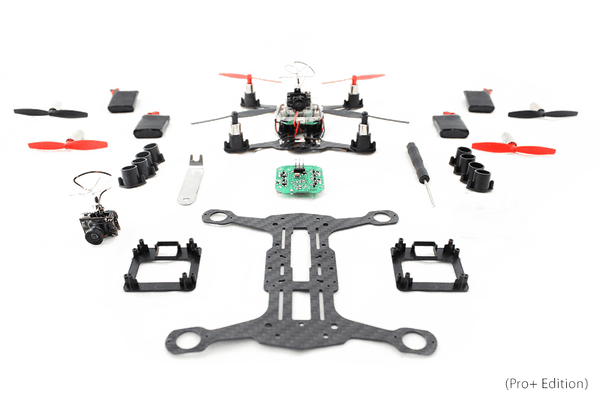
3689731799?profile=originalThe Cheerson CX-95S is a very cheap but nice quadrocopter. Beside the price the seperated components are great especially to use it for other projects. Also the use of open source software makes it quite easy to adapt.

There are mostly three things the new project should have:

  1. Use of small brushed motors (1S or 2S lipo)
  2. Not more than 4 of these motors
  3. No use of servos or brushless motors

Then it might be quite easy to use this approach.

For more details how I did it to fly this funny AirAce plane with just differental motor control, see my full blog entry here

Read more…
3D Robotics

3689730503?profile=original

Next Monday we're hosting a Dronecode meetup after a full day of code sprinting on the forthcoming Dronecode SDK iOS API.

Come meet members of the Dronecode dev team, including developers from 3DR, Yuneec, PX4, Intel, Airmap, ARM and others for an evening of drink, food, demos, music and flying at the 3DR offices in Berkeley.

Sign up here - all welcome!

3689730469?profile=original

Read more…