All Posts (11086)

Sort by

We are happy to share DroneePlotter -  Drone Flight Log Analysis Tool  with drone comunity to make analyse and sharing easier.

DroneePlotter works on browser not (on server) Just drag and drop the log file . It parses binary log file inside browser instantly with Java scrip, and it works very fast . 

It generates flight graphs automatically , also you can  visualise specific flight data on graph and easily share with others, post on blogs, discussion forms.

To share your analyse with others you need to click UPLOAD button, it will generate unique link based on their md5
which means even another person uploads this file,server will generate the same url.

I hope it will make life easier, and your feebacks ,reviews are very welcome.)

https://plot.dron.ee/

Read more…

3689722734?profile=original

Hi All,

We are launching the Fly4Fall campaign, a worldwide initiative to crowd-source science from the drone community over the next few weeks. Please pass on to others you know!

The goal of Fly4Fall is a biogeographic survey of autumn plants everywhere (forests, prairies, deserts and more) to measure plant phenology (botany-speak for how plants look during the growing season) and reveal what the community can accomplish. Volunteer drone pilots are asked to collect data points from the poles to the equator, in places where leaves have already dropped to where they are green all year.

  • Fly4Fall is free and totally voluntary.
  • Open to anyone with a DJI drone and an iOS device (we had to standardize process). See here for compatibility.
  • Download the free Hangar 360 for DJI app on an iPhone/iPad (sorry Android users).
  • Collect a panoramic at the default height in the app of 100 m (300ft) over vegetation located in safe areas to fly (i.e. not national parks or near airports).  
  • Do as many spots as you like. Totally fine if the leaves are already gone in your area.
  • Load the photos from the drone to app and the Hangar cloud to process into the panoramic.
  • Submit the pano link created by the app to the team to plot on a master map.
  • Email or Twitter instructions can be found at www.Fly4Fall.com.
  • Here is an example from the Kearney Ag Station in California that just was submitted.

Full detailed instructions can be found at here

This is a joint initiative that will run for the next few weeks with citizens, schools, universities, companies, and a growing number of partners...including you!

Questions can be directed to Drone Scholars at info@dronescholars.com. 

Thanks everyone!

Greg Crutsinger

Drone Scholars


Read more…

Thrust Stand for Large Motors

DSC_0442C.jpg

My colleague and I received a lot of help from the DIYDrones community two years ago when we launched the Series 1580 with our company RCbenchmark. We had just finished our masters in robotics. After a lot of work, we are now releasing the Series 1780, a dyno to test motors and propellers producing up to 25 kgf of thrust.

Although this tool is intended for businesses and universities, it uses the same open source software used on the Series 1580 and the Series 1520. I have made more videos on our Youtube channel regarding motor and propeller theory since the Series 1580 was released.

It is not a tool for hobbyists, but I know a lot of you work professionally with UAVs too. Hopefully it will be used for one of those hover bikes in development :). We developed custom load cells with our load cell manufacturer. When testing motors this size, EMI become much more a problem. We had to add extra shielding and galvanic isolation almost everywhere.

Here are the specs:

  • Voltage (0-60 V).
  • Current (100A continuous, 150A burst).
  • Power (0-6000W).
  • Thrust (±25 kg).
  • Torque (±12 Nm).

The system will also support coaxial testing, something a lot of larger UAV designers requested. Coaxial is slightly less efficient, but more compact. I am available in the comments if you have any question regarding motor and propeller testing. I had the opportunity to work with hundreds of businesses, researchers and hobbyists who tested all kinds of motors and propellers, so I may be able to help.

Read more…

Setup ArduPilot flight modes with DX6 Gen 2

IMG_20171026_082557.jpg

I've looked around the web to get an understanding the setup of the Ardupilot flight modes with a Spektrum DX6 2nd generation and there was none. So I decided to write this blog. The few things to consider when doing this:

  1. Please follow the instruction given on the ardupilot webpage.
  2. Have the Pixhawk hardware connected to Mission Planner (I have MP 1.3.50 - Copter V3.5.3) 
  3. Use the display bar in the Radio Calibration page as a guide while changing the rate pulse widths on your transmitter.
  4. I've used switch D to change the pulse width ranges on channel 5.

IMG_20171026_082618.jpg

IMG_20171026_082632.jpg

Read more…

What is Tiny Whoop Micro Quadcopter?

Tiny-Whoop-Micro-Quadcopter.jpg?zoom=0.8999999761581421&resize=695%2C391&width=800

Tiny Whoop is a small FPV(first-person-view) micro brushed quadcopter, its propellers are protected by EDF ducts that also makes it a very efficient little machine, we can fly FPV around people and kids safely. It allows some insane indoor FPV flying: chasing people, annoying your pets, cruise around the house without hurting anyone or damage anything. Compared to mini quads, the tiny size opens the horizon for new possibilities in FPV hobby. It’s more fun than I’ve ever had.

What are their advantages?

Tiny-Whoop-Micro-Quadcopter-2.jpg?resize=768%2C512&width=750

  • Tiny size, making them ideal for flying indoors, through shelves, under desks, wherever.
  • They are Efficient, with up to 4 minutes of flight from a tiny battery.
  • Acrobatic Performance, capable of flips, rolls and fast climbs due to their power to weight.
  • Robust, their ducted design also allows them to shrug off most wall impacts.
  • Inexpensive to purchase and repair. Even the bigger-budget bundles represent great value.
  • Many on the market are ready to fly, and such accessibility is rare when it comes to FPV.
  • They are just awesome fun, seriously even if you just want to fly and not tinker.

What do we need know when we build a Tiny whoop?

Tiny-Whoop-Micro-Quadcopter-3.jpg?resize=768%2C512&width=750

You can choose to go full-blown with 2S motors and batteries, or even opt for brushless motors (more on this another time!).

A typical build will contain the following parts:

  • A frame (80-100mm should be good)
  • A flight controller (the SPRacing F3 Brushed is a great choice)
  • Motors (8.5mm brushed) & propellers
  • Battery (400-750mAh; 1S/2S)
  • Receiver (depends on what transmitter you have)
  • AIO (all-in-one) camera (the FX798T is a proven champ)

You can read our Quadcopter frame, lipo battery, motor and propeller size matching table to know more about how to build quadcopter.

Batteries

Tiny Whoop use 1S 150-205mah LiPo batteries and flight time is about 1-2 minutes. Between different brands and discharge rates there might be a difference in flight time. It’s best to get loads of them. I think 10 to 15 of them is a good number to for a living room FPV racing session.

Motors

There are two types of upgrade 0615 motors sold by micro-motor-warehouse: medium & fast. Type of upgrade motors has an impact on performance and battery life. Because stock PIDs on the Inductrix main board are not adjusted to fly with neither medium nor fast so when flying in acro mode motors sound like they struggle and also there are some oscillations. I didn’t have a chance to test the stock motors with FPV gear on so can’t confirm how they perform in acro.

Tiny-Whoop-Micro-Quadcopter-4.jpg?resize=768%2C513&width=750

Read more…

Impressive Ardupilot based Drone Delivery Demo

3689722591?profile=original

Late last month drone company Matternet demoed a first, a precise and fully automated drone delivery (coffee!) to the roof of a Mercedes, capping a lengthy flight over the city of Zurich in Switzerland. Ardupilot is under the hood of the parachute equipped, 10kg, 70km/h copter.

From Techcrunch:

"Drone delivery may be closer than you think: Daimler’s Mercedes-Benz Vans teamed up with e-commerce startup siroop, and drone logistics provider Matternet to kick off a pilot in Zurich of its van-based drone delivery concept. The partners demonstrated a delivery live to an audience of media today, showing a coffee delivery from a small Swiss merchant using siroop’s platform."

More ...

Read more…

3689722704?profile=original

Halloween can be the most fun time of the year, the time of pumpkins, candies, ghosts, witches and of course some great battery offers! It’s been a long waiting offer but finally it has arrived on gensace.de. This is really your perfect time to look out for some great deals to stock up you battery supply. Winter is approaching. Nothing can stop the hobby lovers. Take out your tiny whoops and cars, it’s time for some indoor RC fun. There are also many good deals for your winter RC fun.

First of all, Take up to 70% off batteries. The TATTU 1550mAh 11.1V 75C 3S1P Lipo Battery Pack are now on 40% off, while the Tattu 1800mAh 11.1V 75C 3S1P Lipo Battery are on it’s 30% off. They are both limited edition good for racing FPV. Don’t forget to take advantage of the €10 off order over €150, €25 off order over €250.

Everyone likes the Gensace/Tattu logo caps. It has been a quite popular items in tracks and quads. Not only it’s comfortable and practical, it’s also a sign to express that you are proudly powered by Gens ace/Tattu. This Halloween we are sending out these caps to orders over €100, for free!

3689722662?profile=original

 As above is Gens ace EU Shop : www.gensace.de/halloween

If you are from US, Free shipping on all orders now in US: https://www.genstattu.com/hotdeals.html

Read more…

Should consider factors when selecting drone frame

How-to-choose-best-racing-drone-frame.jpg

Whenever you are looking for racing drone frame, there are the main factor you should always consider when choosing drone frame.

Sizes
X or H type
Weight
Materials

Size: This most important factor to consider before deciding to choose the best racing drone frame is the size of the arm. The size of the arm will guide and help to determine which kind of the props can be used without any effect. The prop restriction varies from one min quad to another one. Therefore you should always need to check the quadcopter before agreeing to buy.

There are basic rules of thumb that may help you understand below they include:
The arms under 200m. This arms can only be able to support props that are no longer than 4''.
The arms that are 200mm to 21 in length are capable of supporting props that are no bigger than 5''.
The arms which are 225mm to about 250mm long can make a support of 6'' props.

Too long , Therefore more please read this article: http://www.rcdronegood.com/best-racing-drone-frame/

Read more…

My Bixler UAV project

3689722622?profile=original

 Hello everyone,

Today I am going to introduce my UAV Bixler project.

I bought this Bixler airplane from H.King about several months ago and wanted to put pixhawk in it to test how well it can fly autonomously.

After receiving the plane I searched the web to get any information about how to modify the plane. There are many DIY examples on such thing however most of them requires cutting the fuselage half or cutting the entire nose section. I think this is not a good idea because if the airplane suffer from crash, I have to do the same process again. 

So I decided to make a UAV module that fits into the cockpit section of the bixler. Luckily, the bixler has a cockpit like section where a model pilot sits and covered with clear plastic.

Finally I could get following result. A complete UAV cockpit module designed to fit into the Bixler plane.

This is rendering of the above 3d printed module

3689722559?profile=original

Following video shows how this module can be assembled. 

All you need are pixhawk with pitot tube and a few M2, M3 sized screws. 

And this design is very helpful reducing the time to prepare for the flight mission.

Just put battery into the fuselage and snap tight the module. That's it.

If you are interested in making the UAV module yourself please order from shapeways!

Base parts here

http://shpws.me/P1iz

Cockpit cover parts here

http://shpws.me/P1iC

If you want to print yourself please give me a message and I will share printable stl file. 

Thanks,

xrotorsnet

Read more…
3D Robotics

DIY Drones now at 86,000 users

3689722535?profile=original

It's customary and traditional that we celebrate the addition of every 1,000 new members here and share the traffic stats. We've now passed 86,000 members! We're also more than ten years old!

Rather than simply give the usual monthly traffic snapshot, I thought I'd give the data for the whole decade, which tells quite a story. 

  • First, some amazing totals:
    • More than 20 million users and 118 million pageviews over the decade. 
    • 13,400 blog posts
    • More than 60,000 discussion threads
    • Nearly a million comments
  • Second, the ups and downs of this industry. Over the ten years, we've gone from one of the few drone communities around to today, when there are hundreds of sites, most of them commercial, and drone users and developers are scattered amongst them. In the early 2010s, DIY Drones was in the top three results on Google for "drones". Now there are pages and pages of commercial sites before it. That's a natural thing and demonstrates classic maturing of an industry. The amateurs have given way to the pros.
  • Third, the related rise and fall of "DIY" in the drone industry. With the triumph of DJI and its Phantom (and now Mavic and Spark) lines, it's no longer necessary to build your own drone. This is a good thing (the same happened with PCs and all sorts of electronics before it), and many people still choose to do so anyway for fun (as they still do with PCs), but it's clearly gone back to a niche activity or one for developers, much as it was in the early days. 

Today, we're still a big community with healthy traffic (about 10,000 visitors and 15,000 page views a day). And we'll continue just as we are for many years to come. We won't be the biggest site in this space, but we'll continue to be one of the most interesting and a friendly, high-quality place to talk about ideas and projects that extend of potential of drones to change the world. And have fun doing it!

Read more…

Drawing Colored Trajectories in the Sky

Hi! I'd like to share something i did about a year ago as a part of my master thesis about aerial construction.

You can read much more about it here: https://www.artyommaxim.com/

This quick experiment used a Leica MS60 Total Station - an instrument often used for positioning machines on a construction site, to guide a quadrotor along a pre planned trajectory, drawn in a CAD design software. 

UAV Colored Trajectory Guidance with Rhino+Grasshopper+ROS+Leica MS60 Multi Station from Artyom Maxim on Vimeo.

a62304_210086b808a744bfacb17359f5f1d444~mv2_d_1920_1437_s_2.webp?width=750

a62304_4675b8bff91c46e980eae02836e1a7cc~mv2_d_1920_1436_s_2.webp?width=750

a62304_89d914c355064fed817d8982fd9e5c9a~mv2_d_1920_1244_s_2.webp?width=750

Read more…

3689724053?profile=original

Have you ever dreamed of assembling a drone with your own hands? Now you have such an opportunity. Like all writers on PaperHelps, we love to fantasize. And soon we are going to build on the drones in order to arrange a championship later. Design kit, proposed by the Dutch amateur engineer, makes almost any object fly. Do not believe me? Then see for yourself.


Jasper van Lenen assembled everything in a small suitcase to create a full-fledged drone: four motors with a speed regulator, fasteners and a housing for electronics, in particular a radio receiver, a flight control unit and a Bluetooth module. All plastic parts were printed on a 3D printer. 

Watch this video. It inspired me.

The software for the unmanned aerial vehicle was developed by OpenPilot. Source files for 3D printing and other details can be found at jaspervanloenen.com.

3689724044?profile=original

3689724072?profile=original

And that's what happened as a result!

3689724174?profile=original

Read more…
Moderator

I am sure most folks here would know how to do this, the more I play with the Sky Viper the more impressed I am with its potential as a lead into the world of Ardupilot and yesterday even UTM's

The official hacking thread is here.

https://discuss.ardupilot.org/c/arducopter/skyviper

It seems to be available in the USA primarily at the moment with some spots having them for $125.

Read more…

Eagle Eye-30IE is a 3-axis high stabilized gimbal with EO(electro-optical) and IR(infrared) sensors for drone inspection,surveillance,search and rescue applications.The SONY 30X zoom camera provides 1080P 60FPS full HD video streaming and up to 360X zoom capability,which enable you to see every detail you need in the air even you are far away from the object.While the thermal camera allows you to detect targets in the night or low visibile conditions,and provides you with priceless information when you are carrying out missions like inspecting or monitoring objects.High-performance 3-axis gimbal is developed based on FOC(field-oriented control) technology,which will give you crystal clear video footage.

Eagle Eye-30IE is using the most advanced thermal tracking technology,with which you will never lose the object,the tracking function works on daylight sensor too.How it works:zoom in and put the object you want to track in the screen,move the cursor to the object and lock it via controller,and then the camera will track it automatically.

Another big feature for Eagle Eye-30IE is that the gimbal will geotag the video streaming and photos,also gimbal Yaw/Pitch angle,height,time information will be displayed on camera OSD,this is really important when you are conducting missions like rescue and search.

Eagle Eye-30IE provides an outstanding wiring hub design for RC receiver and video output port,which makes wiring pretty easily.Also the gimbal offers 2 smart speed modes:FAST speed and LOW speed.Fast speed mode is used for small zooming range,which makes the gimbal control sensitive and quick.LOW speed mode is used for large zoom range,will enable you to target the object more accurately.

Features

1) Weight:1200grams(cameras included)
2) 1/2.8 inch 2.13MP CMOS sensor
3) 30X optical zoom,CVBS and 1080P/60 HDMI output for video downlink
4) 1080P/30 H.264 video recorded for on-board TF card
5) Thermal camera:640*480,25HZ,1-4X digital zooming,radiometric(optional)
6) Auto object tracking function
7) Geotag,gimbal Yaw/Pitch angle info,height,time will be displayed
8) PWM control and serial command control
9) Convenient wiring hub for RC receiver and video output
10) 3-aixs high stabilized gimbal system
11) Adjustable control speed: SLOW speed for large zoom range,accurate.FAST speed for small zoom range,sensitive and quick.
12) One key back to home position

Product link:http://www.yangdaonline.com/eagle-eye-30ie-30x-eo-ir-dual-sensor-drone-zoom-camera/

Photos

3689722392?profile=original

3689722456?profile=original

3689722511?profile=original

3689722479?profile=original

3689722443?profile=original

3689722484?profile=original

Read more…

Open source underwater glider

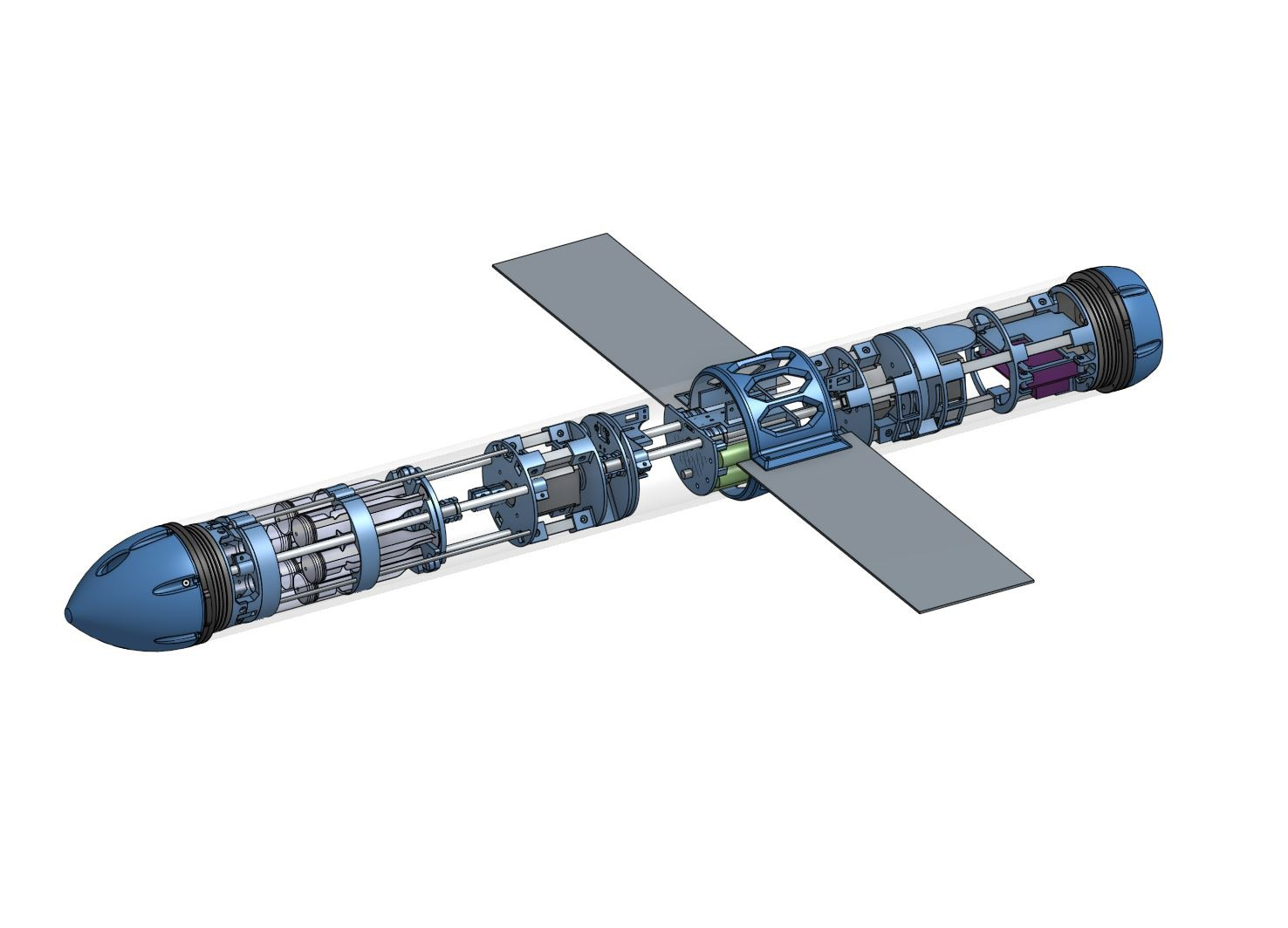
I thought people here might be interested in a project that I’ve been working on for a while.

There are no affordable extended duration underwater exploration projects and I’ve developed a hardware platform to provide this capability. The glider uses a mixture of 3D printed components and commodity parts (such as the Blue Robotics tubing/end-caps/serial communication boards). 

The model is viewable on the Onshape online platform here (requires webGL)

PO2rjt63cRfSN7bqICPzjQM54LRss7SWyHBPh0EOa283Zs8TpcKRkioCSNUwSZ-ACol4zcVcsfJnXLgKBo0wY6FPgNkdRos6Fr__InsCG8SqkYDLrQc89Cufi4M4TwGCE6w3FWMV

The glider is fully open source and assembled using parameterisable 3D prints (to adjust parts for your printer to minimise post processing). Instructions are available, with a level of detail that if you're able to assemble a RepRap kit, you should be able to assemble the glider. The only tools required are a 3D printer, soldering station, dremel and then various hand tools such as hacksaw/allen keys etc. 

With the Onshape CAD model, you are able to duplicate the model and adapt the hardware for your own requirements (such as adding a front mounted camera) - the glider is designed to be a hardware platform for others to use/adapt, not a project with a fixed use case. 

The current software is relatively basic (primarily used to demonstrate the glider ascending/descending underwater), but the control board does have an IMU, allowing for for the addition of a PID algorithm to control glide angle. The control board can also act as a slave board motor controller for the Pixhawk autopilot board and this would integrate with the Mission Planner software in order for the glider to perform autonomous waypoint navigation.


More information can be found on the glider's Hackaday page and any comments/suggestions are more than welcome.


Read more…

TATTU PLUS 2.0 SMART BATTERY


3689721954?profile=original

Today, I’ll tell you more about the 18000mah 6s, which is the updated version of our TATTU Pluse. Tattu pluse 2.0 smart battery.

It’s specially made for agriculture spraying, aerial photography survey drones and some others. Because of the stable discharge curve and super large capacity, it provides you long enough flying time for most of the tasks.

It has 6 cells, it’s a quite large battery in terms of the 18000mah capacity. Comes with 15C discharge rate, with max burst discharge rate at 30C. The discharge plug used here is the AS150 + XT150. It comes with a smart casing. Weighted at 2270gram.

Let’s look at some features. The Tattu plus 2.0 smart battery has overheat , low temperature, over voltage and over current protection. Another cool feature is that it has intelligent storage function.

There are many upgraded functions on this battery comparing to the first generation.

For example, the new LED system has replaced the LED flash warning, 4 LEDs on the side are the charge level and battery cycle life indicator. By pressing the power button for different time length, you then know how full is your battery has been charged and even how many services this battery still lefts.

If short press for 1 sec, it will show battery charge status.And if press for 5 seconds: Display the remaining cycle life of the battery


Besides, for these three LEDs, it has different features. When your battery is unuaual, red light will turn on. When the middle LED light in orange, it means you need to charge the battery as soon as possible. Lastly, if white LED lights up, it means the battery is not suitable for storage. And it will active the protection mode automatically.

3689721796?profile=original

In this new version of the Tattu plus battery. A brand new design has been applied to the outer case, making the battery more safe and sturdy in different scenarios.  We have add in two battery to battery/ battery to drone connection ports, ensuring the battery is safely mounted on your drone. The Foldable handle for easy disassemble and carrying around.

So this is the brand new Tattu plus 2.0 battery. They are now available on our US and EU online store.

For more information please check out the links below.


 https://www.genstattu.com/ta-plus2-0-15c-18000-6s1p.html

Read more…

HackflightSim Rebooted

3689721941?profile=originalIn earlier posts I described HackflightSim, an open-source quadcopter flight simulator built on the V-REP robotics simulation platform, using actual C++ flight-control firmware. After seeing the kinds of beautiful, real-time simulations that Microsoft was able to get with ts AirSim program built on UnrealEngine (UE4), I figured it was worth looking into UE4 for my own simulator. Thanks to the powerful features of UE4, I was able to start from scratch and build a rudimentary, 120 frames-per-second simulator in under 500 lines of C++ code. 

As this video shows, UE4 makes it easy to switch among a variety of cameras: "follow" camera (always in front of the vehicle); "chase" camera (behind the vehicle); and the familiar FPV.  It's also pretty straightforward to import an existing frame design (like this modified 3DFly frame) and propeller design into UE4 as a "mesh", saving you the trouble of designing a vehicle just for the simulation.  

I'm planning to work with a studio-arts student on building some realistic interesting indoor environments in which to fly, using the powerful level-design tools in UE4. This should speed up the prototyping of firmware algorithms to exploit the tiny, powerful new sensors available these days, like the VL53L0X ranging sensor and the PMW3901 optical-flow sensor, before deploying them on an actual MAV.

Read more…

3689721920?profile=original

This article first appeared on UAV Coach.

In this article we’re going to take a look at some of the data collected in the new report from Skylogic Research on the drone industry—data we think is important to you and answers the question: “Where are drone-based service providers making money?”

The report defines Service Providers as those individuals or companies that offer drone-based imaging or sensing services for outside hire (as opposed to Business Owners, who “use or purchase drone-based imaging or sensing services”).

Let’s dive in.

PRIMARY SERVICE AREAS FOR SERVICE PROVIDERS

Skylogic’s report found that the top three primary service areas for commercial drone work are: Aerial Photography / Videography; Surveying / Mapping / GIS; and Real Estate.

However, as indicated in the pie chart below, the first area (i.e., Aerial Photography / Videography) takes up the lion’s share not just of those three, but of the entire services scene, with 41% of the entire chart, while the following category (Surveying / Mapping / GIS) only receives 13%.

skylogic-survey-services.png?width=600

A note on the data: Respondents were asked to indicate the primary and secondary commercial product or services they offer. They could pick one primary and up to three secondary services. Skylogic intentionally had them choose a primary because previous research revealed that many service providers boast about their ability to service multiple industries, but have no domain expertise in those industries.

But just because the majority of commercial drone operators are working in aerial cinematography doesn’t mean they’re actually making money in that sector.

The report goes on to rank the top 10 drone services making over $100K/year. Surprisingly, it’s Surveying / Mapping / GIS that ranks first in that list. Aerial Photography and/or Video is #2. (Of course, just because you’re not making over $100K/year doesn’t mean you’re not making any money.)

After those first two, the third area listed where people are making over $100K/year is Utilities Infrastructure Inspection or Monitoring—even though this is the seventh item listed in the pie chart above, with only 3% of respondents indicating that they work in that field.

SO WHERE IS THE MONEY?

It seems one conclusion we can draw from these data points is that those commercial drone pilots who find a commercial niche (a place where there aren’t many people operating, but there is a demand for the work) are likely to make the most money.

Taking a simplistic view, a commercial operator could potentially look at those areas of minimal saturation on the pie chart—the ones lower down the list—and then look at those areas where people are making over $100K/year, and see what might be required to get into that sector.

Of course, transitioning into commercial mapping or inspections isn’t as easy as just knowing how to fly a drone. But we can foresee a future where solopreneurs team up with other professionals with specific skill sets—for example, a licensed surveyor—to provide high-end services to large industrial operations.

SERVICES MOST LIKELY TO BE OUTSOURCED

Another chart we want to share from Skylogic’s report shows the commercial areas where business owners are outsourcing services.

If you’re a solopreneur looking to find a skill set that will help you find work, this graphic could be a great jumping off place for finding skill sets you might want to develop.

skylogic-survey-outsourced-services.png?width=600

The bottom line is that there is money to be made as a service provider in the drone industry, but the most popular field (i.e., aerial cinematography) is not the most lucrative, and the areas where you’re most likely to find a solid financial foothold will require additional skill sets beyond knowing how to fly and how to operate a camera.

It will be interesting to see the data in another year or two. Things are developing rapidly, with students beginning to study drones and STEM in high school and the landscape appearing to shift radically to focus more on industrial applications. We may soon see mapping, surveying, and similar commercial use cases rise to the top of the services areas for drone service providers, and we might also see a resulting shift in the market from cheap drones to high-end drones developed for niche applications.


Don’t have a copy of the report? Purchase a full copy of the report here.

Read more…