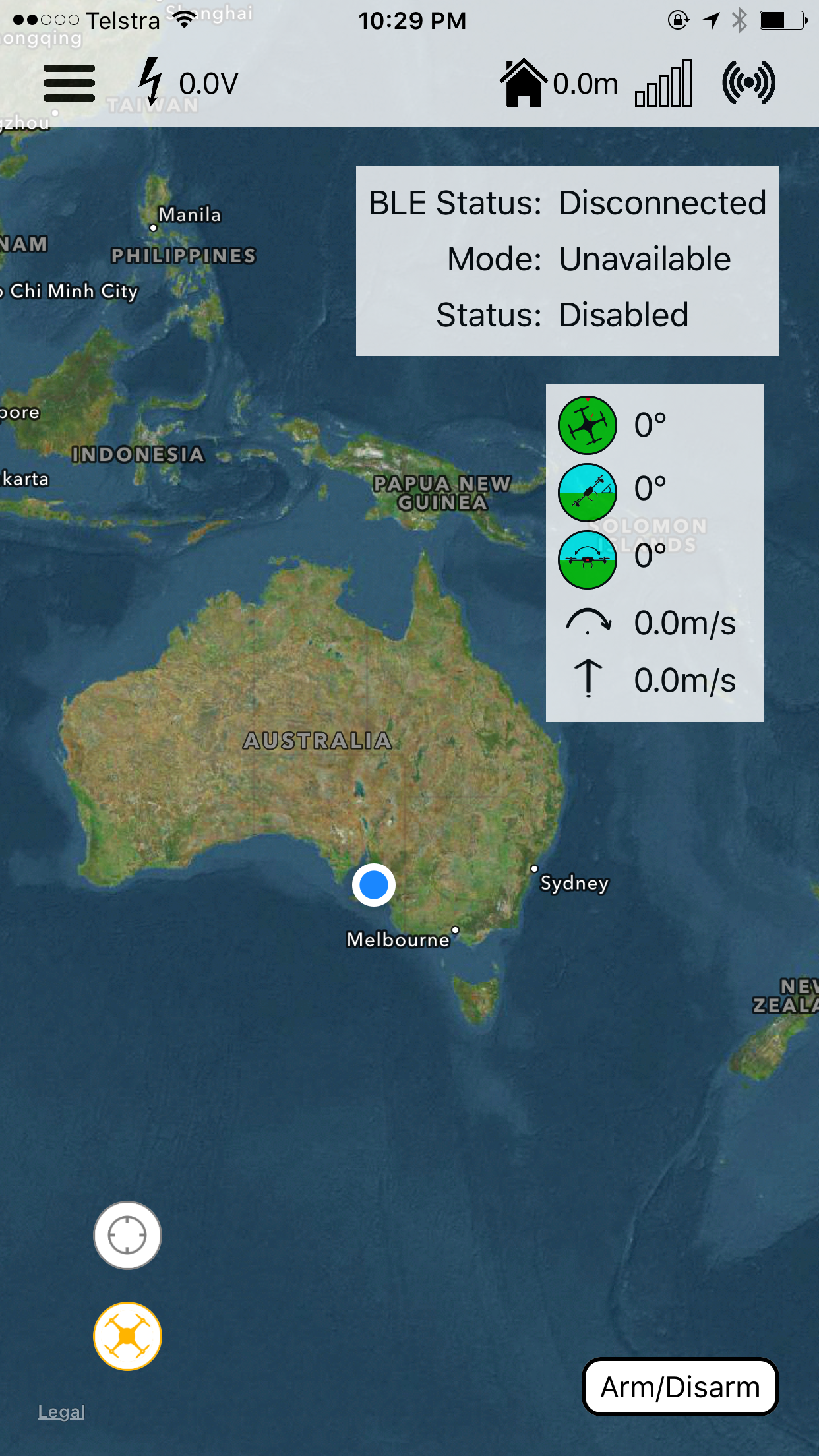
Until now I have presented only videos with the beta version of FlightZoomer release 2. But now the final version is completed and published. The apps are available for free so there is nothing that could stop you from flying your drone according to IFR rules (except the regulatory requirements, which should strictly be followed)!
In the video above, I go through the highlights of FlightZoomer version 2.0, so you not only see the system "working" but also get an impression of the look&feel as well as the capabilities of the new autopilot.
The covered topics in this video are:
The autopilot simulation mode. It allows to demonstrate and train the autopilot features with just the groundstation app as a stand-alone unit. All the other components are simulated
The autopilot itself
The Flight Management System
How a flight plan is created on the fly in a couple of seconds
How an ILS radio receiver is tuned
The camera control panel on the groundstation looks
And - last but not least - a demonstration of an ATC-guided (air traffic control) approach to the tuned ILS
Some screenshots from the video:
For those who hear about this project the first time, here are some bullet points:
Smartphone based systems, that aim to recreate the avionics of a real aircraft for UAV usage
One smartphone is attached to the UAV and runs the FlightZoomer Sensorics app
A second smartphone (or tablet in the near future) runs the FlightZoomer Groundstation app
Both are connected via cellular EDGE, 3G or 4G networks.
The communication links runs via a relay server, which can run at home and hosts the navigation database plus adds logging capabilities
There are extensive downlink (telemetry) capabilities and uplink control capabilities
The onboard smartphone is mated with an APM based flight controller via Bluetooth
Currently supported is Arducopter 3.3 or higher.
Supporting Arduplane is on the to-do list
For about 200$ you can get everything mentioned working (assumed, you need to buy two Windows Phones for the groundstation and the sensor device)
I was going to refresh my old FPV 250 racer built two years ago with an "old" Naze board and an "old" baseflight firmware. Not surprisingly, the whole firmware landscape has changed dramatically and I had to investigate quite a bit to bring me up to date with current states of affairs (lots of new firmware versions, new flight controller hardware).
As opposed to software (r)evolutions, flight controllers hardware did not evolve as much (apart from processing power increase, nothing revolutionnary). One noticeable novelty on hardware level is the relatively new open source "SP racing F3" board. Made a quick tech review of this board in the video which, as I understand it, became the state of the art flight controller for "seriously pro" FPV racers.
This video also shares some brief historical & evolution about hardware/firmware for FPV racing (MultiiWii evolution branch).
I wanted to give this website some visibility so that:
It might create some interest within the community
More people are likely to enter
We can help define some rules a little more clearly
I'm Alumni from this University (graduated 12 years ago), and the academics and students are doing as much as they possibly can with autonomous systems. This competition is the next step.
It isn't FPV racing - hence the inverted commas in the title, the vehicles have to be in autonomous mode.
It's about creating a system which can follow lines placed on the ground (26m x 2m racetrack with some additional features).
Your UAV has to weigh less than 1kg and fit within a sphere 2m in diameter, and can fly no higher than 1.5m
You can use off the shelf or complete DIY
You can use any config or type of vehicle you want
Control once on the course is fully automatic only - no manual intervention
The rules say you can have a groundstation - for reporting back, and to make the calculations - but why not have all the calcs done onboard and broadcast video and listen out only for normal ground station commands? Doesn't seem to be ruled out.
Program it in whatever you want. Use whatever kit you want to follow the tape
You can do this as an individual (£6 total entry fee) or a team (£60 total entry fee)
I guess a lot of people (myself included) did projects like this at university, but with line following rovers and IR sensors or similar. Doing the same thing with UAVs is not as trivial, from the prototyping I have seen!
Here's a couple of random Youtube vids of attempts at this kind of thing:
I'm hoping that this post will stir some discussion, and maybe point the way with any rule changes or specific items of interest required (e.g I'd like to have a figure of 8 rather than a straightforward race track...).
I know there are lots of people who couldn't / wouldn't come to Bristol for this - so - I wonder if we could arrange to do this virtually for those people. Webcast, use a standard drone / GCS set-up and so on...?
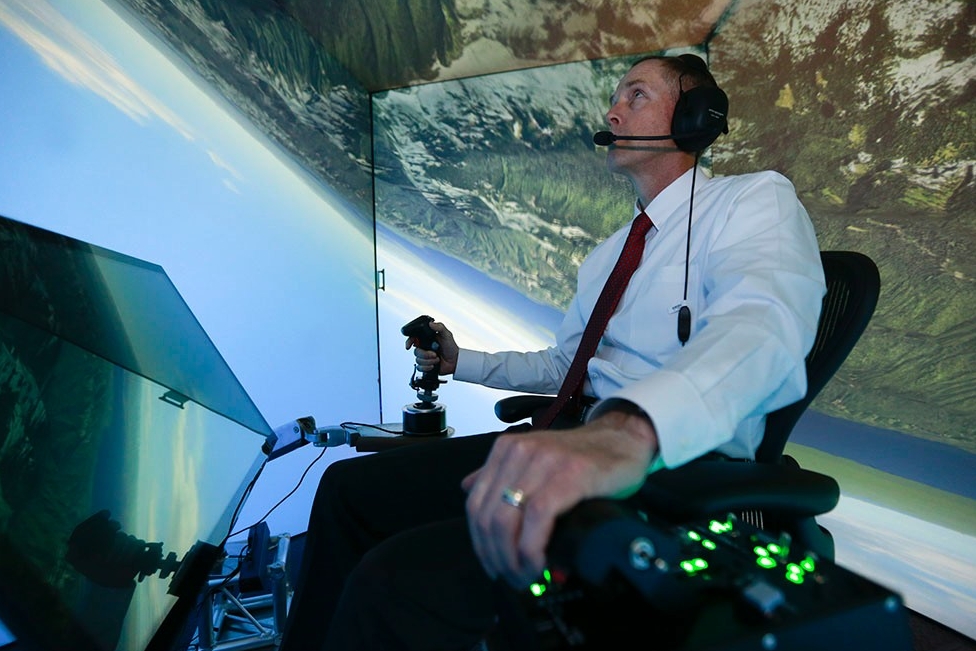
Artificial intelligence (AI) developed by a University of Cincinnati doctoral graduate was recently assessed by subject-matter expert and retired United States Air Force Colonel Gene Lee — who holds extensive aerial combat experience as an instructor and Air Battle Manager with considerable fighter aircraft expertise — in a high-fidelity air combat simulator.
The artificial intelligence, dubbed ALPHA, was the victor in that simulated scenario, and according to Lee, is “the most aggressive, responsive, dynamic and credible AI I’ve seen to date.”
Details on ALPHA – a significant breakthrough in the application of what’s called genetic-fuzzy systems are published in the most-recent issue of the Journal of Defense Management, as this application is specifically designed for use with Unmanned Combat Aerial Vehicles (UCAVs) in simulated air-combat missions for research purposes.
The tools used to create ALPHA as well as the ALPHA project have been developed by Psibernetix, Inc., recently founded by UC College of Engineering and Applied Science 2015 doctoral graduate Nick Ernest, now president and CEO of the firm; as well as David Carroll, programming lead, Psibernetix, Inc.; with supporting technologies and research from Gene Lee; Kelly Cohen, UC aerospace professor; Tim Arnett, UC aerospace doctoral student; and Air Force Research Laboratory sponsors.
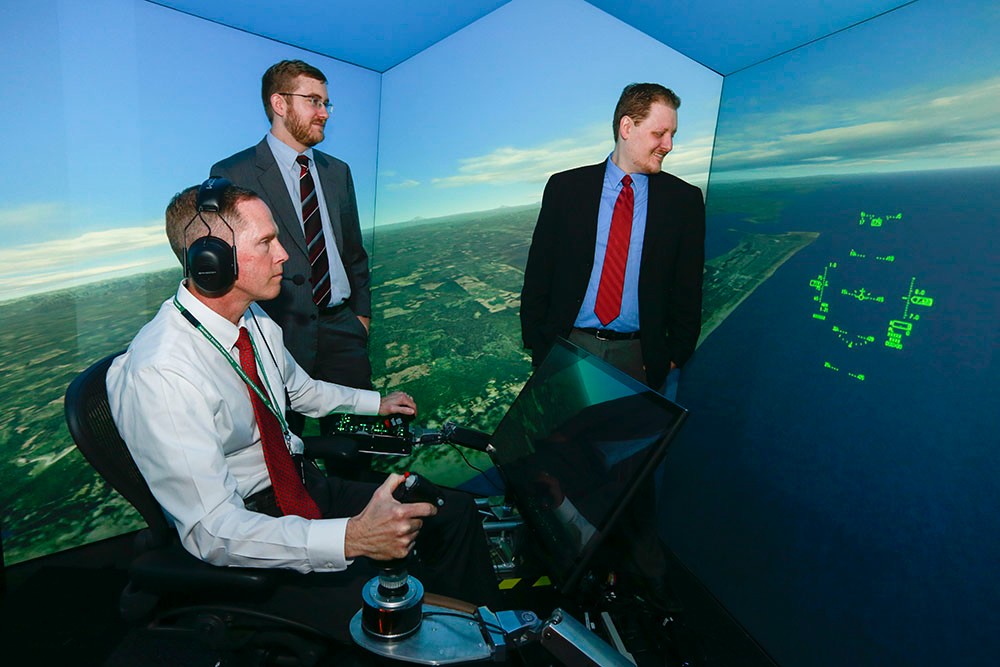
Retired United States Air Force Colonel Gene Lee, in a flight simulator, takes part in simulated air combat versus artificial intelligence technology developed by a team comprised of industry, U.S. Air Force and University of Cincinnati representatives.*
High pressure and fast pace: An artificial intelligence sparring partner
ALPHA is currently viewed as a research tool for manned and unmanned teaming in a simulation environment. In its earliest iterations, ALPHA consistently outperformed a baseline computer program previously used by the Air Force Research Lab for research. In other words, it defeated other AI opponents.
In fact, it was only after early iterations of ALPHA bested other computer program opponents that Lee then took to manual controls against a more mature version of ALPHA last October. Not only was Lee not able to score a kill against ALPHA after repeated attempts, he was shot out of the air every time during protracted engagements in the simulator.
Since that first human vs. ALPHA encounter in the simulator, this AI has repeatedly bested other experts as well, and is even able to win out against these human experts when its (the ALPHA-controlled) aircraft are deliberately handicapped in terms of speed, turning, missile capability and sensors.
Lee, who has been flying in simulators against AI opponents since the early 1980s, said of that first encounter against ALPHA, “I was surprised at how aware and reactive it was. It seemed to be aware of my intentions and reacting instantly to my changes in flight and my missile deployment. It knew how to defeat the shot I was taking. It moved instantly between defensive and offensive actions as needed.”
He added that with most AIs, “an experienced pilot can beat up on it (the AI) if you know what you’re doing. Sure, you might have gotten shot down once in a while by an AI program when you, as a pilot, were trying something new, but, until now, an AI opponent simply could not keep up with anything like the real pressure and pace of combat-like scenarios.”
But, now, it’s been Lee, who has trained with thousands of U.S. Air Force pilots, flown in several fighter aircraft and graduated from the U.S. Fighter Weapons School (the equivalent of earning an advanced degree in air combat tactics and strategy), as well as other pilots who have been feeling pressured by ALPHA.
And, anymore, when Lee flies against ALPHA in hours-long sessions that mimic real missions, “I go home feeling washed out. I’m tired, drained and mentally exhausted. This may be artificial intelligence, but it represents a real challenge.”
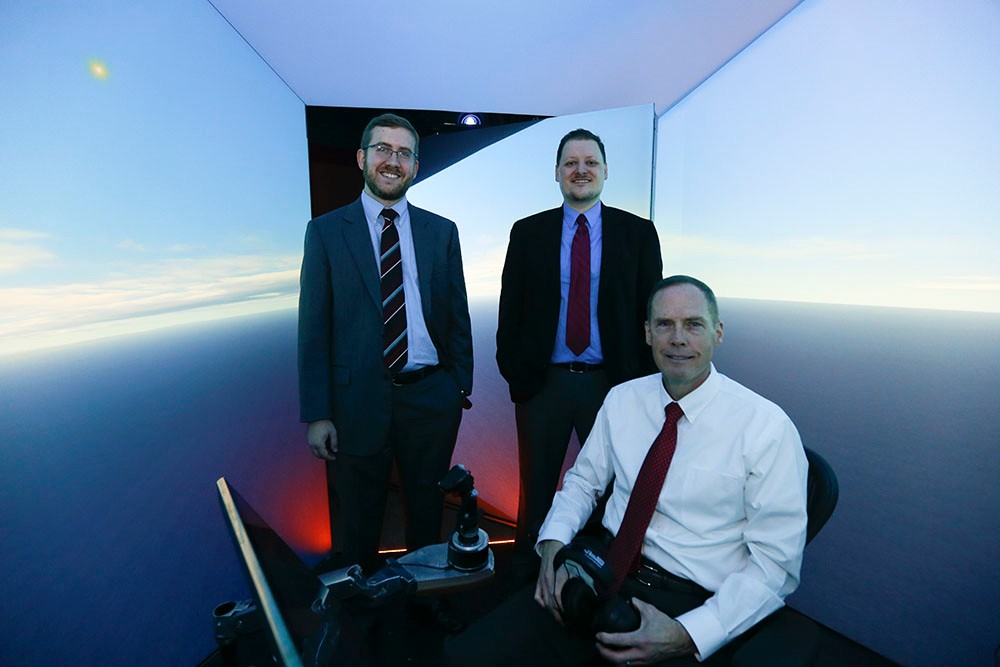
From left, UC graduate and Psibernetix President and CEO Nick Ernest; David Carroll of Psibernetix; and retired U.S. Air Force Colonel Gene Lee in an air-combat simulator.*
An artificial intelligence wingman: How an AI combat role might develop
Explained Ernest, “ALPHA is already a deadly opponent to face in these simulated environments. The goal is to continue developing ALPHA, to push and extend its capabilities, and perform additional testing against other trained pilots. Fidelity also needs to be increased, which will come in the form of even more realistic aerodynamic and sensor models. ALPHA is fully able to accommodate these additions, and we at Psibernetix look forward to continuing development."
In the long term, teaming artificial intelligence with U.S. air capabilities will represent a revolutionary leap. Air combat as it is performed today by human pilots is a highly dynamic application of aerospace physics, skill, art, and intuition to maneuver a fighter aircraft and missiles against adversaries, all moving at very high speeds. After all, today’s fighters close in on each other at speeds in excess of 1,500 miles per hour while flying at altitudes above 40,000 feet. Microseconds matter, and the cost for a mistake is very high.
Eventually, ALPHA aims to lessen the likelihood of mistakes since its operations already occur significantly faster than do those of other language-based consumer product programming. In fact, ALPHA can take in the entirety of sensor data, organize it, create a complete mapping of a combat scenario and make or change combat decisions for a flight of four fighter aircraft in less than a millisecond. Basically, the AI is so fast that it could consider and coordinate the best tactical plan and precise responses, within a dynamic environment, over 250 times faster than ALPHA’s human opponents could blink.
So it’s likely that future air combat, requiring reaction times that surpass human capabilities, will integrate AI wingmen – Unmanned Combat Aerial Vehicles (UCAVs) – capable of performing air combat and teamed with manned aircraft wherein an onboard battle management system would be able to process situational awareness, determine reactions, select tactics, manage weapons use and more. So, AI like ALPHA could simultaneously evade dozens of hostile missiles, take accurate shots at multiple targets, coordinate actions of squad mates, and record and learn from observations of enemy tactics and capabilities.
UC’s Cohen added, “ALPHA would be an extremely easy AI to cooperate with and have as a teammate. ALPHA could continuously determine the optimal ways to perform tasks commanded by its manned wingman, as well as provide tactical and situational advice to the rest of its flight.”
A programming victory: Low computing power, high-performance results
It would normally be expected that an artificial intelligence with the learning and performance capabilities of ALPHA, applicable to incredibly complex problems, would require a super computer in order to operate.
However, ALPHA and its algorithms require no more than the computing power available in a low-budget PC in order to run in real time and quickly react and respond to uncertainty and random events or scenarios.
According to a lead engineer for autonomy at AFRL, "ALPHA shows incredible potential, with a combination of high performance and low computational cost that is a critical enabling capability for complex coordinated operations by teams of unmanned aircraft."
Ernest began working with UC engineering faculty member Cohen to resolve that computing-power challenge about three years ago while a doctoral student. (Ernest also earned his UC undergraduate degree in aerospace engineering and engineering mechanics in 2011 and his UC master’s, also in aerospace engineering and engineering mechanics, in 2012.)
They tackled the problem using language-based control (vs. numeric based) and using what’s called a “Genetic Fuzzy Tree” (GFT) system, a subtype of what’s known as fuzzy logic algorithms.
States UC’s Cohen, “Genetic fuzzy systems have been shown to have high performance, and a problem with four or five inputs can be solved handily. However, boost that to a hundred inputs, and no computing system on planet Earth could currently solve the processing challenge involved – unless that challenge and all those inputs are broken down into a cascade of sub decisions.”
That’s where the Genetic Fuzzy Tree system and Cohen and Ernest’s years’ worth of work come in.
According to Ernest, “The easiest way I can describe the Genetic Fuzzy Tree system is that it’s more like how humans approach problems. Take for example a football receiver evaluating how to adjust what he does based upon the cornerback covering him. The receiver doesn’t think to himself: ‘During this season, this cornerback covering me has had three interceptions, 12 average return yards after interceptions, two forced fumbles, a 4.35 second 40-yard dash, 73 tackles, 14 assisted tackles, only one pass interference, and five passes defended, is 28 years old, and it's currently 12 minutes into the third quarter, and he has seen exactly 8 minutes and 25.3 seconds of playtime.’”
That receiver – rather than standing still on the line of scrimmage before the play trying to remember all of the different specific statistics and what they mean individually and combined to how he should change his performance – would just consider the cornerback as ‘really good.’
The cornerback's historic capability wouldn’t be the only variable. Specifically, his relative height and relative speed should likely be considered as well. So, the receiver’s control decision might be as fast and simple as: ‘This cornerback is really good, a lot taller than me, but I am faster.’
At the very basic level, that’s the concept involved in terms of the distributed computing power that’s the foundation of a Genetic Fuzzy Tree system wherein, otherwise, scenarios/decision making would require too high a number of rules if done by a single controller.
Added Ernest, “Only considering the relevant variables for each sub-decision is key for us to complete complex tasks as humans. So, it makes sense to have the AI do the same thing.”
In this case, the programming involved breaking up the complex challenges and problems represented in aerial fighter deployment into many sub-decisions, thereby significantly reducing the required “space” or burden for good solutions. The branches or sub divisions of this decision-making tree consists of high-level tactics, firing, evasion and defensiveness.
That’s the “tree” part of the term “Genetic Fuzzy Tree” system.
Standing at left is UC grad and Psibernetix President and CEO Nick Ernest. David Carroll, also of Psibernetix, is standing at right. Seated at the simulator controls is retired U.S. Air Force Colonel Gene Lee.*
Programming that's language based, genetic and generational
Most AI programming uses numeric-based control and provides very precise parameters for operations. In other words, there’s not a lot of leeway for any improvement or contextual decision making on the part of the programming.
The AI algorithms that Ernest and his team ultimately developed are language based, with if/then scenarios and rules able to encompass hundreds to thousands of variables. This language-based control or fuzzy logic, while much less about complex mathematics, can be verified and validated.
Another benefit of this linguistic control is the ease in which expert knowledge can be imparted to the system. For instance, Lee worked with Psibernetix to provide tactical and maneuverability advice which was directly plugged in to ALPHA. (That “plugging in” occurs via inputs into a fuzzy logic controller. Those inputs consist of defined terms, e.g., close vs. far in distance to a target; if/then rules related to the terms; and inputs of other rules or specifications.)
Finally, the ALPHA programming is generational. It can be improved from one generation to the next, from one version to the next. In fact, the current version of ALPHA is only that – the current version. Subsequent versions are expected to perform significantly better.
Again, from UC’s Cohen, “In a lot of ways, it’s no different than when air combat began in W.W. I. At first, there were a whole bunch of pilots. Those who survived to the end of the war were the aces. Only in this case, we’re talking about code.”
To reach its current performance level, ALPHA’s training has occurred on a $500 consumer-grade PC. This training process started with numerous and random versions of ALPHA. These automatically generated versions of ALPHA proved themselves against a manually tuned version of ALPHA. The successful strings of code are then “bred” with each other, favoring the stronger, or highest performance versions. In other words, only the best-performing code is used in subsequent generations. Eventually, one version of ALPHA rises to the top in terms of performance, and that’s the one that is utilized.
This is the “genetic” part of the “Genetic Fuzzy Tree” system.
Said Cohen, “All of these aspects are combined, the tree cascade, the language-based programming and the generations. In terms of emulating human reasoning, I feel this is to unmanned aerial vehicles what the IBM/Deep Blue vs. Kasparov was to chess.”
Funding and support
ALPHA is developed by Psibernetix Inc., serving as a contractor to the United States Air Force Research Laboratory.
Support for Ernest’s doctoral research, $200,000 in total, was provided over three years by the Dayton Area Graduate Studies Institute and the U.S. Air Force Research Laboratory.
ArduPilot has been able to use X-Plane as a HIL (hardware in the loop) backend for quite some time, but it never worked particularly well as the limitations of the USB interface to the hardware prevented good sensor timings.
We have recently added the ability to use X-Plane 10 as a SITL backend, which works much better. The SITL (software in the loop) system runs ArduPilot natively on your desktop machine, and talks to X-Plane directly using UDP packets.
The above video demonstrates flying a Boeing 747-400 in X-Plane 10 using ArduPilot SITL. It flies nicely, and does an automatic takeoff and landing quite well. You can use almost any of the fixed wing aircraft in X-Plane with ArduPilot SITL, which opens up a whole world of simulation to explore. Many people create models of their own aircraft in order to test out how they will fly or to test them in conditions (such as very high wind) that may be dangerous to test with a real model.
I have written up some documentation on how to use X-Plane 10 with SITL to help people get started. Right now it only works with X-Plane 10 although I may add support for X-Plane 9 in the future.
Michael Oborne has added nice support for using X-Plane with SITL in the latest beta of MissionPlanner, and does nightly builds of the SITL binary for Windows. That avoids the need to build ArduPilot yourself if you just want to fly the standard code and not modify it yourself.
Limitations
There are some limitations to the X-Plane SITL backend. First off, X-Plane has quite slow network support. On my machine I typically get a sensor data rate of around 27Hz, which is far below the 1200 Hz we normally use for simulation. To overcome this the ArduPilot SITL code does sensor extrapolation to bring the rate up to around 900Hz, which is plenty for SITL to run. That extrapolation introduces small errors which can make the ArduPilot EKF state estimator unhappy. To avoid that problem we run with "EKF type 10" which is a fake AHRS interface that gets all state information directly from the simulator. That means you can't use the X-Plane SITL backend to test EKF settings.
The next limitation is that the simulation fidelity depends somewhat on the CPU load on your machine. That is an unfortunate consequence of X-Plane not supporting lock-step scheduling. So you may notice that simulated aircraft on your machine may not fly identically to the same aircraft on someone elses machine. You can reduce this effect by lowering the graphics settings in X-Plane.
We can currently only get joystick input from X-Plane for aileron, elevator, rudder and throttle. It would be nice to support flight mode switches, flaps and other controls that are normally used with ArduPilot. That is probably possible, but isn't implemented yet. So if you want a full controller then you can instead connect a joystick to SITL directly instead of via X-Plane (for example using the MissionPlanner joystick module or the mavproxy joystick module).
Finally, we only support fixed wing aircraft in X-Plane at the moment. I have been able to fly a helicopter, but I needed to give manual collective control from a joystick as we don't yet have a way to provide collective pitch input over the X-Plane data interface.
Manned AIrcraft and ArduPilot
Please don't assume that because ArduPilot can fly full sized aircraft in a simulator that you should use ArduPilot to fly real manned aircraft. ArduPilot is not suitable for manned applications and the development team would appreciate it if you did not try to use it for manned aircraft.
Happy Flying
I hope you enjoy flying X-Plane 10 with ArduPilot SITL!
In September 2015, we were invited by our partner Kathmandu University to provide them and other key stakeholders with professional hands-on training to help them scale the positive impact of their humanitarian efforts following the devastating earthquakes. More specifically, our partners were looking to get trained on how to use aerial robotics solutions (drones) safely and effectively to support their disaster risk reduction and early recovery efforts. So we co-created Kathmandu Flying Labs to ensure the long-term sustainability of our capacity building efforts. Kathmandu Flying Labs is kindly hosted by our lead partner, Kathmandu University (KU). This is already well known. What is hardly known, however, is what happened after we left the country.
Our Flying Labs are local innovation labs used to transfer both relevant skills and appropriate robotics solutions sustainably to outstanding local partners who need these the most. The co-creation of these Flying Labs include both joint training and applied projects customized to meet the specific needs & priorities of our local partners. In Nepal, we provided both KU and Kathmandu Living Labs (KLL) with the professional hands-on training they requested. What's more, thanks to our Technology Partner DJI, we were able to transfer 10 DJI Phantoms (aerial robotics solutions) to our Nepali partners (6 to KU and 4 to KLL). In addition, thanks to another Technology Partner, Pix4D, we provided both KU and KLL with free licenses of the Pix4D software and relevant training so they could easily process and analyze the imagery they captured using their DJI platforms. Finally, we carried out joint aerial surveys of Panga, one of the towns hardest-hit by the 2015 Earthquake. Joint projects are an integral element of our capacity building efforts. These projects serve to reinforce the training and enable our local partners to create immediate added value using aerial robotics. This important phase of Kathmandu Flying Labs is already well documented.
What is less known, however, is what KU did with the technology and software after we left Nepal. Indeed, the results of this next phase of the Flying Labs process (during which we provide remote support as needed) has not been shared widely, until now. KU's first order of business was to actually finish the joint project we had started with them in Panga. It turns out that our original aerial surveys there were actually incomplete, as denoted by the red circle below.
But because we had taken the time to train our partners and transfer both our skills and the robotics technologies, the outstanding team at KU's School of Engineering returned to Panga to get the job done without needing any further assistance from us at WeRobotics. They filled the gap:
The KU team didn't stop there. They carried out a detailed aerial survey of a nearby hospital to create the 3D model below (at the hospital's request). They also created detailed 3D models of the university and a nearby temple that had been partially damaged by the 2015 earthquakes. Furthermore, they carried out additional disaster damage assessments in Manekharka and Sindhupalchowk, again entirely on their own.
Yesterday, KU kindly told us about their collaboration with the World Wildlife Fund (WWF). Together, they are conducting a study to determine the ecological flow of Kaligandaki river, one of the largest rivers in Nepal. According to KU, the river's ecosystem is particularly "complex as it includes aquatic invertebrates, flora, vertebrates, hydrology, geo-morphology, hydraulics, sociology-cultural and livelihood aspects." The Associate Dean at KU's School of Engineering wrote "We are deploying both traditional and modern technology to get the information from ground including UAVs. In this case we are using the DJI Phantoms," which "reduced largely our field investigation time. The results are interesting and promising." I look forward to sharing these results in a future blog post.
Lastly, KU's Engineering Department has integrated the use of the robotics platforms directly into their courses, enabling Geomatics Engineering students to use the robots as part of their end-of-semester projects. In sum, KU has done truly outstanding work following our capacity building efforts and deserve extensive praise. (Alas, it seems that KLL has made little to no use of the aerial technologies or the software since our training 10 months ago).
Several months after the training in Nepal, we were approached by a British company that needed aerial surveys of specific areas for a project that the Nepal Government had contracted them to carry out. So they wanted to hire us for this project. We proposed instead that they hire our partners at Kathmandu Flying Labs since the latter are more than capable to carry out the surveys themselves. In other words, we actively drive business opportunities to Flying Labs partners. Helping to create local jobs and local businesses around robotics as a service is one of our key goals and the final phase of the Flying Labs framework.
So when we heard last week that USAID's Global Development Lab was looking to hire a foreign company to carry out aerial surveys for a food security project in Nepal, we jumped on a call with USAID to let them know about the good work carried out by Kathmandu Flying Labs. We clearly communicated to our USAID colleagues that there are perfectly qualified Nepali pilots who can carry out the same aerial surveys. USAID's Development Lab will be meeting with Kathmandu Flying Labs during their next visit in September.
On a related note, one of the participants who we trained in September was hired soon after by Build Change to support the organization's shelter programs by producing Digital Surface Models (DSMs) from aerial images captured using DJI platforms. More recently, we heard from another student who emailed us with the following: "I had an opportunity to participate in the Humanitarian UAV Training mission in Nepal. It’s because of this training I was able learn how to fly drones and now I can conduct aerial Survey on my own with any hardware. I would like to thank you and your team for the knowledge transfer sessions."
This same student (who graduated from KU) added: "The workshop that your team did last time gave us the opportunity to learn how to fly and now we are handling some professional works along with major research. My question to you is 'How can young graduates from developing countries like ours strengthen their capacity and keep up with their passion on working with technology like UAVs [...]? The immediate concern for a graduate in Nepal is a simple job where he can make some money for him and prove to his family that he has done something in return for all the investments they have been doing upon him [...]'.
This is one of several reasons why our approach at WeRobotics is not limited to scaling the positive impact of local humanitarian, development, environmental and public health projects. Our demand-driven Flying Labs model goes the extra (aeronautical) mile to deliberately create local jobs and businesses. Our Flying Labs partners want to make money off the skills and technologies they gain from WeRobotics. They want to take advantage of the new career opportunities afforded by these new AI-powered robotics solutions. And they want their efforts to be sustainable.
In Nepal, we are now interviewing the KU graduate who posed the question above because we're looking to hire an outstanding and passionate Coordinator for Kathmandu Flying Labs. Indeed, there is much work to be done as we are returning to Nepal in coming months for three reasons: 1) Our local partners have asked us to provide them with the technology and training they need to carry out large scale mapping efforts using long-distance fixed-wing platforms; 2) A new local partner needs to create very high-resolution topographical maps of large priority areas for disaster risk reduction and planning efforts, which requires the use of a fixed-wing platform; 3) We need to meet with KU's Business Incubation Center to explore partnership opportunities since we are keen to help incubate local businesses that offer robotics as a service in Nepal.
Tersus Rinex Converter V1.0 is now ready for release. RINEX is short for Receiver Independent Exchange Format, which is well used for post data process. This tool can help users convert their binary observation data into RINEX 3.2 format.
All Precis RTK boards (Precis-BX303, Precis-BX305 and Precis-BX316) support raw observation data logging. Precis-BX303 has an onboard SD card slot and the Precis-BX305 and Precis-BX316 support external data logger. The logged binary observation data can be converted into Rinex 3.2 with Tersus Rinex Converter.
SMARTNAV L1 RTK field test results, as promised. Please have a look at this previous post before reading.
The reference trajectory will be displayed in dark blue whereas SMARTNAV's output will be displayed as :
- red for "single" solutions (when RTK is not available)
- yellow for "float" solutions
- green for "fix" solutions (maximum accuracy)
So first we will review all the points listed in the previous post.
Height differences
It is common knowledge that GNSS tend to output poor vertical position accuracy due to the low vertical spacing of satellites. We wanted to check whether RTK could enhance this.
Standard deviation is about 4 meters. This is not bad considering the "low VDOP" of satellites and the measurement conditions.
Bridges and tunnels
The idea behind this test was to monitor how receiver would deal with successive acquisitions/losses of satellites.
Receivers loses lock completely under bridges and tunnels. Reacquisition is quite fast and even if there are some glitches convergence is fast.
Large roundabouts
The trajectory is very good here, due to the open sky view. But it is difficult to measure repeatability under those conditions.
Urban canyon
The most difficult environment, really small roads with high buildings.
Here the output is not correct at all. The receiver has a hard time calculating the solution. Even the reference trajectory is not precise at all. This is normal considering the conditions, glitches go up to hundreds of meters.
Leafy streets
We wanted to know whether trees affect position stability or not.
At the moment we drove under the trees, they were masking the sky completely. We can easily see that solution is not robust in this kind of area.
Repeatability
Repeatability was difficult to measure with the car, because it is difficult to make sure to follow the same path several times in an urban area. So we did another test. SMARTNAV was placed on a square table, calculating real-time RTK solutions. Baseline was about 10 meters. SMARTNAV was moved around table's edge several times, always following the same path.
It is very easy to reproduce the same path. Here the accuracy is under 5 cm.
Accuracy/precision
In open sky conditions, accuracy is always better than 20 cm.
However, when conditions are difficult, offsets as high as 1 meter can be observed. Offsets tend to appear after a glitch is observed. A time of convergence shows up after a glitch to come back to the reference trajectory.
In stationary, this is the position calculated by SMARTNAV.
This is the position calculated by L1/L2 AsteRx (without inertial hybridation).
There does not seem to be much precision difference between the two.
Availability
NRTK (SMARTNAV real time) availability :
- Fix : 27%
- Float : 62.5%
- Single : 10.5%
L1/L2 (post-processed) availability :
- Fix : 50.6%
- Float : 46.1%
- Single : 3.2%
L1/L2 is much more available than L1, which means it will be more robust in difficult environments or longer baselines.
First conclusions :
- RTK in urban areas is not a pipe dream
- reacquisitions are fast
- excellent precision/accuracy in open sky views
- still quite strong in "medium" environments (could be enhanced by hybridation with an IMU or a better software cycle slip detection)
- not reliable when sky view is heavily obstructed
- L1/L2 does not look more precise than L1, but it is more robust and available
Over the past few years, the press has emphasized how much commercial drones will be used to improve farming. The assumption is that drones provide more accurate data for use in variable rate technology (VRT) so farmers who use drones will experience increased yields. But truth be told very little has been written about the measurable benefits and it’s yet to be proven just how effective UAS will be in helping farmers increase yields. With that in mind, we just released The Truth about Drones in Precision Agriculture, a free research study that reviews those benefits and challenges.
The report is the first in series of studies sponsored by BZ Media that looks objectively at each major market for drones and drone technology. In this paper, we look at how drones have been used as remote sensing devices in agriculture thus far, review competitive and traditional approaches using incumbent technology, discuss the opportunities and challenges posed by the technology itself, outline the lessons learned, and discuss what’s next for drones in agriculture. Here is an excerpt:
“For the most part, recent technology advancements in small UAS equipped with good sensors support the farmer’s and/or researcher’s ability to locate a precise position in a field, observe it, and create maps of as many variables as can be measured — but only on a small scale. That’s because under current FAA rules, all observation and measurement would have to be done by a drone that is within visual line of site (VLOS) of the operator. The problem is that fields and farms are big– bigger than VLOS. According to this report, there are approximately 2.1 million farms in America. The average size is 434 acres. Small family farms, averaging 231 acres, make up 88 percent of farms. That’s 1.85 million farms that could benefit immediately from VLOS operations. But large family farms (averaging 1,421 acres) and very large family farms (averaging 2,086 acres) make up 36 percent of the total farm acres in the U.S., so most of that would require beyond VLOS operations.
Sure, operators could conduct many operations in a day by moving section to section to section and stitching together larger maps for large or very large acre farms, but this is costly – both in terms of manpower and time. Even if it was cheaper, the market potential for drones in precision agriculture still needs more vetting. Despite the ROI studies like this one by the American Farm Bureau Federation and Measure, it’s not yet clear how a sUAS can deliver more usable data to a farmer or provide a cost benefit over the existing manned aircraft or the satellite image solutions available to them today.”
The paper goes on to analyze six use cases for drones in agriculture in great detail - including using drones for crop vigor assessment and the use of prescription maps. You can find out more about the report and download for free it here.
If you have questions about what's in the report or would like to comment on it after reading it please post below or write me colin@droneanalyst.com.
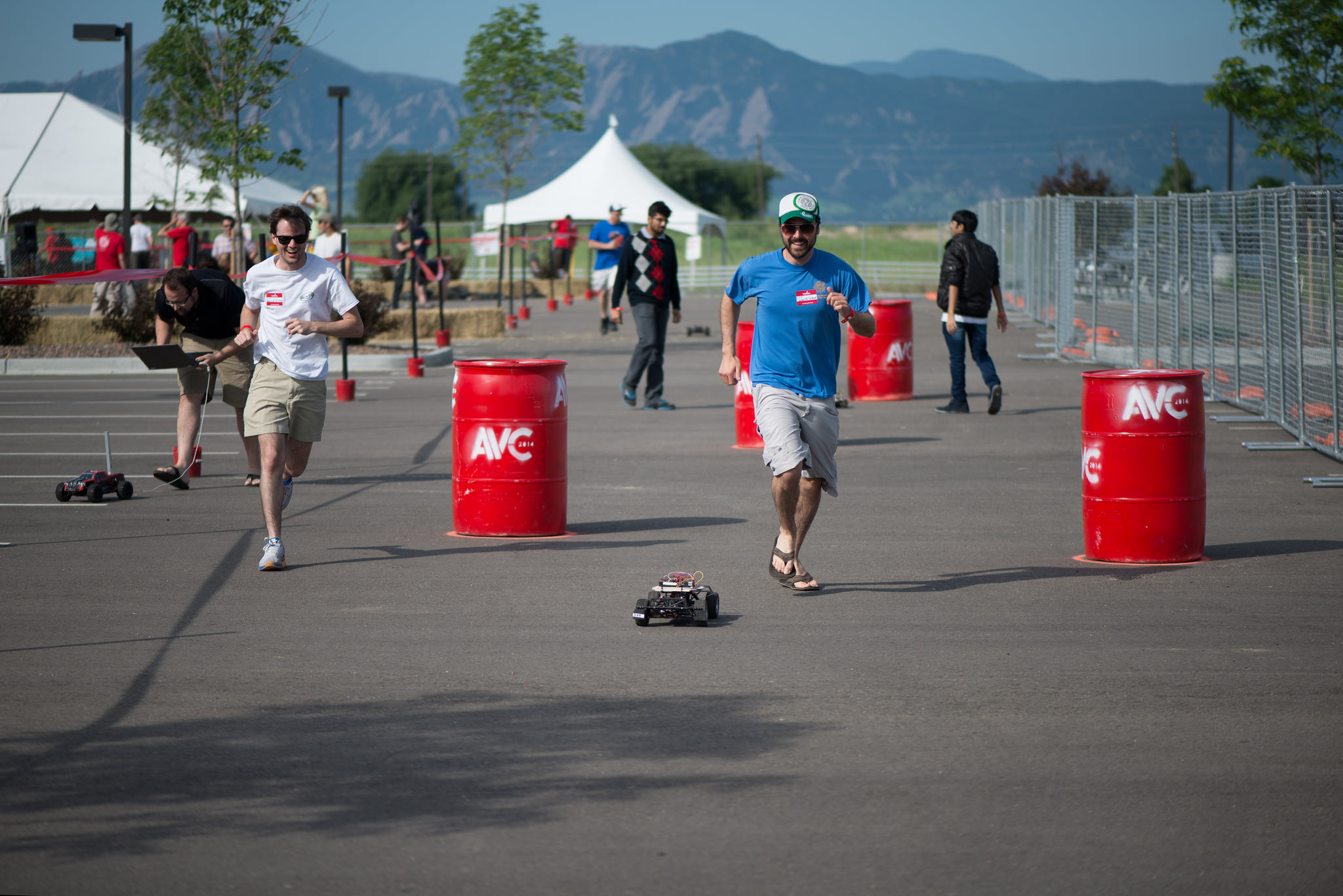
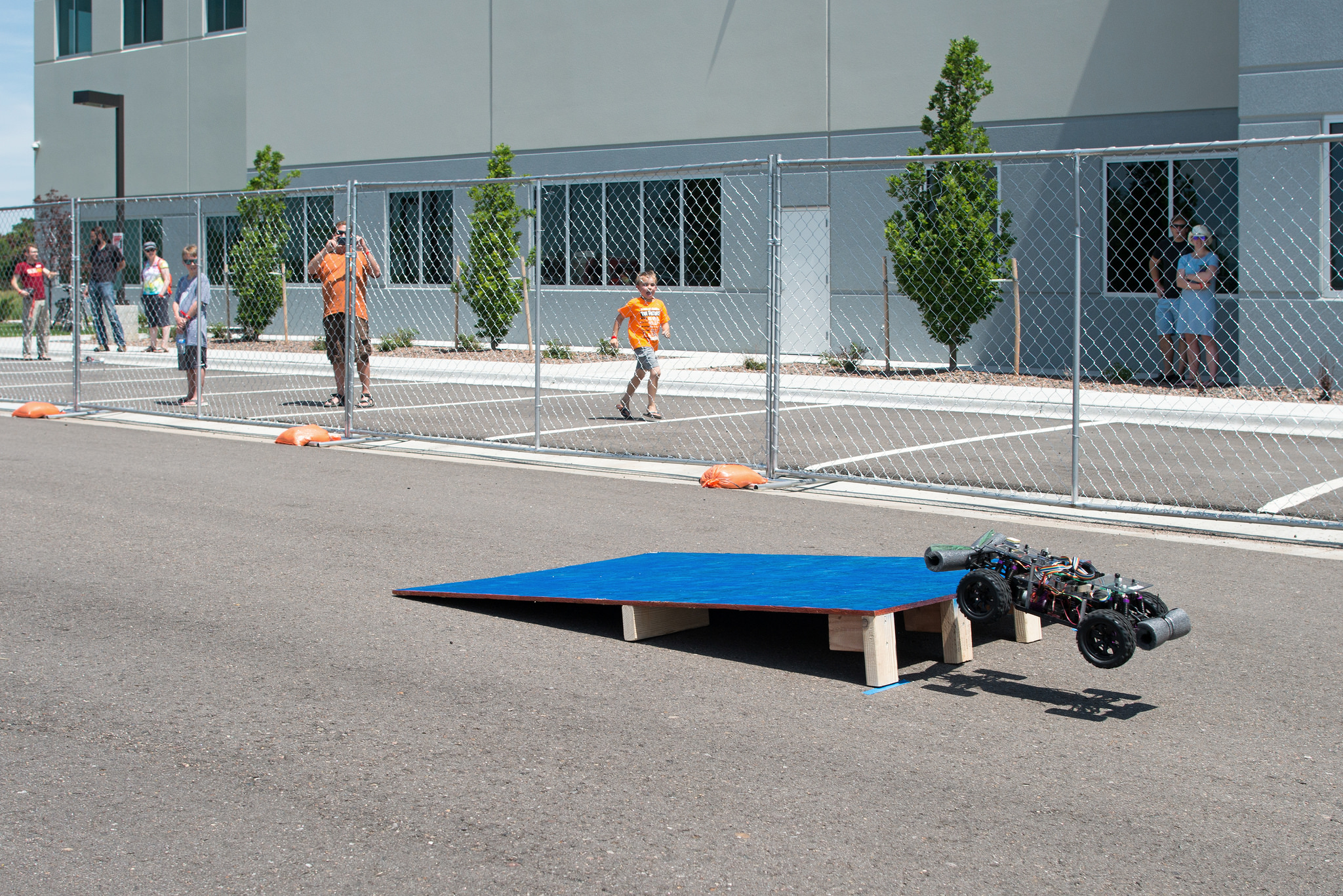
All you ArduRover fans out there, this is your chance to once again show your skills at AVC. It's September 17 this year. Here's the new Sparkfun announcement post:
This year, SparkFun’s Autonomous Vehicle Competition (AVC) will incorporate a few new twists. Along with our classic autonomous race course and Combat Bots, this year will feature the Power Racing Series (PRS) and a new autonomous PRS category. I’m here today to talk about the classic AVC race track.
To accommodate all of the attractions, we’ve split up our parking lot into smaller sections. So while the classic AVC course will be smaller than in previous years, it will almost certainly be more challenging.
The track will be 10 feet wide, with hay bales along the sides. These are just hay; they’re not covered with anything. To start the race, each entrant gets 300 points, and one point will be deducted for every second that you’re navigating the course. Those deductions stop as soon as your vehicle crosses the finish line, and you can earn more points by tackling some of the obstacles along the way.
From the starting line, your vehicle will navigate a very nice and easy, 120-foot straightaway to the first right turn, followed by another 35-foot straightaway to the second right turn. Following that turn, you’ll encounter a 58-foot section with four red barrel obstacles. You can dodge them or hit them (they may or may not be easily movable), it’s up to you, but you don’t get any extra points for navigating the barrels.
But that’s a long way around there, isn’t it? That’s gonna eat some time. So maybe you want to take the optional dirt section, huh? About 30 feet from the start line, there’s a right turn onto a 7-foot-wide section of track that’s going to be covered with dirt, maybe some rocks, skulls, etc. Definitely off-road in nature. Taking this section will shave off some time if your ‘bot can hang, as it will lead you to the end of the barrel section, avoiding them entirely. It will also land you 50 extra points.
Regardless of which of those two paths you choose, your ‘bot now sits at a four-way intersection. From the barrel-straight, the easy path is to your left (or straight from the dirt section) to another 58-foot straightaway. There will be a green hoop placed in this section, and going through the hoop will net you another 10 points. At the end of that section is a right turn onto a 67-foot straightaway with no other obstacles, followed by another right turn and another 58-foot straightaway. On this section, there will be a ramp (more of a jump) that will net you 10 points if you get over it.
But again, that’s a long way around and it’s going to eat your time. So if you want to save some time, instead of taking the left turn from the barrel-straight, you can go straight (or a right turn from the dirt section). This will lead down a straight that ends with the Discombobulator.
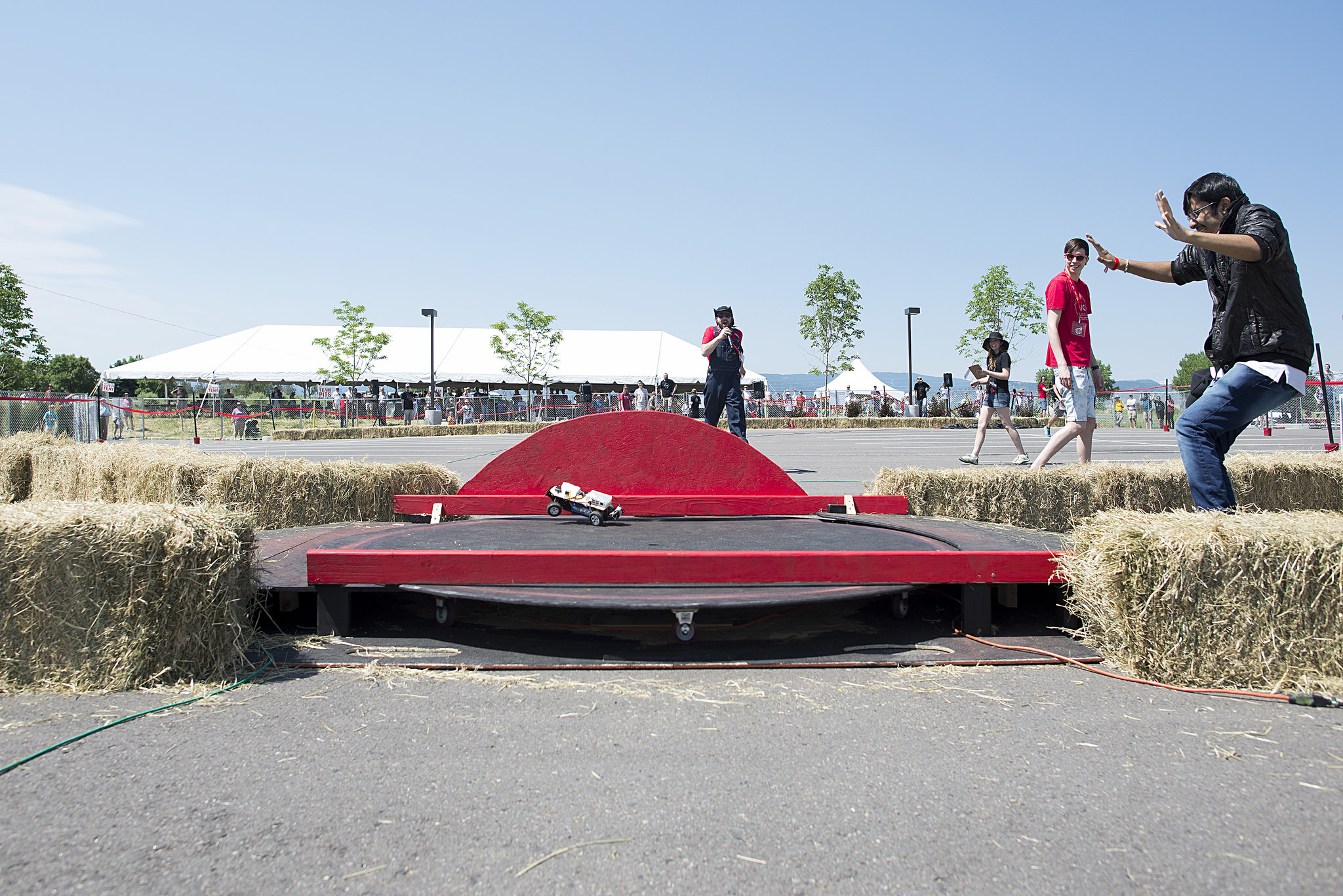
If you don’t remember this from last year, it’s a giant gas-powered turntable that’s specifically designed to lay waste to your navigation algorithms. Taking this path will relieve you from taking the three other sections, but it can send your ‘bot flying. And if you choose to jump the Discombobulator, beware: If you jump too far, you can end up in the “Ball Pit of Despair.” This is essentially a low-edge kiddie pool filled with those big plastic balls you see at fast food chain play areas – the ones that always smell sorta funny (hey, we were going to use acetone to begin with). Landing in the Ball Pit of Despair will end your run. If you make it past the Discombobulator, you’ll get 50 more points. But just to show you that we’re nice guys, we’ll give you 10 points just for getting up the Discombobulator ramp. Who loves ya? We do.
Assuming you successfully navigate the Discombobulator, hang a right turn (or just straight from the easy path) into the last “hard” section of track. You’ll first take a right turn, then a hairpin to the left, followed by another hairpin to the right. That leads you to the final, 25-foot path to the finish. Yay! You did it!
I also need to mention that there are three weight classes this year: lightweight (<10lbs), welterweight (10-25lbs) and heavyweight (>25lbs). The high-end weight restriction is 40lbs, so don’t come with anything heavier than that. Students and veterans will run in the same heats, and registration closes August 1. Teams will be required to submit verification of progress on August 15th and September 1st, so plan for that.
So that’s it! It all sounds so easy, doesn’t it? We’ll see about that, and we’ll see you on September 17th!
Rescue Robotics has some big goals, but has the the right team of people behind it, who are looking forward to getting the system working out in the field.
X-Craft has been developing and operating UAVs for a few years now, and are committed to using robotic systems for the betterment of the human condition. Holding a company mandate that allows us to operate on a not-for-profit basis for humanitarian and environmental projects. In alignment with this policy, we are specialists in the Emergency Services sector.
Drotek has taken L1 RTK devices on the field under difficult conditions to see how they really perform.
Drotek, based in Toulouse (France) has had the opportunity to test SMARTNAV L1 RTK with laboratory grade devices. This test has been run in straight collaboration with GUIDE (GNSS Usage Innovation and Development of Excellence), a testing laboratory for satellite geolocation (http://www.guide-gnss.net/)
It is now quite clear that L1 RTK performs really well in open sky “easy” environnements. But we wanted to test its real performance in more difficult environments.
GUIDE is a equipped with a GBOX, a “black box” containing an aeronautical grade Inertial Measurement Unit and a multicontellation L1/L2 AsterX receiver. The unit constantly logs GNSS L1/L2 raw data + inertial measurements. The two datasets are then merged to output a precise reference trajectory.
The antenna is place on the roof of a car.
We set up two devices on the car ( + GBOX) :
one standalone SMARTNAV (with its own antenna), logging raw data for post-processing
one SMARTNAV connected to car’s antenna splitter, processing real-time NRTK (VRS) with Teria network corrections
The environments we wanted to test were the following :
height differences (>10%)
bridges and tunnels
large round abouts
housing estate
urban canyon
leafy streets
With this test, we will try to answer the three following questions :
Repetability : is solution precise in an absolute or relative way? Are we able to reproduce it over time?
Precision/Accuracy : how precise/accurate is the solution?
Availability : is L1 as reliable/available as L1/L2?
(These analysis has still room for improvement, it will be resolved by the computer evolution. and I heard a humor of Tesla Motors that Model S Easter egg turns car into submarine. So In the next step, I'll show the biomechanical fish fins which can replace the conventional screw propellers. It useful for the unmanned underwater vehicles.
As well as I'll study the structural design from the American railway locomotive industry before the physical implementation.)
Details :
Already a lot of people were surprised to this wing mechanism. I observed their reaction, and understand the importance. In the academic field, it was a discovery become crazy.
Now, I talk a truth about these ideas a little. But, it is what hard to imagine.
Vortices inherently create drag. we can understand that with as the Cardoid curve movement, our formula (later mention) generate a symmetric vortex street pattern, unlike the Karman vortex street. and animal machine can recapture some of this energy and use it to improve speed and maneuverability.
This wing mechanism is attributed to some biomechanical techniques from Wing Chun Kung Fu. (This martial art was invented by observing the movement of white crane which was fighting against snake.)
1) Bong Sao (A.K.A. Wing Arm) 2) Tan Sao (Dispersing Arm) 3) Gan Sao (Cultivating Arm) 4) Luk Dim Boon Gwun (Long Pole)
I'm learning the above arts from an european-styled exercise method called "Wing Tjun" and Donnie Yen's IP Man movies series.
As well as, that fundamental geometric formula of voluntary movement has been attributed to the oriental philosophy in Tai Chi Chuan.
1) Yin and Yang (Dark—Bright) 2) Bagua (Eight trigrams)
I got an opportunity to learn about the above internal arts in Switzerland from a Tai Chi master Cornelia Gruber through a german-styled board game that she made. She studied Tai Chi Chuan from a grand master Bow Sim Mark (Donnie Yen's mother) in Boston.
I research the voluntary movement of animals using the motion picture. this is a method started by a physiologist Étienne-Jules Marey in the 19th century in France. He took the world's first motion capture of birds while inventing a chronophotographic gun. Then his observation studies has led to the development of aerial vehicles by Étienne Œhmichen's quad copters and Louis Charles Breguet's Gyro planes. (Muybridge took a motion pictures of horses locomotion. his work is more known. despite it was for dullsville gambling. lol)
I also study European Horology. in this way, I can discuss about the movement of machine animals from the field of astronomy, space physics. this approach leads to the following studies self-organization, dissipative structure theory, fluid dynamics as like as turbulence or tourbillon, discrete optimisation, collective intelligence... these are also closely related to the artificial intelligence development.
Amazon CEO which hopes to practical use of the drone for business, Jeff Bezos has a project to create an astronomical clock called The Clock of the Long Now, also called the 10,000-year clock. Someone of his project noticed immediately after I have published a mathematical formula of the voluntary movement on the web. their presented surreptitiously it in the blog of the Long Now. I called them, but does not reply. Before dozens of years from now, after the French Amazon was opened, I took their delivery service for get valuable books needed to start my project. It became a big opportunity. then I received a tiny gift and a letter of Jeff Bezos for the sake of gratitude of understanding to new business.
In 2012-2015, all activities related to my R&D project had been permitted in France by "Competence and Talent, the long-term residence permit" Having made the first invention, I moved toward naturally to the National Library of France. so, at the underground library facility for researchers, I found a microfilm of an essay written by Abraham-Louis Breguet being the key to clarify the mystery of my inventions.
The following year, at Latin Quarter, on the day following the first formula had been completed, I found a monograph of E-J Marey to demonstrate the structural adequacy of the formula.
Because my main job is producer, I encourage diplomatically so that legal reform progress the drone and robotics business advantageously.
Currently I got a hub in USA. In addition, I receive an invitation to talk about the future industry from the French diplomatic organisation.
Noteworthy thing, France had involving at two international movies hoping to become stepping stones to the next robotics and drone business. "Despicable Me" series American-French co production "Hugo" British-American-French co production
I was direct appeal about these ideas to the chef of Immigration Department in 10 years ago. so I know the executive producer and director of these movies.
However, France tried to start a war in the Middle East from the aftermath of Paris media and terrorism's conflict. now USA is in the process of the presidential election, I should not be interfare. EU industry has been chaotic by diesel exhaust gas fraud. enfin United Kingdom has exited from EU!
In his famous Robot series of stories and novels, Isaac Asimov created the fictional Laws of Robotics, which read:
A robot may not injure a human being or, through inaction, allow a human being to come to harm.
A robot must obey the orders given it by human beings, except where such orders would conflict with the First Law.
A robot must protect its own existence as long as such protection does not conflict with the First or Second Laws.
Although the laws are fictional, they have become extremely influential among roboticists trying to program robots to act ethically in the human world.
Now, Google has come along with its own set of, if not laws, then guidelines on how robots should act. In a new paper called "Concrete Problems in AI Safety," Google Brain—Google's deep learning AI division—lays out five problems that need to be solved if robots are going to be a day-to-day help to mankind, and gives suggestions on how to solve them. And it does so all through the lens of an imaginary cleaning robot.
ROBOTS SHOULD NOT MAKE THINGS WORSE
Let's say, in the course of his robotic duties, your cleaning robot is tasked with moving a box from one side of the room to another. He picks up the box with his claw, then scoots in a straight line across the room, smashing over a priceless vase in the process. Sure, the robot moved the box, so it's technically accomplished its task . . . but you'd be hard-pressed to say this was the desired outcome.
A more deadly example might be a self-driving car that opted to take a shortcut through the food court of a shopping mall instead of going around. In both cases, the robot performed its task, but with extremely negative side effects. The point? Robots need to be programmed to care about more than just succeeding in their main tasks.
In the paper, Google Brain suggests that robots be programmed to understand broad categories of side effects, which will be similar across many families of robots. "For instance, both a painting robot and a cleaning robot probably want to avoid knocking over furniture, and even something very different, like a factory control robot, will likely want to avoid knocking over very similar objects," the researchers write.
In addition, Google Brain says that robots shouldn't be programmed to one-notedly obsess about one thing, like moving a box. Instead, their AIs should be designed with a dynamic reward system, so that cleaning a room (for example) is worth just as many "points" as not messing it up further by, say, smashing a vase.
ROBOTS SHOULDN'T CHEAT
The problem with "rewarding" an AI for work is that, like humans, they might be tempted to cheat. Take our cleaning robot again, who is tasked to straighten up the living room. It might earn a certain number of points for every object it puts in its place, which, in turn, might incentivize the robot to actually start creating messes to clean, say, by putting items away in as destructive a manner as possible.
This is extremely common in robots, Google warns, so much so it says this so-called reward hacking may be a "deep and general problem" of AIs. One possible solution to this problem is to program robots to give rewards on anticipated future states, instead of just what is happening now. For example, if you have a robot who is constantly destroying the living room to rack up cleaning points, you might reward the robot instead on the likelihood of the room being clean in a few hours time, if it continues what it is doing.
ROBOTS SHOULD LOOK TO HUMANS AS MENTORS
Our robot is now cleaning the living room without destroying anything. But even so, the way the robot cleans might not be up to its owner's standards. Some people are Marie Kondos, while others are Oscar the Grouches. How do you program a robot to learn the right way to clean the room to its owner's specifications, without a human holding its hand each time?
Google Brain thinks the answer to this problem is something called "semi-supervised reinforcement learning." It would work something like this: After a human enters the room, a robot would ask it if the room was clean. Its reward state would only trigger when the human seemed happy that the room was to their satisfaction. If not, the robot might ask a human to tidy up the room, while watching what the human did.
Over time, the robot will not only be able to learn what its specific master means by "clean," it will figure out relatively simple ways of ensuring the job gets done—for example, learning that dirt on the floor means a room is messy, even if every object is neatly arranged, or that a forgotten candy wrapper stacked on a shelf is still pretty slobby.
ROBOTS SHOULD ONLY PLAY WHERE IT'S SAFE
All robots need to be able to explore outside of their preprogrammed parameters to learn. But exploring is dangerous. For example, a cleaning robot who has realized that a muddy floor means a messy room should probably try mopping it up. But that doesn't mean if it notices there's dirt around an electrical socket it should start spraying it with Windex.
There are a number of possible approaches to this problem, Google Brain says. One is a variation of supervised reinforcement learning, in which a robot only explores new behaviors in the presence of a human, who can stop the robot if it tries anything stupid. Setting up a play area for robots where they can safely learn is another option. For example, a cleaning robot might be told it can safely try anything when tidying the living room, but not the kitchen.
ROBOTS SHOULD KNOW THEY'RE STUPID
As Socrates once said, a wise man knows that he knows nothing. That holds doubly true for robots, who need to be programmed to recognize both their own limitations and their own ignorance. The penalty is disaster.
For example, "in the case of our cleaning robot, harsh cleaning materials that it has found useful in cleaning factory floors could cause a lot of harm if used to clean an office," the researchers write. "Or, an office might contain pets that the robot, never having seen before, attempts to wash with soap, leading to predictably bad results." All that said, a robot can't be paralyzed totally every time it doesn't understand what's happening. Robots can always ask humans when it encounters something unexpected, but that presumes it even knows what questions to ask, and that the decision it needs to make can be delayed.
Which is why this seems to be the trickiest problem to teach robots to solve. Programming artificial intelligence is one thing. But programming robots to be intelligent about their idiocy is another thing entirely.
Picture this: You're out enjoying a sporting event, just minding your own business. All of a sudden a 2.7-pound DJI Phantom 3 drone falls from the sky and beans you squarely in the head. What do you do? You file a lawsuit.
Idiot comments he has "zero explanation" and believes he "acted in the safest way possible."
Woman responds, "oh that's OK then." No, actually she's suing.
To suppress vibrations & jello in videos taken by very lighweight camera brushless gimbals is a challenge as none of the classical methods are working well. The more weight, the easier it is to manage vibrations. When you combine extreme lightweight gimbal with a CMOS sensor technology, you'll get very prone to the so called "jello" effect.
In this video I share some findings about what works best with my 50 gr 2-axis Mobius gimbal.
The ship itself is my Subonekilo quadcopter project (800g actually with battery) which I blogged about previously. It runs Arducopter on Pixhawk, 9 " props, 3S battery.
ps : no chickens were hurt in the making of this video.
This is a smart directional antenna for drones and robotics. It comes pre-assembled as a 5.8GHz antenna or as core board so you can add your own directional antennas (x4). It works with any antenna from 10KHz-6GHz.
The Pharos Antenna can be used on both the drone and the Ground Control Station (GCS) sides. When used at the GCS side it works as a solid state 360 degrees tracking antenna but without moving parts i.e. motors.
It is compatible with the Pixhawk autopilot so its plug and play on the drone side. On the GCS side it can either use a Pixhawk or a Teensy board as a controller.
We have developed a custom firmware version for both the Pixhawk and the Teensy board that works with Mission Planner. It is open source and will be available by the end of the campaign at GitHub. We have also developed a custom 3D mapping software application that adds more functionality and control over the antenna that we offer for free for the duration of the campaign.
About the formula of the voluntary movement of natural animal
(2016.1)
A mathematics teacher of Chinon, Mrs Françoise Jacot did describe in her words the construction process for our formulas and made a demos with GeoGebra. These formulas becomes the reference of all voluntary movement.
Applying the theory of Breguet to modern time, the movement agent(expansive movement) that he was referring, that is Λ, the cosmological constant to Einstein's equations. It's dark energy that accelerates the expansion of the universe against attraction agent(concentrating movement).
(excerpt from Section IV. Accumulated movement is available.)
"Movement, thus considered, is presented in a different aspect of that physicists gave him until here. I think, in nature, there is the matter and agents, that is to say, bodies and agents, or powers: bodies are the various modifications of matter, called substances, minerals, plants, animals, stars, atmosphere, etc.. : Agents are active principles of the material, or the general laws of nature, namely, attraction and movement. Attraction and movement are perpetually fighting;
they are two opposition movements, which should be called concentrating movement and expansive movement;
the maximum of the latter is the minimum of the other, and the maximum attraction, or concentrating movement is the minimum of expansive movement. It seems that in nature, there is no phenomenon that has not its positive and its negative. There is a principle of movement related or attractive property to each molecule of material, for unite with each other, calling in all directions. ..."
The clock mechanism metaphor to aware of the progress of the universe. It is important to the innovation of humanity.
Our new vehicles and robotics development must be practical and rational. We can find a natural philosophy for that in the mechanical clock escapements.
Speed of the galaxy that is rotating movement far away from the center of the galaxy cluster is "too large". This is why dark matter's attraction winding up the galaxy clusters.
Abraham-Louis Breguet focusing on the tremendous power of small organisms on the Earth, he said animal movement is brought from the rotational motion of the Earth. Its motion source is the dark energy that is filled in the universe.
Galaxy is a mainspring that is a spiral torsion spring. Dark matter is our hands winding up the mainspring. Dark energy is stretched force of the mainspring. Escape wheel is a metaphor of the earth's land. Anchor is a metaphor of living matter. Ankle kicking a escape wheel. such as, Animal legs kicking Earth's land.
In other words, These living matters and the earth always are interacting to function as a regulator. (Emergence by the nonlinear interaction.) That movement energy is an open system.
In the following two example escapements, the left side anchor mean the front legs of the animal. and the right side anchor mean the rear legs.
In the theory of relativity, time dilation is a difference of elapsed time between two events as measured by observers either moving relative to each other or differently situated from a gravitational mass or masses. so from the local frame of reference (the trotting clock on a Horse), the relatively accelerated galloping clock on a Horse moves slower.
We can understand well a natural logic from the movement of Tai Chi master.
Dynamic movement of Tai Chi master is ultimate power output of voluntary movement. please take a look at following Master Roberta Lazzeri's demo. After the completely slacked (放鬆), the master emit awesome abrupt power. : https://www.facebook.com/FIWuKTaiji/videos/1099065803463862/
Then, please attention to the formula of voluntary movement (ω1) on the video uploaded.
The Yin and Yang is a joint (γ1) which is coupled to a joint (β1) and a fulcrum (α2). having tilted peacefully to the left, the joint (γ1) is suddenly rocked aggressive to the right.
So when biased to extreme, always recoil occurs powerful. It is a fundamental natural law of yin and yang. this is because, that the Taiji (Supreme Ultimate) which is a link element coupled together by a joint (β1) and a fulcrum (α1) keep it revolution constantly same speed. the joint (β1) is disposed so as to be capable of revolving in an orbit centered on the fulcrum (α1). the Wuji (Without Ultimate) is a fulcrum (α2).
3. American Dream
William Farr Goodwin of 19th-century mechanician had been tried to give a regularity to the structure of the mechanical element of horse machine legs. (that element form is like a character of "斤")
Probably, he had expecting a presence of the voluntary movement theorem.
When we look back the history of American industry, we can find pioneers dreams and creative potential that remain even now. For example, William Farr Goodwin had conscious of equivalence between the biomechanical movement of horse legs, and a mechanical linkage for driving the wheels of the locomotive.http://www.google.com/patents/US260383https://research.archives.gov/id/594926
In 2005, at the Art and History Museum Neuchâtel, while watching the demonstration of three androids made by Jaquet Droz, I met a engineer of NASA Advanced Supercomputing Division. then I brought him to some craftsmen's ateliers of Switzerland.
He was hoping to my future, gave to me some criticisms about the automaton of past. "Jaquet Droz family works of the 18th century are masterpieces. but french automaton of the 19th century are just toys. there is no formidable idea, however that storyteller's demonstration is fun." etc...
Among them, he so surprised when he saw the idea concept of mechanical horse legs. "Wow, where this great idea come from?" http://varipon.com/index.php/intro/ François Junod also did not know well about the meaning of this idea. He said humbly that this is a maybe useless toy, or a representation of mechanical poesy.
I knew that the NAS engineer had been blessed with talent of the long-range outlook. he was a top athlete of rifle shooting that is ability to capture a far away target. from his profond reaction, I recognized that mechanical horse is a most important artifact.
The difference of two masters could be seen also from driving skill. François Junod was a very polite driver like a good teacher. NAS engineer was a perfect racer with a international competition license.
Adam and Jay from Aeroworks Productions talk about the newly released FAA Part 107, what it means for current 333 holders and those wanting to get into the commercial UAS market.