All Posts (11086)

Sort by
Developer

APM:Rover 3.0.1 Released!

3689693742?profile=original

Release 3.0.1, 17 June 2016

The ArduPilot development team is proud to announce the release of version 3.0.1 of APM:Rover. This is a minor release with small but important bug fix changes.

The two main motivations for this release
1. Fixing the arming for skid steering Rovers
2. Fix to the rover steering that should really improve steering of all rovers.

Skid Steering Arming

Fixed arming for Skid Steering rovers. You should now be able to arm your skid steering rover using the steering stick. NOTE skid steering Rovers - you will not be able to disarm. The reason for this is zero throttle full left turn is a perfectly valid move for a skid steering rover as it can turn on the spot. You don't want to be executing this and have the rover disarm part way through your turn so we have disabled disarming via the steering stick. You can still disarm from the GCS. Thanks to Pierre Kancir for working on this.

Improved Steering Control

For historical reason's the steering controller was using the raw GPS data for ground speed without any filtering. If you have every graphed this data you will see on a rover its very spiky and all over the place. This spiky'ness was feeding into the lateral accel demand and causing inaccuracies/jitters. Now we using the EKF GPS filtered data which is much smoother and accurate and the steering control has greatly improved.

Improved Cornering

Previously when corning we didn't take into account any "lean or tilt" in the rover - we assumed the turns were always flat. We have changed this to now take into account any lean so turning should be more accurate. Boat users should really benefit from this too.

MAVLink2 support has been added

See this post by Tridge -

http://discuss.ardupilot.org/t/mavlink2-is-in-ardupilot-master/9188/1

The other changes in this release are:

  • setting your sonar_trigger_cm to 0 will now log the sonar data but not use it for vehicle avoidance.
  • the throttle PID is now being logged
  • range finder input is now being captured (thanks to Allan Matthew)
  • added LOG_DISARMED parameter
  • merge upstream PX4Firmware changes
  • numerous waf build improvements
  • numerous EKF2 improvements

Thanks to everyone who helped on the release.

Read more…

back on street on minute 22:00 ;)

Today i´d tried the first high speed tests on public streets with our rover. Time was good cause the streets were empty during the german football match. And, what could i say, i´m impressed how perfect the FPV (720p25 latency max 200ms) and R/C (Latency max. 70ms)  over multiple public cellular networks did work at 30kph.

3689693709?profile=original

not only autonomous driven is interesting - think about the opportunities of remote control driven vehicles by operator 

Read more…

Observer/Ranger Quadplane


3689693359?profile=original

Here is a short build log showing the work required to convert my Quanum Observer to VTOL Quadplane. The mods are done in such a way that the Quadplane can be reverted to pure fixed wing in around 10mins for ultra long duration flight (+-80mins on 15AH packs) and when a landing strip is available.

Total weight added for Quadplane is 1,320g but only 270g of this is permanent (ie. fixed items such as carbon spars in the wings, mounting legs, wiring in the wings, glue, etc). Total all-up weight in Quadplane mode is around 4,800g (including camera and gimbal).

Specs as follows:
Frame size 1070mm (measured diagonal)
T-Motor MT4006 740KV
T-Motor Air 40A ESC
T-Motor carbon props 14 x 4.8
4S 10,000mAh
Pixhawk flight controller, running firmware version 3.6.0 with Quadplane support.

I've done some hover tests and transition flight will hopefully happen soon.Here is a video to show the stabilized footage I was getting before converting to Quadplane: https://vimeo.com/163169301

Thanks to all for the great work being done in this community, particularly Tridge! 

Cheers,

Jacques

3689693308?profile=original3689693402?profile=original3689693384?profile=original3689693427?profile=original3689693334?profile=original3689693552?profile=original3689693459?profile=original3689693510?profile=original3689693536?profile=original3689693484?profile=original

Read more…
Developer

3689693661?profile=original
This is my endurance record at the time, but I think I can do better.
The test was performed on a day with strong winds, shall be equal and over to the navigation speed (11 m/s), it's indeed very curious to see how it behaves my "Mini Talon," sometimes flies backward (at 14.00% in the log), with the groundspeed around "0 m/s".
In a previous flight I did over 114 km, but flying "only" 02:52:00.
The battery pack is Li-Ion 4S3P 10.500 mAh "Sanyo 18650GA", with max of 30A discharge.
Unfortunately the "3DR Power Modules" current sensor is very inaccurate, so the trend of current in the log is not reliable, but the voltage is quite true.

This image shows the flight data after the land, "tempo di volo" in italian is the "flight time":

3689693617?profile=original
And here the residue of the battery pack, this shows that I was thoroughly conservative:

3689693578?profile=original
In a previous flight i reached 114 Km, but flying "only" 2 hours ad 52 mins.

Configuration:
X-UAV MiniTalon
ParkZone 15-Size Brushless Motor (720 Kv)
Aeronaut folding propeller 10x6
E-Flite Pro  30A ESC
Pixhawk with "APM:Plane" V3.6.0
Neo M8N GPS
Analog Airspeed Sensor
Home made Li-Ion battery pack 4S3P 10.500 mAh "Sanyo 18650GA"
1619gr AUW

Flight data:
Total travel: 93,4 Km
Total flight time: 3hours 11mins
Battery used: 8300 mAh (residual: over 20%)
Flight alt: 100mt
Max wind speed: 13 m/s (average: 8 m/s)
Battery failsafe voltage: 12.8V

Here the telemetry log about this endurance test:

https://drive.google.com/folderview?id=0B3HEcrNCOga9bkRkMi00d0cwM0k&usp=sharing

Thanks to all the "ArduPilot Dev Team"!

Marco

Read more…
3D Robotics

Read more…

Drone Formation Flying.... Just Push Play!

I finally put some time and effort into an integration between Dronekit Python and the Systems Tool Kit (STK) software this past weekend.  My goal was to be able to plan a flight inside of STK, connect to my drone(s), and basically just press play to animate the scenario and see it play out in the sky above me!

The short of the story is that I had great success, but also realized that I could adjust the animation speed on the fly (i.e. play things faster or slower and see the drone(s) respond in the sky), or I could Pause/Reset/Reverse/Etc. at any point during the flight!  It worked great!

Above is a quick video of the setup and my first test with 2 drones flying formations I created in STK.

I hope to have a few more demonstrations of this with a few more drones in the coming days/weeks, but this was a great integration with a lot of capability for controlling the "choreography" of the drones in realtime!

Read more…

3689693273?profile=original

The latest pilot version of Precis-BX316 RTK board was showed during 7th China Satellite Navigation Conference in May. This version supports GPS L1L2/BDS B1B2/GLONASS G1G2 and with GPS L1L2 heading mode. In addition, it supports up to 20Hz RTK solution output and onboard SD card for raw data logging, which is key for post process and data analysis. Camera shuttle synchronization feature for aerial mapping applications is added as well. They are ideal for UAVs. The official launch of Precis-BX316 will be in Q4 and datasheet is ready now. If you are interested and want to get details of technical specifications, drop us a line to sales@tersus-gnss.com or click Datasheet for Precis-BX316. Stay tuned. 

Read more…
3D Robotics

Radiolink SE100 GPS module for Pixhawk

3689693253?profile=original

Anybody know anything about this one? It's $35 from Roboshop:

  • 2.5dbI high gain and selectivity ceramic antenna
  • MMIC BGA715L7 from Infineon power amplify IC
  • SAWF (Surface acoustic wave filter) form Murata
  • HMC5983 from Honeywell geomagnetic

The Radiolink SE100 GPS Module for PixHawk exceed the limitation of IC sensitivity index from circuit schematic design to PCB placement.1 meters positional accuracy, positioning in 23 seconds and valley station keeping ability.

Specifications

  • Positional Accuracy: 1m precision when working with concurrent GNSS, 2.5m precision when working with single GNSS
  • Velocity precision: 0.1m/s
  • Max height: 50000m
  • Max speed: 515m/s
  • Max acceleration: 4G
  • Max update rate: up to 18Hz
  • Sensitivity Tracking & Nav.: -167dBm; Reacquisition:-163dBm; Cold start:-151dBm; Hot start:-159dBm
  • Time to first fix: Cold start: 26s, Hot start: 1s
  • Connect ports
  • Power supply: voltage 3.3VDC+-5%, current 50~55mA

Ports

  • A.GPS UART interface, baud rate: 1.2K/4.8K/9.6K/19.2K/38.4K/57.6K/112.5K
  • B.Geomagnetic I2C interface
Read more…

3689693160?profile=original

In 2015 DJI announced the DJI Matrice 100 – their version of a drone for developers and hardware enthusiasts. In early 2016 they released the new Phantom – DJI Phantom 4. Both of these drones feature intelligent maneuvering systems capable of seeing obstacles and are also capable of being equipped with state-of-the-art cameras.

We are pleased to announce that UgCS ground station software for drones will be supporting both – DJI Phantom 4 and Matrice 100. This support will be available in the upcoming version of UgCS - 2.9 which will be released in late June. UgCS is an easy-to-use ground station software which gives you the power to control your drones and send them on automated missions. It runs on Windows and Mac OS X. Phantom 4 and Matrice 100 will be able to connect to UgCS running on a laptop through the Android app UgCS for DJI.


Take a sneak-peek into the features of UgCS 2.9 here:


Phantom 4 and Matrice 100 will be added to the existing list of drones supported in UgCS ground station software. Currently from DJI UgCS supports the following drones:


Phantom 2, Phantom 2 Vision+, Phantom 3, Inspire 1, Ace One, Naza-M V2, A2 and Wookong-M


UgCS also supports drones from other manufacturers such as 3D Robotics, Microdrones, MicroPilot, MikroKopter and even Lockheed Martin.

Get UgCS here: www.ugcs.com

Safe flights,
UgCS Team

Read more…

QGroundControl Usability Test Report

3689693177?profile=original

We’d like to share the Usability Test Report [1] we did for QGC. This report is about the findings from the test which the main purpose was to observe final users dealing with the software interface to address gaps and opportunities from a more realistic point of view improving the overall usability.

 3689693223?profile=original

Comments and suggestions are welcome. We hope the material is useful for future implementations.


Please, contact us for any questions.


[1] https://biapalmeiro.gitbooks.io/qgroundcontrol-usability-test-report/content/


Cheers,

Beatriz Palmeiro

Read more…

evan-palmer

Check out the story on my project!

How’s this for an entrepreneurial spirit and a sharp mind? Evan Palmer, a sophomore over at Amherst High School, is currently developing a fixed-wing drone that will be able to survey crops in Amherst when it is completed. This particular drone will be paired to an infrared camera and 3D mapping software so that it makes life easier for farmers to identify crop issues.

This particular project kicked off after Palmer applied for a $1,000 grant from the Nebraska Farm Bureau, which was duly rewarded to him. Apart from that, Palmer also managed to gain the attention of other sponsors who have since done their bit to assist in the construction of the drone via donations. Palmer also gleaned wisdom from online forums to figure out the drone’s building process as well as required parts, and from there, he shared, “I started to get a basic idea of what I needed for the drone. From there, I started building a components list.”

Palmer further explained that he picked the fixed wing because it will be able to cover a larger area in less time, which is always a good thing where efficiency is concerned. A normalized difference vegetation index imaging system was picked to use infrared photos of crops as an indicator of their health status. This allows farmers on the ground to check out crop health from above without having to walk through their plantation all day long, and will also allow them to make decisions on the spot concerning crop health.

Nebraska Farm Youth of the Month

https://www.youtube.com/watch?v=imX5TGjmUTI

Read more…
Developer

APM:Plane 3.6.0 released

3689651507?profile=originalThe ArduPilot development team is proud to announce the release of version 3.6.0 of APM:Plane. This is a major update so please read the notes carefully.

The biggest changes in this release are:

  • major update to PX4Firmware code
  • major update to QuadPlane code
  • addition of MAVLink2 support

Updated PX4Firmware

The updated PX4Firmware tree greatly improves support for the new Pixracer boards as well as improving scheduling performance and UAVCAN support. It also adds OneShot support for multirotor motors in QuadPlanes.

QuadPlane Updates

The QuadPlane changes are very extensive in this release. A lot of new features have been added, including:

  • improved automatic weathervaning
  • greatly improved support for mixed fixed wing and VTOL missions
  • automatic RTL with VTOL land
  • VTOL GUIDED mode support
  • greatly improved transition code
  • new tuning system for VTOL motors
  • extensive upgrade to logging system for much better flight analysis

 
The new QuadPlane features are documented at:

http://ardupilot.org/plane/docs/quadplane-support.html

Please read the documentation carefully if you are flying a QuadPlane!

Tiltrotors and Tiltwings

This release has initial support for a variety of tiltrotors and tiltwing configurations. So far testing of these types of aircraft has been limited to simulations and it should be considered very experimental.

MAVLink2 Support

The new MAVLink2 support will allow for greatly expanded MAVLink protocol features in the future, and includes support for signing of MAVLink connections for the first time, making them secure against malicious attacks. I will do a separate blog post on upgrading to MAVLink2 soon. MAVLink1 is still the default for this release, but you can enable MAVLink2 on a per port basis by setting SERIALn_PROTOCOL=2.

Credits

Many thanks to everyone who has contributed to this release. Tom and I have been delighted at the number and quality of contributions across the community, and to the extensive testing and flight logs that have been provided.

We would also like to give a special thanks to UAV Solutions for sponsoring the development of many of the new QuadPlane features in this release and Airphrame for development of the improvements to the landing code. We'd also like to thanks aAVIonix for providing hardware for testing of ADSB features.

Special thanks also for the great contributions by many long term contributors to the project. Major contributions to this release have been made by:

  • Peter Barker
  • Lucas De Marchi
  • Gustavo Jose de Sousa
  • Leonard Hall
  • Paul Riseborough
  • Francisco Ferreira
  • Michael du Breuil
  • Grant Morphett
  • Michael Oborne
  • The PX4 development team

among many others. Tom and I really appreciate the effort!

Some of you may also have noticed that Tom Pittenger from Airphrame is now co-lead with me on the fixed wing support for ArduPilot. Tom has been a major contributor for a long time and the dev team was delighted to appoint him as co-lead.

Other Changes
Detailed changes in this release include:

  • added motortest for all quad motors in sequence
  • merge upstream PX4Firmware changes
  • new AC_AttitudeControl library from copter for quadplane
  • modified default gains for quadplanes
  • new velocity controller for initial quadplane landing
  • smooth out final descent for VTOL landing
  • changed default loop rate for quadplanes to 300Hz
  • support up to 16 output channels (two via SBUS output only)
  • fixed bug with landing flare for high values of LAND_FLARE_SEC
  • improved crash detection logic
  • added in-flight transmitter tuning
  • fix handling of SET_HOME_POSITION
  • added Q_VFWD_GAIN for forward motor in VTOL modes
  • added Q_WVANE_GAIN for active weathervaning
  • log the number of lost log messages
  • move position update to 50hz loop rather then the 10hz
  • Suppress throttle when parachute release initiated, not after release.
  • support Y6 frame class in quadplane
  • log L1 xtrack error integrator and remove extra yaw logging
  • limit roll before calculating load factor
  • simplify landing flare logic
  • smooth-out the end of takeoff pitch by reducing takeoff pitch min via TKOFF_PLIM_SEC
  • added support for DO_VTOL_TRANSITION as a mission item
  • fixed is_flying() for VTOL flight
  • added Q_ENABLE=2 for starting AUTO in VTOL
  • reload airspeed after VTOL landing
  • lower default VTOL ANGLE_MAX to 30 degrees
  • Change mode to RTL on end of mission rather then staying in auto
  • implemented QRTL for quadplane RTL
  • added Q_RTL_MODE parameter for QRTL after RTL approach
  • reduced the rate of EKF and attitude logging to 25Hz
  • added CHUTE_DELAY_MS parameter
  • allow remapping of any input channel to any output channel
  • numerous waf build improvements
  • support fast timer capture for camera trigger feedback
  • numerous improvements for Pixracer support
  • added more general tiltrotor support to SITL
  • only save learned compass offsets when disarmed
  • support MISSION_ITEM_INT for more accurate waypoint positions
  • change parachute deployment altitude to above ground not home
  • added AP_Tuning system for QuadPlane tuning
  • added initial support for tiltrotors and tiltwings
  • added LOG_REPLAY and LOG_DISARMED parameters
  • added Q_GUIDED_MODE parameter
  • major update to QuadPlane documentation
  • added MAVLink2 support
  • fixed origin vs home altitude discrepancy
  • improved Lidar based landing glide slope
  • fixed throttle failsafe with THR_PASS_STAB=1
  • prevent EKF blocking during baro and airspeed cal
  • allow for ground testing of parachutes with CHUTE_MINALT=0
  • fixed elevator stick mixing for above 50% input
  • added QuadPlane ESC calibration

Happy flying!

Read more…

When it comes to learning about drones. Do we really learn? Discover and progress our hobby with UAV by simply watching Youtube videos. Well as a new pilot in 2015 I have to say (YES) ok OK ok You must be thinking what is this newbie pilot talking about? 

Youtube was the initial introduction to RC/UAV/Drones with a wealth of false and sponsored retrick which was in my personal experience entertaining. But for a poor few,  simple lack of investigation introduced them to some TOY products. I was lucky! 

What was more Interesting with my tube experience was the fact That how many people in comments directed me to websites such as DIY Drones. Through this website and other social media platforms you can strike relationships.. Not dating ones lols.. Not to many girls fly drones... But meet people locally and share and make videos that can inspire

If anyone knows the videos I produce they will understand that when you collaborate you can make a great vid.

Here is a video that a friend made after watching my videos,and  went out and brought a drone. Like me I got a drone after watching another friends video to see If I could do one too.

This is the end result. I edited it and added music. The Pilot is the quality in this voyage of discovery.

I hope you like the video as it shows about sharing the passion for drone together 

Read more…

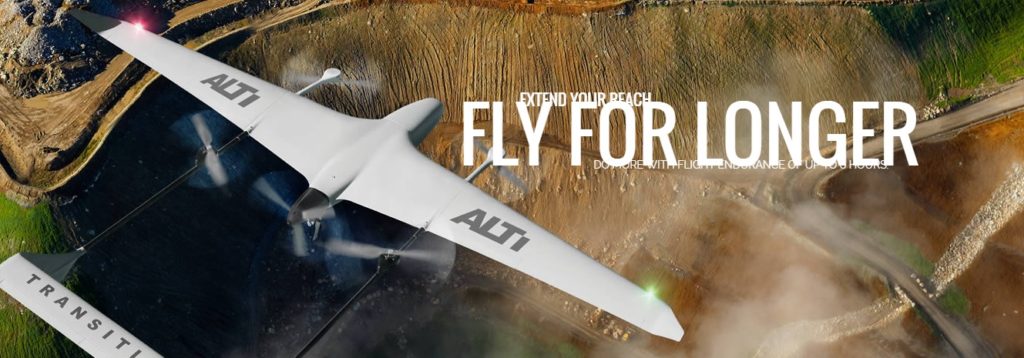
ALTI Transition 6 hour VTOL cargo lifter

altiuas

Congratulations to all at ALTIUAS an RPA made in Africa, for Africa and the rest of the world. This would meet the delivery drone targets of many emerging projects. Instead of delivering things swap out the payload for cameras and be able to survey large areas in rough terrain.

"The ALTI Transition is a radically new VTOL unmanned aerial aircraft, developed from the ground up as an advanced fixed wing system with the ability to take-off and land vertically, anywhere. A powerful electric VTOL system allows the Transition to take-off and land in confined spaces and once at altitude, a 20cc four stroke petrol motor keeps the system airborne for up to 6 hours with support for a wide range of payloads and sensors that can quickly be swapped out and setup. Fully featured autonomous PX4 based open and proprietary software and hardware avionics system with easy to use ground control systems to suite.

Here at Alti we believe vertical take-off and landing is now an essential part to operating small unmanned systems effectively and the ability to operate a fixed wing aircraft from confined areas is invaluable and a huge advantage over bulky traditional systems. Operating costs and staff requirements are reduced significantly allowing more flexibility and a broader mission scope.

altiuasdetail


DOUBLE HYBRID
Multi-rotor and fixed wing, electric and fuel, the Transition is a double-hybrid aircraft unlike anything else available. With a small footprint and no need whatsoever for launch or recovery equipment, it really is the future of small unmanned systems, making operating far more versatile and cost effective.

PURE VTOL
With no need for a take-off run, it's a pure VTOL aircraft, able to vertically ascend to altitude, where it transitions into forward wing-bound flight for the duration of the mission. A smooth and quick transition back to hover with a final descent for a pin point landing.

ENDURANCE
Extend your mission parameters with endurance of up to 6 hours. The ultra-light weight Carbon Kevlar fuselage made with top quality composites used by the likes of Ferrari, Airbus and BMW. It's wind tunnel tested featuring an advanced design with dihedral, washout, winglets and more. The Transition also has duel elevators for redundant control.

AFFORDABILITY
With far lower operating costs as well as no need for expensive launch and recovery hardware and less staffing, the ALTI Transition also prices lower than any comparable system available.

TRANSITION SPECIFICATIONS

Wingspan: 2760mm
Length: 2300mm
Height: 490mm
MTOW 12kg
Max Payload Weight: 1kg
VTOL Propeller Size: 18"
Fuel Pusher Propeller Size: 15-16"
Electric VTOL Endurance: <10 min
Fuel Fixed Wing Endurance <6 Hours

The wings and rear tail-boom are removable, without the need for tools and reduce the size significantly for rapid deployment and transport. The Transition offers incredible fixed wing endurance with true VTOL capability as well as great hover times pending on the AUW, setup, payloads and environmental factors."

http://www.suasnews.com/2016/06/44085/

Read more…

Hello there, 

below is a quick tutorial on how to set up your telemetry over 3G/4G/LTE and use 3DR Tower to control your drone remotely.

To get started - follow these steps: 

  1. Register an account with GlobalARC
  2. Download Andruav App
  3. Enter your access code into Andruav
  4. Click connect!

This video shows how to set up your own Android phone and connect it to APM or Pixhawk: 

Hope you'll like having the option of unlimited distance telemetry and video streaming over GSM networks. 

Let us know what you think of our GlobalARC system - www.globalarc.us

Best, 

Easy Aerial Team

Read more…