All Posts (11086)

Sort by
Developer

New ArduPilot documentation site

home_ardupilot.jpgIf you have visited ardupilot.com recently you may have noticed you are redirected to our new documentation system on ardupilot.org. This is part of our on-going transformation of the ardupilot project that we announced in a previous post.

The new documentation system is based on sphinx and was designed by Hamish Willee. I think Hamish has done a fantastic job with the new site, creating something that will be easier to manage and update, while using less server resources which should make it more responsive for users.

Updates to the documentation will now be done via github pull requests, using the new ardupilot_wiki repository. That git will also host documentation issues, and includes all the issues from the old tracking repository imported to the new repository.

Many thanks to everyone who has helped with this conversion, including Hamish, Buzz, Jani and Peter.

We have endeavoured to make as many existing URLs auto-redirect to the correct URL on the new site, but there are bound to be some errors for which we apologise. If you find issues with the new site please either respond here or open an issue on the repository.

Happy flying!

Read more…

flone 3.0: Open Source Drone Ecosystem Instructable

estructura.jpg

We just published flone 3.0 Instructable: an Open Source Drone Ecosystem.

With up-to-date instructions and new cutting files for fit different materials, and much more!

After the first release of our award winning flone 1.0 instructable three years ago, we made a lot of work.

Flone is a powerful, compact, and smart design of a low-cost quadcopter for carry an smartphone, or a camera in a gimbal, and can be easily extended. The open source ecosystem is composed by:

* SVG files for produce a low cost quadcopter with a laser cutter, or even 3D print it.

* Android App for control the quadcopter.

* Cut files of a servo gimbal for a camera.

* Instructions and cutting files of a transportation box.

Software is licensed by GPL v3. Frame and the rest of elements are licensed under Creative Commons BY-SA.


We offer this smart quadcopter and share design files for everyone, please VOTE US for the FULL SPECTRUM Instructable Contest!!! We will win an extraordinary laser cutter for bring this project to the next level!

FS37ZF7ILIATYHU.MEDIUM.jpg

Read more…

UgCS 2.8.1 has been released!

3689685659?profile=original
We want to announce the release of UgCS 2.8.1 - an update to UgCS 2.8.

In the new version we have improved DJI vehicle detection algorithm as well as improved the DJI Datalink connectivity and stability. Hold & Continue commands have now been added to all DJI vehicles.

We have improved the performance of UgCS on Mac computers, Mac users should notice a significant increase in performance as the map loading time has been decreased.

Geotagging feature has been improved as it now writes the AMSL altitude into the EXIF record of the image.

Automatic calculation of camera trigger by time / distance has been enabled for Area Scan mission. This means that now to achieve full area coverage you have to enable “Action in every point” checkbox.

Please note that now by default in the installer only Pixhawk/APM and DJI vehicle specific modules are selected. If needed, the ones for other autopilots need to be selected manually. This reduces the load on the computer, making UgCS run smoother and more efficiently.

Get UgCS here: www.ugcs.com

Full public release notes regarding all features and fixes can be found here: http://www.ugcs.com/en/page/version-2-8

Safe flights,
UgCS Team

Read more…

3689685419?profile=original

We are designing a new Fixed Wing plane, all composite again, but this time with no landing gear, using a single peg bungy launch, with a parachute recovery. As w are fitting this Gimbal to this plane, we want the nose clear of motors and props. I wish to use a tail boom mounted co-axial prop, but do not approve of the possible options around - noisy and short lived gears, or Gimler belt and toothed gears, etc.All a bit complex, and awkward to locate and then house in the fuselage.

The very Nice Gimbal - Day and Thermal IR Night cameras, 640x480 Pixels. Fully Gyro Stablised. Serial port to drive and control.

3689685275?profile=original3689685432?profile=original

So, I decided to modify a few Brushless motors and make then truly co-axial, with integrated folding prop mount, really beefy bearings, and a nice through hole for tail servo leads and lighting.

I used two HACKER Motors, A40 series, 50amp constant, one of 410kv to spind a 17x15 prop, and one of 610kv to spin a 16x8 prop, and an AXI 4120 series, also 50 amp, of 465kv for a 17x13 prop. Flight test will show which of these is best for our application.

How did I do it? Well, pictures are the best, but essentially I cut of the outrunner bell ends, machine out the inner Aluminium ball race holder, and ream out the hole to 10mm. Then I make a new bell housing, with double beefy bearings at one end, and a folding prop holder. All bonded together with locktite.  

The end results with regard to weights -

The weights are done using a standard motor, fitted with prop holder, fuselage mounting, etc, and then compared to the final weight of a modified motor.

Motor                              Standard weight             Modified weight

AXI-4120-20 465kv                  345g                            342g

Hacker A40-12S-V2-610kv      240g                             243g

Hacker A40-12S-V2-410kv      317g                             310g

As seen, there is no penalty in weight for this mod, even with a 110mm long 10mm diameter stainless steel tube through the motor centers...Through this tube is passed all the wiring for fuse to tail connections. The tube is then fitted to a holder on the fuselage, and the tubular tail boom ( actually an ALIGN 'copter tail boom - 20mm diameter) fits on the other end of the motor shaft, with a small aluminium bushing ( 4grams...)

The pictures:

3689685464?profile=original

3689685294?profile=original   3689685478?profile=original

3689685511?profile=original

3689685449?profile=original

3689685496?profile=original

3689685562?profile=original

3689685609?profile=original

3689685522?profile=original

3689685539?profile=original

The Nampilot.....

Read more…

The Namibian Department of Civil Aviation Presented the first pass of the Unmanned Aircraft operations and requirements Draft Regulation on the 17th March 2016. 

The presentation was held at the Ministry in Windhoek, during most of the morning, and was to a full audience, invited by the DCA, as representative of the UAV manufacturing industry and commercial users in Namibia.

This presentation was the first of a group of meetings to take place over the next few months, massaging and refining the draft to a form acceptable to as many parties as possible.  

The ICAO Articles ( actually DOC-10019) form the basis of the minimum requirements, but DCA is shown to be  extremely open, willing and fully prepared to discuss and negotiate around the draft presented.  

In all , the draft presented is a totally enlightened, practical and realistic proposal.

Since these are drafts, not for public dissemination as yet, I am not going to give deep detail, but some basic elements which cut to the core are given briefly below. I have not detailed all the ruling elements associated with each , so please don't take things out of context here...there are many rules regarding where you may fly, where not, max heights, proximity to people, aircraft, buildings, etc....

This text is also not meant to give insight into the details as yet, but to present the fact that Namibia is now also on the regulatory map, and in a very positive way!

UAV's below 2kg may not be used for commercial gain, and as such need not be licenced, nor its operator.

This allows all the recreational user to play to hearts content. The group present did however feel that all these systems should be placed on a DCA National Register - simply to aid as a deterrent to the fun flyers, for, for example,  making their own movies at sports events, etc, while the commercial operators at the event are grounded due to these operators. ( there are a number of other reasons as well, but not now...) 

All UAVs above 2kg up to 50kg shall be licenced, as shall the pilot/operator.

There is some leniency allowed, but for commercial operators, this shall hold. The UAV shall have full documentation, user manual, operator manual, log book, maintenance manuals, Training manuals, as applicable. The supplier/mnfr shall execute the applications for license.

The operator shall be licensed according to the task - the license will limit operation to that function - eg, sea patrols, real estate photography, photogrammetry, etc. Operational flight areas shall also be defined in the application. For example, if the UAV is used for anti-poaching, only in a national park, over sparsely populated areas, not near a registered airfield, then the license will be very simple. In this case, the operator may possibly not need the UAV flight school training - the Mnfr/supplier training may suffice. He may also not need the VHF Coms license. Someone doing survey work in an urban area, near a registered airfield, etc, will require the full Monty.

Operators shall also be licensed per aircraft type - a license for a fixed wing aircraft shall not allow rotary wing or multirotor operation - a new license is required. Type conversion license are required between different types of similar craft.

All Accidents and Incidents are to be logged and reported to DCA. 

Foreigners visiting Namibia will have to show  verifiable licensed approvals from their home country before being permitted to bring in and operate any UAV in Namibia.

The draft is in great detail, around 90 pages, but has to be to most refreshing UAV regulatory document I have seen!

The group present at the presentation forms a committee that will now continue the discussions and negotiation with DCA in the coming months. I believe the outcome is going to benefit UAV's and their application in Namibia tremendously.

Well done DCA and well done Chris Gundu, Prime Lead at DCA on this grand and brilliant effort!

The Nampilot...
Read more…

Hi everyone,

3689685346?profile=originalWe're proud to announce that Zubax GNSS 2 is now available. Zubax GNSS 2 is a compact multipurpose high-performance positioning module interfaced via redundant CAN bus, USB, and UART. It includes a state-of-the-art multi-system GPS/GLONASS receiver, a high-precision barometric altimeter, and a 3-axis compass with thermal compensation. Zubax GNSS 2 supports variety of standard protocols, which ensures compatibility with most of existing software and hardware: UAVCAN (over CAN bus), NMEA 0183 (over USB and UART), and u-Blox M8 protocol.

Zubax GNSS 2 is the successor of well-received Zubax GNSS v1; it features an upgraded GNSS receiver (latest u-Blox M8Q), smaller form-factor (55x55 mm), and a higher gain antenna. Like it's predecessor, Zubax GNSS 2 features high noise resilience thanks to the RF shielding and good PCB design.

Our website contains tutorials that demonstrate how to use Zubax GNSS 2 with Pixhawk (PX4, ArduPlane 3.5.1, ArcuCopter master), with GIS software, and with non-UAVCAN enabled systems (e.g. lower-end autopilots).

3689685386?profile=original

Features

  • Operating temperature: -30 to +60 °C

Sensors

  • State-of-the-art concurrent GPS/GLONASS receiver u-blox MAX-M8Q
    • Full RF shielding of the GNSS circuits ensures reliable operation in high-EMI environments
    • 35 mm high gain patch antenna with large ground plane for reliable reception even in urban canyons
    • Analog front end with LNA and SAW ensures high noise resilience
    • Backup supercap enables low time-to-first-fix (a few seconds)
    • Up to 15 Hz update rate
  • High precision digital barometer Measurement Specialties MS5611
    • Altitude resolution 10 cm
  • 3-axis digital compass with thermal compensation

Interfaces

  • Doubly redundant UAVCAN
    • Continuous self diagnostic and failure detection outputs
    • Configuration
    • Can be used in non-redundant mode as well (one interface will be inactive)
    • Firmware update
  • USB
    • NMEA output for all sensors
    • Direct access to the u-blox module
    • Diagnostics and configuration via command-line interface
  • UART
    • NMEA output for all sensors

Purchase

Zubax GNSS 2 can be purchased from Titan Elite, Inc. Please follow this link to place an order: http://titaneliteinc.com/titanoc/index.php?route=product/product&product_id=987.

Links

Read more…

G0 GPS Receiver Introduction

Hi Everyone,

I made a new video describing the details of the G0 Paparazzi UAV GPS receiver module. In the video I go through and describe the several design decisions we made to ensure high Signal to Noise Ratio, good multi path GPS signal rejection and overall reliability of the GPS for use in airborne robotics applications.

I hope this video is helpful. If you think so too please let me know in the YouTube comments. If you enjoyed the video make sure to like it on YouTube and subscribe to the channel.

Check out the G0 paparazzi wiki page for more information about the GPS.

G0 is now available for purchase in the 1BitSquared store together with the Elle0 autopilot. It is available in both of our stores; the US Store and the German Store. So if you live in the European union, you can now buy Elle for your next UAV project without having to worry about customs and shipping time. :)

Cheers, and successful flights,
Esden and the 1BitSquared team

Read more…

3689686050?profile=original

The advanced Jupiter JM-1 multicopter autopilot is now compatible with MAVLink protocol further its capability for SUAS research and development.

Taoyuan, Taiwan (R.O.C) – March, 2016

InnoFlight (INF), the leading manufacturer of flight control systems, UAV and stabilised camera gimbals in Taiwan today announced the release of MAVLink compatible Jupiter JM-1 multicopter autopilot. The company has over ten years’ experience in design and development of flight stabilised system for VTOL type aircrafts as well as over thirty years combined experienced in UAV operations.

“We would like to announce the release of the MAVLink compatible Jupiter JM-1 autopilot. We believe that this capability will open up new academic research applications and development opportunities – particularly when you compare the feature-packed JM-1 pricing to other comparable products on the market.”

INF has been producing gyros, IMU and flight stabilisation modules as an OEM since 2006. The company revealed that it has been working on furthering the JM-1 autopilot capabilities since January of this year which includes external sensor integration and advanced redundant system.

Ryan Vu, business development director of INF had this to say, “We are excited with the release of the Jupiter JM-1 autopilot and look forward to introducing our range of products worldwide. I believe our current product range which includes the Stellar X8, the 3-axis stabilised MA-1 gimbal and the JM-1 autopilot will fit very well in the professional aerial photography and UAV market.”

INF also hinted that there will be a release of an exciting new product at NAB in Las Vegas in April this year.

To learn more about INF and its products, contact Ryan Vu (English language) by email, ryan.vu@inf-drone.com or Jenny Wang (Chinese language), jenny.wang@inf-drone.com. INF website at www.inf-drone.com

Read more…
3D Robotics

3689685313?profile=originalIt's sad that Sparkfun removed the aerial category from the AVC, but the silver lining is that this year they've added an totally insane new category: autonomous go-karts with humans aboard who can't steer.  I love the motto: "Trust your code? Prove it."

From the announcement post:

The 2016 PRS AVC will have four options:

  • Power Wheels Racing: You want to hack a Power Wheels and race it? Go for it. Straight up human skill and reaction speed FTW.
  • Classic AVC: You want to reuse an autonomous car from a previous AVC? Go for it. There will be a 25-pound limit.
  • Autonomous Power Wheels Racing: We’re calling this A+PRS. The main difference between Classic AVC and A+PRS is that you must carry a passenger. Yep! Time to get some skin in the game.
  • BattleBots: This was immensely popular last year. If you’ve got a one-pound or three-pound combat robot, bring it.

Read more…
Moderator

3689685094?profile=original

Thanks to 12 air quality monitoring stations in Central London, the Plume Air Report lets Londoners track average pollution levels in their city. But do you know what you breathe in your borough? From street to street? Wherever you go?

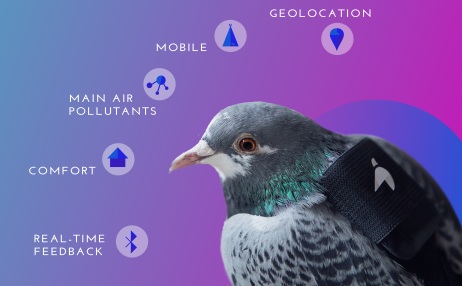
Today, in London, we are launching the first ever flock of pollution-monitoring pigeons to map pollution in the city. We’ve partnered with global marketing & technology agency DigitasLBi and Twitter UK to equip pigeons of little backpacks carrying our ultra-light pollution sensing technologies, to track air quality all around London.

BANDEAU-07 small

The Pigeon Air Patrol will monitor air quality in the capital and report back via Twitter. In London right now?

>> Try tweeting your area to @PigeonAir <<

… and receive instant air pollution level from one of our lovely pigeons (named Coco, Julius and Norbert)!

You can also visit the campaign microsite, where you’ll see a live map of the pigeons’ flights, learn about air pollution and its health risks, find out more about the pigeons and download the Plume Air mobile app.

Our CEO, Romain Lacombe, says: “Air pollution is a huge environmental health issue, killing 10,000 people every year in London alone. Putting air sensors on the back of pigeons goes beyond raising awareness of this problem and helps Londoners understand the impact of pollution in an accessible, tangible and immediate way”.

( Plume Labs BLOG)

Read more…

My research and development with MAVLink and Pixhawk continues.

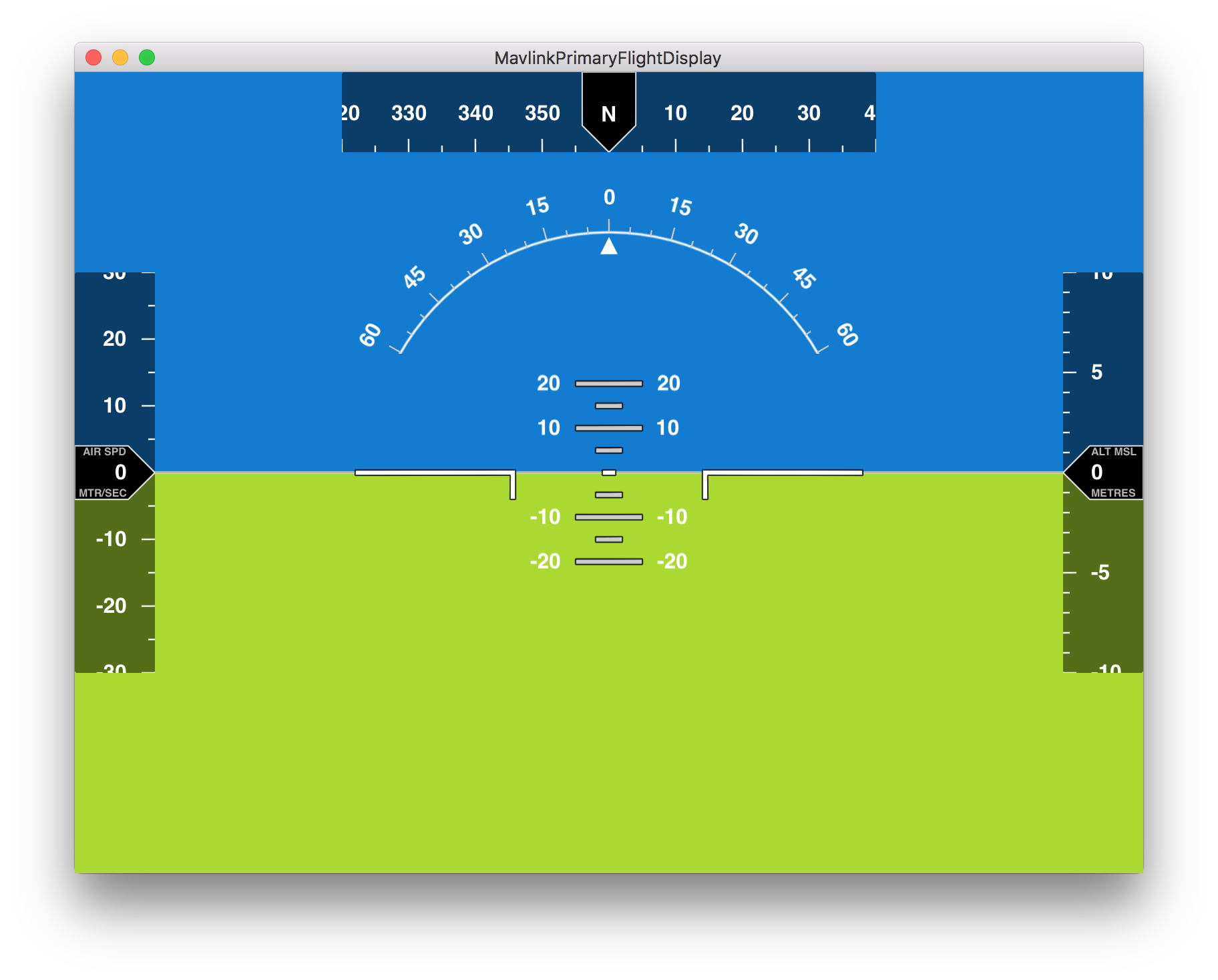
Today I'm pleased to announce the release of PrimaryFlightDisplay, an open source Mac + iOS graphics framework for use in ground control station and telemetry systems for micro UAVs.

default-screenshot.png?width=680

Key features include:

  • Convenient embedding and animation of a primary flight display
  • Highly configurable colors, sizes, and tape indicator scales
  • Crisp procedurally generated graphics
  • No external library dependencies, built using Apple’s SpriteKit
  • Flight stack and protocol agnostic
  • Compatible with MAVLink

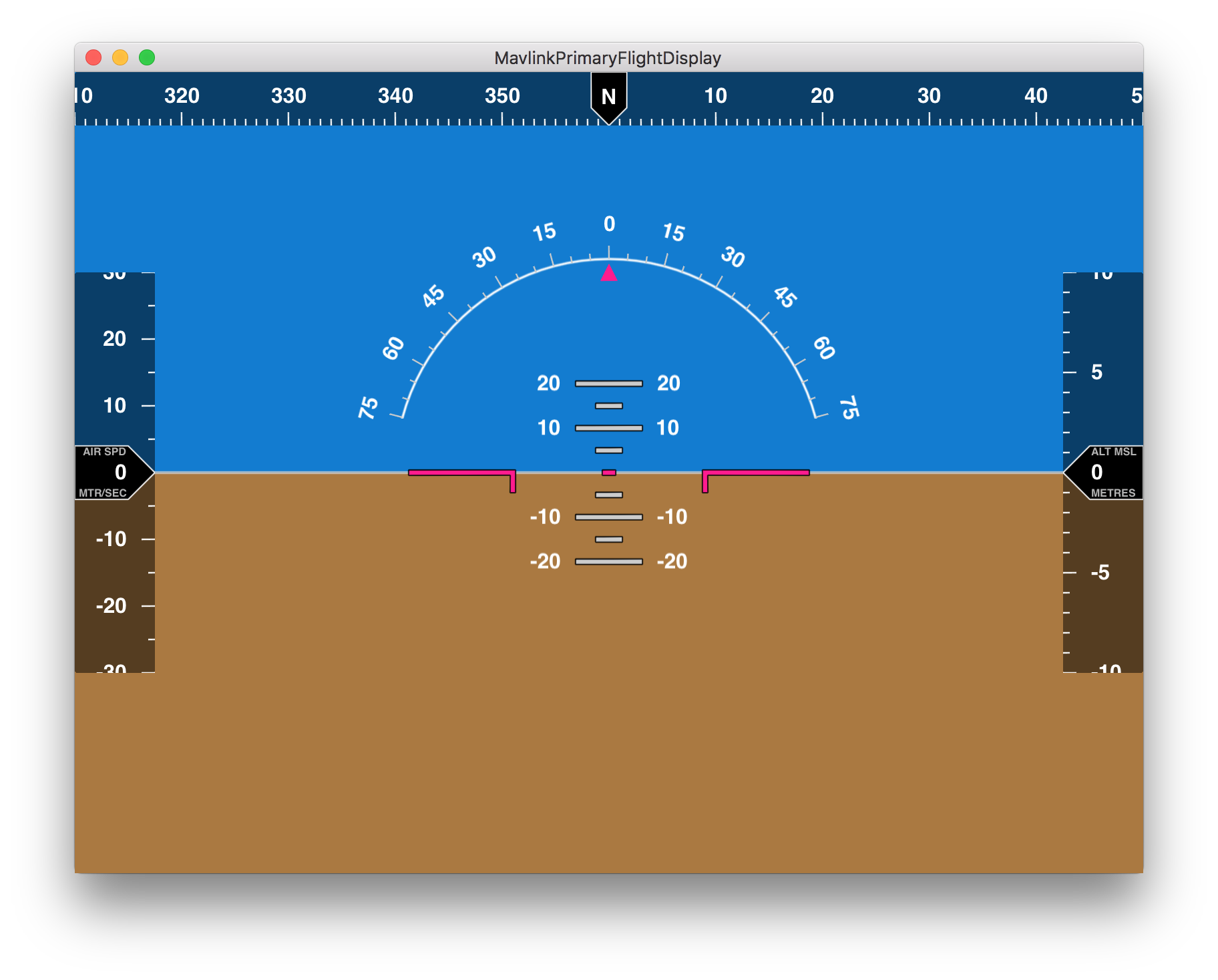
alternative-screenshot.png?width=680

The framework has been designed with easy style customization in mind. The primary flight display above has been customized to present a thinner heading indicator, a bank indicator with a smaller radius and ranging to 75 degrees. As well as custom colors for the attitude reference index, sky pointer, and ground component of the artificial horizon.

For further details please refer to the full writeup on my blog. To test how the flight display performs clone my demo Xcode project and follow the README file to get started with your Pixhawk.

Cheers

Read more…

With URUS you could make like automated control Home, Robotics Games (Like Lego Mindstorm) and more, working with APM Apis and Raspberry Pi under Linux OS.

At first time i will try get this work for Domotic System (Automated System Home), you could do on:

URUS:Home basic system.

ON/OFF Lights directly.
ON/OFF Lights at specified times.
OPEN Doors with keypad.

URUS:Home Advanced system.

Control via Internet all system.
Control Airconditioner temperature and modes with IR.
Control Lights intensity with RC Outputs.
Sensor proximity.
Face detection with camera and OpenCV.
Structure name project

The structure base name for application will be: URUS. For Home systems will be like: URUS: Home.
Examples structured project names likes for robotics, URUS: Arm; URUS: FishGame; URUS: SkateBoard; and so...

PR to APM master repo branch:
github.com/diydrones/ardupilot/pull/3718

Read more…
Developer

APM:Plane 3.5.1 released

3689651507?profile=original

The ArduPilot development team is proud to announce the release of version 3.5.1 of APM:Plane. This is a minor release with primarily small changes.

The changes in this release are:

  • update uavcan to new protocol
  • always exit loiter in AUTO towards next waypoint
  • support more multicopter types in quadplane
  • added support for reverse thrust landings
  • added LAND_THR_SLEW parameter
  • added LAND_THEN_NEUTRL parameter
  • fixed reporting of armed state with safety switch
  • added optional arming check for minimum voltage
  • support motor test for quadplanes
  • added QLAND flight mode (quadplane land mode)
  • added TECS_LAND_SRC (land sink rate change)
  • use throttle slew in quadplane transition
  • added PID tuning for quadplane
  • improved text message queueing to ground stations
  • added LAND_THR_SLEW parameter
  • re-organisation of HAL_Linux bus API
  • improved NMEA parsing in GPS driver
  • changed TECS_LAND_SPDWGT default to -1
  • improved autoconfig of uBlox GPS driver
  • support a wider range of Lightware serial Lidars
  • improved non-GPS performance of EKF2
  • allow for indoor flight of quadplanes
  • improved compass fusion in EKF2
  • improved support for Pixracer board
  • improved NavIO2 support
  • added BATT_WATT_MAX parameter


The reverse thrust landing is particularly exciting as that adds a whole new range of possibilities for landing in restricted areas. Many thanks to Tom for the great work on getting this done.

The uavcan change to the new protocol has been a long time coming, and I'd like to thank Holger for both his great work on this and his patience given how long it has taken to be in a release. This adds support for automatic canbus node assignment which makes setup much easier, and also supports the latest versions of the Zubax canbus GPS.

My apologies if your favourite feature didn't make it into this release! There are a lot more changes pending but we needed to call a halt for the release eventually. This release has had a lot of flight testing and I'm confident it will be a great release.

Happy flying!

Read more…

Zen Flange pitot tube released

The setup of our reader, Itay
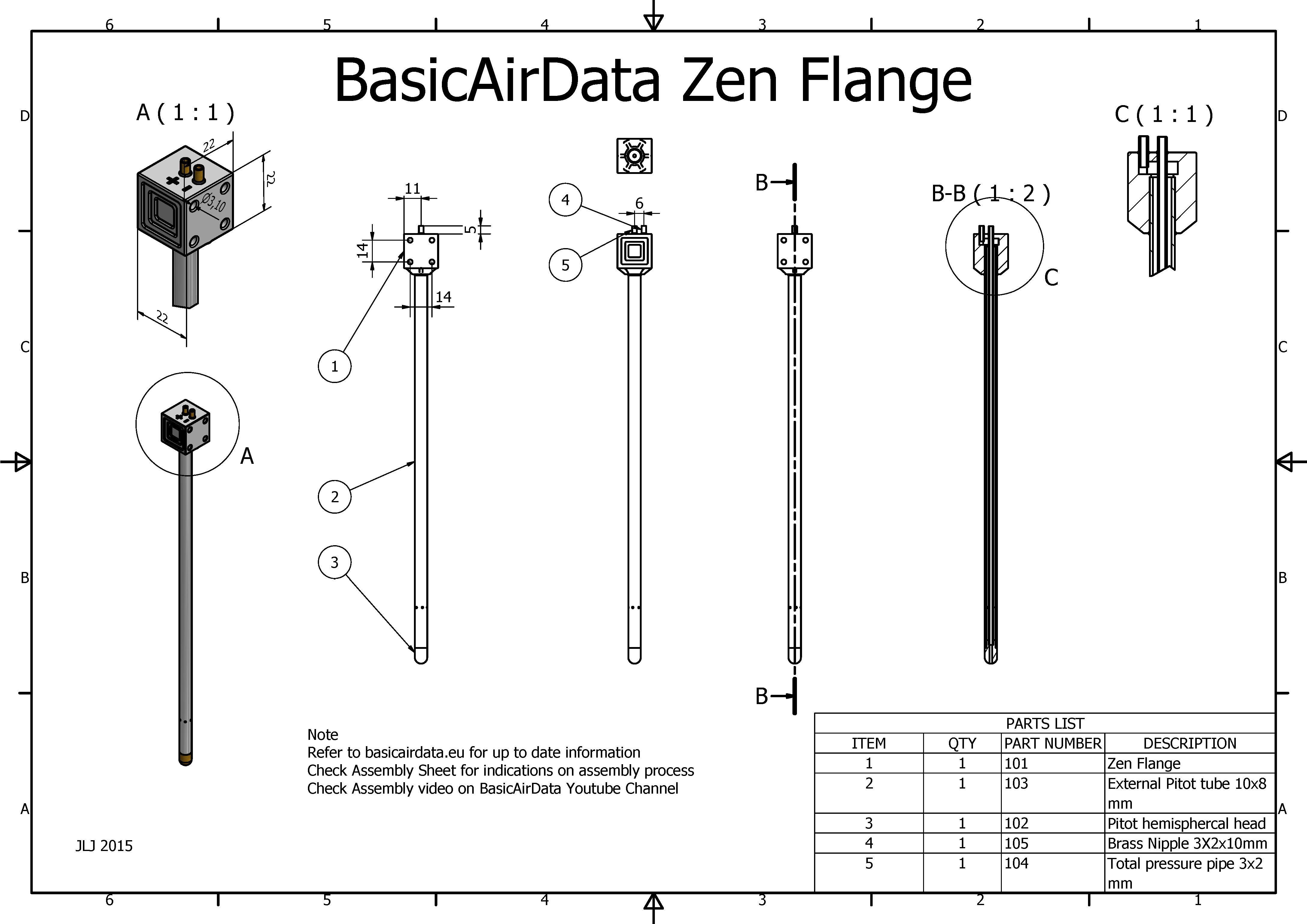
Figure 1: General Assembly Drawing
 

Here I share one of the tested DIY designs from BasicAirData
Our most popular 8mm pitot flange uses two 3D printed barbed nipples as connectors for pneumatic lines. That design is functional, yet the user is required to drill holes in the nipples with a 1mm drill, which can be quite a task. To alleviate that burden, we decided to produce a new nipple design, with the code-name Zen. The resulting flange is also easier to 3D print.

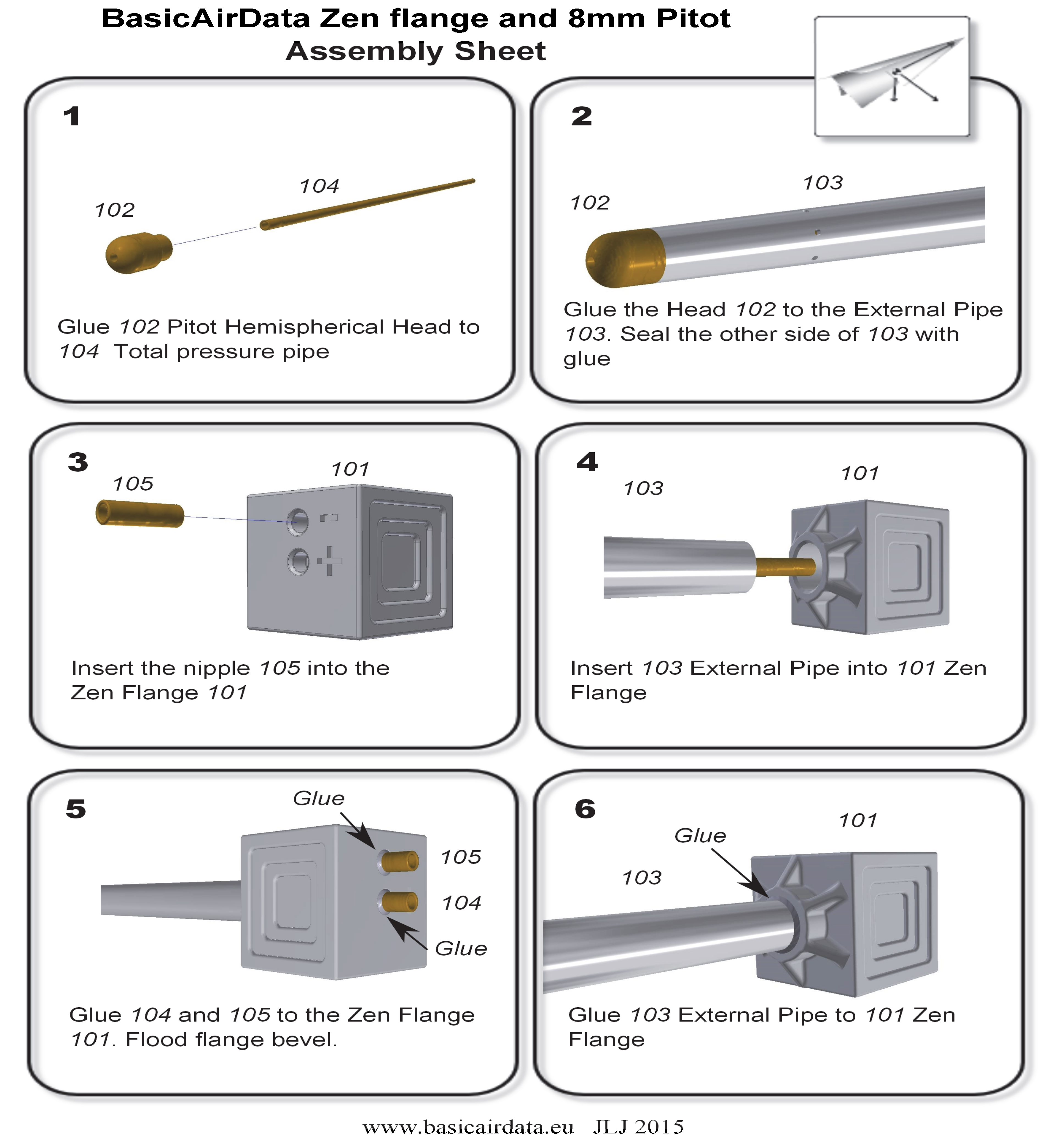
The assembly is fast and revolves around a signle 3D printed part (STL file). An assembly cheat-sheet can be seen in Figure 2.

Assembly Sheet
Figure 2: Assembly Sheet
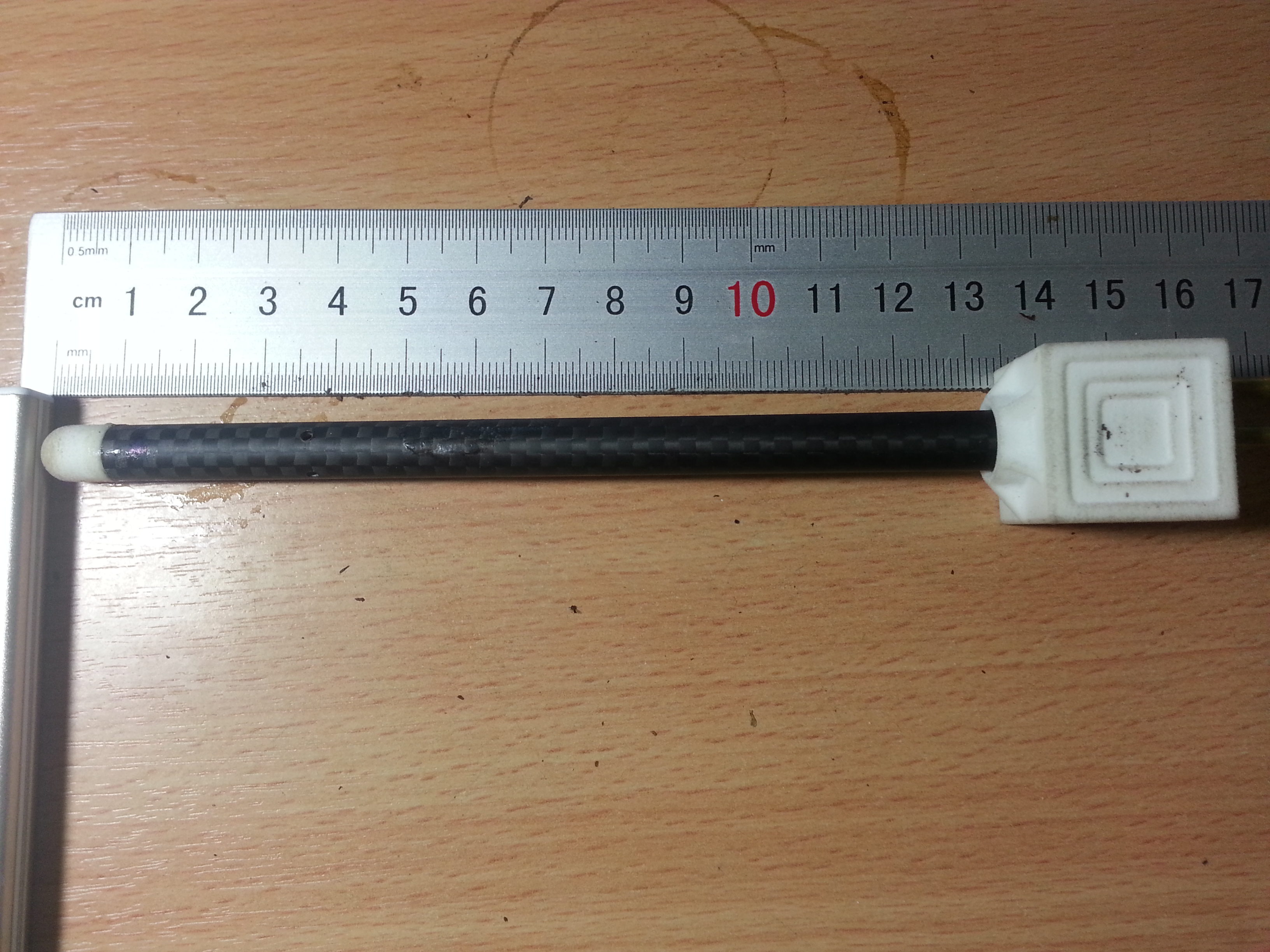
Printed Zen Flange
Figure 3: Printed Zen Flange

The assembly procedure doesn't consist but of trimming three tubes and gluing the whole thing together. Let the overall length of your probe be L(mm), in our example L=200. The overall length is defined as the distance from the tip of the probe to the back of the flange, excluding the nipples.

 
  1. The external pipe has an outer diameter of 8mm and an inner diameter of 6mm. A carbon fiber tube is a good choice. Trim it at L-18mm, which is 182mm in our example.
  2. Drill the static pressure ports on the outer pipe, at a distance of 36mm from the front pipe end. Drill 8 holes of 1mm diameter, 45° apart. This procedure is identical to our previous probe model.
  3. Cut a nipple of length of 10mm (refer to assembly sheet item 105), for example out of a brass tube, with outer diameter of 3mm and inner diameter of 2mm.
  4. Cut the total pressure pipe (item 104) at a length of L-7mm (193mm in our case), for example out of a brass tube, with outer diameter of 3mm and inner diameter of 2mm.
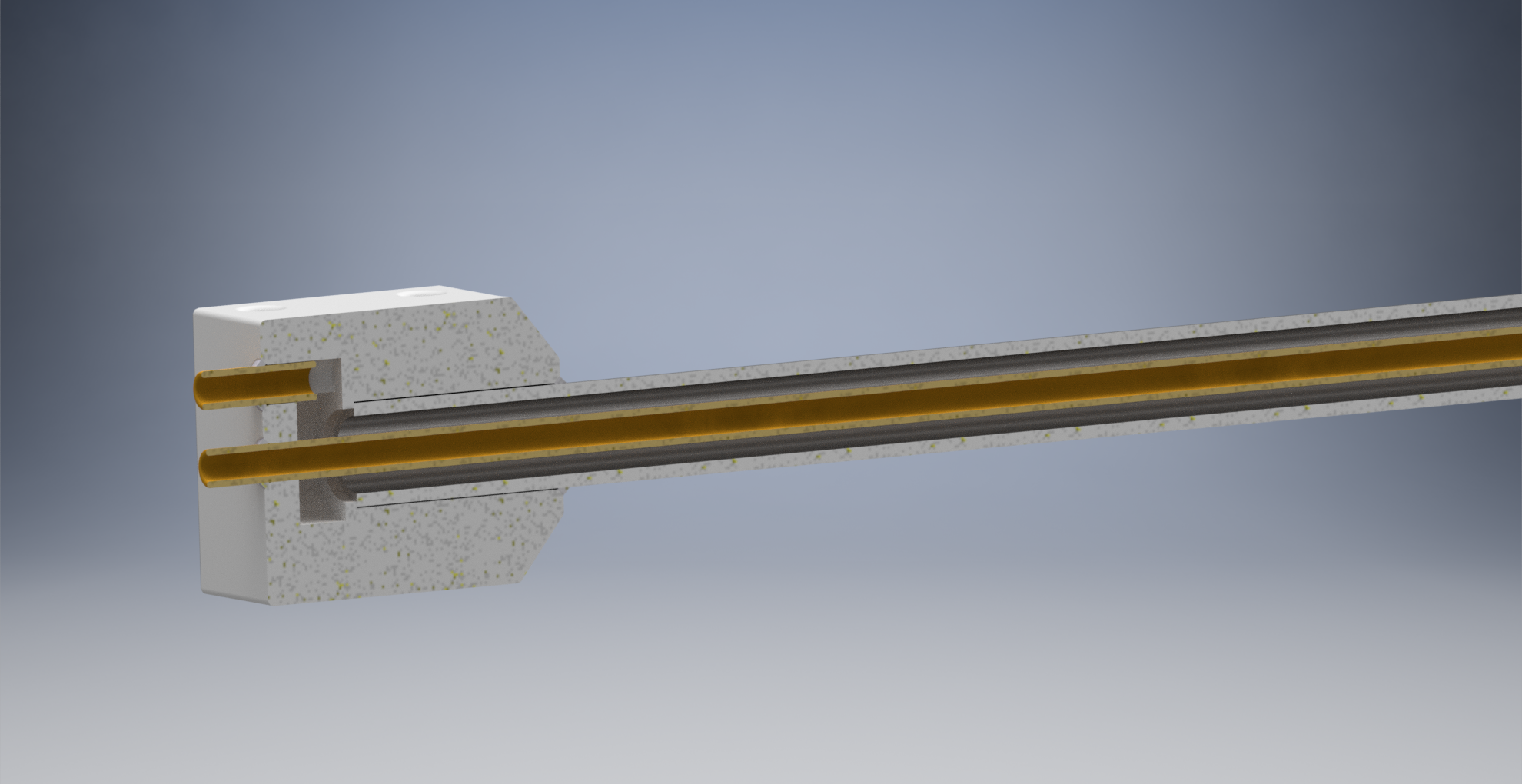
Rendered Section View
Figure 4: Rendered Section View


Video 1: Assembly Test Video
 

When you have prepared all the parts, make a little assembly check as per Video 1.

After a positive assembly check you can glue the pieces together. The important interface is that between the Pitot head (102) and the total pressure pipe (104). It is critical that this glue seal is airtight. Once you glue the external pipe (103) on the Pitot head you will not be able to repair any leaks.

Once you have glued all the parts together, you should test if the two pneumatic paths are free of obstacles and airtight. If it is available, a Pitot-static tester can be used. If not you can perform a quick test by following this simple procedure:

  1. Blow into the + nipple. The air should flow unobstructed down to the total pressure port.
  2. Seal the total pressure port with your finger and blow into the + hole. There should be no air leaks.
  3. Blow into the - nipple. The air should flow unobstructed down to the static pressure ports.
  4. Seal the static pressure ports with adhesive tape and blow into the - hole. There should be no leaks.

That's all. You have a brand new DIY pitot!

Read more…

3689686073?profile=originalWe make new modem for diy use. Can be use as a transparent UART modem. Board have also USB to UART converter.

433MHz (414-454MHz) 100mW (20dBm) Super Long Distance LoRa Wireless data modem with USB and UART interface.


General:

LoRa LRS series is a low cost, high performance transparent transceiver with operating at 433MHz. It is LoRa/FSK/ GFSK/OOK modulation variety. It features small size, high output power, high sensitivity, long transmission distance and most of the parameters can be set via the command. Receive and send data to automatically switch. U s e generic UART interface. It is easy to realize the wireless data transmission with only providing the UART data. It is flexible for the users to set the UART baud rate, output power, data rate, frequency select, modulation mode select etc parameters. It is your ideal choice for designing wireless data transmission products which can be widely used on wireless data transmission field.


Features:

  • Low cost, high performance , high reliability
  • LoRa/FSK/GFSK/OOK modulation, 2-way half –duplex communication, strong anti-interfere
  • Frequency Hopping Spread Spectrum
  • 414-454MHz ISM band,globally license free.
  • Maximal output power100mW(20dBm),output power adjustable between 2-20dBm
  • LORA Sensitivity -139dBm
  • Supply current for Tx 130mA@20dBm, 35mA@13dBm
  • Supply current for Rx 16mA
  • Low current sleep mode 2uA
  • Standard UART interface and USB interface
  • Operation frequency can be configured, acceptable for several modules working in different frequency with no disturbance on each other.
  • RF parameters as needed, users can be modulated by software
  • Easily use, auto exchange on communication & transceiver
  • Communication speed 1.2kbps -115.2kbps,can be modulated through software
  • Afford Sleep control signal,user self control work duty cycle
  • With LED indication
  • Longer transmission distance,over 5Km in open air
  • Small size 42x30mm, USB connector and 4 pin connector for UART
  • Weight 8 gramm
  • SMA antenna connector
  • Tuning free
  • Accord FCC,ETSI standard


3689685971?profile=original

Read more…
3D Robotics

Painting buildings with drones

From TechInsider:

Florida-based startup Apellix developed a prototype unmanned aerial system that can potentially paint homes or ships, apply chemicals, or pressure wash windows. It's called the "Worker Bee."

Company founder Robert Dahlstrom presented the pitch for his drone on Friday at Northrup Grumman's campus in El Segundo, California, hoping to find partners who could potentially use the technology.

"Drones can do more than gather data, take pictures, and deliver packages," Dahlstrom said. "They can do real work."

For its prototype, Apellix flies a quad-copter connected to a base station and paint materials via an umbilical cord and tether. The small drone can then paint evenly on a surface, opening a large opportunity for industrial painting of skyscrapers or ships in dry dock — which normally requires about four days and 30 people setting up scaffolding before they get started.

Apellix wants the drone to take over, which removes the need for scaffolding. And it's also focused on worker safety, since at least 95 climbers working on cell or other towers have died since 2004. "We develop technologies to keep workers safe," said Dahlstrom.

It's a unique new use case for drones, which most associate with military intelligence and targeting operations. The unmanned aircraft are increasingly being used in farming, emergency search and rescue, and overseeing construction. A 2013 report says the civilian drone industry could generate upwards of $82 billion over the next decade.

Currently, the Worker Bee is a pre-production model that can only paint small buildings up to three stories, Dahlstrom told Tech Insider. But now that the drone has a patent pending, he said, the company has emerged out of stealth mode and plans to offer it as a "platform as a service," where clients can rent the drone for about $25 an hour.

Besides painting buildings, there are other potential uses: The drones can be used to de-ice airplanes, or to fumigate ships, both of which are tasks that would keep humans from breathing in toxic chemicals. Dahlstrom also said it'd be ideal for coating above ground storage tanks, power transmission and telecommunication towers, and bridges.

Read more…
Developer

APM Planner 2.0.20 is released

3689685174?profile=original

Hi,

APM Planner 2.0.20 has been released. The main areas for change have been.

- Graphing improvements by ArneW, Ustramooner, AndreK

    (Too many great things to mention, like real-time x-axis, labelling, stability, speed of loading)

- Support for Pixracer FW Updates

- AC3.4 Message Severity compatibility option.

- Windows and Linux 15.10 Build by DaveC - Thanks.

plus many more fixes...

Downloads are available at http://ardupilot.com and automatically from the UI.

Please report issues to http://discuss.ardupilot.org/c/ground-control-software/apm-planner-2-0

Enjoy

APM Planner 2.0 Devs.

Read more…

Long-Line Sensor Payload Demonstration

3689685065?profile=original

Today I did something a little bit unusual, and definitely more difficult than flying around with a camera. A possible commercial customer asked to see a demonstration of a helicopter flying with a 2.5kg sensor.  This sort of thing is commonly done for magnetometer surveys for mining exploration.  The sensitive sensor must be hung from a long line in order to get it away from the magnetic interference from the UAV.  This could also be done for water or gas sampling.

The big helicopter has no problem with flight control despite the hanging weight.  It just requires some special piloting to control the swinging, basic pendulum dynamics.

These sorts of surveys require many tight passes at low speed, so it takes a long time to cover a large area.  It's an ideal job for a gas powered helicopter UAV.  This one can fly for an hour easily.

It would be possible to create a payload management system which would measure the position of the sensor via the angle of the rope, and automatically control the UAV to control the swinging (basically, the reverse of a balance bot).  Something I would love to work on in the future.

Read more…