All Posts (11086)

Sort by
3D Robotics

Self-learning copter uses neural networks

3689588383?profile=originalFrom Hackaday:

Though this project uses an RC helicopter, it’s merely a vessel to demonstrate a fascinating machine learning algorithm developed by two Cornell students – [Akshay] and [Sergio]. The learning environment is set up with the helicopter at its center, attached to a boom. The boom restricts the helicopter’s movement down to one degree of motion, so that it can only move up from the ground (not side to side or front to back).

The goal is for the helicopter to teach itself how to get to a specific height in the quickest amount of time. A handful of IR sensors are used to tell the Atmega644 how high the helicopter is. The genius of this though, is in the firmware. [Akshay] and [Sergio] are using an evolutionary algorithm adopted from Floreano et al, a noted author on biological inspired artificial intelligences. The idea is for the helicopter to create random “runs” and then check the data. The runs that are closer to the goal get refined while the others are eliminated, thus mimicking evolutions’ natural selection.

We’ve seen neural networks before, but nothing like this. Stay with us after the break, as we take this awesome project and narrow it down so that you too can implement this type of algorithm in your next project.


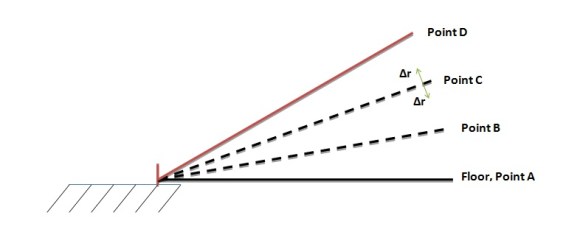
chart showing different points
Consider the image above. The goal is for the helicopter to start at Point A, go to Point C and hover. Allotted time is 10 seconds per run. It has to teach itself how to do this and do it as quickly as possible. Remember, it knows where these points are via IR sensors.  [Akshay] and [Sergio] developed an equation using a piecewise function to determine which runs were closest to Point C for the longest amount of time.


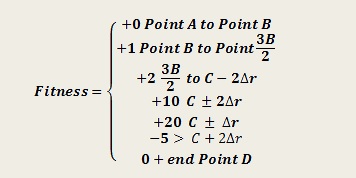
fitness equation for helicopter


Each of the points in the above equation is known via a voltage from the IR sensors, with Point A being 0.1 volts and Point D being 3.7 volts.  The equation is designed to give the greatest value for the longest time spent at Point C. This value is known as a Fitness Value.

A neural network is used to determine at what level the throttle should be at to achieve the highest Fitness Value. This network is apart the Evolutionary Algorithm that runs in the firmware. Basically, it starts off with random values that generate random levels of throttle. The values that achieve the highest Fitness Value get ‘mutated’, while the others are discarded.

The mutations in the values are done at random, and the process repeats. In the end, the firmware learns the best throttle levels to achieve the goal of being at Point C for the longest time in the allotted 10 seconds.

Be sure to check out this linked project for full details on these mutations are carried out in the source.

Read more…
3D Robotics

3689588437?profile=original

From ABC News in Denver:

DENVER - The Federal Aviation Administration announced Tuesday that it is launching an official investigation around the drone that was seen flying over the 4/20 rally in Denver on Sunday.

"Anyone who wants to fly an aircraft -- manned or unmanned -- in U.S. airspace needs some level of authorization from the FAA," Allen Kenitzer from the FAA wrote in an email.

Authorization can be for either the private sector for purposes such as research or training, or for public use, which requires a Certificate of Waiver or Authorization (COA) for public aircraft.

But drones are sometimes considered model aircraft, which only have to follow FAA guidelines. Those guidelines say hobby aircraft-flyers must keep their aircrafts below 400 feet above ground level and away from airports and air traffic. Besides this, the guidelines specifically exclude the flying of model aircraft for business purposes.

The FAA website says that "routine operation" of Unmanned Aircraft Systems over densely-populated areas is not allowed.

Read more…

PdSWDesk1R4.001.jpg

The project

A 7-day walk, along the GR70 in the Cévennes (France), with a portable desk prototype, during which :

  1. I will document on this site and relate my adventure on social media.
  2. I will create a photographic and video report using a follower drone.
  3. I will measure and publish an instrumental data stream in real-time.

Objectives

  • Complete and test a nomadic portable desk prototype.
  • Promote auto-measure (quantified self) practices and the benefits associated with health and well-being.
  • Communicate the positive uses of civil drones.
  • Alert on the dangers and problems linked to amateur multitasking.
  • Create an event and an unusual communication device.

Full article here:

A 7-day walk, along the GR70 in the Cévennes (France), with a portable desk prototype

Read more…

Vulture 2 spaceplane livery wrapped

Our Vulture 2 spaceplane is looking rather splendid, following a quick paintjob and vinyl wrap:

3689588231?profile=original

3689588284?profile=original

3689588248?profile=original

The wrap was designed by Ariadne, the 4-year-old daughter of a Register reader, and applied by Space Graphic Solutions  (see top photo). The underside paintjob, seen above with the Low Orbit Helium Asssisted Navigator (LOHAN) team is an in-house effort.

There are full details and photos of just how all this came together right here. 

Read more…

3689588264?profile=original

Here is a link to a report about an attempt to use UAVs to help emergency responders at Oso in Washington State.

At the recent National Hurricane Conference, the author, Dr. Murphy, presented "Robot-Assisted Search & Rescue and Emergency Informatics". Robert Anspaugh also attended, presenting "Unmanned Aircraft Systems Operations in Disaster Response". The conference has not published videos of those presentations.

Read more…
MR60

3689587956?profile=original

UPDATE 1 of the build below

Hello,

I wanted to share my first Talon build (and my first fixed wing):

(also posted on rcgroups here:http://www.rcgroups.com/forums/showthread.php?t=1977612&page=75)

Once it will be built (might still take a while), I intend to use Pixhawk as I am now deep into it my multicopter side of the force.


 it will be useful to get comments and maybe help others building their own fixed wing. This build thread will consists of more than one posts but these posts will come in sequence when there is progress to show in the build process (especially when some parts are still being ordered and being shipped).

Here we go for this first post,

I ordered the Talon kit , in white, @ www.fpvmodel.com. Unfortunately I saw two weeks later the extension kit for the wings + landing gear + new dome which is oriented toward the ground. So I ordered this extension kit which is still currently blocked at customs...

I have never previously built a fixed wing UAV, this is my first. So bare with me.

First question I wondered was by which step to start : can I glue parts in any order ? Do I risk to be blocked later by assembling the fuselage before organising the electronics and cables inside ?, etc

As there is no step by step guide out there I decided based on intuitive logic in which order to proceed.

I first followed the mounting PDF guide that is the generic mounting guide coming with the XUAV Talon. I followed the guide up to the "gluing the wood pieces" stage. I then left the two halfs of the fuse unglued at this stage.
For gluing I decided to use UHU POR. It is said that CA is too rigid and breaks apart, that hot glue when too hot melt the foam, that the EPO material of the Talon has built-in an unmolding substance that makes it hard to adhere to.
 

When I received the fpvmodel box, it had been slightly crushed and had one of the two EPO dome pieces broken.
I managed to repair the dome piece and glue everything together nicely with UHU POR

3689587898?profile=original3689588076?profile=original

The next step that was clear to me was to understand, before gluing anything definitively, how to mount servos, control rods, control horns.

How to mount servos, control rods and control horns ?

This is the most difficult part as I had read in this thread, even from senior builders like chanyote and blueprint, that they had lost control horns in flight (bad fixing)!

I tried manually to move a servo , just holding by the fingers a control horn : indeed there is a huge force playing on them, especially at the end positions of the servo: it was immediately obvious that just gluing a control horm would not work (I would not trust it in flight).

My approach to this issue : reinforcements of the control horn fixing on the moving surface,

To do so I gathered some fiber glass fabric that I had left from my multicopters builds, Titebond wood glue (the very best of wood glues) and a paintbrush 
3689588111?profile=original

The idea is to apply on both sides of the control surfaces, around the spot where the control horm has to be fixed, a piece of fiber glass fabric glued with wood glue (applied with paintbrush to smooth and even the surface). This results in a quite hard composite that adheres extremely well to EPO foam.

It remains also very smooth, flat and thin (would not have been the case with UHU POR for ex). As a result, the two sides of the control surfaces, that will receive the control horns, are armed with fiber glass. Not only armed EPO offers more resistance to ripping forces, it also reinforces the foam against the squeazing pressure of the screwed control horns.

3689588089?profile=original3689588132?profile=original3689588145?profile=original
I decided to use Titebond wood glue versus foam CA because of a small test I did before : I coated a test piece of fiberglass with foam CA ->apparently CA destroys the fiber glass resistance somehow and the pieces could easily be broken apart. Then I coated another test piece with of fiber glass with wood glue->excellent mechanical property and more rigidity.

I do not have the screwed type control horms yet, they are being delivered. I expect them next week.

Another reinforcement decision was about the control rods. I had also read on this thread that the rods that came with the kit are flexing too much. So what I did was to double the main wing rods (the longer ones; the rods of the V tail are short enough to be left alone as they came in the kit). I cut in piano wire the same length of wire. I then used heat shrink tube pieces to fix the two rods together, as show in picture 8. 
3689588252?profile=original

Then came the question of the servos :

What servos to use ?

I had read in this thread that the servos for the ailerons need to be stronger than the servos for the v-tail. There is a mention somewhere that the V tail servos should be 9g and the servos for the ailerons should be 17g.
I got mistaken from a kit on fpvmodel that provides four 12g servos for the XUAV Talon. So I got 4 of them, model EMAX ES08MD (digital, metal gear, 1.6/2.0 Kg.cm).
Unfortunately when I tried them on the plane, they only are a good fit for the V tail, and they are way too small for the ailerons.
So I got 2 Hitec HS-82MG (Digital, metal gear, 19g, 2.8/3.4 Kg.cm) for the ailerons.

One of the hardest thing for a beginner like me in fixed wings, is how to mount the servo arm, in which position, etc.
After a bit of reading, I had to place the servo in neutral position and than mount it with the servo horn perpendicular to the control rod when the control surface is in neutral position too. It seems easy to sayd (read), but it is much harder to implement.
Especially I am still waiting for the transmitter/receiver (a Hawkeye DTF UHF 433Mhz) that will be used, so I had no way to define the neutral position. I got thus a servo tester for this. It is very cheap and practical; it allowed me to test all servos before installation. To test not only that servo worked ok, but also to test the extreme positions of the control surfaces.
3689588157?profile=original

 I still have an issue with the movements of the surfaces because they move too much : I have +- 45 degrees. According to what I read in this thread, I should limit the movement to +-20 degrees.
How can I achieve that movement reduction mechanically ? (or is it ok to use servo limits in the transmitter without loosing servo resolution ?)

3689588216?profile=original3689588175?profile=original

That's where I am at for the moment. If there is some interest I will continue posting progress on this build.

UPDATE1:

Finalized servo and servo horns on the control surfaces

I have finally found some time to finalize the servo and servo horns attachments on the surfaces. I found this step to be the most difficult of the build so far as the stock control horns are too weak and are not of the screw type (so in practice this would mean a high risk to loose a control horn during flight if it is just glued...not good).

What has been done:

-the default control horns were replaced by screw types control horns

-but in order to fix screws on foam, you first need to reinforce the zone where the screws will put pressure on the foam

-it was also necessary to fill in the factory precut holes for the stock control horns. They were filled flush to the control surface with balsa and foam CA.

-the new control horns were positioned on the same spots where the factory precut holes were. Then the screw holes were marked and drilled.

-the new control horns were then both glued and screwed on the control surfaces:

3689587872?profile=original

To attach servos:

-The servos were positionned at neutral with the servo tester

-The servo horns were screwed on to form a 90 degree angle (or as close as possible to it) with the surface of the wings. Due to the finite number of possible positions on the servo gear, it was sometimes an angle of 80 degrees instead of 90. I hope this will not have any negative effects on flight control.

-the control rods of the ailerons were doubled to reinforce them (otherwise they will flex in flight under the air pressure , they are too thin). The double control rods were fixed to each other with heatshrink:

3689588027?profile=original-On the control horn side, the control rod is fixed with a screw type fixing system that comes with the XUAV Talon kit.

-Little bit of blue loctite and hot glue was used on all screws so that vibrations will not loosen them during flight

Fixing system for the XUAV Talon motor :

The XUAV Talon comes standard in the kit with a plywood piece on which you are supposed to screw the motor. However the defaut manual is so badly done that you risk to glue it in the plane fuselage, as prescribedn and then realize it is too late to fix your motor : because you will not have any access to this plywood piece to screw bolts and/or screws of your motor attachment system.

3689587970?profile=originalSo BEFORE gluing anything, mark the position of the screw holes of your motor fixing plate (it is usually an aluminium cross shaped piece with pre drilled holes for both motor screws and fixation screws on the frame) and drill them.

Then, saw another piece of about 5mm thick plywood a bit smaller than the original kit piece like so:

3689588048?profile=originalIt will be later glued against the kit piece (as shown in picture above). But first this extra plywood piece will be prepared:

-Screw holes are drilled

-Blind nuts are hammered and glued into these drilled holes. (i used 3mm diameter blind nuts for standard 3mm screws we usually use in our UAVs)

-Finally an opening is carved out to pass the motor wires through:

3689587893?profile=originalThen this part is glued on the original motor kit piece (with Titebond wood glue for ex) and fixed on it duriong a whole night to let it dry fully:

3689587983?profile=originalAnd the final result:

3689588063?profile=originalThis will allow me to screw my RC tiger motors on it, even after the two parts of the fuselage will be glued on. It makes it possible to change your motors easily afterwards (which is absolutely necessary to try out different motor/prop combinations).

More updates to come as the build progresses,

Cheers,
Hugues
Read more…

Erle Robot, the educational drone

After some time following conversations here, I finally decided to introduce Erle, the educational drone:

3689587944?profile=original

About

For the last years I've been working in the robotics field, particularly with drones and after some time in several Universities and research centers I found many people (with much passion but) having trouble when it came to get started with them. Technology seemed in most of the cases a black box. Not meant to be used for learning or research. The software they use is in many cases unknown (obviously not in the ardupilot case which is one of the cores of our robot), closed source or not well documented. Given these conditions, how are we going to educate the next generations on this flying technologies? How do you get started programming drones if you don't have $1000+ budget? Which platform allows me to get started with drones without risking a hand?

I wanted to address all these questions so about a year and half ago, from South Korea, I assembled a team and we launched a project called Erle ("bee" in basque language). 

Technology

Erle is a small size, low cost personal drone. Inspired by the BeagleBone development board (a credit-card sized computer), we have designed completely from 0 a small sized flying robot with about 40 sensors, plenty of I/O and processing power for real-time analysis. All of it in a small size Linux flying computer that will bringing robotics to the people. Some of the features we provide are:

  • Linux OS (Ubuntu, Debian, Android, ...)
  • ROS
  • Ardupilot for Linux (work in progress)
  • 40 sensors
  • microSD card storage
  • GPS
  • host USB (WiFi dongles, Bluetooth dongles, Monitors, keyboards, ...)
  • 92 pins for connecting other devices
  • 20 minutes of battery
  • Wireless charging (work in progress)

Definitely, we love ardupilot and we are collaborating in the future of it (through the BeaglePilot project) giving Linux computers such as Erle the ability to fly around.

Next steps

We truly believe that drones are about to change our lives (check our 60 seconds pitch) so our mission is to bring robotics to the people with our educational drone. To fulfill this mission we recently started putting up a set of tutorials through the Erle Robotics GitBook, an online resource that will serve as learning and teaching material.

Soon we hope launch a crowdfunding campaign that will allow everyone to access our technology :).

Finally, we are really excited and happy to share that we have recently been selected as one of the 30 top robotics startups worldwide. We will be pushing our educational drone as high as possible and for that purpose i'd like to invite everyone to share your thoughts about our technology.

Thanks in advance!

Read more…

More Amazing Rocket Footage Shot From Multirotor

Video of Falcon 9 Reusable (F9R) taking its first test flight at our rocket development facility. F9R lifts off from a launch mount to a height of approximately 250m, hovers and then returns for landing just next to the launch stand. Early flights of F9R will take off with legs fixed in the down position. However, we will soon be transitioning to liftoff with legs stowed against the side of the rocket and then extending them just before landing. 

The F9R testing program is the next step towards reusability following completion of the Grasshopper program last year (Grasshopper can be seen in the background of this video). Future testing, including that in New Mexico, will be conducted using the first stage of a F9R as shown here, which is essentially a Falcon 9 v1.1 first stage with legs. F9R test flights in New Mexico will allow us to test at higher altitudes than we are permitted for at our test site in Texas, to do more with unpowered guidance and to prove out landing cases that are more-flight like.

Read more…

Angry goose takes down my UAV

https://www.youtube.com/watch?v=EL9jGwRI92I

Preface: My fault, I should know better.  I've flown over to these geese on numerous occasions without incident. But this time I was controlling from further away and therefore my depth perception wasn't as keen.  I don't blame the goose all, however it is tempting to find him and cook him for dinner.

As soon as I saw the goose rear up and open his wings, I punched it but it was too late.  On the log you see full power commanded, and full power applied, but in the same instant, it was all over.  I took a direct hit from a large Canada Goose from probably 6ft AGL.  This was over the swampy edge of the lake behind my house. It flipped over and hit the water / mud upside down at a weird angle.  The only sound it made was a faint LiPo beeper which was clearly drowned.

So getting it back was when the real fun began.  It hit the swamp right next to their nest. If you've ever tried to walk up to a goose nest, you know that will be a problem.  Papa Goose is very protective, and he's still pretty pissed. I had to hop logs and rocks out into the water, and still ended up falling in.  Papa Goose wouldn't let me anywhere near it.  He got all hissy and tried to eat me when I tried.  So I ended up using a 12ft long tree limb to hook the landing skids, lift it up, and swing it over towards shore.  My neighbor was on the shore waiting to catch it.  The limb almost snapped from the weight of the UAV and two 4S 5000mah batteries.  And the honker was PISSED.

So I brought it back to the house and started assessing damage.  The dome popped off and cracked because I didn't put the screws back in (stupid).  The camera gimbal separated into two pieces (just glued together, so not a problem).  Wires were ripped out of one of the gimbal motors.  The mobius camera was wet.  The landing skids had detached in a few places.  The 3DR telemetry radio, GPS/Compass, and video transmitter were wet.  One prop was broken.  All the motors were wet.  And there was a splash or two on the APM.  The battery mounts had detached as well.

I took it all apart, opened everything up, and went at it with a hair dryer. After snapping the landing skids and battery mounts back on, and drying it all out, the only actual casualties are (1) gimbal motor, (1) battery beeper, and (1) plastic propeller. I put a new propeller on it and it flies perfectly fine, like nothing ever happened.

Won't be making that mistake again.

Read more…
MR60

3689587796?profile=original

If you're old enough, do you remember in the late 80's how we surpassed our own parents when first personal computers, commodore 64 and other Atari computers came out ? Well I feel the same way now with our kids and UAV's.

Along gradual building of various UAVs , I accumulated so many spare parts that were just laying around that I decided to build a trainer quadcopter for my son and proposed him to try out, together, FPV for the first time! The attached youtube video shows our first noobs FPV journey...

 The trainer quad is made of:

-Assembled from various frame parts from : 3DR arms, home made plates, VulcanUAV landing legs, some other frames pieces from HK stuff, etc...

-a Pixhawk autopilot with 3.1.2 fw version

-3DR 880kv motors with 10x4,7 props + quadro ESCs

-powered by a 10.000 mah 4S battery

-5.8Ghz FPV setup with a RMRC 600Tvl camera

-Mobius for HD footage

My son can crash and abuse it, it is easily fixed. However I notice how I never had even to replace a prop (not like when I fly) because he is very prudent and he flies intuitively these things, even in non-FPV flights. He's gonna quickly be able to teach his father how to be a good pilot (for which there is still lots of training to do)!

Read more…
3D Robotics

3689587824?profile=original

From Quartz

Last October, Ridley Scott and more than a thousand extras and film crew arrived in Andalusia, in southern Spain, to shoot Exodus, his new epic about the life of Moses starring Christian Bale. “They spent a whole month here”, Piluca Querol, the director of the Andalusia Film Commission, told Quartz: “It’s the first time unemployment has gone down in Almería at that time of year, thanks to all of the construction.”

The movie industry is an important contributor to the economy in Andalusia, the region with the highest unemployment rate in all of Europe (pdf). “Film producers use drones a lot,” Querol said, “especially in pre-production to get things ready, prepare shots and look for possible camera positions.” She added, “of course [drone images] promote Spain abroad, in our case as a great place to film movies”.
 

So Querol was shocked earlier this month to read of a ban on commercial drone activity published by Spain’s State Agency For Air Safety (AESA): “We are very worried by the news”, she said. “We understand it as a total ban”.

Issued on April 7, the note ‘”reminds” Spaniards, “in order to avoid misunderstandings”, that: “The use of aircraft piloted by remote control with commercial or professional ends is not permitted, and never has been”, and that commercial drone use over Spain is, “illegal and subject to the imposition of the corresponding sanctions”.

AESA told Quartz that “AESA has not prohibited the use of ‘drones’; the Air Safety Act currently does not allow them to be used for certain activities, once drones [are classified] as aircraft.” It said that the drone industry “knew about the situation beforehand.”

“Nonsense”, said Agustín Rivera, the reporter who broke the story at Spanish news site El Confidencial (link in Spanish): “it’s true the legislation existed before but they had never been so blunt about it (…) there was bewilderment in the industry”. Violeta Vargas, who edits a blog on the Spanish drone sector, and is an R&D project manager for a Spanish company that designs and builds larger drones, agreed: “Of course it was news, huge news, people didn’t know it was illegal, they thought there was a kind of gap in the law”.

A cloudy legality

Drone laws vary widely around the world, including within Europe itself, though the European Commission this month announced it would develop continent-wide rules. Regulators that try to restrict or ban drone use can find themselves struggling to control an exploding market, as has happened to the Federal Aviation Administration in the US.

Spain’s rules are rooted in the 1960 Air Navigation Act (Spanish). As one might expect of a piece of legislation written decades before drones were even imagined, it’s ambiguous—for instance, it defines an aircraft as any flying object “suited to the transportation of people or objects,” which commercial drones often aren’t.

But commercial drone operators contacted by Quartz said they understood the AESA ruling as a total ban, and that they had already lost orders. Cromática 45, whose aerial video of Madrid has been seen over 4 million times according to a spokesman, shot it with a small DJI Phantom drone, which Spaniards can acquire for a few hundred euros in El Corte Inglés, Spain’s leading retail store. It’s “a total ban,” a company spokesman said.

Another company, Helifilm, last year produced a whole series of programs for TVE 1, Spain’s main public TV channel, titled “Spain From The Sky Up“, full of drone footage shot above crowds running around Spain’s famous fiestas. “We also used drones to film scenes for Ocho Apellidos Vascos“, said Ramón Canton, Helifilm’s manager, referring to a recent Spanish box office hit (titled A Spanish Affair in English) that includes spectacular landscape shots of the Spanish countryside. Canton described AESA’s ruling as “a total halt until further notice.”

Even Spain’s regional governments are using drones. In April, the Andalusian government ran an emergency exercise for its first responders in a road tunnel (Spanish), and commissioned a local company, Camfly, to film a simulated accident using a drone.

Cromática 45 says it has had four orders cancelled since last week; Camfly has seen 15 orders disappear, “all the work until October;” and the Andalusia Film Commission has even had to stop a project for the Andalusian regional government. “Today the answer [to clients] is that it’s not possible. We’ll see about tomorrow,” says Querol.

AESA refused to say how many production companies or media outlets are being sanctioned for filming and publishing drone images. It said the new legislation is “complex, given it has to take into account technology that is still being developed.” Alberto Castaño, chairman of a commercial drone operators’ association that has started some talks with AESA, told Quartz, “They hope to have the draft bill ready before the summer, but then administratively in reality it’s not really going to be ready until next year; their own legal advisors have told them that getting the new bill officially published as law will take ‘at least a year’”.

Not quick enough, say the drone companies. “We couldn’t last more than a month without filming”, said Canton, the manager of Helifilm: “it would be impossible, we live off this activity, my partner even mortgaged his house to invest in the business”. For now, said the Cromática 45 spokesman, “we are going to continue working in areas of minimum risk.”

Matthew Bennett is a journalist based in Murcia, Spain, and editor of the Spain Report. He tweets at @matthewbennett.

Read more…

PI_14.04.16_FutureofTech_260x2601.jpg?width=260

A new Pew Research Internet Project poll on U.S. Views of Technology and the Future has found that most respondents were pessimistic about the benefits of personal and commercial drone technology.

Among the findings:

  • 63% think it would be a change for the worse if personal and commercial drones are given permission to fly through most U.S. airspace.
  • 22% think it would be a change for the better.
  • Opinions are more positive among men (27%), 18–29-year-olds (30%), and long-term technological optimists (28%).
  • No demographic group was majority positive.

The full results of the poll are available from the Pew Research Internet Project.

Read more…

3689587723?profile=original

This week I visited the National Model Aviation Museum in Muncie, Indiana. If you have never been, put it on your short list of 'to-do' items - seriously. Just inside the main front door, to the right is a double set of doors, with glass windows, that lead into the Claude McCollugh Education Facility (you can see the roll door to the outside in the lead photo). Some local fellows, with their flying trailer, had just arrived before I did at the 10 AM opening time. You can see their trailer just to the right edge of the building. In the room, one fellow had a Futaba shirt on but, didn't look like a factory flyer. I nodded, smiled, and then noticed a multirotor with 'chicken legs' sitting on a far table. I thought, 'That design looks familiar.'

Other fellows were busy setting up cameras and lights for a photo shoot of the multi as well as a 600 or so size conventional heli. Being there to do research on a designer/builder from the 1960's, I didn't have time to chat them up. It was a good thing that I had to make several trips to the car to transfer all the stuff for my research.

On about the 4th trip, stepping out the front door I heard it, that characteristic buzzing that only a multi makes. It took about 5 seconds to locate it hovering over the pond in front of AMA headquarters! The edited Gmap pic below shows where it was located.

3689587669?profile=original

I was certain the pilot was running FPV but didn't want to interrupt the crew that was also taking pictures of the multi while it was flying. It hovered in front of HQ for a moment or two and, in spite of the the stiff breeze with bumpy gusts, held steady and then began to move up and toward the lower left of the Gmap image above. Not having time to enjoy watching it, I grabbed what I went to the car for, went back inside with a big grin, and continued my research.

An hour or so later on yet another trip to the car, I saw the multi sitting behind the trailer on a Pelican box with several folks standing around it. Now was the time to engage them. The closer I got to the multi, the more certain I was of the product.

'Hey there!' I said. 'Is that a 3DR multi?'

'Yep. An X8.' (I knew it. Those 'chicken legs' were a dead give-away.)

'I saw you flying earlier, was that FPV?'

'No. It was autonomous. We are flying for a local TV station story about drones.'

(That explained the photographers and long lenses they were using while it was flying.)

My grin got even bigger on hearing that. The pilot went on to say he was running APM 2.6 with the 3DR radios. He told me he had a Pixhawk too but had not put it in an aircraft yet. I told him about my friend John Githens and his Pixhawk in his Safeflight airframe (too bad about SF) and how he is building up an XPro Heli project (I will say no more to let John tell that story). We parted after a bit more chat and the pictures you see below.

3689587690?profile=original

If that is not complete proof that the AMA is not against multirotors and autonomous flying, then you simply are not paying attention to what is going on in the world today. Even though the X8 was running autonomous, the pilot still had his TX in hand, ready to take over in the event something went awry.

The contrast of what I was researching and the aircraft sitting in front of me could not have been greater.

Visit the NMAM. The collection is huge and a real 'drone' is part of the collection.

3689587597?profile=originalThis was my first trip to the NMAM, certainly not my last. The staff there are friendly and engaging. The archivist I was working with was wonderful and a credit to the museum (Thank you SO MUCH Jackie!).

How was I to know that the technology of today would be present when researching the past?

Truly, this is a great time to be alive and an even better time to be in the hobby!

-=Doug

Read more…
3D Robotics

This is a quick demo of how we vibration-test our next-gen autopilots at 3D Robotics labs. Two big bass speakers are programmed to generate vibrations at a range of frequencies, and the autopilots are mounted on a structure that's driven by them in two dimensions. We then measure the output from the autopilots to look for aliasing and harmonics, which helps us design the internal vibration-insulating foam, brass masses around the sensors, physical shape and software filters.

This particular setup compares two autopilot modules with different vibration-damping, each with two redundant sensor packages. The aim is to design the vibration-damping so that all the normal vibrations from motors and props are handled well.

Read more…

Lipo teardown

lipo04.jpg
Tore down a completely puffed, dead, 0V cell.  It was still air tight.

lipo05.jpg

lipo06.jpg

lipo07.jpg

So basically, it's a stack of copper anodes (-) & aluminum cathodes (+) separated by plastic.  They're soaked in a fluid. The plastic conducts lithium protons between the terminals, but not electrons.  The plastic is why they're called polymer batteries.

The copper sheets (-) are coated in lithium + graphite.  The aluminum sheets (+) are coated in lithium + cobalt.  The positive lithium protons transfer through the polymer from the - to the + electrodes.  The negative electrons transfer through the load from the - to the + electrodes.


lipo08.jpg

lipo09.jpg

lipo10.jpg

Neither the anodes or cathodes reacted violently, even in water.  Despite not being air tight, the electrodes stayed completely black when wrapped up.  Then some of the anode turned white when completely unwrapped.  Since it was completely discharged, it would have been residual lithium. It would have been more exciting if it was fully charged.  The cathode side didn't change color.

lipo11.jpg

lipo12.jpg

lipo13.jpg

They're all connected in a parallel fan at the electrode.

lipo14.jpg


Read more…
Moderator

Prop testing on a 'copter

I wanted to do a few real world hover tests with different prop sizes to satisfy my curiosity.
3689586948?profile=original
I tested 3 sizes of some commonly used props, the RCTimer Carbon 10x4.7, 11x4.7 and 12x3.8, all carefully balanced. There are other very similar props branded differently.

The 'copter is a carbon Tricopter, battery used is a new Turnigy 3300mAh 30C 3 cell. The motors are the very good Sunnysky x2212 980kv. Weight is 1046 grams (37oz) and the altitude above sea level here in Johannesburg, South Africa is 1500m or 5500ft.

The method was to take a fully charged battery, connect a BNB Products "Digital Power Recorder 50" inline, takeoff to 2m (7ft) altitude, hit alt_hold and let it hover in the same place for 90 seconds, then land. I then trimmed the log in the software to show only the first 60 seconds starting once the aircraft was stable. Not terribly scientific but enough to get some interesting data.

A summary of the tests:

 Average Watts Average Amps Average Volts
 10x4.7 140.54 11.81 11.90
 11x4.7 144.97 12.14 11.95
 12x3.8 147.45 12.34

 11.96

First observation is that there is not very much in it, the 10x4.7's are about 3.1% less on the watts compared to the 11x4.7's and about 5% less compared to the 12x3.8's but there is noticeably less power with the 10x4.7's.

In fact, at the altitude I'm flying at I would not use the 10x4.7's as there really is not much power in reserve if you're coming down from a fast descent, it takes a second or two and 2m lost altitude to arrest a descent. It would be really bad with a payload.

I also expected the 12x3.8's to be lower watts than what they are, but this may be due to the larger surface area compared to the others and there must be more drag.

Here are the graphs:

10x4.73689586799?profile=original11x4.7

3689587019?profile=original12x3.8

3689586959?profile=original

Read more…

3689587316?profile=original

Hi All

We would like to share some pictures and stories from our work in Borneo using DIY Tricopter and flying wing with APM for mapping community forest (village forest and customary forest) purpose. We also aim at mapping the land use change at certain areas due to the establishment of large-scale plantation [mostly oil palm] and large scale mining [mostly bauxite and coal] which have impacted the state of the ecosystem [including the life of the people]. The longest river in Indonesia, Kapuas, has been impacted severely by such activities. We hope that UAVs might provide a solution to monitor the rapid ecosystem change thus might provide a little support to the decision making process towards the better condition [i.e. curbing deforestation] as well as provide a little support to the local community members to sustain their forests. 

Our Tricopters are able to fly for 17 minutes [hovering] with a 3 cells Lipo battery of 5,000 mAh [25 C discharge] with Canon SX 230 HS attached for taking continuous picture to be stitched. We have been able to map about 40 Hectares of an area with such combination. We aim at covering larger area with our flying wing. The area of community forests are usually around 1,000 to 5,000 Hectares. We use Mission Planner to plan our mission before we go to the mapping area. We aim at further encouraging the community members' participation in this process, while maintaining the safety of the whole project. We build our DIY tricopters and flying wings to minimize our cost as we are researchers without really support from some funding agencies nor from any other organizations.

We sometimes face difficulties with the landscape as some of the areas are very hilly [with some mountains around]. We haven't found perfect solutions for such difficulties yet, however we have already some ideas to overcome such challenges.But as you all know, one of the biggest challenges is the flight time [power] of the drone. We hope to have some supports [idea, etc.] to overcome such challenges. In the near future, we will start to map the islands of Karimata [West Kalimantan] to support the eco-tourism initiative which was established some months ago. We have managed to capture some videos as well as some aerial images [with GoPro 3 Black] of the archipelago which we will soon upload. One of the future aims is to map the reef cover in some of the islands and try to analyse the results. We are aiming at having kind of first overview on the health of the reef. We have no idea yet if it is possible, but let's see. interesting wind Wind is really the challenge in doing such work.

Thank you for all your share in this forum which have been the source of our knowledge and our inspiration [of course beside some of the youtube channels like rcexplorer, flightriot, the experimental airlines, mygeekshow]. Also thank you very much for the hard works of the MP team. Thanks for your time to read, we hope to have some ideas and inputs from all of you and to continue this work.

Best wishes,

on behalf of the team

3689587437?profile=original3689587345?profile=original3689587486?profile=original3689587568?profile=original

Read more…