All Posts (11086)

Sort by

3689585936?profile=original

http://rt.com/usa/mit-drone-perch-wires-516/

Students at the Massachusetts Institute of Technology are at work on a device that would, if approved by the Federal Aviation Administration, give unmanned aerial vehicles the ability to land on power lines to recharge their batteries.

Joseph Moore, a PhD candidate at the prestigious Ivy League university, told Business Insider he is at work on a magnetometer that would help steer a UAV, better known as a drone, toward a power line, attach itself to that wire, and recharge its system. The drone would use that already existing power source then continue on to its next destination.

Moore said that, because power lines already give off an electromagnetic field, it would be easy for a drone to fly into that source, perching on it as a pigeon or crow might. Such technology could be a major tipping for drones in the future, hypothetically giving them the ability to fly non-stop around the US or even the world.

Moore put on a demonstration for Business Insider and while the young man still has yet to master the technique, the prototype flew “within centimeters” of a mock wire.

Not only would the magnetometer give drone pilots the ability to travel without worrying when their flight is coming to an end, it could also revolutionize how much weight a fixed wing aircraft is able to carry. Quadrotor UAVs, drones that resemble helicopters more than planes, are currently better equipped to haul heavier loads than their jet-like counterparts.

Jeff Bezos, the CEO of Amazon, famously promised last year that he hopes his company will be able to subvert traditional delivery methods and send packages to online shoppers via drone as soon as 2017. Such a bold pronouncement created a wave of headlines, many of them focused on how Bezos’ idea may be inevitable but for now remain incredibly difficult.

“Drones are currently technologically limited, at least when we’re talking about the non-weapon enabled variety,” wrote Kashmir Hill of Forbes magazine. “The Octocopter-type drone favored by amazon can usually only fly for about 30 minutes to an hour with a limited distance. Forget about the ‘neither snow nor rain nor heat nor gloom of night’ postman creed.”

Yet the FAA currently prohibits essentially anyone who is not a hobbyist from operating a UAV. The aircraft must remain under 400 feet and within the pilot’s line of sight, among other restrictions.

That is poised to change after Congress reauthorized the FAA’s budget in 2012 with the stipulation that the regulatory agency make room in the airways for commercial drones no later than 2015. Loosened restrictions could permit Amazon, Google, and other technology leaders to deploy their own fleet of drones for any number of conceivable purposes, possibly even with help from Joseph Moore’s perching technology.

Others at MIT do not have to wait for the laws to change. Researchers at the schools Senseable Lab are developing a small fleet of test UAVs to help lost students find their way through campus, with the aim of eventually using them in emergency situations.

“Drones have had quite bad press because of the military implications. But this project is about helping people,” Carlo Ratti, director of the Senseable City Lab project, told CNN last year. “We are trying to look at the positive side of drones – people controlling drones, rather than the skepticism around drones controlling people."

Read more…

Hi guys,

Have some pictures of the AUAV-X1 board with connectors - top side and bottom side. Also some scopes applied - input voltage from 4V to 8VDC and different loads - 0.5A and 1A.

3689585850?profile=original3689585886?profile=original

3689585914?profile=original3689585969?profile=original3689586003?profile=original3689585994?profile=original

Some picture explanations - from top to bottom:

TPS63061_4V_1A

TPS63061_5V_0.5A

TPS63061_7V_1A

TPS63061_8V_0.5A

The temperatures are respectively - 34.5 deg C of the TPS63061, 31 deg C of the Schottky diode, 28 deg C of the inductor. They remain stable within an hour measurements. The output voltage is perfect stable - 5.05VDC. The LDO output voltages are between 3.305 and 3.312VDC respectively.

Best regards

Nick

Read more…

Robot show

CAM00366.jpg


It was packed with unemployed, flat broke programmers.  As far as jobs, there was 1 engineering job at NASA which required many more years of college & had a line of guys wanting to get in.  There is far more talent than demand.  Stock & buyout prices don't reflect the real economy.

CAM00302.jpg


Earthquake simulator using air bags from a car suspension.

CAM00303.jpg


Pneumatic robot arms.

CAM00300.jpg

CAM00304.jpg


There were lots of these things.

CAM00305.jpg

CAM00367.jpg


The mighty Roomba add-on.

CAM00306.jpg

CAM00307.jpg

CAM00308.jpg

CAM00309.jpg


Where the XV-11 lidar sensor comes from.  They were still using crusty NiMH batteries & relying more on brushing than sucking in their next revision.  It's a shame the robotics can't be combined with 1 of the many high end portable vacuum cleaners.

CAM00310.jpg


Someone still trying to get that thing to work.

exosuit.jpg

Exosuits were the rage, years ago.  There's still someone working on them.  Still no demo of someone lifting something real heavy.

CAM00312.jpg

kubi.jpg

If these startups merely used a beautiful woman in their demos, they would be bought by Google for $50 billion.

CAM00314.jpg


Version 1 of the sixense position sensor abounded in virtual reality & remote manipulator applications.  Its range was only 3ft, beyond which it suddenly died.  In range, it very accurately sensed position, considering it only had a magnetic field, but it had a lot of lag.  There is great demand for position sensing.  Without it, these remote manipulator applications have to rely on keyboard input.

This particular application was a turd.  There was a real trick to calibrating it so the virtual arms appeared anywhere near your real arms.  The lag made it very hard to manipulate any virtual objects.  Got nauseous before succeeding.

CAM00315.jpg

CAM00316.jpg


A piece of the mighty Davinci surgery robot was there, but no complete robot.

CAM00317.jpg


The mechanisms were hanging out.

CAM00320.jpg


All those wires & pieces operating on the ragged edge of failure make for some exciting surgery.

CAM00321.jpg

CAM00323.jpg


There were some job openings, all for lawyers & accountants, but no engineers.

CAM00322.jpg


A remote manipulator being operated by a sixense position sensor.  Very hard to use.

CAM00324.jpg


A bench microscope using a DSLR.

CAM00325.jpg

CAM00326.jpg

CAM00327.jpg

CAM00328.jpg


Bosch has an industrial robotics division, just like Denso.

CAM00329.jpg


Occulus Riftbook wasn't there, but there were a few version 1 headsets with long lines of men waiting to try them on.  Found it as nauseating as every other POV game.  There was a lot of lag.

CAM00330.jpg


A wall climbing robot that uses 5000V to generate static cling.

CAM00331.jpg


 A form of locomotion based on the cytoskeleton.  It looked like a cheap way for hobbyists to get locomotion.

CAM00369.jpg

CAM00333.jpg

CAM00334.jpg

CAM00335.jpg

CAM00336.jpg

CAM00338.jpg


 The actuators were either winches or

 CAM00332.jpg


Very expensive linear motors.

nasa.jpg


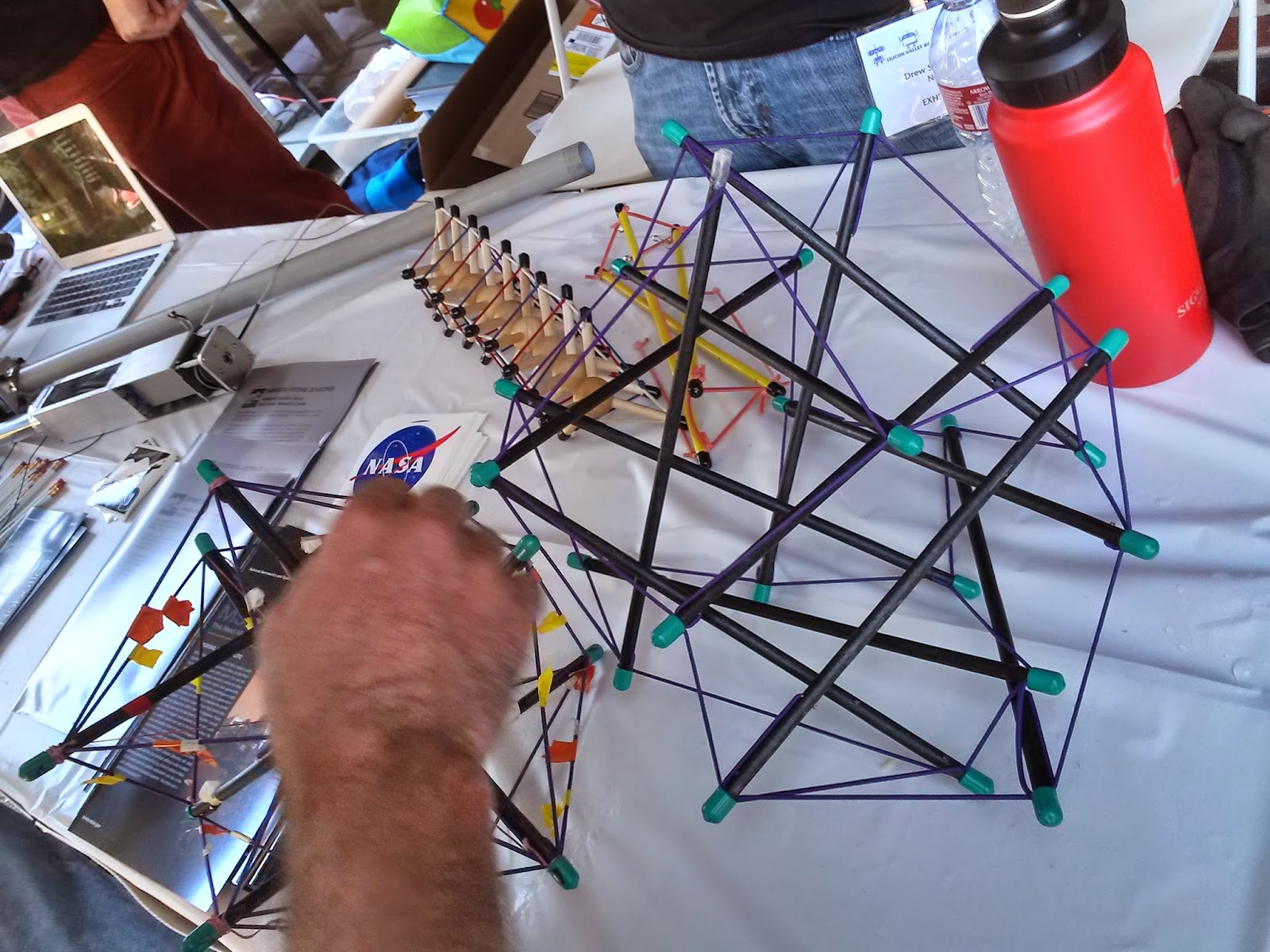
 Despite 50 years of budget cuts, NASA still had 1 extremely over engineered piece of aluminum that put the after-tax hobbyist projects to shame.

CAM00340.jpg


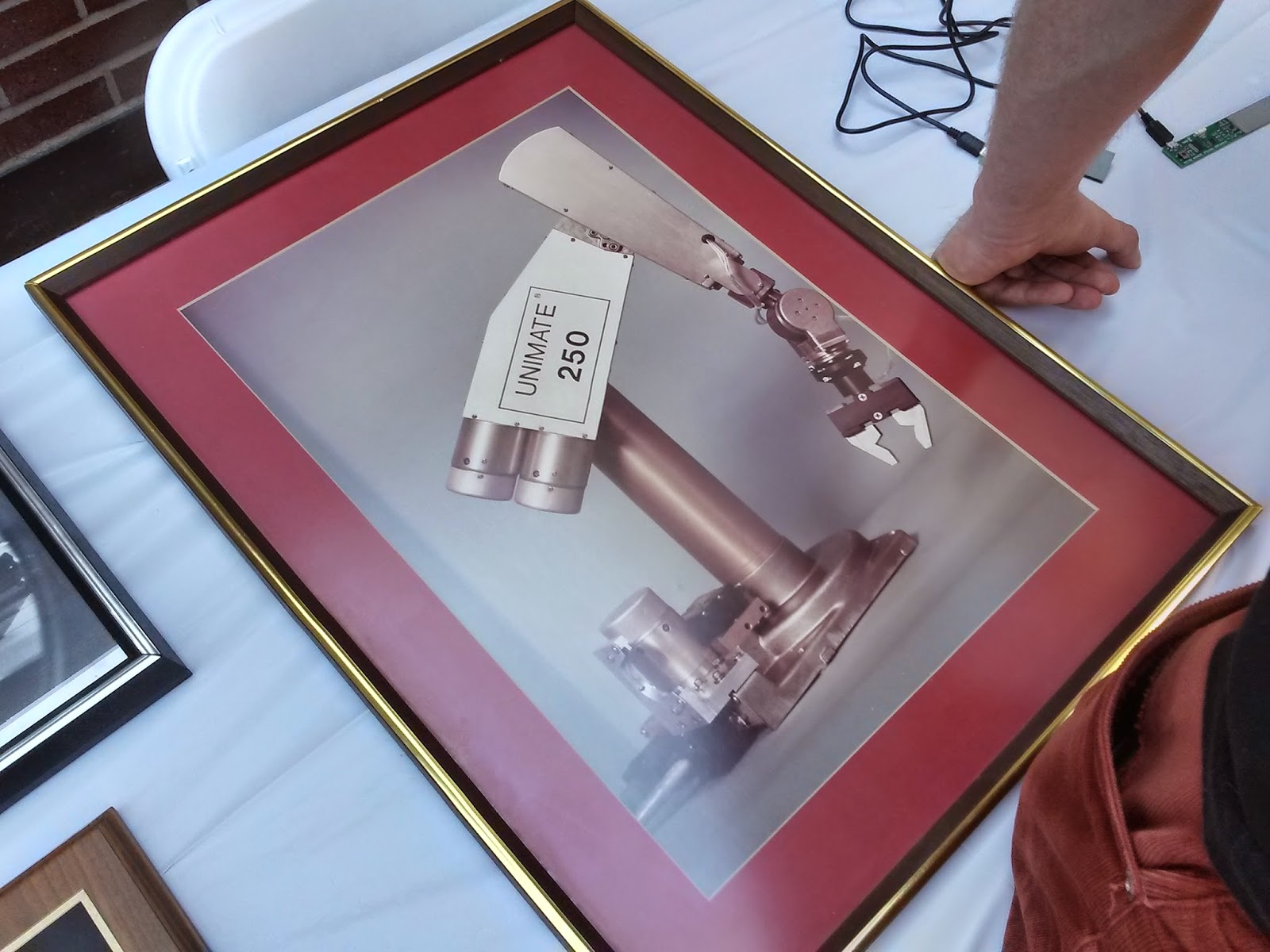
There was a picture of the robot used in Innerspace to handle the microchip. The guy who invented the Unimate was also there.  Didn't really believe it was the exact robot & the guy never heard of Innerspace, so didn't photograph everything.  A quick review of the DVD collection revealed

unimate01.jpg

unimate02.jpg

unimate03.jpg


it was indeed the same robot, if not the same model number from the movie.  It was the 1st robot arm which used direct drive stepper motors & it was patented.  1 of the students of the guy who invented it founded a startup that was sold to Google.


CAM00341.jpg


Pressure sensor with position.

sensor.jpg

CAM00343.jpg


Cheap 2 axis milling machine.

CAM00344.jpg


Boring.

CAM00345.jpg


Biomorphic walking robots made by folding paper & throwing in a bunch of servos.  They scurried pretty fast, on their paper legs.  That took a lot of mechanical engineering.  Only useful in Calif*, where it no longer rains.

CAM00346.jpg

CAM00347.jpg

CAM00348.jpg


3 generations of FOG gyros, including a russian gyro.  The newest & smallest one is $1000.

CAM00349.jpg

homebrew.jpg


After seeing all those government & academic projects, the homebrew clubs were just plain sad.  With so many people now building robots at home & a firmly established level of sophistication that diy robots are now affiliated with, it was clear why building something at home doesn't get jobs anymore.


CAM00352.jpg


CAM00351.jpg


There are a lot more people making robots at home than before. 

CAM00353.jpg


There were definitely signs of very limited after-tax income, not having the means to use the ideal components, projects being started & stopped over many years, a major achievement in just getting something to move on its own.

CAM00364.jpg

diy.jpg

CAM00355.jpg

CAM00356.jpg

Pick n place machine from

CAM00357.jpg

CAM00358.jpg


Telepresence robots abounded.

CAM00360.jpg


Something to do with beards & hair.

CAM00375.jpg


Automotive lidar.

CAM00361.jpg

CAM00362.jpg


It could be an artform.  It updated at some 5Hz.

CAM00363.jpg


It had to spin very fast to get 5Hz.

CAM00371.jpg


Very simple $180 submarine robot.  No doubt, the waterproof motors are a big expense.   The guy couldn't get it balanced & the water wasn't deep enough, so it just floated on the surface.

CAM00372.jpg

CAM00373.jpg

CAM00374.jpg

There was a 3D Robotics Iris, but no need to photograph it.

CAM00376.jpg


Running back home.

CAM00378.jpg

CAM00384.jpg

Read more…
Moderator

Beware if you are in Spain

spanishflag.png

With thanks to Patrick of GrupoAcre in Spain for sending this to us.

Yesterday we came to know (by news) that the Spanish Air Safety Agency (AESA) has suspended “All UAV Operations in Spanish Airspace” and further has declared that all operations, which are not conducted on a “Radio-controlled Aircraft Airfield” or in Sport Hall (Not Track and Field), are Illegal”.

What is the background on that?

Spain has a high level of so called “Pirate Flyers”, those guys fly with toy –equipment or semi-professional equipment, without “Insurances”, without obeying rules in max. Altitude and max. Distances, not obeying “Data Law” and other legal issues. Since, more and more “Not – Professionals” has declared by themselves as “Professionals” and few smaller accidents, obviously happened, AESA Spain has taken the decision to stop such operations, as of 07th April 2014.

For month ago, a Spanish Filming Company flew inside Madrid in FPV Mode on a distance of more than one km, in an altitude band between 20 – 150m, along the skyscraper etc. …. For sure a nice video, but a lot of people complained! Further and important is that Madrid has areas we filming and flying is not allowed …………….

More here

Read more…

3689585622?profile=original

Hello, My next guest will be the creator of the NAVIO board, EMLID. 

We will be airing live on our Google Plus Page today at 16:00 GMT.

If you are in our Circles (diydronestc@gmail.com) you will be receiving an invite, other wise if you miss this episode it will be available on our YouTube channel.

3689585723?profile=original

3689585802?profile=original

3689585636?profile=original

Read more…
3D Robotics

Ground robot tracks and controls air robot

Nice work! Jump ahead to 0:41 for the good stuff. From the video description:

In this video we demonstrate the capabilities of our monocular pose tracking system. It consists of infrared LEDs on the quadrotor and an infrared camera on the arm of a ground robot. Since we know the positions of the LEDs on the quadrotor, we can precisely estimate its position and orientation. We are able to stabilize a quadrotor under illumination changes up to complete darkness. Our algorithm is robust to false detections. This with an additional infrared LED, which we move closely to the other LEDs. To estimate the pose of the quadrotor, we need at least four LEDs. However, five are currently mounted. Our system can handle the occlusion of an LED and is still precise enough to stabilize the quadrotor. Since we track the quadrotor relative to the camera, the quadrotor stays with the ground robot, even if it is moving. Our system works also outdoors.

The system is described in our ICRA 2014 paper:
Matthias Faessler, Elias Mueggler, Karl Schwabe and Davide Scaramuzza: A Monocular Pose Estimation System based on Infrared LEDs. IEEE International Conference on Robotics and Automation (ICRA), Hong Kong, 2014.
http://rpg.ifi.uzh.ch/docs/ICRA14_Fae...

The code can be downloaded from our website:
http://rpg.ifi.uzh.ch/software_datase...

Read more…
3D Robotics

We're not far from all this being possible (although legal or advisable is a whole other matter):

Gofor provides drones on demand. Using our mobile app, you can task a drone to complete a variety of helpful tasks. "Uber, for drones".

Drones are summoned much like taxis in other popular service apps. Your desired task is either noted at the outset using presets, or customized using voice commands. Once the drone arrives, your phone's flashlight is used to pair your device with the drone. From there, it depends on the task, the object-based UI is very easy to understand. 

Read more…

Drone outlook: The next 5 years

https://www.youtube.com/watch?v=4tHs95F5gOE

Helen Greiner who co-founded iRobot 14 years ago spoke yesterday at the DEMO conference. Helen is now the co-founder and CEO of CyPhy Works, a startup developing “Unmanned Ariel Systems” or drones for industrial applications. In her brief DEMO Labs talk (see video below), Helen takes us through the next five years of drones — from hobbyist toys to industrial... surveillance.

3689585765?profile=original

more:

http://robohub.org/drone-outlook-the-next-5-years/

Read more…

3689585697?profile=original

The European Commission has today proposed to set tough new standards to regulate the operations of civil drones (or "remotely piloted aircraft sytems" – RPAS). The new standards will cover safety, security, privacy, data protection, insurance and liability. The aim is to allow European industry to become a global leader in the market for this emerging technology, while at the same time ensuring that all the necessary safeguards are in place.

Civil drones are increasingly being used in Europe, in countries such as Sweden, France and the UK, in different sectors, but under a fragmented regulatory framework. Basic national safety rules apply, but the rules differ across the EU and a number of key safeguards are not addressed in a coherent way.

The new standards will cover the following areas:

  • Strict EU wide rules on safety authorisations. 
  • Tough controls on privacy and data protection.
  • Controls to ensure security. 
  • A clear framework for liability and insurance.
  • Streamlining R&D and supporting new industry.


http://europa.eu/rapid/press-release_IP-14-384_en.htm

Read more…

FAA Grounds Missing-Persons Search Group

IMG_9909.jpeg

Source: http://online.wsj.com/news/article_email/SB10001424052702303847804579481281535674284-lMyQjAxMTA0MDAwNjEwNDYyWj

A Texas group that searches for missing people is fighting a Federal Aviation Administration order to stop using drones for its searches, adding a new challenge to the agency's authority to prohibit drones in the U.S.

The drone industry is challenging the FAA's legal authority to regulate drones. Gene Robinson, right, launches a drone as Jacob Elson handles the controls. Mr. Robinson is a volunteer drone pilot for Texas EquusSearch. RP Flight Systems

The group, Texas EquuSearch, has been using small drones, or unmanned aircraft, since 2006 to map search areas and conduct searches itself. In February, the FAA in an email ordered the group to stop immediately.

Texas EquuSearch last month responded with a letter to the FAA asserting the agency has no legal authority to prohibit drone use and threatening to take legal action if the agency didn't rescind its order in 30 days.

The spat could further emboldenentrepreneurs and companies that are growing restless with the FAA's pace in setting rules for unmanned aircraft.

The FAA effectively bans commercial use of drones in the continental U.S., and has been sending cease-and-desist letters to companies and individuals it suspects are violating that policy, including aerial photographers, journalism professors and tornado researchers, according to the letters, which were obtained by The Wall Street Journal.

The FAA says it must limit the use of drones to preserve the safety of the national airspace, at least until it finalizes rules for small drones in the U.S., which isn't expected until late 2015 at the earliest.

But the drone industry and its advocates are challenging the agency's legal authority to regulate drones at all. Last month, they won a significant victory when a federal administrative-law judge ruled that commercial drones are, in effect, already legal in the U.S.

Tim Miller, who founded Texas EquuSearch after his daughter was abducted in 2000, said drones "save a tremendous amount of time" in mapping search areas for missing-person searches, "and we know in the very beginning that time is very, very important." In about a dozen cases, drones have directly "located bodies we never would have found," he said.

In 2012, for instance, Texas EquuSearch brought in its volunteer drone pilot Gene Robinson and his 4-pound drone as authorities were wrapping up a dayslong search for a 2-year-old boy in southwest Texas. Within hours, the drone spotted a red shirt in a swampy area that led to the discovery of the boy's body.

The February email to Texas EquuSearch from Alvin Brunner, an FAA aviation safety inspector, said: "I understand the pressure to get [drones] integrated into the [national airspace] is mounting, but it must not be at the sacrifice of what is right or safe."

The group halted its use of drones in response. But it hired Brendan Schulman, a New York lawyer and drone enthusiast, to challenge the order. "There is no basis whatsoever, in law, in policy, or in common sense, to prohibit the operation of a model aircraft for volunteer search and rescue activities," Mr. Schulman wrote in his March 17 letter to the FAA.

Texas EquuSearch plans to sue the FAA in federal court if the agency doesn't rescind its order, he said in an interview.

The FAA said it must authorize anyone who wants to operate a drone in the U.S.—unless it is for recreation—and that Texas EquuSearch should obtain "emergency certificates of authorization" from the agency for its missions. The FAA grants those emergency authorizations only to police departments, public universities, or other public entities that already hold certificates for nonemergency use.

The FAA said Texas EquuSearch should try to find one of the more than 500 eligible certificate holders to sponsor its searches, such as a law-enforcement agency involved in a search that also holds an FAA authorization for drone use. It said it issued an emergency authorization within hours last year to the California National Guard to monitor the Rim Fire in the Sierra Nevada.

The agency said it planned to respond to Texas EquuSearch's letter.

Mr. Schulman also represented the man who successfully challenged the FAA's first fine for operating a drone. The Austrian videographer was hit with a $10,000 penalty for allegedly operating a drone recklessly while filming in Virginia.

Last month, administrative law judge Patrick Geraghty with the National Transportation Safety Board overturned the fine, ruling that the FAA has issued nonbinding safety guidelines and policy notices for such aircraft but "no enforceable FAA rule."

Mr. Geraghty deemed commercial drones to be the same legally as model aircraft, which he wrote aren't considered aircraft under federal law—in part because the FAA itself historically hasn't required model aircraft to comply with its rules for manned aircraft. If the FAA's argument that all types of flying devices are aircraft, the judge wrote, then the agency should also regulate "paper aircraft, or a toy balsa wood glider."

The FAA has appealed to the full boardand said the ruling by the administrative law judge is stayed until the NTSB's full board rules. The agency has said: "Anyone who wants to fly an aircraft—manned or unmanned—in U.S. airspace needs some level of authorization from the FAA."

Mr. Geraghty's ruling has helped fuel the ambitions of some drone entrepreneurs.

Steve Klindworth, chief executive of drone retailer UAV Direct, said sales have surged more than 25% to about $10,000 a day since the ruling. Dozens of people, including photographers, real-estate agents and roof inspectors, have called to inquire about drones under the perception that they are now legal for commercial use. "They're emboldened and we have to tell them to use caution," he said.

FlowerDeliveryExpress.com said the FAA told it to stop testing the delivery of flowers by drone in February. The company, based in Commerce Township, Mich., said it resumed testing after the ruling but then halted the program again after the FAA said the ruling was stayed.

"It's more than a little confusing," said CEO Wesley Berry. "Honest to God, if the FAA was around when the Wright Brothers started, there'd be no flight whatsoever."

Read more…
Developer

APM:Plane 3.0.0 released

3689585542?profile=original

The ardupilot development team is proud to announce the release of version 3.0.0 of APM:Plane. This is a major release with a lot of new features.

For each release I try to highlight the two or 3 key new features that have gone in since the last release. That is a more difficult task this time around because there are just so many new things. Still, I think the most important ones are the new Extended Kalman Filter (EKF) for attitude/position estimation, the extensive dual sensors support and the new AP_Mission library.

We have also managed to still keep support for the APM1 and APM2, although quite a few of the new features are not available on those boards. We don't yet know for how long we'll be able to keep going on supporting these old boards, so if you are thinking of getting a new board then you should get a Pixhawk, and if you want the best performance from the APM:Plane code then you should swap to a Pixhawk now. It really is a big improvement.

New Extended Kalman Filter

The biggest change for the 3.0.0 release (and in fact the major reason why we are calling it 3.0.0) is the new Extended Kalman Filter from Paul Riseborough. Using an EKF for attitude and position estimation was never an option on the APM2 as it didn't have the CPU power or memory to handle it. The Pixhawk does have plenty of floating point performance, and Paul has done a fantastic job of taking full advantage of the faster board.

As this is the first stable release with the EKF code we have decided to not enable it by default. It does however run all the time in parallel with the existing DCM code, and both attitude/position solutions are logged both to the on-board SD card and over MAVLink. You can enable the EKF code using the parameter AHRS_EKF_USE=1, which can be set and unset while flying, allowing you to experiment with using the EKF either by examining your logs with the EKF disabled to see how it would have done or by enabling it while flying.

The main thing you will notice with the EKF enabled is more accurate attitude estimation and better handling of sensor glitches. A Kalman filter has an internal estimate of the reliability of each of its sensor inputs, and is able to weight them accordingly. This means that if your accelerometers start giving data that is inconsistent with your other sensors then it can cope in a much more graceful way than our old DCM code.

The result is more accurate flying, particularly in turns. It also makes it possible to use higher tuning gains, as the increased accuracy of the attitude estimation means that you can push the airframe harder without it becoming unstable. You may find you can use a smaller value for NAVL1_PERIOD, giving tighter turns, and higher gains on your roll and pitch attitude controllers.

Paul has written up a more technical description of the new EKF code here:

http://plane.ardupilot.com/wiki/common-apm-navigation-extended-kalman-filter-overview/

Dual Sensors

The second really big change for this release is support for dual-sensors. We now take full advantage of the dual accelerometers and dual gyros in the Pixhawk, and can use dual-GPS for GPS failover. We already had dual compass support, so the only main sensors we don't support two of now are the barometer and the airspeed sensor. I fully expect we will support dual baro and dual airspeed in a future release.

You might wonder why dual sensors is useful, so let me give you an example. I fly a lot of nitro and petrol planes, and one of my planes (a BigStik 60) had a strange problem where it would be flying perfectly in AUTO mode, then when the throttle reached a very specific level the pitch solution would go crazy (sometimes off by 90 degrees). I managed to recover in MANUAL each time, but it certainly was exciting!

A careful analysis of the logs showed that the culprit was accelerometer aliasing. At a very specific throttle level the Z
accelerometer got a DC offset of 11 m/s/s. So when the plane was flying along nice and level the Z accelerometer would change from -10 m/s/s to +1 m/s/s. That resulted in massive errors in the attitude solution.

This sort of error happens because of the way the accelerometer is sampled. In the APM code the MPU6000 (used on both the APM2 and Pixhawk) samples the acceleration at 1kHz. So if you have a strong vibrational mode that is right on 1kHz then you are sampling the "top of the sine wave", and get a DC offset.

The normal way to fix this issue is to improve the physical anti-vibration mounting in the aircraft, but I don't like to fix
problems like this by making changes to my aircraft, as if I fix my aircraft it does nothing for the thousands of other people running the same code. As the lead APM developer I instead like to fix things in software, so that everyone benefits.

The solution was to take advantage of the fact that the Pixhawk has two accelerometers, one is a MPU6000, and the 2nd is a LSM303D. The LSM303D is sampled at 800Hz, whereas the MPU6000 is sampled at 1kHz. It would be extremely unusual to have a vibration mode with aliasing at both frequencies at once, which means that all we needed
to do was work out which accelerometer is accurate at any point in time. For the DCM code that involved matching each accelerometer at each time step to the combination of the GPS velocity vector and current attitude, and for the EKF it was a matter of producing a weighting for the two accelerometers based on the covariance matrix.

The result is that the plane flew perfectly with the new dual accelerometer code, automatically switching between accelerometers as aliasing occurred.

Since adding that code I have been on the lookout for signs of aliasing in other logs that people send me, and it looks like it is more common than we expected. It is rarely so dramatic as seen on my BigStik, but often results in some pitch error in turns. I am hopeful that with a Pixhawk and the 3.0 release of APM:Plane that these types of problems will now be greatly reduced.

For the dual gyro support we went with a much simpler solution and just average the two gyros when both are healthy. That reduces noise, and works well, but doesn't produce the dramatic improvements that the dual accelerometer code resulted in.

Dual GPS was also quite a large development effort. We now support connecting a 2nd GPS to the serial4/5 port on the Pixhawk. This allows you to protect against GPS glitches, and has also allowed us to get a lot of logs showing that even with two identical GPS modules it is quite common for one of the GPS modules to get a significant error
during a flight. The new code currently switches between the two GPS modules based on the lock status and number of satellites, but we are working on a more sophisticated switching mechanism.

Supporting dual GPS has also made it easier to test new GPS modules. This has enabled us to do more direct comparisons between the Lea6 and the Neo7 for example, and found the Neo7 performs very well. It also helps with developing completely new GPS drivers, such as the Piksi driver (see notes below).

New AP_Mission library

Many months ago Brandon Jones re-worked our mission handling code to be a library, making it much cleaner and fixing a number of long term annoyances with the behaviour. For this release Randy built upon the work that Brandon did and created the new AP_Mission library.

The main feature of this library from the point of view of the developers is that it has a much cleaner interface, but it also has some new user-visible features. The one that many users will be glad to hear is that it no longer needs a "dummy waypoint" after a jump. That was always an annoyance when creating complex missions.

The real advantage of AP_Mission will come in future releases though, as it has the ability to look ahead in the mission to see what is coming, allowing for more sophisticated navigation. The copter code already takes advantage of this with the new spline waypoint feature, and we expect to take similar advantage of this in APM:Plane in future releases.

New Piksi GPS driver

One of the most exciting things to happen in the world of GPS modules in the last couple of years is the announcement by SwiftNav that they would be producing a RTK capable GPS module called the Piksi at a price that (while certainly expensive!) is within reach of more dedicated hobbyists. It offers the possibility of decimeter and possibly even centimetre level relative positioning, which has a lot of potential for small aircraft, particularly for landing control and more precise aerial mapping.

This release of APM:Plane has the first driver for the Piksi. The new driver is written by Niels Joubert, and he has done a great job. It is only a start though, as this is a single point positioning driver. It will allow you to use your new Piksi if you were part of the kickstarter, but it doesn't yet let you use it in RTK mode. Niels and the SwiftNav team are working on a full RTK driver which we hope will be in the next release.

Support for more RC channels

This release is the first to allow use of more than 8 RC input channels. We now support up to 18 input channels on  SBus on Pixhawk, with up to 14 of them able to be assigned to functions using the RCn_FUNCTION settings. For my own flying I now use a FrSky Taranis with X8R and X6R receivers and they work very nicely. Many thanks to the PX4 team, and especially to Holger and Lorenz for their great work on improving the SBus code.

Flaperon Support

This release is the first to have integrated flaperon support, and also includes much improved flaps support in general. You can now set a FLAP_IN_CHANNEL parameter to give an RC channel for manual flap control, and setup a  FLAPERON_OUTPUT to allow you to setup your ailerons for both manual and automatic flaperon control.

We don't yet have a full wiki page on setting up flaperons, but you can read about the parameters here:

http://plane.ardupilot.com/wiki/arduplane-parameters/#Flap_input_channel_ArduPlaneFLAP_IN_CHANNEL

Geofence improvements

Michael Day has made an number of significant improvements to the geo-fencing support for this release. It is now possible to enable/disable the geofence via MAVLink, allowing ground stations to control the fence.

There are also three new fence control parameters. One is FENCE_RET_RALLY which when enabled tells APM to fly back to the closest rally point on a fence breach, instead of flying to the centre of the fence area. That can be very useful for more precise control of fence breach handling.

The second new parameter is FENCE_AUTOENABLE, which allows you to automatically enable a geofence on takeoff, and disable when doing an automatic landing. That is very useful for fully automated missions.

The third new geofence parameter is FENCE_RETALT, which allows you to specify a return altitude on fence breach. This can be used to override the default (half way between min and max fence altitude).

Automatic Landing improvements

Michael has also been busy on the automatic landing code, with improvements to the TECS speed/height control when landing and new TECS_LAND_ARSPD and TECS_LAND_THR parameters to control airspeed and throttle when landing. This is much simpler to setup than DO_CHANGE_SPEED commands in a mission.

Michael is also working on automatic path planning for landing, based on the rally points code. We hope that will get into a release soon.

Detailed Pixhawk Power Logging

One of the most common causes of issues with autopilots is power handling, with poor power supplies leading to brownouts or sensor malfunction. For this release we have enabled detailed logging of the information available from the on-board power management system of the Pixhawk, allowing us to log the status of 3 different power sources (brick input, servo rail and USB) and log the voltage level of the servo rail separately from the 5v peripheral rail on the FMU.

This new logging should make it much easier for us to diagnose power issues that users may run into.

New SERIAL_CONTROL protocol

This release adds a new SERIAL_CONTROL MAVLink message which makes it possible to remotely control a serial port on a Pixhawk from a ground station. This makes it possible to do things like upgrade the firmware on a 3DR radio without removing it from an aircraft, and will also make it possible to attach to and control a GPS without removing it from the plane.

There is still work to be done in the ground station code to take full advantage of this new feature and we hope to provide documentation soon on how to use u-Blox uCenter to talk to and configure a GPS in an aircraft and to offer an easy 3DR radio upgrade button via the Pixhawk USB port.

Lots of other changes!

There have been a lot of other improvements in the code, but to stop this turning into a book instead of a set of release notes I'll stop the detailed description there. Instead here is a list of the more important changes not mentioned above:

  • added LOG_WHEN_DISARMED flag in LOG_BITMASK
  • raised default LIM_PITCH_MAX to 20 degrees
  • support a separate steering channel from the rudder channel
  • faster mission upload on USB
  • new mavlink API for reduced memory usage
  • fixes for the APM_OBC Outback Challenge module
  • fixed accelerometer launch detection with no airspeed sensor
  • greatly improved UART flow control on Pixhawk
  • added BRD_SAFETYENABLE option to auto-enable the safety switch on PX4 and Pixhawk on boot
  • fixed pitot tube ordering bug and added ARSPD_TUBE_ORDER parameter
  • fixed log corruption bug on PX4 and Pixhawk
  • fixed repeated log download bug on PX4 and Pixhawk
  • new Replay tool for detailed log replay and analysis
  • flymaple updates from Mike McCauley
  • fixed zero logs display in MAVLink log download
  • fixed norm_input for cruise mode attitude control
  • added RADIO_STATUS logging in aircraft logs
  • added UBX monitor messages for detailed hardware logging of u-Blox status
  • added MS4525 I2C airspeed sensor voltage compensation

I hope that everyone enjoys flying this new APM:Plane release as much as we enjoyed producing it! It is a major milestone in the development of the fixed wing code for APM, and I think puts us in a great position for future development.

Happy flying!

Read more…

New website for RC enthusiasts

3689585398?profile=original

Thought I'd share with you all - just finished building a new website to help RC communities find each-other.

Gone RC Website

Don't be thrown-off by creating a record for your own RC operation, you're just as good as a big club!

If you enter Google Map coordinates - people could easily find you where you fly/race/whatever or join you if you've posted "on the field" status while keeping your information private.

All stuff works but, as always - work in progress! New features added by requests and if needed.

Cheers,

Mark

Read more…

Game of Clones...........

4-7-2014_6-39-22_pm.jpg?width=600

Just came across this Pixhawk clone, so thought I would share.

http://witespyquad.gostorego.com/flight-controllers/rtfhawk-2-4.html

Ready to Fly Quads is a reputable distributor, and I have made a few purchases from them already. They already have a clone of the APM2.x, that has been somewhat successful. Will this new clone be just as good. for under $100USD, might be work a try.

Read more…

3DR Y6 first flight and AutoTune

3689585462?profile=originalTakeoff weight was 2160 g, 4S 6000mAh, 8 minutes in the air.

I closed the GPS and open SONAR. Set CH7 switch AutoTune.

First, Stabilize mode and height 10 meters remain, Then, Change the flight mode to ALT HOLD

I open AutoTune, any did not happen. 
I closed AutoTune, Plane began "dancing" and I got a new PID at three minutes later.

I checked found, Remote control is set incorrectly, CH7 switch is reversed.

3689585503?profile=original

3689585479?profile=original

3689585554?profile=original

3689585528?profile=original

3689585579?profile=original

3689585379?profile=original

Read more…
T3

Krasiczyn Castle 3D model, Poland

Melown maps: a new 3D reconstruction method for interactive 3D digital surface models.

3689585365?profile=originalGuys, check out the newest sample obtained from the photos I have gathered almost a year ago. It took some serious research effort because the area is very difficult (many trees and vertical object) and we were testing 3D reconstruction from strictly oblique imaginery gathered during low level flight (5cm/pixel, 150m agl, used stabilised head in order to limit roll deviations).

https://www.melown.com/maps/#2

Honestly, the result is even more detailed than the results I got from CMP-SFM institute from Prague one year ago, much better than from any other method, moreover the resulting product is easily viewed within web browser. You can compare the quality of regular satellite imaginery taken at 100cm resolution surrounding this castle (and relatively coarse public 10m elevation grid in the area).

I am not 'affiliated' with them in any way, just provided the data. They are from Czech Republic.

Amazing results!

Read more…

Syma X3 as a robotic platform

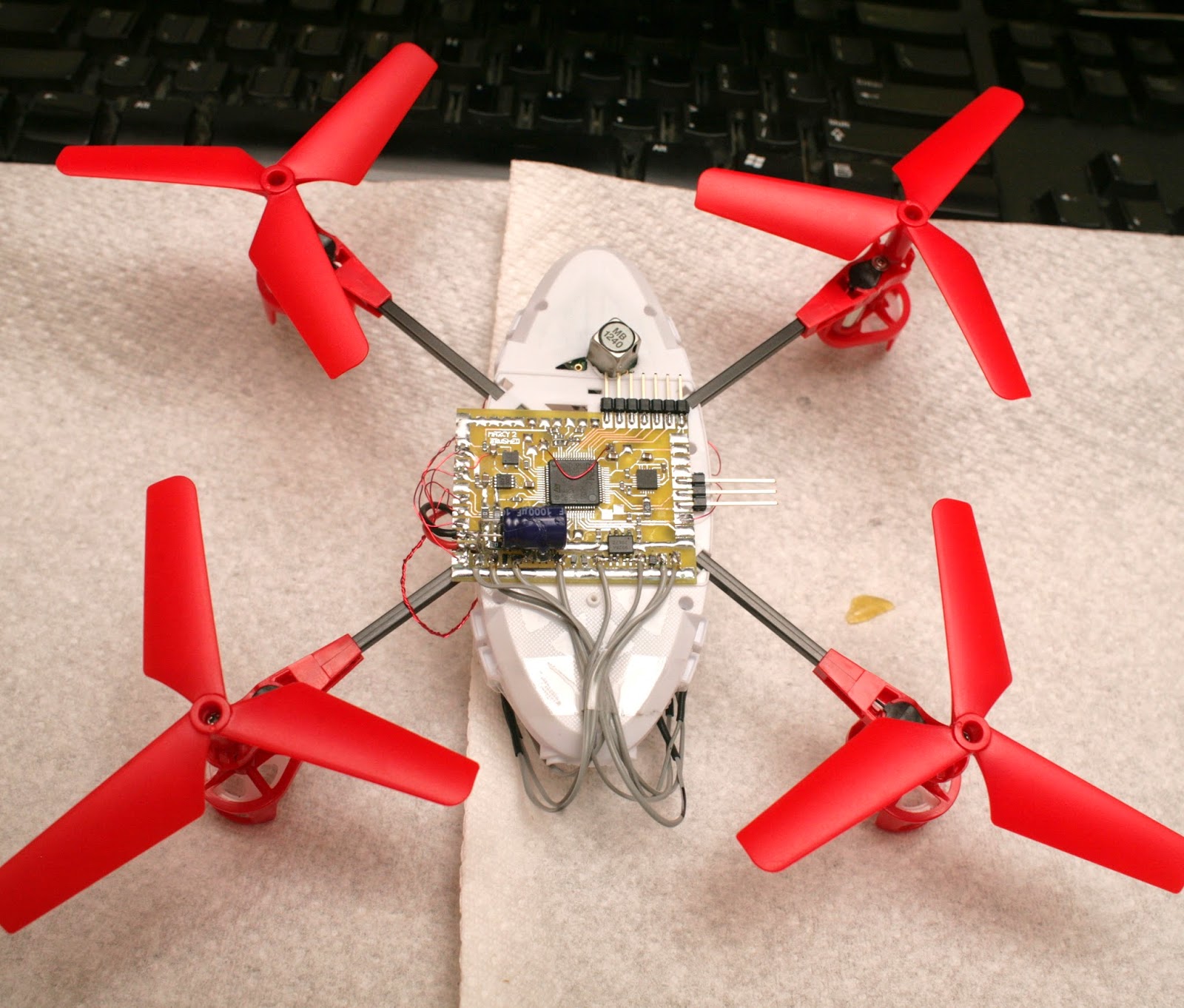
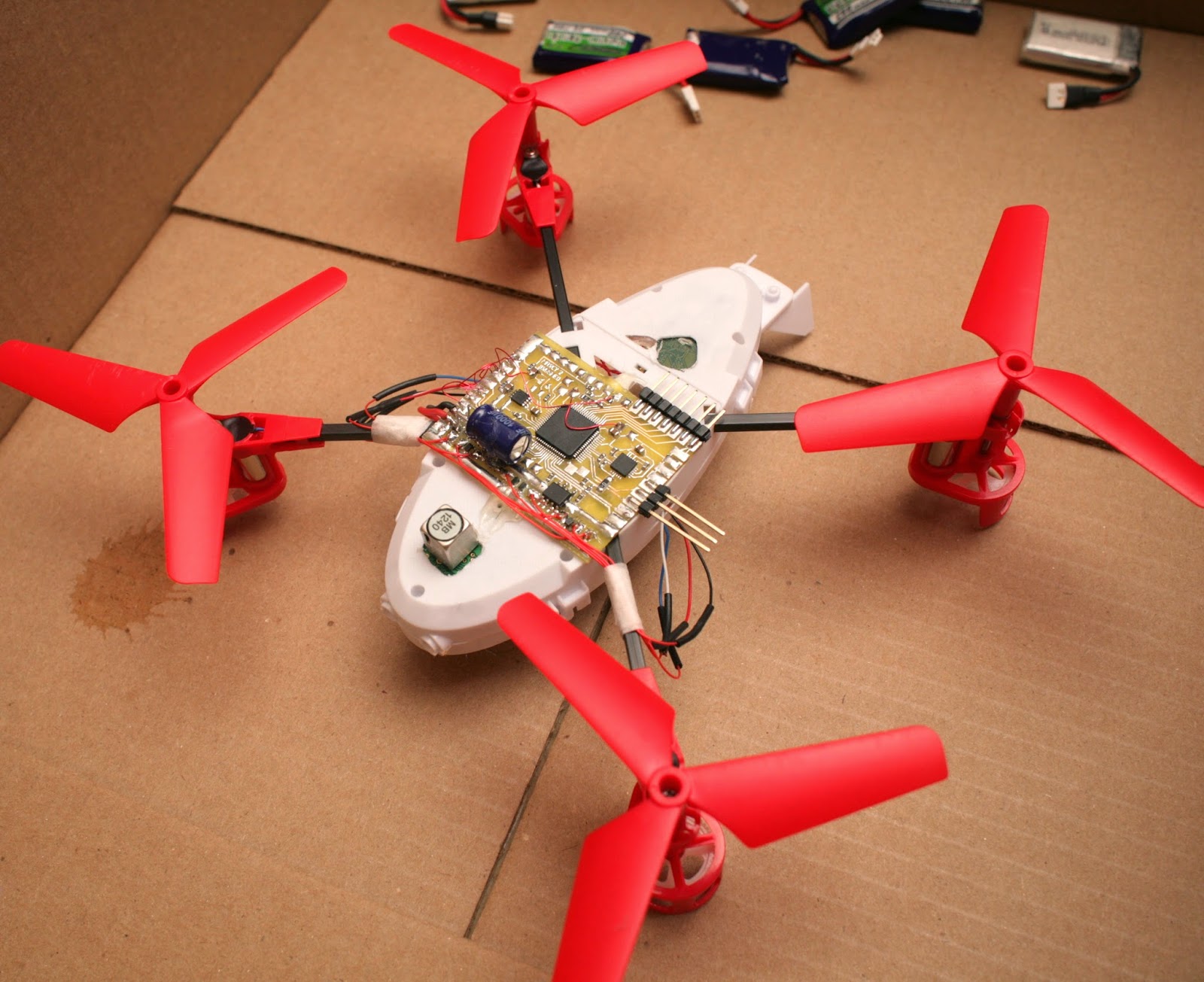
syma_x3_10.jpg

syma_x3_11.jpg
syma_x3_01.jpg
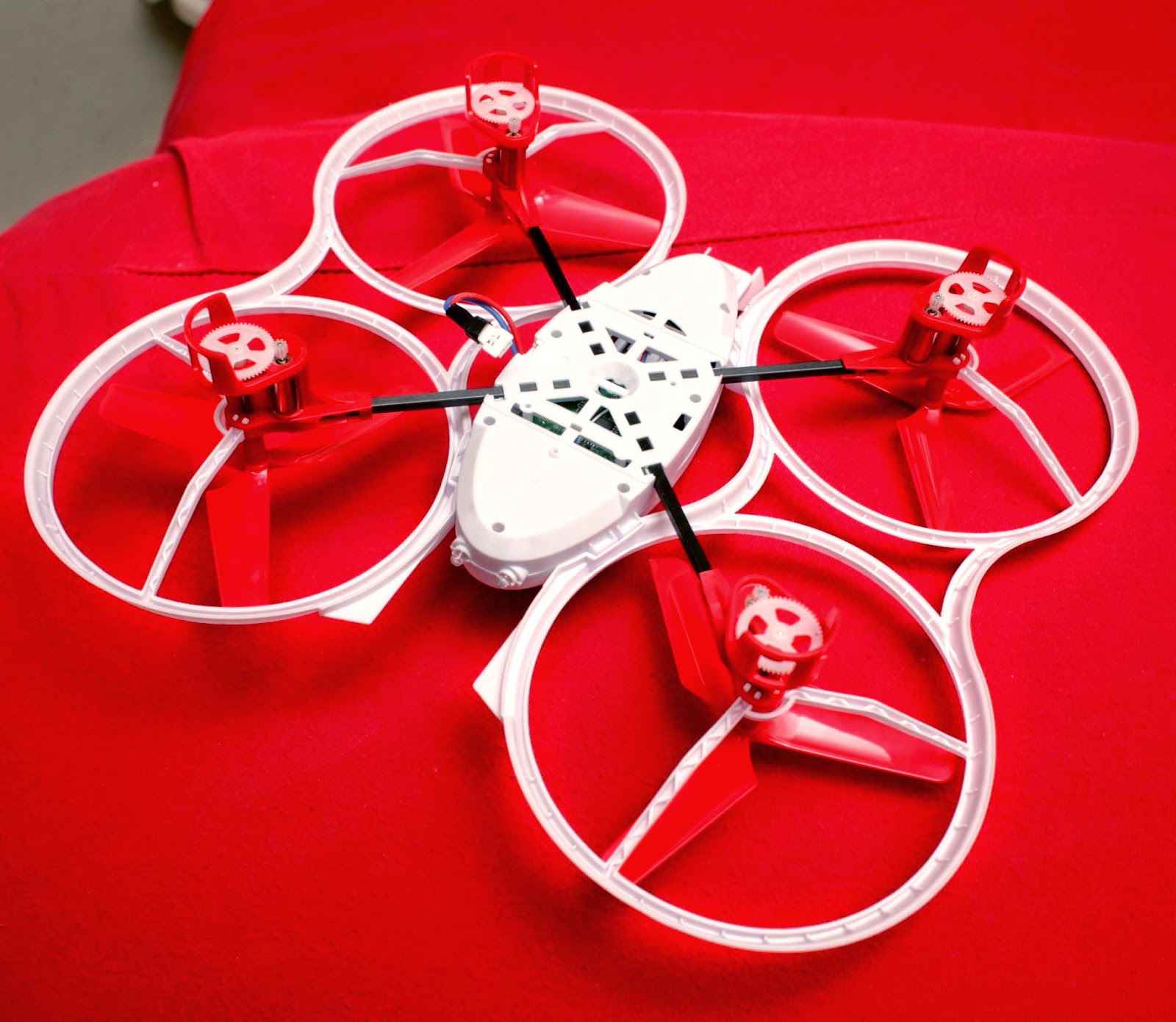
The Syma brand copters have been more stable than anything else their size, probably owing to high mass, low loading propellers.


syma_x3_02.jpg

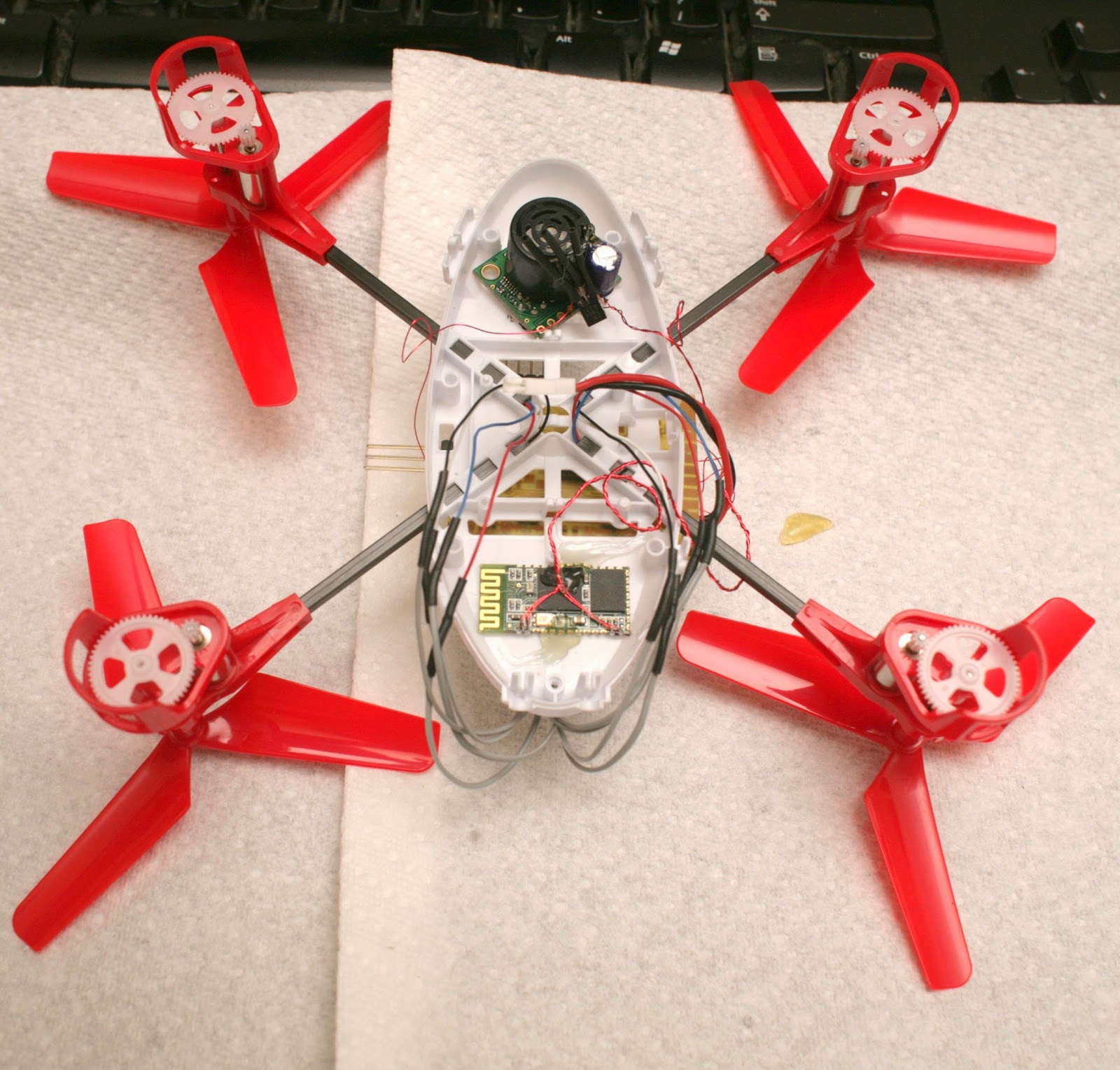
 The fuselage can be flipped over, making a flat surface.

syma_x3_03.jpg

The original battery holder wouldn't fit in this arrangement.  Another rearrangement of electronics got the original battery holder to fit.

syma_x3_08.jpg

The downward tail fins give it a bit of an MQ-1 look.  The tail fins do nothing, of course.

 syma_x3_04.jpg
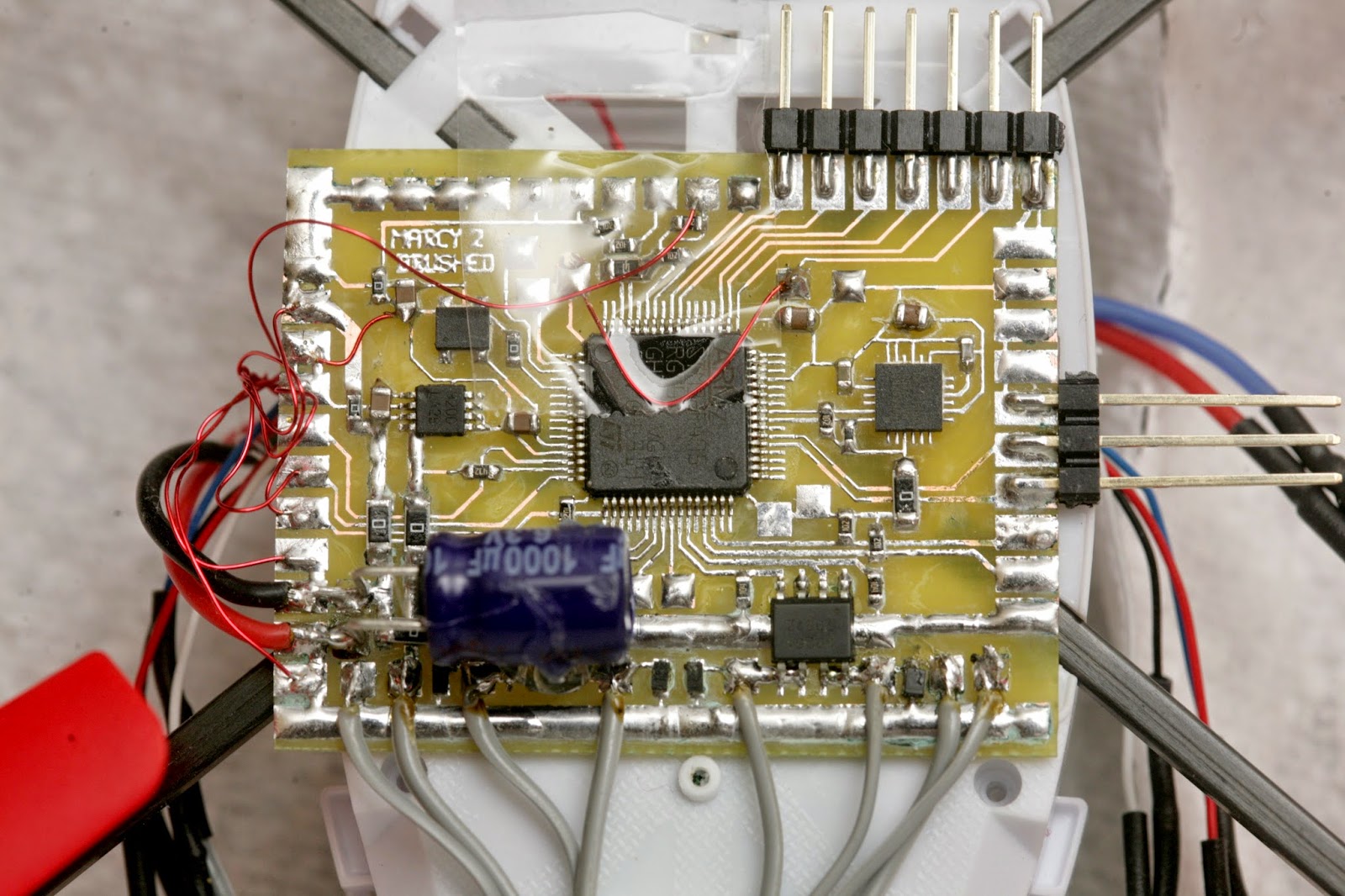
Today's discovery was the LP2989 spikes to the full battery voltage before settling at 3.3V. Accidentally plugged a 7.4V into it. The spike made bluetooth fail. It can only handle 4.2V.

Sonar was totally non functional with any motor power, but functional with the motors off. It didn't work on regulated 3.3V or unregulated 4.2V. The Syma X1's had the same sonar module working, but they're gone. A 500mAh had the same voltage drop & sonar failure.
syma_x3_07.jpg
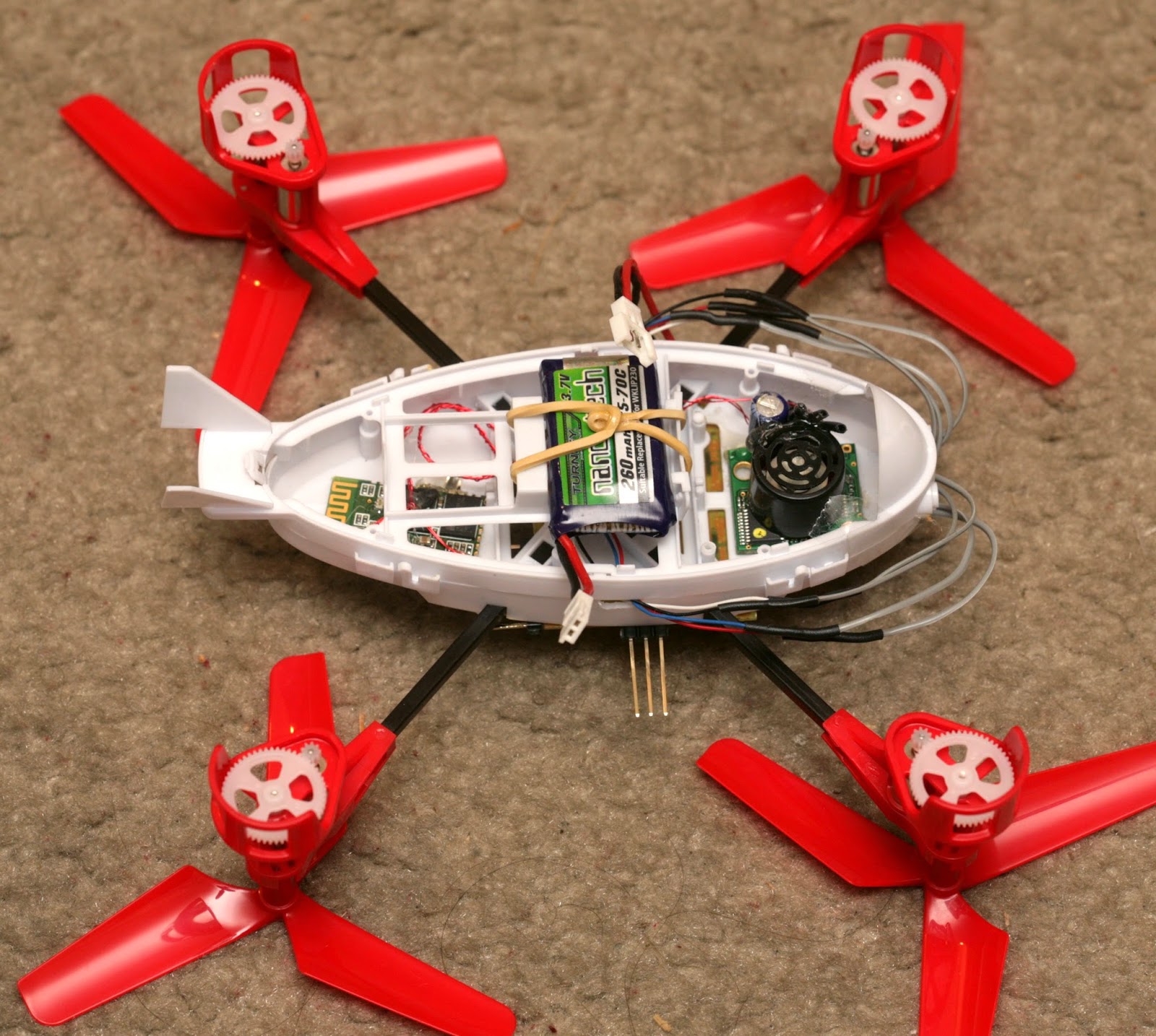
The tried & true rubber band allows a 260mAh to fit. The 260mAh gets it off the ground, but is pulled down to 3.4V. It flies for 2 minutes.

The IMU goes at 1400Hz with only 6 axes being read. The PWM goes at 1200Hz. The IMU is more stable than on the turnigy microquad.  At least it's now possible to upload a new configuration file without power cycling it. That was a tricky reset bit, years in the making.


syma_x3_09.jpg

So the motor wires had to be routed away from the sonar transformer. There aren't many places for those wires. With that out of the way, the Syma X3 worked perfectly. It was very stable, performing the autonomous open loop maneuvers exactly as hoped.


Without any position sensing besides altitude, it took several takes to get a maneuver to work. It was more successful in the packed apartment than the large room. The apartment might break up the air currents more. 1 key seems to be making it as light as possible.

 Open loop autopilot is how all the commercial quads do flips.  It's how the early academic quads did aerobatics.  They just repeatedly flew a fixed set of stick inputs & delays until the maneuver came out.  There might be room for some tweeking to try to keep it inside a box, but the maneuver is flown without any position knowledge.  The Vicon system might have improved enough that open loop flying is no longer necessary in academia.


Miniaturization beyond a point still costs you. There is a weight advantage to using $5 of ceramic caps instead of $0.35 of electrolytic.

Ceramic 100uF 6.3v * 5: 0.3g
Electrolytic 470uF 6.3v: 0.6g

But the weight of the soldering for the ceramics would make them heavier. Digikey has a 220uF 6.3 for $1.65. 2 of those would be lighter than the electrolytic.


What about using 2 batteries + regulator instead of a boost converter to get 5V 300mA?

Extra 4.2V 260mAh: >7.5g
boost converter: 3.1g

So all the work designing the boost converter was worth it. The choice in motor wire makes a difference, too.

Ribbon cable: 1.2g
wrapping wire: 0.1g

Didn't notice any reduction in power from using wrapping wire.
Read more…
3D Robotics

3689585299?profile=original

Here's a very interesting (if challenging) online course that you can audit for free. It starts May 6th. I liked this bit:

Do I need to build/own a quadrotor?

No, we provide a web-based quadrotor simulator that will allow you to test your solutions in simulation. However, we took special care that the code you will be writing will be compatible with a real Parrot Ardrone quadrotor. So if you happen to have a Parrot Ardrone quadrotor, we encourage you to try out your solutions for real.

----------

Autonomous Navigation for Flying Robots

In this course, we will introduce the basic concepts for autonomous navigation with quadrotors, including topics such as probabilistic state estimation, linear control, and path planning.

About this Course

In recent years, flying robots such as miniature helicopters or quadrotors have received a large gain in popularity. Potential applications range from aerial filming over remote visual inspection to automatic 3D reconstruction of buildings. Navigating a quadrotor manually requires a skilled pilot and constant concentration. Therefore, there is a strong scientific interest to develop solutions that enable quadrotors to fly autonomously and without constant human supervision. This is a challenging research problem because the payload of a quadrotor is uttermost constrained and so both the quality of the onboard sensors and the available computing power is strongly limited.

In this course, we will introduce the basic concepts for autonomous navigation for quadrotors including topics such as probabilistic state estimation, linear control, and path planning. You will learn how to infer the position of the quadrotor from its sensor readings, how to navigate along a series of waypoints, and how to plan collision free trajectories. The course consists of a series of weekly lecture videos that we be interleaved by interactive quizzes and hands-on programming tasks. The programming exercises will require you to write small code snippets in Python to make a quadrotor fly in simulation.

This course is intended for graduate students in computer science, electrical engineering or mechanical engineering. The course is based on the TUM lecture “Visual Navigation for Flying Robots” which received the TUM TeachInf best lecture award in 2012 and 2013. The course website from last year (including lecture videos and course syllabus) can be found here:http://vision.in.tum.de/teaching/ss2013/visnav2013

Read more…

A little progress with instruments

I haven't been posting anything in ages - and about as long have I been pretty busy with other stuff but now I finally had the time and peace to continue working on the flight instruments integration. Here's a little video of the progress.

I still have to iron out a few minor issues but basically it's working, so I hope, I can go to the next gauge soon, which would probably be altimeter.

Still need to to the hardware design for the interface board - which is not my strong side...

Read more…