All Posts (11086)

Sort by

3689576814?profile=original

Ok, so I took the SSS APM 2.5 up again this weekend once on Saturday and once today (Sunday) and the flights taught me important lessons in why we should read the documentation that is available for our equipment.

The Saturday flight was just stupid. It was windy and my pilot (I just man the computer and let a professional RC buddy do the take offs, lame, I know, but I'll learn later) put her down after a few loops and didn't want to take her up again. At several points you could cut the throttle and SSS would just hang in the air like a vulture and every time she banked I held my breadth as the wind caught the 2.4 meter wing and hurled her across the field. When he landed her we almost decided to catch it because the wind just held her steady and still a few feet above the ground. Gentle wind the manual says. Gentle.

You can see here how the surfer almost remains still as the red GPS readings clump together as she heads west (right of image) near the path).

3689576709?profile=original

Sunday

Ok this was a biggie mistake. Nice weather, warm, perfect day for testing out a mission using the autopilot. I plotted out a mission like this using mission planner, my pilot launched her, took her out to the middle of the field and I hit "auto". I expected brilliance. 

The Plan (note in the real plan I moved "home" to the middle of the field).

3689576690?profile=original

So it's in the middle of the field and I inform my pilot that I'm going "auto" he says good luck. I engage. The SSS promptly turns away from the assigned grid area and heads straight back toward us. Like sailors watching the torpedo they launched coming back at them I start freaking out as it heads over us and the highway behind us (a decreed no-fly zone for us). I return it to manual and check my mission.  I get her over the field and again inform my pilot that I'm taking control. Again she turns and begins to charge us down. Again, I switch to manual and cry silent, dry, tears as my pilot brings her in to land. 

What happened? I had a "compass error" earlier so I thought it might be a north south issue (no, not the civil war) and that it was heading "north" instead of "south" to the first waypoint (yes, that makes no sense considering it was displaying direction fine during manual mode). I packed my gear and came home.

What happened?


Well, I can't be 100% until I get it back up in the air but it might have something to do with the fact that I didn't "write" waypoints in Mission planner. I'm fairly certain that when I hit auto the APM detected no mission and just went into RTL mode. Which, given the default "home" position" would put her in a circle over me and, in part, the highway behind. 

Moral of the story: Skipping steps is bad. Don't do it. 

Safe flying folks.

-JimiSlew

Bonus map of my failed "Auto" attempts. Green and Pink are Auto tracks. 
3689576731?profile=original

Read more…

Ardusoar cross country X-Plane simulation

3689576559?profile=original

Hello all,

I have been doing some work on Peter Braswell's Ardusoar code (http://diydrones.com/forum/topics/autonomous-soaring?xg_source=activity) to improve thermal centring.

I finally got around to getting HIL working in XPlane to allow some cross country soaring simulations. I am using the PT60 model which has a terrible glide ratio (about 1:7) so thermal strength has been set quite high (1000 ft/min) although thermal coverage is only 10%. The Ardusoar code is working very well - the extended Kalman filter does a good job of centring thermals and almost never loses them. The throttle is set to zero when soaring but is re-enabled if the altitude drops too low, allowing automated climbs back to a good altitude. The flight mode is AUTO until an updraft is encountered (climbrate exceeds a certain threshold) at which point the mode is switched to LOITER. In LOITER mode, the Kalman filter is updated whenever new measurements (GPS positions and barometric altitude) are available. The update takes 4-5ms and doesn't appear to slow down the main loop below 50Hz. My repository is here if anyone is interested in trying out the code. https://github.com/samuelctabor/Arduplane

Below is a several kilometre flight (this was a 5-hour Xplane flight) with quite a lot of thermal encounters. The code includes logic about whether a thermal at a given strength and height is worth taking. This leads to quite a few brief thermal encounters in which the algorithm begins to search for the thermal but decided not to continue based on the thermals strength (too weak for the altitude the plane is at).

Below is the altitude throughout the flight (after the initial climb to 850m, the motor is off). There are a few long thermal climbs, especially early in the flight up to 3000m (cloudbase).3689576511?profile=original

Below is a close up of a typical climb. After switching to loiter mode (purple)  it takes a couple of circles to centre the thermal. 

3689576618?profile=original

The filter's states are saving in the onboard log to allow post-flight analysis. Here the algorithm's estimate of the thermal centre location is the blue track. You can see it moves it quite a bit during the initial centring and very little after that.3689576591?profile=original

The internal model of the updraft strength is a Gaussian distribution. Effectively the Kalman filter tries to adjust the estimated strength size and location to match the measurements.

3689576534?profile=original

As you can see the states change quite a lot during the initial centring. After that they are quite stable except for some ripple. This is due to the XPlane thermals not quite matching the Gaussian distribution assumed in the algorithm.

3689576642?profile=original

I am hoping to do some real-world flight testing when the weather improves here. Eventually this code is going to be used in a 3m balsa Bird of Time glider I am building, but flight testing will probably be done on something a little more tough and expendable, probably a Parkzone Radian.

3689576664?profile=original

Happy flying!

Sam

Read more…
3D Robotics

Politico: "FAA risks losing the drone war"

3689576606?profile=original

From Politico, a long piece arguing that the "FAA is often powerless to halt the growing drone swarm".


Excerpt:

The Washington Nationals used a drone to photograph spring training. Real estate agents use them to show off sprawling properties. Martin Scorsese hired one to film a scene in “The Wolf of Wall Street.”

So where does this leave the Federal Aviation Administration, which insists that commercial drone use is illegal?

Way behind — and facing turbulence as drone use explodes.

Thanks to falling prices, spotty enforcement and the fact that it’s almost impossible to spot the devices being used, the FAA is often powerless to halt the growing drone swarm. Retailers freely sell the tiny planes, quadcopters and hexacopters for as little as a few hundred dollars, and entrepreneurs continually come up with creative uses like wedding photography and crop monitoring — along with delivering beer and dropping off dry-cleaning.

The result, observers and drone users warn, could be a Wild, Wild West in the nation’s skies. As small drone operators grow used to flying them without the FAA’s permission, they could become less inclined to obey any rules the agency puts in place. And with the cost of the technology continuing to drop, the drones could eventually become far too ubiquitous for the agency to police.

Meanwhile, the FAA is lagging in meeting a congressional mandate to allow commercial drones to share the skies legally.

“Most people want to comply with the FAA rules,” said Ted Ellett, a former FAA general counsel who is now a partner specializing in aviation at the law firm Hogan Levells. “But the more the FAA acts like a big daddy, behemoth government agency that is imposing excessive restrictions, the more the feeling of ‘I’m an American, they can’t tell me what to do’ kicks in. And that’s a real danger for the FAA.”

Plenty of drone users are going ahead without waiting for the agency.

“A lot of our members would like to start businesses using this technology,” said Timothy Reuter, the founder of the Drone User Group Network in Washington. “Some of them are waiting for the regulations to open up. Others, honestly, aren’t.”


Read more…

Maritime RobotX Challenge

Embry-Riddle Aeronautical University is excited to have been selected as one of 15 teams worldwide to participate in the inaugural Maritime RobotX Challenge.  We thought it would be good to post some links and video here so people in the community can see what the competition is about and start following the teams.  We had our first successful test a few weeks ago and already have the platform running autonomously.

Each team is awarded one WAM-V platform and a stipend to outfit it with the most sophisticated autonomy package they are capable of assembling.  Tasks range from obstacle avoidance, navigation and sonar homing.

We will do our best to answer any questions.

Embry-Riddle's RobotX Page

Maritime RobotX Challenge Website

Read more…

Chinese man makes what out of what?!

http://news.yahoo.com/photos/unique-inventions-and-self-made-projects-from-china-1393004083-slideshow/

3689576461?profile=original So I found this via Yahoo, and I Included a link to the story. So going from what the story said, the man used motorcycle engines to create this man operated octocopter in china. Does not go very high, cant go far, and cant stay up long but its cool none the less. Now would you believe he is only a graduate of a junior middle school. Click on the link for more, but I had to share this! Fair flying friends!

ps: virtual cookie to anyone who can make something like this, I know its been done before, but still.

Read more…
Developer

APM Planner 2.0 RC5 Update

3689576438?profile=original

Just a small update and notification for user of APM Planner 2.0. We have a new release candidate available for people to try. You can find the downloads here 

In this release we have almost 50 fixes & improvements (and we have more to come)

If you are looking for specific fix or change, check the changes_rc5.txt

Thanks everybody whose downloaded used, tested or given feedback.

For support please post your questions here on ardupilot.com 

Read more…

3689576299?profile=original

I imagine this 3DR Y6, as filming a documentary on my Amazon aerial plan.

I do not use universal joints, only the damping to obtain subjective images.
FPV flight , and use Stabilize and AltHold mode, in the range of 3 km.
Use PX4FLOW maintain a high level of 3-5 meters ,
3 MB1240 attached to the front , left and right to avoid obstacles.

3DR Y6 Frame + Electronics Kit (2013 Version)
Pixhawk Autopilot System
3DR u-blox GPS with magnetometer
PX4FLOW Kit
MB1240 XL-MaxSonar-EZ4 High Performance Ultrasonic Range Finder
3DR Radio Set with Cloverleaf Antenna
APM MinimOSD Rev. 1.1 Kit
TX­V1012 V2 1000mW 1.2GHz plug and play transmitter ­ Lawmate
Sony High Definition POV Action Video Camera HDR­AS30V
XM495 5 Volt 170 Degree Camera
850 Kv brushless motors
20 Amp ESCs with SimonK firmware
11x4.7 10x4.7 slow-fly APC propellers
4S 6000 mAh and 3S 2600 mAh battery pack
Vehicle weight (with battery): 6.14 lbs / 2.79 Kg

I will test .
Any suggestions , Greatly appreciated !


3689576224?profile=original


3689576362?profile=original


3689576235?profile=original


3689576326?profile=original


3689576416?profile=original

Read more…

Google gets into 3D mapping with Project Tango

Project Tango is Google's plan to bring full SLAM (optical mapping and location detection) into smartphones. 

We can build it faster together.

As we walk through our daily lives, we use visual cues to navigate and understand the world around us. We observe the size and shape of objects and rooms, and we learn their position and layout almost effortlessly over time. This awareness of space and motion is fundamental to the way we interact with our environment and each other. We are physical beings that live in a 3D world. Yet, our mobile devices assume that physical world ends at the boundaries of the screen.

The goal of Project Tango is to give mobile devices a human-scale understanding of space and motion.

Over the past year, our team has been working with universities, research labs, and industrial partners spanning nine countries around the world to harvest research from the last decade of work in robotics and computer vision, concentrating that technology into a unique mobile phone. Now, we’re ready to put early prototypes into the hands of developers that can imagine the possibilities and help bring those ideas into reality.

We hope you will take this journey with us. We believe it will be one worth traveling.

- Johnny Lee and the ATAP-Project Tango Team


Read more…

Hi Everyone,

I'm working on Bluetooth Low Energy (BLE, Bluetooth Smart or Bluetooth 4.0)  technology since summer 2013 and after few hundred hours code work my first BLE product(iCELL) ready to show and I'm happy to share here with the community.

May be you know, Some Android devices and all iPhones(since 4S) including this low power transceivers.
I think BLE will be most important interaction method for near devices at the future. Currently you can find thousands different BLE device on the market and hundred thousands coming. 

iCELL hardware is a small electronic hardware with 8 cell battery reading capability and you can easily connect it to balance port of your LiPO to read battery voltage and cell conditions from your iPhone or iPad. (details here)

 
BLE has some limitations. The range around 30-100 meters. Data speed ~200 byte per seconds max. Not useful for drone data telemetry but possible to make your multirotor settings before flight or checking some important variables when your platform passes above you.
Main advantage is iPhone/iPad/Android. Everyone has one of them. Software update is easy. Screen is tough sensitive. Resolving all display problems on a single platform. 
The second big advantage is "Low Energy". BLE devices can works 1 year with a coin cell.

Now I'm working on a weather station for house usage, a camera trigger for timelapse, a camera slider and lost plane beacon. All of them working over BLE.  

Please share your opinion about iCELL idea. is it useful? or useless? 
and If you have any new idea for BLE technology please feel free. I will glad to work over it. 

Thanks
Melih


Read more…

Google's indoor flying space

hangar-one-at-moffett-field.jpg


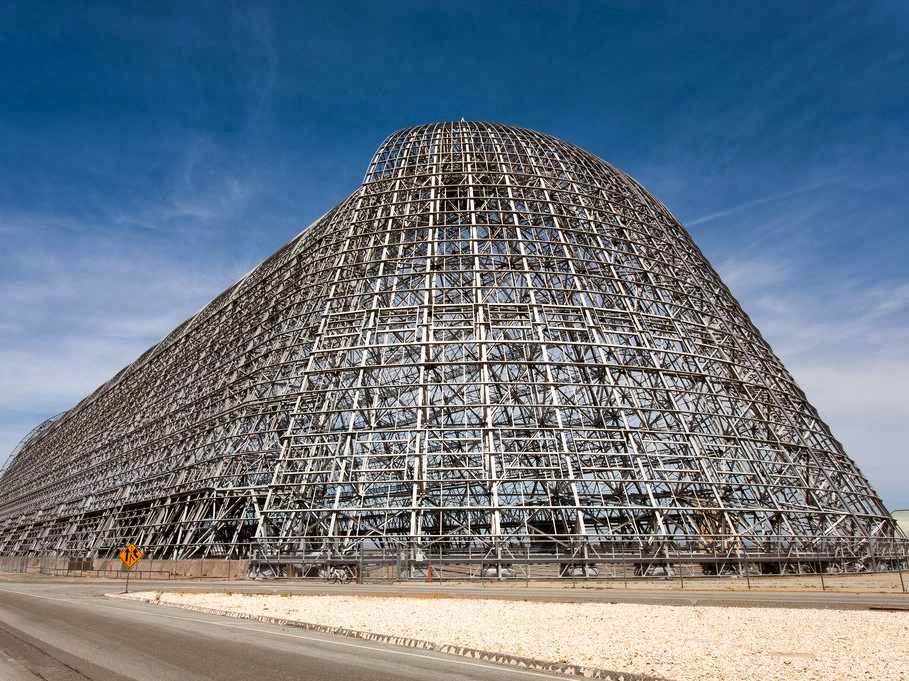
http://www.businessinsider.com/what-next-taking-google-blimps-to-work-2014-2

For better or worse, we got ourselves a dot com boom.  Unlike the 1st go round which affected everyone, it's all concentrated in 2 companies this time, they're a lot harder to get into, but that concentrated wealth is letting the lucky few do much bigger things.

 It's going to be a hell of a flying space for developing indoor navigation algorithms, developing very efficient vehicles with wing loadings too low to fly outside, not having to wait for good weather.  Imagine the Vicon system it's going to take to provide optical navigation data to the entire space.  The Vicon system alone could be worth a few billion 3D Robotics's.

Google & Facebook are buying most everything with a roof, to perfect most everything from robots to cooking, to the fabled dot com foosball tables.  With a lot more of the flying being done by the big companies, a lot more of a career that was once the domain of everyone is requiring master's degrees.

It's another sign of the UAV business following personal computers, internet service providers, Linux, & 3D printing.  Micro startups have just enough capital to produce the starting point, but the true penetration of the technology ends up being dominated by the big companies with the capital to push through massive infrastructure & massive investment that it takes to bring the new technology to the masses.

The only way to survive is to get bought out or to go back to school.

Read more…

PX 31A (Update)


Cormorant class wing
50inch span 10.5ich chord at root
Payload bay 10x5x1 inch
battery bay 2x5x1 inch

Payload capacity (yet to be tested)
RC Skill Level intermediate

this is a relatively large plane . intended for FPV and other UAV function.
slightly slower than PX33

being a slow plane , don't expect it to take on winds of 20mph its just dangerous

its intended for First timers in FPV.

>> this was revisited cause some people cant handle the speed and agility of PX33 wing

so its basically a  redesign of the PX31 model.since the original plane has no probation for payload

PX31 and PX31-A comparison by synersignart

comparison from the 1st version and 2nd version of the same wings.
5inch bigger with payload bay and more capacity.
hopeful to improve stability too

FEB23 Update

Servo relocation to maximize the control throws and baydoor flaps to prevent hardware from flying out on hard landings.

CG moved to 9inch from nose.seems more balance there.

Flight results looking good just a bit of trimming and torque reduction.

tested on 9x45 and 8x6 props

px31_and_px31a_cormorant_by_synersignart-d77wv9l.jpg

so far these where from the old wing with camera on board but flown manual.

https://www.youtube.com/watch?v=UrH7cHpmotg

https://www.youtube.com/watch?v=Y5GLKnINwCQ

Read more…
3D Robotics

Sparkfun AVC Registration Now Open

3689576172?profile=original

It's that time again! The Sparkfun Autonomous Vehicle Competition registration is now open. Changes for UAVs include separate fixed-wing and rotary-wing categories and extra points for popping bal;oons:

AVC is back and we’ve made some improvements to everyone’s favorite robotic challenge. If you’re not familiar with AVC (or Autonomous Vehicle Competition), it’s SparkFun’s yearly competition where we let you put your autonomous creation through its paces. This year’s competition is going to be June 21st, and will once again be held at the Boulder Reservoir. Check out the recap video from last year.

Registration is now officially open, so head on over to the AVC website and get your robot registered for 2014! Registration has been updated a bit for this year, so make sure you double-check all your information. Also, students teams are encouraged to register! There are special awards just for student teams, so let us know you’re a student team and what school you’re associated with when registering. Although the courses and scoring are remaining largely the same as last year, we’ve made a few minor tweaks to the ground and aerial portions. For a refresher, here are the full rules for 2014. Now let’s talk about the changes we’ve made for this year.

Ground

alt text

We’re adding a new feature to the ground course this year that will make the GPS haters (and anyone competing in the Micro/PBR class) happy. We will be adding a line through the course, so you no longer have to rely solely on GPS for navigation. The line will snake through the course, avoiding obstacles, and ultimately end up at the finish line. Coming soon, we will have a course preview video that will show exactly what this line looks like. But for the time being, we can tell you that it will be a white spray chalk line (similar to what’s found on football fields, etc) that will be on the course. It may have some curves, breaks, or other tricks. Generally speaking, it will get harder as the course progresses.

Aerial

alt text

The first change for the aerial competition will be class designations. This year, there will be two aerial vehicle classes, fixed wing or rotating wing. So quadcopters will be competing only against their own kind; and fixed wings will be competing only against other fixed wing crafts. Not only does this mean you are only competing directly with similar vehicles, but there will be two pools of prizes, so your chance of winning is better!

As we alluded to in our previous AVC post, we needed to make the aerial competition more challenging. When we were planning for 2013, I distinctively remember almost scratching the idea of the wicket or the aerial drop because we thought “no one’s going to try that.” We were dead wrong.

This year we are introducing a new obstacle, the Red Balloons of Death. We will be randomly placing 3 large (roughly 10' in diameter) red balloons somewhere in the aerial course. We’re not telling you where. You are allowed to avoid them, but if you choose to destroy them you will get extra points. You get 25 points for making contact, and an additional 25 points (for each) if you manage to destroy it. Last year was the first year we held the competition over water. Ironically, it was the first year we didn’t give out a water hazard award. This year, I REALLY want to give out this award. If you figure out a way to fly through balloons and still stay up in the air, bring it.

alt text

AVC is always a lot of fun for everyone involved, and we highly encourage you to show up, even if it’s just to watch. The event is free to attend, just make sure you register over at the AVC website as a spectator. At the very least, you get free entrance to the Boulder Reservoir. We once again are not capping the registration for entrants, so if you want to compete, there’s no rush on getting a spot. Just register when you’re ready!

Read more…

Quadcopter used by the Piano Guys!

This is one of the finest uses for the quadcopter that I have ever seen, bringing together two great passions in my life! You can see the quadcopter and some if the equipment the filming crew made use of at 10:15 onward in the 'behind the sceens footage below!

Needless to say I am sure everyone here would have jumped at the opportunity to work on a project like this. The filming took place at the 'Midway Ice Castles'.

Read more…

Future of FPV?


3689576124?profile=original

Now suppose that your phone wants to connect with this pCell network. It would simply send out an access request as it normally does. And all of the “dumb” antennas in your vicinity—let’s say there are 10 of them—would pick up those signals and relay them to the data center.

That’s where things get interesting. Say, for example, you play a YouTube video. The pCell data center would request the video from Google’s servers, and then stream it to your phone through those 10 antennas. But here’s the key innovation: No one antenna would send the complete stream or even part of the stream. Instead, the data center would use the positions of the antennas and the channel characteristics of the system, such as multipath and fading, to calculate 10 unique waveforms, each transmitted by a different antenna. Although illegible when they leave the antennas, these waveforms would add up to the desired signal at your phone, exploiting interference rather than trying to avoid it.

And as you move about, and as other devices connect to and drop off the network, the data center would continuously recalculate new waveforms so that each device receives the correct aggregate signal. “There’s no handoffs and one has to take turns,” Perlman says. “You could literally light up a whole city using all the same spectrum.”

If pCell technology does take off in the next few years, it will likely be because it’s compatible with 4G LTE phones. It does this by simulating LTE base stations in software. The data center would use these virtual radios to inform its waveform calculations, essentially tricking an LTE phone into believing it’s connected to a physical base station. “Your phone thinks its the only phone in the cell and is sitting right next to the tower,” Perlman says. The same technique could also work for other wireless standards, such as 3G and Wi-Fi, he says.

So will operators adopt pCell? It’s unlikely that LTE carriers would replace their networks any time soon, even if Artemis’s technology proves to be the “seed change” Perelman believes it is. But its compatibility with LTE changes the game. For instance, operators could deploy pCell antennas in congested hot spots such as airports, sports stadiums, and city centers—places where they’re already investing in new infrastructure. Users could roam seamlessly between the two networks without having to buy new phones or switch service plans.

Artemis says it plans to license pCell to wireless carriers and Internet service providers. The company is now beginning large-scale trials in San Francisco and expects the technology will be ready for commercial rollouts by the end of 2014. It will be fascinating to see how its ambitions pan out.


more:

http://spectrum.ieee.org/tech-talk/telecom/wireless/5g-service-on-your-4g-phone

Read more…

California Call To Action

3689576115?profile=original

California Tell Your Elected Officials You Support Drones


California bill AB1327 would allow law enforcement and public agencies to use drones. This means technology and service jobs for Californians as well as savings for the taxpayer. Drone end-users can support this bill while still supporting the 4th amendment.


AB1327 will let State, and local agencies use drones to better manage the public’s resources. Drones will also be used to help save lives and property of all Californians. AB1327 will allow drones to be used in the same manner as manned assets are currently being employed now. Drones are more efficient and cost less to operate than manned aircraft.


Read: AB1327.


The bill has already passed the CA Assembly, so call the following representatives and tell them that you support this technology and industry.


Tell them to vote yes on AB1327. Tell them you support the benefits drones can bring in the California skies.


Loni Hancock, Chair: (916) 651-4009

Joel Anderson, Vice Chair: (916) 651-4036


Also call the members of the public safety committee. Tell them to vote yes on AB1327. Tell them you are for the lawful and positive uses of drones in California skies.


Steve Knight: (916) 651-4021

Kevin de León: (916) 651-4022

Carol Liu: (916) 651-4028

Holly Mitchell: (916) 651-4026

Darrell Steinberg: (916) 651-1529


This is your opportunity to share the good drones can do.

http://www.suasnews.com/2014/02/27582/california-tell-your-elected-officials-you-support-drones/

Read more…

A friendly wave from The Register

Enjoy this quick heads-up about DIY Drones from the home of the Low Orbit Helium Assisted Navigator (LOHAN) mission.

3689576155?profile=original

Described as "The Leading Community for Personal UAVs", DIY Drones is where amateur experts and newbies alike share their projects, seek and dispense advice, and generally hang about to see what's what in the wonderful world of UAVs.

The site was started back in 2008 by Chris Anderson, head honcho down at 3D Robotics, which kindly provided our Vulture 2 spaceplane's Pixhawk autopilot.

Read more…

New Wiki Advanced Multicopter Design Page

Hi Everybody, I have added a new "Advanced Multicopter Design page to the Wiki.

3689575972?profile=original

It covers a lot of concepts in Multicopter design both for selecting components and frames and in designing your own if that's what you might really want to do.

http://copter.ardupilot.com/wiki/advanced-multicopter-design/

It doesn't by any means cover everything, it is primarily not oriented to "engineers" and it is a work in progress.

Please contribute any feedback, suggestions for additional material to include and criticisms (polite preferred) and I will update the Page to include worthwhile suggestions as best I can.

I am hoping this page can become a repository for serious undertaking of multicopter design and at least include descriptive links to any worthy individual projects.

Hope this meets with your approval.

Best Regards,

Gary

Read more…

Octocopter Scratch Build

IMG_6670_zps5b79706f.jpg?width=650

Hello Diy-droners,

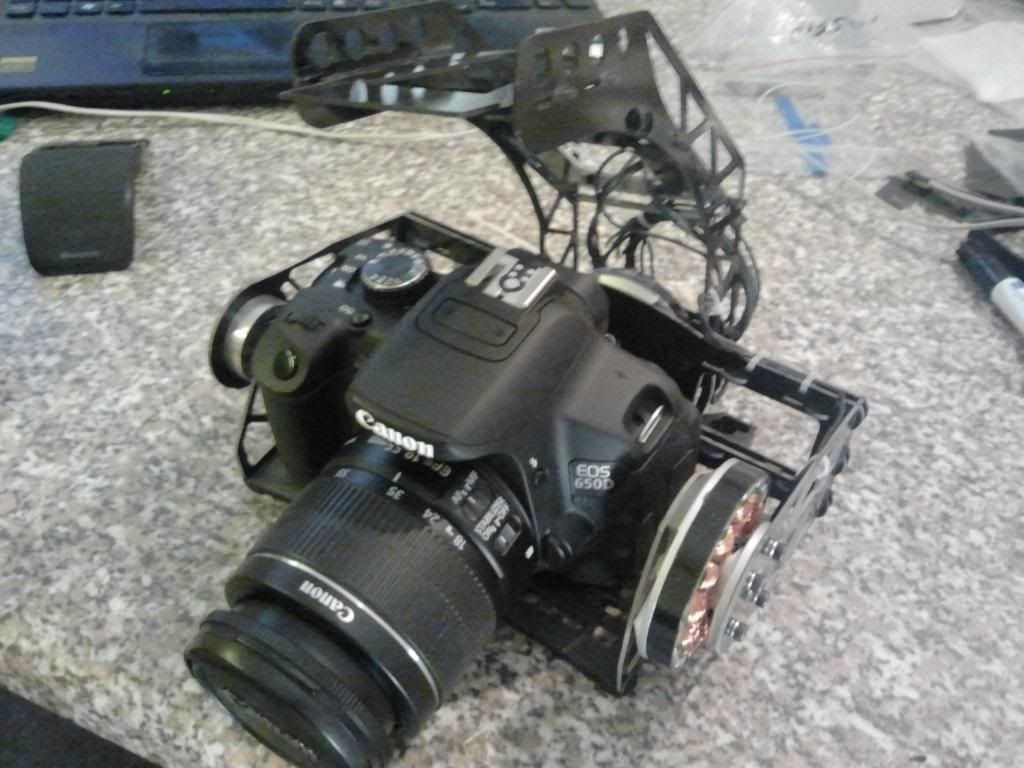
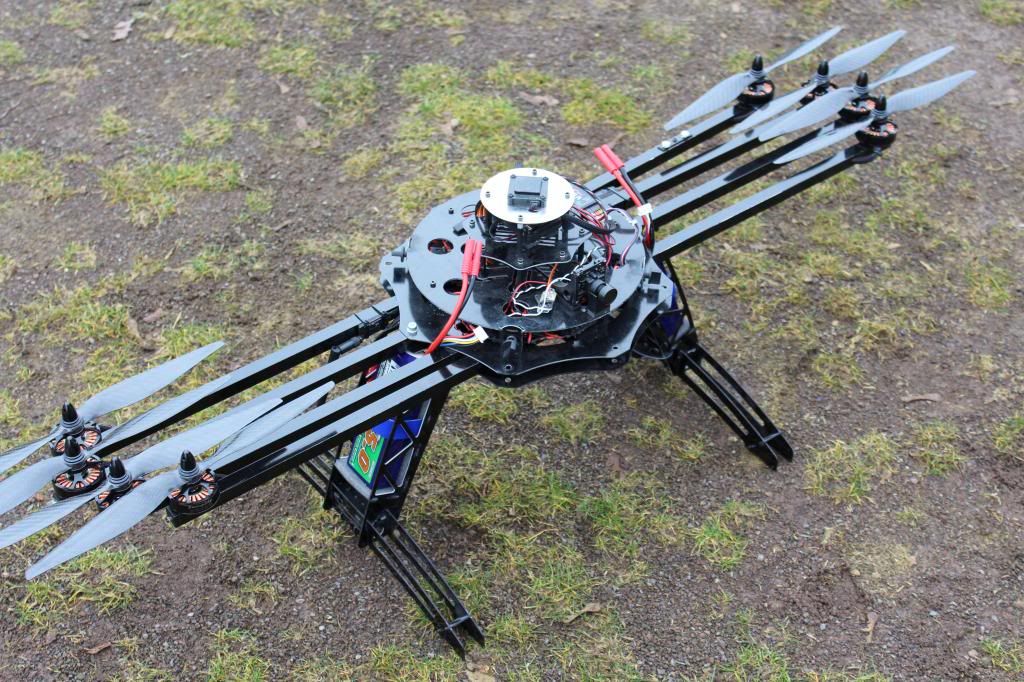
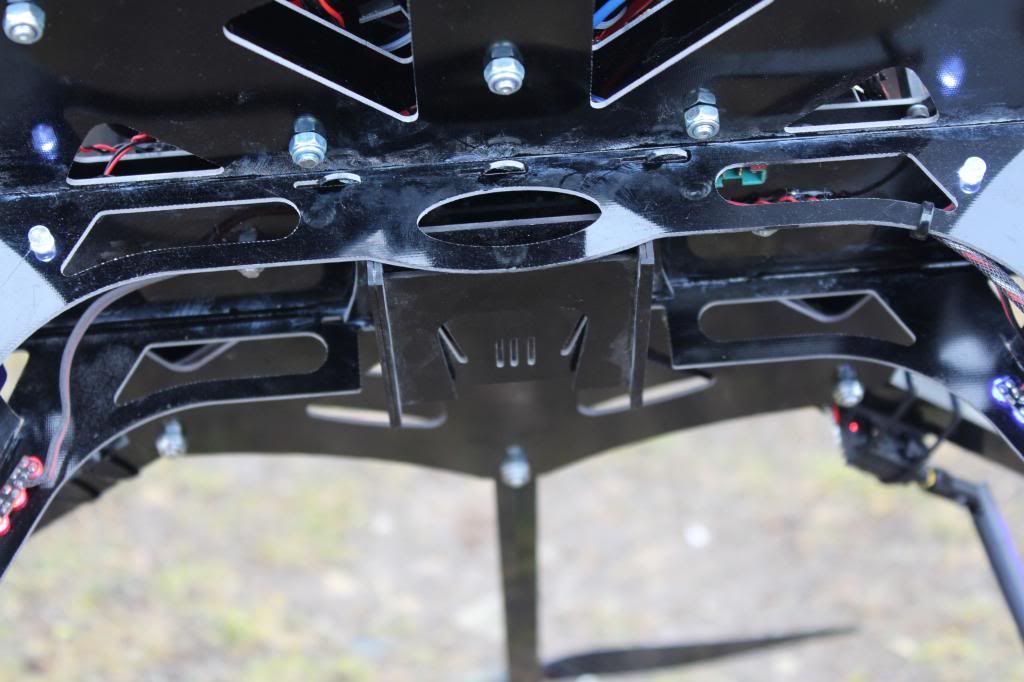
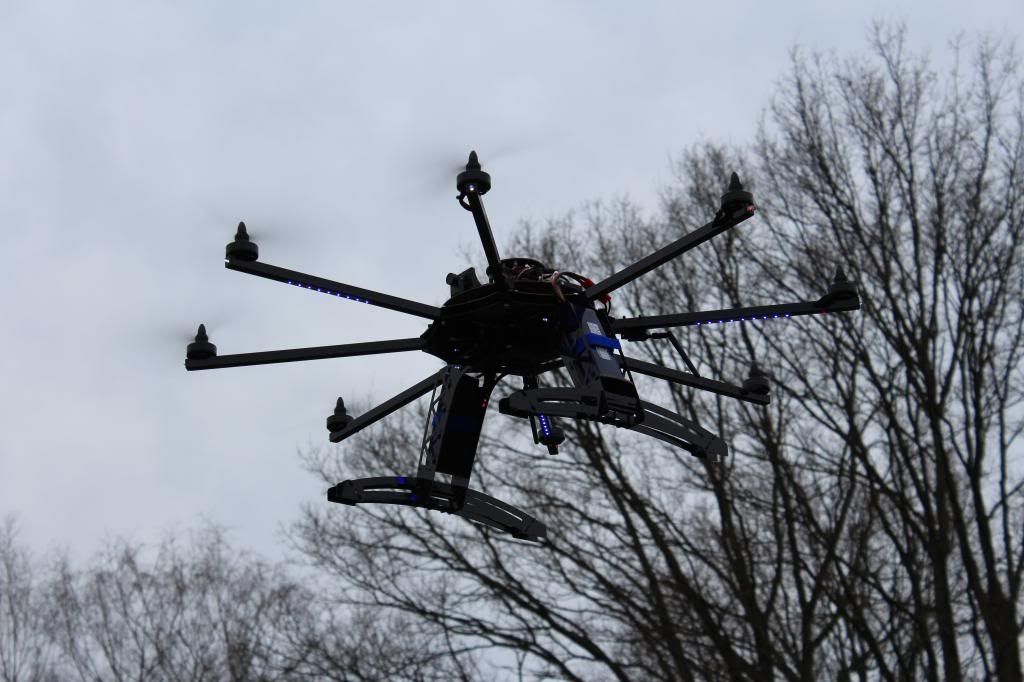
I just wanted to share my latest completed project and some of my experiences. As you can see in the photo it is a large octocopter. It is designed for aerial photography with a canon 650d DSLR camera and a Small FPV Cam on top with the osd data, I can switch between the two with a switch on the TX. I also designed the Brushless gimball and it is detachable from the copter itself. I have broken the Parts down into sections below with further information:

Motors: The motors I used are from Sunnysky (Motor X4108S) They come in a small cardboard box and are well protected. I am very impressed with these motors the quality is great and best of all They come perfectly balanced, I checked them all using the laser pointer technique and there was no balancing to do on any of them. I especialy like the Propeller mount, it screws to to Outrunner outer case, I Just wish they would make them with the thread running both ways for the counter rotating props. My props are 13x4,3.

3689575955?profile=original3689575944?profile=original3689575889?profile=original

http://www.rcsunnysky.com

Speed controllers: I decided to use Opto25A speed controllers from maytech they come preflashed with the SimonK firmware which I like, I really didnt want to be flashing speedcontrollers mayself. I must say from the eight ESC's, I did have problems with one. I removed them from their heatshrink and solder motor wires directly to the board, so the fault was most likly caused by me. However Maytech where very quick in replying to my mails and sent me spares within one week. In the pic below you can see how they are mounted, they are also covered in PlastiDip.

3689576019?profile=original3689576033?profile=original2013-09-15180701_zps36bf30b2.jpg?width=200

http://www.maytech.cn

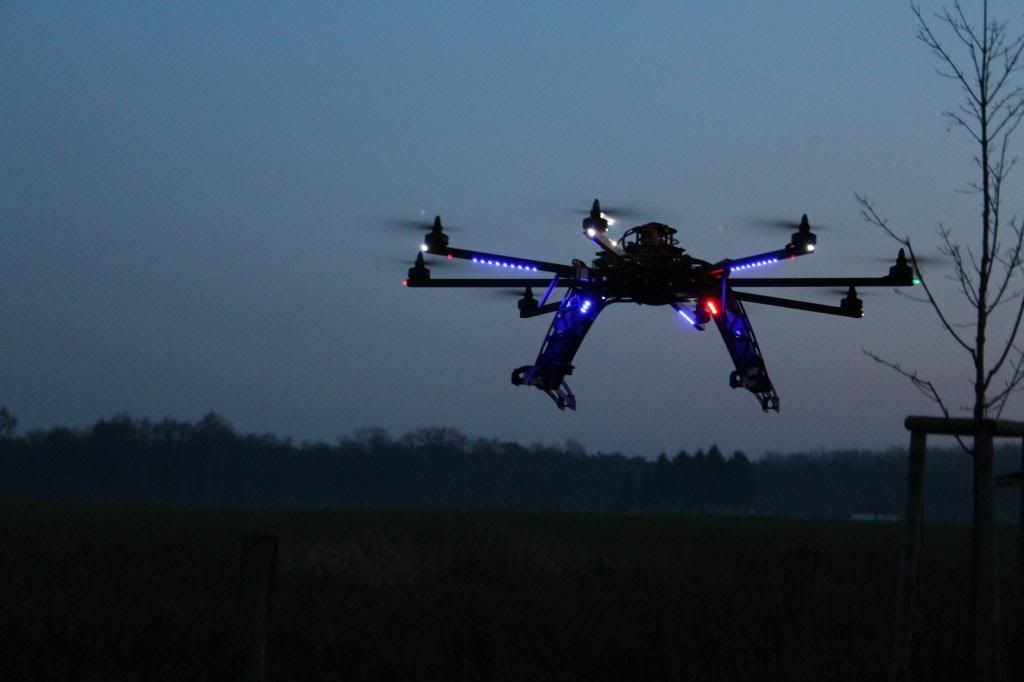
Lighting: I wanted the copter to be well lit so I could fly in the evenings and at night and still be able to see exactly what position the copter is in. Underneath I have Blue stick on light strips, On the tip of each arm is a 5mm white Led and the left and right arms are Red and Green leds aswell. On top of the rear arm is a 10mm Ultra bright white Led and a10mm Red Strobe. Ive put some Photos further down the page.

Camera gimball: The Gimball is also my own design, I wanted it to be easyly detachable light but strong. All the Electronics come from I-flight the motors are and im using a Martinez controller. It is designed for a Canon 650D. Tuning was a major headache, It took me days of testing to get something worthy of a test flight. As for the electronics; The motors are built to a high standard but the windings look like they have been done by hard, they are not uniform. Flight controller is from them aswell and the quality of soldering what should be expected. I Still have more flight testing to do with this and will make a separate post for it at a later date.

2013-05-24153502_zpsf1e8f583.jpg?width=300http://www.iflight-rc.com/

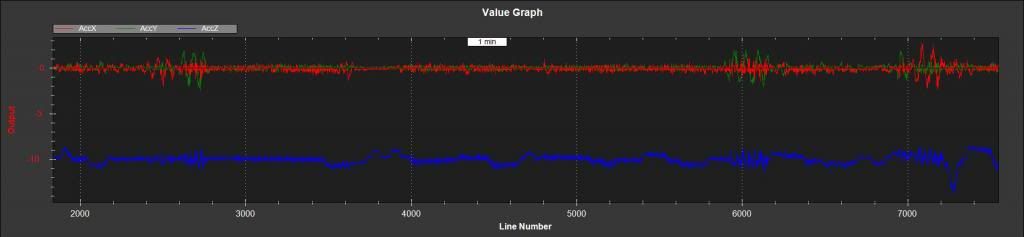
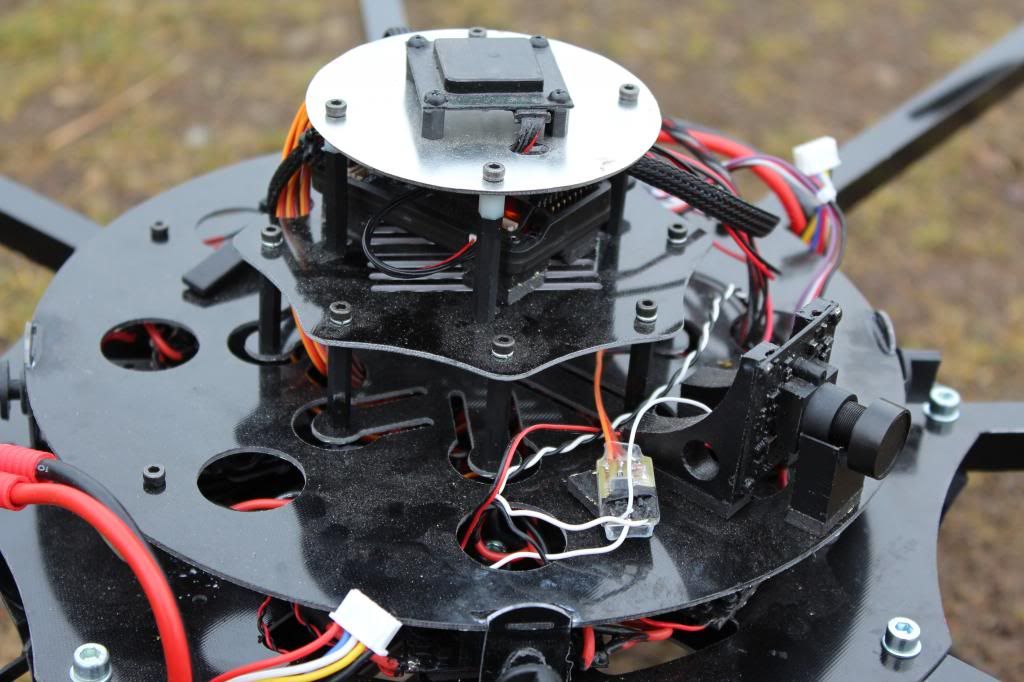
APM setup:I am using 3DR APM 2.6 with internal magnetometer. Ive Mounted a 3DR Ublox GPS Right on top, I used the shielding out of a hardrive to sheild the GPS from interferience. The sonar is a MB1200 EZ0 And is mounted on the bottom of one of the legs. I fitted external LEDs for the GPS fix and Armed/disarmed status. The APM has a Piece of lead glued to the bottom to add mass and is mounted using normal double sided tape on the corners, This proves to be quite effective when checking the logs. My Radio is the FrSky Taranis, I am quite impressed with the radio and all its features, I also made a six button mode switcher as listed here and have assined speach output to each button.

vibrations_zps4c7683b1.jpg?width=600

The spikes are me bouncing the copter on the ground.

Frame design: I designed and CNC cut the frame Myself, It is made from 1.5mm black glassfiber plate. The arms Are 15mm Square Aluminium profile and are about mm long, They all fold inwards to make transport easyer. I can also remove the feet if I need to with 4 small screws. I Also wanted to be able to remove the camera gimball if needed so i designed a clip system where the gimball clips onto the bottom of the copter.(Photo below) This way I can basicly clip anything i want to the bottom, I plan at a later date to add Floats and a gopro on a long arm for underwater footage. :)

One thing I Would change and still might is the arms, they are quite heavy at about 120grams each. I could save alot of weight by using carbon arms. Antivibration was also taken into account when designing the frame. I designed it so that the mounting screws for the tower where the APM is mounted are Flexible, Its best it look at the photos to see how i did it. The speed controllers are mounted just above the Arms and the Glassplate that covers them has aluminium tape stuck to the underside. The idea of that was to reduce the interferience, Im not sure if it works but i thought for the few grams extra weight to was worth a try. The copter is powered by 2 5000Mah 4s nanotech Batterys parallel, they are mounted in the legs on each side.

Weight is about 6kg with Camera and im getting flight times of about 15mins. Up to now I have tested alt hold and Loiter and they where both rock solid with the default PIDs. I Just need to make a Protective dome for the top now.

IMG_6673_zpsac69ec6f.jpg?width=250

2013-09-12190913_zps511c6ee5.jpg?width=250

I would like to thank all the developers and the whole comunity for making this Tech possible and avalable to us all.

Lets keep it going!!

IMG_6682_zpsb145a96f.jpg?width=600

IMG_6687_zpsd4223bf6.jpg?width=650

IMG_6676_zpsda8e1ae7.jpg?width=650

IMG_6657_zps229cbbc2.jpg?width=650

IMG_6658_zps78da442b.jpg?width=650

IMG_6605_zpsf41efb24.jpg?width=650

IMG_6608_zpsf47229ac.jpg?width=650

Here is a short video of me testing the PIDs in stabilise mode. It wasnt meant for here hence its not long and all that good, But you can see the copter in flight. (Weather depending ill make a half decent video next week)

Read more…

When boats are launched for the first time, it's customary to smash a bottle of champagne across the bow. But for industrial-robot maker Kuka, its new factory in southwestern Shanghai is being celebrated with a battle between man and machine. On March 11th, the company's squaring off one of its Agilus robots against German table tennis player Timo Boll. While Boll has a storied career of victories against human players, he's playing against a model Kuka says is the fastest in the world. Typically those machines are used for product assembly, loading and unloading, and even painting, but in this case it will be trading volleys over a standard ping pong table.

Man vs. machine, to celebrate a robot factory

This isn't the first time the very same robot has been used for something unusual. Late last year Kuka showed off the KR Agilus model replicating 3D artwork made by Israeli industrial designer Yaron Elyasi. The robot's orange color was also the inspiration for a line of stainless steel luxury watches made by Sevenfriday.

3689575861?profile=original

more:

http://www.theverge.com/2014/2/17/5420966/german-ping-pong-champion-to-play-against-industrial-robot-next-month

Read more…