There have been discussions before calling for reliable and accurate alternatives to GPS. The Vikings may have had the answer without knowing the physics. They were adept navigators at latitudes where frequent cloudiness and low sun angle(winter) could have made direct observation of the sun difficult. Legend has it that they had a magic stone, called a Sunstone, that allowed them to navigate by the sun even after dark. You're wondering how maybe, and I'm wondering when will this be available on a chip.
...During a question-and-answer session with "3D Robotics" editor-in-chief Chris Anderson, Musk said that affordable commercial space travel will never be possible with the current model, which relies on single-use booster rockets.
Here is their products page. I am glad to see that this is being considered for multirotor applications. It looks to be a rock solid system and will open up live HD transmission for news and sporting events.
This is the beginning of a project I've been thinking about for awhile. I'm making this blog post to encourage myself to get going on it. Spring is coming to Colorado, and I want to be out filming in the wild and remote reaches as soon as the snow melts!
This is a Surly Troll frame with an Xtracycle FreeRadical cargo attachment. I laced a lower kv hub-motor into a Surly Large Marge 65mm wide rim, that will allow me to run a big fat tire underneath all the weight I'll be carrying.
I have two separate battery packs in mind (depending on the mission), both are LiFePO4 16s for ~53V. One pack will be made up of 40Ah cells and the second one 10Ah. A voltage regulator will give me 12V for all the ground station needs.
The 10Ah pack is built already, including battery management system(BMS).
It will be necessary to modify the FreeRadical structure to make room for the 10Ah pack just in front of the rear wheel. The 40Ah pack will need to be mounted on the outside of the frame.
These Pelican cases will figure in to the mix somehow.
Maybe not the huge case, it's kind of ridiculously large.
RQ-9 Reaper and an Aeryon Scout Quadrotor The armed RQ-9 Reaper MQ-1 Predator, seen on the left, is visually distinct from the Aeryon Scout Quadrotor. The Reaper is also six almost eleven times as long. Wikimedia Commons
When an unmanned aerial vehicle reportedly flew within about 200 feet of an airliner earlier this week, outlets like Time and CNN chose to accompany their stories with a picture of the RQ-9 Reaper--this, despite that initially, there was no concrete description of the unmanned aircraft.
It's not terribly surprising that news outlets would default to an image of the Reaper; it's perhaps the most widely recognized drone in operation. But as more details of the incident surfaced, this simplification proved incredibly wrong. The unmanned craft is now described as a 3-foot-long quadrotor--a four-blade copter--which is wildly distinct from the 36-foot-long Reaper; a bit like the difference between a Johnny Seven O.M.A and an AK-47. That's when I realized: drones are really confusing. Even to people who get paid to write about them! So here's a primer on what is and isn't a drone, the differences between common types of drones, and a bunch of other stuff you need to know to sound smart talking about these things:
Where does the term drone come from?
When unmanned flying vehicles were first introduced to the U.S. military, the ability to control them from afar wasn't very sophisticated. So the first drones flew along pre-set paths, operating off an internal navigation system. This led to servicemen informally referring to any machine that flew without human control a "drone," and Germany still has some like this in service today. That said, the "not being controlled by a human" part of the definition has since been lost to everyday use.
What exactly are drones?
"Drone" as a category refers to any unmanned, remotely piloted flying craft, ranging from something as small as a radio-controlled toy helicopter to the 32,000-pound, $104 million Global Hawk. If it flies and it's controlled by a pilot on the ground, it fits under the everyday-language definition of drone.
Global Hawk: Wikimedia Commons
Wait, does that mean model airplanes are drones?
Almost! Actually, under the law as it stands, any unmanned, remotely piloted vehicle in the United States flown for hobby or recreational purposes is a model airplane, thanks to the 2012 FAA re-authorization act. In 2015, the FAA will suggest new, drone-specific regulations, at which point model airplane law and drone law will probably diverge. Until then, though, all small drones used by private citizens in the U.S. are legally model airplanes.
So is the military using model airplanes?
No. The military is not considered a private citizen, so it plays by different rules, and uses different terminology.
Okay, so what terms does the military use?
The military has described drones, variously, as Unmanned Aerial Vehicles (UAVs), Remotely Piloted Vehicles (RPVs), Unmanned Aerial Systems (UASs), and Remotely Piloted Systems. (The FAA uses some of these terms, too.) The difference between UAV/RPV and UAS/RPS is that the former terms refer to the vehicle itself, and the latter terms describe the vehicle as well as the pilot and support staff. These are useful distinctions for specialists, but not for regular people.
What are the different types of drones the military uses?
The United States military alone maintains three different classifications, one each for the Air Force, Army, and Marines. Part of the confusion in drone terminology is overlapping and competing definitions. The Air Force files drones under five different tiers; the Army and the Marines file drones under three tiers, and none of those tiers perfectly overlap. That's boring and technical. Instead, here are some of the most commonly used or iconic drones:
RQ-11 Raven The RQ-11 Raven weighs 4 pounds, is launched with a throw, and is piloted with a hand-held unit that resembles a video-game controller. The Raven isn't the most iconic military drone, but it is probably the most used: more than 19,000 have been built. It's mainly useful for seeing around corners and sending footage of rooftops back to troops moving through a city.
It also looks like an awkward model airplane, and it breaks apart like LEGOs when it lands:
RQ-7 Shadow The RQ-7 Shadow is approximately man-sized, and can fly almost 80 miles away from its commander while providing near-instant video to give a good picture of the battlefield.
Shadow 200 : Wikimedia Commons
MQ-1 Predator and MQ-9 Reaper The MQ-1 Predator and MQ-9 Reaper are the most iconic drones, and odds are if there's a news story about a drone, it's going to have a picture of one of these. These guys can be armed so that makes them largely, though by no means exclusively, the preferred tool for what we call drone strikes. The main difference between them is that the newer Reaper is larger, has a more powerful engine, and can carry much, much more. They still both look like someone slapped a giant wing on a match, though.
MQ-1 Predator UAV: Wikimedia Commons
Rq-4 Global Hawk The Rq-4 Global Hawk is the leviathan of the drone fleet. As mentioned above, it weighs more than 32,000 pounds, has a 130-foot wingspan, and can fly for more than a day. It can reach up to 60,000 feet, and from high elevation it can take high-resolution images of the land below, as well as detect and track moving targets.
Aeryon Scout Though not in use by the United States, let's take a look at the Aeryon Scout. It's a small quadrotor that NATO allies supplied to the Libyan rebels in the recent campaign to overthrow Gaddafi. The scout weighs less than 3 pounds and can fly for about 25 minutes, making it useful for checking around corners. It's operated with a touch screen, too.
Aeryon Scout: Wikimedia Commons
That's by no means a comprehensive list of military drones, but it should get you through a dinner party.
What about private industry? Does it use simpler terms?
As of last week, yes! Not because the drone industry doesn't have weird or obscure terms, but on Friday the drone lobbyist Association for Unmanned Vehicle Systems International (AUVSI) conceded that "drone" is what people are calling unmanned aerial vehicles, so "drone" is now begrudgingly the industry term.
So what should I call them?
Ultimately, depends on your audience. In everyday conversation or casual writing, "drone" is fine. If the audience is military or industry, or knowledgeable policy makers, it might be best to skip the informal terms, crack open Google, and figure out exactly how these people are going to talk about flying robots.
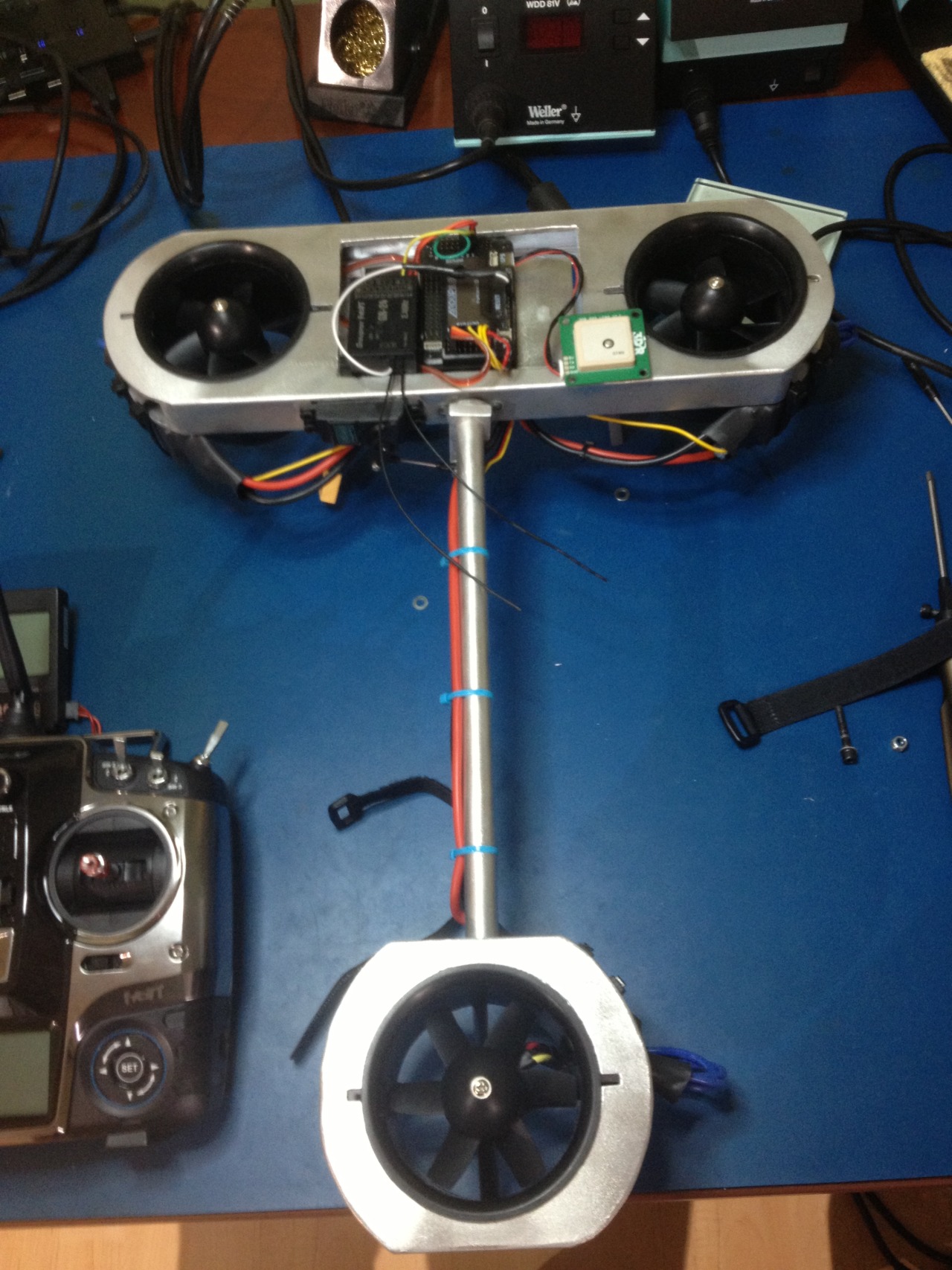
I really wanted to build something with ducted fans... And I also really wanted a tricopter for its yaw control (great for video). So after contemplating a hover tank quad for a while, I decided that a tricopter would be smarter (also way less involved! I will probably come back to the hover tank at some point :P).
I had the basic frame design come to me after I started to shape the front section. I decided, since I had so much space in the front portion, that I would put the tail control servo up the front and articulate the entire tail.
Summary:
All aluminum hand built frame, with full tilt tail boom (bearings for smoothness)
3x 70mm ducted fan units (CW & CCW) powered by 2300KV motors + 60A ESCs on 6s battery!
Weight: 3lbs 4oz (4lbs 4oz with 3200Mah 6s battery)
I am amazed that this flew with default 2.9 PIDs… One thing to note, which I am sure some tuning will help, is it starts to pitch and that pitch builds until stick correction is no longer enough (which is what happened in the vid). I hope its not electro magnetic interference from the motors… I would figure the aluminum around everything would act as a shield to some degree.
I've recently had the chance to get some basic acrobatic moves scripted for fixed-wing airplanes. They are far from perfect, but I wanted to share.
In the (slightly choppy) video, you'll see a left roll, a right roll and most of a loop.
Let's talk a bit about how to set this up:
1) You need a Hardware In Loop (HIL) setup. I use X-plane. There's a good tutorial on setting up a X-plane HIL configuration here.
2) All of your regular controls and modes should work properly in the simulator.
3) You need a python based script. You can start with the one I've put together. It's attached here. "simple_script.txt"
4) With X-plane, the APM Mission Planner (MP) and the script open, get your plane in the air and press "p" for pause. "a" will put you in chase view ("w" to go back in the plane) and "-" and "=" will zoom your view of the plane in and out.
5) In the MP click on the "Flight Data" button, then select the "Actions" tab underneath the Heads-Up-Display.
6) Click on the "Script" button. This will bring up another window with a preloaded script (for arducopter). Switch to the already open "simple_script.txt" and select-all then copy.
7) Go to the python script window and paste "simple_script.txt" in the python script window. DO NOT close it yet.
8) Go to X-plane, and press "p" again to un-pause the plane.
9) Go back to your python script window and close it. This will trigger the execution of the script when you click "yes" in the pop-up.
10) Watch your plane do some rolls, and most of a loop.
Let's also talk a bit about issues and my thoughts for the future.
1) I do not seem to get RC control back after the script has run. I'm not sure what's going on here.
2) (IANAP) I am not a programmer, but I feel like we should be able to create python classes (objects?) that take pertinent arguments. For the roll class it could include (direction, rate, duration) and the class would handle the slight down elevator when inverted, etc...
3) It also seems like we could effectively have another PID type of structure in the scripts that would give us smooth loops. I'd like to see us just pass two arguments to a loop class, size of loop, and what direction. 0 is perpendicular to the ground up, 90 would be a flat loop parallel to the ground going to the right, 270 to the left.
4) Is there a way to temporarily make stabilize a negative value? This would seem to give us solid inverted flight.
5) Eventually I envision an "Acrobatic Move Repository" where we can keep moves for different vehicles. At some point, I see a set of macros that you can just string together an entire acrobatic show.
I'm looking forward to your comments, and seeing what others come up with! Thanks!
Drones and robotics are being integrated into our lives at an extremely fast pace. Do you ask yourself why? It's because computer/robotics programs can preform tedious tasks over and over at a very high success rate. Their is some kind of unmanned system in almost every piece of technology you own or use today. If you own a Smart Phone for example they are very cheap affordable systems that are being converted at a low cost into amateur robotics and even corporate robotics.
With this fast paced integration of robotics into cars/transportation, medicine/healthcare, and our hobbies their will be people out there that will fear this. It's our job as robotics hobbyists to help inform and educate the people who aren't informed.
With all the Military Drone news most people see on TV they have a bad image painted in their heads. The amateur news articles showcasing great uses for these systems that could revolutionize our lives are often brushed aside. I've seen hundreds of podcast's, video, and projects that are soon going to be hitting the market. These products are going to change everything in our lives and the amount of free time we have in our lives. The Google Map Cars for example have been driving around for years unmanned while avoiding accidents with unpredictable human drivers all around. Soon we will be enjoying TV, Books, and entertainment all inside of our cars on our car rides. We won't be driving cars soon just ridding in them.
I hope that fellow hobbyists feel the urge that I feel to educate and share with the misinformed that the technology that fuels our hobby is safe. With all this technology and fast passed growth and expansion comes the laws and regulations. Over the next 10 years we will see a rise in laws, regulations, permits, rules surrounding our hobby. If we inform more people on the great uses the better the odds will be that Drone/Robotic Regulation will be less harsh on the average robotics/Drone hobbyist. Everyday these technologies get cheaper and cheaper to produce and innovate new affordable products with. Stay informed and educated so you don't miss out on this fast paced hobby.
***Please take all Military Conversation, Political Debates, and other such Debates over to Dronecafe.com***
"Winglets all work in the same basic way, but they don't all look the same. In essence, winglets reduce drag by recovering some of the energy in the wingtip vortex. This provides an effective increase in wing aspect-ratio (span² divided by area - a measure of slenderness), and therefore a reduction in lift-induced drag, for a smaller increase in span, weight and profile drag compared with simply making the wing longer
Once rare, winglets have become commonplace, and over the years their design has evolved to make them more efficient and maximize the fuel savings they provide. Here are some examples of how winglets have changed - and how they could change in the future."
"A third recent patent, also assigned to Airbus (above, US patent 8,387,922), uses the winglet for more than just reducing wing drag. Actively controlled surfaces are added to the trailing edges of the winglets to introduce aerodynamic instabilities into the eddies shed by the wing. These instabilities would accelerate the dissipation of high-velocity wake vortices and allow aircraft to follow each other more closely. (in the diagram above the cylindrical object (20) at the bottom is a structural housing for the active-surface actuators)."
Hi guys I had an opportunity build the aluminum spine to put between the 2 haves of the Multiplex Easy star this week What I observed on you tube Foam planes don't stand up to impact very well when they hit the ground they break in half or they suffer from compression damage the foam compresses loosing it's original shape . The problem I had with the Radian pro was when you turned the rudder the tail would flex the fuselage independent of the front end The idea of the spine is to give some rigidity to the fuselage the Radian motor and propeller are much bigger than the Easy stars I made the new motor mount for the Radian pro motor and I just have to weld it to the spine then I can laminate the 2 haves of the Easy Star to it.I am extending the fuselage2 3/4 inches and making the rudder and elevator bigger I am going to "the big city tomorrow night and the hobby shop to look at ways to reinforce the wings I just fly out my backdoor so I can leave the wings assembled and join them permanently together Im going with "flaperons and might "flatten the wing tips . Have a Great Day!
Please take a moment to congratulate Tom Coyle on his new position as Senior Administrator for the diydrones.com site.
Tom has been a community member for almost four years now, and has been a great asset to the site. He founded the ArduRover user group, and has been a long-time moderator. In short, Tom is a great example of a positive contributor to the diydrones.com site.
Here's a bit more about Tom from the man himself:
"I guess that you could say that I have engineering in my blood as I have always had to be tinkering with some technical project since I was a child. Both my grandfather and father were engineers and I followed suit, after a six year stint in the US Navy as an electronic technician, earning my BS in Electrical Engineering from CSUN while working for Hughes Aircraft Co.
Except for about a five year period where I worked in the Motion Picture Industry, I have been involved with the Aerospace Industry like my father before me. During the last 15 years, before my recent retirement, I worked for the Raytheon Co as a Senior Principal Engineer providing reliability, testing, and system engineering expertise for the F/A 18 Advanced Targeting FLIR (ATFLIR) Program, the F-16 Modular Mission Computer (MMC) Program, and the Space Tracking and Surveillance System (STSS) Missile Defense Program.
Presently I am enjoying my retirement in sunny Florida, however I have found additional enjoyment participating as a developer/moderator on the DIY Drones website. I am the founder of the ArduRover User Group on DIY Drones and am presently working with Tridgell and Linus on updating the ArduRover2 operating firmware."
Tom, we appreciate your efforts to date and look forward to your continued success with diydrones.com.
Nearly 13 hours after he started, Sen. Rand Paul, R-Ky., ended a dramatic, old-fashioned filibuster early Thursday morning -- having held the floor for most of the day and night to rail against the administration's drone program while holding up the nomination of John Brennan for CIA director.
Business in the Senate ground to a halt Wednesday as Paul, aided by colleagues from both parties, launched into the filibuster as he challenged the president’s authority to kill Americans with drones.
Paul's filibuster was longer than most in U.S. history, as most flame out by the 10-hour mark. Paul finished speaking around 12:40 a.m. local time, and his filibuster lasted 12 hours and 52 minutes.
"My legs hurt. My feet hurt. Everything hurts right now," Paul told Fox News shortly after stepping off the Senate floor, saying he believes "we did the best that we could."
"I would be surprised if we didn’t hear back from the White House," Paul said.
Watch Paul discuss his filibuster on Fox News at 2:05 p.m. ET on Thursday.
In a show of support, Republican Senate Minority Leader Mitch McConnell came to the Senate floor and congratulated Paul for his "tenacity and for his conviction." McConnell also called Obama's choice of Brennan a "controversial nominee."
The late Rep. Strom Thurmond holds the record for the longest filibuster, at more than 24 hours.
Paul is one of several lawmakers -- on both sides of the aisle -- who has raised concerns about the legal justification for launching drone strikes against Americans overseas. But Paul took to the floor after receiving a statement from Attorney General Eric Holder that creaked open the door to the possibility of using a drone to kill an American inside the United States.
“To allow one man to accuse you in secret -- you never get notified you've been accused,” Paul said on the floor. “Your notification is the buzz of propellers on the drone as it flies overhead in the seconds before you're killed. Is that what we really want from our government?”
Paul said he’d be raising the same complaints under a Republican president.
“No one politician should be allowed to judge the guilt, to charge an individual, to judge the guilt of an individual and to execute an individual. It goes against everything that we fundamentally believe in our country,” he said.
The senator, speaking for hours, was later joined by Democratic Sen. Ron Wyden of Oregon, as well as fellow Republican senators -- all of whom dragged out the filibuster by asking Paul lengthy and drawn-out questions. At one point, after the filibuster neared it's eleventh hour, Sen. Ted Cruz of Texas began reading numerous Tweets in favor of Paul.
That tactic allowed Paul to take brief breaks -- which included a snack break when the senator ate a Milky Way candy bar -- before resuming his speech.
Senate Majority Leader Harry Reid briefly interrupted to ask Paul if he planned to allow a vote to end debate. When Paul said he wouldn't, Reid concluded that other senators should acknowledge that their work for the day is "through" and plan to come back Thursday.
Paul, who started speaking shortly before noon, said he will filibuster Brennan's nomination “until I can no longer speak,” though he later suggested he would back down if he received a written assurance from Attorney General Eric Holder that the administration would not carry out drone strikes on noncombatant Americans.
This kind of filibuster is rare – typically, senators “filibuster” by refusing to grant the majority the 60 votes needed to proceed to a final vote on certain bills.
Paul, though, said he wanted to raise the “alarm” about the drone issue.
He spoke after receiving letters from Holder on drone authority.
In one letter, Holder said the U.S. has never carried out a drone strike against one of its citizens on American soil, and called a situation where such a strike may occur "entirely hypothetical" and "unlikely to occur."
However, Holder did not entirely rule out that such a scenario may occur in the future, and indicated that such a strike would be legal under the Constitution.
“It is possible, I suppose, to imagine an extraordinary circumstance in which it would be necessary and appropriate under the Constitution and applicable laws of the United States for the president to authorize the military to use lethal force within the territory of the United States," Holder said.
Holder said "catastrophic" attacks such as the Sept. 11 attacks or the attack on Pearl Harbor are examples of circumstances where the president could conceivably feel such an action is necessary.
Testifying on Capitol Hill on Wednesday, Holder agreed that it would be unconstitutional to use a drone on American soil against a U.S. citizen and suspected terrorist who did not pose an imminent threat.
Brennan has been a staunch supporter of the administration’s drone program. But, after members of the Senate Intelligence Committee extracted key documents on the program from the administration, the panel on Tuesday voted 12-3 to approve the nomination.
Fox News' Chad Pergram contributed to this report.
With the recent release of APM 2.9x for Arducopter, reducing vibration has become a top top priority. This is because inertial navigation is being implemented, starting with an inertial PID loop in altitude hold. Vibration problems show up in altitude hold and any mode that requires the use of the altitude controller. I was having problems with my quad climbing uncontrollably in forward flight (while in altitude hold) and then descending again when forward motion stopped. I thought it had something to do with transnational lift or air blowing into my APM case, but Randy (developer) helped me determine that the root cause of the problem was in fact vibration.
By enabling RAW logging I was able to see the acceleration forces on the quad in flight. The current thought is that during normal flight (not just a hover - you need to include data from high power settings) the Z acceleration should generally stay between -15 and -5. As shown by the green line on the graph below I was well outside that. I've got a motor that really whistles while flying, so I would guess it has a bent shaft. All my props are meticulously balanced. The red line shows the current vibration level the APM feels after I made a simple mod to the mounting of the APM. By no means was this my idea, but it works great and I highly recommend anyone having trouble with altitude give something like this a shot. Here is the wiki on Vibration Control. By importing the log data to Excel I was able to determine that the standard deviation of the red line is 1.4. I learned how to analyze flight data here. The second video discusses using Excel.
I previously had my APM mounted on a high quality gyro mounting tape, the same kind that the xBee is mounted on in the second picture. The ONLY modification I made to achieve the lower vibration to the APM was to switch to supporting the APM, receiver, xBee and a 42 gram plate with four really squishy earplugs. The diameter of the holes I drilled for the earplugs are a .25". The distance between the plate and frame is 7/32". I admit, 42 grams is A LOT of weight to just add to the quad, but the results are excellent. The all up weight of the supported structure is 111 grams. I first saw this mounting method here. The earplugs hold very well, I can actually pick up the whole quad by the APM and not have it all come disconnected. I messed around with using a little CA glue to hold the ear plugs in more permanently and found that thick CA and some accelerator did not attack the foam at all.
I hope this can help someone who has had trouble switching to 2.9.1.
From Hackaday, news of a new Indiegogo project to produce a real IR camera for less than $300 (although it needs an iPhone/Android smarthphone, too):
These devices normally cost a few thousand dollars, but the team behind the Mu Thermal Camera managed to get the price down to about $300.
The basic idea behind the Mu Thermal Camera is overlaying the output of an infrared thermopile – basically, an infrared camera – on top of the video feed of a smart phone’s camera. This is an approach we’ve seen before and something that has even been turned into a successful Kickstarter. These previous incarnations suffered from terrible resolution, though; just 16×4 pixels for the infrared camera. The Mu thermal camera, on the other hand, has 160×120 pixels of resolution. That’s the same resolution as this $2500 Fluke IR camera. After the indiegogo campaign is over, the Mu camera will eventually sell for $325.
We have no idea how the folks behind the Mu camera were able to create a thermal imaging with such exceptional resolution at this price point. The good news is the team will be open sourcing the Mu camera after their indiegogo run is over. W’e'd love to see those docs now, if only to figure out how a thousand dollars of infrared sensor is crammed into a $300 device.
Drones continue to come home. Nine states, including Minnesota, are working on domestic drone legislation, and a Government Accountability report released last week raises questions about where the federal government is in opening up the skies domestically.
If you need further evidence of how drones are invading our everyday life, there is now a Drone Journalism Lab, a product of the University of Nebraska-Lincoln’s College of Journalism and Mass Communications.
The American Civil Liberties Union reports that the domestic drone legislation that is perhaps the furthest along is in Florida, where a bill would ban drones with exceptions for certain emergencies, suspected terrorism and surveillance that’s been approved by a judge. The measure is moving through the Legislature even as law enforcement has suggested there should be exceptions to allow monitoring of crowds at things like football games, which, in Florida, often translates into civil disturbance.
Last year, we went to North Dakota to see how the domestic drone debate was playing out. At the time, the federal government was trying to come up with rules and regulations to control the use of drones in domestic airspace. Current domestic use of drones is limited to activities such as law enforcement, search and rescue, forensic photography, border security, weather research and the collection of scientific data.
But drones have a future in everything from pipeline safety to monitoring crops to film production to the real estate industry. The Federal Aviation Administration estimates that about 30,000 drones will be flying over the United States in the next 10 years.
Last week, the Government Accountability Office released a report that said the FAA has made progress but still faces challenges. North Dakota hopes to become one of six test sites for drones, known in military parlance as Unmanned Aerial Vehicles, but that process is being delayed by privacy concerns. Other concerns: Drones have yet to successfully develop a “sense-and-avoid” technology to keep from hitting other aircraft.
***Please take all Military Conversation, Political Debates, and other such Debates over to Dronecafe.com***
FERGUS FALLS, MINN. - A few years ago, the folks in Otter Tail County thought they had come up with an efficient and inexpensive way to map county land and check for beaver dams in drainage ditches.
They built their own drone with a couple thousand dollars worth of computer equipment, a garage door remote control, a digital camera they bought at Wal-Mart, and a paper and balsa 9-pound plane anyone could buy on the Internet. Using GPS and Mosaic mapping equipment, they could survey 80 acres of farmland 400 feet overhead in about 20 minutes, a job that could take hours on foot in hip boots or cost thousands if they hired a pilot to fly overhead.
That was until the cease and desist letter came from the federal government. The plane has been grounded since then.
"Somebody from Washington called and said, 'What are you doing?' recalled Brian Armstrong, spatial address coordinator with the county's GIS Department. "I said, 'I'm doing this.' And he said, 'You can't do that.'"
County officials recently sought approval from the FAA to begin flying their drone again, in the process becoming embroiled in the larger debate over the increased domestic use of Unmanned Aerial Vehicles, more commonly known as drones. Otter Tail County showed up on a list of groups seeking to fly above U.S. skies that included the military, the FBI, Border and Customs Patrol, and NASA.
When the list was made public by a group called the Electronic Frontier Foundation, a San Francisco-based consumer digital advocacy group, questions were raised among civil libertarians and conspiracy theorists about why the likes of quiet Otter Tail County in west-central Minnesota would need its own drone. Ever since, Brian Armstrong has been explaining that his drone would be used for surveying, not surveillance.
"I got caught up in the 'Why are you spying on us?' program," he said, "In other countries, people use this for monitoring crops, managing wildlife. There's a lot of uses people have for these small remote-controlled aircraft."
When it was operating, the Otter Tail County drone was never anything more than what you could fly with your kids in the park on a Sunday. Armstrong operated the plane with two people on each end of the flight path, with two additional spotters strictly to watch for "hot air balloons, 747s and fighter jets so it wouldn't crash into anybody at a whooping 400 feet above the ground," Armstrong said.
When he inquired about what would be needed to qualify for federal approval, he was told he had to be a registered pilot and that his ground crew needed to pass airmen physicals.
"All to sit in a lawn chair with a pair of binoculars to watch a plane 400 feet above the ground snapping photographs."
***Please take all Military Conversation, Political Debates, and other such Debates over to Dronecafe.com***


 What mammi says? Son, always check with a dry fit!