All Posts (11086)

Sort by

DIY Reflow Soldering - Ready for Pizza?

satrap-formello.jpg

Solder yourself in a pizza oven! While we're still waiting for the last quotes to get pxIMU ready for the batch production, we'd like to share how we build the prototypes ourselves. Of course pxIMU will come fully assembled, this guide is just intended for those who want to tinker with their own electronics or want to assemble one of our bare PCBs.

It is actually quite easy and cheap, and all you need is a pizza oven and an oven thermometer. We are already working on the new pxServo board, which will have servo outputs on standard servo ports and a connector for the ArduPilot / DIYDrones GPS modules. It will be also available with a 5V / 2.25A (12.5W) power module mounted, but still be smaller than pxPower. This combination should satisfy all user needs. This tutorial was written with delicate ICs like gyroscopes, accelemeters and magnetometers in mind. We had good success and zero failure so far with the temperature curves from our tutorial.
Read more…

Novel means of quadrotor control / adjust

Here's the demo of my gamecube remote controlling my quad. Newly implemented is the ability to adjust the PID.P value on the field using just the remote.


This method can be implemented with the analog remotes most people use. I've got another remote that uses only analog sticks to drive a menu system. Something similar could be done for the main AeroQuad project if anyone is interested.


The idea was that I wanted a durable, reliable, ergonomic, economical, and digital remote to fly my quadcopter. I started at gamestop since I don't own a gamecube. Using with Andrew Brown's code, J.Ward's page as reference, and a logic analyzer I was able to get a gamecube interface working on 8mhz and 16mhz cpus (albeit with pretty messy code).


More info on the quad design is on my site here.

My publicly viewable svn repo is here on my server.

Pictures:


quad03-_MG_1296-2010-04-18_700.jpg

quad-gc-_MG_3303_2010-05-18_700.jpg

quad-gc-_MG_3339_2010-05-18_700.jpg

Read more…
Moderator

Particolare%20passo%20L.jpg


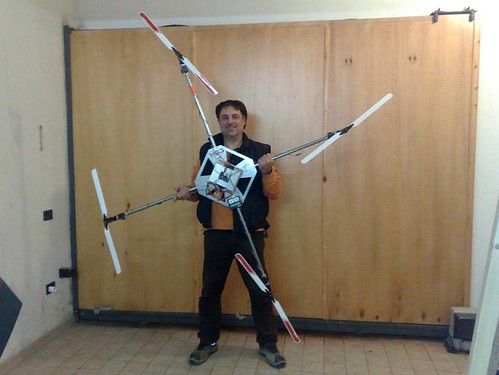
Multipilot Board support Hg3 Variable Pitch Mega Quadcopter actualy I'm implementing the support of HG3 (Variable Pitch Quad) to new Arducopter firmware. The last flight had doing with Aeroquad 1.5

This is last post from Pipposoft as lot of work this is a new version of HG3.2 Variable Pitch Propeller.
"
Between job and family commitments
although slow, here's some special preview of the new HG3 V2 ...
... To see it looking good, but ... fly?
leaving us with this doubt, all for now.

Pipposoft
"

This is old version of HG3

4373218270_45578d8746.jpg


For full story FoxTeam:
http://www.virtualrobotix.com/profiles/blogs/hg3-the-era-of-quad-variable
Read more…

The journey begins

For my first post I thought I'd give back to the community (and edit later to add anything else I can do).

Viability spreadsheet

I'm pretty new to RC planes although I have had a JP Zagi for years but with it being unpowered I'm at the mercy of the wind and I'm still pretty jittery. Seeing the DIY Drones setup I thought it would help me become a bit more competent but instead I bought an EasyStar and new system to have fun with the electronics instead and my Zagi will be my crash craft in free air anyway :D

UAV setup:
  • Futaba 6EX Tx and Rx
  • Multiplex EasyStar
  • Ardupilot Mega
  • Ardupilot Mega IMU (aka Oil Pan)
  • MediaTek GPS module
  • eTronix 40A ESC
  • Hacker A30-16M
  • Overlander 3S 2200mAH 11.1v LiPO
I'll document my build as best as I can to show the pitfalls :D so others do not copy me.
Read more…

Indoor UAV - 3D position estimation


Watch on Dailymotion

Hi!

I am currently working on 3D position and attitude etimation of my indoor drone. I use a 6 Dof IMU, a 3D magnetometer, and 4 sonars (Devantech).

The position estimation is not yet accurate (still bugs), but I am working to improve it. I also have lot of problems with the magnetometer. All the computation are done on the drone. I just use Matlab for visualization.

The drone is still manually piloted.

My intention is to make my drone navigate autonomously in a simple indoor environment.

A short demo video is above:


A quick description of my drone:

http://www.diydrones.com/forum/topics/bob4-indoor-autonomous

Leon - french hobbyist

Read more…

A minimum cable solution for UAV DevBoard


I hate all those cables invading our little planes !
I like the german expression which describes this situation : "Kabelsalat".
I'm sorry that still no one uses PPM connections (yes, this receiver has a PPM out on channel 12).

This is then the best solution I found to minimize the amount of cables to connect the receiver to the UDB.
The connection includes 5 channels in (throttle, ailerons, elevator, rudder and autopilot mode), receiver feeding, a board to connect pan/tilt camera servos for autonomous targeting firmware, extra servos feeding.

Please note that the connections are on the bottom of the UDB board. I modified the pins to use the UDB with the Oilpan, but in this case I'm not using it (the Oilpan).

Here is the complete connection.


All the system is feeded by the throttle out / ESC BEC (already extensively tested on my Arcus, in the standard "Kabelsalat" layout).


It could be simpler but for the moment I'm using a board I already made.

I crimp all the cables myself. This way I can have the exact length I want, avoiding unuseful extra copper on board.


After that it remains to connect servos, eventually telemetry (another 3 poles cable to a logger or OSD or ...), eventually a magnetometer (4 poles cable).


Hope this will help some and stimulate some others ;)


Best regards,


Ric

Read more…
3D Robotics

The effects of the recession on Asian electronics suppliers are being felt across the electronics industry, from cell phones to smaller firms like us and Sparkfun. This article explains what the root causes are, but the effect is that you're seeing more and more products going temporarily out of stock from many suppliers as we wait for components. In the case of ArduPilot Mega, which is currently out of stock, Sparkfun is waiting for a shipment of Atmega1280s to come in (ETA not currently known, but probably a matter of a couple weeks. UPDATE: Sparkfun says next week).


Our magnetometer board is also waiting for a shipment of new sensors, which will be arriving at the end of November (the good news is that we got a good deal on them by buying in massive quantities, so the price of the board will be going down).


Most other major products, such as the original ArduPilot board, the ArduPilot Mega IMU shield, ArduIMU and both the MediaTek and uBlox GPS modules are still in stock, albeit with limited inventories (act now!).


One of the components that we're having a lot of trouble sourcing is the 16MB dataflash chip that is used for on-board datalogging on the APM IMU shield. We've managed to find another 300, but at a very high price (around $15 each), so we may have to temporarily increase the price of the board by $10. Around the end of the year, we have been promised access to a larger supply, but at an even higher price!


We really don't want to pass these costs on to you and are looking for a cheaper source. Can anyone here help? The part number is AT45DB161D-SU. Does anyone know where we can get hundreds or more of them at a cost below $8 each? (We've considered other options, such as switching to micro-SD cards, but the production complexity and cost of that is no better. We are, however, willing to consider DIP chips and a socket rather than the current SMD chips)

Read more…
3D Robotics

Could this be a good UAV platform?


Over at RCG, Gary, who makes these sweet birds in his workshop in Toronto, asks if if there would be interest in selling them for UAV use:

"The only electronics onboard are 3 gyros + 2 mixers. The first video is with one 4S 3000 battery, the second is with two. Payload capacity above and beyond the batteries is 2 lb. There's more info, including the 5-lb-payload eVader 750, at

http://www.gressaero.com

I think the main features of these aircraft are that they are quite robust, have lots of payload room between the props, and handle winds well.

As stated I currently make just the platforms, and have had some interest from APers. What I'd like to do is determine if they might be viable as UAVs and, if so, develop them for this segment. Specifically, I would need:
your feedback
--to determine if there is interest in the platform by itself for DIY UAVs
--info on a good autopilot for integrating in-house
--info on 3rd parties that could integrate and package
--good exposure for the end-product"
Read more…
p1030255.jpg?w=300&h=200

I thought to gather few of my experiences while making my own
transmitter / receiver. The project started after I finally moved to 2.4
GHz technology by purchasing Hitec Aurora transmitter. One near crash
later I learned that 2.4 GHz controller and 2.4 GHz video transmitter
don’t play well together. Since here in Finland 2.4 GHz band is just
about the only band available for video without amateur radio license, I
thought to replace Aurora’s transmitter with something different.

The full story can be read here: http://antibore.wordpress.com/2010/08/27/making-of-xbee-pro-868-based-rc-controller/


Read more…
Moderator

Outback Challenge contestants

Beginning to get a fairly complete list of entrants and their D2 videos here. Am also getting more and more despondent that I did'nt go to a school like this, three entries in the contest and they all look good. These lads and lasses are the future of aviation. Best of luck to them and everybody else. Its no small task to enter a contest of this magnitude.

Read more…

In progress APM/UDB Mission Planner

map3.jpg

Yet another mission planner in the works, i dont personally use either AP as i am creating my own.
As part of my dabblings i am creating an offline mapping tool etc for my GCS which i though might be useful to others. It's written in C# and leverages a fair few different map sources and caches the images to disk for offline use.

Needs .net 3.5 framework to run.

Right click to drag the map.

Grab it from here http://www.exsis.co.uk/MissionPlanner.zip

- and yes it is very much a work in progress (read full of bugs and missing fluff)

Cheers

Justin

Read more…
Developer


OK - After working with a small group of Alpha testers, I guess we are ready to open the flood gates and make a public release of ArduPilotMega!


Here is what you need to know:

  • This is an Alpha release - expect there to be bugs. If you don't want to deal with bugs, wait for the Beta. There will still be bugs in the Beta (probably), but a lot less.
  • For the Alpha release we will NOT be providing a .zip download. The code will be changing frequently as we find and fix bugs. You should use a SVN client to get the most recent revision to the code. Look below for a mini tutorial. If you don't want to mess with SVN, please wait for the Beta release.
  • Read the ArduPilot Mega manual. It is located here. Expect the manual to change on a daily basis. Recheck it frequently.
  • Please understand that there is a HUGE amount of functionality in ArduPilotMega. Most of it is still untested in actual flight, and some specific commands are not fully implemented.
  • We have made extensive use of libraries. You must either add these to your Arduino install or we would recommend using the great new "Sketchbook checkout" put together by Michael Smith which will handle getting the libraries for you and keeping them current. See the SVN mini tutorial below.
  • There is some functionality in place for the Legacy ground station. There is also functionality in place for the new ground station, however the new ground station is not ready yet.
What has been tested successfully? We have tested the basic flight modes (Manual, Stabilize, Fly By Wire, Auto) and the basic commands (Navigate to Waypoint, Loiter commands, and RTL)

What has not been tested:

  • Airspeed Sensor and associated control laws
  • Magnetometer
  • NMEA
  • Most of the commands
  • Use of many of the options in the config file
How can you help? If you feel you are up to Alpha testing, then join in. We are taking bug reports through the Google code repository "Issues" feature. You can find that here.

Good luck and happy autonomous flying!


Mini SVN Tutorial
This is a quick tutorial on how to use Tortise SVN to download the ArduPilotMega code using the "Sketchbook checkout" and how to keep your copy up to date.
  • Install the TortiseSVN client on your PC. Get it here.
  • On your PC open a window for the directory into which you would like to store your local copy of the code. Right click in the window and choose SVN Checkout.
  • Fill in the URL of repository with: http://ardupilot-mega.googlecode.com/svn/Sketchbook/trunk/
  • The checkout directory field should contain a folder name of the folder you are in appended with \Sketchbook
  • Click OK. This step downloads all the firmware and library files you will need. If you have a slow connection this step can be glitchy. If you get an error that one or more libraries you can use the SVN update feature to correct this after the checkout completes.
  • You should now have a Sketchbook folder which contains folders for ArduPilotMega, libraries, and Tests.
  • Open the Arduino IDE. Go to Preferences in the File menu. Change the Sketchbook location to this new Sketchbook folder. Now choose Sketchbook from the File menu and choose ArduPilotMega.
  • You are now ready to compile the latest code.
  • To update your local working copy to the latest revision, go to the directory containing your Sketchbook folder, right click on the Sketchbook folder, and choose SVN Update. With this one step you will get the latest code for ArduPilotMega and all the libraries downloaded to your PC.
Read more…
As my inaugural blog post on DIY drones, here's a video of my first step towards building an autopilot: browser-based flight instruments using HTML5 canvas and websockets, with measurements from X-plane via UDP. Here I am flying (badly) off into the subset over Cape Town:

HTML5 Flight Instruments Demo from Benjamin Nortier on Vimeo.

(ed: seems like embedding videos from vimeo are not supported?)


My intention is to build an autopilot, where I'll be doing in-silico development using X-plane at first, then moving on to actual hardware (if the autopilot proves feasible). The plan is to do things a bit differently than what I've read here so far. Notably I'll be programming in Erlang for the autopilot, with the intention of running on something like a Beagleboard on a plane. All my visualisation, ground station, configuration etc. will be browser-based (i.e. Javascript).

The reasons for this approach, in a nutshell are
1. A desire to homogenise the development environment between GS and plane
2. Ability to develop in-silico as much as possible, e.g. not having to deploy each build to hardware and use complicate Hardware-In-Loop setups for testing
3. If you don't know Erlang, it's a great choice for building fault-tolerant soft real-time systems, with the emphasis on "fault-tolerant".
4. Basing control and configuration on a browser will enable you to control and configure from a laptop, ipad, smartphone, form across the world.

Hopefully there will be more to come. Some of these ideas may turn out be be bad decisions, we'll have to wait and see...

Read more…
3D Robotics

New CityFlyer GCS

There are an awful lot of GCSs out there (possibly more than anyone needs), but here's another one: CityFlyer.


I Heart Robotics explains: "The CityFlyer ground station takes different approach to developing a control system for UAVs. While other systems try to provide as much information as possible, this one seems to focus on readability. Also, since it is based on GTK+ and ROS it may be useful for other robots."


"Each of the instruments are well documented and implemented using the Cairo scalable vector graphics library, which means that each gauge could scale up to full screen without looking pixelated. Controls are also provided for a high contrast mode which might be useful for daylight readable displays. Since the individual instruments are implemented as GTK widgets they could also be used to build your own ground station.


Rumor has it that the lead developer is graduating soon and looking for work, so feel free to contact him here."

Read more…