All Posts (11086)

Sort by
3D Robotics

3689635554?profile=originalA very good piece in IEEE Spectrum reports on the research on the risks small/med bird strikes in aviation. Short conclusion: it rarely causes a fatal accident -- indeed, there may be no record of one with standard aircraft.

Last December, a group of investors called the UAS America Fund petitioned the Federal Aviation Administration to create a set of rules that would govern “micro unmanned aircraft.” The basic idea is that these microdrones—defined as being 3 pounds (1.4 kilograms) and under—pose much less of a hazard than many of the model aircraft now flying in the United States, which can weigh as much as 55 pounds (25 kilograms). So it makes no sense to regulate all “small unmanned aircraft systems,” as the FAA likes to call them, the same way, which might well be what the U.S. government has in store.

While the rules the investment group has drafted make for an interesting read, what I found particularly eye-opening was an attached report from Exponent, a failure-analysis consultancy. That report tries to quantify the threat such microdrones—a category that includes popular models like the DJI Phantom and 3DR Iris—would pose to full-scale aircraft using data the FAA has collected on collisions with birds.

Bird strikes, as these incidents are called, have plagued aviation since its inception. And that’s not surprising. There are a lot of birds—10 billion in the United States, according to Exponent—and some of them get quite large. You only have to think back to the dramatic goose-caused ditching of US Airways Flight 1549 in the Hudson River in 2009 to realize that birds are more than a theoretical threat.

Fortunately, the aviation industry and regulators have found ways to reduce these natural hazards. For example, airports use a type of grass that geese don’t particularly like to eat. And aircraft are subject to various regulations about how robust they have to be in the face of something like a goose flying into the blades of a jet turbine.

That’s not to say that the aviation industry has this problem licked. By no means. Bird strikes are a very real threat to aviators and their passengers. But as Exponent’s report aptly shows, the severity of the danger scales with the size of the bird, which only makes sense.

US Airways Flight 1549, for example, suffered crippling damage to its engines on takeoff after it ran into a flock of Canadian geese, which can weigh as much as 18 pounds (8 kilograms). And there are plenty of other examples of other large birds—pelicans, vultures, cranes, and so forth—creating similar havoc in the air, sometimes with tragic results.

But Exponent’s examination of the FAA’s wildlife-strike database reveals something interesting. The smaller classes of birds documented there (those the size of sparrows or gulls) rarely cause aviation fatalities. Indeed, the FAA’s database, which records incidents back to 1990, lists only three fatal accidents attributed to small or medium-size birds, according to the Exponent report. And a deeper examination of those three accidents casts considerable doubt on whether a collision with smallish birds really caused two of the three.

The earliest of these three fatal accidents took place in 1994. According to the ensuing report of the National Transportation Safety Board, the helicopter involved crashed not because of an actual collision with one or more birds, but because the pilot took aggressive evasive actions to avoid a flock of birds and inadvertently overstressed his aircraft. The rotor then struck the tail boom, and the helicopter dropped out of the sky.

The second of the three fatal incidents took place in 1998. Here it was a fixed-wing aircraft involved. Two people flying in the plane died. Thankfully, the plane killed no one on the ground, despite crashing into the roof of New Jersey condo. The type of bird responsible for this tragedy remains unknown. Actually, investigators are not at all sure there really was a bird involved.

The evidence for some sort of avian component to this accident consists of one witness’s report that she saw a large number of birds flying in the area. There was some enigmatic damage to a portion of the plane’s horizontal stabilizer, but no bird feathers, blood, or remains were found on the plane. Swabbing by ornithologists called in to examine the wreckage failed to turn up bird DNA. And after reviewing the relevant photos, the Air Force’s Bird/Wildlife Aircraft Strike Hazard Team, like the ornithologists, demurred in attributing the damage to a bird strike.

This leaves only one more fatal accident in the FAA database that has been ascribed to a small or medium-size bird. This one, the crash of a helicopter ferrying oil-field workers to offshore platforms in the Gulf of Mexico, took place in 2009. Two pilots and six of the seven passengers died.

Although there was no obvious evidence of a bird strike on initial inspection of the wreckage, swabs sent to the Smithsonian Institution’s feather-identification lab turned up DNA from a female red-tailed hawk. Such birds generally weigh a kilogram or perhaps slightly more (say, 2 to 3 pounds), so it’s surprising at least to me that a collision with something this small would be enough to take down a helicopter. The National Transportation Safety Boards summary of this accident hints at a complicating factor, however: a windshield that might not have been up to par.

You see, the company running this helicopter-ferry service had had issues with the stock glass windshields on its helicopters delaminating, so they replaced them with aftermarket acrylic windshields, which according to the NTSB report hadn’t been tested for their resistance to bird strikes. And an identical acrylic windshield installed in a different helicopter allowed a colliding gull to pass right through it three years earlier. But that incident hadn’t caused this obviously fragile windshield design to be removed from service generally.

So some bird strikes can be darn dangerous. But despite that fact, and despite the enormous numbers of these creatures zooming around the sky, only very rarely do collisions with smaller varieties of birds kill people. Less serious accidents aren’t, however, uncommon.

According to the Exponent study, the FAA’s database has a total of 150,000 entries, and out of those, there are 13,906 reports that note damage from small or medium birds. And there are 227 incidents noted that had non-fatal injuries. Of course, we have no idea how many inconsequential bird strikes go unreported. So it’s hard to judge odds of a bird strike being significant from these numbers.

What’s more, if you only consider small- and medium-size bird strikes that occurred in places where microdrones would be likely allowed (below 400 feet altitude and more than 5 miles from an airport), the results don’t look at all alarming: the Exponent report says there have been zero fatalities and at most a handful of accidents with injuries.

This is all to say that drones of about a kilogram or so in mass would likely pose little danger, so long as people flew them away from where full-size aircraft are allowed to fly. (In the United States, piloted aircraft are supposed to fly above either 500 feet or 1000 feet above ground level, depending on how densely the area is populated.)

So why not let drones of a size that pose comparatively little danger fly without imposing onerous restrictions on them? Any flub-ups that bring a full-sized aircraft and a microdrone to the same area and altitude are bound to be no more worrisome than the situation equivalently sized birds have long put aviators in. And we’ve somehow put up with that.
 

Read more…

Is it a hobby or not?

3689635573?profile=original

I have been posting here for a couple years. Back when it consisted of a lot less drone and a lot more DIY. So please refrain from making silly comments like,"Do you know the name of the site you just posted on?"

Now that that's taken care of. You may have noticed the Commander in Chief told the FAA yesterday to do their job. That made me  think. Not that I don't have this thought at least once a week. What happens if we lose our hobby what will I do?

I've been flying for awhile now.

My first plane was a 3 meter balsa glider with way too much everything on it. I built it and covered it myself without any help in middle school 29 years ago. It flew like a rock but the servos from my RC car made the elevator and rudder move so I was impressed.

Like all of us, money is my speed bump in the sky. Flying RC has always been expensive. It's still expensive even with all the ARF's and RTF's. But it's a lot more accessible to the masses now. More so in the past couple years. Fast forward to today and we have DRONES! To me for the lack of a better word I think it sounds LAME, totally lame to call them drones. Have you ever watched Joe Dirt? If not take a moment and watch this clip.

It's just trying to make a toy sound like it's something more important. Look, I hate it when my wife talks about my hobby like I'm playing with toys in the garage. But I'm definitely not gonna tell her that they’re drones. She'd laugh me right out of the house. 

So yesterday a drunk Federal not so intelligent agent decided to take his friend's DJI Phantom for a spin. Lost control, and put it out for a yard sale on the White house lawn. Then went to bed. Stay classy nerds in DC stay classy.

But this brings me to the next thing I want to talk about. DJI, Love them or hate them? I personally have hated them for a long time. Rewind to 2012 and they had a youtube video(which has since been taken down) of a man throwing a DJI Flame wheel frame across the room, then going over and jumping with both feet onto the frame, then he picked it up and tossed it out the factory window. I was sold! I ordered one that day. I received it, put it together, took off, had a radio malfunction, it dropped 25 feet onto the driveway and two of the four arm snapped. My wife looked at me with disgust when she saw me out in the driveway screaming at a little red and white quadcopter. (They weren’t drones yet.) I lost all faith in DJI then. In my opinion they can't be trusted.

I was so very proud of Flitetest for not reviewing the Phantom, but then they went and did it. Josh bought an Inspire. I admit, I watched it. I wasn't happy to watch it, but I did. My wife looked at me strange again when I yelled at the Apple TV, "OH come on! No! No you didn't! You just helped them sell those stupid things!" I haven't been that mad at Josh since he made the Box O Copter video and didn't give me any credit. Took me lots of donuts to get over that one.

Now let me admit this, the technology is impressive. I build junk out of whatever I can get my hands on, i.e. tupperware, wood, plastic and hot glue. What they have done is great. But I just don't believe they are honest. They don't tell people what these things can and can't do. 

So is the government gonna take away our toys? I don't know. I doubt it, but I can almost guarantee that some sort of payment is gonna be required to fly. I've been flying multicopters since 2011. I haven't flown fixed wing since. I love it and I know that I'll pay the price to fly. I'll pay the fine, if there ends up being a fine. For the past week I've been consolidating all my video's into one. I even started a new youtube channel. https://www.youtube.com/fleshpilot, why? Because I love the hobby. Or should I say, I strongly like it. I like to design, build, and share with everyone. I like to see my design's built and enjoyed by others and I like to make those designs availabe for free. Anyway, please subscribe as I deleted my old channel with over 800 of you guys subscribed. It was full and disorganized, I wanted a fresh start. I ended up with 3 years jammed into 20 minutes.

Back to the word Drone. Everyone calls them Drones until, they get in trouble. Years ago Chris Anderson owner of 3DRobotics crashed one of his planes onto property he shouldn't have been over and told the security guard, "I lost control of my TOY plane." They let him on the property to get it back. He didn't tell them it was a drone and that he had been taking pictures of their facility. No way! Why? Because the word Drone implies you're flying something other than a harmless toy.

I know the war is lost. People are going to call them drones. I mean come on, what am I thinking, if a man will wear skinny jeans, he'll obviously think it's cool to try to church up a toy. Just know that if you are one to call your toy a drone. I'm laughing at you. Although that doesn't say much because my wife is laughing at me for playing with expensive toys and writing articles about them, and talking about them, and crying over them.

Finally, I know, that the people reading this aren't the problem at all. It's the misinformed, money hungry and or drunk fed in Washington D.C.

Finally Finally, is it a hobby? Yes it's a hobby, it's my hobby and I totally admit, if they make it illegal to fly, I'll be at the first FPV Speak Easy I can find ready to have fun flying my toy.

Read more…
Moderator

DJI to release mandatory firmware update

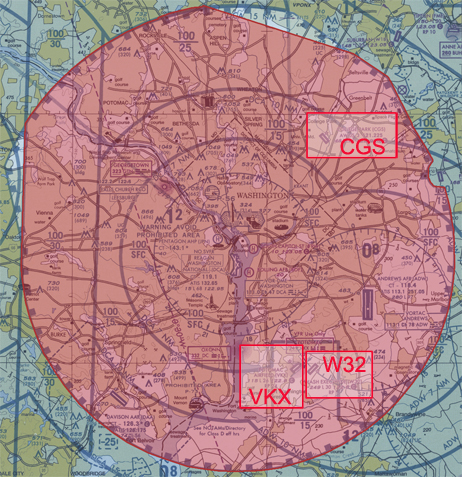
WashingtonFRZ.jpg?width=350

DJI will release a mandatory firmware update for the Phantom 2, Phantom 2 Vision, and Phantom 2 Vision+ to help users comply with the FAA’s Notice to Airmen (NOTAM) 0/8326, which restricts unmanned flight around the Washington, DC metropolitan area.

The updated firmware (V3.10) will be released in coming days and adds a No-Fly Zone centered on downtown Washington,

The restriction is part of a planned extension of DJI’s No Fly Zone system that prohibits flight near airports and other locations where flight is restricted by local authorities. These extended no fly zones will include over 10,000 airports registered with the International Air Transport Association (IATA) and will expand no fly zones to ensure they cover the runways at major international airports. DC and extends for a 25 kilometer (15.5 mile) radius in all directions. Phantom pilots in this area will not be able to take off from or fly into this airspace.

http://www.suasnews.com/2015/01/34070/dji-announces-mandatory-firmware-update/

Read more…

Vulture 2 spaceplane HIL simulation

3689635427?profile=originalWe've been quietly beavering away at hardware-in-the-loop simulations for our Vulture 2 spaceplane, and Pixhawk wrangler Linus Penzlien has finally got the aircraft to land itself at a virtual Spaceport America.

The HIL work involves ArduPilot controlling an X-Plane model created by Billy Bargagliotti. The APM deploys some custom mission parameters by Andrew Tridgell, plus a smidge of autotune.

For your viewing pleasure, see this short video, grabbed by Linus during a recent simulation.

There are details of the HIL work here, and full coverage of the Low Orbit Helium Assisted Navigator (LOHAN) mission right here.

Read more…

OpenMV Cam on KS

3689635218?profile=original

Hey all, remember OpenMV Cam? It's the machine vision module that runs Python.

Well, we finally launched it on Kickstarter http://bit.ly/openmvcam. It does color tracking, object tracking, records movies and photos, too. All scriptable with Python. And it supports shields (think WiFi, LCD, IMU, ...)  It has IR LEDs. M12 lens mount. STM32F427 @ 180MHz.

3689635386?profile=original

Read more…

Percepto - computer vision for drones

Hi,


My name is Raviv Raz and I am a co-founder of a really cool startup called Percepto. I really hope you will like it since it pretty much grew out of reading and following this community.


Percepto is an add-on device, some may call a companion computer, that is designed to give almost any UAV computer vision capabilities.


It has been well discuss throughout the community that computer vision will play a crucial part in the future of drone technology. Understanding that, and being inspired by the power of open source community development, we have decided to create Percepto. A Platform that

makes the journey from a computer vision code to an actual drone application straight forward.


While we developed our first computer vision “follow me” application for our drone we’ve encountered many issues that were unrelated to our computer vision core algorithm.  Assembling the right hardware, integrating it with our drone and developing good testing methods consumed the majority of our time.


With Percepto we set out to change all that. We’ve created it to minimize the development time between a working computer vision code and an actual flying drone. We’ve included computer vision optimized and accelerated hardware, choosing each component in our system to best integrate with drones and designing our system to be “flight testing friendly”.


We strongly believe in open-source development, this is why we want Percepto to be in the hands and on the drones of as many developers and users as possible.


We are a team of experienced engineers from industry leading drone manufacturers, top tier communication and computer vision systems vendors and semiconductor producers. We hope to incorporate the best of these worlds into the hands of developers and users, helping create a new set of capabilities for drones.


I will keep updating our blog, technical and physical characteristics will be out soon.

www.percepto.co 


Thanks,

Raviv


Read more…

Ground station survey

missionplanner2.PNG?width=750

Ground stations are the means you have available in the field to interact with your autonomous vehicle, so they're a very important part of the toolset to conduct your work or hobby. The ground station as we know it now is not just there to support your activities to plan or execute the flight, they also contain functions for initial setups, configuration of sensors and parameters that manipulate their behavior and post-flight analysis tools.

I wrote a public, anonymous survey where my intention is to see how people experience ground stations in general, with the intention to learn more on how they are experienced. Are they easy to use?  Do many people just use them to log the flight data?  How many people are in your team?  How do you divide the roles?

There are ten questions, most multiple choice, so shouldn't take too long. Looking forward to the responses.

In good opensource fashion, the detailed survey results are also open, so when you complete the survey, you get a link to download the results yourself (so far, of course). My intention is to run this survey for about a week, which is about the time a blog post sort of disappears into the archives. So this survey will close sunday evening 1st of february at 24h UTC. After that, I'll get the results and make a new blog post on the findings and the numbers. 

The survey is available here:

https://docs.google.com/forms/d/1h0LPVE2wBQ9M2ggtfrSf1tVHnUgg5ygf1msSuElUdyc/viewform?usp=send_form

Read more…
3D Robotics

3689635267?profile=originalFrom Fast Company:

The next time you spend 20 minutes circling a parking garage trying to find the last empty spot, consider this: Someday soon, you might be able to let a drone do the work. A concept for a new parking system would use a fleet of quadcopters to scout out open spaces and then guide cars to the closest one.

"I was always frustrated trying to find parking…I thought there should be a better way," says Amir Ehsani Zonouz, a UMass Dartmouth student who came up with the concept.

3689635082?profile=original

The network of quadcopters would hover over a parking lot, automatically detect an open spot, and then either lead a driver through the car's navigation system. For someone with an older car, or in underground parking garages that block GPS signals, the drone could just fly in front, manually guiding the driver into the spot.

The concept won a mobility competition held by the technology company Siemens, which is considering working with Zonouz to develop the idea into an actual product.

"We're going to hold a prototyping workshop, and we're going to spend a couple of days putting together either the whole system or a part of the system, just as kind of a proof of concept so we can get this rolling," says Ben Collar, head of U.S. research and development for Siemens Road and City Mobility.

The system is feasible to build, Collar says. "Technically, there are some challenges, but I don't foresee that any of them are insurmountable," he says. "The technology that he's choosing, working on quadcopters, is enough on the edge of technology to be interesting and to provide a good technical challenge for university students and researchers, but it's not out of this world and it's going to be solvable."

The biggest challenge, as with all things drone-related, will be waiting for regulations from the FAA. But if it happens, the technology could make a big difference—drivers spend 70 million hours each year, and countless gallons of gas, trying to park their car

Read more…
3D Robotics

3689634788?profile=original

Back in June 2013, I shared some pictures from the then-new 3D Robotics Tijuana factory.  Here's another batch, showing the growth and progress there. It's buzzing and packed!

Four pick-and-place machines running all the time: 

3689635064?profile=original

Visual inspection of boards after they come out of the reflow ovens3689634993?profile=original

Part of the customer service call center3689635022?profile=original

Firmware loading and diagnostics

3689635108?profile=original

IRISs waiting for testing

3689635038?profile=original

Pallets of IRISs waiting to be shipped to distributors

3689635168?profile=original

The outdoor test facility. Every vehicle is flight tested before leaving the factory

3689635134?profile=original

Here's about half of the flight testing that each IRIS goes through. This part tests GPS and Loiter modes.

The ionized water washing machine, used to clean PCBs after manufacturing:

3689635183?profile=original

Read more…

Thermal imaging system for drones

I would like to introduce a thermal imaging system for drones and UAV systems made by european company Workswell s.r.o.

Basic parameters

Workswell Thermal Vision Pro is high-end and unique wireless thermal imaging solution with two cameras and storage for unmanned aerial vehicles, quadrocopters or drones. This lightweight system offers a maximum resolution of 640 x 512 pixels and a temperature sensitivity of 0.05 °C which ranks to the best on the market. You can record continuous video, take images and save data to storage for later analysis.

More information is avaible on our website: http://www.drone-thermal-camera.com/

Some advantages of system

  • see in a day or night, even in complete darkness
  • radimetrics data recording
  • see through the fog, thick smoke and partly through the vegetation
  • all the data are sent wirelessly to the operator’s controller
  • one touch system for saving all images at the same time

The aim of the whole system is the simple transfer, storage and processing of radiometric (temperature) data directly from a UAV (drone) and displaying the data on the screen of the remote control in real time. The system offers three picture modes that can be set by the operator using the keyboard prior to take off. During the flight, the operator can switch between the modes using the UAV remote control.

Vayage on YouTube

Building inspection:

Chasing the Bad Guys :)


Twitter

Stay connected with us on Twitter: https://twitter.com/WorkswellCZ

Read more…

Drones for Science, Exploration and Conservation

3689634931?profile=original

Photo via Lian Pin Koh 

OpenExplorer just received a small grant to help send UAVs to individuals and groups using drones for the purposes of science, exploration, or conservation. If you know anyone who might fit this description, please pass on the details! For both professional and amateur scientists...

The details on how to get one of the drones are here:
https://medium.com/openexplorer-journal/drones-for-science-exploration-and-conservation-3476a9ab8c13

More on OpenExplorer here: https://openexplorer.com/home

Read more…
Moderator

Trappy ended up paying

trappyhk.jpg

By  JACK NICAS

Raphael Pirker agreed on Thursday to pay the FAA $1,100 to settle the agency’s $10,000 fine for allegedly flying a drone recklessly to film the University of Virginia in 2011. Under the settlement terms, Mr. Pirker doesn’t admit to guilt and the FAA agreed to drop some of its accusations against Mr. Pirker.

The FAA declined to elaborate beyond the details of the settlement.

Mr. Pirker’s attorney Brendan Schulman said his client decided to settle because the length of time needed to finish the case and recent comments by the FAA “have diminished the utility of the case to assist the commercial drone industry in its regulatory struggle.” The FAA has said its authority to regulate drones stems from a 2012 statute that post-dates Mr. Pirker’s flight.

The FAA fined Mr. Pirker, a dual national of Austria and Switzerland, in 2012. The case gained attention after a federal administrative law judge ruled this past March that Mr. Pirker’s plastic-foam drone was a model aircraft and thus not subject to FAA rules for manned aircraft. The decision cast doubt on the FAA’s authority to regulate drones.

In November, the National Transportation Safety Board overturned that decision and ruled that drones are aircraft and subject to aviation laws, affirming the FAA’s regulatory power over the devices.

http://www.wsj.com/articles/u-s-federal-aviation-administration-settles-with-videographer-over-drones-1421960972

Read more…

ESPN's Winter X Games allowed to film with UAV.

RS312436_20150121_E1X7092.0.0.JPG

Thought everyone might want see/read this.

ESPN is adding camera-carrying drones to its coverage of the Winter X Games, using the cutting-edge technology to cover snowboardcross and snowmobiling events this week in Aspen, Colorado.

Full story: Winter X Games using drones

This being in my "backyard" so to speak, I am pleased to see a major US event stepping up and using a UAV to film with.

Read more…

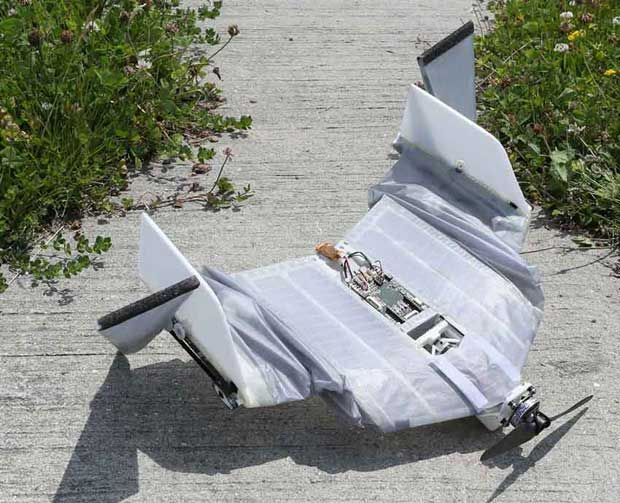
Flying, Walking Vampire Bat Robot Is Back

daler1-1421902017023.jpg

A few years ago, Ludovic Daler showed us a flying robot that he was working on that had the ability to “walk” by rotating its wings while on the ground. We love seeing designs like this that are completely, utterly out of the box, and Ludovic promised even more: 

We aim to make adaptive deployable wings... their shape could be adaptively modified to augment efficiency of forward flight, hover flight, and displacement on the ground.

With a little bit of inspiration from the common vampire bat (!), Ludovic has delivered with this updated robot that keeps its walking ability and now includes a foldable skeleton mechanism that lets it deploy and retract its wings.

The robot is called DALER (Deployable Air-Land Exploration Robot), and I’m sure it’s just a coincidence that Ludovic Daler is the lead author on a paper that’s just been published in Bionspiration & Biomimetics. The focus of the paper is, of course, the robot’s adaptive wings, which enable ground locomotion without sacrificing much weight or structural efficiency, since the rotating wingtips double as an attitude control system when the robot is in the air. The foldable wings (studying the bats helped out here) help to increase walking efficiency on the ground, and also allow the robot to squeeze into places that it might not otherwise be able to reach.

It’s obvious that DALER is, um, not the most graceful of robots when it’s stuck on the ground, but there’s a huge difference between the zero ground mobility that most aerial robots have and some ground mobility, however limited. For what it’s worth, bats operate the same way. In the air, DALER can reach 20 m/s, while on the ground, it tops out at 6 cm/s. It’s not going to get very far at 6 cm/s, but in a search and rescue scenario, the ability to move on the ground at all means that it can land and scramble around a little bit, maybe moving underneath obstructions to investigate areas that are otherwise inaccessible from the air.

The other appeal of ground mobility is that it gives a winged robot the capability to land, reorient itself, and then take off again. Rotary winged aircraft can do this, but they’re substantially less efficient over long distances. When a winged robot comes in for an autonomous landing, it’s usually better described as a controlled crash, and taking off without some form of assistance is usually impossible. DALER shouldn’t have this problem, and that’s where the research is heading next, according to EPFL:

Future development of the DALER will include the possibility to hover and to take off autonomously from the ground in order to allow the robot to return to the air and come back to base after the mission.

source:

http://spectrum.ieee.org/automaton/robotics/robotics-hardware/flying-walking-vampire-bat-robot-is-back

http://lis.epfl.ch/DALER

http://actu.epfl.ch/news/a-flying-robot-that-can-walk-4/

Read more…
Moderator

Actually it's 3DR's rather sane Colin Guinn, who did an excellent job presenting his material and seemed to impress Chairman Lamar Smith.

Colin Guinn, an executive with 3D Robotics, released the unmanned aerial vehicle during a hearing on the subject of drone development, much to the amazement of the committee’s chairman, Representative Lamar Smith (R., Texas).

“I was hoping you’d fly it around the whole room — not just one location,” Smith said after the drone landed.

“You said no haircuts!” Guinn joked back. “We could have arranged that.” A disappointed Smith admitted he set those parameters before the hearing.

http://www.nationalreview.com/corner/396874/drone-flies-through-congressional-hearing-andrew-johnson

Read more…

Teleoperating an Hexacopter

Hi everybody, i would like to show you my advance with the teleoperation topic, the main objective is use the Novint Falcon to operate the copter, avoid collisions and feel the velocities and distance to an obstacle by the force feedback. The firmware is for the pixhawk, based on some of the ArduCopter 3.2 libraries.


Also the copter is able to fly in external or internal environments, so if the gps signal is good to fly with it, it flies with gps, if not, i use the optical flow PX4flow to try to maintain the position.


To avoid the collision an ultrasonic sensor is used, but have some issues i think because the noise of the motors,
Still is not fully tested, but at this moment is functional. Greetings

Read more…

3689634758?profile=original

Its very early to judge, whether Microsoft Hololens is going to be a good product, but from what i see it could be the ultimate FPV solution. Just imagine Telemetry, video screen and a natural view of the drone all on a holographic, augmented reality glasses. The setup should also be fast, because its Windows! Just setup APMplanner and a screen from light bridge and you are ready to go. No laptops or tablets, no fpv monitors, just your goggles and a radio in hands. I think we might see some review of that setup in the next several months.

Here's an article:

Microsoft's HoloLens headset is a holographic display for Windows 10

Microsoft is building support for holographic displays into Windows 10, so it only makes sense that the company would make one of those displays, wouldn't it? Meet HoloLens, an official headset with see-through lenses that merges digital content with the physical. It includes spatial sound so that you can hear things happening behind you in the virtual world, and it even has a dedicated Holographic Processing Unit (HPU) to make sure everything works smoothly. The company is shy about just when it'll start selling HoloLens, but it should be available "in the Windows 10 time frame."

source:

http://www.engadget.com/2015/01/21/microsofts-hololens-headset-gives-your-windows-10-pc-a-holograp/

Read more…

no practical reasons why

from last year's builds . gone overboard where design is over function. no practical reasons why but just for the fun of it.

whether or not will find useful UAV function for these design if ever. just got bored of the common designs as soon they hit saturation point.

pylon_seagle_by_synersignart-d8661ft.jpg

Pylon Seagle
px35_twin_fur2y_and_450_au_quad_by_synersignart-d7rkipt.jpgmy 500mm quad and PX35 TwinFur2y 

px35_twin_fur2y_by_synersignart-d7qwzzb.jpg

Draco450heli_you_scary_2__finish__by_synersignart-d7kb3sk.jpg

Read more…

You might have seen this video before. Recently there's been some rumours about IMU issues of the new DJI drone Inspire.

The company just confirmed the issue, and they are fixing it in a hurry. It might never happened, if it was an open source software ;), just saying.

Don't Trust Your Expensive Autonomous Drone to Always Be Autonomous 

Everybody is super excited about affordable, portable autonomous drones this year. Well, affordable might be stretch. The badass new DJI Inspire costs $2,900, but it can fly around shooting video in 4K without any help. One problem: A bug in the firmware is making Inspire drift randomly—and crash.

Just ask Mark Taylor. The experienced drone pilot recently bought DJI's expensive new masterpiece and was excited to use the drone's auto-takeoff feature to "do a house fly-by for real estate." (This is potentially illegal, but we won't tell.) After experiencing some "shimming and drifting," Taylor decided to film a flight so that he could send the feedback to DJI. "This happened with no operator input just in auto take off mode," he said in the video's YouTube description. What happened? The flying robot almost took out his wife!

In an email to Gizmodo, DJI confirmed that there was an issue with the Inspire's firmware. (We can only assume that this dangerous random drifting is related.) The company said that its "product support team has noted the issue and is currently taking care of it." A fix is due to be released in the next 24 to 36 hours.

Nevertheless, Mark Taylor's scary video is a great reason not to trust your supposedly autonomous drone. We've already seen how problematic human drone pilots can be—and more problems are surely to come. We've also had our own problems with DJI's earlier autonomous flight features in the past. 

Your very expensive new toy may say it can fly itself, but do steer clear of those propellors. You never know when your drone will get a mind of its own. [YouTube via Daily Dot]


MORE:

http://gizmodo.com/dont-trust-your-expensive-autonomous-drone-to-always-be-1679451438

Read more…