All Posts (11086)

Sort by

https://www.youtube.com/watch?v=3LMaO3o5t3E&feature=youtu.be

Hi, i´m making my own firmware based on the ArduCopter 3.2 Libraries, i have implemented various flight modes like STABILIZE, LOITER, ALT HOLD, RTL, AUTO, but changing the control law and configuring to my necessities, also i have implemented some functions like MAVLINK, LOGGING and until now all seems to be ok, but i required the use of the Optical Flow sensor to perform flight in an environment with poor GPS signal, so i want to show you my progress in my firmware because i have implemented the PX4Flow sensor on the APM and Pixhawk based on the AC 3.2 Libraries.

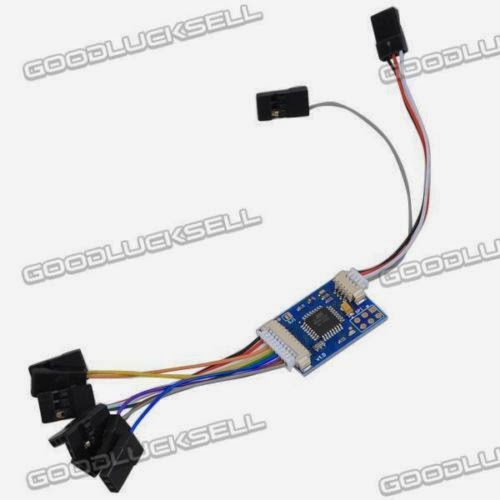
I have implemented the sensor via i2c, i thought i could have problems in the APM because took approximately 1ms to read the 22 bytes of the PX4Flow. On Pixhawk also was easy because already was implemented a library in the PX4 Firmware to communicate with the PX4Flow.

The mode is like Loiter but with Optical Flow, basically try to maintain the position integrating the Optical Flow and controlling the X-Y velocities by the radio stick, when i release the sticks the copter try to maintain the position, i notice that i have a better result on APM but maybe because i use the same controller gains on the 2 copters and maybe require more running but i´m happy with the results. I will try to modify ArduCopter to implement this on both controllers, but i´m not sure if are enough space on APM to add the code. Also i´m going to try to implement a data fusion to have a more reliable X-Y velocities.

PD. Sorry for my english.

Read more…

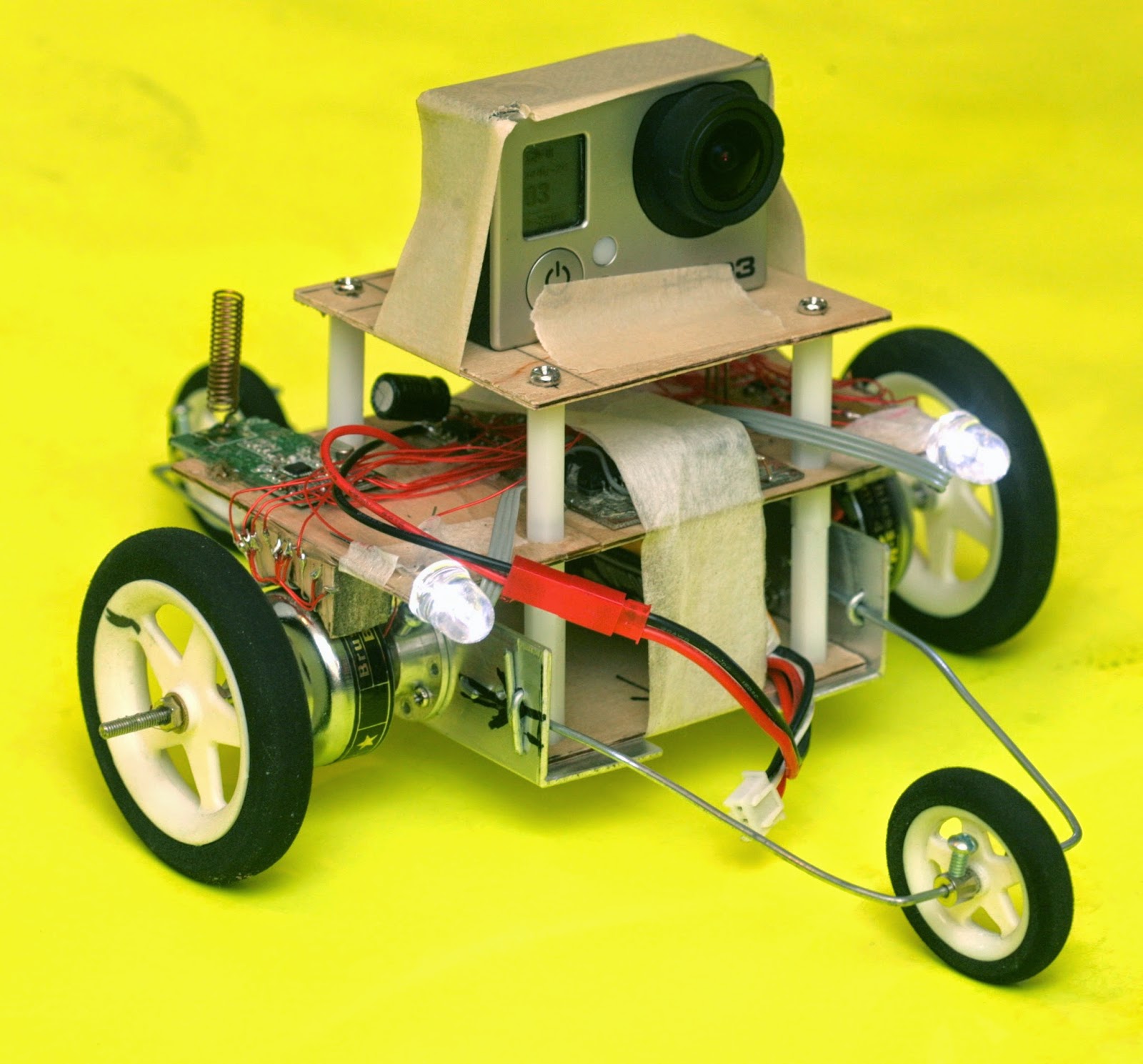
Brushless direct drive rover


rover12.jpg

The journey began when the G-buggy which served for 6 months was stepped on, bending a shaft & putting it out of duty.  It was otherwise falling apart on its own, after pacing 110 miles of running.


car51.jpg


car52.jpg


The replacement had to go 7.5mph for 8 miles, using only spare parts.  It focused on a brushless direct drive balancing robot.

balancer01.jpg


Ancient motors were rewound.

motor01.jpg


 A session of pin punching, allen wrench punching, back & forth sliding, & metal removal liberated the shaft.  It was heavily jammed in.

motor03.jpg


The original windings were 4 strands of 0.25mm in a wye.

motor06.jpg


The new winding was 50 turns of 0.2mm, 7ohms end to end.  It got toasty at  0.6A 4.4V but made decent torque.  Mounting on aluminum would probably do the job.  At this power, they would be dramatically more efficient than the RC car, for a lot less money than any gear motors.

motor09.jpg


motor10.jpg


A motor is tested for a winding error by using the right hand rule, a fixed current source, & permanent magnet.  10 & 3 were swapped.
In order to reach 7.5mph, the motors would work in stepper mode when stationary, then at a certain speed, transition to back EMF mode.  Over time, it became clear that balancing robots were not stable enough to reach 7.5mph, at the required size.  Even the mighty segway relies on some passive stability.

A balancing robot could probably do the job with a control moment gyro, but having 3 motors would defeat the purpose of having a balancing robot. 

Focus shifted back to doing it as simply as possible.  A bare minimum 4 wheeled thing appeared.

rover05.jpg

rover06.jpg

rover07.jpg

rover08.jpg

rover09.jpg


A transition between stepper mode & back EMF mode was still required if the same wheels were going to provide steering & high speed.  Thus began the mysterious world of writing a double motor controller which could control 2 motors in stepper & back EMF mode, in 2 directions, using L6234 brushless gimbal drivers.

Reviewing source code of simple ESC's reveals they're not very simple at all. They all depend on hitting a minimum RPM from hard coded delays before sensing back EMF.  Commutation doesn't occur at the zero crossing, but after another delay equal to the time between the last commutation & the zero crossing.

They need a holdoff time to avoid a false crossing from noise.  The holdoff time is 1/2 the lowpass filtering of the previous zero crossing time & initially from the hard coded delays.  To further reduce errors, they require the zero crossing to be a certain direction.  Stalling is detected by a timeout.

NewFile0.bmp


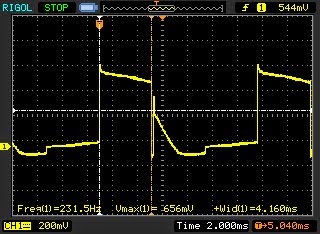
At 660rpm, the real back EMF looked nothing like the textbooks. 

NewFile1.bmp


Oscilloscope plots of the full power voltage are never shown, but they have the clearest view of the 2 powered phases with the back EMF clearly visible in the floating phase.  There's a glitch where it goes from 9V to floating.  Software detects the halfway point to determine the commutation time.

NewFile2.bmp


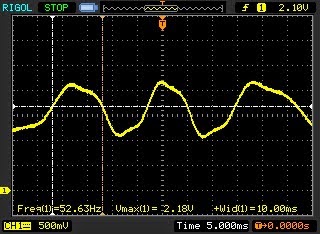
 The normal oscilloscope plot shows PWM modulated voltages.  The back EMF phase is less visible.

NewFile3.bmp


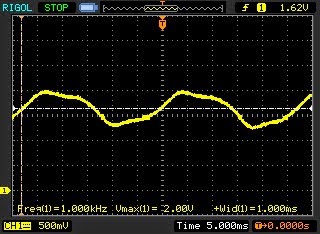
Back EMF fluctuates from PWM on the other 2 phases.  It must be sampled on only 1 edge of the PWM, which limits the number of samples to the PWM frequency.  PWM didn't work completely.  It had to be done in software to get all 6 pins of the L6234 transitioning.

Sadly, back EMF ended up not working.  The 1st sign was that the waveform didn't obey the textbooks, because the working RPM of a 7.5mph rover was too low.

A workaround was to lowpass filter the commutation time.  This meant it took 10 commutations to respond to a change in load or voltage, while the reference design could respond in 1 commutation.  As soon as it hit a bump, it stalled.

After a period of dejection, self pity, & planning to lose $80 on a Losi micro T, a voice from the distant past appeared.  Maybe a sensored motor would work.

There are no teardowns of a sensored motor, but blurry, shaky videos appear to show home made attempts with 3 hall effect sensors outside the motor casing.

hall01.jpg


A single A1321 sensor is applied to the outside & powered by 3.3V.

NewFile6.bmp


Waveform when turned manually.

NewFile7.bmp


Waveform when powered slowly.  The sensor did indeed work without modifying the motor.  It just needed seriously accurate alignment.  There is a blog post about writing a sensored motor controller.  It's just a lookup table.

Mounting 3 sensors in the perfect arc was a serious wood carving & hot gluing job for just 1 motor. It was finally a task worthy of 3D printing.

halls03.jpg


halls09.jpg


The alignment had to be on the inner edges of the magnets & spot on. Any errors would make it randomly stall.


halls05.jpg

halls06.jpg


It was such a complicated nest of wiring & precision wood carving, it was 1 of those classic, simple, cheap internet solutions to an expensive problem which ends up requiring an enormous amount of skill to fabricate, in reality.

halls01.jpg


  The alignment errors showed up in the waveforms, but the rotor position was clearly sensed outside the casing.  The sensors & phase voltages had to be in exactly the right order.  It required trying out all 6 possible sensor orders.  It didn't completely stop when in the wrong order, but it wasn't as smooth & tended to stall.

Once configured, it worked perfectly.  It handled much higher torque.  No load current was 0.25A at 15V.  It was just like physical brushes.  Instead of stalling below a minimum speed, it kept going, with speed responding to load.  For precision movement, it still supported stepper mode.  It was a surprising payback for an external sensor sensing the unmodified motor through the motor casing.

rover10.jpg

rover11.jpg


The 1st road test with motor sensors worked perfectly.  It definitely needed breaks & slightly faster startup.  The stalls were gone.  7.4V got it to the 7.5mph range, without getting hot.  It was virtually silent.  Radio range was only 10ft.

It easily rolled over rough terrain.  The rolling distance without breaks was surprisingly long.  Even with no power, it rolled into curbs hard enough to flip over.  The sensors seemed to withstand it. 

Startup was a hard coded stepper acceleration, transitioning to commutating mode, to keep the wheels from slipping.  That failed miserably.  It slipped when rotating to the 1st step.  It was a long way from transitioning into commutating mode seamlessly.

The only practical way to get straight driving was to go straight into full power.  It didn't slip as much as feared.  It used less current.

After implementing heading hold steering & all the manual controls, it worked perfectly.  All the issues with bang bang steering were gone.  Manual steering was effective.  Steering by unbalancing the motor PWM was indistinguishable from the fully articulated suspension.  The difference was it was utterly dependent on software to drive straight.

As soon as it hit a puddle, it was dead.  The surface mounted boards need a conformal coating.  Radio range was another issue, being nowhere close to what it was on the g-buggy.  Finally, the gyro is extremely temperature sensitive.   It reused the IMU from the balancer, but being back to 4 wheels means it could use the more temperature resistant gyro.

It's probably the fastest a 60mm Pololu wheel has ever gone, certainly the fastest a brushless direct drive rover ever went.  Another $80 purchase was averted.

The 1st run with the brushless direct drive rover went way beyond predicted range, yet again. Range on 2S 900mAh was over 8 miles. Maximum downhill speed was 8 min/mile. Uphill speed sagged to 8m50s/mile. It was hopeless on rough terrain. It needed D feedback & shorter battery cables.

It was finally documented with the latest improvements.


The camera made it top heavy enough to flip over from the smallest obstacle. 

Read more…

Screen-Shot-2014-07-09-at-10.02.19-PM.png?width=400This is just a copy-paste of a new Forbes article:

http://www.forbes.com/sites/gregorymcneal/2014/07/10/drone-users-largely-silent-regarding-faa-rules-that-may-limit-flights/

Users of consumer drones and model aircraft aren’t afraid to share their ideas and imagery in social media.  Surprisingly though, these users have been largely silent when it comes to protecting their hobby from pending Federal Aviation Administration rules — rules that threaten to curtail many uses of the exciting new devices.

Drone users are oftentimes quick to comment when a government official with the FAA or the National Park Service tells them they can’t use their cool toy somewhere.  Realtors, photographers and other potential commercial users have expressed dismay over the FAA’s backwards regulations which allow flying for fun, but not flying for work.

Drone users are also good at organizing to share everything from photos to techniques.  The DIY Drones user group has more than 55,000 members.  The Quadcopters Facebook group has over 2,400 members, and the UAV Legal News and Discussion group on Facebook has more than 1,000 members.  DJI, the maker of the popular DJI Phantom quadcopter has over 72,000 Twitter followers and 3D Robotics has more than 13,000.  Those two companies combined sell tens of thousands of consumer drones each month, who knows how many more Parrot, the maker of the AR.Drone and dozens of other manufacturers sell.  Some blog posts on drones receive hundreds of comments, and thousands of social media shares.  Drone users are certainly active in some places on the web, but they have dedicated very little of their attention towards influencing public policy.

As a supporter of the nascent industry and the decades old hobby, I’m baffled by the lack of pushback against the FAA by otherwise very vocal people.  With just 15 days left before the FAA’s comment period on model aircraft rules closes, tens of thousands of drone users have been largely silent.  For those unfamiliar with FAA regulations, a little background is necessary.  On June 23, 2014 the FAA released their Interpretation of the Special Rule For Model Aircraft.  That interpretation is open for public comment until July 25, 2014.  Once the comment period closes, the FAA will consider public input (and the degree of public interest) and finalize their interpretation.  The game is largely over at that point, as there will be very few opportunities (short of lawsuits) for the drone community to push back against the FAA’s rule.  The stakes are high, yet to date a mere 2,811 comments have been received on the proposed regulation.

FAA regulations of the consumer drone industry, while controversial in social media, have drawn relatively few public comments.

That’s a paltry number.  Brendan Schulman, a lawyer specializing in drones says ”The FAA’s Notice is dense and hard to navigate, and that might be discouraging comments.  The main reason hobbyists should be very concerned is on the last page, where the FAA says that despite Congress’s intent to exclude model aircraft from future regulation, the FAA feels that any part of its existing regulations ‘may apply to model aircraft operations, depending on the particular circumstances.’  That means the agency is poised to arbitrarily tell hobbyists what conduct may be subject to fines — but only after the fact.”

That’s a significant threat to the emergent industry.  While not everyone know’s how to comment on a regulation, other regulations that impact less tech savvy audiences have garnered far more comments.  For example, a regulation having to do with snakes has over 50,000 comments and a petition to amend the standard identity of milk received over 40,000 comments.  It’s simple to submit a comment at Regulations.gov, so perhaps the drone users are waiting until the deadline to file their comments.  But given the number of users, and their passion for the hobby, it’s shocking that the number of comments received thus far is so low.

The lack of response is not due to a lack of media attention or advocacy group organizing.  The FAA’s new policy guidelines were widely covered in traditional and non-traditional media (I have stories on it here).  Moreover, the Academy of Model Aeronautics (AMA), the 1650,000 member group representing model aircraft users posted a call for action to their blog and sent emails to their members.  They even provided their members with instructions on how to respond to the regulation and posted a detailed guide explaining the organization’s concerns.

The AMA has valid reasons to be concerned, “Since 1981, the FAA has said it is fine to fly a model aircraft if you are more than three miles from an airport, and just to notify the airport operator if you are closer.” Schulman explains, “Now, the FAA is demanding that hobbyists request permission in advance from air traffic control if they are within five miles of an airport.  In some places in the country, like New York City or Florida, those five miles cover vast areas where people live, and apparently would even apply to toy airplanes in back yards or playgrounds.” But even assuming every comment on Regulations.gov was from an AMA member, that would still only account for 1.6% of the AMA’s membership.  Silence abounds.

Where are the drone users and model aircraft enthusiasts who have been so vocal in social media?  Is it possible they ? It’s a legitimate concern, just consider the fact that the FAA has spent the last few months cracking down on realtors.  Given such an enforcement climate, it’s understandable that some commercial users would not want to reveal their identity by commenting on a regulation.  Whatever the reason, what’s clear is that with just two weeks until the deadline, most drone users are sitting out this regulatory fight.

Feel free to leave your comment below, but better yet, leave it here.

Read more…
Moderator

3689605572?profile=original

Dear Friends,

I'm very happy to present the result of latest VirtualRobotix's development: the new VRX GPS NEO-M8 .

I'ts the first Virtualrobotix's Multi Constellation GPS (GPS, GLONASS, Galileo, QZSS and SBAS),  engine, using Ublox NEO-M8 receiver.

The NEO-M8 is a 72-channel high sensitive engine that boasts a Time-To-First-Fix (TTFF) of less than 1 second.

The dedicated acquisition engine, with over 2 million correlators, is capable of massive parallel time/frequency space searches, enabling it to find satellites instantly.

Innovative design and technology suppresses interference sources and mitigates multipath effects, giving NEO-M8 GPS receivers excellent navigation performance even in the most challenging environments.

VRX GPS NEO-M8 is  equipped with a Panasonic Amplifier for better reception and a backup battery for quicker warm restarts.

3689605595?profile=original

The VRX GPS NEO-M8 also integrates Honywell's latest high precision digital mag (HMC5983). 

The HMC5983 can be used either in SPI or in I2C (selectable via a solder Jumper), it has a 200Hz output rate and it's temperature compensated, giving the best experience for our vehicles. 

The VRX GPS NEO-M8 is fully compatible with APM:Copter's  firmware and it's plug and play on VRBRAIN5, VRuBRAIN5, APM 2.5+, PixHawk and all boards that mount the DF13 connectors.

If you don't have a DF13, you can easly solder standard servo pins on the exposed pads.

Now The order is open at:

VRX GPS NEO-M8: http://www.virtualrobotix.it/index.php/en/shop/accessories/gps-ublox-8-detail

VR uBrain 5:  http://www.virtualrobotix.it/index.php/en/shop/autopilot/vrbrainmicro51-detail

The delivery time could be 3/4 weeks

If you are interested in more info to the product send a mail to info@virtualrobotix.com

The VRX GPS NEO-M8 has been tested in the field with our VRX300 "Personal Fly Robot SDK Platform"  here are some photos and  graphs from latest flights.

3689605445?profile=original

Flight Controller: VR Micro BRAIN

GPS: VRX GPS NEO-M8

Compass: HMC5983 mounted on GPS board

ESC: 12 A Kiss ESC

Motors: RCX - ZMR 

Propellers: APC 6x4

Lipo: 2200 mAh

Radio: Taranis with SBUS receiver X8R

These are the vibration graphs on the VRX300 

3689605617?profile=original

The number of satellites during this flight started at 11 and arrived to 15, the hdop was  from 1.3 to 1.5.

During my tests we have seen up to 18 satellites with an hdop of 0.7 .

With standard GPS module some times it is possible to see only 5 with an high HDOP

3689605530?profile=original

Here is possible to see the Altitude from Baro vs Altitude from GPS is not so bad :) 

3689605668?profile=original

Some RTL and Loiter tests in the Field with precision of less than 1 meter.

3689605641?profile=original

3689605543?profile=original

Features and Specifications:

  • ublox NEO-8 module
  • Concurrent reception of GPS/QZSS, GLONASS, BeiDou
  • Industry leading –167 dBm navigation sensitivity
  • 3,3V or 5V Inputs, with low noise 3.3V regulator.
  • 5 Hz update rate
  • Rechargeable 3V lithium backup battery for high efficient warm start
  • Panasonic Low Noise Amplifier for antenna signal with high gain (19dB)
  • EPCOS SAW high quality low-loss RF filter for GPS application
  • 25 x 25 x 4 mm ceramic patch antenna
  • Dedicated I2C EEPROM for receiver configuration storage
  • High resolution compass (2 milli-gauss) and high speed (2 milli-gauss)
  • Power and fix indicator LEDs
  • ArduPilot Mega compatible 6-pin JST connector
  • Exposed pads for simple soldering connection
  • 38 x 38 x 8.5 mm total size, 19 grams.
  • Receiver type NEO 8
    • 72-channel u-blox M8 engine
    • GPS/QZSS L1 C/A, GLONASS L10F
    • BeiDou B1
    • SBAS L1 C/A: WAAS, EGNOS, MSAS
  • Navigation update rate: 
    • Single GNSS up to 18 Hz
    • Concurrent GNSS up to 10 Hz
    • Position accuracy: 2.0 m CEP
  • Acquisition (NEO-M8Q/N)
    • (Default mode, GPS/SBAS/QZSS+GLONASS with TCXO)
    • Cold starts: 26 s
    • Aided starts: 2 s
    • Reacquisition: 1.5 s
  • Sensitivity 
  • (Default mode, GPS/SBAS/QZSS+GLONASS with TCXO)
    • Tracking & Nav: –167 dBm
    • Cold starts: –148 dBm
    • Hot starts: –156 dBm
  • Connector : Serial Bus , I2C Bus and SPI as option plug and play fully compatible with : VR Brain , APM 2.x , PX4 and Pixhawk Flight Control . Available also solder pad for OEM Application .

Best

Roberto and Emile

original blog post :

http://www.virtualrobotix.com/profiles/blogs/vrx-gps-ublox-8-the-first-plug-and-play-multi-constallation-gps-g

Read more…

CarbonCore Cortex by Autonomous Avionics

3689605764?profile=original


Autonomous Avionics is proud to annouce their latest ready-to-fly X8 octocopter. The CarbonCore Cortex folding airframe is an 800mm coaxial carbon fiber airframe loaded with a 3D Robotics Pixhawk flight controller. The 8 MN4120 T-Motors are more than adequate for carrying a full frame DSLR camera and 3-Axis gimbal. Each aircraft is hand-assembled, tuned, and flight tested before it leaves the shop.


3689605691?profile=original3689605719?profile=original3689605800?profile=original


More Info

Read more…
3D Robotics

3689605335?profile=originalFrom The Verge:

Amazon has asked the Federal Aviation Administration if it can start testing delivery drones in its own facilities in a bid to speed up the rollout of its Amazon Prime Air shipping service. The company sent a letter to the FAA this week, in which it requested the opportunity to carry out research and development on the unmanned aerial vehicles designed to carry packages to Amazon customers. Currently, if the Seattle-based company wants to test new designs for its drones outside, it has to travel to one of six FAA-approved sites dotted around the country. If its request for exemption from FAA rules is granted, it would mean the company's R&D team — which includes an ex-NASA astronaut — wouldn't need to leave the Amazon campus to trial new drones.

The retail giant has been rapidly iterating on drone technology since it announced plans for unmanned aerial delivery late last year. In April, Amazon boss Jeff Bezos said the company had already tested the fifth and sixth iterations of the unmanned aerial vehicles it plans to use to deliver goods, with the seventh and eighth being designed. In Amazon's request for exemption, it says it's now ready to test the eighth- and ninth-generation vehicles.

In the same document, Amazon offers up some details about its planned delivery drones, saying that it plans for them to be capable of travelling over 50 miles per hour while carrying up to 5 pounds worth of products. CThe request for exemption also states that drones will remain within line of sight of observers during testing, and will stop their journey and return to a specific point if their communications link is severed.

Read more…

ppm+encoder.JPG

If you are using MegapirateNG and a Crius AIOP board with the Turnigy 9x, as you will be aware, the standard 9x receiver doesn't enable the somewhat important throttle failsafe feature in Arducopter & Mission Planner. This is due to the AIOP board not having a PPM encoder like the Ardupilot board. I say important, because in the event the turnigy 9x loses power, and then regains power, It will not be in control of the quadcopter anymore. Which can be a bad thing indeed.

However, I have the Throttle failsafe working on my 'Locust Quadcopter' AIOP board, using the standard 9x receiver (9x8cV2). 
It appears to have allowed me not to purchase the Frsky modules (£50/pair?) just to enable throttle failsafe.

If you would like to try it, I have used this cheap PPM encoder V1 board which cost me just over £4 on ebay.

It was quite simple:

I set up MegapirateNG on the Arduino software to enable the default PPM (Changing it from my previous PWM signal), and uploaded it.

I then plugged the ppm encoder board between the 9x receiver and AIOP, sending the 3 ppm wires (+5v, GND, PPM) to the AIOP board (+5v, GND, A8).

I powered the 9x receiver from the AIOP board also (powering using the PPM encoder board didn't work for me). I didn't use the MUX wire on the PPM encoder either. It's not necessary.

Then, it was just a case of connecting the ch pins from 9x receiver to PPM encoder as you see fit for your needs.

I didn't have to modify the PPM encoder at all. It worked as it came, out of the bag.

If anyone wants assistance I'm happy to offer advice. 

how to:

http://benbojanglesosd.blogspot.co.uk/

Read more…

3689577990?profile=original

Full Meetup Link Here

From "Nerds-For-Nature" Meetup:
Fresh Sierra 
snowmelt and other runoff flowing down the Sacramento and San Joaquin Rivers meets the salty seawater of Suisun Bay near the Antioch Bridge. This tidally and seasonally shifting demarcation between the two major types of aquatic habitat is known as the Low Salinity Zone. The location of this freshwater boundary also determines how much water can be diverted to support agricultural production.

A near-king tide on Friday, July 11th (chart) in combination with the ongoing drought will bring the salt level closer to Sacramento than normal. To investigate this interesting situation we will join with the California Department of Water Resources, California King Tides Project, high school students, and citizen scientists to:

• Fly a small quadcopter that will land on the water to measure salinity, temperature, and flow gradients in this habitat transition zone.

• Use aerial cameras to image the area during high and low tides, which can then be processed into large highly-detailed orthomosaics as well as 3D-mesh photogrammetry models.  

• Bioblitz and otherwise observe and discuss the local flora and fauna to help understand the affected habitat.

• Try other fun apps and gadgets -- smartphone microscopes, electronic field guides, DIY water sensors -- bring it along and we'll try it out!

Join us for this historic gathering of students, environmental professionals, and nature nerds as we explore this rich and dynamic ecosystem!

Read more…

Today, a judge granted "Accelerated Rehabilitation" probation to Andrea Mears.  Mears is the 23yr old woman that violently attacked a responsible UAV pilot at a large CT state park back in May 2014. She then lied to the police claiming he attacked her.  He had video of the whole event showing she launched an unprovoked attack on him. And it turns out his video from the Iris was so high up and far away, you couldn't make out any of the people on the beach anyway.  It was scenery video, not beach babe video.

For those who are not familiar, Accelerated Rehabilitation ("AR") in Connecticut is also know as Probation Before Judgement ("PBJ") in other states.  It is not a conviction with a sentence of probation.  Instead you are put on probation before trial and judgement.  You are on probation for X years with conditions that must be met.  If you behave and do not violate any of those conditions, your record will be wiped clean.  No record at all. The case is dropped and no record is left.

Mears was given two years of AR, which is rather common in CT.  If she behaves for those two years, her record will be wiped clean.  She receives no fine, no jail, no punishment, no restitution, nothing. Literally, her "punishment" is that she is not allowed to commit crimes for the next two years.

Personally I think it is pathetic. She violently assaulted an unarmed non-aggressive minor, made false statements to the police via 911, and made false statements to the police in person when they arrived.  She attempted to frame him for a crime he didn't commit by claiming he assaulted her.  Had it not been for his video, the police would have arrested him for assaulting her.  And for this, her punishment is being told not to do that again for two years.

Aerial video:

http://www.courant.com/community/new-haven/hc-new-haven-drone-assault-0710-20140709,0,3673256.story?ncid=newsltuspatc00000010

Read more…

US20140180508A1-20140626-D00003-300x308.png

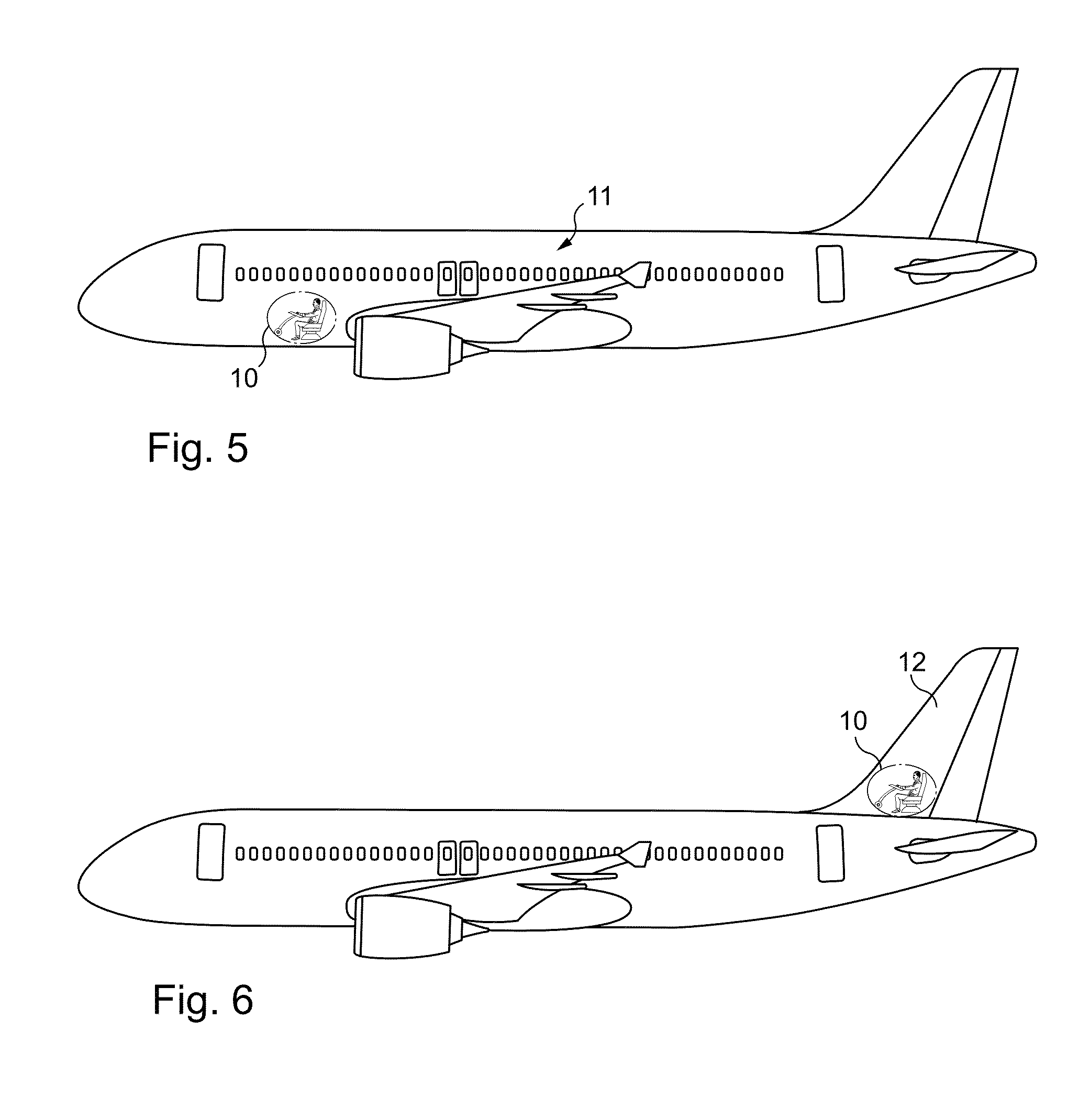
The FAA thinks FPV should be illegal while the airline industry is filing patents on flying airliners with no windows.

An article published in the Seattle Post-Intelligencer the other evening describes a patent application from European aerospace company Airbus in which pilots fly aircraft entirely through electronic means. The patent application, number US20140180508 A1, is titled "Aircraft with a cockpit including a viewing surface for piloting which is at least partially virtual" and notes that while an aircraft’s cockpit must be located in its nose to afford its pilot forward visibility, the physical requirements of the cockpit’s shape and the amount of glass required are aerodynamically and structurally non-optimal.

Enlarge / Cockpit, cockpit, where's the cockpit?

"For aerodynamic reasons," explains the patent application’s description, "the nose should ideally be lancet-shaped. However, the housing in the nose for radar, a landing gear, and especially for the cockpit, requires a much more complex shape and structure to be provided, with numerous radii of curvature." It would be better, says the patent, if the cockpit were moved into some other area of the aircraft and the pilot equipped with entirely electronic means of observing and controlling the aircraft’s flight.

According to the application, the non-windows cockpit would contain "a screen and associated means for projection (including back-projection)" of various "scenes," including the environment immediately forward of the aircraft, and also "a device with lasers for forming a holographic image" to display items like "a 3D mesh of the earth’s surface," "a hologram representing for example an assistant pilot on the ground," or "a holographic representation…of one or more flight instruments."

The lack of "glazed surfaces" (i.e., glass or other transparent elements) means that the cockpit itself could be free of the "numerous structural reinforcements" required to support the typical weight of glass as opposed to the same amount of aluminum. It also means that the cockpit could be placed literally anywhere inside the aircraft’s volume, including in the cargo hold or even in or near the aircraft’s empennage.

http://arstechnica.com/gadgets/2014/07/airbus-submits-patent-application-for-windowless-jet-cockpit/

Read more…

Batteries and Boosted Flight Times

We have been digging into the flight times of our crafts and trying to extend flight times,, recently this was published.

rogoneplotbatteries.jpg

Ragone plot, comparing Li-CNT-F batteries with other batteries in terms of weight of cathode materials.

Based on the 5-8 times Li-Ion type that was compared, Amazing to think of a 10-16 times longer flight time.. I hope these are quick to production

Article Link : http://nextbigfuture.com/2014/07/lithium-carbon-battery-could-be-cost.html

Lithium-carbon battery could be cost effective, safe and have five to eight times the energy density of lithium ion batteries

Journal Nature Scientific Reports - Rechargeable Batteries with High Energy Storage Activated by In-situ Induced Fluorination of Carbon Nanotube Cathode


The advantages of using carbon are that it is cost-effective and safe to use, and the energy output is five to eight times higher than lithium-ion batteries currently on the market. The new battery technology also performs better than two other future technologies: lithium-sulfur batteries, currently in the prototype stage, and lithium-air batteries, now under development. For example, the induced-fluorination technology could be used to produce cellphone batteries that would charge faster and last longer. The research team developed the new battery technology for energy storage using carbon nanomaterials and a process called induced fluorination.


High performance rechargeable batteries are urgently demanded for future energy storage systems. Here, we adopted a lithium-carbon battery configuration. Instead of using carbon materials as the surface provider for lithium-ion adsorption and desorption, we realized induced fluorination of carbon nanotube array (CNTA) paper cathodes, with the source of fluoride ions from electrolytes, by an in-situ electrochemical induction process. The induced fluorination of CNTA papers activated the reversible fluorination/defluorination reactions and lithium-ion storage/release at the CNTA paper cathodes, resulting in a dual-storage mechanism. The rechargeable battery with this dual-storage mechanism demonstrated a maximum discharging capacity of 2174 mAh gcarbon−1 and a specific energy of 4113 Wh kgcarbon−1 with good cycling performance.


Although Li-ion batteries (LIBs) have transformed portable electronics, the energy density and cycle life of existing LIBs, even if fully developed, remain insufficient. Reaching beyond the horizon of LIBs requires the exploration of new electrochemistry and/or new materials1. The recent popular attempts are Li-sulfur (Li-S) and Li-air (Li-O2) batteries. However, there are some formidable challenges for Li-S and Li-O2 batteries, e.g., dissolution of discharging products, poor cathode electrical conductivity, and large volume expansion upon lithiation.

lithiumcarbonbat.jpg

Dual-storage mechanism with reversible fluorination/defluorination reactions and lithium-ion storage/release occurring at CNTA paper cathode.

Li-CFx batteries have the highest energy density among all primary lithium batteries with a theoretical specific energy of 2180 Wh kg(Li+CF)−1. A high capacity of 615 mAh gCFx−1 was also reported for the pre-synthesized CFx cathodes. It is well known that defluorination of carbon fluorides can be achieved with the assistance of lithium cations during discharging in Li-CFx batteries. However, Li-CFx batteries have attracted limited interest because of their strictly non-rechargeable nature16 and the non-environmental-friendly synthesis process for carbon fluorides, e.g., the use of F2 gas and/or catalysts under extreme temperature condition


The complex anion of [F-TPFPB]− was previously found to be reversibly intercalated in graphite with limited capacity, 60 ~ 80 mA gcarbon−1. It is the intercalation of the bulky complex anion of [F-TPFPB]− that will sterically hinder further anion intercalation and worsen the cathode specific capacity. However, in this report, the intercalation of [F-TPFPB]− was successfully suppressed, as suggested in Figure 2f, which may explain the high capacity achieved in Figure 4. The suppression of bulky [F-TPFPB]− intercalation is due to the particular induction temperature (70°C) conducted, which reduces the energy barrier for the F− release from [F-TPFPB]−, and therefore, promotes the intercalation of free F− in CNTA papers. It is also worth to note that the free fluoride ions released from [F-TPFPB]− are originally from the dissolved LiF salts, rather than from the decomposition of TPFPB molecules. It has been calculated that the energy barrier for the fluoride anion release from TPFPB (59.2 kcal/mol) is much lower than the breakdown of a true covalent bond (typically on the order of 100 kcal/mol) in TPFPB


In conclusion, they realized the induced fluorination of CNTA paper cathodes by an in-situ electrochemical induction process at 70°C and in the presence of TPFPB. The induced fluorination of CNTA papers activated the reversible fluorination/defluorination reactions and lithium-ion storage/release at the CNTA paper cathodes, resulting in a dual-storage mechanism. It is the first time that the reversible fluorination/defluorination reactions were realized at pure carbon and non-fluoride materials. In addition, the induced fluorination destructed the graphitic carbon to defective nanostructures, which further facilitated the two reversible reactions at both 70°C and 22°C. The rechargeable battery with this dual-storage mechanism demonstrated a maximum discharging capacity of 2174 mAh gcarbon−1 and a specific energy of 4113 Wh kgcarbon−1 with good cycling performance. This paper uncovers the significance of energy storage by carbon materials at high voltages, and demonstrates the Li-C-F battery system a new promising candidate for the future energy storage systems.


Read more…

My 2 cents to the FAA

3689605230?profile=original

Not sure if anyone will ever read it, or anyone cares, but I commented here. If you haven't done so yet I encourage you to do so too:

http://www.regulations.gov/#!documentDetail;D=FAA-2014-0396-0001

To whom it may concern,

I am writing in response to the FAA's Interpretive rule for model aircraft. The proposed regulations are concerning to me as a hobbyist, photographer, and engineer interested in developing new technology. The specifics of the rule portray the FAA to be  ignorant of the hobby and acting out of retribution for the Piker V Huerta ruling. The proposal does little to improve the safety of air travel. Instead, it threatens to destroy a past time, stifle innovation, and squash entrepreneurship.

I have been involved in model aviation for nearly 20 years, and an AMA member for most of them. I grew up following the technological advances in this hobby and attribute much of my professional success as an engineer to skills and interests cultivated in this hobby. I worked summers in high school teaching kids model aviation and rocketry. I believe this hobby gave me a lot and can do the same for others, which is why I feel strongly about protecting it.

To many, including myself, the technology side of hobby is more exciting than actually flying. The advancements in electronic flight controllers, first person video, and new battery technology has given birth to a new era of innovators and hobbyists. The FAA's ban on video goggles is silly and misinformed. FPV flying has the potential to be a more accurate and safe way to fly model air craft than the conventional 'line of sight' method. Safe flight has nothing to do with FPV and everything to do with pilots acting responsibly and with care.

I also take objection to the FAA's strict ban on commercial flights under the guise of public safety. If a model aircraft pilot is paid to take aerial photographs of a location, how does that make it less safe than if if he or she were not paid? Why can professionally sponsored pilots not be paid, as they have been for years, for demonstrating their skills at controlled events? Do hobby and toy companies need a COA to test their products?

There needs to be a distinction between small hobby grade UAV for commercial use and large UAV used by our government. The two are not the same and should not be treated as such. A size or weight class exemption would be appropriate for small UAV commercial use.  UAVs have the potential to do great good and improve the safety of our airspace by doing things that would normally put a human operator in danger. The United States should strive to be a leader in this technology.

I suggest that the FAA work with hobbyists and entrepreneurs to develop common sense guidelines that preserves our country's safe airspace while protecting the rights of the model aviation community and encouraging growth of commercial UAV. I believe that the previous FAA advisory to model aircraft is appropriate:

1) Stay below 400 feet
2) Do not fly beyond line of slight range with the ground pilot
3) Stay away from developed areas

I would further suggest that size or weight classes be setup so there can be a distinction between small UAV and larger aircraft. Hobby grade UAV, be it used for commercial or recreational use, do not pose the same risk as aircraft that are orders of magnitude bigger. The FAA should recognize this and know which is appropriate to regulate.

By working with the community, the FAA can ensure that our country remains a leader in both air safety and emerging technology. I hope the FAA will revise their rule making based on feedback from the public.

Read more…
3D Robotics

3689605134?profile=originalOne of the things that thrills me the most is watching the ecosystem grow around the APM/Pixhawk platform, ranging from simple cloners to the most advanced value innovators. An example is the new and very impressive Follow-me copter projects on Kickstarter, all of which are based on the Pixhawk/PX4 platform. We're supporting all of them and love them all equally, but the first one we've announced a formal collaboration with is the AirDog team, to work together on next-gen follow and autonomous video capture technology. Stay tuned for more!

Here's AirDog's announcement:

Last week on July 3rd, AirDog team members convened at the labs of 3D Robotics (3DR) in Berkeley, California and signed a cooperation contract.

Over the next few weeks, several of AirDog’s key engineers will be transitioning into the 3DR labs in order to collaborate closely with 3DR on advanced drone technologies.

The makers of the AirDog are committed to creating the best auto-follow drone. The innovative partnership with 3DR is a crucial part of maintaining this commitment.

AirDog uses the Pixhawk autopilot hardware component, which is provided by 3DR. Pixhawk is an open source flight controller, which integrates with all the onboard electronics of the AirDog. 3DR has an ambition to become one of the leading drone technology platform providers in the world.

Edgars Rozentals, CEO of Helico said, "By being closer to each other, we have access to a Pixhawk platform development roadmap. It will make it much easier to fully focus on the development of our business level application — an auto-follow drone and obstacle avoidance solution. Our goal is to develop personal drones that have excellent user experience and powerful software that delivers what we have promised. The 3DR technology platform creates a solid base for the goal to be achieved”

"The talented team behind AirDog have a clear technology and business vision. We're delighted to welcome them as a premier adopter of the 3DR platform and look forward to working with them to combine our technologies for an unprecedented flight and video experience," commented Chris Anderson, CEO and co-founder of 3DR.

The wider community of drone engineers, innovators, thinkers, and fans are eager to see what new technologies, inventions, and creativity will come from the AirDog + 3DR cooperation.

http://3drobotics.com/
http://www.helico-aerospace.com
http://www.airdog.com

Read more…

Pixhawk on DealExtreme

sku_329229_1.jpg?width=400

Just as other 3DR products appeared as copies in all kinds of web stores, now also the Pixhawk starts to show up in the same stores. The one pictured above is available from DealExtreme for US$ 126 including worldwide shipping (US$ 280 in 3DR store)

Advanced 32 bit ARM Cortex® M4 processor running NuttX RTOS;
14 PWM/servo outputs
Abundant connectivity options for additional peripherals (UART, I2C, CAN)
Integrated backup system for in-flight recovery and manual override with dedicated processor and stand-alone power supply
Backup system integrates mixing, providing consistent autopilot and manual override mixing modes
Redundant power supply inputs and automatic failover
External safety button for easy motor activation
Multicolor LED indicator
High-power, multi-tone piezo audio indicator
Micro SD card for long-time high-rate logging
Hardware Parameters: Processor: 32 bit STM32F427 Cortex M4 core with FPU
168 MHz / 256KB RAM/2 MB Flash
32 bit STM32F103 failsafe co-processor Sensors: ST Micro L3GD20H 16 bit gyroscope
ST Micro LSM303D 14 bit accelerometer / magnetometer
MPU6000 6-Axis Accelebrator/magnetometer
MEAS MS5611 barometer Interfaces: 5 x UART (serial ports), one high-power capable, 2 x with HW flow control, 2 x CAN
Spektrum DSM / DSM2 / DSM-X® Satellite compatible input
Futaba S.BUS® compatible input and output
PPM sum signal
RSSI (PWM or voltage) input
I2C
SPI
3.3 and 6.6V ADC inputs
External microUSB port

Specifications seem pretty much the same, so I guess they are comparable. According to the product page it comes with the board and a shell. No mentioning of cables (that seem to be included in the box of the Pixhawk from 3RD). At moment of writing no accessories seem to be available.

Also no mentioning of 3DR on the product page.

Read more…

New Professional Multirotor Airframes

3689605053?profile=original

We would like to introduce our new line of high quality professional multirotor airframes.

Please check them on our online shop at: www.aeroazores.com

FEATURES:
- Extremely Rigid and durable structure
- Professional grade airframe
- 3K twill weave matte carbon fiber parts (2mm thickness)
- 3K twill weave matte carbon fiber booms (OD 22mm)
- Customable and grow with the owners needs
- Clear assembly instructions and parts list
- Ability to attach other vendors accessories and components
- Suitable for 22XX to 28XX sized motors (M3) - Other sizes available also. Check options.

3689604974?profile=original

3689604987?profile=original

Read more…

PRE-Flight RC Simulator Drone Edition

3689604893?profile=original
It is my pleasure to present the PRE-Flight RC Simulator Drone Edition.
 
In my experience, 50% of beginners totally destroy their RC aircraft in the first week. About 25% destroy them in their first flight. This is a costly exercise, as the typical FPV-capable drone start at around $400 and may cost up to $3000. Some High-end drones may cost up to $30,000. It does make sense to have some form of FPV (First Person View) and line-of-sight flying practice without risking a huge investment in money (and time in building and repair as well as waiting time for the goods to arrive).
 
Limited practice can be had from flying any of the numerous toy drones costing $40 or so but:
 
1)not the same flying characteristics as the larger FPV drones
2)not suitable for outdoor practice (even in light wind)
3)too small for longer range line-of-sight flying
4)range is too short
5)most importantly - no FPV practice possible
 
Note: There are some micro FPV drones available but they would cost closer to $200 - and would still have problems 1-4 above as well as be prone to damage and loss.
 
The PRE-Flight Drone Edition is a special collection of popular drones, like the Parrot Drone and the Phantom, all faithfully reproduced. The Drone Edition also has a set of special FPV sceneries featuring realistic, interesting - and some - challenging 3D elements (like the London Eye and Statue of Liberty). These models and sceneries make the Drone Edition a pleasure in putting several hours of flying experience where it counts - towards a safer, more enjoyable, and less expensive crash-free flying experience.
 
The PRE-Flight Drone Edition models (all models have configurable on-board cameras and its possible to add more):
 
-Parrot Drone 2 - Indoor mode
-Parrot Drone 2 - Outdoor mode
-DJI Phantom 2
-x525 quadcopter - popular DIY drone
-Octocopter - Carbon Giant, heavy lifter, high-speed
-Reaper UAV - scale model
-Reaper UAV - full scale
-Walkera UFO - one of the first true drones
-Walkera UFO - 3X scale for visibility and ease of flying
 
The PRE-Flight Drone Edition sceneries (all sceneries have customizable wind conditions):
 
-London Eye - animated
-Statue of Liberty - great for FPV exploring
-Titanic - explore the outside, and inside of this famous vessel
-Titanic and Iceberg - on a meeting with destiny
-Titanic sinking - be in the front seat with FPV
-200 Windmills - animated windmills
-T62 Tank - animated - try to track this intimidating object in FPV
-T62 Tank - static - not so intimidating
 
For Ordering and more details, see this link: http://preflightsim.com/mainre.html
PRE-Flight Main Page: http://www.preflightsim.com/
Read more…

BeaglePilot: the five pilars

3689604697?profile=original

Here are the 5 entities supporting the BeaglePilot project (a.k.a. push the AP_HAL_Linux of ardupilot):

To this we should add many developers doing a great work. All of it on the behalf of the Open Source Drone community (btw, anyone heard something else about the DroneCode Foundation?).

So how far are we on the road? Well, in the last weeks we've had good progress. We fixed several issues with the SPI bus managing to get better data form the sensors. We even compared it with the APM2.

It seems we have good enough data to run it on a Rover (and maybe on a plane) but it seems like it's still no good for a copter.

https://www.youtube.com/watch?v=QoPwKTos7B4

We will keep pushing it forward. Thanks to everyone for the support and interest.

Edit: Thankfully, i was pointed out of my mistake speaking solely of the initial 4 entities. Obviously the ardupilot team is one of  the most important component. I sincerely hope that no one got offended and if so, my apologies.

Read more…