All Posts (11086)

Sort by

3689611455?profile=originalHi guys,

I'm thinking over new multicopter power distribution board which will integrate also 4 current sensing shunts, two dual current/voltage/power sensors, a 42 Vin 3A DC-DC Buck regulator. The current,voltage and power measurements will be carried out over I2C interface. I think it's time to place aside the analogue measurements as there are a lot of clever ICs for the purpose.

Some explanations:

1. R1-R4 are 4 current shunts. Each of them can handle 60A...or even more, but some more thermal researches should be done;

2. US1 and US2 are dual current/voltage/power sensors with I2C interface;

3. U6 and surrounding passive components are the DC-DC Buck regulator;

4. The PCB is 6 Oz double sided with glued heat sink ( optional...if needed ) on the bottom layer.

As this is just a preliminary idea, I'd like to know your pro and cons about the design.

Best regards

Nick

Read more…

UgCS now supports DJI!

3689611271?profile=original

Hi,

We received huge interest in our work since last post about using DJI and Pix4D combination. (http://diydrones.com/profiles/blogs/creating-3d-models-using-pix4d-ugcs-and-dji-phantom-2)

Most of questions were when DJI owners themselves will be able to try it out :)

And here is the answer: NOW IT IS!

New version of UgCS Beta containing DJI support can be downloaded from www.ugcs.com  Products & Services/Download section. Build 1.3.43.0. (Need to register and log-in to access)

Currently DJI support is available for Win and Linux versions.

DJI connection manual can be found here http://ugcs.com/documentation 


Enjoy and we are waiting for your feedback!


UgCS Team

Read more…

Very cool application using the excellent HackRF platform demoed at Defcon.

From HackADay:

What do you get when you combine one of the best (and certainly one of the best for the price) software defined radios with the user interface of a 10-year-old iPod? The HackRF PortaPack, developed by [Jared Boone], and demonstrated at DEFCON last weekend.

[Jared] is one of the original developers for the HackRF, a 10MHz to 6GHz software defined radio that can also transmit in half duplex. Since the development of the HackRF has (somewhat) wrapped up, [Jared] has been working on the PortaPack, an add-on for the HackRF that turns it into a portable, ARM Cortex M4-powered software defined radio. No, it’s not as powerful as a full computer running GNU Radio, but it does have the capability to listen in on a surprising amount of radio signals.

Read more…

3689612224?profile=original
TKquadrotor 32 bit run roop 400 Hz ,TK_Quad32bit_SlidingPID_V1, use PID Sliding Surface controller
Observers and Kalman Filters
support: Arduino Due
• Atmel SAM3X8E ARM Cortex-M3 CPU 32-bit a 84 MHz clock, ARM core microcontroller
• MPU6050C Gyro Accelerometer
• MS561101BA Barometer
• HMC5883L Magnetometer
TURNIGY Plush 25amp Speed Controller
Brushless Motor NTM Prop Drive 1200kv

Propeller 8"

by Tinnakon Kheowree
Mechanical Systems Control Laboratory, RMUTSB.
tinnakon_za@hotmail.com or tinnakonza@gmail.com
https://www.facebook.com/tinnakonza

download code https://db.tt/qaBfOrNM

Read more…
3D Robotics

3689611333?profile=originalWe've been working on this for a while, but I'm delighted the news is finally out. From USA Today:

Amazon recently banded together with several makers of small unmanned aerial vehicles (UAVs) to create a coalition to speed federal action. And the e-tailer is also buttressing its lobbying efforts on Capitol Hill.

"Amazon Prime Air is participating in several groups ... that share Congress' goal of getting small UAVs flying commercially in the United States safely and soon," said Paul Misener, the company's vice president of global public policy.

Such efforts are needed because the advance of commercial drones covers a swath of federal agencies including the Federal Aviation Administration, which governs airspace, and the Federal Communications Commission, with oversight of communications frequencies drones would use. The White House Office of Science and Technology Policy also has rules in the works regarding privacy.

"This is uncharted territory," says Chris Anderson, co-founder of drone maker 3D Robotics. His firm joined Amazon, DJI Innovations and Parrot in founding the coalition. The group aims to represent commercial uses of drones, establish a code of conduct and educate the public about benefits of the technology, he says.

Amazon's interest "lets people realize how big it can be," Anderson says. "They have a well-established presence in Washington and they were able to kick-start the mechanics of this coalition so we could quickly join and get moving."

Drones are coming. The FAA has estimated that as many as 7,500 small, commercial drones may be in use in the U.S. by 2018, assuming regulations are in place. Globally, drone spending is expected to increase from $6.4 billion this year to $11.5 billion annually a decade from now, as projected by aerospace and defense industry research firm the Teal Group.

Both Amazon and the new coalition have retained Washington, D.C., law firm Akin Gump to assist in lobbying efforts. Already, Amazon is among nearly two dozen other companies that have sought exemptions from the FAA to begin tests with drones that weigh less than 55 pounds and fly below 400 feet.

In its filing to the FAA, Amazon said that so far it has only been able to test its drones inside its Seattle R&D lab or in other countries. Its goal is to get packages to customers in 30 minutes or less via the rotor-powered flying machines. "One day, seeing Amazon Prime Air will be as normal as seeing mail trucks," wrote Amazon's v Misener in the filing.

The FAA is determining the best way to respond to Amazon's petition, said FAA spokesman Les Dorr.

Drone potential goes far beyond package delivery into such things as providing wireless broadband Internet in the Third World and monitoring areas where endangered species are hunted.

"A number of companies are looking at getting into philanthropic purposes," says Michael Drobac, one of the lobbyists at Akin Gump working on the issues. "They're also looking at recreational uses, mapping and aerial photography — the possibilities are limitless."

Regulatory support for testing and deployment will help businesses harness the potential and help unlock the job-creation potential of the technology, said Ben Gielow, general counsel for the Association for Unmanned Vehicle Systems International, a non-profit technology advocacy group.

Amazon has hired Gielow, who will leave the Arlington, Va.-based association next month to join Amazon's Prime Air public policy group.

Congress has charged the FAA with developing rules to test and integrate dronesinto the airspace. But a report that Transportation Department Inspector General Calvin Scovel delivered to Congress in February said the FAA will unlikely meet a September 2015 deadline set by Congress.

Companies need a "safe sandbox" to begin testing applications, Anderson says.

Eventually, drones could be a boon to law enforcement and public safety, helping assess crime situations and natural disasters such as fires, Akin Gump's Drobac said.

And, yes, drones will help with the more mundane functions. "I envision a world where I walk outside and one drone delivers diapers for my children and another shows up with my pizza," he said. "I have a vision of the world that is very good."

Read more…

3689611197?profile=original 3689611241?profile=original

Hi,

some days ago a new folder appeared in DIYDrones ArduPilot repository:

https://github.com/diydrones/ardupilot/tree/master/AntennaTracker

After reading the notes, I shouted up! HORRAY! That's what I'm exactly looking for to be used in my mobile Ground station, since this code uses the built-in sensors for proper positioning too!

So I immediatelly wired up a small test platform for initial testing, with the using of:

  • APM 2.6
  • 2 servos
  • 868 Telemetry module
  • GPS receiver
  • 4s NiMh AA battery
  • some masking tape… :):)

Here is the result (first take-off!!!):

http://youtu.be/qiuzMma1RE4

Please note that APM has terrible magnetic interference caused by cheap metal-gear servo (servo ofsets over 400 after calibration!!!), and also not fine-tuned. But still, can do the job!!! And also programmable through telemetry module!

So I'm going to design a small 3D printed tracker block at the top of my previously built mobile ground station, covered with a plastic dome, and using of a mini APM and flat patch antenna.

Just keep on good work, DIYDrones ArduPilot dev TEAM!!!

Best regards

Adrian

Read more…
Moderator

3689610743?profile=original

3689611001?profile=original

* Pro is only on request and customizable , the PRO IMU could be also based on Maxim , Analog Device and ST mems. * The two expansion bus support indipendent i2c , spi and some some specific I/O for manage multiple chipset. On expansion bus it's available also wifi module with specific nuttx driver. Ask for more info.

As request from some user i try to do a matrix comparison chart , if there are some error on Pixhawk help me to correct please :) 

3689611048?profile=original

After the VR micro Brain 5 here finally get the VR Brain 5.
Sorry for the long wait but we had to work a lot on the operating system, new driver and all the infrastructure to support the mission planner firmware repository.

Today the board is  available on the store.
Here are the first pictures of the oem version, I prefer to show you the board without enclosure because  it's a jewel of technology :)

It will initially be available in the basic version. Only for more experienced users that join our advanced dev program will be available version that supports up to 3 SPI IMU  with (Acc , Gyro , Magnetometer and barometer ) . In advanced configuration the board support until 2 VR Multiconstellation GPS Ublox 8  
Provides CAN Bus with driver on board, SD Card, and realtime operating system NuttX RTOS operating sysyem.

Full tech specification :

Hardware:

  • CPU:
    • ARM CortexM4F microcontroller with DSP and FPU.
    • 1024KiB di flash , 192KiB of RAM.
    • 1 SD Card Slot support until 64 gigabyte.
    •  Jtag support for onboard realtime debugging.
  • IMU Sensor:
    • mems accelerometer and gyroscope (different option , available pro certify ,too ) 
    • barometer with  10 cm resolution.
    • 2  SPI expansion BUS for optional IMU
    • 1  sonar input.
  • RC 
    • 6 RC INPUT standard PPM.
    • 1 PPMSUM 
    • 1 ARM Switch
    • 1 SBUS input compatible with  Futaba and  FRKSY technology. 
    • 8 RC output ( 60 - 490 hz ) , 4 optional RC output ( in SBUS mode)
  • Expansion BUS
    • 1 CAN BUS .
    • 2 serial port for interface VR GPS Ublox 8
    • 1 i2c bus for magnetometer connection.
  • Additional IN - OUT
    • 3 Output Switch digitali (ULN2003) 2 LED 1 BUZZER.
    • 1 input for voltage control.
    • 1 input for current control.
  • Dimension 6x4.
  • Available plastic and aluminium case as option.

IDE and development kit . 

  • Eclipse IDE.
  • Arm GCC Toolchain.
  • Support real time debug .

Firmware:

For this platform are available many libraries developed by the community Virtualrobotix and Diydrones. 

Native support of the operating system Nuttx rev 6.20 to 7.30. 

Bootloading and Automatic Update standard and custom firmware. 

Repository Server with native support Mission Planner 32 and 64 bit.

The supported UAV firmware are  : APM Copter, Plane and Rover

Our dev team support and improve VRBrain NuttX operating systems and AP_HAL_VRBRAIN . The Hardware Abstraction Layer for integration with APM firwmare enviroment. 

The mini site is available at : 

http://vrbrain.wordpress.com/

For more info send a mail to : info@virtualrobotix.com


The link where you can buy the board and find more info is this: 
http://www.virtualrobotix.it/index.php/en/shop/autopilot/vrbrain5-detail

For this product is available a professional customer support program. University and Research Lab use VRBrain 5 in advanced research project. Join to our pro dev team today :) Some company that want certify their drone ask the support to our dev team for support during the qualification test .

For more info send a mail to info@virtualrobotix.com 

original blog post : http://www.virtualrobotix.com/profiles/blogs/vr-brain-5-0-after-some-month-of-waiting-the-new-professional-vir

Read more…

The PRE-Flight Virtual RC Controller

vrccs.png

I would like to announce my latest free App - the PRE-Flight Virtual RC Controller (for PRE-Flight Drone Simulator).

Convert your Android Smartphone or tablet to a full-featured, 12-channel, wireless Controller for PRE-Flight Flight Simulator. This free downloadable app will allow you to control PRE-Flight models without the bother of cables, configuring, or even waiting for your controller to be delivered to you.

pfconts.jpgvrccthumb.jpg

Operate the Virtual RC Controller with your thumbs on the control pads - as you would a normal 2-stick controller. An optional, on-screen (in PRE-Flight) transmitter display shows your control stick positions. All controls are fully user-cutomizable - you can move them around the screen and even re-size them to the most comfortable configuration.

You'll quickly find that the PRE-Flight Virtual RC Controller is more accurate and faster than your old USB Controller (actual performance is dependent on your hardware specifications).

Features:

  • Wireless operation (via WIFI)
  • Runs on Android devices with touch screen and WIFI
  • Fully integrated with PRE-Flight, no calibration required
  • No special drivers for PC required
  • Visible Transmitter (in PRE-Flight) shows control stick positions
  • Easy to install, just download the app and use
  • Smooth operation, low-latency, and High-precision Controls
  • Up to 12 proportional Channels
  • Supports Mode 1 and Mode 2 operation (user selectable)
  • Trim on all channels
  • Multiple programmable rates
  • Multiple Heli Modes (Normal, Idle-Up, Stunt, and Autorotation)
  • 5-point Throttle and Collective smooth curves for all modes
  • Fully User-configurable
  • Quick Auto Configure for basic channels
  • Dedicated Reset button for PRE-Flight operation
  • Dedicated View Cycle buttons for PRE-Flight FPV and Line-of-sight operation
  • Dedicated Zoom in/out View buttons
  • Dedicated Display Visible TX button
  • Dedicated Display Zoom Window button
  • and more...
 
See the PRE-Flight Main Page: http://www.preflightsim.com/
for more details.

Read more…
3D Robotics

3689611183?profile=originalOur friends at OpenROV have launched OpenExplorer, which is a site that combines maps, photos, videos and text to tell the story of mission in a fantastic timeline-based way. It mashes up MapBox maps and Crowdmap multimedia widgets into a really engaging whole. This is a model of where we'd like to take Droneshare, too. 

Makezine has a good writeup on it here. 

Read more…

Drone footage of damage in Puna, Hawaii

http://youtu.be/tRZriynYNCA

Drones are being used to capture the damage from Tropical Storm Iselle in Puna both for video and for mapping. Our district is holding up a major election for Senate as well: 

http://www.nytimes.com/2014/08/14/us/rare-spotlight-on-rural-hawaii-after-storm-leaves-election-cliffhanger.html?_r=0

Many subdivisions have no power or water since last week Thursday and downed trees and power lines block access to roads for some. 

Read more…

Vulture 2 spaceplane Pixhawk brain surgery

3689611070?profile=original

Linus Penzlien (above) is in Spain this week working with Andrew Tridgell on our Low Orbit Helium Assisted Navigator (LOHAN) Vulture 2 spaceplane's custom Pixhawk parameters. While Linus is in our magnificent temporary workshop, Tridge is in Canberra tinkering remotely via OpenVPN. Here's an intense Skype chat between the two as we investigate a servo rail voltage anomaly:

3689611149?profile=original

There's more on the ongoing brain surgery, and the just what APM:Plane parameters we're cooking up right here.

Read more…

3689610828?profile=original

Hello all,

First of all, we wanted to remind everyone that the BlueRobotics T100 Thruster Kickstarter is live starting at 8:30am Pacific time today! The T100 is the first underwater thruster that is affordable for hobbyist projects. We've put tons of work into it and we hope that you will consider backing us! There are many ways it can be used on drone/APM/Pixhawk projects. Check out the ArduBoat User Group for ideas.

You can back the Kickstarter here.

Speaking of APM-based marine robotics projects, we've made some significant progress on our SolarSurfer vehicle. The SolarSurfer is a T100 propelled autonomous robot that is powered by a solar panel and navigated by an APM2.6. We are working towards a non-stop trip from Los Angeles to Hawaii.

Last week we completed a 24 hour test in the open ocean. The SolarSurfer was launched from a boat off the coast of Los Angeles and autonomously navigated under solar power until the sun went down. At night, the robot drifts with the current. The electronics and satellite link stay active so that we can track it's movement.

The following morning it "woke-up" and continued on its way. We intercepted it with the boat in the middle of the day. Successful test.

Here's an image from the test. We'll have a map of the GPS track posted on our website in the next few days.

3689610781?profile=originalThanks and remember to check out the Kickstarter campaign!

- Rusty, Joe, and Josh from BlueRobotics

Read more…

Among Microsoft Research's contributions to SIGGRAPH 2014, a machine learning technique for estimating absolute, per-pixel depth using any conventional monocular 2D camera, with minor hardware modifications. Our approach targets close-range human capture and interaction where dense 3D estimation of hands and faces is desired. We use hybrid classification-regression forests to learn how to map from near infrared intensity images to absolute, metric depth in real-time. We demonstrate a variety of humancomputer interaction and capture scenarios. Experiments show an accuracy that outperforms a conventional light fall-off baseline, and is comparable to high-quality consumer depth cameras, but with a dramatically reduced cost, power consumption, and form-factor.

Read more…

"TripAdvisor" for UAV/Drone Travel

3689610875?profile=original

The Humanitarian UAV Network (UAViators) promotes the safe and responsible use of UAVs in humanitarian settings. As noted in the network's Code of Conduct, knowing national and local UAV laws is an important aspect flying UAVs in a safe and responsible manner. To this end, we have just launched a "TripAdvisor" for UAV/drone travel in the form of this wiki.

The Wiki is a country directory for UAV pilots to share their travel and flying experiences around the world, such as going through customs and how to obtain permits for flying, for example. The Wiki also includes information on national and local laws when available. We would like this to be a community-driven effort, which is why we decided to use a Wiki. In sum, we'd like to crowdsource the content for this Wiki. Our mission is make it the most popular and useful resource on the web for UAV pilots. You can help by adding your experience and knowledge directly to the Wiki. Thank you!

See Also:

  • Crisis Map of UAV Videos for Disaster Response [link]
  • Humanitarians in the Sky: Using UAVs for Disaster Response [link]
  • Humanitarian UAV Missions During Balkan Floods [link]
  • UAVs, Community Mapping & Disaster Risk Reduction in Haiti [link]
  • Humanitarian UAV Network: Strategy for 2014-2015 [link] 
Read more…

International Micro Air Vehicle Conference 2014

3689610866?profile=original

3689610717?profile=original

The Micro Aerial Vehicle Laboratory (MAVLab) of Delft University of Technology (TU Delft) is proud the present the 2014 International Micro Air Vehicle Conference (IMAV 2014), now offering the possibility of attending the conference by live stream free-of-cost. The live stream will support most platforms showing innovative keynotes of pioneers in the industry as well as the current state-of-the-art presented by many researchers working on MAV's. The schedule is published on the website of the conference.


Tuesday, August 12, 2014 (closed)

https://www.youtube.com/watch?v=ahqIv6_PR_I

Thursday, August 13, 2014 

https://www.youtube.com/watch?v=jzPwSVq5R84

Friday, August 15, 2014

https://www.youtube.com/watch?v=9CdmJ8ES1qs

3689610851?profile=original


Read more…

Another Pixhawk Clone...

PX4 Pixhawk V2.4.5 32Bits Flight Controller with Ublox NEO-7N GPS 3 axis Compass Combo

Seems almost weekly we see these, this one looking very competitive price $148.20 with , my experience with GLB has been very poor but the prices are intriguing, then I see that many of the parts that are common with the Pixhawk are missing, maybe just in the description... I do not plan on being the guinea pig...

http://www.goodluckbuy.com/px4-pixhawk-v2-4-5-32bits-flight-controller-with-ublox-neo-7n-gps-3-axis-compass-combo.html

Read more…
3D Robotics

What UAVs can learn from manned aircraft

3689610804?profile=originalHere's a very interesting article on Medium from a Marc Ausman, a pilot, on what the lessons in FAA regulation of manned aircraft suggest about the right path for unmanned ones.  Excerpt:

There are regulations governing how a plane can be operated depending on the weather conditions. Good weather flyers follow simple regulations and inclement weather flyers follow more complex regulations. I believe there will be a similar parallel governing UAV flights within line of sight (simple) and beyond line of sight (complex).

A main tenant for manned aircraft is “see and avoid,” which means the pilot in command of the aircraft is responsible for separation from other aircraft in visual conditions. Aircraft can fly in the NAS under two different rules. Visual Flight Rules (VFR) and Instrument Flight Rules (IFR). Under VFR, the pilot does not have to talk to controllers and can fly (mostly) wherever he or she wants. Under IFR, the pilot is under “positive control” and must follow specific instructions from air traffic control (ATC). Even under IFR where the air traffic controllers use ground-based radar to separate aircraft, the pilot is still responsible for visual separation with other aircraft as able. All commercial and most business jet air traffic is flown under IFR for safety, and most small piston aircraft fly under VFR for simplicity.

Therefore, unmanned aircraft must have a method for separation from both VFR and IFR manned aircraft.

The first and easiest way to provide separation is visually by the UAV pilot. That is why, I believe, regulations governing line of sight (LOS) UAV operations will be implemented first.

The more challenging task is integration of UAVs that fly autonomously beyond line of sight (BLOS). A failure of the control system could cause serious harm to other aircraft or persons on the ground. Autonomous operations may be allowed under very controlled circumstances on a case-by-case basis within the next 10 years (my personal estimate), and complete regulations for autonomous UAV operations are years past that.

An agreed upon technology to provide separation between manned and autonomous unmanned aircraft is many years away as well. You might think that installing a new technology in all manned aircraft may be an easy or viable solution. Think again. The manned aircraft community is currently under legal mandate to install a new technology called ADS-B in all aircraft by 2020. The process took decades in spite of its obvious safety benefits. ADS-B is a system that broadcasts the aircraft’s GPS position, altitude, track and other information to surrounding aircraft and ground stations. Only time will tell if ADS-B is the magic bullet we’re all looking for. Mandating new equipment for manned aircraft is very unpopular because it adds to the cost of flying, and the political hurdles tend to be much larger than the technology hurdles.

In addition to separation issues, small UAVs will fly over populated areas and mix in with manned aircraft – the FAA’s primary concern is safety of people in the air and on the ground. Designing your systems and best practices with safety in mind will go a long way to building UAV acceptance in the NAS.

Rules governing VFR flight are much simpler than rules governing IFR flight. A basic pilot’s license allows you to fly VFR flights. Pilots must study and test for a special license to fly IFR flights. I believe that regulations for operating UAVs LOS will be relatively simple and straightforward, just like VFR rules are today. Regulations for operating BLOS can be likened to IFR flights today – much stricter operating regulations and a higher level of pilot proficiency is required. And much longer for the FAA to develop since the regulations are more involved and cover not only the pilot qualifications, but also the design of the UAV hardware, software and airframe.

Intended Use

The same actual manned aircraft is covered by different regulations depending on its intended use. The main distinction is whether the aircraft is used for commercial or personal-use purposes. The Federal Aviation Regulations (FAR) Part 91 covers non-commercial operations of generally smaller aircraft. Part 135 covers non-scheduled 

We are seeing a basic version of this same distinction with small UAVs today. A multi-copter you use to take pictures of your house is legal, but once you charge money to take pictures for a realtor it becomes illegal. Note there is currently a lot of uncertainty about the commercial use of small UAVs because the law is unclear and subject of much legal debate. The FAA is under a lot of pressure to issue UAV regulations while at the same time it is facing legal challenges to its interpretation of the law. I won’t discuss the rapidly-changing state of UAV regulatory affairs in this write up – that is a separate and very fluid document.

Further, a pilot has to have a special license to fly manned commercial flights, over and above the basic pilot’s license. It is certainly reasonable to expect the FAA to hold commercial UAV pilots to a higher standard than recreational pilots. These higher standards could include formal practical and written tests. Even though commercial UAV pilots don’t carry passengers (yet), they are still bound to a higher standard for whatever work they do. Interestingly, the insurance industry often holds manned aircraft pilots to higher proficiency and experience standards than the FAA. Not many small UAVs are insured today, but as commercial operations grow, insurance requirements will become a driver of UAV operating procedures and pilot experience qualifications.

To make matters even more complex, each of these regulations has specific criteria for aircraft maintenance standards. As you might expect, an aircraft used for commercial purposes is subject to more stringent maintenance standards than a recreational-use aircraft.

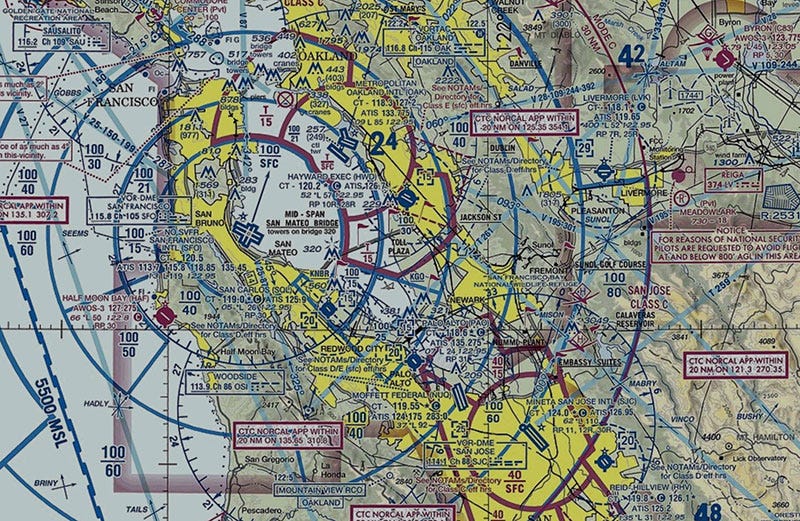
Airspace

Airspace (from the ground up to 60,000 feet) around the US is divided into sections, and each section has it own set of regulations. Airspace around busy airports, for example, is more restrictive than airspace in the middle of Montana. By “restrictive” I mean the need to get permission from ATC prior to entering the airspace. The current regulations and technology infrastructure assume there is a manned aircraft with a pilot who can talk on the radio and the ability for an air traffic controller to provide verbal instructions to the pilot. Regulations that govern airspace will likely be almost identical for both manned and unmanned aircraft. They have to be – it’s the same air.

1*vpjAcNFf-JrC_VQAFEGpEQ.jpeg
Airspace around San Francisco

From a technology perspective all of the airspace boundaries are available in database format, so it is straightforward for a UAV to be aware of its virtual surroundings.

The future challenge will be the command and control infrastructure needed for UAVs to travel autonomously through the various airspaces. The simplest path forward is to travel in only the least restrictive type of airspace, where no permission is required. To be truly effective, a system must be in place that allows UAVs to fly in all airspace, especially the restrictive airspace over or near large urban areas.

It will take many years for the FAA and industry to figure out a command and control infrastructure for truly autonomous flight. In the meantime, interested parties can apply for individual waivers from the FAA on a case-by-case basis. Since each applicant is evaluated individually it is difficult for a startup to plan and clearly understand the FAA’s needs.

Weight

The FAA chose what appears to be an arbitrary number and decided that “small” UAVs include anything under 55 pounds. I anticipate that future UAV regulations for the smaller UAVs will be different than those for the larger UAVs, as that’s how its been done for manned aircraft for decades. Part 23 regulations govern the design of aircraft typically under 12,500 pounds and Part 25 regulations, which are more strict, apply to aircraft larger than that. It makes sense that more stringent regulations apply to larger aircraft as they can carry more people and have the potential to create more damage on the ground.

The manned aircraft industry and the FAA realized that the Part 23 regulations needed a “re-write” in order to improve safety and lower the cost to bring an aircraft to market. This is particularly true for smaller, recreational use aircraft. In a significant shift from normal policy, for the Part 23 re-write the FAA is willing to move from direct oversight to a system whereby manufacturers build towards an industry standard. Be aware, this process began in 2007 and completion is not expected until 2017. Hopefully, the FAA will build on this and implement UAV regulations that utilize industry standards.

Get Involved

Industry working groups and steering committees need more input from small UAV users and businesses. As the FAA moves forward with UAV regulations, be on the lookout for open comment periods where you can provide feedback to the FAA on proposed regulations.

Take the next step further. Sign up for private pilot ground school. Go to your local small airport (San Carlos or Palo Alto, but not SFO) and take a few introductory flying lessons. Ask you instructor to show you VFR charts and tell you about maintenance procedures. Go to AirVenture in Oshkosh next July. Doing any of these things will give you an appreciation for aviation and the rigor required to fly safely.

Conclusion

The use of small, recreational-use UAVs is growing rapidly. Ironically, the commercial UAV industry in the US has the potential to explode but only once FAA regulations are in place. Regulations for LOS operations are the most likely to be implemented first. Widespread autonomous operations are many years off.

It appears there are already many signs that the FAA will follow what it currently knows when developing future UAV regulations. The more you understand about manned aircraft regulations the better you’ll be able to predict what is coming for unmanned aircraft regulations.

Read more…

This is my first attempt at producing something with drone video that is not boring or painful to watch. The footage I captured with my new Tarot T-2D and GoPro had some vibration and lighting issues, but this edit is the best of what I did get.

I used LightWorks to edit the video, add the music, and to increase the contrast - the raw video from the GoPro was a little washed out. I've ordered a neutral density filter to try to help with that. Lightworks is as quirky as any other NLE I've used, but it was solid, runs on linux, and is available by monthly subscription so I could try it out without a big investment.

There is some obvious jello at some speeds. I'm going to try to address that with some tuning of PIDs and maybe some different props. The ND filter will hopefully help with that a bit as well. For this footage, I may try to stabilize the video with Blender and see if that helps.

Here's another short video of just a 360-degree yaw, shot in 60fps and slowed down to 30.

Does anyone else use linux? If so, what's your workflow?

Read more…