All Posts (11086)

Sort by

Passenger plane flies 800 kilometers without a pilot

Say hello to the droneliner. A business plane has flown an 800-kilometre round trip in civilian airspace without the pilot onboard operating its controls.

Instead, the plane flew itself like an outsized drone with continual monitoring of its autonomous manoeuvres performed by a pilot based on the ground.

The flight from Warton in Lancashire, to Inverness in Scotland by a British Aerospace Jetstream is being hailed as a milestone by members of ASTRAEA, a £62 million UK research consortium aiming to develop the technology that will allow civilian aircraft to share their airspace with drones – some of which could be as big as airliners.

The flight happened back in April but the details have only just been revealed. It took off with a regular pilot and test engineers on board. But once the aircraft was straight and level, the pilot handed control  to the ground pilot and sat back for the ride, only taking over again for the landing.

The aircraft – a 19-seat propeller-powered business plane – was not merely on autopilot. It tested the detect-and-avoid technology, which drones in civil airspace will need to have to ensure they keep their distance from other air traffic and automatically undertake collision-avoidance manoeuvres.

The algorithm that runs this technology has been thrashed out with air-safety experts at the UK Civil Aviation Authority who have ensured it sticks to the "rules of the air" understood by pilots worldwide.

Replacing eyeballs

To test the system, fake objects to avoid were introduced to the flight computer, says Lambert Dopping-Hepenstal at BAE Systems, program director for ASTRAEA.

"Because we were in shared airspace, all the sense-and-avoid manoeuvres we tested used synthetic targets. Any changes to the flight route were communicated to the ground-based pilot by air traffic control, with the pilot then instructing the aircraft to amend its course accordingly," he says.

Jim Scanlan, one of the designers of the world's first 3D-printed unmanned aerial vehicle Movie Cameraat the University of Southampton, UK, is impressed. "I think it's great. It's good to see such progress in the UK – especially with the US hoping to open up its airspace to UAVs in 2015."

The main thing ASTRAEA needs to get right is that sensing and avoiding capability, says Scanlan. "That's the showstopper at the moment. Without a pilot they need a sensing system to replace the Mark 1 eyeball – one that can tell a hot-air balloon from a cloud."

source:http://www.newscientist.com/article/dn23521-passenger-jet-flies-800-kilometres-without-a-pilot.html?cmpid=RSS|NSNS|2012-GLOBAL|online-news

Read more…

Cat toys and PCBs

catpcb.jpg

So what does a cat toy and a PCB have to do with UAVs?

Very easy: One of my dogs had taken my cat's pole toy and left little but the handle stick. I was wondering what to do with that now. At that time, my MF450 frame was on my desk waiting to be completed and I shortly before read about external LED indicators. I also mounted my APM on top of the frame and was worried about damages in case of a flipover.

So - I cut the stick in halves - well somewhat half... Then I soldered suitable resistors for 5V to the LEDs and short cables with 3p jumper plugs. After that I filled the respective parts of the stick with heat glue - pretty much completely to give some additional stability. For mounting, I pushed an M3x35 bolt into the still soft heat glue.

As a result, I have two little masts which carry the external LEDs for GPS and ARM as well as double as some kind of "roll cage" to protect the APM in case of a crash.

As for the PCBs, I did have massive stability problems with my quad in Alt Holt mode and was advised that vibrations might be the cause. The MF450's gimbal comes with rubber balls which are a good bit too soft for that gimbal construction (the gimbal shakes badly) so I mounted the roll servo to the frame with double-sided tape and had the rubber balls as a leftover. I also recently bought a 50 pack of small PCBs from eBay, so I made a quick-and-dirty (and cheap) anti-vibration mount from 4 rubber balls and 2 PCBs.

That's the final result:

FILE0004.jpgThe anti-vibration mount will be tested soon when I got my new props.

Read more…
3D Robotics

Sticky drone perches on ceilings

3689521678?profile=originalFrom Gizmag:

Micro UAVs that have the ability to slip into tight spaces, including inside buildings, have wide ranging military and search and rescue applications. To reach their full potential, however, these UAVs are going to need to learn how to land in rougher areas that don't always have a horizontal surface to touch down on. One team of scientists has begun taking a huge step towards accomplishing just that by developing a quadcopter with a mechanism that allows it to land on walls or ceilings, stay for a while, and then take off again.

The landing mechanism makes use of the same dry adhesive used on the gecko-inspired Stickybot, combined with aligned tendons to allow the quadcopter to stick to most surfaces and remain in place. Once it hits a flat spot at any angle, the adhesives are deployed and the tendons tightened, creating enough surface friction to form a strong grip. The landing impact also compresses several springs and locks them down, so they can be triggered later to launch the aircraft away. As a bonus, this process doesn't deplete any extra power, since the quadcopter's own kinetic energy is used to both activate and release the landing mechanism.

Inspired by the abilities of geckos and insects, the landing mechanism combines dry adhesi...

It's hard not to picture a microphone-equipped UAV with this system flying into an open window and affixing itself underneath a desk, out of sight, but the ability to stick to walls and ceilings has applications other than spying. Landing on any surface would allow it to conserve power or take time to recharge an onboard battery, even when landing conditions aren't optimal. It would also be able to find better shelter from harsh weather or falling debris in a disaster zone.

The project is a joint effort between laboratories at Stanford, the University of Maryland, and MIT – all partly funded by the US Army Research Lab and the National Science Foundation. In fact, Stanford's Biomimetics and Dexterous Manipulation Lab had previously experimented with a similar perching mechanism for a fixed-wing aircraft as well as systems for the wall-climbing Stickybot, so this was a natural progression for the development team.

The video below only shows how a quadcopter can land on a smooth sheet of acrylic at an angle or upside down, but the team hopes to upgrade it to the point where it will attach to rough surfaces, fly away from a landing point, and even crawl along walls.

Source: Autonomous Vehicle Laboratory, Biomimetics and Dexterous Manipulation Lab via Popular Science

Read more…
Moderator

3689521660?profile=original

 3689521586?profile=original

Dear Friends,

after 4 months of hard work the first Virtualrobotix RTF frame is ready , we received first two sample yesterday . We are very happy to this result .

We start some month ago presenting some design concept.

http://www.diydrones.com/profiles/blogs/what-kind-of-design-do-you-prefer-for-your-next-drone

Then after a long selection and technical evaluation of platform doing on 3d cad , testing the frame with FEM simulation and then send the prototype to our maker company.

580340_539054516139727_1350674614_n.png?width=750

The next step is test on air. Inside we put our flight control platform VR Brain , 3DR Ublox GPS , 3DR radio telemetry module , VR ESC and VR Radio .


We are working hard on a lot of component and we'll be on air in one month .

  • The VR Copter design is from italy :)
  • This Copter is in a 550 category.
  • The weight of frame is around 330 gr.
  • Below support different configuration of payload ad in front will be available a revision of VR Copter with VR Direct Drive Gimbal that's coming ,too
  • The tile is removable , so if drone crash you can change the tail or in future will be different configuration available.
  • We are available also to customize the frame with your colors or texture on it . With our modular approach we haven't limit to customize our platform.


We need your help to understand if you like our new and innovative drone platform and what kind of feature do you like on it :)


We are searching farm in the world that have competitive price for production of this frame . We have two kind of version of project one for going in production with professional 3D printer. We are evaluation also to buy one . If someone have some suggestion about a good product at competitive price that's welcome :)


The other opportunity is to produce by molding technology process , but we need a good price for it :) In italy is not enough competitive price :)

if you can help us comment this post or contact us at info@virtualrobotix.com 

Best

Roberto Navoni

original blog post : http://www.virtualrobotix.com/profiles/blogs/after-4-months-of-hard-work-the-vr-copter-frame-is-here-on-my-tab


Read more…

To watch the flight, go to: 2:33

I wanted to carry my GoPro (with housing) in a plane but without expending too much, so I built it by myself, using foam, depron and barbecue sticks.

The fuselage was done with EPS foam 12g/dm3 (isopor P0, comum de papelaria). Wings, ailerons, elevator and rudder with depron 4mm. I used some barbecue sticks to strengthen wings and tail. To assemble everything i used hot glue and packing tape.

Even though it had some crashes during this video, the plane is intact! Nothing happened to it. It's very resistant!

It is not flying very well because the wing angle of attack is 0 and the wing was not attached very well. I've already done these improvements but i still have not done a new flight.

Motor: D2826-6 2200kv Outrunner Motor
ESC: Hobbyking SS Series 40-50A ESC
Servo: Turnigy TG9e 9g / 1.5kg / 0.10sec Eco Micro Servo
Propeller: APC Style Propeller 6x4R
Battery: Turnigy 3s 2200mah 25C
RX: Turnigy 9x

Wingspan: 1200mm
Lenght: 1000mm
Chord: 250mm
Wing area: 30dm2
Wing weight: 252g
Fuselage thickness: 70mm
Fuselage weight (with motor, ESC, RX and servos): 468g
Battery weight: 200g
GoPro (with housing): 200g
Total weight: 1120g
Wing loading: 37,3g/dm2 (should use a bigger wing to have a slower flight)

This is the 2nd flight I've done with my homemade plane for carrying a GoPro. I advanced the CG a little bit and now it's flying much better, very smooth!

I still need to balance motor and prop.

Beautiful dusk, filmed with the homemade plane.

Some flybys, landings, panoramics ...

Changed the 2200kv motor + 6x4 prop to a 750kv motor + triblade 9x4.5: a little bit slower but prompt response when I add throttle and much better efficiency, almost double flight time (10min).

Read more…

DF-X4_39.jpg

Mounties in Saskatchewan are crediting a high-tech drone for the rescue of a man who had walked away from his vehicle after a rollover crash and could not be found.

Sgt. Doug Green, who deployed the drone in the search, told CBC News the machine was built and designed by a Saskatoon company, Draganfly Innovations.

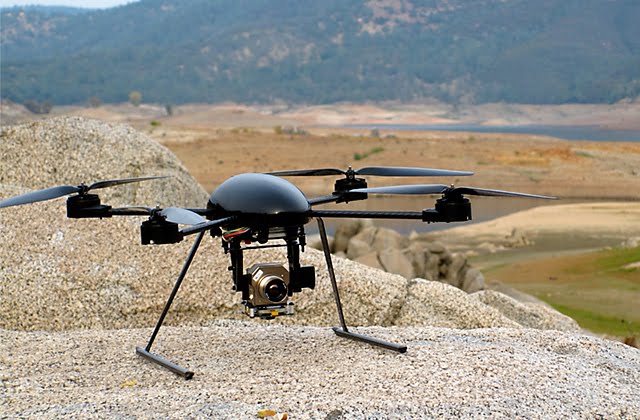
"It's a small little four-armed helicopter that has the capability of a camera or a FLIR [Forward Looking Infrared] or a low-light camera attachment that has a video link right back to the hand-held controller that I fly it with," Green explained. "I see exactly what the camera is looking at and I can control the camera up and down."

RCMP are trying out Saskatoon-made drones. A Dragan Flyer X4-ES was used to find an injured man who wandered away from a roll over crash. (Draganfly.com)

Green said the drone used a FLIR camera which detects heat from an object during Thursday morning's rescue.

He said that in most highway crashes, victims are found near to their vehicles or within about 200 metres.

In Thursday's case, Green said the man suffered a head injury and was disoriented.

"He just, instead of phoning right away, he wandered off and got lost in the dark," Green said, adding it was cold, the field had water in it and the wind was picking up. "He was wet and cold."

Green said the RCMP have been using the Dragan Flyer X4-ES for just over a year in a series of trials to determine how they might assist different elements of police work. Green was equipped with one for use in traffic analysis.

"We're still just trying out different platforms," he said, adding that five officers have obtained the necessary training and licences from aviation authorities to fly the devices.

http://www.cbc.ca/news/canada/saskatchewan/story/2013/05/09/sk-rcmp-drone-infrared-night-rescue-130509.html

More Info on the RCMP operations:

http://www.draganfly.com/our-customers/customer_spotlight/RCMP_spotlight_v5.pdf

Read more…

3689521386?profile=original

By MARY SHINN  Cronkite News

WASHINGTON – Stephen Rayleigh and Matt Lyon thought they were done with careers in drones after they left the Army in 2010 and enrolled at Embry-Riddle Aeronautical University in Prescott.

Until they met Professor Ray Bedard.

Rayleigh wanted to start a club that would build and fly drones; Bedard had wanted for years to launch drone classes. The club became a class in 2011, with the help of Lyon and Rayleigh’s expertise, and the class grew into a full-fledged drone minor that attracted 28 students when it launched at the school in August.

The minor aims to prepare students to build and fly unmanned aerial vehicles – UAVs, or drones – for a commercial market that doesn’t yet exist.

http://cronkitenewsonline.com/2013/05/uav-degree-colleges-offer-courses-in-drone-design-marketing/

Read more…

2013 Sparkfun AVC entry video

I put together a short video of Data Bus driving in autonomous mode in the rain. Hopefully I got the video in before the deadline. We'll see...

Data Bus is configured to drive between four waypoints outside my house at a much slower pace than during the 2012 AVC due to the much smaller area and the danger of collision with moving or stationary cars :)

Read more…

Wildfowl and Wetlands Trust, Scotland

ResearchDrones and ConservationDrones recently went to Scotland to examine the potential of using drones for the conservation work of the Wildfowl and Wetlands Trust. The team went to the amazingly beautiful Caerlaverock wetland area to obtain images and footage of the wildlife and vegetation in the area. In the video you can see some of the footage and preliminary mosaics that were made from the photos taken during the flights.

Read more…

I was getting lots of vibrations from my Hextronik DT750 even after balancing it and using balanced props. I replaced the bearings and now the motors are like new! 

The steps for DT700 and DT850 are similar

To remove the C-Clip, it would be easier if you use a snap-ring plier (unfortunatelly i don't have one hhehehe)

Read more…

3689520986?profile=original

http://blogs.ottawacitizen.com/2013/05/05/canadian-uav-competition-tests-ability-to-locate-forest-fires/

News release from the organizers:

Alma, QC – May 3-5, 2013 – Ten university student teams from across Canada competed in the Operational Phase of the 5thUnmanned Systems Canada UAV Student Competition hosted by Ville d’Alma at the Centre d’excellence sur les drones (UAS CE). The teams were challenged to use unmanned air vehicles (UAVs) in support of forest fire fighting.  They were tasked with automatically locating targets that would represent points of interest in an actual forest fire fighting scenario in the remote Canadian wilderness, using their own experimental unmanned aircraft flying under the control of autopilots.


Winning Teams:


Phase 1 Design Phase


1stPlace          Team COBRA, University of New Brunswick

2ndPlace          UTA Team, University of Toronto

3rdPlace          Team VAMUdeS, Université de Sherbrooke


Phase 2 Operational Phase


1stPlace          Team VAMUdeS, Université de Sherbrooke

2ndPlace          UTA Team, University of Toronto

3rd  Place         Team COBRA, University of New Brunswick


All teams who participated in the operational phase of the competition received a cash award; overall $12,000.00 of prize money was awarded to the teams.


“It’s incredibly satisfying to see the rapid growth in capability that these teams bring to our annual competition,” said Eric Edwards, Chairman of Unmanned Systems Canada.  “We provide a safe environment where the students can fully exercise their technical creativity, and the results are just stunning.  They are self-motivated, and they are the best of the best from their respective faculties.  The corporate sponsors of this event thoroughly enjoyed meeting each of them and seeing their potential future employees at the top of their game, under a bit of competitive stress and dealing with real-life complications.”


Participating Teams:


University of New Brunswick – Team Cobra

Université de Sherbrooke – Team VAMUdeS

École Polytechnique Montréal – Team Smartbird

École de Technologie Supérieure (ÉTS) – Team Dronolab

Université du Québec à Chicoutimi – Team UQAC

University of Alberta – Team UAARG

University of Toronto – UTA Team

University of British Columbia – Team Thunderbird

Simon Fraser University – Team GUARDIAN

Carleton University – Team Blackbird


Unmanned Systems Canada – Systèmes télécommandés Canada (USC-STC) is the not-for-profit association representing the interests of the Canadian unmanned systems sector – industry, academia, government, military, and other interested persons. It provides a single voice for advocacy and representation to government and international bodies, and jointly leads Canada’s regulatory development efforts for UVS. The organization promotes and facilitates the growth of the Canadian unmanned vehicle systems community through education, engagement of new market sectors, and exchange of ideas and technologies.


The Unmanned Aerial System Center of Excellence is a non-profit organization whose mission is to develop an international center of expertise and innovations focused on the development, applications and operations of UAS. Services are available to both private and public companies. The UASCE collaborates withTransport Canada towards the integration of unmanned aerial vehicles in the Canadian airspace. UAV flights have been conducted since March 2012 in the Alma region and the future looks promising for the Centre.

Read more…

arduplane Automatic flight to alt 2414m

Disclaimer:- DIYDRONES does not advocate or condone any RC flights beyond LOS or above 400'AGL. Do not try this. This APM assisted FPV was supposedly attempted in Russia. Such Flights may be illegal in many parts of the  world. Members/ Diy UAV enthusiasts are advised to check with local regulations/authorities for required permits & comply. DiyDrones bears no responsibility for such action.

Link

Prototype of the compact UAV on the basis of popular model of the radio-controlled EasyStar plane

Basic characteristics of a glider:

initial look:

easystar_01s.jpg

Material ELAPOR
Wingspan: 137 cm / 2400 quarter sm.
Loading: 3,28 kg/sq.m
Fuselage length: 86,3 cm
Weight: 680 g

Changes are made to a plane design:

Ailerons are cut through
The rudder is increased by 100%
the tail beam (3 carbonic rods 1мм at sides and a bottom) is reinforced
wings are straightened t and in this position are reinforced by three bars everyone
the niche in a tail beam under the 7-inch screw is cut out
servo are mounted near surfaces

motor 250w 2200KV
esc turnigy plush 30A
APC 7*5

This configuration  gives near 1kg pool (static measurement) that allows to provide reliable take-off.

Autopilot:

APM 2.5 flight controller
GPS external mediatek 3329 speed of updating of data 10Hz
Voltage sensor
The separate UBEC power supply for avionics

FPV equipment:

720 lines camera  with high sensitivity
Video the transmitter 5,8GHz 200mw
video receiver 5,8GHz
FatShark video glasses

Battery:

Zippy Flymax 3S 5000ma  (external  on the bottom of a fuselage)

3689520279?profile=originalRussian style hummer-drones laboratory

3689520251?profile=originalmotor and esc

3689520356?profile=originalelevator servo and rudder size

3689520426?profile=originalrc receiver and self-made apm2

3689520337?profile=originalfoam door to communication box

3689520382?profile=originalcamera and battery

Read more…

Parachute tests with a multirotor

A multirotor flight is very critical: if it happens an ESC, motor, propeller, RX failure or even if you get a lot of vibrations in the flight controller, the multirotor will crash. That's why I created a parachute and attached it to the quadcopter. This was the first test I've done with a parachute for quadcopter:

It had a stick so it kept the parachute away from the propellers. The problem is that the CG is difficult to keep in the center of the quadcopter and also because if the quadcopter hits the stick on the ground when it lands it's going to break the stick.

Therefore, I positioned the parachute on the back of the quadcopter without a stick. I've done a "wind tunnel" test (lol ;D) to check if the parachute would open:

As you can see, it seems to work, so I tried it in field:

Although it didn't land well, nothing was broken because the quadcopter arms are foldable and the ground was soft (grass).

The parachute is activated with a receiver channel and a servo. So when I get in trouble I press a button in my transmitter and it will release the parachute.

Currently i'm projecting a parachute launcher with springs, so it will  be launch vertically and thus it will open faster. Another option would be using a small rocket/gunpowder to pull the parachute, but i'm still thinking on the positioning to avoid unwanted burn to the parachute and the multirotor

Cheers!

Read more…

With a brushless motor and a TRex tail rotor mechanism I could assemble a simple variable pitch system. I measured and it generates 700g with the TRex 500 tail rotor blades.

I tried the Trex 250 blades from the main rotor but although they are longer the thrust is smaller, just 400g. This is probably because the motor doesn't have enough torque.

This could be used for a variable pitch quadcopter or with an airplane.

Specs:
Motor: Hextronik DT750
ESC: Plush 25A
Battery: Turnigy 2200mah 25C
Tail rotor: HK-500GT
Wood to support the tail mechanism: 38mm tall

Read more…

New (APMcopter) Wiki up and operating!

The new APMcopter Wiki is up and running!

3689521020?profile=original

As you probably know, some of us have been hard at work trying to bring up a new Wiki for the copters, planes and rovers.

I have recently completed installing the vast majority of the pages from the Old ArduCopter Wiki into the new APMcopter Wiki/Manual.

And I have produced a Drop Down Menu as well as a Hyperlinked Table Of Contents (that is accessible from the top of each Wiki page).

Please look over the new APMcopter wiki here: http://copter.ardupilot.com/wiki/arducopter/

And provide feedback.

There is still some work to do repairing broken hyperlinks (they do not import correctly from WordPress and the images all need to be moved to the WordPress repository), but I am slogging through all 109 Wiki pages fixing them and performing minor reformatting.

There is an issue that I would really like you all to look at carefully.

Right now, I have constructed a Drop Down menu and Table of Contents that completely mirror each other and I think they work effectively together.

However, it is 3DR's intention to minimize or eliminate the Wikis Drop Down Menu at the very least removing the vast majority of links so that it will work better with tablets and to support their own vision of what is in the best interests of themselves and the community.

They envision a very short set of quick starts designed to get uninitiated users up and running as quickly as possible.

And while I think that is a very worthwhile pursuit, I do not think that it is appropriate to do it by applying the scarce drop down menu resource to that endeavor and removing it from the full Wiki.

I think that the current full Drop Down Menu and Table Of Contents work very well together and are an asset to our community.

Please look this over with special regard to the Drop Down Menu and the Table of Contents and Weigh in here, it may be your best chance to influence the final form of our Wiki/Manuals.

Of course, I invite 3DR to respond here as well.

This is an open community that has benefited greatly and grown considerably in no small part due to massive support from Chris and 3DR.

I'm not trying to cause a problem here, but this is a time where our feedback is really important.

Read more…