All Posts (11086)

Sort by

3689703406?profile=original

3D map georeferenced with Reach GPS data.

Tuffwing, a manufacturer of affordable aerial mapping systems recently performed integration of Reach RTK to enable making precision maps without use of ground control points. The system was benchmarked by comparing direct georeferenced model with a set of GCPs, used solely for error detection purposes. Achieved lateral RMS error is just 4cm according to the Pix4D quality report.

3689703363?profile=original

Possible setup for surveying drone with Reach RTK and Tuffwing hot shoe.

The key feature of the setup is use of Reach RTK and Tuffwing/Reach RTK hot shoe cable together connected to the camera's hot shoe. This cable powers Reach rover, triggers camera from Pixhawk and directs flash sync pulses to Reach. Exact moment of each pulse is stored as time mark in the Reach RINEX files. No configuration for the Reach hot shoe cable is required, the camera will automatically trigger the hot shoe and the Reach will automatically record events down to fractions of a millisecond. This process does not require communication between autopilot and RTK receiver.

After the flight the time marks are converted into geotags with a free RTKLIB software provided by Emlid and are used for direct georeferencing of images. Commercial software such as Grafnav will be efficient as well.

To validate performance of the system Tuffwing organized flights using their Tuffwing UAV Mapper drone with Reach RTK GPS onboard. 112 photos were acquired with a Sony Nex 5T with Sony 16mm lens triggered by a Pixhawk.

     Information about acquired data:

  • Altitude: 100m.
  • Average Ground Sampling Distance (GSD) 2.82 cm / 1.11
  • Area Covered 0.1139 km2 / 11.3916 ha / 0.044 sq. mi. / 28.1638 acres.


Comparative quality report prepared in Pix4D by Tuffwing was based on geotag file from Reach RTK and GCP-file for validating the accuracy of 3d map. It is showing that the RMS error for Y-direction is about 4 cm while X-direction is less than 3 cm. All the data with detailed manual for processing the report is available.

Tuffwing is now working on documentation to show complete data processing workflow. 

Read more…
Developer

Flight Demo of Matrix Pilot 5.0

This is a flight demo of the recently released MatrixPilot 5.0flying the helical Turn algorithms by William Premerlani.

MatrixPilot is a relatively small open source GPL v3 licensed Autopilot, which provides a platform for DIY enthusiasts to experiment with new algorithms and ideas. It does not have a large user base, partly because any change in it's configuration requires a recompilation of the code.  The official announcements for this 5.0 release is on the uavdevboard discussion list.

Read more…
3D Robotics

Using AI to design a drone frame

531372_4_57167_kTrKCBNsd.png

This render from Fusion 360 features the Hooligan 1000, with an additional thruster and rotors set at 30-degree pitch for optimal thrust. The final design may change based on the results of Autodesk Dreamcatcher. / Credit: Eli D'Elia, Autodesk

From Core77:

Someday in the not-too-distant future, a drone designed by a computer will be flown by a computer. That's Eli D'Elia's dream. 

It's a dream he's working to make a reality by partnering with Autodesk to design the Hooligan 1000, among the first entrants in the newly emerging 1,000 mm drone racing class. But racing is just the beginning for D'Elia, a product designer, roboticist, and professional drone operator who has helped to pioneer drone racing as we know it. For him, it's more important that the Hooligan be durable, practical, and easily adapted for use in industry and agriculture, possibly search and rescue, and eventually, mapping and exploration. He envisions a future where drones move not only through the air, but through water and outer space as well. "We're really just in the Kitty Hawk stage of drone development," says D'Elia. "Competition through sports is a great way to test out ideas and get rid of the bad ones."


Letting the Computer Do the Work

"AI-grown, AI-flown," is how D'Elia summarizes his goal. To that end, D'Elia and his partners at Autodesk, Taylor Stein and Daniele Grandi, will use the Autodesk Dreamcatcher generative design system to design the drone's chassis. With generative design, the designer doesn't come up with the actual design, but instead inputs a set of requirements and lets the computer go to work. While still in its infancy, it has already been used to create an experimental automobile chassis and components for commercial aircraft.


After the design is finalized, D'Elia will start working on the AI control system that will steer the craft using 3D photogrammetry and the NVIDIA Jetson TX1 processor. He expects the AI to be able to learn a given racecourse after several test flights, then fly it both with and without human control. But he also wants it to have situational awareness, the ability to identify objects in the air like birds and other drones, and respond appropriately. "We're putting an additional thruster in there to provide a turbo boost at the end of the race," D'Elia says. "I'd like the drone to be able to tell if there's another drone close to it so it knows when to kick that thruster in for some extra speed."

Drones Far and Near

What D'Elia wants to do and what the Federal Aviation Administration (FAA) will permit are two different things, of course. According to current FAA regulations, all drones in the U.S. must have a pilot at the controls and be within the pilot's line of sight. And it may be years before autonomous drones can be flown in civilian airspace simply due to the danger of a drone hurting people, damaging property, or interfering with air flight. "They'll need to do things like employ redundant flight control systems so that, if a propeller goes out, it won't fall out of the sky," says D'Elia.

But there's no question that many people and companies see a future for drone autonomy, both near and far. Amazon is testing delivery by drone in the UK, where more lax regulations permit drones to be operated beyond the pilot's line of sight. Meanwhile, the startup, Zipline, is already using autonomous winged drones to deliver emergency medical supplies to distant communities in rural Rwanda. And companies in the U.S. are petitioning the FAA for waivers to the line-of-sight rule. The first such waiver was granted in August to PrecisionHawk, an aerial data analysis company, after they provided a year's worth of drone flight safety data.

For D'Elia, all of this is interesting, but the truly exciting possibilities lie further afield. He notes that there's already an XPRIZE competition underway to design a drone that can map the ocean floor by itself. D'Elia thinks it's only a matter of time before similar efforts begin to explore outer space. 

In the Field and in the Lab

When he's not working on the Hooligan 1000 designs, you'll often find D'Elia flying drones in the vineyards of Northern California. The company he started, Eagle Eye Metrics, deploys drones to help farmers, generally vintners, monitor their crops and map their fields. Using a NDVI camera, his drones capture infrared frequencies that can reveal information about soil quality, pest infestation, and overall plant health. On foot, this kind of necessary recon can take farmers a week. D'Elia and his drones can do it in less than an hour. 

531403_4_57167_Dih6YzsPq.jpgWhen he's not designing drones, Eli D'Elia performs drone-based aerial mapping for farmers in Northern California through his company, Eagle Eye Metrics. / Credit: Eli D'Elia

D'Elia has always had an interest in both the sport and the practical use of robotics. Long before BattleBots hit the airwaves, he was part of an amateur robotics community in the San Francisco Bay Area in the '90s. They would build their robots during the week, then put them into the arena to do battle on Saturday night. "The whole idea was to one-up whatever the other guy's robot did. If he clobbered you, you hit him with a projectile. If he fired at you, you hit him back with a flamethrower," D'Elia says.

When drones hit the hobbyist market in the mid-2000s, D'Elia was immediately interested. However, he and his frequent collaborator, Marque Cornblatt, saw one big problem: drones were too fragile. "You could spend two weeks and $1000 building a drone, but you can make one mistake and crash it in ten seconds and you're back to square one," D'Elia says.

Under the auspices of their own organization, the Aerial Sports League, D'Elia and Cornblatt designed the Hiro, a drone with a monocoque frame made from a lightweight, super-strong polycarbonate used in aerospace and military applications. The design was fireproof, waterproof, and sturdy enough to withstand direct hits from a baseball bat and even a shotgun blast. It was among the first successful drone projects on Kickstarter. 

D'Elia and his Autodesk collaborators are currently finalizing design parameters for the Hooligan using Autodesk® Fusion 360™ software, specifying requirements for mounting connections and access ports. When completed, they'll feed the requirements into Dreamcatcher, which will take several weeks to generate designs for the chassis. They'll then print that design in polycarbonate, assemble the components, and take it out for a test flight. Then they'll begin working on the pilot AI with help from NVIDIA. 

D'Elia remains upbeat about the near future not only for his project, but for drones overall. "Sometimes you hear people say that all this amazing stuff is going to happen 'in the future,' but you have to remember—that's like three to five years from now," he says. "Think how far self-driving cars have come in five years. This stuff is coming and it's coming fast." 

Eli D'Elia and Taylor Stein will be speaking about designing racing drones using Autodesk Fusion 360 software and Flow Design wind-tunnel simulator as part of Autodesk University 2016 in Las Vegas, November 15-17. Learn more and register today.

Read more…

logo.png

HobbyKing has recently updated their web site making it more difficult to hone in what you are looking for. I was trying to see what was available for 4s lipos, but it was so convoluted that I became frustrated and gave up. Before the web site update it was a simple task to filter 4s lipos and have a long list of what was available shown on the page to see what was available. Now you have to use several sliders to filter with and there are only a few listings per page. You have to go through numerous pages to see what is available.

Read more…
3D Robotics

New 3DR autopilot: Pixhawk Mini

DSC_0343.jpg

The wait is over! We are proud to introduce the next generation 3DR autopilot, Pixhawk Mini. Pixhawk Mini is an upgraded Pixhawk designed in collaboration with HobbyKing and optimized to run the Dronecode PX4 firmware stack and QGroundControl multi-platform ground station (Windows, Mac, Linux, Android, iOS).

For just $199, Pixhawk Mini includes autopilot, GPS, and all the cables and connectors needed to get started building DIY quads, planes, rovers, and boats.

What's improved over Pixhawk 1?

  • One third the size--dimensions reduced from 50 mm x 81.5 mm x15.5 mm to 38 mm x 43 mm x 12 mm. Smaller airframes can now operate autonomously without making sacrifices for the Pixhawk footprint.

  • Rev 3 STM32 processor allow for full utilization of 2MB flash memory. Pixhawk Mini operates at only 50% compute capacity, 40 percentage points lower than the original Pixhawk. There is significantly more overhead available to run custom code.

  • Improved sensors, including both primary and secondary IMU (MPU9250 and ICM20608, respectively), lead to much better vibration handling and increased reliability.

  • GPS module included--Neo M8N with quad-constellation support and upgraded HMC5983 compass.

  • Micro JST connectors replace DF-13. We can all breath a sigh of relief.

  • Integrated piezo speaker and safety switch

What's improved over Pixfalcon?

  • Again, improved sensors, including both primary and secondary IMU (MPU9250 and ICM20608 respectively) for much better vibration handling and increased reliability.

  • Dedicated CAN port for UAVCAN applications.

  • Includes 8-channel servo output board for planes and other vehicles requiring powered PWM output.

  • Includes I2C breakout board for a total of 5 I2C connections.

Pixhawk Mini features an advanced processor and sensor technology from ST Microelectronics® and a NuttX real-time operating system, delivering incredible performance, flexibility, and reliability for controlling any autonomous vehicle.

SPECIFICATIONS

  • Main Processor: STM32F427 Rev 3

  • IO Processor: STM32F103

  • Accel/Gyro/Mag: MPU9250

  • Accel/Gyro: ICM20608

  • Barometer: MS5611

  • Dimensions: 38x43x12mm

  • Weight: 15.8g

GPS Module: ublox Neo-M8N GPS/GLONASS receiver; integrated magnetometer HMC5983

  • Dimensions: 37x37x12mm

  • Weight: 22.4g

Interface

  • 1 x UART Serial Port (for GPS)

  • Spektrum DSM/DSM2/DSM-X® Satellite Compatible RC input

  • Futaba S BUS® Compatible RC input

  • PPM Sum Signal RC Input

  • I2C (for digital sensors)

  • CAN (for digital motor control with compatible controllers)

  • ADC (for analog sensors)

  • Micro USB Port

What’s Included?

  • Pixhawk Mini Flight Controller

  • GPS with uBlox M8N module with  

    • Concurrent reception of up to 3 GNSS (GPS, Galileo, GLONASS, BeiDou)

    • Industry leading –167 dBm navigation sensitivity

    • Security and integrity protection

    • Supports all satellite augmentation systems

    • Advanced jamming and spoofing detection

    • Product variants to meet performance and cost requirements

    • Backward compatible with NEO‑7 and NEO‑6 families

  • Integrated Power Module (up to 6s batteries) and power distribution board for quadcopters

3B3FytiZ9aBC7N1xM9mkVE2LtETaxoqrgFAo_5Dp2hetpbvuYqCWjy6GkC5PnREW1XekrloCNwg-laNm6sI3ERq6DHl5Bx3aPNzdFNVyQd-_MczJwSIpd-TcgCVlZ4il1SU5jUjc

  • 8-channel servo output board for planes and other vehicles requiring powered PWM output.

  • Cables

    • 4 pin I2C cable and breakout board

    • 6 pin GPS+Compass cable

    • 6 to 6/4 ‘Y’ adapter for additional I2C devices

    • 4 JST to 6 DF13 cable for legacy telemetry radios

    • External safety switch cable

    • RCIN cable for PPM/SBUS input

    • 8 channel RC output cable

    • 6 pin power cable for included Power Distribution Board

OPTIONAL ACCESSORIES

All available here

3Im6wXwv4oHZ81nl6aARLkPJJNnyj6-ibPJ4lew51mPvtg_hBbic67qH2WuCSHKikEQEXXTXR2pgWF8HAr2VGdYod6kFjPntRJnivhntxCCbxulsYDn6WhyxLrdcGewyyJBlNatv


Read more…

Future of On-Demand Urban Air Transportation

3689703290?profile=original

On-demand aviation has the potential to radically improve urban mobility, giving people back time lost in their daily commutes. Uber is close to the commute pain that citizens in cities around the world feel. We view helping to solve this problem as core to our mission and our commitment to our rider base. Just as skyscrapers allowed cities to use limited land more efficiently, urban air transportation will use three-dimensional airspace to alleviate transportation congestion on the ground. A network of small, electric aircraft that take off and land vertically (called VTOL aircraft for Vertical Take-off and Landing), will enable rapid, reliable transportation between suburbs and cities and, ultimately, within cities.

Read the full text here:   https://medium.com/@UberPubPolicy/fast-forwarding-to-a-future-of-on-demand-urban-air-transportation-f6ad36950ffa#.gkptt7fho

Read more…

Autonomous Boat to Cross the Atlantic Ocean

Over the last few months, I have been busy building a fully autonomous sailboat that attempted to cross the Atlantic Ocean.

3689703156?profile=original

It was initially launched from Newfoundland heading towards Ireland. Although the initial attempt was not successful, I've gained a lot of extremely valuable experience, and I am going to build another, more capable boat. You can find more details along with a tracking map on www.opentransat.com.

3689703125?profile=original

The base consists of a surfboard and aluminum profiles. It is balanced by a heavy keel with lead weights that would flip the boat back over in case it flips. All materials used should survive for years in the ocean. It is rather an experimental concept that can be easily modified to test various configurations. My next boat will be optimized for speed.

3689703181?profile=original

The primary power source is four LiFePo4 3.2V 36Ah cells that are being charged by a 100W solar panel. When the batteries are fully charged, the boat can work four days without any sunlight.

The boat reports its position via the Iridium satellite network using the RockBlock module and two additional SPOT trackers (Globalstar satellite network).

The main electronic components are sealed in a Pelican case. The Iridium satellite module, as well as GPS, are in a separate polycarbonate case for better signal reception.

3689703046?profile=original

3689703203?profile=original

3689703267?profile=original

There are plenty of sensors on board that tell us more about the condition of the boat, such as the humidity inside the waterproof housing, air temperature and water temperature. There is also a hacked action camera that is powered by the main source, and it is turned on by the Arduino controller for 30 seconds every hour. The video is recorded on a 128 GB uSD card.

3689703226?profile=original

Hopefully, I will recover the boat one day to see exactly what went wrong before proceeding to the next design. My next attempt will be most likely next year, but it depends mostly on the weather conditions (it's not a good idea to navigate the boat through icebergs or hurricanes). Crossing the Atlantic Ocean autonomously is quite a significant challenge. At the time of writing this post, nobody so far has ever attained this. I will keep you updated on this front!

The MicroTransat Challenge competition with the rules that my boat strictly follows is below:

www.microtransat.org 

Project website:

www.opentransat.com

fb group:

www.facebook.com/OpenTransat

Read more…
3D Robotics

Towards ROS-native drones

1*dTyGF0bTYF4SkPgMZdXteA.jpeg From Victor Mayoral:

Announcing alpha support for the PX4 flight stack in a path towards drones that speak ROS natively.

The drones field is an interesting one to analyze from a robotics perspective. While capable flying robots are reasonably new, RC-hobbyists have been around for a much longer time building flying machines developing communities around the so called flight stacks or software autopilots.

Among these, there’re popular options such as the Paparazzi, the APM (commonly known as ardupilot) or the PX4. These autopilots matured to the point of acquiring autonomous capabilities and turning these flying machines into actual drones. Many of these open source flight stacks provide a general codebase for building basic drone behaviors however modifications are generally needed when one has the intention of tackling traditional problems in robotics such as navigation, mapping, obstacle avoidance and so on. These modifications are not straightforward when performed directly in the autopilot code thereby, in an attempt to enhance (or sometimes just simplify) the capabilities of autopilots, abstraction layers such as DroneKit started appearing.

For a roboticist however, the common language is the Robot Operating System (ROS). Getting ROS to talk to these flight stacks natively would require a decent amount of resources and effort thereby, generally, roboticists use a bridge such as the mavros ROS package to talk to the flight stacks.

We at Erle Robotics have been offering services with flying robots using such architecture but we’ve always wondered what would be the path towards a ROS-native drone. In order to explore this possibility we’ve added support for the PX4 Pro flight stack.

Supporting the PX4 Pro flight stack

1*ErmgDNaQj2PWIrKYOMzkHg.png
PX4 pro autopilot official logo from http://px4.io/

The PX4 Pro drone autopilot is an open source flight control solution for drones that can “fly anything from a racing to a cargo drone — be it a multi copter, plane or VTOL”. PX4 has been built with a philosophy similar to ROS, composed by different software blocks where each one of these modules communicates using a publish/subscribe architecture (currently, a simplified pub/sub middleware called uORB).

1*_7Vix-n10Hdub9Mc7ZT6Xw.png
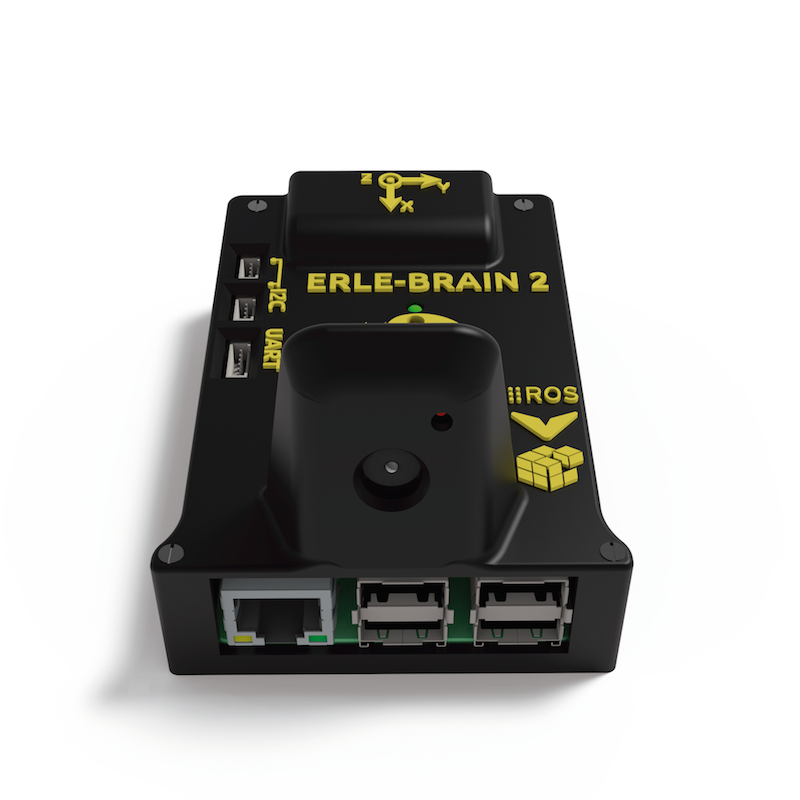
Erle-Brain 2 Linux brain for robots and drones

In an internal attempt to research the path of getting ROS-native flight stacks and to open up this work to the community I’m happy to announce official alpha support for the PX4 Pro in all our products meant for developers such as the PXFmini, Erle-Brain 2 or Erle-Copter. Our team has put together a new set of Operating System images for our products that will help you switch between flight stacks easily.

To install PX4 Pro, just type the following:

sudo apt-get purge -y apm-* # e.g.: apm-copter-erlebrain
sudo apt-get update 
sudo apt-get install px4-erle-robotics

ROS-native flight stacks

Using the PX4 Pro flight stack as a starting point, our team will be dedicating resources to prototype the concept of a drone autopilot that speaks ROS natively, that is, that uses ROS nodes to abstract each submodule within the autopilot’s logic (attitude estimator, position control, navigator, …) and ROS topics/services to communicate with the rest of the blocks within the autopilot.

Ultimately, this initiative should deliver a software autopilot capable of creating a variety of drones that merges nicely with all the traditional ROS interfaces that roboticists have been building for over a decade now.

If you’re interested in participating with this initiative, reach us out.

Read more…

Why I Think the Prosumer Drone Will Never Die

3689703088?profile=original

Innovations will flourish on drones that target the prosumer market for a long time

THE FACTS:

In the 1980 book, The Third Wave, futurologist Alvin Toffler coined the term “prosumer” when he predicted that the role of producers and consumers would begin to blur and merge. Today, the term is well accepted as a descriptor for camcorders, digital cameras, and similar goods. Prosumers are enthusiasts who buy products (almost always technical) that fall between professional and consumer-grade standards in quality, complexity, or functionality. Prosumer also commonly refers to those products.

Recently, a well-respected analyst mentioned that his firm thought that prosumer drones would disappear from the market in the near future. At the time, I thought this quite bizarre—because our research says exactly the opposite. I’m still shaking my head.

Earlier this year, we released “Drones in the Channel: 2016 Market Report,” a research study examining drone sales and distribution channels in North America. It’s the first in-depth study of drone sales that reveals the buying patterns of both consumers and professionals.  The report has a detailed analysis that calls into question the commonly held and often undefined prosumer term. I’ll summarize the salient points of that research and offer insights into why I think the prosumer drone is here to stay.

Continue reading here: http://droneanalyst.com/2016/10/26/the-prosumer-drone-will-never-die/

Read more…

A lot of work went into building this plane, adding redundancies and safeties, as well as fitting 3 cameras, and the result was well worth it. Big thanks to the ardupilot team, nightghost for his OSD firmware, and all the other folks who wrote some of the software the 5 computer/microcontrollers that were in the plane (not counting those on the camera or VTX):

Day Video (4K): https://www.youtube.com/watch?v=G-8X1Y_1fW0

Night Video (2.7K): https://www.youtube.com/watch?v=E94CXMC3gm8

Details on the plane and more still pictures:

http://marc.merlins.org/perso/rc/post_2016-08-29_RC-Flights-over-Burning-Man_-2016-edition.html
http://marc.merlins.org/perso/rc/post_2016-08-05_120kph-Capable-HK-Sky-Eye-FPV-build-with-Pixhawk-Ardupilot-3_5.html

prev1024_901_20160829_Burning_Man_Sky_Eye.jpg?width=700

thumb1024_167_20160829_Burning_Man_Flight1_rear.jpg?width=700

thumb1024_120_20160829_Burning_Man_Flight1_front.jpg?width=700

Read more…
Moderator

sUAS News Guide, Q3 update

sUAS-Guide-4-issues-article-featured-image-696x365.png

Another quarter of the year has flown by (yes, I just did that) and there is no shortage of new drones milling about the skies of this blue marble.

Q3 Update – October 2016 – https://joom.ag/OEsQ

Gary, Editor of sUAS News, recently mentioned that in his neck of the woods, and besides his own fleet of UAS, there are now at least four Phantoms flying around his vicinity that he knows about. This might seem quite the dull acknowledgement at first glance (it being dull in itself says something), but when one considers that his neck of the woods is quite a rural-middle-of-nowhere-amongst-the-rolling-hills-and-some-mountains of central eastern South Africa, it may not be so dull after all. As Gary quite rightly put it, “the drone age is really here”.

In this sUAS Guide update, we continue showing some interesting commercial and non-profit uses of drones operating in everyday life as well as in exceptional circumstances. sUAS News was also fortunate enough to be invited to see first hand a new electric/liquid-fuel hybrid VTOL UAS called the ALTi Transition on one of its final test flight days before production begins. This particular UAS is a great example of high-quality not-from-the-defence-industry industrial grade UAS beginning to show up on the market and further showing how far along the civilian industry has come from “home-built” once-off-suited-for-a-single-purpose type systems.

With the continued minification of high grade sensors and other hardware, manufacturers are now able to design and build high quality and affordable (relative to defence industry systems) industrial grade UAS to are fill a rapidly growing demand in sectors such as mining, OGP (oil, gas, petroleum) and law enforcement, to name but a few. Another tick mark in the “the drone age is here” column.

Don’t forget to subscribe to sUAS Guide to get notified when new issues are published. If you have any questions, feel free to email me via tiaan@suasnews.com

You can read it below directly from this article (view full screen via button top left of the window) or you can choose one of the options below:

sUAS Guide is available across All Devices. It has been optimized for all major mobile platforms including iOS, Android, and Windows, Desktop.

App installations are not required unless you would like to view the sUAS Guide offline.

In order to be able to view the mag offline on your mobile device, you can use the apps below:
Apple App Store https://itunes.apple.com/us/app/joomag/id454833442
Google Play https://play.google.com/store/apps/details?id=com.joomag.apps.joomag

Read more…

We have presented this video to the kids during our open days a couple of weeks ago at ENAC, Toulouse. It is just one application of a guidance algorithm that we have developed and later implemented in Paparazzi. I was actually surprised about the performance since the planes only exchange information once per second (even we allow some drops and the guys are still robust). I guess somewhere within next week I will write the "how to" in my blog, and together with code, people should be able to port it to other autopilots if they want to. Once it is ready, I will post it here too :P.

Read more…

Parrot Bebop 2 RTK over WiFi using paparazzi uav

Using Paparazzi UAV and a Stock Parrot Bebop 2 with its ublox M8N GNSS chip replace by a M8P we managed to stream the RTCM3 stream over WiFi to the drone from our groundstation. The groundstation was connected to a ublox M8P operating in base station mode. The video demonstrates the bebop doing a pure GPS navigation task, sonar nor optical-flow were used

Read more…
3D Robotics

3689703104?profile=originalVery nice use of the Microsoft Azure cloud AI APIs to make a AR.Drone do some pretty magic stuff. Excerpt from the full O'Reilly post, which has the full details and code:

The Azure Face API is powerful and simple to use. You can upload pictures of your friends and it will identify them. It will also guess age and gender, both functions of which I found to be surprisingly accurate. The latency is around 200 milliseconds, and it costs $1.50 per 1,000 predictions, which feels completely reasonable for this application. See below for my code that sends an image and does face recognition.

I used the excellent ImageMagick library to annotate the faces in my PNGs. There are a lot of possible extensions at this point—for example, there is anemotion API that can determine the emotion of faces.

Running speech recognition to drive the drone

The trickiest part about doing speech recognition was not the speech recognition itself, but streaming audio from a webpage to my local server in the format Microsoft’s Speech API wants, so that ends up being the bulk of the code. Once you’ve got the audio saved with one channel and the right sample frequency, the API works great and is extremely easy to use. It costs $4 per 1,000 requests, so for hobby applications, it’s basically free.

RecordRTC has a great library, and it’s a good starting point for doing client-side web audio recording. On the client side, we can add code to save the audio file:

I used the FFmpeg utility to downsample the audio and combine it into one channel for uploading to Microsoft:

While we’re at it, we might as well use Microsoft’s text-to-speech API so the drone can talk back to us!

Autonomous search paths

I used the ardrone-autonomy library to map out autonomous search paths for my drone. After crashing my drone into the furniture and houseplants one too many times in my livingroom, my wife nicely suggested I move my project to my garage, where there is less to break—but there isn’t much room to maneuver (see Figure 3).

Flying the droneFigure 3. Flying the drone in my “lab.” Source: Lukas Biewald.

When I get a bigger lab space, I’ll work more on smart searching algorithms, but for now I’ll just have my drone take off and rotate, looking for my friends and enemies:

Read more…
3D Robotics

From Sparkfun:

Let’s savor our final look back at AVC 2016: It’s time for the final recap video for the Power Racing Series and Autonomous Power Racing Series events! If you enjoy watching full-grown adults in costumes strap themselves to souped-up Power Wheels (plus shopping carts, Batmobiles…and other “vehicles”) – human-controlled and decidedly otherwise – you’ve come to the right place.

Read more…
3D Robotics

The flying umbrella project

That's a tough controls problem! From Popular Science:

The sight of flying umbrellas, changing altitude with a fluttering rhythm, looks more like an animated Disney scene than graduate work by a student engineer.

“I wanted to push the envelope of coordinating drones in the sky,” says the project’s creator Alan Kwan, a student in MIT’s “ACT” (Art, Culture and Technology) program. He wanted his drones to act almost alive, “not like things to be controlled by an algorithm,” he says, “but flying creatures that take on a synchronous life.”

A Hong Kong native, Kwan, 25, has explored scientific art before. He won an award for his Beating Clock project, a reanimated pig heart that keeps time. He’s also exhibited numerous virtual reality projects, like terrifying simulations of mental hospitals and alien abductions. Perhaps the most memorable isBad Trip, an explorable 3D dreamscape filled with scenes from Kwan’s daily life: ten hours of first-person “life logging” videos that he has been recording since November 2011.

Beating Clock

Courtesy of Alan Kwan

Beating Clock

Kwan's interest in blurring the mechanical and the organic is visible in his Beating Clockproject.

Coming off his virtual pursuits, Kwan wanted to explore a physical, real-world project. He found an opportunity in February 2015, when the University of Applied Arts in Vienna commissioned him to explore synesthetic works for their Digital Synesthesia Research Project (DSRP).

Traditional synesthesia is a rare neurological condition where sensory experiences overlap—a person might associate sounds with colors or words with flavors. Digital synesthesia, according to the DSRP’s website, is “an artistic research area which focuses on the possibilities of digital art to create translational and cross-modal sensory experiences and to provide synesthetic experiences for “non-synesthetes.”

Kwan decided to create a synesthesia-like experience by flipping the audience’s perception and giving a typically inanimate object a life of its own: He would make umbrellas behave like jellyfish.

“I think flying robots really embody our fascination with unreal things flying in the sky,” Kwan says. The DSRP agreed—they accepted his proposal for umbrella jellies, and Kwan received additional funding from the MIT Council for the Arts.

The trouble started when Kwan started building: As soon as it began, the project was beset by technical setbacks. Umbrellas are not particularly aerodynamic—neither are the jellyfish Kwan wanted them to imitate.

First, Kwan tried to rig umbrellas to commercial drones, but that method failed quickly. The drones Kwan wanted to use concentrated all their mass in the center of the flying body. This meant that the shaft of the umbrella had nowhere to go, and placing it in an off-centered position threw off the drone’s balance. He would have to build a drone from scratch.

Custom Drone

Courtesy of Alan Kwan

Custom Drone

Kwan's design employs a custom drone that is center mounted to the umbrella, with the battery serving as a stabilizing weight.

Kwan’s classmate, Bjorn Sparrman, helped him to fabricate the custom carbon fiber and metal components of the new drone. The pair also received input from interested peers and faculty.

The umbrella did not just need a holder—the custom drones needed to compensate for the weight of the umbrella, its aerodynamic drag, and its disruption of a free airstream to the drone’s propellers.

“It generates a lot of resistance,” Kwan says. “Airplanes and helicopters are much more aerodynamic. This is, however, a performance. It’s not about drones. It’s about umbrellas—the drones are a tool that we use.”

Sustained flight was becoming possible, but takeoff was not. Kwan developed a launching platform that would accommodate the awkwardly shaped aircraft and let it land more precisely.

Within three months, the drone was successfully airborne indoors. But it had not yet stood up to the rigors of open skies, and it did not yet move like a jellyfish. Kwan tried to devise a mechanical method for the umbrella to pulsate like the real thing. This idea literally would not fly: The servo motors necessary to power such a system would weigh the drones down too much.

Servo Control

Courtesy of Alan Kwan

Servo Control

Kwan's original concept for mimicking jellyfish used servo motors to open and close the umbrellas.

But as it turned out, the servos were not necessary—nothing was. When the drone’s propellers hit just the right speed, the rotors actually changed the air pressure above and below the umbrella. This pulled the umbrella open and shut, just slightly, which created a rippling jellyfish effect. This method is actually similar to the way real jellyfish move. Engineers have comparedjellyfish propulsion to helicopter propulsion, finding that a helicopter’s thrust is much less efficient than the biological version.

By February 2016, Kwan’s flying umbrellas took off outdoors and unassisted. Synchronized to music, the bizarre concept achieves the artist’s goal: Technology has transformed a mechanical object into a living—and flying—creature from the sea.

Digital synesthesia is not the only goal of Kwan’s project. “People have this perception of drones as weapons,” he says, “and I’m trying to push this work in the direction of the poetic. I think that contrast is interesting.”

Read more…

Hi all,

We are testing the RTK GPS receiver from Septentrio, the AsteRX-m UAS with ArduCopter 3.4. The GPS can be used to land accurate as shown in the first part of our video. The land location was logged and loaded into the waypoint file in Mission Planner. In the second part we show an autonomous transportation of a package as possible application.


3689703610?profile=original

We made a multirotor with a 6s battery, 11" props, RTK GPS to land accurate, an EPM from NicaDrone for package delivery, and a balance charger to reload the battery of the vehicle.  

Next step: implementing this technologie on a low weight drone that flies fast and far (VertiKUL 2) to deliver packages.

Read more…
Developer

d1e0503e9c82827d1c126b9f408bb210fd71cb2d.jpg

New plane releases from ArduPilot.org:

Development is really hotting up for fixed wing and quadplanes! I've just released 3.7.1 and I plan on releasing the first beta of the major 3.8.0 release in the next week.
The 3.7.1 release fixes some significant bugs reported by users since the 3.7.0 release. Many thanks for all the great feedback on the release from users!
The 3.8.0 release includes a lot more new stuff, including a new servo mapping backend and a new persistent auto-trim system that is makes getting the servo trim just right a breeze.
Happy flying!

Read more…