We're obliged to the chaps at Edge Research Lab for sending over a HackHD camera for use on our Low Orbit Helium Assisted Navigator (LOHAN) mission. We haven't got it into the air yet for a test, but the guys at Edge have used it for various flights and say it works perfectly. Let's face it, it must be better than our stroppy GoPro 3. More here.
All Posts (11086)
Sort by
Luftfotos24 presents the first UAS product line "Beast series”. The system allows everyone to take aerial pictures, research, Orthophotos, aerial surveying and precision farming.
The unmanned aircraft system (UAS) operates completely autonomous. The autopilot is based on the well known paparazzi project. The product range includes ready-to-fly multicopters and fixedwings with 1 - 4 meters wingspan . Various sensors can be used, such as video live link, NIR, multispectral cameras or up to two 24 megapixel cameras. The resolution is up to 0.5 cm/ per pixel. The "Beast Plane“ series can reach a flight time up to 50 minutes and covers up to 10 square kilometers. The pilot has the choice whether takeoff and landing are to be executed fully automatic or assisted by a stabilized mode - so every landing is a breeze.
Safety features like “Coming Home” which will bring back the UAS into a defined area e.g. in case of connection failure and lands if needed are also implemented. The ground station combines remote control, ground control and video receiver in one device. Image processing for orthophotos is done with "Pix4D", which is included in all complete packages.
Luftfotos24 is a young and innovative company dedicated to producing the highest quality solutions for research, precision farming and aerial surveying. Since 6 years Luftfotos24 is working at the field of soft- and hardware development. Among flight hardware also pilot training and aerial photography is offered as a service.
More information about Luftfotos24 is available at: www.luftfotos24.de
Visit us at the DLG Feldtage from June 17 to 19, 2014
Stand G GD38a Bernburg - Strenzfeld / Germany www.dlg-feldtage.de
This weekend STL files of Barcelona 3D printed UAV will be uploaded for all of you!
I have been upgrading vertical tail in order to increase control power factor and preparing some information for the slicer process and assembly.
Sorry for the delay.
Brief explanation of this UAV with English subtitles, PRESS CAPTION:

Again this platform is not for private UAV project. If you are looking for a great private UAS platform take a look at this one Ranger Ex UAV platform
Latest version of the MUGIN 4450 mm wingspan super huge UAV in stock now, gives you a super cool flight experience.
Wingspan:4450mm
Length:3670mm
fuselage maximum width:375mm
wing area:225.6 dm2
empty weight:15 kg
Maximum speed :170km/hr
stalling speed:55km/hr
Payload (except tank plane still can load):15kg
Equipments cabin size:920mmx340mmx350mm
Volume of fuel tank:27 L


More info about the Mugin 4450 UAV platform
Just completed the assembly and setup of my new 3DR X4. I am using all 3DR parts including:
- Pix Hawk
- GPS/Compass
- 915 Mhz Tele,
- 3DR Power Module
- 3DR 850 Kv 28/30 Motors
- 3DR Simon. K ESC
- APC 10 X 4.7 Props
- FrSky Tx &Rx
- GCS
- Nexus 7 running DroidPlanner 2.0
I have completed my first flight using the default X4 Param. It was stable but I wanted it to have a more locked in feeling so I performed the Auto-Tune and all I can say is "WOW", really nice. I have made a mount for a digital camera to be mounted to the bottom for Ortho-mapping small areas. I use a Canon Elf 115 with CHDK for USB remote triggering by the PixHawk. Works great....
The DIY frame kit is excellent. It even included locktite. Great quality and it goes together nicely.
Thanks 3DR for such a great product....
Joe Millette
Easy Drone is a cool new Kickstarter project with two interesting innovations: a "FlyBot" module that contains all the electronics (APM and FPV gear) and can be moved to other frames, and a simple and robust frame design:
Here's more from the Kickstarter listing:
EasyDrone is an advanced, modular quadcopter designed for videographers that need quick, easy and affordable aerial shots. It is convenient to transport and quick setup without tools. EasyDrone has wireless video and camera gimbal control built in as standard features.
Functional design that stands out
It has been noted that 2014 is the year of the drone and for a good reason. If you look around you will find a number of drone options for different applications.
However you will notice that all existing multirotors kind of look alike. They are rigid, not modular and hard to take apart for transportation. If you want advanced features like video stream and gimbal options - brace yourself for a spaghetti of wires that you'll have to deal with every time you want to deploy.
Easy as...
I took a radically different approach with Easy Drone challenging existing design patterns and the result is taking drone design to a whole new level. On top of that I made all of the features that I often wanted to use already built in:
- wireless video
- on screen display
- telemetry
- gimbal control
- camera power
KEY FEATURES
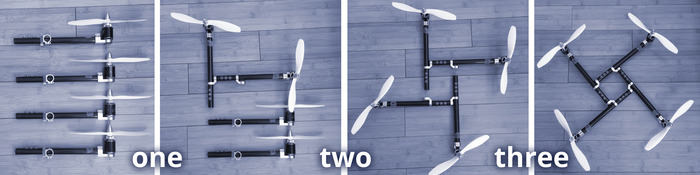
1. Unique lightweight frame - It's self-supporting™ carbon frame is a proprietary design never before utilized on quadcopters. It makes transportation and assembly a breeze while providing incredible strength.
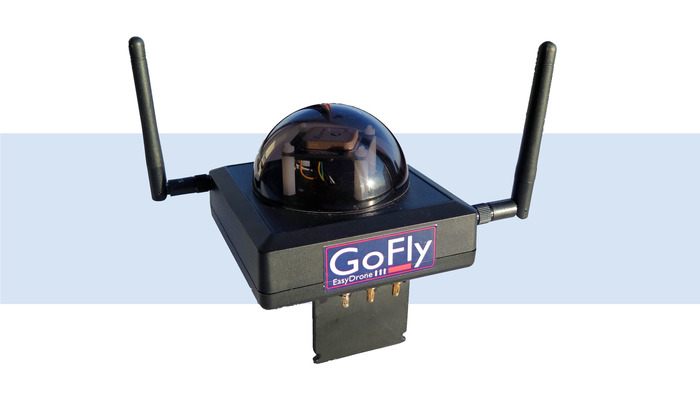
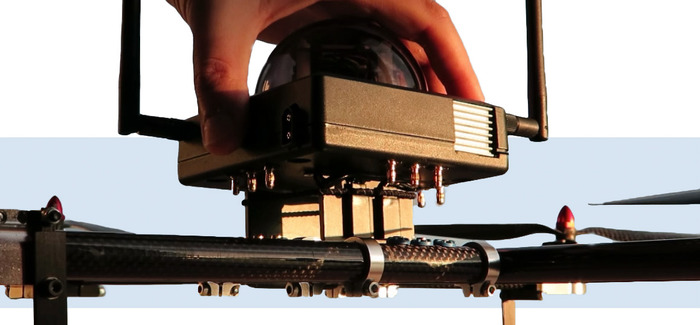
2. One compact command unit - Easy Drone's command unit (Fly Bot) has all the features you need built in and no wires! It's a true plug-and-fly solution.
3. Use one Fly Bot with multiple frames - Pre-programmed, tuned settings for any combination of motors and blades. Just wirelessly load new settings and it will be optimized for your new build.
Example: I like to use larger props and slower motors for the gimbal and faster ones for FPV flying.
4. Auto tuning for any configuration - with a flip of a switch you can make the Easy Drone determine it's own best settings, no manual tuning necessary.
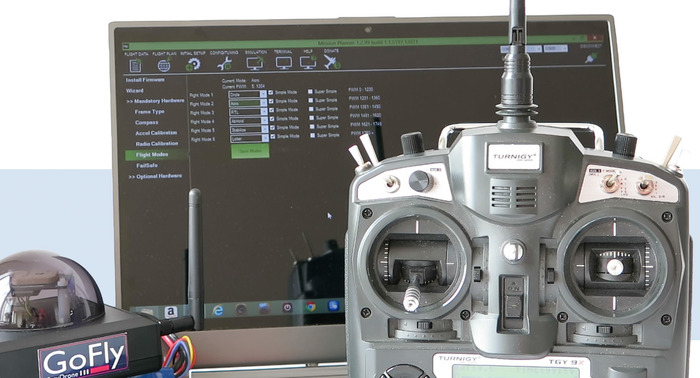
5. Six flying modes - EasyDrone can be flown in any one of the six flying modes with a flip of the switch.
6. Telemetry module built in - Connect to your computer or tablet to wirelessly change settings or set path points.
7. Video stream is not an option - it comes standard - Feel free to turn it off, but it is built in to every FlyBot so you can plug in any camera feed and see the live stream on the ground.
8. Camera battery never runs out - Power the camera in flight while transmitting video from it. Uses the main battery for power.
9. Important flight data on your video screen - See altitude, speed, battery status and dozens of other data points superimposed on your preview video.
The Easy Drone story
I made my first robot when I was 10 by combining parts from several RC toys my parents bought me. Since then I have been fascinated with remotely controlled machines where flying RC robots make the ultimate feat.
Idea development
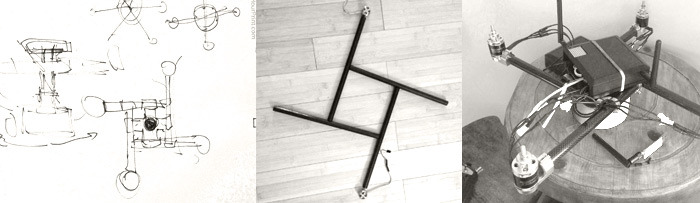
It has been six months from the first napkin sketch to first functional prototype. Another few months of testing and tuning followed.
I have tried many existing aerial videography solutions, but couldn't find one that was modular, easily customizable and had necessary features built in to it. Easy Dronewas developed to offer a modular solution for professional videographers and a fresh approach to drone design.
How is it better?
What you need from your aircraft for filming aerial video:
- ease of transportation and deployment
- flexibility in terms of lift power (different cameras) and maneuverability
- certain features (like wireless video) built-in, not added-on
- and you certainly DON'T want to deal with wires
Easy Drone is a modular multirotor drone that pushes the envelope when it comes to customization for different flying needs because one control unit can be used with any frame (combination of motors and props).
This allows you to go from a fast flyer to a slower, heavy lift by just plugging the control unit (Fly Bot) onto a different frame.
What has been done so far:
- Created 9 iterations of working prototypes
- Speed controllers/Motors/Battery combination performance testing
- Selected flight controller system
- Video link selection and testing
- On-Screen-Display module selection and testing
- Radio telemetry module
- Tune hardware and software
- Program radio controller
- Finalize production design
- Develop assembly capability
What we are planning to do (pending successful campaign)
- Expand our current shop o handle demand
- Secure alternative sources and vendors
- Order parts and components
- Marketing materials (instructions, packaging, etc.)
- Produce training videos and post on our website
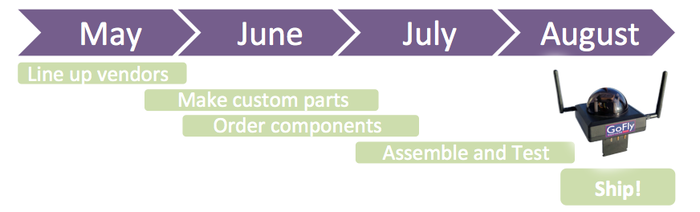
Production timeline for 2014
The Goal :: Why KickStarter?
Our goal is to make the Easy Drone a standard piece of equipment for photographers and videographers who like to shoot aerial videos. To make this a reality we need your support to set up mass production and get Easy Drones into the hands of you early adopters. We are confident that your experience will be our best recommendation.
Technical specs
There are two different frames that we offer at this time - L and XL. See their specs below. We will be coming out with many more different frames because with the Easy Drone there is an infinite number of combinations.
- Assembled weight (without camera) - 2.5lb (L) or 3lb (XL)
- Maneuverable camera weight - 1lb (L) or 1.5lb (XL)
- Autopilot - APM 2.6
- External GPS + Compass
- Telemetry freq. - 433 MHz
- Video link freq. - 5.8 GHz
- Radio freq. - 2.4 GHz
- On-Screen-Display: MinimOSD Rev. 1.1
- Battery monitor/power regulator
- Power - 3S LiPo 11.1V battery
- Remote - 12V LiFe battery
Flight times:
- All features on (camera power, gimbal power, video link on) - approx. 12 minutes
- Gimbal on - approx. 14 minutes
- No additional equipment - approx. 16 minutes
Flying time greatly depends on the battery, the amount of wind, style of flying and load so it's hard to say precisely what you'll get out of it. The above are some averages we have encountered so far. We are actively looking for the optimal battery/motor/prop combination to extend flying time.


I don't think I have to add much more in the way of a post. The exploded diagram of the platform at the end of the video says it all.
"The Royal Society for the Protection of Birds (RSPB) is using a remotely controlled drone to spy on the nests of endangered breeds and monitor the progress of reintroduced species.
Breeding patterns of bitterns and marsh harriers can be seen without disturbing precious habitat, and the RSPB is also using the drone to monitor how cranes and corncrakes are faring as they are reintroduced to the UK."
Full story by The Guardian is here.
Graham, Myself and the pilot Ryan after the successful 100+ KM flight
It seems to fly for a distance of 100 KM with our electric air plane equip with APM or so is a norm now a day. Someone even suggest to rise the bench mark to 150 KM as the entry level for long range challenge.
A few months ago, I gave it a try with my Skywalker carry 2 piece 6S 5000 mah battery in parallel. It travelled some 80 km before the ESC cut because of low voltage protection. Although the attempt was fail, but I learn some lessons. The first lesson was, it is not as easy as I think.
Skywalker is a little draggy by design, facing a strong head winds, sometimes it's ground speed will drop to a few KM per hour. It is struggling in windy condition and unfortunately, this is the condition where we usually have to deal with in tropical area. With the two big and heavy battery in the fuselage, it is also very difficult to find space for our mapping camera. But don't get me wrong, Skywalker, especially the 2014 version is a very capable air frame for what I consider mid range ( 20 to 30 KM ) mission.
Recently I read quite a number of good report of the Zeta Science FX 79. Being a flying wing design, it has a lot of space for battery AND my on board equipment. The removable wing also make this huge wing ( 2 meter wings span ) become very easy to transport.
For this 100 KM challenge, my set up is :
Zeta Science FX79
APM 2.6 external compass
3.02 firmware
Analog air speed sensor
2 pieces 6S 5000 mah battery in parallel
T motor 3110-470
APC 12 x 8
CC Edge 50 A
attopilot current sensor
CC 10A BEC
Savox 257 servo
3DR 433 telemetry.
Futaba 10C radio system
All up weight : 3.4 KG
I start the flight in the afternoon in windy condition. According to APM, the winds blow at 10 to 30 KM per hour in east or north east direction. It is certainly not a favourable condition to go for the badge but I would like simulate the actual flying condition for our usual mission.
Launching a big and heavy wings need a little caution, I wear a welder grove to protect my hand from the hungry rear propeller. With my power set up, take off is quite easy with a little head winds. After some minor trim and it start the mission.
The flight path was planned along our local Sandakan Turf Club race track. The distance of the track is 1.4 KM. This will be easier for me to confirm the total distance after the flight. I also plan it to fly at 100 meter hoping for calmer condition at lower altitude.
APM 2.6 and the latest 3.02 firmware was rock solid throughout the whole flight. After 78 rounds and the battery voltage drop to below 20 volt, I terminate the mission. After some simple calculation, it was 109 KM and APM show slightly more. The whole flight duration was one hour and 57 minutes.
My next target now is 150 KM WITH reasonable extra payload. After all, no point for us to fly for hours and come back empty handed.
I would like to thank Prof LianPin Khoo, Prof Serge Wich, Simon and Brenden of conservationdrones for their encouragement and technical advise. I also want to thank Graham who came all the way from Medan, Indonesia to have a great time flying together and tune up his conservationdrones Maja. He make the two long hours a lot of fun. Special thanks to the Arduplane development team lead by Andrew Tridge. Without all their hard work, we are still confine to fly a few hundred meter from us for fun. Thanks guys.
Here is the link for the tlog.
https://docs.google.com/file/d/0BwRKGgIOJSELWEFXd1dhblNuYjg/edit

From The Verge:
Instead of using a motorized gimbal to move the camera — which would add additional weight — the Bebop Drone uses an ingenius combination of software and hardware to let a 180-degree fisheye lens do the trick. Using a dedicated image processor and loads of sensors, the drone simply carves out a nice small rectangular section of the huge curved fisheye image while simultaneously stabilizing the image digitally. That means you wind up throwing away a lot of the data, but it's hard to argue with the results: a clear, stabilized video feed from a tiny drone that weighs less than a pound.
Besides, the ability to rapidly chop up pieces of a huge fisheye image allows the Parrot to perform another neat trick. If you buy the optional Skycontroller — a giant R/C flight controller with huge antennas that can communicate with the drone from a full two kilometers away — you can also plug in an Oculus Rift virtual reality headset and freely look around while piloting the drone from a first-person perspective. There was quite a bit of lag in a prototype we tried, which resulted in a painful-sounding crash into a wall, but it makes for an incredible out-of-body sensation and the featherweight drone emerged unharmed.
The elephant in the room is battery life, as the Bebop Drone is limited to 12-minute flights with its included 1200mAh battery pack. That's not a lot of time to get the perfect shot for a film, nor nearly enough to make a two-kilometer trip. It's also not clear what the drone might cost, but Parrot CEO Henri Seydoux said it will ring up somewhere between the original $300 Parrot AR.Drone and the $1,000 you might spend for one of DJI's camera-equipped Phantoms.
The Bebop Drone should ship in the fourth quarter of the year.
From USA Today:
The French company's new Bebop drone sports full HD video and cutting-edge image stabilization with a wide-angle 180-degree view. Like Parrot's other hobby drones, you control Bebop via an app on an Apple or Android smartphone or tablet.
What sets Bebop apart is the 14 megapixel fish-eye lens that captures and streams live HD views of its flight to the device you're using to pilot it and the stability Parrot is claiming, which is achieved by several on-board sensors — all in a device that weighs less than a pound.
The high tech specs make Bebop truly "a flying camera," Parrot founder and CEO Henri Seydoux told reporters at a demo in San Francisco last week.
Also available when it launches late this year: An accessory controller with four antennas that lets you tap into an amplified Wi-Fi radio to extend the flight range up to 2 kilometers. Battery life, though, is just 12 minutes.
Oh, and if you happen to be a tech geek with a developer version of the Oculus Rift augmented reality glasses, you can use those to pilot the thing.
No pricing details were announced.
Paris-based Parrot has been around since the 1990s and has an eclectic catalog. It started out selling wireless devices. Now, it offers headphones and in-car hands-free audio products. And it has buzzed into the commercial drone market.
It's perhaps best known for its app-controlled AR.Drone, which it showed off at CES in January along with a couple of other new hobby-level variations on it. The current flagship model costs around $300.
At the San Francisco event, Seydoux touted Bebop's pint-sized weight, maneuverability and ease of use. The geek-chic factor is incredible, to be sure. But Parrot also is clearly aiming beyond the small hobbyist market.
Seydoux imagined uses for business customers including architects. As part of the demo at San Francisco's historic Old Mint building, he gamely donned an Oculus headset and piloted Bebop indoors.
"This can be used as more of a tool than anything else they have done," says Andrew Amato, managing editor of a new website called Dronelife that covers the nascent drone industry. "I think it's going to appeal to the hobbyist market that Parrot knows well, but also to videographers and real estate and architecture-based customers."
Stabilization of the camera is key, he says. Currently, you can spend hundreds of dollars for add-ons to help stabilize drone images.
The latest drone from competitor DJI also is aimed at videography. Its Phantom Vision 2 weighs 2.5 pounds and can snap 14-mp images, record 1080p video, and livestream footage to a mobile device. It starts at $999.
The burgeoning drone industry has stirred no shortage of angst over privacy issues. Seydoux acknowledged the concerns. But he said restrictions inherent in personal drone use make it "not particularly more dangerous" than smartphone cameras or products like Google Glass.
As for the Oculus tie-in — that was a natural fit, says Amato at Dronelife.
"It's something that people who own both the AR drone and Oculus have already started playing around with. There are videos on YouTube of people who have custom-built systems like that."
From Hackaday:
The computing power inside a quadcopter is enough to read a few gyros and accelerometers, do some math, and figure out how much power to send to the motors. What if a quadcopter had immensely more computing power, and enough peripherals to do something cool? That’s what Phenox has done with a micro quad that is able to run Linux.
Phenox looks like any other micro quad, but under the hood things get a lot more interesting. Instead of the usual microcontroller-based control system, the Phenox features a ZINQ-7000 System on Chip, featuring an ARM core with an FPGA and a little bit of DDR3 memory. This allows the quad to run Linux, made even more interesting by the addition of two cameras (one forward facing, one down facing), a microphone, an IMU, and a range sensor. Basically, if you want a robotic pet that can hover, you wouldn’t do bad by starting with a Phenox.
The folks behind Phenox are putting up a Kickstarter tomorrow. No word on how much a base Phenox will run you, but it’ll probably be a little bit more than the cheap quads you can pick up from the usual Chinese retailers.
Hi UAVers!
I would like to show you the new Barcelona 100% 3D printed UAV.
https://www.youtube.com/watch?v=Ew334q5Dan0
https://www.youtube.com/watch?v=3mbl7IXBJHQ
Basic Features:
1500mm wingspan
1000mm fuselage length
845g operational weight
I think it is the first one in Spain, the second one in Europe and the fifth in the world (after SULSA, AMRC, WENDY & VAST) Is there any list of 3D 100% 3D printed UAV's?
Yesterday at the sUSB Expo in San Francisco, we were lucky enough to get a sneak peak of the new Parrot Bebop drone (AKA AR.Drone 3.0), which will be formally announced tomorrow at the AUVSI conference. Above is Parrot CEO Henri Seydoux at the controls.
This thing is amazing. It's a full GPS-guided drone, with a similar tablet/phone control as the original Parrot AR.Drone. But the big difference is that it now has a GoPro-quality camera with digital stabilization. That means that it has no gimbal, but is able to achieve the same effect entirely in software. I tried it and it was spectacular -- with nearly 180 degrees of stabilization range, acting just like a gimbal but without the mechanical complexity, size and weight. This means that you can get a much lighter, cheaper and smaller vehicle. Software eats the world!
The vehicle also has a special long-range radio and antenna combination to extend the WiFi range far beyond that of the original AR.Drone. And it's designed for outdoors use, unlike the AR.Drone. No pricing announced yet, but at first look, Parrot has a real winner with this one.
Photographer Edward Burtynsky and director Jennifer Baichwal give us an inside look into the making of their cinematic feat, Watermark. The documentary was shot using groundbreaking 5K ultra high definition photography and aerial technology and explores mankind's complicated relationship with water, using a diverse set of stories that challenge how easily we take it for granted.
By popular demand, 3DR is now selling the external Pixhawk USB and LED boards that are used in IRIS as stand-alone products. Great for adding an external LED and USB port to any vehicle you're using with Pixhawk. $20 for the pair.

UAE Application for public service drones award starts:
The UAE government on Saturday announced that it has started accepting entries for the ‘UAE Drones for Good Award’ that gives prizes worth around Dh4 million. The award aims to explore how people apply the technology of drones or Unmanned Aerial Vehicles (UAV) to improve people’s lives.
Not news, but a sign of the mainstreaming of drones. The New Yorker covers the ban on drones in US national parks:
This past week, a couple of volunteers at Zion National Park, in Utah, came upon a drone, equipped with its very own onboard camera, buzzing over a herd of bighorn. The sheep bounded away and, in the ensuing mayhem, several lambs were separated from their mothers. The volunteer spotted the offending filmmakers nearby and shooed them away. The park issued a statement reminding visitors that the use of unmanned aerial vehicles is strictly prohibited and punishable by a jail sentence of up to five months and/or a five-thousand-dollar fine.
Zion is not alone in its protest of drones. Just days before Zion’s declaration, Yosemite National Park, in California, had reminded visitors that drones of any type were unwelcome. Photo hobbyists have flocked to Yosemite and turned the park’s most popular vistas into buzzy air shows, much to the irritation of the park’s keepers.
...
Read the rest here.
From Hackaday:
There are a lot of cheap quadcopter kits out there, sold ready to fly with a transmitter and battery for right around $50 USD. One of the more popular of these micro quads is the V2X2 series. They are, unfortunately not compatible with any other radio protocol out there, but [Alexandre] has managed to use the transmitter included with his V202 quad to send data to an Arduino.
Like most quads, the transmitter that came with [Alexandre]‘s V202 operates on 2.4GHz. Listening in on that band required a little bit of hardware, in this case a nordic Semiconductors nRF24L01p. Attached to this chip is a regular ‘ol Arduino running a bit of code that includes [Alexandre]‘s V202 library.
Right now, the build can detect if the quad is bound or not, and read the current position of the throttle, yaw, pitch, and roll, as well as all the associated trims. It’s just the beginnings of [Alexandre]‘s project, but his eventual goal is to build an Arduino bot based on the code, complete with RC servos. Not bad for a transmitter that will be utterly useless when the microquad eventually breaks.
 (Image: Wikipedia)
Dear Jamie, Adam, Tori, Kari, Grant and production crew,
I'm a huge fan and watch your show since the first episode!
I'm sure you have by now noticed the dire situation in which not only us "drone"-hobbyists but in fact all R/C-hobbyists are in!
Fearmongers and your US FAA are painting horrible pictures of airliners going down in flames after colliding with a 2kg foam R/C plane or a comparable multicopter almost on a daily basis.
My dad having been CFO of a major German airline and thus me having run around in maintenance halls a lot when I was little, I believe that is a myth and many of us hobbyists believe it's propaganda.
There is no doubt that we hobbyists have an obligation to be safe at all times and nobody is advising unsafe behavior! But there is a difference between advising safety in a reasonable way and fearmongering!
Therefore, I would like to ask you to do a "drone dangers" episode! You already have shot chickens, frozen and not, into aircraft windows. Please now shoot R/C airplanes and multicopters into aircraft and aircraft engines, so everybody knows once and for all, what is going to happen and what isn't.
Please bust the drone myths!
-Stefan

A great announcement from DroneDeploy, whose cloud-based drone management service is optimized for APM and Pixhawk-controlled drones. From sUAS News:
Today, DroneDeploy launches their web-based drone control platform, enabling users to control drones over the internet. The software is designed to simplify drone workflows, making it easy to create high-precision surveys, agricultural maps, and point clouds.
The cloud-based software is enabled by their Copilot – a smart cellular telemetry radio, which makes it possible to control drones, directly from a smartphone or any internet connected device.
The Copilot not only controls drones, but controls the sensors. According to Mike Winn, CEO, “the Copilot can control several types of cameras, and can upload the data as it is collected, enabling automatic processing of the data. Drone operators can get stitched maps produced within minutes of landing, and share it with others instantly. Previously this would have taken hours!”
The DroneDeploy software can enable control of multiple drones, or in fact have many people collaborate in the operation of one drone. Jono Millin, CPO, explains “You can imagine a wind turbine inspection where engineers back in the office can get imagery back in real time, and coordinate closer inspection of turbines with potential problems.”
Nick Pilkington, CTO continued, “While there are so many applications of this technology, and we’re actually looking to create more by working with partners and specialists to enhance our workflows for more drone use-cases”.
The product launches today, with an “Explorer Program”, giving access to just 50 teams to start using their product. The device is $299, and applications start today onwww.DroneDeploy.com

