All Posts (11069)

Sort by

5334381075?profile=original

UPDATE

We have some good news. A battery manufacturer Titan Power is working with BatMon kickstarter backers to assemble BatMon into Lithium Ion batteries for free! Backers also get a 5% discount on Titan batteries upto $1000 purchase. Now, you can get a custom shape/size Lithium ion battery without having to assemble BatMon into the pack yourself.

Hi robot enthusiasts, 

We launched a kickstarter campaign to support production of “smartification” module for robot batteries. BatMon is a small module that can be attached to your lithium batteries to convert it into smart batteries.

Here are some of the specs:

  • Voltage, current, and temp sensors
  • 64 bit unique battery id
  • OLED display
  • Current battery life display
  • Automatic discharging to maintain cycle life
  • No discharge cutoff
  • Open  source case design 
  • Dual LED, optional buzzer
  • Cell balancing, with individual voltages
  • Only 12 grams
  • Compatible with SMBUS, PX4, Ardupilot, and Arduino
  • Integrated coulomb counting

5334380882?profile=original

BatMon data on QGroundControl: Individual cell voltages of 6S cell during flight

5334381455?profile=original

Opensource case design for a 6S Smart Battery

5334381869?profile=original

If you are interested in a smart battery for your robots or other projects, PLEASE FUND US at BatMon Kickstarter

Read more…
Distributor

I'm looking at a new project for 2020, I am working together with a company which has developed a 4WD RC-Controlled Hybrid Mulcher for grass cutting work on steep terrain.

The current version of the unit (see video) uses a ruggedized RC controller for the operator.

We are currently looking at implementing an autopilot system - so that the unit will be able to work inside an area (under supervision), but without the need for active steering by the operator.

I was wondering if anybody has already worked on something similar and would be happy to share their ideas and thoughts on this.

I will keep this post updated on the project :-)

www.diesunddas.co.uk
Read more…

Dear All

We are introducing Ellipso, a new domestic robot drone from FRACH robotics and we would like to hear your feedback!

Ellipso is an autonomous intelligent home robot drone, which is always online, listening to you and ready to execute your requests or just connect you with your loved ones. The robot drone implements an animal like brain model, so it behaves almost like it is alive. Ellipso is also integrated with Google Assistant, Google Drive, Google Mail, YouTube and Microsoft Skype to let you stay in touch.

Ellipso website

Please review the functionality, HW, SW & AI and share with us your views and suggestions.

Thank you so much in advance for your feedback!

Read more…
MR60

Research and build for a sub 250 drone capable of running Ardupilot in all of its functions (including autnomous flight) to maximize flight time.

Weight minimization is key to maximize flight endurance. Batteries represent the bigger % of total weight in such a build. In order to stay below the 250 grams limit (thank you @!_* regulators), 2S voltage is practically a constraint. Therefore research has to be invested in ESCs and flight controllers able to operate under such small voltage. Li-Ion appears to be the current only battery having the best capacity/weight ratio to build a lightweight 2S battery.

Then comes the frame optimization. Most drone frames are overbuilt on purpose in a hype to resist hypothetical circumstances that never happen or are simply unrealistic. Therefore there is a huge oportunity in researching frame design improvements that minimize weight while still maintaining enough rigidity and solidity.


Frame used in this video comes as a result of many hours and discussions in our private international research group of experts. In particular I would like to thank and put Ryan forward (see quadstardrones) who holds the current worldwide record of designing and making the fastest racer drones.

cheers

Hugues

Read more…

So, I started this project 2 years ago. Not cutting my hair until i finish it.

The High Altitude Balloon Return project aims to return a flying wing autonomously from a 100,000 feet. There's a lot of challenges associated with this. I tried to make my own flight controller in the beginning (Project log 1-6 to see this progress), now I'm using dronekit and Arduplane because someone with an IQ that isnt in the single digits told me I was being stubborn.

Or, if you just want to see the flight test footage:

Follow me and this project:

Twitter - twitter.com/ohitstarik & twitter.com/uavtarik

Instagram - instagram.com/ohitstarik

Real life - please dont

Linkedin - https://www.linkedin.com/in/uavtarik/

Read more…
3D Robotics

5334392480?profile=original

Hey, all 91,000 of you! After way too many years of an old-skool design here based on the original Ning network template of 2007, I'm thinking it's time to upgrade to the more modern Ning 3.0 service. It should be much more usable on mobile, big screens and otherwise the responsive, social-friendly platform you'd expect today.  It's also an opportunity to clean up the site without losing more than 13 years of content (which is a lot! Millions of pages...). 

I've set up a staging site where we can see and refine this site on Ning 3.0 before making the formal switchover.  It's here.

Would you like to help me update the site for a new decade? If so, please PM me and I'll give you edit access to the new site.

Thanks!

Chris

Read more…

Remote ID Proposal Outlaws Home-built RC Aircraft

5334391481?profile=original

I want to clear up a myth about the FAA's proposed remote ID rules that I've been seeing floating around. People think that amateur home-built model aircraft will be largely unaffected by this, since they can just fly at AMA fields. Or people think that to build and fly model aircraft outside of AMA fields, all they would have to do is slap some kind of transponder on their model and they are good to go. This is completely wrong. This proposal will effectively outlaw home-built model aircraft as most people actually build them. 

The reason for this is the production standards. The proposal contains two completely different types of rules: operational rules and production rules. The operational rules allow UAS without remote ID to be flown at a FRIA site. The production standards prohibit anyone from producing a UAS that does not comply with the remote ID rules, regardless of whether it is even flown. Just building a UAS for private use that does not comply with remote ID is a violation of the law, unless one qualifies for an exemption from the production rules.

Many people (including the AMA apparently) read that amateur-built models are exempt from the production requirements and think that means they're fine. However, the devil is in the details, which in this case is the definition of amateur-built, which "means an unmanned aircraft system the major portion of which has been fabricated and assembled by a person who undertook the construction project solely for their own education or recreation.

The FAA's proposal clarifies that this means more than 50% of the total components in the Unmanned Aircraft System (which includes the ground control station) must be fabricated and assembled by the hobbyist. Home-built models using mostly parts that are pre-fabricated and purchased separately are expressly excluded from this exemption:

UAS assembled completely from pre-fabricated parts. The FAA anticipates that some model aircraft enthusiasts may assemble UAS entirely from pre-fabricated parts and that commercial vendors may wish to sell UAS parts, including packages that contain more than 50 but less than 100 percent of the parts necessary to build a UAS. The resulting UAS would not qualify as amateur-built because the person building it would be fabricating and assembling 50 percent or less of the UAS. The UAS would not qualify as built from a kit because it did not include 100 percent of the necessary parts. Under these circumstances, the person assembling the UAS would be considered the producer and would be required to comply with the design and production requirements of proposed subpart F. (NPRM p. 152.)

We’ll leave aside the fact that the proposed regulation provides no way to quantify parts. Raw number of all components down to individual chips on circuit boards? Number of black-boxed components like receivers and flight controllers? Total mass? As currently written, the amateur-built exception to the production requirements would not apply to the vast majority of modelers. 

Even assuming parts are quantified by black-boxed components, most amateur model aircraft would fall into the pre-fabricated, rather than amateur-built category, as most people assemble model aircraft from a collection of pre-fabricated parts they buy separately from various manufacturers. They might buy the airframe as a pre-cut styrofoam body (for planes) or carbon fiber sections (for quads), then glue/screw it together and mount and wire up motors, flight controllers, speed controllers, receivers, and cameras and video transmitters for FPV craft.

The most anyone ever fabricates themselves is the aircraft body. Nobody is fabricating their own receivers, speed controllers, lithium batteries, motors, or remote controllers, so virtually no model aircraft hobbyists would actually qualify for the amateur-built exception which requires more than 50% of parts (however that is quantified) to be fabricated and assembled by the builder.

The vast majority of RC hobbyists would fall under the category of using more than 50% prefabricated parts that do not come as a single kit with 100% of the parts necessary to fly. The proposed regulation would treat such modelers as UAS producers, and would require them to comply with all the production standards to produce and certify a UAS as RID compliant. This process is long and convoluted, and is clearly contemplated to only be used by large corporations developing mass produced UAS to be sold to consumers (the proposal estimates this process would only ever be used by a few hundred corporate entities).

Let’s assume a hobbyist could even comply with the technical requirements to equip a model with remote ID (doubtful given the tamper-resistant requirement which would at minimum prohibit the use of open source flight controllers and could be interpreted to require the person who built the model to somehow prevent himself from bypassing the remote ID system). The certification process requires the purchase of multiple standards that could cost hundreds of dollars to even read, and the filing of extensive forms and reports with the FAA that is estimated to exceed over 50 pages and take hundreds of man hours to produce. It would be completely impossible for any individual hobbyist to comply with these procedures for their home-built model aircraft.

Thus as written in the currently proposal, building your own home-built model aircraft the way the vast majority of hobbyists actually do that would be illegal. It doesn’t matter where you fly them, or even if you fly them at all. Merely building a UAS without equipping it with remote ID and following the process to certify it with the FAA would be an independent violation of the law. It goes without saying that this would be completely unenforceable, but that’s not the point. Legally at least, this proposal will completely outlaw home-built RC model aircraft as they are actually made by hobbyists.

The FAA attempted to disguise this by putting in the amateur-built exemption, and then defining it in such a way as it will be impossible to actually qualify for. I fully expect the AMA to fall for this trick and act like everything is fine because of the amateur-built exemption and the FRIA sites, because they have always sucked at statutory interpretation and anticipating how regulations affecting model aircraft will actually be applied (Sec. 336 anyone?). That’s even without considering that the FRIA exemption for AMA fields is only intended to be temporary and will be phased out over time, leaving hobbyists with nowhere to fly where they are not subject to the operational remote ID requirements.

No matter what the AMA says, this regulation will be the death of amateur home-built model aircraft, period. It doesn’t matter if it’s a quadcopter or traditional RC plane, flown by an AMA member or not. We’re all affected by this equally, and all RC hobbyists have a duty to oppose this regulation wholesale as bringing about the extinction of our hobby. 
Read more…

Route Eagle 2380mm VTOL Long Range Airplane

5334390497?profile=original

Route Eagle 2380mm VTOL Long Range Airplane

My friend install electronic parts for this VTOL long range airplane. You could see coating full set of this airplane as below"
From different angle of this airplane

5334390871?profile=original

5334390682?profile=original

5334391078?profile=original

5334391655?profile=original

5334391261?profile=original

If you have any question about this airplane, pls let me know. My email/skype is skywalker-ellen@outlook.com.

Read more…

A drone to reforest Brazil

We spend the last month in Brazil in the University of Rondonopolis to build a drone for large scale restoration.

This is the video of the construction process. It can sow up to 10 kg of coated seeds in 10 minutes in 1 hectare.

Dronecoria was invited by the university to use the technology of drones to face the wildfires and illegal logging that are devastating the region, and investigate how drones could be useful in the seeding tasks.

The pilot project was developed as a workshop in drone building, repairing, and seed coating, to provide to the university with a powerful tool to experiment and investigate with aerial sowing procedures to deploy after the tests in the experimentation site.

The frame is open source, and we use Pixhawk as flight controller.
You can get more info in our site: dronecoria.org or in our social networks: linkedin, instagram, facebook or twitter.

Read more…
100KM

DeltaQuad first mapping VTOL with 61 Megapixel sensor

5334387861?profile=original

Vertical Technologies has successfully integrated the new Sony A7R mark IV on the DeltaQuad Pro #MAP VTOL UAV. This release marks the first VTOL mapping UAV that supports 61 megapixel mapping.

Earlier this year Sony announced the release of their highest resolution camera yet. the Sony Alpha 7R IV offers a full frame 61.0 MP back-illuminated Exmor R™ CMOS image sensor with latest-generation BIONZ X™ image processor

This camera system has now been integrated on the DeltaQuad Pro #MAP VTOL UAV. With this sensor the vehicle can produce imagery down to 0.4cm/px or cover up to 1200 hectares at 3cm/px in a single flight. A full coverage sheet is available here.

Vertical Technologies is a Netherlands based manufacturer of commercial grade VTOL drones for Surveillance, Transport, Mapping and Inspection. For more information please visit www.deltaquad.com.

Read more…

Build Your Dream Drone Research!

5334394863?profile=original

Hello! My name is Alejandra Rodriguez Vega (ale.rodriguez@asu.edu) and I am a PhD student and research member in the School of Arts, Media, and Engineering at Arizona State University. My current focus is on using design fiction to shape the future design of drones.

We have built an online platform http://dreamdrone.org/ where you can create your very own dream drone! All data will be confidential and no personal information will be shared from the participants. Please feel free to share and create your own drone!

Read more…
3D Robotics

Microsoft AirSim drone racing at NeuroIPS

5334386873?profile=original

From the Microsoft Research Team:

Drone racing has transformed from a niche activity sparked by enthusiastic hobbyists to an internationally televised sport. In parallel, computer vision and machine learning are making rapid progress, along with advances in agile trajectory planning, control, and state estimation for quadcopters. These advances enable increased autonomy and reliability for drones. More recently, the unmanned aerial vehicle (UAV) research community has begun to tackle the drone-racing problem. This has given rise to competitions, with the goal of beating human performance in drone racing.

At the thirty-third Conference on Neural Information Processing Systems (NeurIPS 2019), the AirSim research team is working together with Stanford University and University of Zurich to further democratize drone-racing research by hosting a simulation-based competition, Game of Drones. We are hosting the competition on Microsoft AirSim, our Unreal Engine-based simulator for multirotors. The competition focuses on trajectory planning and control, computer vision, and opponent drone avoidance. This is achieved via three tiers:

  • Tier 1  Planning only: The participant’s drone races tête-à-tête with a Microsoft Research opponent racer. The goal is to go through all gates in the minimum possible time, without hitting the opponent drone. Ground truth for gate poses, the opponent drone pose, and the participant drone are provided. These are accessible via our application-programming interfaces (APIs). The opponent racer follows a minimum jerk trajectory, which goes through randomized waypoints selected in each gate’s cross section.
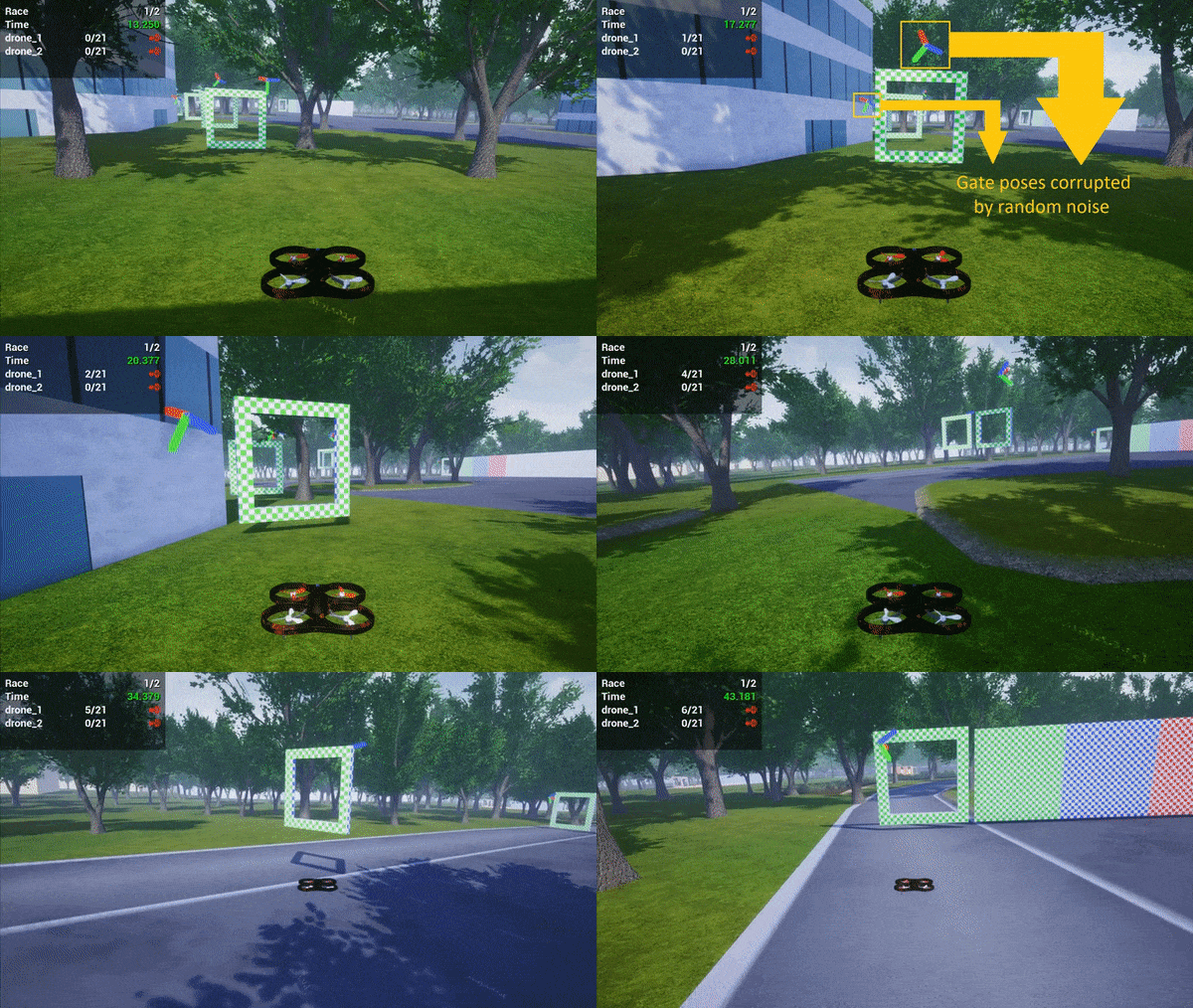
  • Tier 2  Perception only: This is a time trial format where the participants are provided with noisy gate poses. There’s no opponent drone. The next gate will not always be in view, but the noisy pose returned by our API will steer the drone roughly in the right direction, after which vision-based control would be necessary.
  • Tier 3 – Perception and Planning: This combines Tier 1 and 2. Given the ground truth state estimate for participant drone and noisy estimate for gates, the goal is to race against the opponent racer without colliding with it.

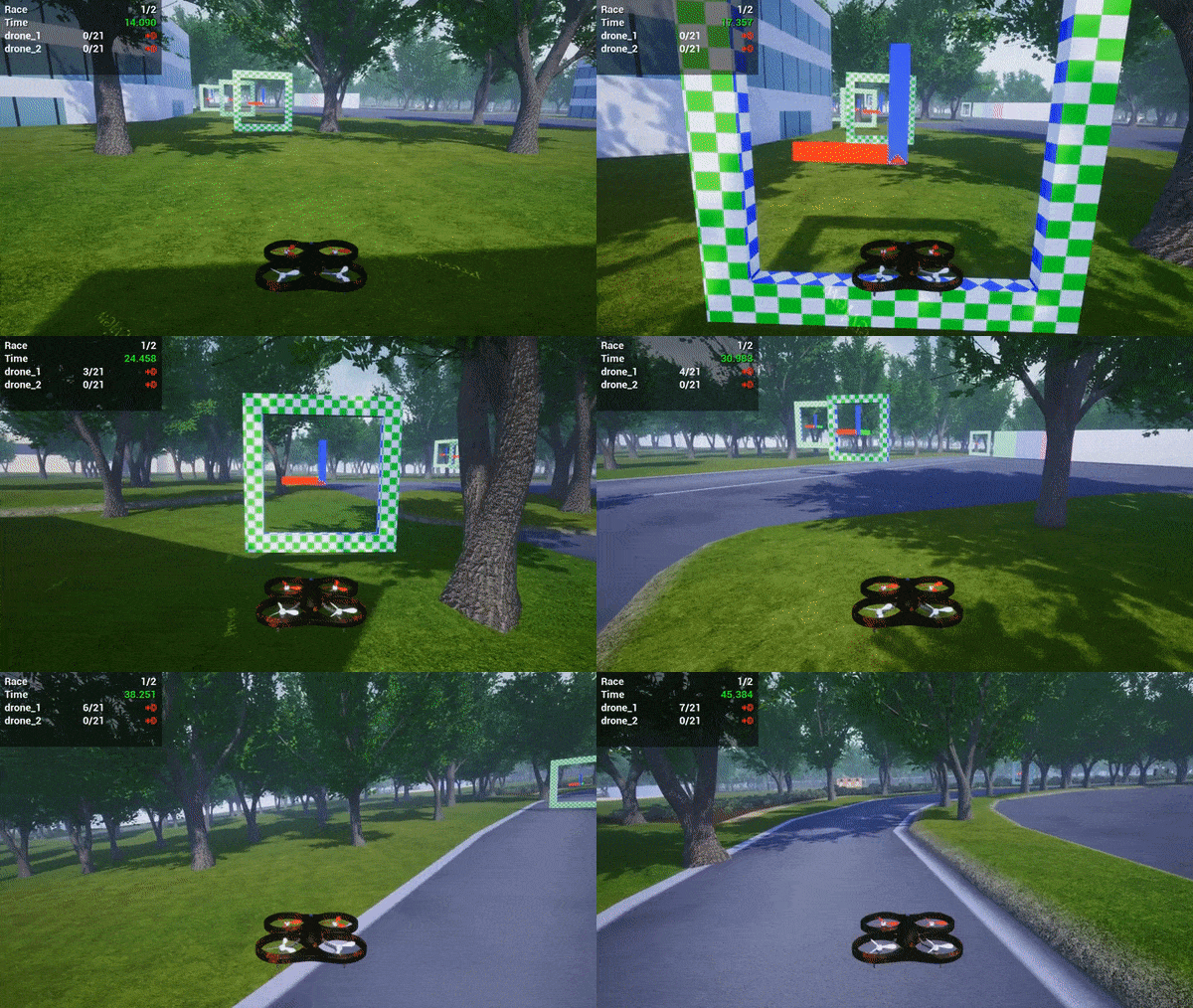
The animation on the left below shows the ground truth gate poses (Tier 1), while the animation on the right shows the noisy gate poses (Tier 2 and Tier 3). In each animation, the drone is tracking a minimum jerk trajectory using one of our competition APIs.

Image shows the ground truth gate poses


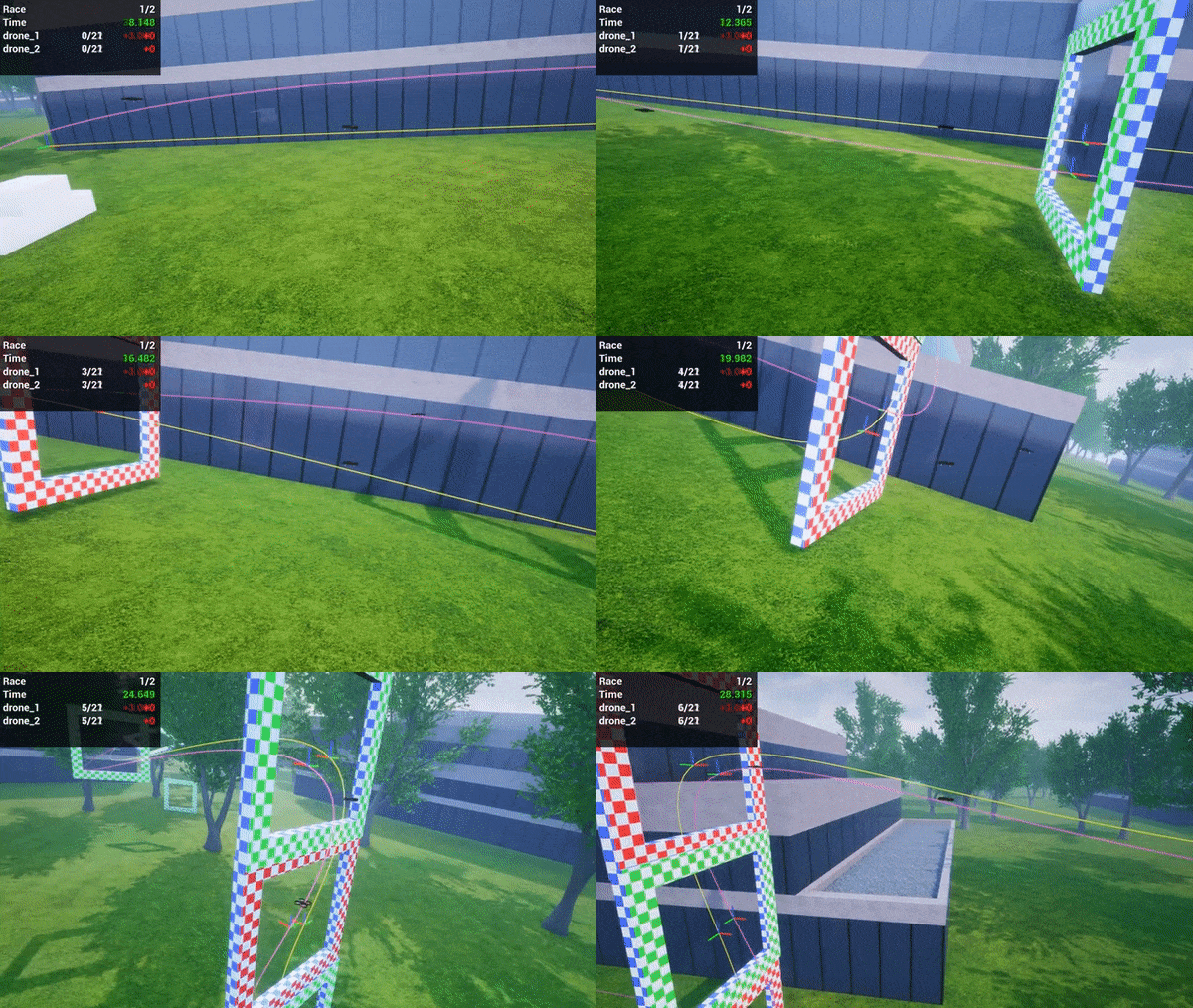
The following animation shows a segment of one of our racing tracks with two drones racing against each other. Here “drone_2” (pink spline) is the opponent racer going through randomized waypoints in each gate cross section, while “drone_1” (yellow spline) is a representative competitor going through the gate centers.

This animation shows a segment of one of our racing tracks with two drones racing against each other

The competition is being run in two stages—an initial qualification round and a final round. A set of training binaries with configurable racetracks was made available to the participants initially, for prototyping and verification of algorithms on arbitrary racetracks. In the qualification stage (Oct 15th to Nov 21st), teams were asked to submit their entries for a subset or all of the three competition tiers.  117 teams registered for the competition worldwide, with 16 unique entries that have shown up on the qualification leaderboard.

We are now running the final round of the competition and the corresponding leaderboard is available here. All of the information for the competition is available at our GitHub repository, along with the training, qualification, and final race environments.

Engineering-wise, we introduced some new APIs in AirSim specifically for the competition, and we’re continually adding more features as we get feedback. We highlight the main components below:

In the long term, we intend to keep the competition open, and we will be adding more racing environments after NeurIPS 2019. While the first iteration brought an array of new features to AirSim, there are still many essential ingredients for trustable autonomy in real-world scenarios and effective simulation-to-reality transfer of learned policies. These include reliable state estimation; camera sensor models and motion blur; robustness to environmental conditions like weather, brightness, and diversity in texture and shape of the drone racing gates; and robustness against dynamics of the quadcopter. Over the next iterations, we aim to extend the competition to focus on these components of autonomy as well.

For more of the exciting work Microsoft is doing with AirSim, see our blog post on Ignite 2019.

Read more…

5334384490?profile=original

there are lots of type of VTOL UAVs that can be used for aerial mapping platforms, for my personal option, I like 4+1 configuration. Simply it is more reliable and more stable on dual batteries system.

there are many of 4+1 VTOL Mapping platform in the market, I can list more than 30 of them, here I am introduce you the full composite material VTOL platform-Swift VTOL.

5334384870?profile=original

here is the question, is it expensive to build?

it is not cheap to make a composite material frame for sure, it is time consuming and also master skill required..

The Swift Composite Material VTOL Mapping UAV is a high quality Vertical takeoff and Landing fixed wing UAV with a very safe,more high reliable and effcient features. It can take off on ground less than 1 square meter, and had 1.5-2  hours duration depends on its payload. We have tested the aerodynamics both on simulation software and real field test, it is designed so that the air provides the optimal upthrust with minimum resistance. It can takeoff with 6S batteries power instead of 12S, when it cruises, the current usage is between 8-10A, the power consumption of this plane is 140mAh/1km, and futhermore, it has large interior fuselage space, so it can carry large size of payload or large size of 18650 li ion batteries pack.

5334385058?profile=original

you can choose 5010 400kv motor with 17-18 inch foldable props and 60A 6S ESC for quad propulsion system. 3520 550kv with 1380 props and 60-80A HV ESC for fixed wing propulsion system. 6-7S 18650 22000-25000mah li ion pack for fixed wing and 6S 4500+ lipo for quad motors. It has been tested and approved that it has 2 hours 20 mins flight time with payload (720g) for mapping mission.

list of parts:

Swift VTOL Frame

5010 400kv Motors

3520 550kv Motors

1755 foldable props (18 foldable props)

1380 pushing props

60A 6S ESC for Quad

60A HV ESC for Fixed Wing

pixhawk 2 with here 2 or (pixhawk V5)

so the cost of building it by yourself is around 3500$ for the VTOL plant only, and you have to choose your own RC or GCS and data telemetry. 

5334385452?profile=original

you should choose high C rate (100 above) 4500-5500 mAh Lipo battery for Quad motors.

and you can make your own 18650 22000mAh Li ion pack for fixed wing Batteries. or purchasing online like two of 18650 12500 6S Li ion.

In conclusion, building your own VTOL plane requires master experiences, it seems to be easy and does require detail oriented and fully understanding of VTOL Arduplane. I am sharing the pixhawk parameters here

the last two videos:

Introduce to Swift VTOL: https://www.youtube.com/watch?v=iOWLLDdv8mI&t=3s

Easy to setup the Swift VTOL: https://youtu.be/-I93z-QhB1g

Read more…

Pi-Connect released

5334383065?profile=originalI'm pleased to announce that after 9 months of design and testing, the Pi-Connect (Lite) is now available!

The Pi-Connect Lite is a HAT addon board for the Raspberry Pi that integrates the following into a single board:

  • 5.1V/3A BEC with high quality components
  • Telemetry port for connection to Ardupilot/PX4 based flight controller
  • Power switch for safety shutting down the Raspberry Pi

By putting all 3 functions into a single board, it makes for a far simpler (just plug it in and go) and reliable (all connectors are positively locked) setup when including a Raspberry Pi in an Ardupilot/PX4 powered vehicle.

For more information (and webstore), see www.rpanion.com

Read more…

Aerial Mapping Via Misson Planner

5334381488?profile=original

Hey Guys, we just conducted an aerial mapping on Mission Planner using one mapping VTOL, and the mapping camera is SONY A7R camera-based. Also, RTK/PPK system is used during the whole process. We want to share with you the video here and get more suggestions about mapping via the Mission planner.

Video link of the mapping: https://youtu.be/G-W3uIMTwVA

Read more…