All Posts (11086)

Sort by
Moderator

3689483959?profile=original

This last update  about VBRAIN add ON. In the picture you can see the first prototype of VR Neuron (Down) near the VR Brain (UP) . As you can see te board have the same mechanical design of VR Brain . The board is very compact 6x4 cm VR Brain 7x4 VR Neuron. You can put VR Neuron above and VR Brain up , connect the board by serial port and the use VR Neuron to connect the World :)

Above the board there is PAD for connect by an Header a breadboard or directly thw wire for add yor specific applciation. On the PAD there are available a lot of input output port 27 GPIO , SPI , I2C , Serial port .

3689483837?profile=original


In the next days will be more update until official presentation 9 November 2012 at Makers Italy .

In the last six month i decide to implement a new revolutionary design that could be usefull for add a lot on new functionality to our drones.

In the past we only work on micro controller : AVR , SAM3X, STM32 , great platform the last STM32f4 is best micro controller for manage our drone : acro and stable flight , loiter , waypoint navigation ecc ecc. But if i want to put on it a o.s. i start to have a lot of problem : small memory footprint available , not enough ram slow speed processor. So a lot of proposal .... ChibiOS , Nuttx . But what is better and opensource of the worlds ? No doubt It's Linux :)

In my professional work i used a lot of micro controller and micro processor , but all ,too complex to be hackable as a STM32. Until i start to play with a great Italian product , the first that put an Android on a wearable PC .

I like a lot the micro inside it and decide to use that microprocessor for my next opensource design.

I'm happy to present the first design of VR Neuron . It will be official present the 10 November 2012 at the Makers Italy exibithion so who would see our great new design are welcome to meet us at Makers Italy in Milan.

These are preliminary technical info about VR Neuron :

  • Freescale Imx Arm9 microprocessor.
  • 64 Megabyte Ram
  • Flash until 32 Gbyte Flash on SDIO bus
  • 456 mhz clock
  • DUAL BEC 5V Input
  • 1 for CPU
  • 1 for USB channel
  • 1 Pal Video Output
  • 2 Audio Channel Output
  • 1 Input audio channel
  • 26 GPIO (LCD BUS)
  • 2 i2c bus
  • 1 SPI MISO MOSI SCK
  • 2 serial Port
  • 1 USB Host 2.0 channel
  • Only 6x5 cm half of Raspberry PI

The operating system that i choose for my development is ArchLinuxArm , the powerfull of this design is incredible , i play a lot with the kernel and add a lot of usb device : wifi dongle , 3G dongle , webcam and install a lot of application and test it : apache2 , mysql , mjp-streamer .

So on this platform is possible to do anything of application , it's available python , gcc , i ply with mavlink_proxy and it work fine ... i connect the VBRAIN serial port to VNeuron and by wifi connect mission planner to VBRAIN and see live the telemetry of my quadcopter online.

With the PAL output could be possibile to develop a great OSD application or with oudio you can implement a tele presence systems ... the limit will be only fantasy :)

So i'm very exited about this project and i hope that you like it and join us in development.

Follow the evolution of project here :

http://www.virtualrobotix.com/group/armcopterdevgroup/forum/topics/penguin-project-introduction-and-started-the-developer-enrolment?xg_source=activity

Best

Roberto Navoni


Read more…
Moderator

24656.jpg?width=400

Here's some good news for people with a Turnigy 9X radio that are still using the default FlySky module.

HobbyKing has released a Spektrum DSM2/DSMX compatible module.  It has a working failsafe mode (the absence of which is a much-discussed topic), supports the popular ParkZone ARFS such as the Champ and Night Vapor, and uses the popular "Orange" line of DSM2 and DSMX receivers.

I've got mine on order and started a writeup here:

http://eastbay-rc.blogspot.com/2012/10/dsm2dsmx-jr-module.html

For some reason it's not showing a buddy code, but when/if it does I'll post that as well.

Read more…

Event 38 Enters Startup Chile

3689484995?profile=original

I know I've been quiet for a while but now that I'm almost settled into my new international home I figured I'd let you all know what I'm up to. Thanks to all my early customers and of course Jordi Munoz and Chris Anderson, Event 38 has recently joined the accelerator Startup Chile! Startup Chile is a program started by the Chilean government to attract small businesses to Santiago in the hope that it will create an entrepreneurial hotspot.. a Chilecon Valley.

You'll notice that everything is out of stock right now at Event38.com because I am also moving all production to Santiago temporarily. The long term will see a smaller US based office plus production internationally and potentially partnering with resellers to keep shipping prices low.

Look out for a new mapping plane in the next few months... cheaper, more rugged and easier to use!

If you're interested, check out my intro day slides I presented this morning to the other participants. Comments welcome!

Read more…

Seattle Police Consider Using Drones

seattle-drone--articleInline.jpgWe had quite a show last week as the Seattle Police held a public meeting to discuss their plans to use small surveillance drones for various purposes. Protesters made the meeting pretty much useless - lots of loud concern over civil liberties. I fear the coverage of offensive weaponized drones combined with a general concern over past misbehaviors by the police here have caused people to be especially suspicious of both the technology and the motives of the department.


The city is planning on spending app. $80,000 for two devices (which seems outrageous to me, but then again, I suspect they are getting a really good warranty).


I believe the ones they are looking at are the Draganflyer units (http://www.draganfly.com/)


Read more…
Developer

jDrones time to move on.... (part 1)

3689484906?profile=original

jDrones: 1.2.3.. Let's break the wall as it's time to move on....

We already stayed on our current office almost 2 years now and finally after a long search, it is our time to move to a next location. Our current office is getting just way too small and we have already expanded it to hold some of our bigger machines that we use to produce some of our parts. And there are more machines on their way so we can ensure that in future production quality and capacity is getting better and better. 

As we always been big part of this great DIYDrones community, and same thing like 3DR shown their new facilities, it is now our time to show few insiders of our new office. Also if you ever visit on Bangkok/Thailand you are most welcome to visit our office. Just contact us before your arrival so we can send map/destination details for you.

Anyways we did search quite long of this new area. Bangkok is a big city and it's not so easy to find areas with good access, flying areas etc on closeby but we did manage to find one.

First small background details of our new jDrones office: It is a 3 storey "town house" style with 2 units. Total office/factory area is around 420m2 (4500 ft2). Left side of the office we will have all engineering, manufacturing and testing, on right side there will be administration, packing & shipping.

So 1.2.3 let's break the wall.... On first month everything was looking bad or even worse, our engineers just wanted to break everything on the building. Dust and pieces of concrete lying everywhere. 

2nd floor where administration/management will be and oh more pieces of concrete.. You should never give big hammer to engineers, they have a bad habits to break everything.  

3689484928?profile=original

Immediately after the wall breaking operation was done at inside, we did build extra rooms on back side of the building so future expansion is easier.

3689484804?profile=original

Finally after month or so it was time to start put something back together, floors were done and it's time for first layers of new paint on the walls. Things are starting to look a bit better.

3689484950?profile=original

As we are working on flying devices, our walls have nice sky blueish color. Many of our customer know this girl already, Nin who is in charge of admin and shipping. After her daily packing and admin jobs were done at old office, she came to new office to do some paining jobs. She says that painting is really relaxing after packing and administration jobs.

3689484856?profile=original

Finally it's time to start closing those big holes that construction engineers made earlier. Time to assemble doors and walls between units. 

3689484818?profile=original

After inside doors were ready, engineers assembled front door/wall frames so we can keep precious cool air inside and naturally hot air outside. 

3689484967?profile=original

Things are finally starting to look promising and we can start to plan move soon. There are still many things to do before whole office is ready but it will be ready soon enough.

Part 2, coming soon shortly. We plan to move all operations to new office at end of October

Everyone welcome to visit us on new office starting from November 2012.

Jani / jDrones

Read more…
3D Robotics

Lettuce Bot, part of the coming robotic farm

3689484499?profile=originalI think agricultural uses are going to be one of the main drivers of commercial drones and other robotic technologies, so I love stories like this. From The Economist:

[Lettuce] is a fiddly business. Not only does lettuce need to be fertilised and weeded, but also "thinned" so that good plants do not grow too close to each other, inhibiting growth. Much of this is still done by hand. Labourers, who tend to be paid per acre, not per hour, have little incentive to pay close attention to what they pull from the ground, often leading to unnecessary waste.

Enter Lettuce Bot, the brainchild of Stanford-trained engineers, Jorge Heraud and Lee Redden. Their diligent robotic labourer, pulled behind a tractor, takes pictures of passing plants. Computer-vision algorithms devised by Mr Redden compare these to a database of more than a million images, taken from different angles against different backdrops of soil and other plants, that he and Mr Heraud have amassed from their visits to lettuce farms. A simple shield blocks out the Californian sun to prevent odd shading from confounding the software. 

When a plant is identified as a weed—or as a lettuce head that is growing too close to another one—a nozzle at the back of the unit squirts out a concentrated dose of fertiliser. If this sounds bonkers, it turns out that fertiliser can be as deadly as a pesticide, which is why farmers usually sprinkle it at a safe distance of 10-15cm from the plants to be nourished, so as to dilute its effect. So the robot not only kills weeds and excess heads, but feeds the remaining crops at the same time.  

The battery-powered system crunches the image data fast enough to work with 98% accuracy while chugging along at a bit less than 2kph. In September Blue River Technology, a start-up founded by Mr Heraud and Mr Redden, raised $3m from Khosla Ventures, a venture-capital firm active in agribusiness. The launch of a fully operational, ruggedised version of the robot is planned for next year. Mr Heraud is coy about Lettuce Bot's cost, but says it will be competitive with manual labour.

Its creators are also working on a machine capable of excising weeds mechanically using a rotating blade. (Indeed, the robot was originally conceived as an automated lawnmower for parks and other public places but legal issues—think spinning metal blades in areas frequented by children—prompted Mr Heraud and Mr Redden to turn to agricultural users instead.) That would make it a boon to California's "organic" farmers who eschew the potent, weed-killing fertiliser. 

Next in Mr Heraud's and Mr Redden's sights is corn (maize), America's biggest crop. Teaching the robot to deal with plants like tomatoes, where distinguishing weeds from the crop can be hard even to a trained human eye, will take longer. But where Lettuce Bot treads, other salad bots are sure to follow.

Read more…
3D Robotics

Looks like fun, and $85 isn't bad for the early backers (I'm among them). Details here.

The iStrike Shuttle was designed with the iOS in mind. We wanted to create something that was unique and unlike anything else out there. The iStrike Shuttle’s sleek vertical body gives it an almost human-like characteristic in its flight pattern and makes use of built-in balancing gyro technology which results in a more steady flight.

For greater ease of use, we have developed an app with multiple operation modes that will suite right and left handed people. In each mode, different operations are done by sliding your fingers over the controls on the screen of your iOS device. You can also use the G-Sensor swivel motions to make the iStrike Shuttle move. After a bit of practice you will be able to hover over your targets with a simple touch of a button you can drop the ball wherever you want.


Read more…
3D Robotics

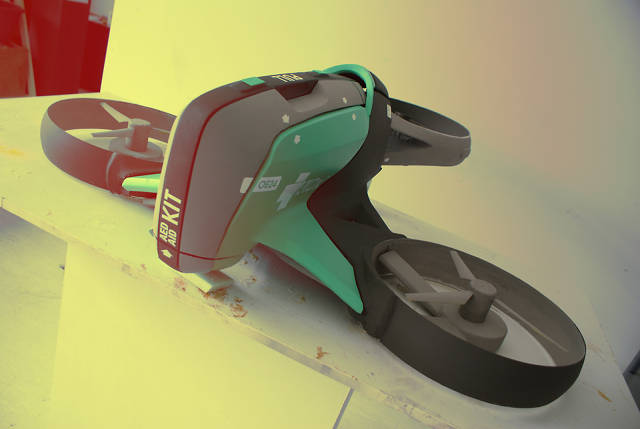
Defibrillator drone?

Fast Company reports:

A USA Today investigation a few years ago found that, of the 250,000 fatal cardiac arrests that occur outside of U.S. hospitals every year, up to 76,000 cases were treatable. That is, the patients would have survived if the ambulance had got there in time. A quick zap with a defibrillator was all that was needed, but many cities could not promise a response within six minutes--the standard survival window.

The normal reaction to this might be: invest in a better ambulance fleet, more call centers, and so on. But Stefen Riegebauer, a graduate student from Austria, has a different, more futuristic, idea: to build a first aid drone network that gets people and equipment to the scene more quickly.

His idea works like this: You create an app that anyone trained in first aid signs up to, creating a mobile community. You then station defibrillator-equipped drones on top of tall buildings across the city, linked by sensors. When someone needs help, they, or someone nearby, sends a request. The nearest first-aider accepts the task, and rushes to the site, and the unmanned vehicle sweeps from the sky, delivering the kit where it’s needed. No more ambulances battling the traffic. No more sirens blaring away waking up the kids. Fewer deaths from tardy responders.

Simple, no? Well, maybe not. But Riegebauer has built a non-working prototype, his visualizations are pretty funky, and he says the drone technology already exists. A team at MIT recently unveiled an autonomous UVV capable of flying at 22 mph in tight spaces; Riegebauer says it would be ideal.

"Autonomous systems are where we are heading," says Riegebauer. 'Why shouldn’t we use them for emergencies, if it can help you?"

His idea has received the backing of the James Dyson Award, reaching the last-15 stage. But Riegebauer stresses that he doesn’t see drones replacing ambulances and staff completely. They would be employed only if they were closer and likely to get to the scene faster.

Read more…
Moderator

3689479971?profile=original

This project has been blogged here almost a month ago. Now they are closer to their deadline ($105,345 needed). Recently they've provided many interesting updates on the project (I wish they've done that sooner). 

As a backer I'm excited about the potential applications it could support. As John pointed out in his original post, not only this could be used for future autopilots, but also for vision based navigation systems.

more information from their kickstarter page,  

http://www.kickstarter.com/projects/adapteva/parallella-a-supercomputer-for-everyone

some excerpts from their page,

The following list shows the major components planned for the Parallella computer:

  • Zynq-7010 Dual-core ARM A9 CPU
  • Epiphany Multicore Accelerator (16 or 64 cores)
  • 1GB RAM
  • MicroSD Card
  • USB 2.0 (two)
  • Two general purpose expansion connectors
  • Ethernet 10/100/1000
  • HDMI connection
  • Ships with Ubuntu OS
  • Ships with free open source Epiphany development tools that include C compiler, multicore debugger, Eclipse IDE, OpenCL SDK/compiler, and run time libraries.
  • Dimensions are 3.4'' x 2.1''
Read more…

Hexa Fun

I've managed to get everything up and running again! This is my newish hexa from uDrones (I've decided to forgo a rant on that subject for now). After working around my PDB issue (still unsolved) and engaging in some close combat, things are looking good.

Recently I have been working on a research project involving autonomously acquiring imagery and data for GIS processing so I've been trying to put in as much time as possible before the snow starts flying. Over the past few weeks I've become significantly more confident in my flying abilities, as the video might infer, and I'm very happy with how the hexa flies with the APM2.5 and AC 2.8 (i've been just lazy enough to avoid upgrading to 2.8.1).

Thanks to everyone who puts so much time into developing all the parts and systems which make these amazing things possible!


Cheers,
Eric

Read more…

GoPro low-pro 2.5mm AV plug

3689484410?profile=original3689484395?profile=original3689484427?profile=originalHere are a couple of images that show a hacked 2.5mm 4-pole AV plug cut down to its smallest possible form.

 I converted this to 3-pole by omitting the tip. For mkII I will keep the tip for mechanical reasons, GoPro puts out only one channel of audio for live view, so we just need the first 3 poles to have conductors attached.

 The motive was to be able to have live video out while using the waterproof case, and it works! I bring the wires through the back of the case, where they are sealed and a servo lead terminates on the outside. This position is a neutral point for the tilt and roll arcs, a great place to make a connection!

3689484251?profile=original

Read more…
T3

EPP FPV Wing Project

3689484305?profile=original

I have designed my own flying wing and had it cut from flyingfoam. I would love the input of some of the members of DIYDRONES. The span is 60", I chose an MH60 airfoil and added about 2 deg washout. I cutout the motor mount and servo mounts on my CNC router. I'm turning an 850kv motor rated at something like 100w with a 10x4.7. (I'm gonna burn it out at this rate, but oh well, it was cheap.) Flies great on 3 cells. Its a rocket ship on 4S. 

I've found the CG to be super finicky, only about a .375" range that it flies acceptable in, at about 15% MAC. Notice in the picture I running a monster 5Ah 3s. This is what I had laying around, I think its a little to big. I think a 2Ah 3S pack would be better weight wise. Because its nose heavy I have huge control throws. If I'm not careful when I get slow and start turning its easy to find myself in a semi-stalled over banking situation. The only way to break that is to let up on the back pressure and apply a lot of opposite aileron. It does have a tendency to spin if I sit on the elevator full aft. I think this is because I have insufficient washout and giant elevons at the tips to compensate for the CG. 

Hand launching is a breeze, just give it a little throw while holding onto the battery pack. Landing is an easy affair. It will fly inverted, rolls are not dialed in yet, still messing with differential.

I would love anyones input on the stall characteristics or anything else regarding this bird When I've learned what I can from this I am going to order up a new set of cores with whatever changes I think are necessary, probably more washout, and maybe tips cut with a little toe in. 

Eventually I want to put my Ardupilot 2.5 recessed into the foam with an FPV setup. Just ordered my goggles! 

Anyone interested in having me cut them anything custom on my CNC router, I've got a 24"x36" CNC router setup. I am tooled mostly for composites like carbon fiber and G10/FR4, but can cut most anything. I'd love to help out the community here with a reasonable CNC service. Send me a PM. 

3689484356?profile=original

I made my motor mount way to big. I'm going to make a low profile one. 
3689484323?profile=original

I just glued the servo mount down with thick CA. My z-bend sucks, I know. The control horn goes all the way through the elevon and is glued in with CA. 

Read more…
Developer

New Throttle PID Idea

3689484042?profile=original

Hi All,

I have been thinking about the way we have implemented our throttle and the performance issues that we have observed. First of all I would like to say that I get great altitude hold. I can cruise around at 1 or 2 meters above the ground with no problems. It is only when I start to get aggressive with my pitch, roll and speed that I start to see areas that we could improve. So I started thinking about how we are doing things and why this might cause us problems.

So the problems I see are:

  1. The pwm input to the esc is not linear with respect to the lifting force generated by the motors. Randy improved this by adding a throttle curve, however this can only be truly accurate for a particular combination of esc, motor, and propeller AT HOVER. When we start to climb, descend or move forward, the curve changes and we are back to a non linear response.
  2. Boost throttle compensates for the angle that the copter is compared to the ground. But how much do we compensate? We don’t know because of point 1. We know what force we need but not how this translates to pwm. Hang on...... Force.... Acceleration.....

So I got thinking about how we could ensure we could get the correct acceleration from the props for any given situation. Then I thought we have a sensor to measure that!!! Why don’t we put the Z accelerometer in a pid loop to directly measure and calibrate the lifting force supplied by the motors and propellers. The Pid loop design I started thinking about is shown above and compared to our current design at the top of the figure.

This has a number of advantages over the current system:

  1. The last pid loop, running at 100 Hz, takes an acceleration request then uses the z-axis accelerometer to vary the motor pwm until the required acceleration is achieved.
  2. The last pid loop linearises the rest of the system making analysis and tuning simpler.
  3. The frame translation takes care of the angle boost function automatically.
  4. When at hover or in fast forward flight changes in pitch will cause much smaller variations in altitude because the last pid loop will be working to ensure the vertical acceleration (in the earth frame) will stay as close to 9.9g as possible. We no longer are waiting to detect a change in altitude, we are reacting when we feel that we are accelerating at the very beginning of the unwanted movement.
  5. This should also improve the rise on yaw problem. As the yaw command is entered we experience a positive acceleration body frame z axis. The final control loop should sense this very quickly and reduce the throttle to bring it back to 9.8G.

There are a number of problems we may also need to solve:

  1. The z accelerometer will have noise that may need to be filtered. A moving average filter is the best choice for this because it give the greatest noise reduction with the fastest step response. This filter will be one of the biggest contributors to the delay in the throttle control.
  2. When at rest on the ground the copter will experience an acceleration in the vertical direction of 9.8G provided the motors are going slower than that required to lift off. How do we ensure that the copter provides the user with the appropriate feedback to let them know that they are near hover or not? How does the user know when the copter is about to lift off? This could be a problem because the integrator could wind the motors down to minimum throttle. This may not increase until the requested G increases above 9.8 and then it could increase very quickly to make the copter take off as requested. I believe that these effects could be minimized by sensible selection of Imax in the final loop but only experience will say.

Ok, so that pretty much sums up my idea. I would really appreciate any feedback that people can give. Has this been tried before? Does anybody know if this is being done in other systems?

Thanks for taking the time to read this far,

Leonard

Read more…