All Posts (11086)

Sort by
3D Robotics

Open source Iridium modem

3689701767?profile=originalFrom sUASNews:

If over the horizon satellite communications are a requirement you are in luck! An Outback Challenge team from Holland just helped you out.
For participation to the https://uavchallenge.org/medical-express/ the http://mavlab.tudelft.nl/ team had to design a cheap and light weight iridium satellite communication module for there www.delftAcopter.nl.
As there is huge interest from the UAV community in using light weight and reliable satellite communication the http://mavlab.tudelft.nl/ made the iridium development open-source so the UAV community can benefit from this achievement.
For the opensource hardware and software see:

Read more…

3DR Solo for $399. Is this even possible?

3689701741?profile=original

Hi guys,

i just came across this reddit post which claims that 3DR Solo is now available at Best Buy and Amazon for $399.

It all looks valid, but the price seems tobr to good to be true for me. 

Take a look at this:

https://www.reddit.com/r/drones/comments/55i6he/3dr_solo_drone_price_dropped_to_399/

Is this even possble? :)

I wonder how many customers will resign from DJI P4/Mavic for 3DR Solo, if this price will remain. I have 6 copters my self, but for $399 i am getting one more for sure.

Best Buy:

http://www.bestbuy.com/site/3dr-solo-drone-black/5351035.p

Amazon:

http://www.bestbuy.com/site/3dr-solo-drone-black/5351035.p

With this type of prices the sky will be full of robots soon! ;)

Cheers!

Read more…

XtremeOSD

I would like to formally announce the availability of the XtremeOSD. It is a full color pixel graphic OSD with support for many popular flight controllers including Pixhawk over serial and DJI over CAN bus and others. The XtremeOSD is feature rich. It is designed to be used on copters, planes, rovers and can even be implemented in the ground station to save weight and space on the vehicle. 

  • Flexible voltage regulators 7.2V to 36V input
  • Multiple camera input and display output support
  • Switchable main and PiP live cameras
  • Both main and PiP camera ports are switchable between 4 cameras each
  • Easy Firmware upgrades
  • Waypoint display on supported flight controllers
  • Virtual position indicator
  • Serial pass-thru of telemetry data
  • Real-time hardware assisted color graphics
  • NTSC/PAL
  • CVBS/S-Video/Component camera support
  • CVBS/S-Video display support
  • On-screen instruments can be enabled or disable to add or remove them from the display
  • 3 screens, full instruments, text only critical data across the top line, and video only

For more information please visit: XtremeOSD

If you have any questions, please ask!

Read more…

3689701656?profile=originalThis afternoon I received an email from FPV UK.

I haven't fully digested, but FPV UK is a proponent of protecting us and our hobby.

I haven't posted here in a good while, but this sparked my attention.

The European Aviation Safety Agency EASA have a prototype rule book out for review.

It says that  home built Unmanned Aircraft shall not exceed 250grams ( a gopro and gimbal alone weigh more than that)! among other things, like a ceiling cap of 50m, 100m max distance from operator and speed limit of 33mph (personally not so concerned about 33mph, but still think its daft).

operator registration does not have to be a bad thing if done properly...but lets see, I cant see details of what is required for a suitable registration.

https://www.easa.europa.eu/easa-and-you/civil-drones-rpas

and more importantly 

https://www.easa.europa.eu/system/files/dfu/UAS%20Prototype%20Regulation%20final.pdf

Lets hope as a UK resident and if the government follow the the voted wish of the UK masses, will not need to worry about this over zealous regulation if it comes in...if we are lucky.

Read more…

Precis-BX305 Quick Start Video

A quick start video provides basic instruction for setting up and using Precis-BX305 RTK solution. For details, please refer to Precis-BX305 user guide. 

Stay tuned, Precis-BX316 is coming very soon…
  • Multi-GNSS Signal Tracking
    • GPS L1L2/GLONASS G1G2/BeiDou B1B2
  • Reliable Centimeter-level Positioning
    • Up to 20Hz RTK solution output
  • Dual-Antenna GNSS Heading
    • Accurate yaw & pitch angle of moving platform
  • Accurate Shutter Synchronization
    • Ideal for aerial mapping and drone
  • Raw Observation Data Logging
    • Onboard SD Card for data logging & storage
  • Smaller, Lighter 
    • Compact and lightweight design

More details, contact us info@tersus-gnss.com

Read more…

FlytSIM - 3D simulator for Drones - Now on Cloud


FlytSIM is a 3D simulator that helps in the development and testing of commercial drone applications using the FlytBase platform. FlytSIM is now available on cloud and can be accessed through your web browser.


Development of commercial drone applications involves integrating payloads, coding business specific logic and building custom user interfaces as web/mobile apps. To address this, FlytBase offers a platform with FlytPOD (advanced flight computer), that runs FlytOS (operating system for drones), and a set of developer tools, including FlytSIM (3D simulator).


FlytSIM offers a SITL simulation environment for testing user apps without the drone hardware. The drones and a virtual world is simulated using a ROS-Gazebo based setup. The autopilot in simulation uses the same control algorithms as on the FlytPOD making the behaviour closer to real flight.

3689701712?profile=original

FlytSIM has now taken to the cloud with Beta release of FlytSIM (cloud). It is a web-app which provides a 3D software simulation environment for drones, right from the comfort of your web browser. Applications developed using FlytAPIs (RESTful and websocket) can be tested in FlytSIM (cloud), before deploying on real drones. First login to the flytsim cloud portal. Then just direct the API calls in your app to FlytSIM (flytsim.flytbase.com) with your username as namespace. This will allow you to interface with the drone in FlytSIM from your app.

      Screenshot_2016-05-26-17-56-42.png    Screenshot from 2016-05-26 17_59_58.png


Taking FlytSIM to cloud had several motivations, including ease of access without having to install a virtual machine or a native Linux, ROS based setup. Secondly, web-app allows cross-platform support, allowing developers to develop apps on their platform of choice. Also, introducing updates and new features becomes seamless. This offers developers a pleasant drone application development experience, while keeping it safe, and saving them a huge amount of time and effort.


We are accepting signups for a limited time. Subscribe to this program here, and we would revert to you with your subscription details.


For more details:

Website: flytbase.com

Docs: docs.flytbase.com

Read more…

iMavlink - iOS Ground Control for ArduCopter/PX4 Drones

Z8pnoLUl.jpg

Hi!As some may know, I have been working on a new iOS based GCS called iMavlink. I have just released the version 1.0 of the app! 

As you can see, the app is has a clean and simple UI, with many features.

Features:

  • GPS Location of drone
  • Set, edit and delete waypoints
  • Arm/Disarm
  • Display VFR information such as altitude, yaw, pitch and roll.
  • Voice alerts for mode changes and other important information
  • Edit Parameters
  • Log flights for future reference
  • GPS Status of drone
  • Distance from home/device
  • Battery voltage display and warnings
  • Calibration of battery monitor and accelerometer
  • Light and Dark themes
  • Manage multiple BLE Repeaters
  • Live video feed from drone (if supported)
  • Change flight modes
  • And many more

For more info please visit http://imavlink.com

Download on the App Store Here

You must have either the BLE Repeater device that accompanies the app, or a Wifi connection to your drone (such as 3DR Solo). You can purchase the repeater from here: http://imavlink.com/store

If you purchase the BLE Repeater, the app is included for free!

If you have any questions please ask!

Read more…

One of the world’s first automated inspections by an intelligent drone with deep learning capabilities was demonstrated at the GPU Technology Conference Europe today by Aerialtronics, a Dutch manufacturer of technologically advanced drones, Neurala, a pioneer in deep learning software, and NVIDIA®, the world leader in GPU-accelerated computing.

This new “intelligent drone” identifies objects and their condition in flight, which dramatically increases the efficiency and accuracy of documenting assets, lowering costs, and making it easier for frequent inspections. It adds to the use of commercial drones to help businesses access difficult and dangerous areas, such as cell towers and turbines.

Aerialtronics and Neurala collaborated to make the demonstration on the Altura Zenith UAS, which incorporates the NVIDIA Jetson™ TX1 module. The resulting system can visually inspect a cell tower and recognize the equipment mounted on the mast. This is the first step required to start automating the documentation of assets, and assessing the mechanical functionality and condition of the cell tower to identify rust and other defects..

The real-time processing of the data stream is made possible by combining Aerialtronics unmanned aerial system and their smart dual camera payload with Neurala’s deep learning neural network software, which is capable of finding and recognizing objects in flight, using the NVIDIA Jetson TX1 platform.

“The Jetson platform features high-performance, low-energy computing for deep learning and computer vision, making it ideal for products such as drones,” said Serge Palaric, vice president of EMEAI sales and marketing of embedded and OEM at NVIDIA. “These drones can handle complex or dangerous tasks without risking human life, which is game changing for many industries.”

source: http://www.aerialtronics.com/2016/09/ai-powered-drone-inspections-unveiled-aerialtronics-neurala-nvidia/

Read more…
3D Robotics

From IEEE Spectrum:

Just a few weeks ago, we posted about some incredible research from Vijay Kumar’s lab at the University of Pennsylvania getting quadrotors to zip through narrow gaps using only onboard localization. This is a big deal, because it means that drones are getting closer to being able to aggressively avoid obstacles without depending on external localization systems. The one little asterisk to this research was that the quadrotors were provided the location and orientation of the gap in advance, rather than having to figure it out for themselves.

Yesterday, Davide Falanga, Elias Mueggler, Matthias Faessler, andProfessor Davide Scaramuzza, who leads the Robotics and Perception Group at the University of Zurich, shared some research that they’ve just submitted to ICRA 2017. It’s the same kind of aggressive quadrotor maneuvering, except absolutely everything is done on board, including obstacle perception. It doesn’t get any more autonomous than this.

Let’s be clear about this: to autonomously fly through these gaps (which are only 1.5 times the size of the robot, with a mere 10 centimeter of clearance on each side), the quadrotor is using a 752 x 480-pixel monochrome camera with a 180-degree field of view lens, and a PX4FMU autopilot with an IMU and a smartphone-class single board Odroid XU4 computer running ROS. That’s it. After passing through the gap, the quadrotor also uses a downward-facing distance sensor and camera to stabilize itself. All of the sensing and computation is taken care of on board the quadrotor, meaning that you could do this exact same thing in your house.

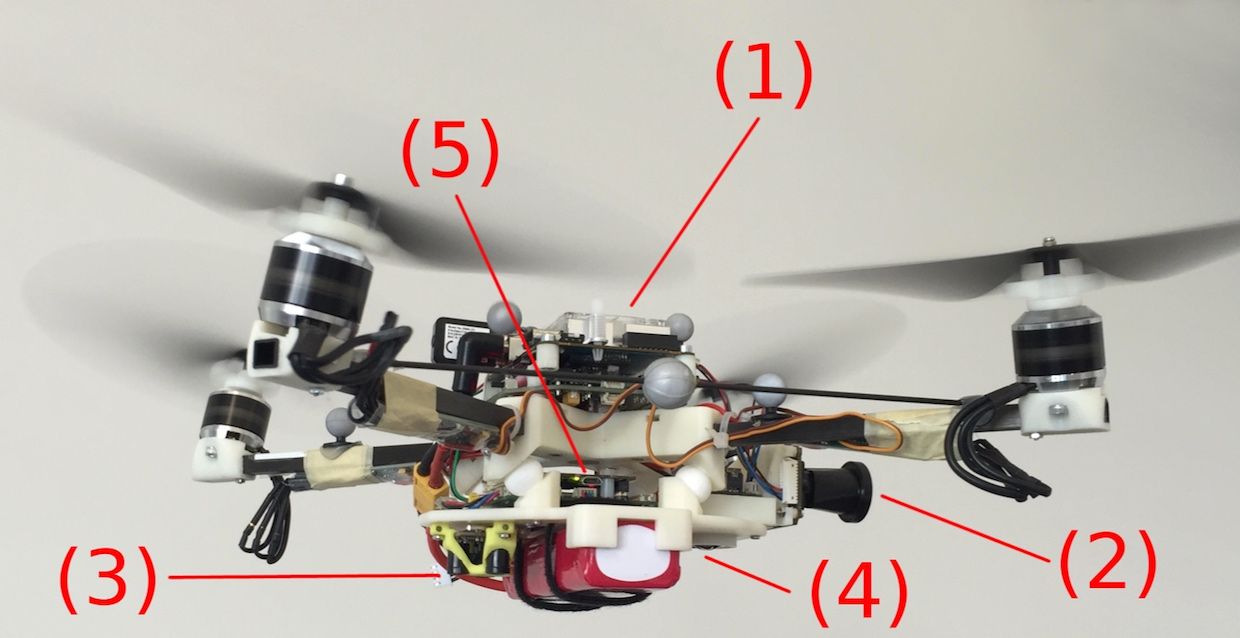
Agressive quadrotorPhoto: Robotics and Perception Group at the University of ZurichThe quadrotor platform used in the experiments. (1) Onboard computer. (2) Forward-facing fisheye camera. (3) TeraRanger One distance sensor and (4) downward-facing camera, both used solely during the recovery phase. (5) PX4 autopilot. The motors are tilted by 15º to provide three times more yaw-control action, while only losing 3 percent of the collective thrust.

Most of this hardware is relatively standard stuff, although the overall platform is custom. The notable tweak is that the rotors have been tilted by 15 degrees, which triples the amount of yaw control without significantly affecting the available thrust. It’s critical to have powerful yaw control since the quadrotor reaches angular speeds of up to 400 degrees per second while approaching a gap. 

The actual process of flying through the window goes like this: first, the quadrotor locates the gap (of a known size*) with its onboard camera. It then computes a trajectory to pass through the gap that keeps the quadrotor as far as possible from the edges, which is what you want to do to not run into stuff, while also trying to keep the gap itself in view of the quadrotor’s camera as much as possible. This trajectory is very focused on gap traversal, so the starting point for it involves the quadrotor moving at high speed and possibly oriented a little bit sideways, so the system also needs to come up with a second trajectory that takes the robot from a stable hover into the gap traversal trajectory. Put these two trajectories together, and you’ve got your path through the gap.

Once the robot starts heading for the gap, it does its best to keep its camera pointed at the frame of the gap to continually update its state estimation relative to the space it’s trying to squeeze through and dynamically replan its trajectory as necessary. Assuming it makes it through successfully (which happens about 80 percent of the time), the final step is for the quadrotor to “catch” itself, recovering from whatever crazy speed and orientation it ends up in. It seems like this would be particularly tricky (and it is), but the researchers had already solved this problem in the context of stabilizing quadrotors that are thrown into the air to launch them. 

Just in case you were thinking that this kind of thing is easy, the researchers asked two Swiss professional drone-racing pilots to give it a try:

Skills like this are very cool (for humans and robots alike), and it’s hard to understate the importance of being able to run all sensing and computation on board the robot itself. This is a requirement for actually using these skills in a way that’s practical: it’s not just about getting drones to fly through windows, but more about teaching them to be able to reliably maneuver around all kinds of different obstacles, in any environment, from forests to urban areas to your living room.

For more details on this research, we spoke with Professor Scaramuzza:

IEEE Spectrum: What was the biggest challenge of this work, and how did you solve it?

Davide Scaramuzza: The biggest challenge was to couple perception and control, which are typically considered separately. Indeed, for the robot to localize with respect to the gap, a trajectory should be selected, which guarantees that the quadrotor always faces the gap and should be re-planned multiple times during its execution to cope with the varying uncertainty of the state estimate (the uncertainty increases quadratically with the distance from the gap) while respecting the vehicle dynamics. Furthermore, during the traverse, the quadrotor should maximize the distance from the edges of the gap to avoid collisions. It is not trivial to combine all these constraints into a single path-planning problem, since the set of "feasible trajectories" reduces significantly as the quadrotor approaches the gap. Also, the gap is no longer visible when the vehicle is close to the gap, which makes it necessary to execute the traverse without any visual feedback (i.e., blindly). 

We solved these problems using a two step approach. To traverse the gap, we compute a trajectory which can be executed blindly thanks to its short duration and to the fact that it requires precomputed constant inputs (namely, a collective thrust of given magnitude and zero angular velocities). To approach the gap, we use a trajectory generation method that allows us to evaluate a very large set of candidate trajectories; for each candidate trajectory, we compute the optimal vehicle orientation that allows the quadrotor to align its onboard camera as much as possible with the gap direction. Within a short amount of time then we select the best trajectory as the one that guarantees that the gap is always visible and the center of the gap is as close as possible to the center of the image. This method has the additional benefit of being extremely fast, allowing us to replan the approach trajectory during its execution to exploit the more accurate pose estimate we get when we are closer to the gap.

Can the drone fly through several gaps in a row? What are the constraints on its performance?

Yes, if we modify the approach to allow the drone to continue flying after the traverse rather locking into a hovering position. The main constraint is the agility of the vehicle, which can be translated into constraints on its weight/inertia. Using a small and very agile quadrotor, it gets easier to stabilize after passing through a gap before immediately approaching another one. On the other hand, if the vehicle is heavy, recovering after such an aggressive maneuver takes longer before the drone is ready to fly again towards the next gap. To summarize: as the vehicle mass shrinks, we can reduce the distance between the the gaps.

Can this research be applied to other kinds of high speed maneuvering, like avoiding tree branches, or urban obstacles like lamp posts?

Of course! Avoiding obstacles such as tree branches or lamp posts is our next challenge. These scenarios are conceptually similar and our approach can be adapted such that, beside being perception aware (i.e., the pole or tree always visible in the image), the distance from the pole is now minimized (to minimize the overall flight time) while ensuring that is there is no collision.

How difficult will it be for commercial or recreational drones to take advantage of this research?

It will not be difficult. Hardware-wise, we only need an onboard camera, an IMU, and computer. Nowadays, almost any commercially-available drone has this hardware and with the right algorithms one can take advantage of our research to let autonomous quadrotors safely avoid obstacles or, as in our case, literally pass through them.

What are you working on next?

We are planning to extend our work into different directions. One is about passing through multiple gaps without any stop; instead by allowing a smooth and fast behavior to traverse a gap after the other. Other possible extensions are passing through a swinging gap or passing through a static gap along with a suspended payload. Finally, also slalom among trees, poles, or other similar obstacles.

“Aggressive Quadrotor Flight through Narrow Gaps with Onboard Sensing and Computing,” by Davide Falanga, Elias Mueggler, Matthias Faessler and Davide Scaramuzza from the Robotics and Perception Group, University of Zurich, Switzerland, has been submitted to ICRA 2017 which will take place next May in Singapore.

[ RPG @ UZH ]

* So, I guess technically it could get slightly more autonomous than this.

Read more…
3D Robotics

From Hackaday: A history of drones

Out of respect for a great job, a verbatim history on drones from Hackaday:

In the early 1930s, Reginald Denny, an English actor living in Los Angeles, stumbled upon a young boy flying a rubber band-powered airplane. After attempting to help the boy by adjusting the rubber and control surfaces, the plane spun into the ground. Denny promised he would build another plane for the boy, and wrote to a New York model manufacturer for a kit. This first model airplane kit grew into his own hobby shop on Hollywood Boulevard, frequented by Jimmy Stewart and Henry Fonda.

The business blossomed into Radioplane Co. Inc., where Denny designed and built the first remote controlled military aircraft used by the United States. In 1944, Captain Ronald Reagan of the Army Air Forces’ Motion Picture unit wanted some film of these new flying targets and sent photographer David Conover to the Radioplane factory at the Van Nuys airport. There, Conover met Norma Jeane Dougherty and convinced her to go into modeling. She would later be known as Marilyn Monroe. The nexus of all American culture from 1930 to 1960 was a hobby shop that smelled of balsa sawdust and airplane glue. That hobby shop is now a 7-Eleven just off the 101 freeway.

Science historian James Burke had a TV wonderful show in the early 90s – Connections – where the previous paragraphs would be par for the course. Unfortunately, the timbre of public discourse has changed in the last twenty years and the worldwide revolution in communications allowing people to instantaneously exchange ideas has only led to people instantaneously exchanging opinions. The story of how the Dutch East India Company led to the rubber band led to Jimmy Stewart led to remote control led to Ronald Reagan led to Death of a Salesmanhas a modern fault: I’d have to use the word ‘drone’.

The word ‘propaganda’ only gained its negative connotation the late 1930s – it’s now ‘public relations’. The phrase ‘global warming’ doesn’t work with idiots in winter, so now it’s called ‘climate change’. Likewise, quadcopter pilots don’t want anyone to think their flying machine can rain hellfire missiles down on a neighborhood, so ‘drone’ is verboten. The preferred term is quadcopters, tricopters, multicopters, flying wings, fixed-wing remote-controlled vehicles, unmanned aerial systems, or toys.

I’m slightly annoyed by this and by the reminder I kindly get in my inbox every time I use the dreaded d-word. The etymology of the word ‘drone’ has nothing to do with spying, firing missiles into hospitals, or illegally killing American civilians. People like to argue, though, and I need something to point to when someone complains about my misuse of the word ‘drone’. Instead of an article on Hollywood starlets, the first remote control systems, and model aviation, you get an article on the etymology of a word. You have no one else to blame but yourself, Internet.

An Introduction, and Why This Article Exists

This article is purely about the etymology of the word ‘drone’. Without exception, every article and blog post I read while researching this topic failed to consider whether an unmanned or remotely piloted aircraft was called a ‘drone’ before its maiden flight, or while it was being developed. For example, numerous articles refer to the Hewitt-Sperry Automatic Airplane as the first ‘drone’. For the purposes of this article, this is patently untrue. The word ‘drone’ was first applied to unmanned aircraft in late 1934 or early 1935, and a World War I-era experiment could never be considered a drone by contemporaneous sources. Consider this article a compendium of the evolution of the word ‘drone’ over time.

Why this article belongs on Hackaday should require no explanation. This is one of the Internet’s largest communities of grammar enthusiasts, peculiarly coming from a subculture where linguistic play (and exceptionally dry sarcasm) is encouraged. Truthfully, I am so very tired of hearing people complain about the use of the word ‘drone’ when referring to quadcopters and other remote-controlled toys. To me, this article simply exists as something I can point to when telling off offended quadrotor pilots. I am considering writing a bot to do this automatically. Perhaps I will call this bot a ‘drone’.

The Source of ‘Drone’ c. 1935
quote-sack-full-of-beesBefore the word was used to describe aircraft, ‘drone’ had two meanings. First as a continuous low humming sound, and second as a male bee. The male bee does no work, gathers no honey, and only exists for the purpose of impregnating the queen. It’s not hard to see why ‘drone’ is the perfect word to describe a quadcopter — a Phantom is mindless, and sounds like a sack full of bees. Where then did the third definition of ‘drone’ come from, a flying machine without a pilot on board?

The most cited definition of ‘drone’ comes from a 2013 Wall Street Journal article [1] from linguist and lexicographer Ben Zimmer, tracing the first use of the word to 1935. In this year, US Admiral William H. Standley witnessed a British demonstration of the Royal Navy’s new remote-controlled aircraft for target practice. The aircraft used was based on the de Havilland Tiger Moth, a biplane trainer built in huge numbers during the interwar period, redesignated as the Queen Bee. The implication of Zimmer’s article is that the word ‘drone’ comes from the de Havilland Queen Bee. This etymology is repeated in a piece in the New York Times Magazine published just after World War II [2]:

Drones are not new; inventors were experimenting with them twenty-five years ago. Before the war, small specially built radio-controlled planes were used for anti-aircraft purposes – widely in England, where the name “drone” originated, less extensively here…. The form of radio control used in the experimental days was developed and refined so that it could be applied to nearly any type of conventional plane.

I found this obvious primary source for Ben Zimmer’s etymology of drone in five minutes, but it doesn’t tell anyone if the Queen Bee designation of a remote-controlled biplane came about from the word ‘drone’ or vice versa. This etymology doesn’t really give any information about the technical capabilities or the tactical use of these drones. The unmanned aircraft discussed in the New York Times article would be better called a cruise missile, not a drone. Was the Queen Bee an offensive drone, or was it merely a device built for target practice? These are questions that need to be answered if we’re going to tell the people flying Phantoms to buzz off with their drones.
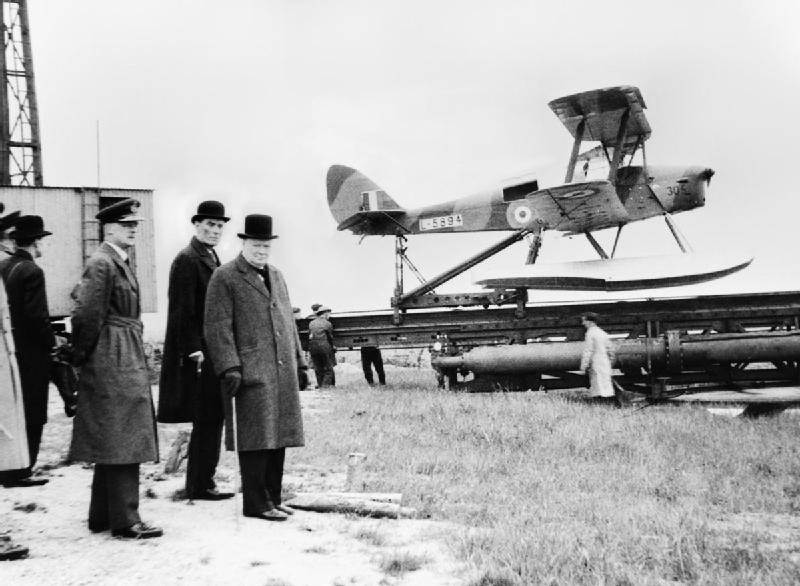
The Queen Bee, with ChurchillThe Queen Bee, with Churchill

Biology sometimes mirrors linguistics, and the best place to look for the history of ‘drone’, then, is to look into the history of the Queen Bee. The Queen Bee – not its original name – was born out of a British Air Ministry specification 18/33. At the time, the Air Ministry issued several specifications every year for different types of aircraft. The Supermarine Spitfire was originally known to the military as F.37/34; a fighter, based on the thirty-seventh specification published in 1934. Therefore, the specification for a ‘radio-controlled fleet gunnery target aircraft’ means the concept of what a ‘drone’ would be was defined in 1933. Drones, at least in the original sense of a military aircraft, are not offensive weapons. They’re target practice, with similar usage entering the US Navy in 1936, and the US Air Force in 1948. The question remains, did ‘drone’ come before the Queen Bee, or is it the other way around?

The first target drone was built between late 1933 and early 1935 at RAF Farnborough by combining the fuselage of the de Havilland Moth Major with the engine, wings, and control surfaces of the de Havalland Tiger Moth [3]. The aircraft was tested from an airbase, and later launched off the HMS Orion for target practice. Gunnery crews noticed a particularly strange effect. This aircraft never turned, never pitched or rolled, and never changed its throttle position: this aircraft droned. It made a loud, low hum as it passed overhead. Drones are named for the hum, and the Queen Bee is just a clever play on words.

The word ‘drone’ does not come from the de Havilland Queen Bee, because the Queen Bee was originally a de Havilland Moth Major and Tiger Moth. ‘Queen Bee’, in fact, comes from ‘drone’, and ‘drone’ comes from the buzzing sound of an airplane flying slowly overhead. There’s a slight refinement of the etymology for you: the Brits brought the bantz, and a de Havilland was deemed a drone.

A ‘Drone’ is for Target Practice, 1936-1959

The word ‘drone’ entered the US Navy’s lexicon in 1936 [4] shortly after US Admiral William H. Standley arrived back from Europe, having viewed a Queen Bee being shot at by gunners on the HMS Orion. This would be the beginning of the US Navy’s use of the phrase, a term that would not officially enter the US Army and US Air Force’s lexicon for another decade.

Beginning in 1922, the US Navy would use an aircraft designation system to signify the role and manufacturer of any aircraft in the fleet. For example, the fourth (4) fighter (F) delivered to the Navy built by Vought (U) was the F4U Corsair. The first patrol bomber (PB) delivered by Consolidated (Y) was the PBY Catalina. In this system, ‘Drone’ makes an appearance in 1936, but only as ‘TD’, target drone, an airplane designed to be shot at for target practice.
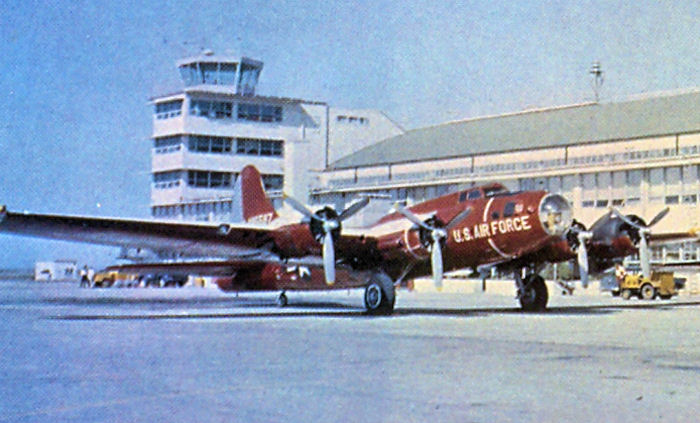
A QB-17 drone, similar to what was used in Operation Aphrodite, at Holloman AFB, 1959. Source: United States Air ForceA QB-17 drone at Holloman AFB, 1959.

For nearly twenty years following the introduction of the word into military parlance, ‘drone’ meant only a remote controlled aircraft used for target practice. B-17 and PB4Y (B-24) bombers converted to remote control under Operation Aphrodite and Operation Anvil were referred to as ‘guided bombs’. Just a few years after World War II, quite possibly using the same personnel and the same radio control technology that was developed during Operation Aphrodite, war surplus B-17s would be repurposed for use as target practice, where they would be called target drones. Obviously, ‘drone’ meant only target practice until the late 1950s.

If you’re looking for a proper etymology and definition of the most modern sense of the word ‘drone’, there you have it. It’s a remote-controlled plane designed for target practice. For the quadcopter pilots who dabble in lexicography, have an interest in linguistic purity, and are utterly offended by calling their flying camera platform a ‘drone’, there’s the evidence. A ‘drone’ has nothing to do with firing weapons down on a population or spying on civilians from forty thousand feet. In the original sense of the word, a drone is simply a remote-controlled aircraft designed to be shot at.

Language changes, though, and to successfully defend against all critics of my use of the word ‘drone’ as applying to all remote controlled aircraft, I’ll have to trace the usage of the word drone up to modern times.

The Changing Definition of ‘Drone’, 1960-1965

A word used for a quarter century will undoubtedly gain a few more definitions, and in the early 1960s, the definition of ‘drone’ was expanding from an aerial target used by British forces in World War II to a word that could be retroactively applied to the German V-1, an aerial target used by the British forces in World War II.

The next evolution of the word ‘drone’ can be found in the New York Times, November 19, 1964 edition [5], again from Pulitzer Prize-winning author Hanson W. Baldwin. Surely the first reporter on the ‘drone’ beat has more to add to the linguistic history of the word. In the twenty years that passed since Mr. Baldwin introduced the public to the word ‘drone’, a few more capabilities have been added to these unmanned aircraft:

Drone, or unpiloted aircraft, have been used for military and experimental purposes for more than a quarter of a century.

Since the spectacular German V-1, or winged missile, in World War II, advances in electronics and missile-guidance systems have fostered the development of drone aircraft that appear to be almost like piloted craft in their maneuverability.

The description of the capabilities of drones continues on to anti-submarine warfare, battlefield surveillance, and the classic application of target practice. Even in the aerospace industry, the definition of ‘drone’ was changing ever so slightly from a very complex clay pigeon to something slightly more capable.

In the early 1960s, NASA was given the challenge of putting a man on the moon. This challenge requires docking spacecraft, and at the time Kennedy issued this challenge, no one knew how to perform this feat of orbital mechanics. Martin Marietta solved this problem, and they did it with drones.
spacedrone

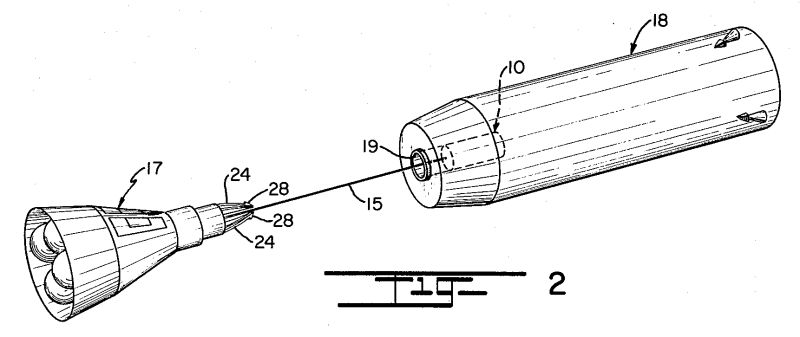
US patent 3,201,065 solves the problem of docking two spacecraft and does it with a drone.

Orbital docking was a problem NASA needed to solve before getting to the moon, and the solution came from the Gemini program. Beginning with the Gemini program, astronauts would perform an orbital rendezvous and dock with an unmanned spacecraft launched a few hours or days earlier. Later missions used the engine on the Agena to boost their orbit to world altitude records. The first experiments in artificial gravity came from tethering the Gemini capsule to the Agena and spinning the spacecraft around a common point.

The unmanned spacecraft used in the Gemini program, the Agena Target Vehicle, was not a drone. However, years before these rendezvous and docking missions would pave the way to a lunar landing, engineers at Martin Marietta would devise a method of bringing two spacecraft together with a device they called a ‘drone’ [6].

Martin Marietta’s patent 3,201,065 used an autonomous, remote-controlled spacecraft tethered to the nose of a Gemini spacecraft. Laden with a tank of pressurized gas, a few thrusters, and an electromagnet, an astronaut would fly this ‘docking drone’ into a receptacle in the target vehicle, activate the electromagnet, and reel in the tether bringing two spacecraft together. Here the drone was, like the target drones of World War II, remote-controlled. This drone spacecraft never flew, but it does show the expanding use of the word ‘drone’, especially in the aerospace industry.

If you’re looking an unimaginably cool drone that actually took to the air, you need only look at the Lockheed D-21, a reconnaissance aircraft designed to fly over Red China at Mach 3.
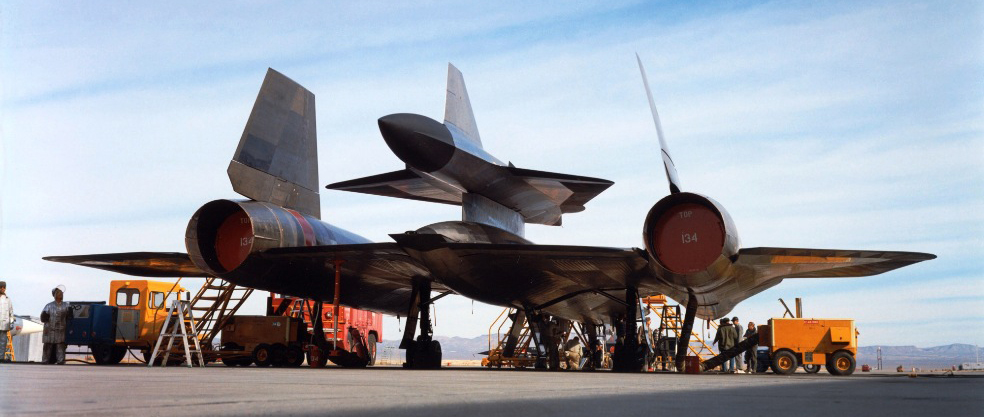
The M-21 carrier aircraft and D-21 drone. The M-21 was a variant of the A-12 reconnaissance aircraft, predecessor to the SR-71 reconnaissance aircraft.The M-21 carrier aircraft and D-21 drone. The M-21 was a variant of the A-12 reconnaissance aircraft, predecessor to the SR-71 reconnaissance aircraft.

The ‘D’ in ‘D-21’ means ‘daughter’, and the carrier aircraft for this unmanned spy plane is the M-21, ‘M’ meaning ‘mother’. Nevertheless, the D-21 was referred to in contemporary sources as a drone. The D-21 was perhaps the first drone referred to as such that was a pure observation aircraft, meant to spy on the enemy.

The 1960s didn’t just give drones the ability to haul a camera over the enemy. 1960 saw the first offensive drone – the first drone called as such that was able to drop homing torpedos into the ocean above enemy submarines.

qh-50cThe Gyrodyne QH-50 – also know as DASH, the Drone Anti-Submarine Helicopter – was the US Navy’s answer to a problem. At the time, the Soviets were building submarines faster than the United States could build anti-submarine frigates. Older ships were available, but these ships weren’t large enough for a full-sized helicopter. The solution was a drone that could launch off the deck, fly a few miles to an interesting ping on the sonar, and drop a torpedo. The solution was the first offensive drone, the first unmanned aircraft capable of delivering a weapon.

The QH-50 was a relatively small coaxial helicopter piloted by remote control. It was big enough to haul one torpedo twenty miles away from a ship and have this self-guided torpedo take care of the rest.

The QH-50 was a historical curiosity born from two realities. The US Navy had anti-submarine ships that could detect Soviet subs dozens of miles away. These anti-submarine ships didn’t have torpedos with that range and didn’t have a flight deck to launch larger helicopters. The QH-50 was the result, but new ships and more capable torpedos made this drone obsolete in less than a decade. An otherwise entirely unremarkable weapons platform, the QH-50 has one claim to fame: it was the first drone, referred to as such in contemporary sources, that could launch a weapon. It was the first offensive drone.

The Confusion of the Tounges, c. 1965-2000

On June 13, 1963, a Reuters article reported a joint venture between Britain and Canada to build an unmanned spy plane, specifically referred to as an ‘unmanned aerial vehicle’ [7]. The reporter, with full knowledge of the previous two decades of unmanned aerospace achievement, said this new project was ‘commonly referred to as a drone.’ By the mid-60s, the word ‘drone’ had its fully modern definition: it was simply any unmanned aerial vehicle, used for any purpose, ostensibly controlled in any manner. This definition was being supplanted by several competing terms, including ‘unmanned aerial vehicle’ and ‘remotely piloted vehicle’.

The term ‘drone’ would be usurped in common parlance for the newer, clumsier term, ‘unmanned aerial vehicle.’ A word that once referred to everything from flying targets to spacecraft subsystems would now be replaced. The term ‘unmanned aerial vehicle’ would make its first public military appearance in the Department of Defense report on Appropriations for 1972. The related term ‘remotely piloted vehicle’ or RPV, would first appear in government documents in the late 1980s. From the word drone, a thousand slightly different terms are born in the 60s, 70s, and 80s. Even today, ‘unmanned aerial system’ is the preferred term used by the FAA. This phrase was created less than a decade ago.

Engineers built drones to surveil the Communist Chinese at Mach 3. Engineers patented a drone to dock two spacecraft together. Engineers built drones to hunt and sink submarines. The Air Force took old planes, painted them orange, and called them target drones. So the Lord scattered them abroad over the face of all the Earth, and they ceased calling their aircraft drones.

In the 1970s, 80s, and 90s, the term ‘drone’ would still be applied to target aircraft, and even today is still the preferred term for unmanned military aircraft used for target practice. Elsewhere in the military, the vast array of new and novel applications of unmanned aircraft heave meant new terms have cropped up.

Why these new terms were created is open to debate and interpretation. The military and aerospace companies have never shied away from a plague of acronyms, and a dizzying array of random letters thrown into a report is the easiest way of ensuring operational security. How can the enemy know what we’re doing if we don’t know ourselves? It’s questionable if the improved capabilities of drones, such as dropping torpedos or relaying video, can account for the vast array of acronyms — it appears these new acronyms were simply the creation of a few captains, majors, and engineers either at the Pentagon or one of a dozen aerospace companies. By the 1990s, the word drone was in a state of disuse, replaced by ‘UAV’, ‘RPV’, ‘UAS’, and a dozen other phrases synonymous with the word drone.

The Era of the Modern Drone, October 21, 2001 – Present
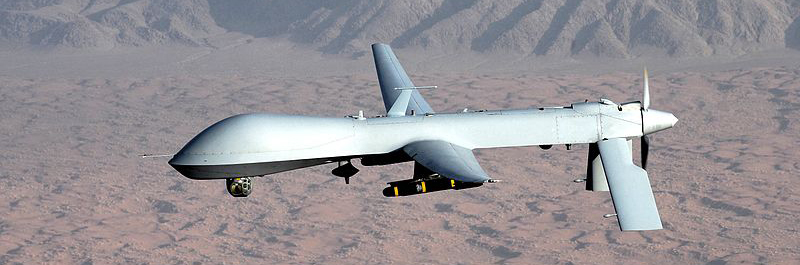
predator

The definitive image of the modern drone is that of the General Atomics MQ-1 Predator laden with a Hellfire anti-tank missile on each wing. The Predator is an unmistakable aircraft featuring a bulbous nose just barely large enough to house the satellite antennae underneath. A small camera pod hangs off its chin. The long, thin wings appear as if they were stolen off a glider. A small propeller is mounted directly on the tail, and the unique inverted v-tail gives the impression this aircraft can never land, lest it be destroyed.

The Predator program began in the mid-1990s and was from the get-go referred to as an Unmanned Aerial Vehicle, or UAV. This changed on October 21, 2001, in a Washingon Post article from Bob Woodward. In the article, CIA Told to Do ‘Whatever Necessary’ to Kill Bin Laden, Woodward reintroduced the word ‘drone’ into the vernacular [8]. The drone in question was a CIA-operated Predator equipped with, “Hellfire antitank missiles that can be fired at targets of opportunity” Woodward, either through conversations with military officials, remembering the old term for this type of aircraft, needing a new word to describe this weapon delivery system, or simply being fed up with the alphabet soup of acronyms, chose to use the word ‘drone’.

If you’re angry at the word ‘drone’ being applied to a Phantom quadcopter, you have two people to blame. The first is Hanson W. Baldwin, military editor to the New York Times. Over a career of forty years, he introduced the word ‘drone’ to describe everything to target aircraft to cruise missiles. The second is Bob Woodward of the Washington Post. The man who broke Watergate also reintroduced the word ‘drone’ into the American consciousness.

A Briefer History Of ‘Drone’, and an Argument for its Use

The word ‘drone’ was first applied to unmanned aircraft in late 1934 or early 1935 because biplanes flying low overhead sound like a cloud of bees. For twenty-five years, ‘drone’ applied only to aircraft used as target aircraft. Beginning in the late 1950s and early 1960s, the definition of ‘drone’ expanded to included all unmanned aircraft, from cruise missiles to spaceships. Around 1965, acronyms such as ‘UAV’, and ‘RPV’ took over as being either more descriptive or as a function of the military aerospace industry’s obsession with acronyms. In the late 1990s, the US Air Force and CIA began experimenting with Predator UAVs and Hellfire missiles. The first use of this weapons platform was mere weeks after the 9/11 attacks. This weapons platform became known as a Predator ‘drone’ in late 2001 thanks to Bob Woodward. Colloquially, the term ‘drone’ now applies to everything from unmanned military aircraft to quadcopters that fit in the palm of your hand.

The most frequently cited reason for not using the word ‘drone’ to describe everything from racing quadcopters to remote-controlled fixed wing aircraft orbiting a point for hours is linguistic purity. Words have meaning, so the argument goes, and it’s much better to use precise language to describe individual aircraft. A quadcopter is just that — a quadcopter. An autonomous plane used for inspecting pipelines is an unmanned aircraft system.
quote-drone-applied-to-every-aircraft-in-historyThe argument of linguistic purity fails immediately, as the word ‘drone’ was applied to every conceivable aircraft at some time in history. In the 1960s, a ‘drone’ could mean a spaceship or spy plane. In the 1940s, a ‘drone’ simply meant an aircraft that was indistinguishable in characteristics from a balsa wood, gas powered remote controlled airplane of today. Even accepting the argument of linguistic purity has consequences: ‘drone’ originally meant ‘target drone’, an aircraft flown only for target practice. Sure, keep flying, I’ll go get my 12 gauge.

The argument of not using the word ‘drone’ to apply to what are effectively toys on the basis of language being defined by common parlance fails by tautology. ‘Drone’, critics say, only apply to military aircraft used for spying or raining Hellfires down on the enemy. It’s been this way since 2001, and since language is defined by common usage, the word ‘drone’ should not be applied to a Phantom quadcopter. This argument fails to consider that the word ‘drone’ has been applied to the Phantom since its introduction, and if language is defined by common usage than surely a quadcopter can be called a drone.

Instead of linguistic trickery, I choose to argue for the application of ‘drone’ on a philosophical basis. You are now reading this article on Hackaday, and for the thirty years, a ‘hacker’ is someone who breaks into computer systems, steals money from banks, leaks passwords to the darknet, and other illegal activities. Many other negative appellations apply to these activities; ‘crackers’ are those who simply break stuff, ‘script kiddies’ are responsible for the latest DDOS attack. Overall, though, ‘hackers’ is the collective that causes the most damage, or so the dictionary definition goes.

Obviously, the image of ‘hacking’ being only illegal or immoral is not one we embrace. The word is right there at the top of every page, and every word written here exudes the definition we want. ‘Hacking’, to us, is firmware tomfoolery, and electronic explorations of what should be possible but isn’t available to the public. We own the word ‘hack’ in every word we publish by extolling the virtues of independent study and discovery.

Everyone here learned a very long time ago you don’t impress people with pedantry. You won’t convert anyone from believing hackers stole aunt Mable’s identity to believing ‘hack’ is an inherently neutral term simply by telling them. Be the change you want to see in the world or some other idiotic phrase from a motivational poster, but the point remains. It’s always better to own a term than to insufferably deny it. It’s a lesson we’ve learned over the last decade, and hopefully one the drone community will soon pick up.

Read more…

3689701294?profile=original

I'm thrilled to announce that Skysense was awarded the 1st prize in the "business" section of the NASA WorldWind Europa Challenge 2016, offering an innovative Open Source remote control of drones, with multiple commercial applications.

3689701419?profile=original

Skysense Planner is web-based, runs in the cloud and allows you manage remote fleets of drones. Advanced features include Ardupilot and DJI support, ADS-B aircraft tracking, geofence management and orchestration of complex multi-agent workflows for logistics, surveillance, and industrial inspections.


Get early access to code, samples and demos

Hexacopter demo flight video: https://vimeo.com/182517631

Skysense Planner relies on several Open Source projects: Ardupilot, Gazebo,MAVLink, MAVROS, ROS, Robot Web Tools, NASA Web World Wind. This prize serves also as a recognition of the tremendous importance of these extremely powerful projects, that have been so instrumental in building Skysense Planner.

3689701368?profile=original

Company profile

Skysense's business is to enable private companies and government agencies integrating and running fully autonomous UAVs operations without human intervention. Skysense Drone Systems are fully automated and scalable drone installations, enabling remote inspection, surveillance and survey operations without human intervention. Skysense partners with enterprises at the forefront of the security, energy, inspection, aerospace and defense markets.

Read more…

Antenna Tracking - Initial Testing

I know that antenna tracking is nothing new, but I had to share my excitement in getting mine built and working!  My inner-nerd celebrated at the sound of the servo motors coming to life for the first time and I have been trying to perfect the pointing ever since.

My basic approach was to designate a position in the software for my "Antenna Tracker" to reflect where it was actually placed, then start pumping in my aircraft's telemetry data.  I am using STK to handle all of the angle calculations for Azimuth and Elevation between the tracker and the aircraft and I have a plugin that is then feeding that data to the actual hardware.  

So far everything looks very positive and seems to be working great!  I hope to take everything out for its maiden flight later this week and I can't wait!  I will hopefully update with some additional video and keeping my fingers crossed that the setup will provide me with crystal clear video links....but even if it doesn't, it will still look straight-up cool sitting there spinning around!

Read more…
MR60

190 size FPV racer build & review from GEP

Hi,

A 190 size FPV racer kit review from the GEP brand (so called ZX5 model). What's different about the previous FPV racers build I did before is a X frame while my former builds were always made with a classical H frame.

X frames have an advantage over H frames in that they are more symetrical (useful in FPV racing) and they twist much less along the central beam : that is a better Yaw control in racing.

Issue though with an X frame in a small FPV racer is the lack of room to setup all of the electronics.

Also beware when buying those kits: I noticed during the build that the provided camera was not meant for the holes designed in the camera carbon fiber plates (camera models evolve so fast and there are no dimension standards yet).

Overall we notice a good level of maturity in this kit and suppliers that obviously listen and learn from the field experience.

Links are available in the youtube video description.

Cheers

Read more…
Developer


Unfortunately these things can happen, and you've to know how to best manage, not to be caught unprepared.
This test was performed with the aid of a wireless termination system on main power, so if the drone was out of control I had a chance to get it to fall in the area  permitted for this operation in my country (70 meters high , 200 of radius).
As specified in the video don't try this thing if you don't know with absolute certainty that you're doing!
Turn off the TX when the drone is flying it's not recommended in any case
This video is in italian language, but subtitles in english are available.
If you want to create subtitles in your own language or simply correct my "maccheronic english" click this link: https://www.youtube.com/timedtext_video?v=mqiOk_o6O4o&ref=share

Bests,

Marco

Read more…

Introducing the AUAV X2.1 Flight Controller

3689701263?profile=original

The AUAV X2.1 is all about lessons learned. The X2 was a very successful board but there was still room for improvement. Following the PixRacer project we had time to invest into making the X2 the high quality PixHawk replacement we intended it to be. Major changes include: updated IMU sensors, power supply has been redesigned, headers have been laid out more logically, remote USB connector, industry standard 30.5mm mounting points.

Questions and comments are welcome!

Phil and Nick

Available: October 1, 2016

Price: $130

Site: http://www.auav.co/product-p/auavx21.htm

Processors:
Main: STM32F427VIT6 ARM microcontroller - Revision 3
IO: STM32F100C8T6 ARM microcontroller

Next Generation Sensors:

Invensense MPU9250 9DOF
Invensense ICM-20608 6DOF
MEAS MS5611 barometer

New Power OR-ing schematic with reverse voltage protection. 5V power module is required!


Connections:

2.54mm headers:
GPS (USART4)
i2c
RC input
PPM input
Spektrum input
RSSI input
sBus input
sBus output
Power input
Buzzer output
LED output
8 x Servo outputs
6 x Aux outputs
USART7 (Console)
USART8 (OSD)


JST GH connectors:
CAN
USART2 with flow control (Telem 1)
USART3 with flow control (Telem 2)
USB (150mm GH to Micro USB cable included for convenient mounting)
JTAG FMU Processor
JTAG IO Processor

Size: 36mm x 50mm

Mounting Points: 30.5mm x 30.5mm 3.2mm diameter

Weight: 10.9g

3689701163?profile=original

3689701239?profile=original

3689701276?profile=original

3689701305?profile=original

Read more…

DJI Inspire 1 thermal Gimbal

3689702206?profile=original

THERMAL GIMBAL FOR DJI INSPIRE

Dual Sensor IR + EO Thermal gimbal for DJI Inspire 1/Pro with 16MP Daylight and Flir Thermal IR camera support. Onboard video recording, geotagging system combined with advanced control unit and real time digital video transmission through DJI GO app.

Gemini IR-Pro dual sensor gimbal provides high precision pointing accuracies in a small, lightweight payload specially designed for DJI Inspire.  more details

Main Features

Gemini IR-Pro is the most advanced thermal gimbal for DJI Inspire in the market! Fully plug&play, with the same mount adapter of Zenmuse X3/X5

  • 3-axis 360° dual sensor thermal gimbal for DJI Inspire
  • Plug & Play system with adapter for Inspire Gimbal mount
  • DJI Go App Ready with Thermal/Daylight Video feedback
  • Additional remote controll for Gimbal and camera function (868mhz, 2km range)
  • Simultaneously daylight and thermal live view (2km range, optional)
  • Flir Ready (Flir Vue, Vue Pro, Vue Pro-R, Tau 2, Thermal Capture 1&2
  • Advanced remote control for FLIR camera (tilting, palettes, digital zoom..etc)
  • Onboard 16MP Sony Exmor Camera
  • Synchronized IR+EO photo and video
  • Geotaging System with automatic/manual trigger control
  • TimeLapse with Synchronized IR+EO images
  • Target lock, automatically hold the video centered on the scene douring movements
  • Fully powerd from DJI Inspire, no extra battery, no wire, just plug & fly

more details

3689702162?profile=original

more details

Read more…