All Posts (11086)

Sort by
3D Robotics

Huge congrats to orginal ArduCopter developer Jose Julio, who won the Internet today with his awesome air hockey robot.

From I09

In an effort to suck the fun out of every activity still left for us puny humans, an engineer has built an amazing 3D printable air hockey playing robot that, in addition to moving across the required two dimensions, can predict the movements of rebounding pucks.

The robot was developed by Jose Julio who describes the system at his blog. Many of the components — like NEMA17 stepper motors, drivers, Arduino Mega, RAMPS, belts, bearings, and rods — are 'left over' parts from a RepRap 3D printer. The bracketry, puck, and paddle came out of a 3D printer. Julio built the table using off-the-shelf wood. The robot uses a PS3 camera to monitor the action.

This robot will utterly destroy you at air hockey

The camera is mounted above the table and it watched the puck to determine its trajectory. It then moves the paddle to the appropriate position to block and return the puck. It can even anticipate bounces off the wall. And in the event the robot is too good for you, you can always adjust the robot's speed to dumb-down its acceleration and strategy algorithms.

This robot will utterly destroy you at air hockey

Julio has even made the specs available at his website.

It would be interesting to see Julio's Air Hockey Robot pitted against the one developed by Namiki Labs — though that one only moves across one-dimension.

Yet another activity in which we don't stand a chance.

Read more…

Drone TV films the 3D Printer World Expo

It is fascinating to see how the 3D printing industry is thriving and expanding to cover so many applications. This technology is not hampered by federal regulation, unlike the commercial use of UAS, so entrepreneurs and DIY Makers are flocking to the field of additive manufacturing at an astounding rate...

Read more…

It's amazing the contribution Andrew Tridgell is making. I love how the new version installations are automated on my APM 2.5.  I'm waiting for the next major upgrade (3 ?) before flying my big plane on the new Pixhawk.  The 32-bit STM32F427 Pixhawk processor with single precision FPU has the compute power to support the coming new features.

Above is a link to my Mission Planner recording of the second flight taken by my plane since 39 years as seen here using APM 2.5 and Mission Planner:

My job right now is inspecting the quality of C/C++ code inside digital radios.  I used to write C code controlling earth terminal communications to geosynchronous satellites.  I've fixed a lot of bugs in my day, and I've been a key participant in the architectural design of several systems.  I watched twice Dr Tridgell's presentation, "A peek into the future of ardupilot." I loved it and have the following thoughts:

1.  I think a Memory Management Unit or a separate processor is needed to separate Linux desktop applications (like in flight compilers) from the safety critical autopilot code.  Beagle Bone Black does not have a MMU although it could be a stepping stone to something like a Xilinx Zynq SoC.  For example, the Zynq has dual core ARM Cortex A9 each with MMU and separate double precision FPU plus FPGA fabric integrated on one SoC.  See MicroZed or ZYBO (Digilent).  One core could run the autopilot and its RTOS while the other core runs Linux.  The cores share a common large external RAM protected by MMU's.


2.  I think the autopilot RTOS needs to be light weight, fast, simple, and very reliable.  Simplicity is the first step towards reliability.  "Flexibility" and "Power" are code words for complexity and trouble whether it be the choice of computer language or choice of Operating System.  There is an added wattage and monetary cost to going airborne with Linux. It weakens reliability unless the processor hardware has a MMU to protect the autopilot code.


3  If I could, I'd say all memory shall be allocated statically at compile and link time.  There shall be no “heap”, no memory allocation or de-allocation at run time, no malloc, no instantiations.  Before initialized data is transfer from ROM to RAM, all RAM memory shall be initialized to zero, including the stacks, uninitialized and initialized memory space.


4.  Limit “If Else” decision making to two levels, four states.  Handle all states including the unexpected. Limit “switch” statements to one level (no nested switches).  All “switch” statements shall implement the “default” case.  For more complex decisions, use single dimension function tables or multi-dimension state-event tables in order to assure every case is considered by the designer and coder.  All states in function tables have a function handler including the, ignore(), unexpected(), and forbidden() cases. Function table logging may be enabled or disabled on command at run time.


Those are my thoughts for what they are worth.  I continue to be pleased by the amazing work the community is doing, and particularly Andrew Tridgell.


Sincerely,

Francis Nelson Henderson


Read more…
3D Robotics

Experimenting with quads in free-fall

From Hackaday:

Nearly every tri/quad/hex/multicopter pilot has the impulse to chop the throttle while flying around. Most quadcopters are fixed pitch, which means that as power drops, so does control authority. When power is cut, they fall like stones. A quick throttle chop usually results in a few feet of lost altitude and a quickened pulse for the pilot. Cut power for much longer than that, and things can get really interesting.  [RcTestFlight] decided to study free fall in depth, and modified a test bed quadcopter just for this purpose.

First, a bit of a primer on free-falling quadcopters and their power systems.  Quadcopters always have two motors spinning clockwise, and two spinning counterclockwise. This configuration counters torque and allows for yaw control. Most large quads these days use sensorless brushless motors, which can be finicky about startup conditions. Brushless controllers are generally programmed to kick a motor into spinning in the proper direction. If a motor is spinning in reverse at several hundred RPM, things can get interesting. There will often be several seconds of stuttering before the motor starts up, if it starts at all. The controller MOSFETS can even be destroyed in cases like this.

When a quadcopter loses power, the motors slow down and thrust drops off. The quad begins to drop. As the falling quadcopter picks up speed, the propellers begin to spin (windmill) due to the air rushing up from below. If the quadcopter started its fall in a normal attitude, all four of  the propellers will rotate reverse of its normal direction.  The now spinning props will actually act as something of an air brake, slowing the fall of the quad. This is similar to a falling maple seed, or autorotation in a helicopter.  The spinning blades will also act as gyroscopes, which will add some level of stabilization to the falling quadcopter. Don’t get us wrong – the quadcopter can still be unstable as it falls, generally bobbing and weaving through the air. 

None of this is a guarantee that the quad won’t tip over onto its back – which will reverse the entire process.  Through all of this bobbing, weaving, and falling the flight controller has been along for the ride. Most flight controllers we’ve worked with have not been programmed with free fall in mind, so there is no guarantee that they will come back on-line when the throttle is rolled on. Thankfully many controllers are open source, so testing and changes are only a matter of risking your quadcopter.


quadcrash

[RcTestFlight] found that his FPV h-quad quad was relatively stable in free fall, so he began experimenting with falls from high altitude. He found that many tests don’t end well. One crash managed to bend his aluminum frame badly enough that he replaced two of the arms with more forgiving wood.  His quad originally had 9 inch props. In an attempt to go for a slower sink rate,  [RcTestFlight] switched to 14 inch props. The larger props also needed slower motors with more torque. After these changes, the quad definitely fell slower, however he found the fall was actually less stable than the 9 inch props. Self deploying foam drag flaps slowed things down even further, but the flaps themselves became an issue when a particularly violent fall ripped them all off.  After taking his quad up to 4142 feet, nearly losing his quad, and a number of rough crashes, [RcTestFlight] had has his fill of free fall. We’d love to see more testing, especially with collective pitch quadcopters. We’ll keep our own quads safe in powered flight though.


Read more…
Moderator

Finwing Air Titan

ai16481373-114-thumb-AirTitan-02.jpg?d=1391621339Looks like a good fpv/camera ship for long distance flights with ArduPlane.

$189 - airframe kit only

http://www.readymaderc.com/store/index.php?main_page=product_info&cPath=101&products_id=2482

http://youtu.be/9stpfujoUcA

Specifications:

  • Wingspan: 2520mm / 99.2inch
  • Kits Airplane weight: 2.4kg (5.3lb) including all reinforcement parts
  • Extra Payload: 3.0kg-4.0kg (6.6lb-8.8lb)/ flight weight>6.0kg
  • Customized Brushless Power system:
  • Customized Motor for Airtitan:  M60K/ Power 1500W
  • Testing static thrust: 5.5-6.0kg (6S, 15" Prop)
  • Propeller recommend: 15*6 / 15*7
  • ESC: Advanced 80A OPTO (without Built-in BEC) 
  • External UBEC: 5V/6A,5.5V/6A or 6V/6A (Switchable)
  • Material of fuselage and Wing: EPO
Read more…

Drone in Disaster Area...

Today one of our team (seribubintang) helping Center for Research and Technology Volcanoes Development (BPPTK) to monitor Volcano activity in Sinabung mountain North Sumatera. No aircraft can fly in this area since the dust from the eruption all over the air.

An official of the Center for Research and Technology Volcanoes Development (BPPTK) releases a drone quadcopter to monitor activity from the Mount Sinabung volcano at Sibintun village in Karo district, North Sumatra province February 4, 2014. Indonesia's Mount Sinabung volcano erupted and killed at least 11 people on the western island of Sumatra on Saturday, the first time it is known to have claimed any lives, a senior government official said. REUTERS/Beawiharta (INDONESIA - Tags: DISASTER ENVIRONMENT SCIENCE TECHNOLOGY)

1546377_10202442195069754_1156129847_n.jpg?width=400
1511681_10202436203839977_411802041_n.jpg?width=400Taking View of the area, on the last day, our team will try to get much closer to the mountain.

source :
http://www.trust.org/item/20140204065312-h2fns?view=print

www.seribubintang.com

Read more…

Pixhawk bodged into Vulture 2 spaceplane

3689573276?profile=original

We've done some initial work getting the Pixhawk into our Vulture 2, complete with the hot-off-the-press external LED and digital airspeed sensor.

There are more details and pics right here. As of this morning, we can't persuade the airspeed sensor to, er, sense, so that'll keep us off the streets for a while.

Read more…

Flying my ArduIMU in tri_chord space

apps-38b02b00.jpg

I haven't flown much of anything because of the weather, so I decided to see if I could do something different with my ArduIMU.  I decided that if I could get a MIDI port to read the IMU, I might be able to make music.

I used a VBscript to read the serial port and send pitch data from the ArduIMU to a slot.  I then used a MIDI program to record the keys as the IMU hit them.  The next step was to use a music theory program to filter it into chords.  I sent that output to another MIDI program to record it again and then sent it through a synthesizer to give it the Wow sound. 

Here's the first attempt,

MonkeyMusic

Read more…

Pixhawk Infographic

3689573342?profile=original

Hi everyone!

I would like to introduce to you the final "Pixhawk Infographic" that I have been working on for a while now... it illustrates some of the tips I have learned over the past few years and shows the components that I would like to use in my own personal quadcopter design.

For the full resolution image please go here (thanks to Gary McCray): http://copter.ardupilot.com/wiki/advanced-pixhawk-quadcopter-wiring-chart/

In my next blog post I would also like to release some of the original individual PNG graphics for anyone who wants to use them in their own diagrams! Hopefully some of this can be used in the wiki!

I would appreciate it if any mistakes in the Infographic could also be pointed out so that I can make adjustments!


Best regards,

Jethro.

Read more…

logoPrint.png?width=600


The FAA has finally provided the first set of documents in response to a FOIA request I filed back in April 2013, requesting copies "of all records related to investigations and enforcement actions related to alleged violations of regulations, rules, policies, or advisory circulars by operators of unmanned aerial systems." After months of delays, excuses, and requesting extensions, they have provided copies of 17 cease and desist letters sent by various FAA regional offices to UAS operators in 2012 and 2013.

I filed my FOIA request after this article was published by TheIndyChannel in Indianapolis last April, which described documents they received in response to a FOIA request, stating that:

  • 23 investigations were launched by FAA over the past two- years in response to complaints or inspectors finding drone flights depicted online
  • 10 drone operators received warning letters or advisories that their flights were illegal
  • 5 unauthorized drones were spotted by pilots and reported to FAA
  • Several drone operators garnered new complaints after having been previously warned by the FAA that their flights were illegal

Since the Indianapolis news outlet did not make the documents they received public, I filed a FOIA request of my own in an effort to obtain the same documents. Nine months after my request was filed, the FAA has only been able to provide me with copies of the cease and desist letters they have sent out (now numbering 17). They are still searching for other records relating to investigations and enforcement proceedings initiated by their regional offices, which their latest communication estimates will be available in mid-March.

Here is the response letter I received from the FAA, followed by the responsive documents themselves (unfortunately Scribd documents do not seem to embed properly on this site). The documents are also available for download as attachments to this post.

View on Scribd: FAA FOIA Response Letter 2-4-14

View on Scribed: FAA FOIA Response 2-4-14

Impressions

While I have not yet have time to go over the provided documents in detail, here are my initial impressions:

  1. Though the cease and desist letters were sent out by different regional offices of the FAA, they all follow the same basic structure and they are all clearly working off the same form letter.
  2. The FAA seems to be exclusively targeting UAS operators who are using drones for commercial aerial photography (or in the cases of the University of Missouri and the University of Nebraska, universities that wish to teach people to use drones for aerial photography). Other commercial uses of unmanned aircraft, including agriculture, commercial YouTube channels, sponsored competitions, etc. do not appear to be targeted.
  3. Most of the letters were sent to individuals/companies that had either been the subject of recent media coverage highlighting their use of RC aircraft for commercial aerial photography, or who were advertising such services on the web.
  4. The FAA routinely misrepresents the law regarding unmanned aircraft in its cease and desist letters.

Legal Misrepresentations

In all of the provided letters, the FAA actively misrepresents that status of the law regarding both commercial and hobbyist model aircraft, as well as the legal effect of key documents and legislation.

1. The FAA misrepresents the legal status of commercial UAS

The most significant misrepresentation is the repeated assertion that flying unmanned aircraft for commercial purposes is prohibited. The FAA repeatedly states that commercial operators are using UAS "without proper authorization" and are therefore "in violation of FAA guidance for UAS," or "in violation of FAA mandates for UAS," warns UAS operators that "operations of this kind may be in violation of the Federal Aviation Regulations and result in legal enforcement action," speaks of "devastating liability" in the event of an accident, and concludes with a command either requiring or "advising" the subject to cease UAS operations.

Each of these letters is premised on the notion that the FAA's 2007 Policy Notice creates a mandatory prohibition that is binding on the general public. However, by law a mere "policy notice" by a federal agency cannot create legally binding and enforceable obligations on the general public. Only "regulations," passed through the proper notice and comment procedures dictated by the Administrative Procedures Act, can be considered mandatory. This is one of the central issues in the ongoing case regarding Raphael Pirker ("Trappy"). In fact, in a legal filing in that case, the FAA even admitted:

"To the extent that the Respondent is arguing that the information contained in the AC 91­57 and
the 2007 Notice supersede the operational requirements contained in 14 CFR part  91 regulations, it
2 is clear that compliance with the regulations is mandatory, while the policies addressed in AC 91-57 
and  the  2007  Notice  are  not  mandatory."

Despite this admission, the FAA continues to label failure to abide by the 2007 Policy Statement's prohibition on commercial use of unmanned aircraft as a "violation" which could subject operators to legal enforcement action. This begs the question, how can someone be penalized for failure to obey a non-mandatory policy? What regulation are they violating, and on what basis could the FAA initiate an enforcement action if compliance is not mandatory? The FAA has no answers to these questions, which is likely why they have never initiated an enforcement action against someone solely for operating a commercial UAS. Yet they continue to misrepresent the law and tell people such operation is illegal, despite having no legal basis for this claim.

2. The FAA Misrepresents the legal status of hobbyist RC aircraft

The boilerplate statement regarding hobbyists in the most recent versions of the FAA's letter says:

Advisory Circular 91-57 for recreational hobbyists. Those who use UAS only for recreational enjoyment and not for compensation or hire, operate in accordance with Advisory Circular 91-57. This generally applies to operations in remotely populated areas away from airports, persons and buildings, below 400 feet AGL and within visual line of sight. The FAA Reauthorization Act of 2012, now Public Law 112-95, Section 336, also defines Model Aircraft and their allowed uses, restricting their operation to visual line of sight operations and to hobby or recreational purposes.

This statement misrepresents both AC 91-57 and Public Law 112-95. Both by its nature as an advisory circular and by the express terms of its text, compliance with AC 91-57 is entirely voluntary. Contrary to the FAA's clear implication here, there is no implied condition that hobbyists must comply with every provision in AC 91-57 in order to qualify as hobbyists. Given that there are AMA model aircraft fields located in the middle of major cities like New York and on active airport grounds, model aircraft are obviously not restricted to rural locations away from airports. AC 91-57 also contains no mention of the term "visual line of sight." Considering it was written in the 1980s, long before long-range FPV capability existed, this is not surprising.

The first mention of the term "visual line of sight" in reference to hobbyists occurred in the FAA's 2007 Policy Statement, and not even in the actual "policy statement" portion of the document, but in the descriptive section above it. The actual wording was, "The FAA expects that hobbyists will operate these recreational model aircraft within visual line-of-sight." Not even the 2007 Policy Statement says hobbyists are required to remain within visual line of sight. Rather, the non-operative preamble of the document states that the FAA "expects" that hobbyists will remain within visual line of sight. (This expectation, incidentally, is clearly contrary to reality, given that thousands of FPV hobbyists regularly fly beyond visual line of sight all the time.) To the extent the FAA implies that AC 91-57 or the 2007 Policy Statement impose a visual line of sight condition in order to qualify as a hobbyist, they are misrepresenting their own documents.

The same goes for the idea introduced in the 2007 Policy Statement that AC 91-57 somehow provides "authorization" for hobbyists to operate RC aircraft, when the very document says nothing of the kind. Nowhere in AC 91-57 is there any kind of statement of authorization or any other indication that this document is intended to confer some kind of legal authority to operate model aircraft. By its own terms, "This advisory circular outlines, and encourages voluntary compliance with, safety standards for model aircraft operators." Nothing more. To interpret this document as providing the sole legal basis for model aircraft operation is a legal ret-con unworthy of serious consideration.

Second, the FAA misrepresents the legal effect of the FAA Reauthorization Act. The letters state that the model aircraft exception in Sec. 336 restricts model aircraft to non-commercial use within visual line of sight. That is simply false. Section 336 begins:

Notwithstanding any other provision of law
relating to the incorporation of unmanned aircraft systems into
Federal Aviation Administration plans and policies, including this
subtitle, the Administrator of the Federal Aviation Administration
may not promulgate any rule or regulation regarding a model
aircraft, or an aircraft being developed as a model aircraft, if—

By its own terms, the only entity subject to the provisions of Sec. 336 is the FAA itself. The Model Aircraft Exception serves only to restrict the FAA's authority to regulate model aircraft, and the definition of model aircraft it provides only defines what is considered a model aircraft for the purposes of that exemption. The Act in no way purports to establish a general definition of what is and is not considered a model aircraft. Neither does it have any legal effect on the general public or restrict how citizens are allowed to operate remote control aircraft in any way. When you consider that the hobby exception occurs in the context of a congressional directive to the FAA, ordering the agency to create regulations for  unmanned aircraft, it is obvious that the only thing the Act restricts is the FAA's authority to regulate. To suggest that this act imposes restrictions on modelers at large is disingenuous at best.

Conclusion

From the above, it is clear that the FAA is actively misrepresenting the legal status of unmanned aircraft in order to cow business offering unmanned aerial photography services into compliance with an improperly adopted prohibition that is in all likelihood unenforceable. It's time for drone enthusiasts to realize that the 2007 Policy Statement is most likely toothless, and to begin calling the FAA on their illegal attempts to enforce a non-law.

Attachments: FAA Response Letter; Responsive Records.pdf

Read more…
MR60

3689573022?profile=original3689573053?profile=original3689573043?profile=original3689572950?profile=original3689573114?profile=original3689573075?profile=original3689573172?profile=original3689573136?profile=original3689573207?profile=original3689573096?profile=original3689573189?profile=original(For those who'd like to read PART 1, it is here )

Pixhawk params were tuned (but strangely enough I do not find anymore the Low_Volt param I had previously on APM. I only find a way to enter this parameter via the battery monitor GUI - weird), ESCs were calibrated, the FPV POD was bench tested succesfully, the Accel, compass calibrations are done.

I still need now attach propellers , then run a compassmot, calibrate current & voltage and I will be good to go !

Stay tuned for maiden flight...

Read more…

3689572952?profile=originalIn Nov 13 Falcon UAV traveled to Namibia in cooperation with the WWF and Namibia Ministry of Environment and Tourism to participate in field tests for anti poaching and other conservation missions.  While in Namibia Falcon flew a number of day and nighttime missions at two separate parks and based on our performance we were selected for an initial fielding to occur in 2014.  

We are very proud to be selected for this mission but realize that we didn't do this alone.  We proudly fly the APM autopilot and use Mission Planner on the ground and want to take this opportunity to thank the DIY community, the APM dev team, and the staff of 3DRobotics.  Special thanks to Andrew Tridgell, Michael Oborne, and Craig Elder for their support of our efforts in Africa and beyond.  This system wouldn't be as amazingly capable as it is without the contributions of the entire community.  So thank you all for your contributions to this noble mission.

For more information on the WWF project:

http://worldwildlife.org/stories/an-eye-in-the-sky-for-boots-on-the-ground 

Sincerely,

Chris Miser

Falcon UAV

Read more…
Moderator

3D Printed TBS Discovery Brushless Gimbal

3689572985?profile=originalI decided to have a go at designing a brushless gimbal for my TBS Discovery because I didn't want to spend another $500 to buy a TBS Discovery PRO.

Designed to work with Tiger GB2208-80 gimbal motor ($30 each), had an Alexmos BGC lying around, you can get them for about $80.

The camera is balanced so that the lens is in line with the roll motor.  If the FPV camera isn't used the roll motor can by mounted on the centreline of the TBS Discovery.  

Another feature is the ability to mount the camera upside-down and have the pitch motor away from the FPV camera, yet still keeping the lens lined up on the roll motor.

The final design feature is the usb port still being accessible and a simple elastic band to retain the camera.

Read more…

UgCS Public Beta is available!

3689572856?profile=originalHi DIYDrones community!


UgCS is Universal Ground Control Software for mission planning and execution independently from drone manufacturers.

At the moment we have performed extensive field tests on microdrones, ardrone, arducopter.

Presentation on features and architecture is available on SlideShare

We've released our beta version and happy to announce that it is accessible for beta testers. Please register on our website and you'll get access to "Download" area inside "Products & Services" section. Please visit us at www.ugcs.com

For those who wish to go deeper SDK is available.

At the moment Windows is available, Linux will follow shortly.

Please join UGCS group here on DIYDrones.com as support and Q&A will be provided under it for the public beta and later Open(free) version of UGCS.

For latest news please follow us on Facebook and LinkedIn

Thank you!

Read more…
100KM

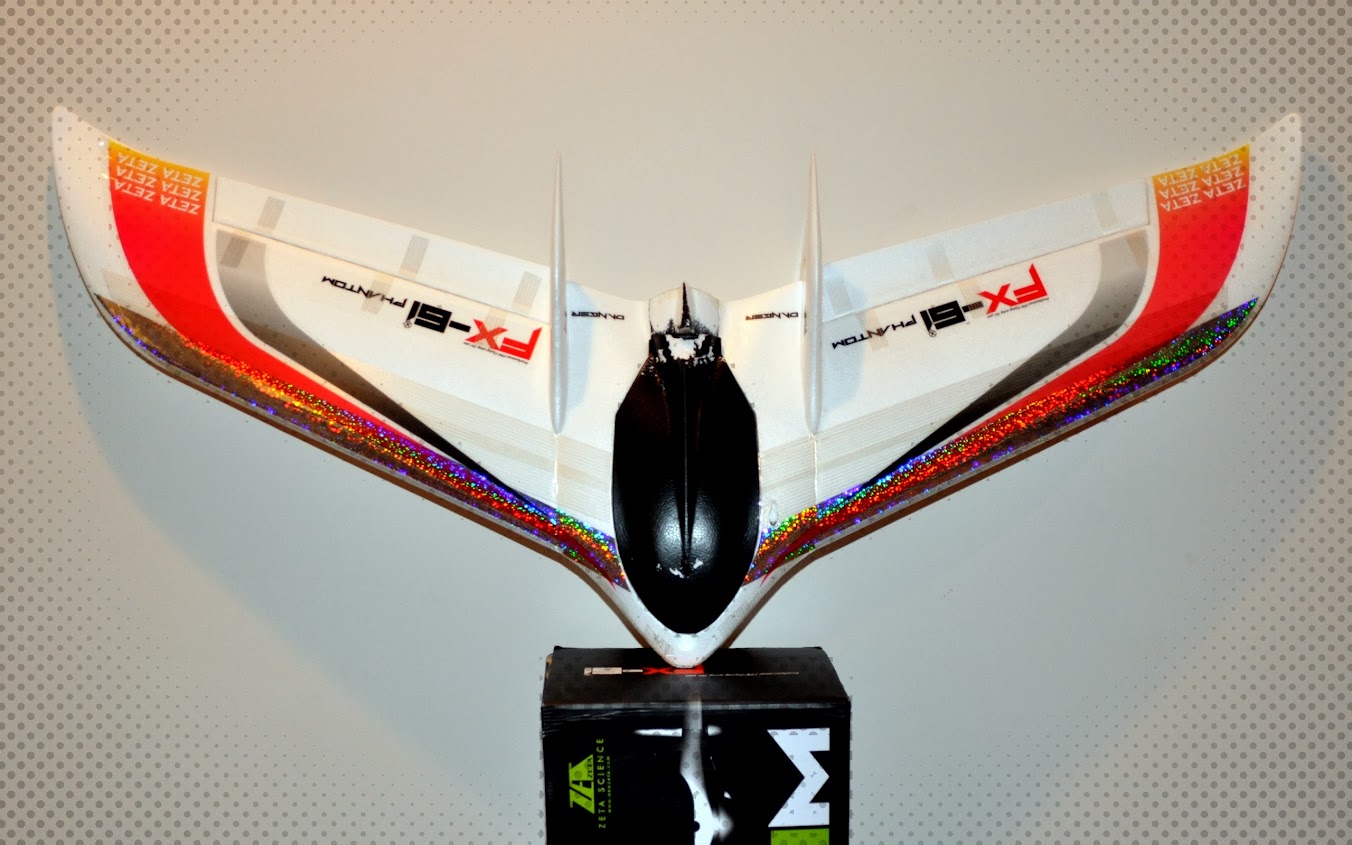
Phantom FX-61 Flying Wing 114 km Flight

DSC_0083.JPG

Hello all,

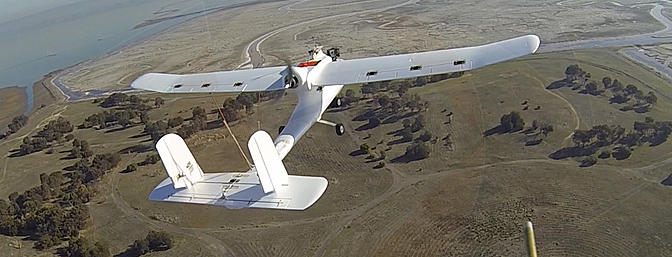
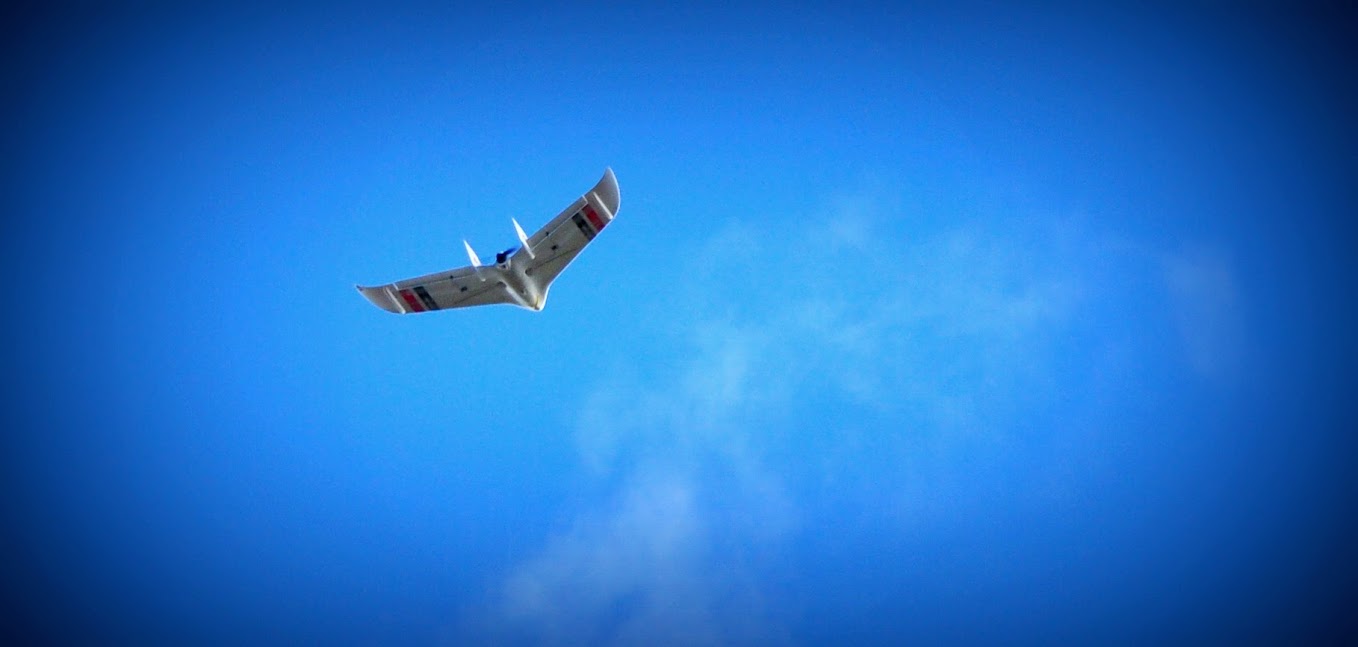
I just wanted to detail my small triumph this past weekend with this - my first blog. I have been building up to a 100 km flight for the past few weeks (months?) It's just something I've been wanting to do - and do it with budget friendly parts.  Data analysis and design optimization are things I enjoy almost as much as flying. Aero design and controls are not my expertise though, so this has been a trying but enjoyable learning process. Thanks to the knowledgeable folks here, and other forums, I gleaned enough tips to go for my own 100 km attempt.  Enough about me - on to the plane and flight!

Airframe: Phantom FX-61 flying wing by Zeta Science
WS: 1550 mm (61")

DSC_0205.JPG

I chose this airframe because I have some experience with wings (DIY foamies), they are generally durable, and I was just tired of fiddling with/fixing my Skywalkers.  Failed launch attempts on my SWs (V6 and 2013) usually meant my day was done and time to get out the hot water and glue.  The Phantom has survived several rough launches and hard landings with very little damage to show.  The worse is to the canopy when it came loose during a cart wheel and was chewed up by the prop.  I also had a motor mount fail on the day of the attempt.  (more on that later)  The Phantom does not appear to be the sleekest of wing designs.  It has fat dual vertical stabs, upturned tips, and a lot of reflex in the airfoil.  It does make for a slow and steady FPV platform, which is what it was designed for.


Mods:

Printed motor mount extension to move the light motor rearwards and help balance the batteries.  This, along with shaving down the curious horn shaped fuselage end, also considerably reduced the noise of the prop.

bbUX2M0eC8T5h7IcPqejYHMFM2VORHnm70EHZ-zXLtg=w150-h135-p-no

No additional spars other than bracing the top and bottom with lots of fiber strapping tape.
The ailerons were cut free and tape hinges were applied.  The hinge line was also sealed top and bottom with Blenderm.


Electronics:
Motor: Turnigy Multistar 4225-390Kv 16Pole Multi-Rotor Outrunner

Prop:  APC 10 x 10
ESC: Hobbyking YEP 40A (2~6S) SBEC

Batteries:  6S 7200mAh (2 X 3S 5000 mAh 20C + 2 X 3S 2200 mAh 20C) lipos

Control:  9x with er9x, FrSky 2.4Ghz tx module, D8R-XP rx

FC:  APM 2.5 (2.77 firmware)

Sensors & misc:  NEO-6M GPS, Airspeed (disabled for flight - not by choice), 90A RCTimer-style power module (needed for 6S I believe), and 915 mhz 3DR telemetry


On the ground, I ran the latest version of MP with the 3DR ground radio zip tied to a fiberglass driveway marker rod on a 10ft usb cord - very simple and cheap.


I designed the power system based roughly on a discussion here on DIYD.  (Wayne Garris' 170 min Techpod flight)  It was some time ago, and when I went back to check, I realized it was Reto Buettner advising Moglos - who just joined the 100 km club as well!  Well done Reto.  You should start charging a fee, or perhaps deserve a "100 km master" badge.


I will include the testing/tuning flights leading up to this, but felt this blog entry was getting long.  I'll add the preflights below.


The Flight
The winds were mild last Saturday so I decided to go for it.  There was a window in the morning with the afternoon bringing more wind and rain.  To make certain of the distance I decided to go to 7200 mAh of lipos.  This took some foam removal and a few frustrating hours of getting wires to fit.  I hesitate to cut the heavy gage wires and make a custom power harness, but that is really what should have been done.

My first launch attempt at the heavy weight (relatively) ended in a premature belly landing and flip.  Since I was still on the throttle trying to eek out the launch, the prop hit the ground and tore the motor and mount out.  My AS sensor pitot was also ripped out.  Desperate to fly with no end to crummy weather in the extended forcast, I performed field surgery with superglue and kicker.  I also disabled the airspeed sensor.  The second launch was not much better.  This time I cut the throttle to avoid snapping the motor mounton the ground, but the plane skipped up like a rock!  I hit the throttle and away she went.  Everything appeared to be working properly so I started the WP pattern.  Fast forward a couple of hours and here are the results!


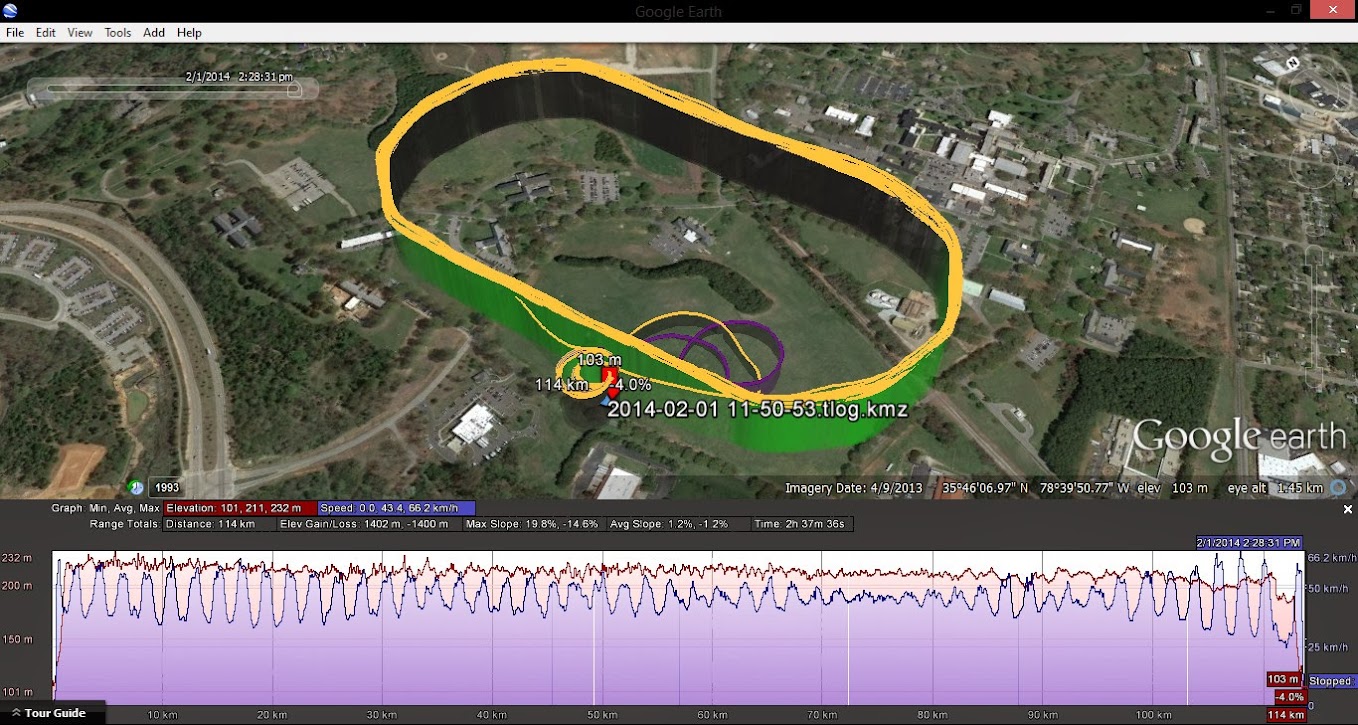
Flight time:  2 hrs 37 mins

Total flying distance:  114 km

Battery consumed:  60% 68%

Ave current during Auto:  3.7 A  1.9A*

Ave power during Auto:  87 W  44 W*

Ave airspeed during Auto:  13 m/s

AUW: 2145 g

I am not sure how to attach the tlog.  It is 15Mb.

*I have edited the originally reported current valves (and subsequent calculated power values) to the correct values.  Thank you to frederic reblewski for catching the error.

Fullscreen+capture+212014+83823+PM.jpg


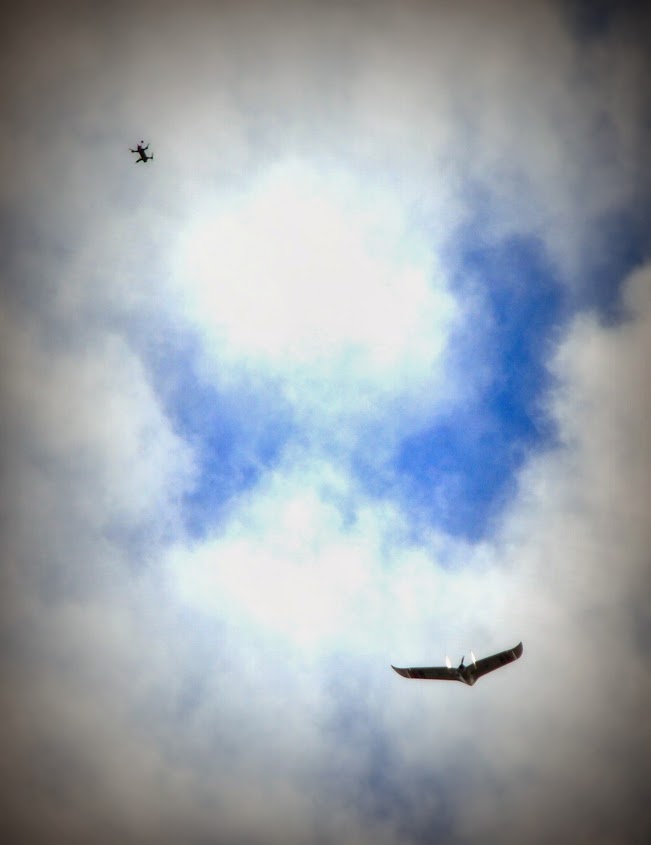
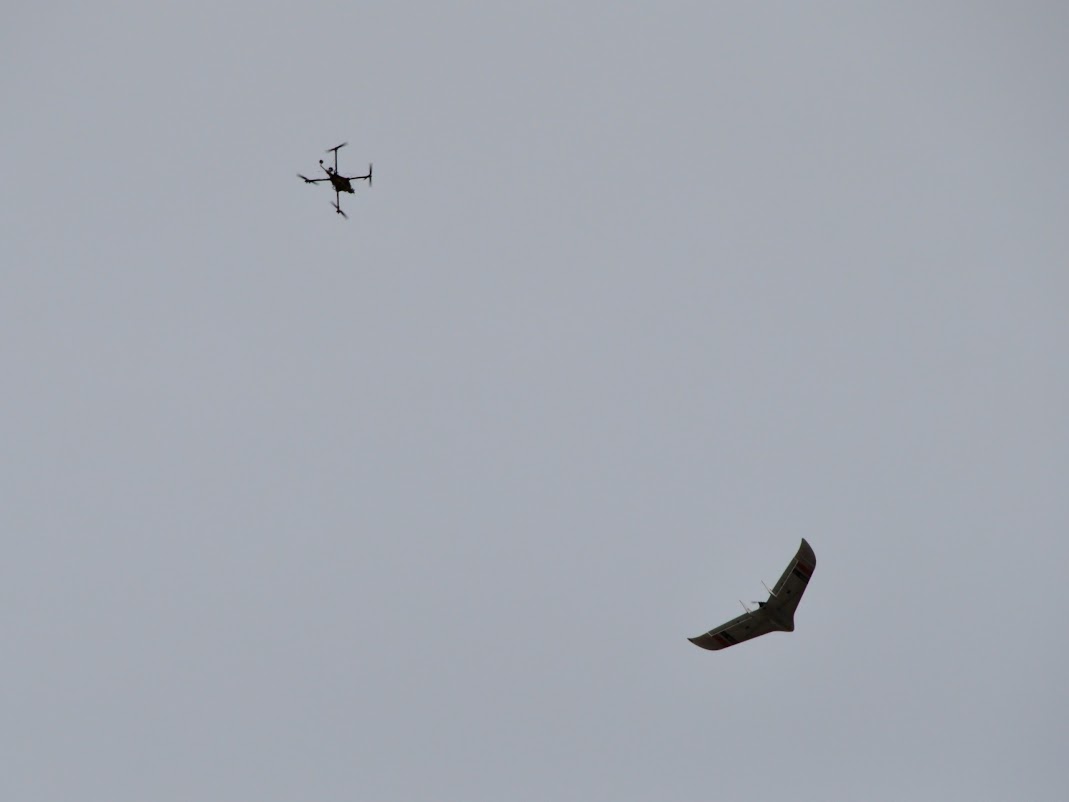
It is strange to be able to photograph your own plane in flight.

DSC_0092.JPG

Two of the guys flying FPV quads actually chased the plane around its circuit.  I got to experience a chase plane view of my Phantom as it navigated to WPs through a spare set of goggles!  One even advised me that my plane seems to be speeding up and slowing down throughout the flight - which was later confirmed in the tlog.  This was an unexpected treat to have a full scale flight instructor giving feedback from a chase "plane" like a real prototype flight.

DSC_0186.JPG

Due to the early launch issues, the tail end of my flight missed the target window and the last 20 km of the flight were in gustier winds and light rain.  I still had plenty of juice left, but the conditions were worsening, so I brought her in.  After a 114 km flight, I greased the landing within 10 ft but still broke the motor mount off.  Resting voltage was still 3.75 V per cell.


All in all, it was a spectacular day in my book - one of the best days of flying in a long time even though I was on the sticks for about 3 total minutes!

Read more…

At last! Found the right legs!

3689572622?profile=original

Just a short post/update today on Terence - I've eventually found some legs I'm happy with! Yay, at last! Not the most elegant, and looks positively sinister from some angles (see above), but there we go. 

Got these from quadframe, and the only fault I can find is that each clamp only clamps the leg once, and the leg angle is adjustable. I'd have preferred the angle to be fixed, and a double clamp, but it's still way stronger, simpler and sturdier than before.

(Loose wire in the pic is the Rx satellite cable...Given this thing is nearly 100% carbon apart from the aluminium arm clamps and screws, I'm upgrading it to a fully diverse system using this: http://www.quadrocopter.com/Diversity-Controller-for-Spektrum-and-Jeti_p_344.html). Sats will go on all 4 legs.

3689572665?profile=original

You can compare them to the old legs here. I'm going to canibalise the small plates to mount the sats on, as the legs are still 16mm

3689572711?profile=original

I did look at "Peg legs" at the beginning, due to their simplicity, but I live in Switzerland - if you fly in winter, you need ski-style legs, even if it mean you need to add foam in winter. Peg legs, you don't have that option, and you're going into the snow, rather than onto it. Your gimbal won't be impressed...

It's now getting interesting - just waiting for the chinese holidays to end for version 1.2 prototype to get cut...all the pixhawk holes are configured and ready for the accessories when they get released. And this is the "gold" prototype, which will be release to beta testers at some point in March. 2 of the testers are on here, so hopefully you'll get to hear just how good/crap Terence actually is! After a couple of months of testing...make some tweaks from the beta test comments, then production!

Read more…

3689572542?profile=original

I've been working on a new helicopter platform the last few months. Based on an MSH Protos heli which I chose because it's an extremely light weight platform, weighing in at only ~1200g without battery. It has a full belt drive which I much prefer to gears as it's quieter, lower vibration and more reliable. I've had a few problems with it because the belt drive makes a really awesome Van deGraaf generator... not a good thing on a UAV. But I solved that, and am conducting test flights now.


The flight controller is a modified PX4v1. I replaced the switching regulator with a MIC29300, so that I can run it on 2S direct with the servos. Main motor power is 4S 5000, typically this heli would run on 6S 3300. Using the MSH stretch kit and 465mm Spinblade Asymmetric blades. In otherwise standard form, this heli flew for 17 minutes on an old crusty battery, in -10C temperatures.

I have now added a subframe to hold an extra battery, FPV gear with a camera in the nose, and a vibration damped NADIR camera mount to be used for aerial mapping. The idea is to develop a mapping UAV that is superior to a multirotor, offering a valid alternative to a fixed wing for short to medium range missions. The VTOL capabilities would eliminate all the nastiness of catapults, and controlled-crash landings with onboard cameras in rugged areas.  Even the price is attractive at about $400 for the basic kit with motor and ESC (no servos).

Specifications show the advantage of a heli platform. This machine has an AUW including the batteries and camera of only ~3kg. It is 80m long, and about 15cm wide not including the extended legs, and 30cm high. The blades fold for easy transport, without requiring any lose wires or vibration-prone electrical connectors as a folding multirotor does. It actually looks much bigger on the table than it really is. This seems to be very good compared to multirotors I've seen with the same performance. (payload and duration)

Vibrations are always a problem with helis, but manageable with the right design and construction techniques.

3689572574?profile=original

Arducopter really makes helis worthwhile. You could buy two entire heli systems including a Tx for the price of a single DJI Ace One non-waypoint controller.  Or 7 for the cost of a single Ace One waypoint enabled controller.  I strongly prefer the PX4 controller over the APM and Pixhawk, because it offers 32-bit performance in a small package that is easier to mount in a heli frame.

So does it work? I took it up for it's first photo tests yesterday, and it worked beautifully. Better than 80% photos are usable. It flies for 20 minutes in a hover with old, cold batteries (-5C). I'm hoping for closer to 30 minutes while actually moving (helis are more efficient moving than hovering), in warmer weather with new batteries.  It should have an easy cruising speed of 15 m/s with little or no reduction in flight time.  At 20 minutes, this would offer an 18km range, and 27 if it can do 30 minutes.  If you wanted to do FPV and not mapping, you could configure it with a 3rd battery in place of the SX260 and fly for... 30-45 minutes, and a range of up to 36km.  Top airspeed is still TBD, but probably 20-25 m/s.  

Wind penetration and stability is excellent compared to both multirotors and fixed-wing.  You could do a mapping mission in winds up to 40 km/h with little effect on stability or duration.

3689572438?profile=original

If the success continues, I'm going to consider building a large gasser heli.  This would allow flight times up to 2 hours, or payloads on the order of 10 lbs for 30 minutes.  So you could map large areas, or even perform light duty spraying operations.  I'm thinking about local application of a herbicide for things like Giant Hogweed elimination, that sort of thing. Such a large heli does pose significant danger and should only be used in industrial, agricultural or remote areas.

Read more…

Drone TV Network

dtvn.jpeg?width=300

The sUAS News Group has launched the Drone TV Network in an effort to inform and educate both the unmanned aviation community and the general public about the commercial applications that embrace this transformative technology.

sUAS News has partnered with MahaPix Studio to produce this video series. The husband and wife team of Gus and Maha Calderon produced the documentary “Civilian Drones – Search & Rescue” which can be viewed at www.civiliandronesmovie.com.

Both Gus and Maha are FAA licensed commercial pilots. Gus owns the small UAS company IsisCopter and was also a collaborator and pilot of Lady Gaga’s “Volantis” project. Maha is a journalist, commercial photographer, and Certified Flight Instructor.

Our primary motivation is to improve the perception of UAS and demonstrate the benefits of unmanned aviation to those outside the community. By interviewing pioneers and innovators in the field of UAS, we hope to show the human side of the industry to develop and foster a broader acceptance of this technology with the general public.

We see the addition of video production to the sUAS News Group website, Podcast series and Small Unmanned Systems Business Exposition as one more dimension to round out the news and information we provide to our global audience.

www.dronetvnetwork.com

We hope you enjoy watching it as much as we enjoy making it.


Read more…
100KM

Searching crocodile nest with new technology

3689572391?profile=original3689572516?profile=original

Luke Evan, a Phd student of Cardiff University, England has beentrying very hard to look for crocodile nest for his research in the region of Kinabatangan river, the longest river in Sabah, the land below the wind in North Borneo.


Over the past two years, he has been explored lot of area with small boat or simply walk in the field, hoping to find some crocodile nest which is essential for his research. Unfortunately lady luck seems shy away from him all this while.  Even though this talented young English man work so hard, he just did not encounter any one nest which he is longing for.

https://www.youtube.com/watch?v=RJ7gJ4M-PLs

Through the connection of Dr Benoid with conservationdrones, eventually they acquire a Maja type drone system. The hardware is there, but no one can operate it. After some e mail and a visit to the study site, Danau Gilang Field Centre, As Asia team member of conservationdrones, We offer to do a trial mission flight with our own equipment, a reliable Skywalker base UAV.


As the field centre is surrounded by thick tropical rain forest, we can not find any suitable landing area. But since the area of interest is all by the river side, we think we may able to land the plane by the river bank or some tall grass by the river.


Eventually about 10 missions have been flown with thousands of high definition images acquire by the on board camera. These images then  stitch together to generate geo reference othomosaic and digital surface model of difference study site.


Upon download raw images from the camera, Luke go through each images carefully with his trained eyes. This time the lady luck is with him, very soon his sharp eyes identify a few possible sign of crocodile nest in the images. Since each image is geo tag and the fact that he know the area very well, he visit the site the very next morning and true enough, there is a crocodile nest and the rest is history.


We are very please to learn that conservationdrones help yet another researcher to facilitate his study of crocodile and the drone can operate in this type of challenging environment.

Read more…