I am as excited as anyone in the commercial drone field for the passage of Part 107 and the relaxing of the currently extremely restrictive rules on commercial UAS usage, which will dramatically increase adoption of tools like Site Scan, the product that my team at 3DR has been building for the last year.
However, just registering to sit for the exam requires a guide itself. Startlingly, this is even more painful than the process implemented by NCEES for the Engineer in Training and Professional Engineer exams. The FAA doesn’t appear to have evolved in the last 50 years. All registration is done by phone, all study guides are published in non-semantic pdf documents, and all instructions are scattered about a patchwork of different public and private websites and documents. I hope this post can serve as an easy-to-digest, authoritative guide for registering for the exam.
Find a test center near you. You can either look through the FAA’s awful official test center list here or use a 21st century web app like this one.
Despite the conflicting information out there, you cannot register for the test online. You must call or email to schedule the exam.
Don’t call the test center directly. They are not in charge of scheduling. You must call the mothership, which in this case is not the FAA, but PSI, a private company with which the FAA has contracted to administer the test who has published very dense website explaining some of the procedures. For some reason, PSI gives two numbers, neither of which were answered on my first attempt, 1-800-211-2754 and 1-800-733-9267.
Once you get through to the operator, I spoke with Deborah who was amazing, you will walk through availability and testing centers. The Oakland test center’s schedule was wide open, so I don’t think this is terribly popular yet. The test center takes a credit card over the phone for the $150 fee.
Prepare everything you need to take the exam. You must bring a photo ID with a current address. If the address on your ID is not current, you must bring a utility bill or other fairly official piece of documentation.
Study! The exam ain’t easy and includes quite a bit of general aviation knowledge with which typical commercial drone operators won’t be familiar.
A summary of the Part 107 rule can be found here and the complete text here
Details as to how to operate under the rule are here
Posted by hiroshi takey on August 22, 2016 at 5:00am
This is a most focused development for beginner APM developers to understand how multitasking work with interrupts and APIs.
The main purpose about this port is the scheduler developed by Andrew Tridgell and introduced to Ardupilot for atmega2560. Right now it's the main structure multitask process for all APM platform.
STORAGE: Fited to 328p Eeprom size. It's secure work with AP_Param.
GPIO: Remaped for 328p, all work good.
SPI: Working.
I2C: Working.
Scheduler: Working very good, now we have fully multitasking on atmega328p.
Changes without testing
RCOutput.
RCInput.
Not Working
Analog input.
ADC.
HOW TO BUILD
- Download and install Arduino 1.6.6 (Tested with this version).
- Open Arduino, click File, Preference and select ArdupilotMicro or ArdupilotTiny path root respectively.
- Open included example and compile.
WINGSLAND, a Chinese drone company, has just taken the wraps off the S6 in a successful launch event on August 18, Beijing, China.
First time to look at S6, the most notable things are the 4 foldable motor arms and an ultra-thin body design. Its size is roughly the same as an iPhone 6 Plus. Featuring a 13MP low distortion camera, S6 becomes world’s thinnest 4K drone an it weights only 230g include battery and is only 28.6mm thick.
There are six color ways of the S6, and also one special painting which is collaborated with fashion brand-MLGB.
What’s neat about the S6 is it allows you attach different functional accessories through extended port which located on the upper shell of the S6. Wingsland says, right now, they have three fun compatible modules for users to choose: a toy gun, a searchlight and an emoji display screen. An all-around obstacle avoidance module will also be put up later on. The S6 is controlled with a powerful piloting app and can be maneuvered in different control modes. And it is also got all the main stream drone features: Intelligent orientation control, auto return home, follow me, one-key takeoff/landing, etc.
If DJI is the drone world’s “DSLR”, then S6 can be seen as the “smartphone”. Light, smart, portable, it has all the features that you expect on a drone, but more functions can be added through compatible accessories. Itis like an aerial robot.
The S6 is pricing at 2199 RMB in China. The approx. price for overseas is 350 USD. WINGSLAND said S6 will be available for shipping worldwide in a really short time.
Hi, I'd like to share my 3D printer design and building.
The idea itself came from Kossel Mini, but I completelly redesigned according to my needs and experiences.
Finally I got a functional ABS printer, with dia.220 x height 250 mm printable volume. Till now I spent on nearly 1100 USB on this project (with some support in 3D printing, I only had to pay for filaments) and linear rails would take another 500 USD (described above). So if anybody would like to reproduce my design, take this into account!!!
The complete 3D model including stl files can be downloaded from the project's GrabCAD page, along with further renders and pictures.
All electric parts incl. controller, motors, hotend, etc. were bought from Think3Dprint3D, many thanks for the continous support during building process!!!
***Please note that this is fully a personal DIY project (I did in my quite limited spare time), without any donation or help. Because of this I can't give any support on building one or modifying plan/files for personal wishes, please don't send me PMs or email related this. ***
My last upgrade will be moving to linear rails from the roller design, 3D model already included in the GrabCAD package. Hence the price of linear rails, I'm still collecting funds for buying them. (The roller design also works great, but there is some abrasion on rollers, so I'm sure they'd need continous replacement uppon a while.)
If you find my work useful and would like to support my continous development in DIY world, you can donate by paypal (nhadrian@gmail.com), any donations are wellcome! Thanks in advance.
Thought to share, something I've been working on for the last year or so.
Anyhow, hope you like the PRO and happy flying guyz!
Will share more details when I make it available.
Best,
D.
Special Thanks to the Armattan Productions, this design is only possible thanks to the quality of your materials, diamond cut precision and 3d cutting capabilities! Love you guyz! ;)
A part of the PX4 team has been working on an open source ESC since late 2013. The objectives we had in mind were roughly as follows:
BSD licensed codebase.
CAN bus interface (using UAVCAN as a high level protocol), with specific sub-goals:
low latency;
ESC status monitoring, at least health, temperature and RPM;
automatic and transparent for the user firmware upgrades.
Better alternative to the popular RCPWM BLDC controllers in terms of reliability and response characteristics.
The project was first known as PX4ESC, later renamed into Sapog for reasons of clarity. After about two and half years of development and experimenting, the first, for-developers-only release was announced at the ELC 2016 (slides here). Now, a few months after that, we're announcing that the project is finally ready for public release, and that the first ESC based on this project - Zubax Orel 20 - is now available from Titan Elite, Inc.
Zubax Orel 20, pictured on the right, is rated for supply voltage 9~18 V (3~4S LiPo) and continuous motor currents up to 20 A. More info can be gathered from the documentation page at the Zubax Docs website.
We welcome all companies that specialize in electric drive systems for UAV to consider extending their product portfolio with UAVCAN enabled solutions. In order to encourage this move, we're planning to release the reference hardware sources under a permissive Creative Commons license.
It should be emphasized that all of the features of Sapog are exposed via UAVCAN, an open and royalty-free protocol standard. We encourage all vendors of UAV avionics to support it, since relying on a common and open ecosystem is beneficial for everyone. For ease of migration we're providing MIT-licensed libraries in C++, C, and Python. Here we have a small collection of demo scripts that demonstrate how to access the capabilities of Sapog, or any other UAVCAN-interfaced ESC, using plain Python from a regular desktop computer: https://docs.zubax.com/sapog/direct_control_via_uavcan.
Posted by Tersus GNSS on August 18, 2016 at 8:56pm
Watch this video that shows how to log data with external data logger. The logged binary observation data can be converted in to RINEX format with Tersus GNSS Center.
Especial thanks to Andrew Tridgell, Randy, Lucas de Marchi, Gustavo José de Sousa and Ardupilot Team for let me learn and show me the power of the API APM.
Thanks to Lorenz Meier to create and share Mavlink to the world.
MAVLink or Micro Air Vehicle Link is a protocol for communicating with small unmanned vehicle. It is designed as a header-only message marshaling library. MAVLink was first released early 2009 by Lorenz Meier under LGPL license.
I stopped development to here, because i discovered a new way to transport telemetry data side by side, and it's will be release when URUS System development finish. You will be updated about this if you want following the development at https://github.com/hiro2233
All URUS System and new URUS Protocol will be a member project and a part of Ardupilot Development.
TESTING
There is an example in example path to test te unit, it's tested with Embarcadero RAD Studio Berlin in multidevice mode with windows and android. I think the unit will work with LAZARUS with little modifications.
Posted by Bill Bonney on August 17, 2016 at 10:00pm
MAV Pilot v1.4 for iPhone has updated and published to the App Store. It supports connection to ArduPilot & ARDrone autopilots using WiFi (& LTE/3G connections) including 3DR Solo.
This release add Basic Tuning views, Message Log view & 3D Maps. (+ other bug fixes and improvements)
Even if you don't plan to bring an autonomous rover to Sparkfun's AVC in Boulder, Colorado on Sept 17, you can still register as a spectator to see the racing. Tickets are now on sale here.
Posted by Jared Reabow on August 17, 2016 at 6:30am
A FARMER whose 60-acre crop was destroyed by a fire ploughed up the edges of the field to help firefighters stop the blaze spreading.
The un-named farmer at Lane End Farm near Newington in South Oxfordshire worked with crews from four Oxfordshire fire engines and one Berkshire team to contain the inferno yesterday evening.
In the end they managed to save ten acres of crop, but also stoped the fire spreading into neighbouring fields, also full of crops.
Firefighters spent more than an hour battling the blaze in what they said were hot and strenuous conditions.
The blaze was spotted by several motorists just before 6pm on the A329 just past Newington, heading from between Warborough and Stadhampton.
Oxfordshire Fire and Rescue Service has now said the massive fire was believed to have been caused when a metal part of a farm vehicle hit a stone in the field causing a tiny spark.
Wallingford Fire Station manager Marcus Reay warned people: "The current spell of dry weather means that the fire risks in the countryside remain very high.
"Although this fire was thought to have been caused by a spark when a metal part of the farm vehicle has grazed a hard stone in the field - I would still ask that people take extra care with naked flames or other sources of ignition, this type of fire can quickly spread out of control and have devastating consequences."
Passerby Jared Reabow, of ReabowRotors.com, captured the incredible scale of the fire from above using a drone.
Today at the Intel Developer Forum, CEO Brian Krzanichannounced both the company's Aero drone development board and a full ready-to-fly drone based on Aer on the company's RealSense sense-and-avoid solution, which is already used on the Yuneec Typhoon H drone. Both of them are using the Dronecode PX4 flight stack.
Both will be available in Q4 2016. The Aero board is $399 and the price for the whole drone has not been set. More details are here.
IDF San Francisco 2016 – Drones Intel Reveals UAV Developments and Availability of New Technologies at IDF Aug. 17, 2016 – Intel Corporation today announced its involvement in the development of multiple best-in-class unmanned aerial vehicles (UAVs), commonly called drones, showcasing how they interact with their environment, solve problems and thrill users by helping them explore and interact with their worlds unlike ever before.
Intel® Aero Platform for UAVs Intel’s® Aero Platform is available today for developers to build their own drones. This purpose-built, UAV developer kit powered by an Intel® Atom™ quad-core processor combines compute, storage, communications and flexible I/O all in a form factor the size of a standard playing card. When matched with the optional Vision Accessory Kit, developers will have tremendous opportunities to launch sophisticated drone applications into the sky. Aero supports several “plug and play” options, including a flight controller with Dronecode PX4 software, Intel® RealSense™ technology for vision, AirMap SDK for airspace services, and will support LTE for communications. The Intel Aero Platform is available for preorder now on click.intel.com – the Intel Aero compute board is $399, the Intel Aero Vision Accessory Kit is $149, and the Intel Aero Enclosure Kit is $69.
A separate Intel Aero Platform Ready-to-Fly Drone will be available in Q4. Yuneec Typhoon H* with Intel RealSense Technology Now publically available, the Yuneec Typhoon H is the most advanced, compact aerial photography and videography platform available, featuring Intel RealSense technology. With an intelligent obstacle navigation system, the drone can see objects and self-navigate around them. The drone has an Intel RealSense camera and an Intel Atom processor while the ground station is also equipped with an Intel Atom processor. The Typhoon H with Intel RealSense technology is available for purchase for $1,899. AscTec Falcon 8* The AscTec Falcon 8 drone went into serial production in 2009 and has since been used globally for professional applications, most recently as an aerial inspection and surveying tool for Airbus*. The patented V-form octocopter is designed for precision and safety with the reliable AscTec HighPerformance GPS and the new control unit AscTec Trinity. It weighs only 2.3 kilograms on takeoff and works with maximum efficiency in the air, on- and offshore, even in challenging conditions.
Intel and Drone Policy Advocacy Intel CEO Brian Krzanich was recently appointed by the Federal Aviation Administration (FAA) to chair the Drone Advisory Council, a committee focused on addressing “integration strategies” regarding drones. In August, Brian addressed The White House Office of Science and Technology Policy, which includes experts in government, academia and industry, to discuss airspace integration, public and commercial uses, and ways to ensure safety, security and privacy in this emerging field. On Tuesday afternoon, Anil Nanduri (Vice President and General Manager, UAV Segment and Perceptual Computing Group at Intel), Earl Lawrence (Director, Unmanned Aircraft Systems Integration Office at the Federal Aviation Administration), Art Pregler (UAS Director at AT&T*), Ronnie Gnecco (Innovation Manager for UAVs at Airbus), and Shan Phillips (USA CEO at Yuneec) discussed how new drone capabilities and regulatory changes present new opportunities for drone developers
One of the more important features that will arrive with Copter-3.4 (still in beta testing) is the Polygon Fence (the full list of features can be seen in the ReleaseNotes.txt).
Plane has had the polygon fence for years but when we added it to Copter, we also added the ability to stop at the fence in Loiter mode and when using Guided mode's velocity controller. This stop-at-the-fence feature is quite exciting, not only because it's a feature people have been asking for for a long time but because it's also a solid step towards reliable object avoidance.
If you want to give it a try now and are happy to accept the risks of beta testing, there's a quick how-to video below showing how to define and upload the fence using the Mission Planner (MAVProxy can also be used but other GCSs don't yet support this feature). Over the coming weeks we will update the wiki to include this info. For those not looking to become beta testers you can look forward to it once Copter-3.4 is official released.
You can also find the code showing how we implemented stop-at-the-fence here.
Some extra info and a couple of warnings:
The fence can theoretically have up to 84 points but I have not tested with more than about 10 so far. As the number of points grows, it does require a small amount of additional CPU so we will keep an eye on the "PM" (performance management) dataflash log message to see if the real limit is less than 84.
There is also a slight issue with very acute angles meaning the vehicle might be able to breach the fence if you create a fence that looks like Bart Simpson's hair. Nothing horrible will happen except that the vehicle will RTL as it normally does when it breaches the fence.
By the way, the stop-at-the-fence feature works with the circular fence as well. If you define both a circular and a polygon fence, the vehicle will stop at whichever barrier it hits first (i.e. the green lines shown below)
As I mentioned above, if you do give it a try, remember that Copter-3.4-rc2 is still beta so although it seems quite solid it's best to keep your eyes our for troubles, don't test on a vehicle that you could not stand to be involved in a crash and report any issues on our discourse server.
Thanks in particular to Leonard Hall and Daniel Ricketts for the code to stop the vehicle at the fence.
Posted by Project Helin on August 16, 2016 at 3:30am
We have created an Open Source Platform which allows everyone to deliver products with drones. We support drones with MAVLink and you are able to define save flying-zones for your region. The platform then calculates save flying paths from you to a customer.
This video shows work in progress done jointly by u-blox (an ETH spinoff) and PX4 (an ETH open source autopilot) to leverage the latest u-blox RTK hardware on the PX4 flight stack. No additional hardware is required, the RTCM correction data is forwarded straight from the ground control station via MAVLink (over Wifi)
Posted by elad orbach on August 14, 2016 at 3:05am
Michael Fallon, the Defence Secretary, will today announce an innovation unit which will encourage individuals and companies to pitch ideas to a panel of experts. The best ideas will be fast-tracked with the support of an £800million fund over the next decade.
Projects which will be funded include a "micro-drone" with tiny flapping wings inspired by the biology of a dragon fly, which could have a "huge impact" on operations in urban environments.
It weighs less than two pound coins, is less than five inches long and will be able to fly at speeds of up to 45mph. The drone, which has been developed by a company called Animal Dynamics in Oxford, will be equipped with a camera and a microphone enabling it to carry out covert surveillance.
The unit will also fund new "Quantum Gravimeter" which is being developed with the University of Birmingham to survey underground structures.
Michael Fallon, the Defence Secretary, said: "This new approach will help to keep Britain safe while supporting our economy, with our brightest brains keeping us ahead of our adversaries.
“Backed by a defence budget that will rise every year until the end of the decade, it will ensure that the UK maintains its military advantage in an increasingly dangerous world.”
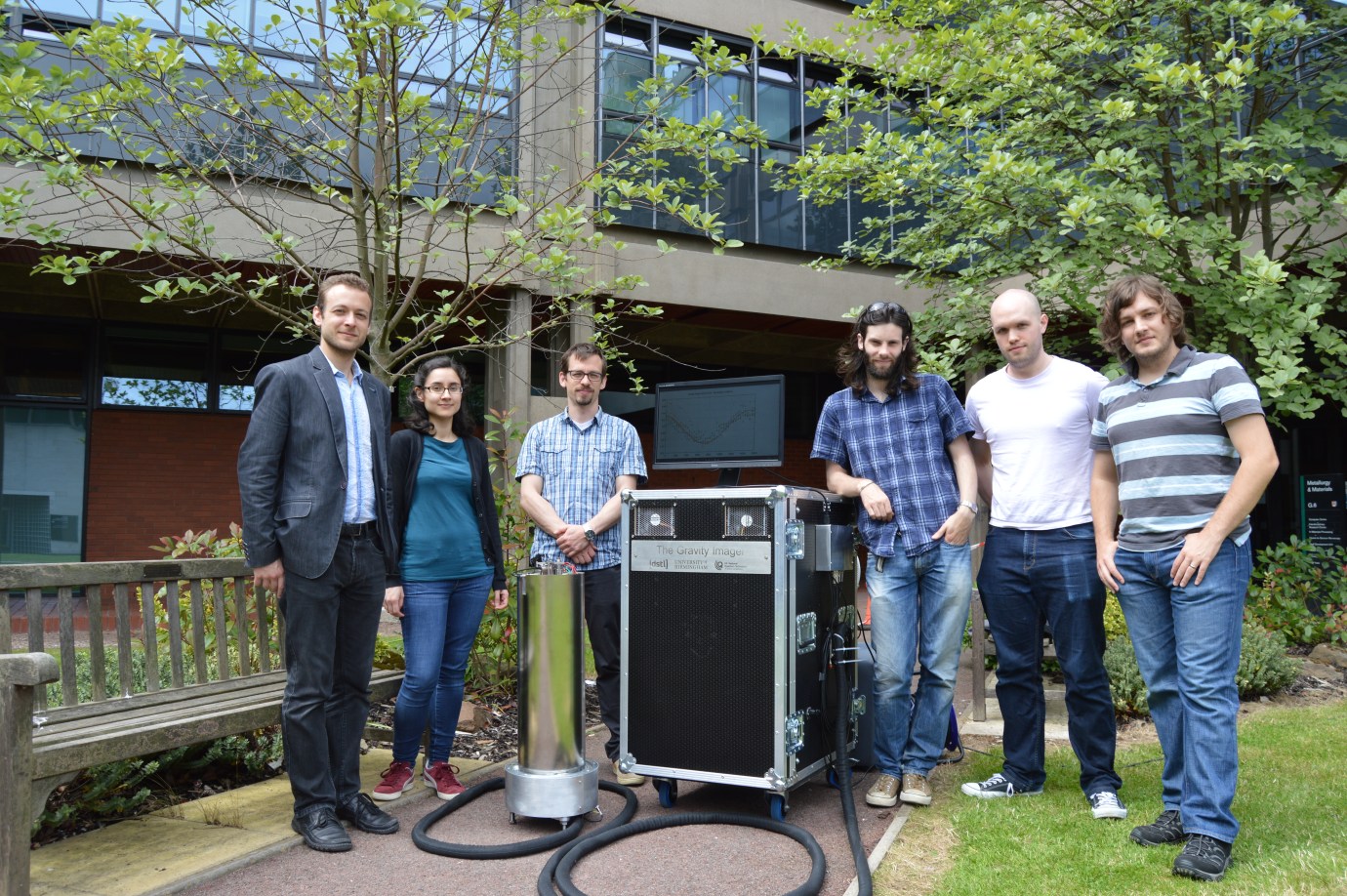
The Gravity Sensing team from the University of Birmingham has made successful outdoor measurements with their quantum gravimeter for the first time. The quantum gravimeter, designed and built in the labs at Birmingham, represents a significant step forward in developing robust quantum technologies for use in real-world environments. The technique of gravity mapping is already used by civil engineers for carrying out surveys – such as on brownfield sites – and detecting underground features. The Gravity Imager is intended to provide higher sensitivity and reliability for such applications, while also drastically reducing measurement time through enhancing the robustness to external noise sources. These first outdoor measurements of gravity represent a step along the way to starting full field trials.
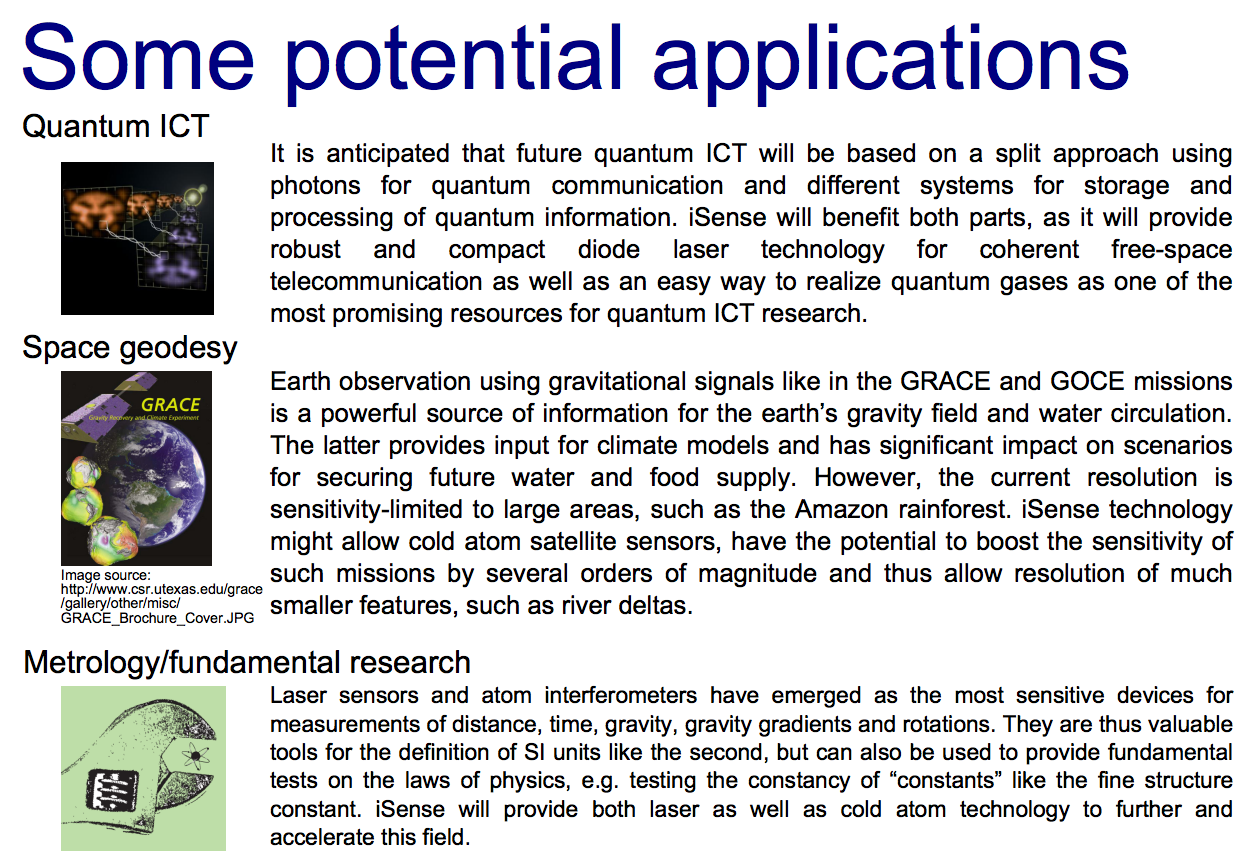
The iSense project aims to bring the latest developments in ultracold atom science to practical applications by developing the technology that will turn laboratory-based instrumentation into portable and robust instruments and sensors. One most attractive application of such instruments would be to create a very compact, highly sensitive gravimeter, which is one long term goal of the Project.
The vision behind this project is to unleash the power of high-precision quantum sensors in a wide range of science and technology applications. In terms of fundamental science a precise force sensor based on the proposed technology would be designed and fabricated enabling a crucial step forward in detailed investigations of the Casimir force, or a search for deviations from Newtonian gravity. It would also be a tool for space missions, where compact, low power, ultra-high precision investigation of the local space-time manifold is required, or indeed where a distributed network of such sensors would be appropriate. The absence of local gravitational “noise” has the potential to achieve significantly higher sensitivity. All these scientific applications would provide extremely sensitive fundamental tests of our current theoretical framework in physics where small deviations from theory would be revolutionary.
Gravity sensors are already used in geodesy (e.g. ocean circulation, water balances, Antarctic ice levels, magma flows, etc), in the exploration of resources (location of scarce minerals, oil fields, etc) and archaeology (non-destructive mapping of sites and location of intact caverns). The improvements in precision and robustness offered by the quantum force sensor targeted in this proposal would not only make these applications more routine but offer completely new possibilities, e.g. the location and extraction of fragmented oil bubbles in current oil fields (potentially increasing the fraction of oil captured from today’s typical 40%). Other applications include the temporal supervision of carbon storage sites and monitoring of ground water, snow and soil moisture to improve climate models and our understanding of the global ecosystem.
In the longer term we anticipate novel communications paradigms (e.g. ultra wide band network timing) using a quantum-based position-time grid that would not require GPS, and exceed its accuracy by orders of magnitude. Further applications would become apparent as the technology develops, e.g. atom-based quantum information technology including computing and secure communications for a range of purposes including global trade exchange.
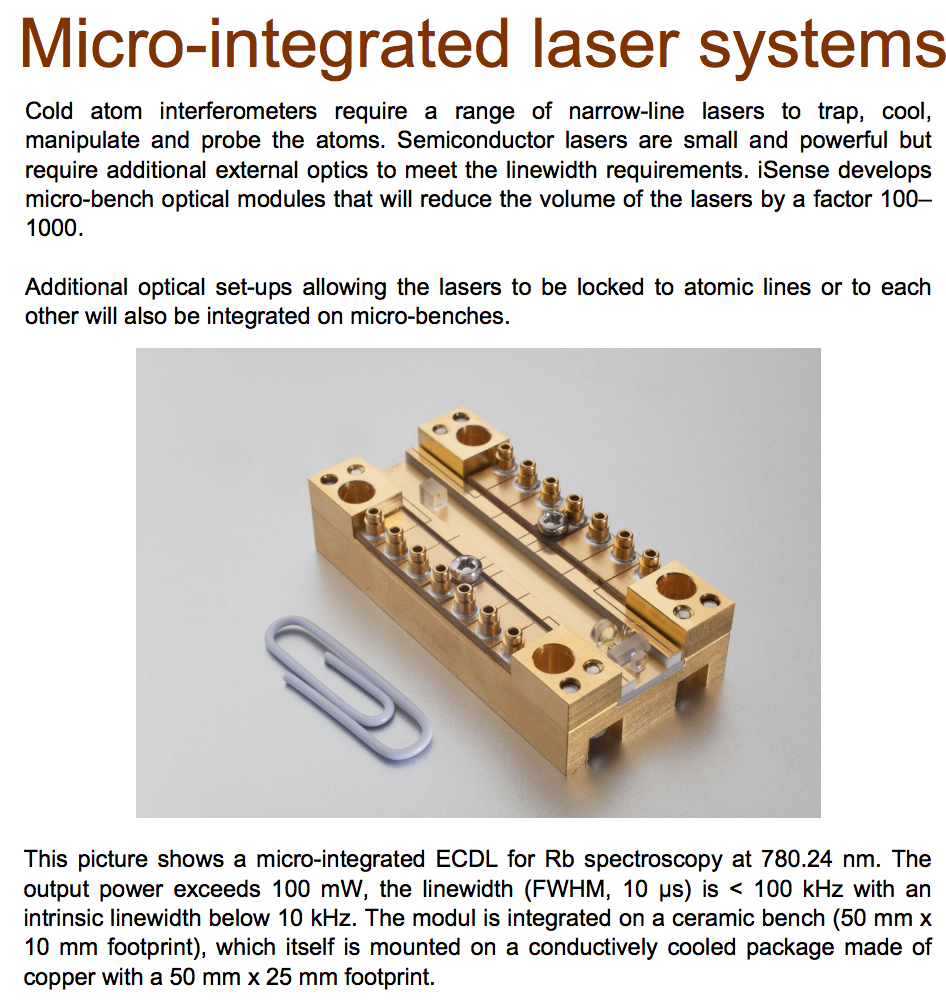
The technological breakthrough of transferring and adapting ICT into laser systems for cold atom preparation and control is the key essential and challenging step towards achieving these long term visions, as all rely on precise control of coherent, laser-generated photon fields and precision pulses. Laser systems based on integrated optics would not only be significantly more compact than standard laser technology but would also offer superior stability, adaptability and control, which will be crucial for precision measurements as well as quantum gate operations.
Gravimeter on a chip
The University of Glasgow have built a gravimeter on a chip that could offer a simple, compact and low-cost way of measuring gravity. The chip uses a microelectromechanical system (MEMS) that is similar to that used in accelerometers, which are ubiquitous in smartphones. However, the new device is about 1000 times more sensitive to accelerations than the devices found in consumer electronics.
The device has a sensitivity that is about ten times worse than the best commercial devices. According to the team, the device is still sensitive enough to detect a tunnel of cross-sectional area 2 m2 at a depth of 2 meters, and could be used to find an oil reservoir with a volume of 50 cubic meters at a depth of 150 meters.
The team is now working with a geological-survey company to develop a portable gravimeter that can be tested in the field. While the current design only measures acceleration in one direction, the physicists plan to create a device that works in 3D.
The team says that it could be produced for a 1000th of the normal $100,000 cost (so $100).
Posted by VGR-Systems on August 14, 2016 at 2:29am
Hi,
Just a quick update for the thrust vectoring coaxial drone project,
Config:
Maxxprod Himax contra-rotating brushless motor CR2805,
7x5 props replaced by T-Motor carbon fiber 9x3 resulting in more efficiency.
Flight time is about 15 minutes with Fatshark HD pilot and 12 minutes with a Gopro 3. Could be even better with a more adapted motor. The advantage of this system is to allow large props with little frame (the 3D printed frame of this coax weights less than 30 grams) resulting in a very good efficiency.
Flight controller is a CC3D revolution with a standard coaxial vehicle config.
The system seems to not accept too much the integral (often resulting in a counter pendulum effect during fast pitch forward translation but maybe it can be a variable overshoot??) but no pendulum effect with a simple P (no I nor D) for the inner loop (acro) and a simple P (no I) for the outer loop (attitude). With this config, the system reacts very good and is very stable and controllable even with wind.
Next step will be to remove the clevis in the commands because the system could maybe accept a direct servo in the roll and pitch plates and take advantage of a larger roll and pitch travel (-45°, +45° for ex) and more room in the frame (or a lighter one). CC3D will be replaced by a SP racing F3.
This summer, one of the interns atNavStik Labs, Saumya Saksena (an undergraduate student), built a low-cost obstacle detection kit using ultrasonic sensors. He also designed a custom web-app to configure his sensor-kit and visualise the obstacle data. This was an uphill task for a student with limited programming/development background. However, the generic data-sharing model, available within FlytOS, made it extremely simple for him to get it all done within a few days.
Saumya’s kit makes use of 4 ultrasonic sensors (later extended to 6), which are interfaced to an arduino board. This board, in turn, talks to FlytPOD (flight computer on the drone, running FlytOS) using rosserial. Since this architecture is built on top of ROS, getting the sensor data published into FlytOS was a piece of cake.
Sonar jig with Arduino Sonar jig mounted under the drone
With data-acquisition done, the next step was to develop a web-app to help him visualize the data from his kit, and configure his sensor parameters, such as polling rate, ability to disable/enable a certain sensor, etc. He spent an evening writing FlytSONAR (webapp) using the websocket and RESTful FlytAPIs to share data between his webapp and sensor kit. Further, he hosted this web-app on FlytPOD itself. Which means that he did not need to install any application on his local machine to configure the custom sensor or visualise data. He could just point the web-browser on his local machine to the IP address of the FlytPOD (FlytPOD has a powerful built-in wifi router, which can create a hotspot or connect to another router) and get access to his app on any laptop or mobile.
All the design files and arduino code for building this DIY kit are available here as adownload.Check out our extensive documentation on using FlytAPIs for designing web-appshere.
Drones are evolving fast. New sensors, payloads, and algorithms are being developed, and new application areas are being discovered, everyday. It is, therefore, critical to have a robust, scalable data-sharing model inFlytOS. This enables all these components seamlessly share data with each other, and with other devices. FlytOS is built on top of ROS, making it a great platform to interact with various devices/payloads. It exposes high level FlytAPIs in ROS, C++, Python, REST and Websocket. The modular design of FlytOS allows for integration with external ROS/Linux libraries, and do custom data-plumbing between your onboard and offboard apps.
FlytPOD is now live on Indiegogo. Checkout the campaign and grab the early bird perks.
For more hacks to build powerful drone applications, check out following posts from past.
The VL53L0X from ST Microelectronics is a time-of-flight ranging system integrated into a compact module. This board is a carrier for the VL53L0X, so we recommend careful reading of theVL53L0X datasheet (1MB pdf) before using this product.
The VL53L0 uses ST’s FlightSense technology to precisely measure how long it takes for emitted pulses of infrared laser light to reach the nearest object and be reflected back to a detector, so it can be considered a tiny, self-contained lidar system. This time-of-flight (TOF) measurement enables it to accurately determine the absolute distance to a target without the object’s reflectance greatly influencing the measurement. The sensor can report distances of up to 2 m (6.6 ft) with 1 mm resolution, but its effective range and accuracy (noise) depend heavily on ambient conditions and target characteristics like reflectance and size, as well as the sensor configuration. (The sensor’s accuracy is specified to range from ±3% at best to over ±10% in less optimal conditions.)
Ranging measurements are available through the sensor’s I²C (TWI) interface, which is also used to configure sensor settings, and the sensor provides two additional pins: a shutdown input and an interrupt output.
The VL53L0X is a great IC, but its small, leadless, LGA package makes it difficult for the typical student or hobbyist to use. It also operates at a recommended voltage of 2.8 V, which can make interfacing difficult for microcontrollers operating at 3.3 V or 5 V. Our breakout board addresses these issues, making it easier to get started using the sensor, while keeping the overall size as small as possible.
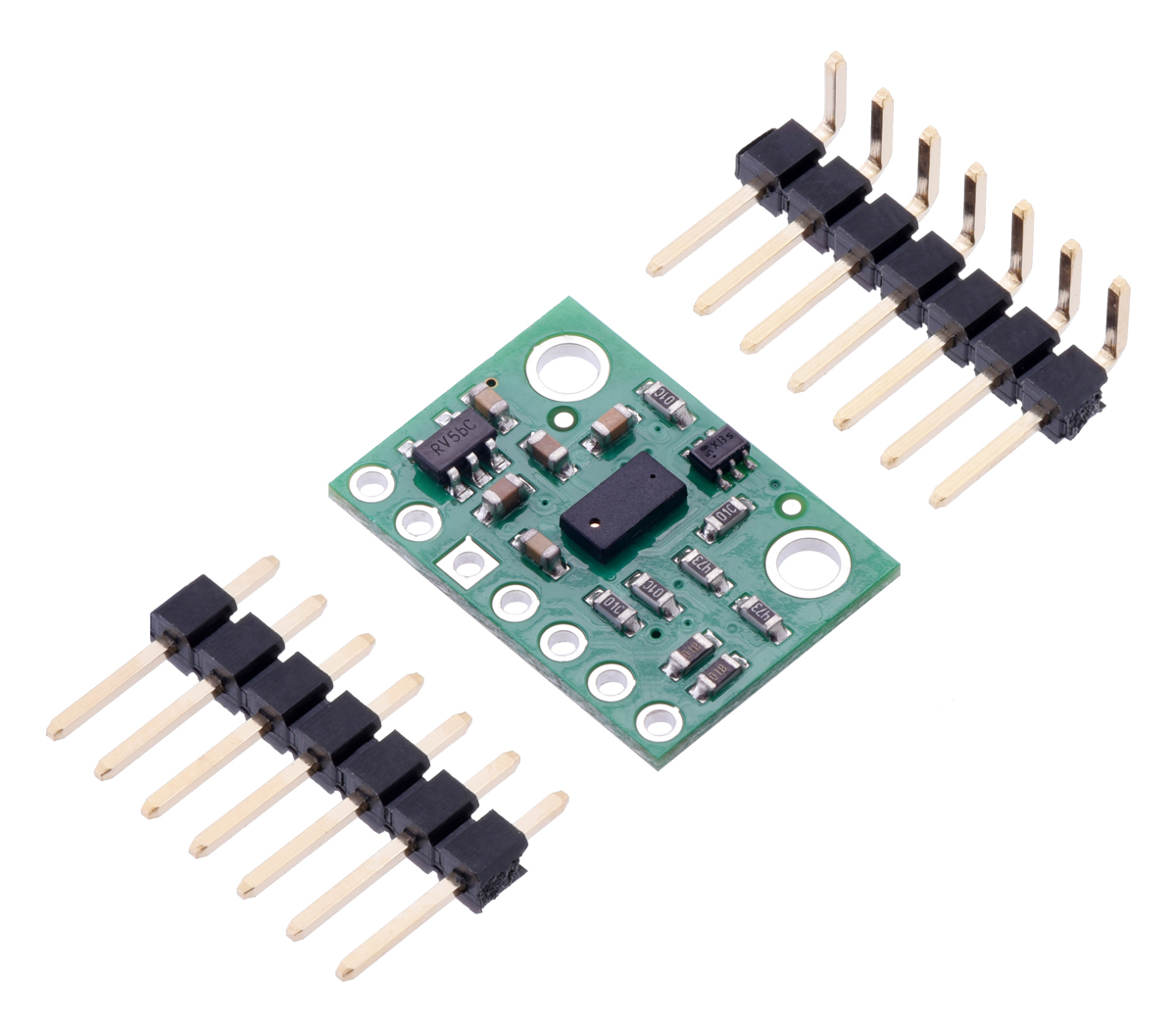
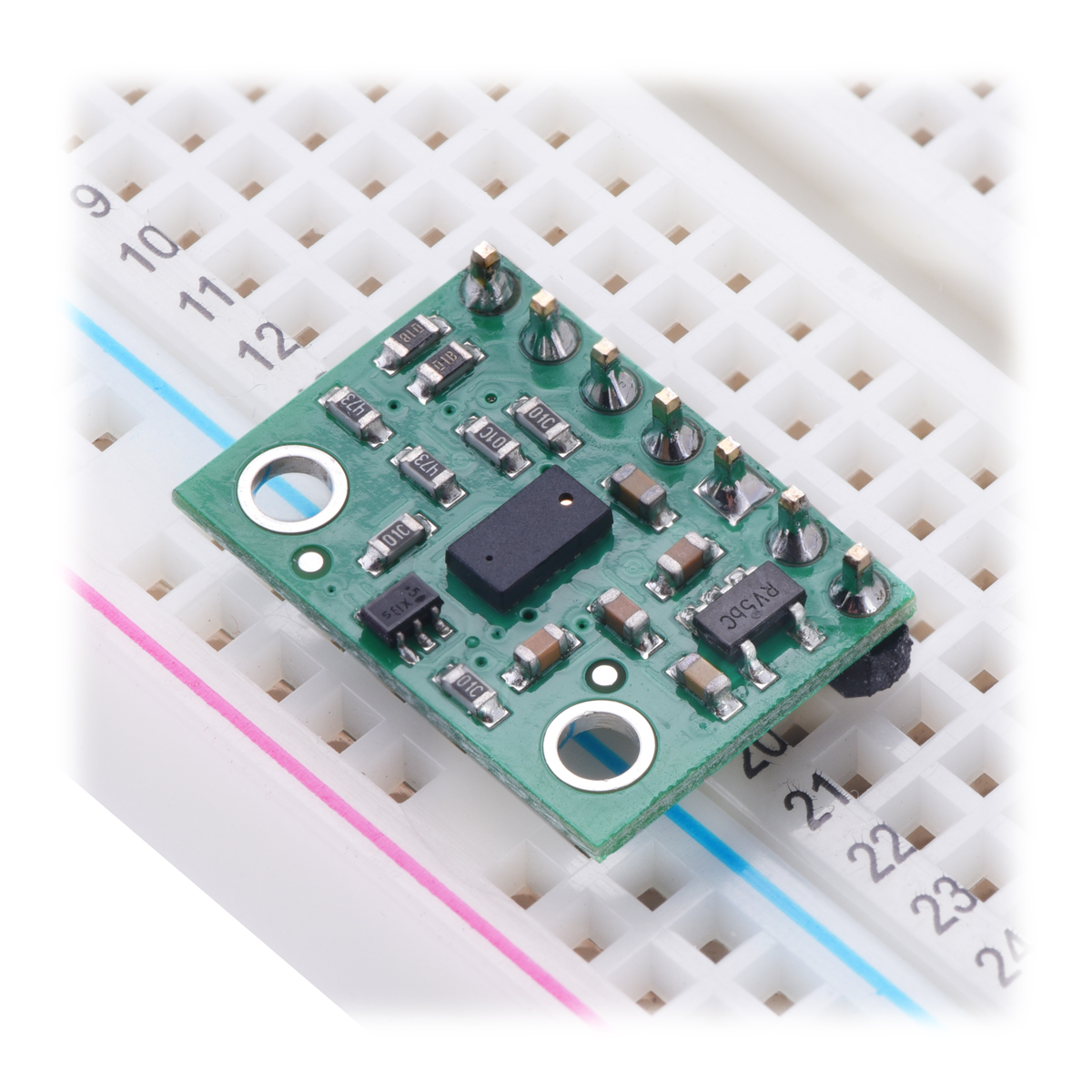
The carrier board includes a low-dropout linear voltage regulator that provides the 2.8 V required by the VL53L0X, which allows the sensor to be powered from a 2.6 V to 5.5 V supply. The regulator output is available on the VDD pin and can supply almost 150 mA to external devices. The breakout board also includes a circuit that shifts the I²C clock and data lines to the same logic voltage level as the supplied VIN, making it simple to interface the board with 3.3 V or 5 V systems, and the board’s 0.1″ pin spacing makes it easy to use with standard solderless breadboards and 0.1″ perfboards. The board ships fully populated with its SMD components, including the VL53L0X, as shown in the product picture.
For a similar but shorter-range sensor (up to 20 cm, or 60 cm with reduced resolution) that includes ambient light sensing functionality, see our VL6180X carrier.
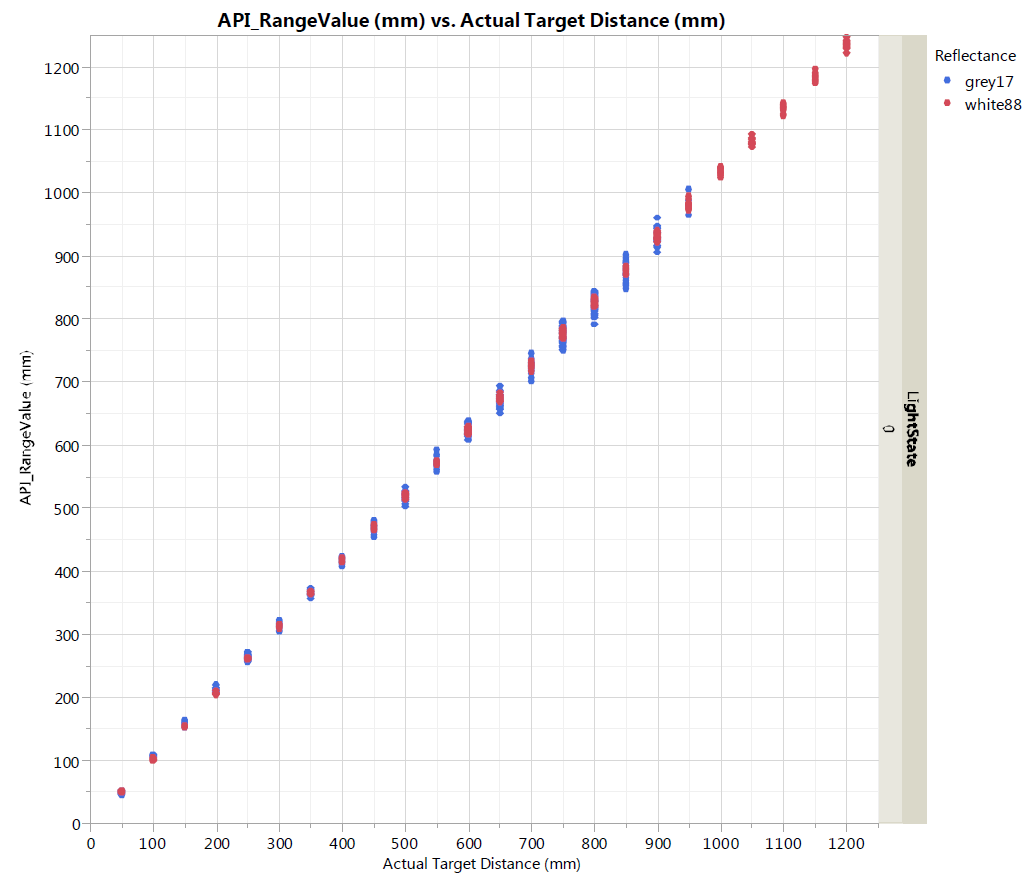
VL53L0X datasheet graph of typical ranging performance (in default mode).
Specifications
Dimensions: 0.5″ × 0.7″ × 0.085″ (13 mm × 18 mm × 2 mm)
Weight without header pins: 0.5 g (0.02 oz)
Operating voltage: 2.6 V to 5.5 V
Supply current: 10 mA (typical average during active ranging)
Varies with configuration, target, and environment. Peak current can reach 40 mA.
Output format (I²C): 16-bit distance reading (in millimeters)
Distance measuring range: up to 2 m (6.6 ft); see the graph at the right for typical ranging performance.
Effective range depends on configuration, target, and environment.
The datasheet does not specify a minimum range, but in our experience, the effective limit is about 3 cm.
Included components
A 1×7 strip of 0.1″ header pins and a 1×7 strip of 0.1″ right-angle header pins are included, as shown in the picture below. You can solder the header strip of your choice to the board for use with custom cables or solderless breadboards, or you can solder wires directly to the board itself for more compact installations.
VL53L0X Time-of-Flight Distance Sensor Carrier with included header pins.
VL53L0X Time-of-Flight Distance Sensor Carrier in a breadboard.