All Posts (11086)

Sort by
3D Robotics

Cubli, a stunning display of balance from ETH

From Wired, the latest IMU/control research from Raffaello d’Andreas' amazing team at ETH:

Cubli, a project out of the Dynamic Systems and Control lab at the Swiss engineering school ETH Zurich, is a 6 inch by 6 inch metal block that employs three spinning wheels to perform a variety of tricks. Its creators humbly tout its ability to “walk,” using angular momentum to flip itself from face to face. This feat was kinda cute when MIT’s diminutive M-Blocks were doing it. Here it’s a little more unsettling.

Even more unsettling, though (and more impressive), are Cubli’s preternatural powers of balance. “Once the Cubli has almost reached the corner stand up position, controlled motor torques are applied to make it balance on its corner,” we’re told. You can change the angle of the surface it’s on, give the balancing wonder a gentle push to the side, or send it spinning like a top, and still, the devil cube retains its balletic poise.

The stabilization comes courtesy of the precise choreography of the internal spinning wheels–a system the researchers point out is similar to the one that keeps satellites oriented in space. Now, the team says they’re developing algorithms that allow Cubli to “automatically learn” and respond dynamically to changes in inertia, weight, or its surface. Presumably after that comes the algorithm that lets it tumble out of its lab in Zurich and lurch into your bedroom at night.

Read more…
3D Robotics

A little bit of history

3689564451?profile=originalNow that Pixhawk, our new 32-bit autopilot, is shipping, I dug up all of its predecessors just to remind myself how far we've come. That takes me back -- that first ArduPilot was designed by Jordi and manufactured by Sparkfun, long before 3D Robotics was even a company. I still have a fond spot for APM 1, which was the first board 3DR made and is still supported today. 

Three of the biggest changes were the shift from thermopile to IMU stabilization between ArduPilot and APM 1 (2010), the shift from mostly fixed-wing UAVs to mostly multicopters with APM 2 (2011), and the shift from 8-bit platforms to 32-bit platforms with Pixhawk (2013). 

Read more…

3689564247?profile=original

Gabriel Shatumbu, A qualified Pilot, receives his competency certification for the SurVoyeur mk-II UAS .

Etosha National Park in Northen Namiba received their first Wide Horizons SurVoyeur mk-II UAS yesterday. The Pilot completed his training on Friday. The system consists of the 2.6meter wingspan SurVoyeur mk-II aircraft , stabilized steerable Infra-Red gimballed camera ( FLIR TAU-2) and an 18mpixel stills camera also with video downlink.

The Aircraft is capable of 60minute flight at 1500meter ASL @ 35deg C @ 18m/s, and 75minutes @ 14m/s.

The aircraft is fully autonomous - auto launch and land - and has a video and datalink range of 20km.

The video receive ground segment consists of a 14dBi gain Helical antenna, fitted within a tracking system, tracking the aircraft in flight.

The Pilot completed 4 days of intensive training with 9 flights day and 6 night. The Pilot also is a qualified civil Pilot and a Senior Warden at the Etosha National Park. He was well at home with the system and its operation.   Since his arrival with the system in the Park on Friday afternoon he has already flown 3 flights.

The system is to be used as an aid in day and night patrols of 'hot spots' in the Park and on the critical boundary fence lines. If it proves to add value to the process, the Park intends to supplement the system with at least 3 more systems.

We hope this will help in even the smallest way to aid the Good People in these parks in there plight against poaching.

                                       Mk-II in its case, and then assembled on the stand  in its case.

3689564293?profile=original

3689564368?profile=original

               Ready to Launch..

3689564402?profile=original

Pilot at the GCS

3689564415?profile=original

Pilot filling in Log Book after flight - Tracking antenna in the background

3689564436?profile=original

The NamPilot.

Read more…

Long Endurance Flying Technology Prototype

Please see the video below for a description of my fuel cell controller (so far) for a remote controlled plane. A fuel cell provides much greater energy density than a battery, so for long endurance it is far superior (hours). Hopefully, with a bit of refinement I'll have the system flying in my SkyWalker X8 in the spring.

 Feel free to comment, I look forward to sparking some interest!


Simon


Read more…
Developer

jDrones_ModeSwitch_OLED.JPG?width=500

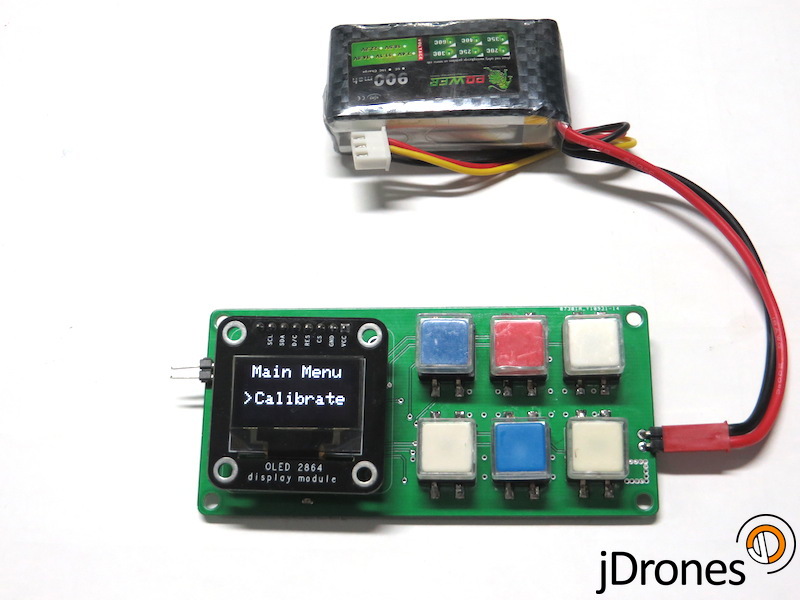
The ModeSwitch saga continues, I am happy to announce our new OLED ModeSwitch project for all. 

Several days we published LED based Flight ModeSwitch project here and I promised to show this OLED project too so here goes. 

This is more advanced compared to our upcoming LED ModeSwitch. Both of the projects we would like to have comments from our community here so please start posting those hard questions and we try to answer the call.

Basic details of the OLED ModeSwitch:

- Size: 45 x 90mm

- Display: OLED 0.96" 

- 6 Buttons for all 6 different flight modes

- +5V, and 6 - 18V input, polarity protected

- 3.5mm Jack for PPM Output (to your RC Radio trainer port)

- 3.5mm Jack for PPM Input (from for example your head-tracker)

Main software features:

- Internal menu system to configure various functions

- Supports 18 different flight mode texts, more will be added when needed

- PPM output has full 8 channels

- PPM input reads 1-8 channels

- PPM input -> output channel rewrites

- Output Mode channel can be what ever from ch1 to ch8

Other:

- after casing issues are solved we will look some mounting brackets for it. 

- cabling, we are looking to have 3.5mm plug cables with futaba, hitec etc adapters (similar to those RC Simulator cables)

- looking several types of buttons and keyboards

Regards,

Jani / jDrones

Read more…
Moderator

Drone TV Field Trip

3689564072?profile=original

Patricks cracker barrel makes another appearance and Lady Gaga's pilot, Gus Calderon goes through his multirotor flight safety routine in this the second episode of Drone TV. We think this is a sensible way of operating what do folks here think?


More videos on the sUAS News YouTube channel https://www.youtube.com/user/sUASNews

If you are in the car you can always catch up with the podcast here http://www.blogtalkradio.com/suasnews

Read more…

Wildlife Conservation UAV Challenge

3689563902?profile=originalThe Wells Fargo Bank of Great Falls honored Princess Aliyah with a Community Partner Grant for her efforts in bringing the world together in a Challenge to save rhinos from extinction. Princess Aliyah is CEO of Kashmir Robotics and sponsor of the Wildlife Conservation UAV Challenge. Its goal is to develop UAVs optimized for protecting rhinos and other endangered species, and with over 100 Teams from over 20 countries and 6 continents participating in the Challenge, it is the world's largest distributed drone research project.

Kruger National Park in South Africa is the battleground in the fight to save rhinos from extinction, so the Princess took members of her Leadership Team deep into the battleground on a Fact Finding Mission during the full moon phase when the battle is most intense. Hosted by Major General (Ret.) Johan Jooste, Commander Special Projects SANParks, the Team received a morning briefing on the battle plan, then provided a short demonstration of Skate, a small UAV developed by Aurora Flight Sciences in Manassas, VA, reconfigured to help rangers more effectively engage poachers. Within minutes the Aurora Team began training Park rangers how to launch, operate, and recover Skate. Impressed with the simplicity of operation and quality of data, General Jooste requested the Princess bring Skate into the battle. Each night the Team traveled into remote regions of the Park and introduced UAVs for the first time in the struggle to stop poaching. From a remote army outpost on a hill near the border of Mozambique, Skate dove into a ravine, providing the first imagery every of this high risk area. From a Sector camp deep in the Park, Skate swooped low to provide imagery under a bridge where poachers pass during the night.


Registration for the Challenge is still open (www.wcuavc.com). Design concepts are due by Jan. 31, 2014.

Read more…

Pixhawk Graphic for Documentation

3689563807?profile=original

Here is a sample from an "info-graphic" that we are currently working on for the new Pixhawk flight controller.

Knowing how daunting it is to gather enough info on a new flight controller (to be able to get into the air) I want this graphic to give a clear overview of the main components in a typical "quadcopter" system, from the Battery Warning Indicator to Telemetry connections. The purpose is to clearly show how all the components work together and to illustrate and name all of the connectors and plugs necessary.

To that end, I would like to know what specific components you would like to see included in the info-graphic, so please share your ideas! Also please feel free to use any of the Graphic for your own purposes.

Read more…

Orange Hawk VTOL Update December 2013

3689563629?profile=original

I've been several months under the radar, being pretty elusive. My apologies to all who are or have been hoping for more information. I noticed this morning that there have been a consistent number of views of my goofy Introduction video (See here: Introduction to the Orange Hawk ), and so, here is an update of the progress on the project:


I presented the Orange Hawk at the AIAA Region VI Student Conference, held in Salt Lake City, March 28-30, 2013. I won 1st Place in the undergraduate division, and was spoken of highly by the attending AIAA special guest, Dr. Sandra Magnus. As I've won the regional conference, I will be one of a dozen or so finalists to present in the AIAA SciTech 2014 conference being held in Maryland this January, less than 25 days from this writing. ("Dozen" as in a handful of other undergraduates presenting in the student competition, the SciTech Conference proper will be huge with hundreds of presenters.)

3689563599?profile=original
I've probably placed about 2 hours of flight on the Orange Hawk prototype since the conference, of which about 20 minutes has been sustained forward flight. The majority of that flight time was accumulated in May and late August and the first week of September. I took an internship with Raytheon in Tucson AZ for June to August, and only flew the Orange Hawk twice during that time, due to the lack of accessible fields (it is nothing but cactus there) and little time. One flight is documented in this Vimeo upload:

2013-07-20 18.03.36 from Stephen Carlson on Vimeo.


On September 12, during the furthest and longest forward flight test thus far, I flew out of range of the 72 MHz R/C link that I had been using on the vehicle. I was flying "heads down" using the vehicle's FPV video telemetry, and dealing with severe interference on both the video link and my old 72 MHz receiver. At about 500 feet, the control link spazzed out and the vehicle dove into the thick alfalfa that comprises my main test flight area. There was little damage, but as a full time student in electrical engineering this semester, I've had little time to repair and fly the vehicle. I've decided to retire the offending 72 MHz R/C receiver, and have purchased a DragonLink V1 setup for all further test flights.

3689563704?profile=original

The most common questions I've had, both in public and private messages, have been requests for the code for some other multicopter flight controller. One of my regrets from this summer is that I was offered a position by a fellow to work out porting the project to the APM or PixHawk architecture. Worried about money for school, I took Raytheon instead. :( It is still possible to port this to other platforms, and in it's full implementation, would see the Orange Hawk and other VTOLs flying around in fully autonomous forward flight. I would like to pursue this goal, and would like to see it realized at the SparkFun Autonomous Vehicle Competition to be held in Boulder CO in June 2014. Otherwise, my hands are full in just trying to keep the code up-to-date with the most recent version of the MultiWii. In the RcGroups VTOL forum, there have been posts about a VTOL software suite for the OpenPilot architecture; I've not kept up on the specifics. Here on DIYD, there have also been efforts/suggestions to build a cross between the ArduPilot and ArduCopter code bases, again, I'm somewhat ignorant on specifics, but would like to contribute.


Another question I get is "Why 'Orange Hawk' ?". The predecessor to this project was the tail-pusher I constructed in August 2011 (shown here: White Hawk Flight Video ), which I christened the "White Hawk". Googling for obscure hawks, I found that there are/were hardly any entries for "Orange Hawk", and as orange is my favorite color, that is what I chose. At present, searching for "Orange Hawk" almost always yields a link/reference to this VTOL design.


Beyond the Orange Hawk and school, there is actually a lot more I've been working on. During May, I constructed my own Long Range System based on the RFM22 and RFM23 RF transceivers and the atMega 328p. It is my own design, motivated by my interest in making a system that functions as both a LRS and an emergency locator beacon. The system has a single cell LiPo charger built into the receiver, and is capable of intermittent transmission for several weeks even if disconnected from the aircraft power supply. I was inspired by FMkit's emergency locator modules that are also RFM22-based, and use an audio tone location scheme. I'd like to improve on that by making the locator capable of audio and data, such as transmitting the most recent good GPS value along with time-stamp. The prototype boards are finished and have been tested with a simple audio tone generator, but I have not had the time to code the firmware for the actual R/C system functionality.


3689563729?profile=original3689563687?profile=original3689563862?profile=original

My blog at RcGroups still has the links to the design plan PDFs and MultiWii source code that I use on the Orange Hawk. The main landing page for that blog is here: KatanaGuy RcGroups Blog . I hope sharing my work here will promote interest in VTOLs and demonstrate the utility and value of such designs. Thanks for reading, and let me know what you think.

-Steve

Read more…

Emergency parachute trigger options

I´m finally finishing the setup of a new airframe, wich now has a parachute system released by a servo (almost like this):
https://www.youtube.com/watch?v=XSkEhjy5PLY


Now comes the tricky part: how to setup a good way of activating the parachute from APM?


For now, i have it on channel 6 and APM just passes from rc input to output, so i can only activate it from primary rc control. i don´t want to activate it on a failsafe (sure, RTL is much better for this) but in case of a strange system failure and no rc control i would like to activate easily from mission planner. is there a simple method for this?


By the way, the ropes of my parachute don´t go over the propeller, so even if it keeps spinning, or even still trying to fly, the parachute will stop the plane.


Thanks for any advice on this, Ricardo.

Read more…

Hi all,

Alfatroll AS in Norway has developed a knowledge based autopilot. We intend to cover all aspects of a pilots dutoes, such as....

  • Flight Operation are all normal tasks covered by an autopilot, such as bringing the plane safel3689563612?profile=originaly from waypoint to waypoint along the scheduled trajectory and at the designated time schedule (dubbed 4D control)
  • Mission Progress, including necessary actions to be carried out at pre-defined locations or in certain situations. The task includes contingency management, i.e. reactions to unexpected events that may occur during the flight, such as engine failure, low on fuel, etc.
  • Contact with base, including reports back in the form of data streams and status messages, as well as the ability to react promptly to orders from the ground station.
  • ATC relations. In the beginning, all communication with air traffic controllers (ATC) will most likely be through the ground station controller. When ATC communications becomes message based (Single European Sky specifies this), more and more can be handled directly by the unmanned aircraft itself. Proper responses and reactions are expected by the on-board intelligent controller, of course.
  • System Health. A major part of the responsibility of an autonomous system is to keep track of its own operational status. System health can include such tasks as the checking of and proper reactions to icing or icing conditions, low fuel reserves, sensor information signaling trouble with an engine, slow reactions, etc.
  • Detect Terrain. By following the plane’s movements in relation the terrain below, the control logic shall be able to avoid conflicts with terrain objects, controlled or prohibited airspace, tall objects on the ground, etc. The plane shall also be able to react differently to corrective actions at low level flight from normal high level flights.
  • Sensor info and collection. Sensor information is normally collected on-board or forwarded to the ground control. If the sensors detect items of interest to the current mission (e.g. a hot spot in the sea during search and rescue), this may cause the control logic to launch specific actions (e.g. drop marker, go lower and take picture/video). This task can also be responsible for intersystem cooperation.
  • See and Avoid. This is the focus of many UAV producers at the time: to make systems that can detect other air traffic or other obstacles in the same, non-segregated airspace, and react as if a pilot was on-board. Using ADS-B and other sources, keeping track with traffic nearby is possible. But visual and radar detection will always be less precise.

We use APM Mission Planner as ground control, and some of the features can be seen in this video: See video here

We seek co-operation partners, preferably in Europe, due to distances etc.

Read more…
Developer

Arduino ModeSwitch with LEDs

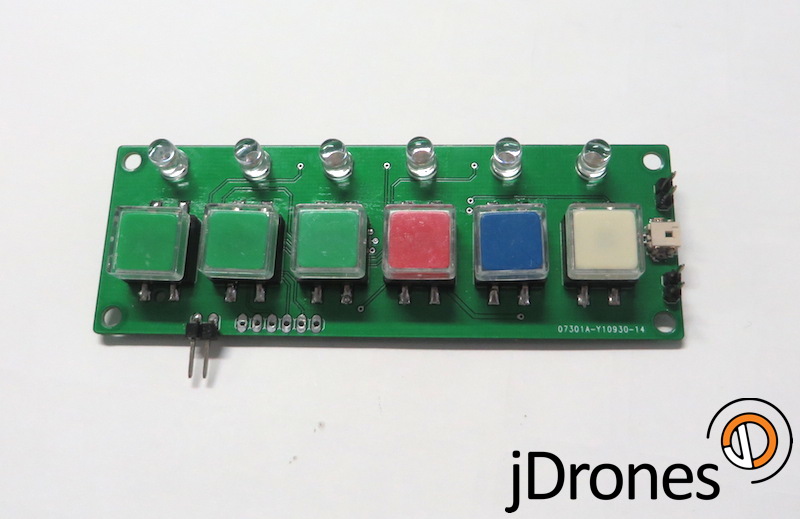
jDrones_ModeSwitch_LED.JPG?width=500

6 Way mode switch gets life...

Finally after several iterations on PCB and electronics design, first jDrones ModeSwitches are getting to daylight.

First boards are fully operational and we are testing them with several of our test flyers. 

Stefan made original Arduino Sketch for his boards and we started to work from point forward.

There are total of two models of this ModeSwitches coming. One is this as shown on above and another will have even more intelligence in forms of OLED displays and programmable menus. 

Later boards will be installed on nice cases and we are looking now what type of cases to use for these boards. 

Features of the ModeSwitch:

  • ArduPilot specific flight modes, 6 modes in total
  • Easy to connect to RC radios. Use trainer port, has 3.5mm jack and pin headers
  • +5V and +12V operation voltages with polarity protection, DF13 connector and pin headers
  • Removable caps on switches for mode texts
  • Size 35 x 100mm, yes it's long but also has big easy to access buttons.

Regards,

Jani / jDrones

Read more…
3D Robotics

Cameron Rose from the Biomimetic Millisystems Lab from the University of California Berkeley with his flying H2Bird robot. Photo © KIKE CALVO

Cameron Rose quite eloquently put his thoughts and hopes on the futures of UAVs in a recent National Geographic article.  Cameron is a graduate student at UC Berkeley in EECS in Ron Fearing's group, which is famous for, among other things, foundational work in flying insects through the MFI project, rapid prototyping of millirobotis, and the recent spin off company, Dash robotics.

¨My dream is to be able to contribute one day to advancing the field of robotics enough to achieve something even close to the level of maneuverability and control that animals possess in nature,¨ said Cameron Rose, a graduate student in the Department of Electrical Engineering and Computer Science at the University of California, Berkeley. ¨There is so much to be learned from behaviors and control surfaces of animals that can be applied to robotics.

Rose, 25, graduated from the University of Maryland, College Park in 2010 with a Bachelor of Science in Computer Engineering. Today, he is a member of Prof. Ron Fearing’s Biomimetic Millisystems Laboratory, and his research focuses on modeling and control of flapping-winged robots in flight away from equilibrium. ¨I also dream to use my knowledge and passion for robotics to encourage other African American students to pursue similar paths. There are so many middle and high school students that don’t have the same opportunities that I had growing up. If I can do anything to fix that, be it through simply speaking at schools or showing my robots, I’d like to help. I’d like to see the number of African Americans pursuing undergraduate degrees and PhDs in engineering increase.¨

¨I was always fascinated with planes and flight growing up,¨ said Rose. ¨I liked to play with everything from paper airplanes, to building models, to launching model rockets. I have many memories of my dad out in the field behind my house launching all sorts of flying things into the air.¨

Rose is inspired by his grandfather in the way that he approaches his life. ¨He always puts his family and God first,¨ said Rose. ¨The level of passion and joy he has for photography is remarkable in the face of some of the hardship that is in his life. I hope to achieve that level of passion and happiness from my work in spite of the tough times that may arise.¨

¨When I was in high school, I was in the Civil Air Patrol,¨ said Rose. ¨I had the opportunity to attend Solo Flight School, where I could get the classroom training and flight time to work towards my solo flight and eventually my pilot’s license. I’ll never forget the first time I was able to take the plane up in the cockpit by myself. It was one of the most exhilarating and honestly terrifying moments of my life. Fortunately, there were no problems, and I successfully completed the flight by myself. I’ll never forget the feeling of accomplishment, freedom, and relief, when I successfully landed the plane at the end of the flight.¨

Regarding the FAA regulations Rose thinks there should be licenses for operating civilian drones in public settings to ensure people know how to operate them safely around others to avoid injury.

Rose Master’s thesis “Flight Simulation of an Ornithopter” has been published by the University of California. His paper “Cooperative Control and Modeling for Narrow Passage Traversal with an Ornithopter and Ground Station,” was in the 2013 Autonomous Agent and Multiagent Systems (AAMAS) Conference.

¨The H2Bird is a 13 gram flapping-winged robot that includes custom-designed electronics for sensing and control,¨ explained Rose.¨ Flapping flight provides high maneuverability necessary for navigating in indoor environments on a small mass scale. Building fliers on such a small scale is made possible by advances in the size scale of electronics and sensor packages, and through study of flapping aerodynamics. Additionally, minimizing the power consumption of the motors and electronics has enabled flight times up to 5 minutes. The goals of the current project are to develop optimal control policies for single or multiple vehicles to achieve sensing and navigation among un-modeled obstacles such as doors and walls. One of the possible applications for the project in the future is within the realm of disaster relief. If a group of sensor-equipped crawlers and fliers can be released into something like a collapsed building, they can help locate survivors or areas that could be dangerous for humans.¨

5 good things people should know about drones:

  • They’re good for more than just military applications.
  • Occurrences in nature that could not ordinarily be photographed or recorded by humans can be captured with the aid of drones.
  • Drones can be used in emergency situations in conditions that would be dangerous to humans.
  • Drones can be used to transport materials on repetitive journeys that would be a waste of human resources.
  • Drones can be used to create art.

5 things people probably are not aware when it comes to drones:

  • Not all drones are quadrotors.
  • The large majority of them are not armed.
  • Civilian users of drones are increasing more rapidly than military-use drones.
  • More information on your life can be gained simply by using your cell phone than a drone can provide.
  • There are a wide variety of non-military applications for drones that are beneficial.
Read more…
3D Robotics

3689563328?profile=original

Our favorite drone policy/law analyst, Ryan Calo, has a smart op-ed in CNN today arguing against over-regulation of drones, which could hurt the grassroots innovation that communities like this have encouraged.  Excerpt:

The real [drone] innovation will come when companies such as Amazon mix their robotics strategy with their love for open platforms.

What does that mean?

Recall that the first personal computers did not come to the market until the mid-1970s. Before that, government and industry purchased or leased computer equipment dedicated to a particular purpose such as database management. That's analogous to what Amazon and other companies are doing today.

...

The real explosion of innovation in computing occurred when devices got into the hands of regular people. Suddenly consumers did not have to wait for IBM or Apple to write every software program they might want to use. Other companies and individuals could also write a "killer app." Much of the software that makes personal computers, tablets and smartphones such an essential part of daily life now have been written by third-party developers.

As author Jonathan Zittrain points out, it would be hard to name a category of important software -- from word-processing to e-mail -- that some computer hobbyist did not create first at home. Today, popular apps such as Snapchat or Instagram are used by millions of people. Yet, both were created by just two or three people in their 20s.

...

Once companies such as Google, Amazon or Apple create a personal drone that is app-enabled, we will begin to see the true promise of this technology. This is still a ways off. There are certainly many technical, regulatory and social hurdles to overcome. But I would think that within 10 to 15 years, we will see robust, multipurpose robots in the hands of consumers.

Worried about your kid getting to and from the bus? A drone app lets you follow her there by trailing her phone and returning when she waves. Selling your house? An app on a drone will command it to fly around your property and stitch together a panorama of photos for a virtual tour. Same drone, thousands of possibilities.

Put another way, the day when Amazon or Apple opens a drone app store is the day when drone innovation takes off. On an open model, the sky is quite literally the limit.

Read more…
Distributor

RC/FPV mod for DJI Phantom

3689563311?profile=original

Pimping/modding your Phantom seems to be popular. Here is the latest offering from our friends at goodluckbuy:

http://www.goodluckbuy.com/dji-phantom-5inch-800480-screen-display-remote-controller-diy-modify-w-full-carbon-fiber-shell.html

For a USD 329.67, you get a 5 inch display and a CF box to put the RC electronics in but make sure that you check the features before you buy: "For Professionals". (so you really are a professional :-)

The little thumbstick located on the left side looks handy for controlling a gimbal though.

Read more…