All Posts (11086)

Sort by

Active cooled brushless gimbal

gimbal43.jpg

gimbal44.jpg
Active cooling has been a cheap way to get more power out of underrated motors.  You want as much power as the motors can handle.  When you can't afford a variety of motors, there's active cooling.  
Testing with the narrowest field of view, the slightest motor cogging is revealed.


Got the tiny motors up to .9A with active cooling.  The pitch still has .3A without active cooling, to minimize vibration.  The tiny motors have the least cogging artifacts, so active cooling might get them all the way.  It's never going to be perfect, without bigger motors.


10 bit PWM, 1024 step sin table added a tiny bit of precision.  No amount of power or PWM precision could completely eliminate cogging. 8khz, 32khz, shifting the magnets away from the stator didn't matter. If you don't get a bog standard gimbal for $100, you'll end up paying more to find ideal motors.

Slightly better in the running timelapse with software stabilization, which means it could be superb when flying.  For a running timelapse, it's probably not worth supporting yaw or pitch at all, if software stabilization is required. A simple roll stabilizer is what you want for running.

gimbal40.jpg

gimbal41.jpg

gimbal42.jpg

Wound up a 3rd Turnigy 2205 1350kv for the yaw.  Grinding off the enclosure made it a lot easier & opened up more airflow.  It was just about as easy as a DT700.  The enclosure served no purpose.
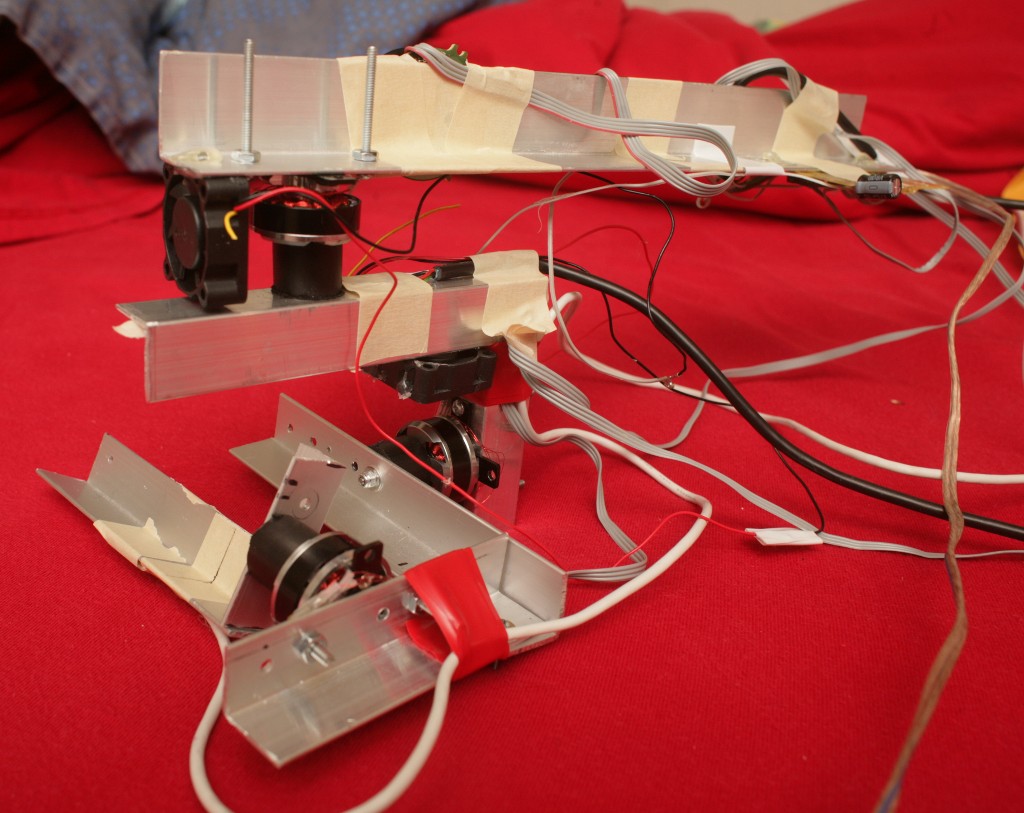


 Aluminum cooled it off a bit better.


Given enough current, active cooling, a high resolution DAC, brushless motors have a lot of potential in highly accurate pointing.  A 16 bit DAC can get 65535 steps in 90 deg.  They don't need an IMU.


There were some test videos using the passively cooled DT750, revealing how much worse the cogging & the roll was without enough power.


Brushless motors would have made a decent laser projector, years ago.  Kids were making stepper motors for laser projectors, but they had to machine the bearings. No-one realized a hobby motor or a fan motor could be used for a pointing task.
Read more…
3D Robotics

From CBS news. 

Oklahoma State University researchers are designing and building sleek, Kevlar-reinforced unmanned aircraft — or drones — to fly directly into the nation's worst storms and send back real-time data to first responders and forecasters.

"We have all the elements in place that make this the right place for this study to occur," said Stephen McKeever, Oklahoma's secretary of science and technology. "We have the world's best natural laboratory."

Read more…
Developer

Looking For Testers: New MAVPilot App

3689527997?profile=original3689528083?profile=original

3689528171?profile=original

We will be releasing in a few weeks the first version of MAVPilot. This is a "Ground Control Station for your Pocket". Its target audience is iPhone users (iPad version will come later). Pilots often fly unaccompanied and this can make it difficult to use a laptop at the same time. This is more so when a pilot is using a semi-auto modes like Alt-Hold etc... Using your iPhone instead of a laptop is a great way to keep focused on the MAV and still have all the useful information in reach. With inbuilt text-to-speech support your iPhone will let you know instantly the status of your MAV as you are flying.

MAVPilot will incorporate the  FIND MY DRONE feature.

Features Targeted for V1.0 of MAVPilot

  • Telemetry Screen showing flight information e.g
    • Speed
    • Altitude
    • Yaw
    • Rate of Climb
    • Battery Voltage
    • Battery Remaining %
    • GPS accuracy
    • Throttle %
  • Mode Control e.g.
    • Auto
    • Stabilize
    • Alt Hold
    • Land
    • RTL
    • Loiter
  • Map View with Mission outline
  • Mission Waypoint editor
    • includes waypoint parameter editing
  • Configuration
    • Calibration for level
  • Commonly used parameter editing
    • Tuning of common parameters

The app is also compatible with Bluetooth Low Energy to link to a long range radio like 3DR 915/433MHz Telemetry Radio. Details to follow soon.

Compatibility: ArduPilot (other MAVLink compatible products will be added at a later date)

!!! Wow, thanks for the great response. I now have my initial quota of tester positions filled. You can still register, as I may add more people nearer the release date !!!


To sign-up as a Alpha/Beta tester follow this link 

Read more…
Moderator


This is the video of first fly test

Dear Friends,
with great pleasure we present the latest developments of the prototype # 1 of our first drone RTF.

The idea for this drone , began when Carlo a student of the faculty of Industrial Design in Milan came to us to do his thesis ... we tried to think of something completely new and that it was not the classic drone MK or DJI 450.

In addition to the aesthetic aspect ,appreciated by the community, we have especially tried to make the drone in a very functional, easy to maintain, expandable with options which will be released in the future.
The frame initially was made with 3D printing, combined with inserts from epoxy glass and carbon fiber .

Our designer Carlo ... ,now officially came into VRI , with Flavio studied the FEM of the drone to achieve a good level of resistance to twisting of the drone. Particular attention was held for the theme of the vibrations.


3689527938?profile=originalThis is the BOD Logo.


The BOD have inside :

  • VR Brain 4.5
  • GPS Ublox 6H
  • 3DR Radio
  • 4 30 Amp ESC with WiiEsc firmware.
  • use 4 T-Motord engines.
  • with 12 inch propelles.
  • 3S - 4S 4500 mah battery


The feature available are the same available in arducopter32 rev 2.9.3

  • Flight in acro and stable mode.
  • Loiter , return to home and auto navigation.
  • Auto landing and takeoff


After making the first hovering Emile will take care to test it in order to put a little 'under pressure the drone.

Thanks to all the time for this great results :)

original blog post : http://www.virtualrobotix.com/profiles/blogs/first-flight-of-bod-the-first-rtf-drone-developed-by-virtualrobot?xg_source=activity

Best Regards
Roberto

Read more…
Moderator

An Analysis of the Texas Drone Bill

3689527377?profile=original

After some repetition of some really terrible reporting by somebody who should know better ;-), here's my analysis of the Texas Drone Bill.

tl;dr for hobbyists: If you're flying over public property, private property with permission of the owner, or not intending to surveil a particular person, you're good to fly and take pictures by this law.

http://eastbay-rc.blogspot.com/2013/05/eastbay-rc-analysis-of-texas-drone-bill.html

Read more…

3689527777?profile=original

3689527847?profile=original

Our friends at Instructables have announced a contest looking for the best step-by-step Instructable for building a project involving airborne autonomous and radio controlled vehicles!

You can find all the details here: http://www.instructables.com/contest/drones2013/?show=ENTER

I can't imagine a more perfect group of participants than the DIY Drone community. There are a lot of sweet prizes to be won. You have until July 8, 2013.

Let's represent!

Read more…

http://www.robotics.umd.edu/

This video demonstrates a new robotic bird, "Robo Raven," whose wings flap completely independently of each other, and also can be programmed to perform any desired motion, enabling the bird to perform aerobatic maneuvers. This is the first time a robotic bird with these capabilities has been built and successfully flown. 'Robo Raven', developed by University of Maryland Professors S. K. Gupta and Hugh Bruck and their students uses two programmable motors that can be synchronized electronically to coordinate motion between the wings. 'Robo Raven' can now be programmed to any desired motion patterns for the wings which allows new in-flight aerobatics—like diving and rolling—that would have not been possible before, bringing the 'Robo Raven' team a big step closer to faithfully reproducing the way real birds fly.

The Maryland Robotics Center is an interdisciplinary research center housed in the Institute for Systems Research within the 
A. James Clark School of Engineering. The mission of the center is to advance robotic systems, underlying component technologies, and applications of robotics through research and educational programs that are interdisciplinary in nature and based on a systems approach.

The center's research activities include all aspects of robotics including development of component technologies (e.g., sensors, actuators, structures, and communication), novel robotic platforms, and intelligence and autonomy for robotic systems. The center consists of faculty members spanning the following academic departments: Aerospace Engineering, Bioengineering, Biology, Civil and Environmental Engineering, Computer Science, Electrical and Computer Engineering, Kinesiology and Mechanical Engineering. Research projects in the center are supported by the major federal funding agencies including NSF, ARO, ARL, ONR, AFOSR, NIH, DARPA, NASA, and NIST.

Current research areas

. Collaborative, Cooperative, Networked Robotics:bio-inspired robotics concepts, time-delayed robotics, robotic swarms, robotic cooperation under limited communication, and distributed robotics.

. Medical Robotics: MRI-compatible surgical robotics, haptics-enabled AFM, exoskeletons for rehabilitation, and magnetic micromanipulation for drug delivery.

. Miniature Robotics: mesoscale robots; bio-inspired sensing, actuation, and locomotion; cell manipulation (optical, AFM based, and micro fluidics); and micro and nano manipulation (optical and magnetic).

. Robotics for Extreme Environments: space robotics and autonomous deep-submergence sampling systems.

. Unmanned Vehicles: micro air vehicles, unmanned sea surface vehicles, unmanned underwater vehicles, and planetary surface rovers.

Read more…

Yesterday the highs...today - the lows...

Boooo...

After a good day out yesterday, I took my small quad out for some full stick action tonight.

And it was all going well until...I think I sheared off a motor. At 20m. So this happened:

3689527598?profile=original

Reason I think the bolt sheared, is the fine thread left in the bottom of the motor (I tried to show it in the pic). And the way it just tumbled out the sky. I think you can see it in the logs from the motor logs (crash event starts at 20 with impact at 20.4).

3689527640?profile=original

Up until then it was flying well - but if anything a little under powered; feels more "Nissan Micra" than "Nissan GTR". Though it would appear the mounts can't handle it if you drive the Micra like a GTR...

It appears the legs took the brunt - all props and unsheared motors are ok, as is rx/telem, battery GPS and APM. Motors were pretty hot when I picked it up - they'd been working hard.

Vibes until then were good - +/-5 to 6 when doing full sticks, and +/-2 when hovering:

3689527681?profile=original

3689527724?profile=original

I've attached the flight log, just in case anyone wants to prove my "sheared motor" theory wrong.

2013-05-30%2021-20%201.log

Read more…

First video of my quad

My first ever video from a quad

This will bring a laugh to the veterans...

After spending a few months and every available night doing flying since I took up the hobby, tonight, I took the plunge and slapped a go-pro 2 underneath my quad legs. Absolutely no attempt was made at optimization, alignment or vibe control.


Try and spot how many error I make, both in technical setup, cinematics and piloting...I think I count at least 18. :-)


Total flight time 13 minutes, using 2 x 4000 6S instead of 1x11,000 - still had 3.85v left in the cell (about another 3-4 minutes). Spot of rain were appearing, so had to land quickly (I don't have the dome fitted).

Most notable (apart from my dreadful piloting skills) was the climb at about 11 minutes in...this is the first time I used 100% throttle on the climb, and it did not like it; it lurched quite dramatically. 100% is not actually recommended for my rig, as ecalc recons 90% is the maximum watts for my motors (MN3508-29's 380kv). Sure enough, the motor were noticeably warm on landing, when normally they are barely warm at all. Time to get some throttle limits set in APM, but not sure how yet. Might just set the rpm alarm on the DX8/TM1000.

I engaged loiter at minute 6 minutes, and it seems a bit jittery. No real winds to speak of at ground level, but there might have been at 140m and above the tree line. Opinions welcome of course - I might just be paranoid.

It's still yawing very slightly on throttle as well - on alt hold descents, you can see it very slowly circle around nose-in on the vertical line of descent. Checked all physical alignments with tape measure and spirit levels, and recalibrated the Accels, moved some electrics out the way... but it's still doing it.

You can also hear the whistle/whine quite distinctly now.

Flight logs attached for those who are interested. Next logs will include Current and Motor parameters too - looks like I might need them.

2013-05-29%2020-43%202.log

Read more…

Optical flow stories


Look how well you can navigate using just el cheapo optical flow odometry & sonar.  Over carpet, 0.5 meters is all you get before the camera loses velocity detection.  Over the floor pattern, it can do 2 meters.


Went back to position->velocity->tilt feedback. That was done in 2007, then changed to position->tilt in 2008, when GPS got good enough.  For very precise indoor navigation, position->velocity->tilt feedback seems to be better.   This seems to be what Arducopter also uses.


Originally saw position->tilt in Mikrokopter when it was open source, thinking it was going to be the standard design. It was faster, but caused more toilet bowl effect.  That crazy German even used position->throttle for altitude.


Vision guidance doesn't have doppler shift, which makes velocity delayed. Also, the IMU drifts too much to limit velocity by clamping tilt at a reasonable value. You have to clamp velocity so a long movement doesn't go out of control.


Increased the optical flow frame rate to 50. There is always a hunt for the highest frame rate before the minimum speed becomes too high, yet not too slow to have too much error. Those improvements made it pretty damn stable.


There were some cheap optical flow floor covers at the dollar store. It takes painting 3 with a dry brush to create a reasonable flying space.


No better than unrolled garbage bags, but the most compact material. Can't imagine who would ever use them as table covers.


The 1st board which didn't have any defects. It worked on the 1st power up. It makes sense, because after that, you realized you needed a day job.


marcy2_96.jpg
Didn't have much luck with the  MB1043 but the MB1240 was golden.  That can range useful altitudes over carpet, with the propeller noise.  mm or cm accuracy didn't make any difference.

marcy2_97.jpg

marcy2_98.jpg

marcy2_99.jpg

marcy2_100.jpg


It's hard to conceive a business model for something that flies for only 5 minutes & needs a special floor.  The AR Drone did it by implementing an easy programming language & having enough spare clockcycles for developers to process the video.  Something smaller, with no spare clockcycles would be harder.


marcy2_95.jpg
Read more…

9x gets 3DR 915 MHz air module

Finally completed the 3dr mod on my 9x. Seems to link up instantly - no more waiting for mission planner to download parameters or the awkwardness of forwarding the mav data back out over bluetooth!

3689527510?profile=original

3689527447?profile=original

3689527573?profile=original

More details, as requested:

The stock 9x has the Throttle Cut and Aileron switches connected to a UART on the Atmega. These need to be re-routed to free up the UART for telemetry purposes. There are several posts out there on how to do it - this was the cleanest (from https://code.google.com/p/open9x/downloads/detail?name=9x_modifications_EN.pdf):

3689527092?profile=original

Since I have a smartieparts 9x programmer, I didn't have to worry about the connections going to the header on the left - just the two connections that are circled in red.I reused the resistors that came off the pads (Thanks to Rod for his fine soldering skills). Note that the connections are made from the bottom most resistor pads up to the resistors then they cross over and attach to the two free pads on the right. Keep in mind that once this mode is made, firmware is required that knows about the new locations.

After that, I installed the smartieparts programmer according to their installation instructions:

http://www.smartieparts.com/shop/index.php?main_page=page&id=9

With that in place, the extra UART is now availible on the TelemeterEZ port (two pin header, top row, left):

SP_24_contents.jpg

The 3dr air module conveniently runs at 5v, so I grabbed 5v and ground off the back PCB (you can just barely see the connections in the 2nd photo from the top above). 5v is in the middle, ground on either side of it.  

3689527539?profile=original 

When installing, I connected power and ground to the 3dr module first (red and black wires on the cable that came with it). Fired up mission planner and when through the radio setup to load the correct settings into the module. Then I unplugged the usb radio for the PC (to make sure it didn't interfere) and powered up my quad - data stated flowing to the module in the 9x. This made it easy to identify which way to hook up the RX/TX lines to the TelemetryEZ port on the 9x Programmer board using my DSO Quad pocket scope.

Next time I open up the 9x, I'll grab photos of the actual connections. The OpenTx developers are currently working on adding Mavlink support - I was a little impatient and rolled my own, but I do intend on getting my code to them so they can merge all the best ideas. 

I should also add that I'm not 100% sure the radio module won't draw too much power... it probably makes sense to at least add a cap between the power and ground connections to help the regulator out. 

Read more…

In a previous post, I put video up from my attempt at a cheap HD camera quad. I was using a WLtoys v959 quad as the airframe, and an Emerson Action Cam GoPro knock-off as the camera. It worked, but with terrible jello effect on the video. I finally bought an 808 #16 keychain camera with a D wide angle lens from MassiveRC after reading some good reviews, and seeing some great video. However, when it arrived, my quad was down thanks to a crash...argh!

So, I waited for my spare parts, and some better props from GWS. Long story short, all the parts came together this past weekend, but holiday plans, and work obligations over the last several days kept me from flying until today. It was worth the wait! In winds which, honestly, I probably should have not been flying in, the new props allowed the quad to handle beautifully! Some quick balancing of the props before the flight also meant I had relatively jello free video. In fact, a quick flight indoors after my high-wind adventure revealed the breeze to be a major culprit in shakiness of the video, as it was dolly smooth. Not too surprising considering how light this quad is, and given 8mph steady winds, with a recorded gust up to 14mph during the flight. In fact, it was the 14mph gust which drove me back into the house. After a rebuild this last weekend, the last thing I wanted to do was rebuild again this weekend.

Hopefully a better flying day will come around soon, and by then I will have the camera settings and the mounting system tweaked to provide some great cheap HD aerial video!

Read more…
3D Robotics

3689527377?profile=originalThe Texas Legislature has passed a drone bill, which only requires the Governor's signature to become law.

Description, from The Verge:

The Texas Privacy Act makes it a misdemeanor the use aerial drones to film any person or private property "with the intent to conduct surveillance," but it also carves out a whopping 40 exemptions. According to the bill's text, law enforcement officers will have wide authority to use surveillance drones both with and without a warrant, in order to investigate crime scenes or pursue individuals when police have "reasonable suspicion" that they have committed a crime — among a host of other circumstances. The bill also has broad exemptions for oil and electrical companies, real estate agents using drones for "marketing purposes," educational institutions, and areas within 25 miles of the Mexican border.

Read morehere

Read more…
Developer

3689527199?profile=original

Pleased to announce today that my new App FIND MY DRONE is now available in the App Store. FIND MY DRONE is a FREE App that connects your iPhone to your personal UAV (unmanned aerial vehicle) using the popular MAVLink protocol.

Watch this space, FIND MY DRONE will soon be followed by MAVPilot, a ground control station for your pocket.

more info 

http://www.communistech.com/blog/now-in-the-app-store-find-my-drone/

http://www.communistech.com/blog/products/

Download from the App Store 3689527358?profile=original

Read more…

photo-main.jpg?1368722514

Planetary Resources launched a Kickstarter project to fund a first-of-its-kind public "Hubble Space Telescope."

http://www.kickstarter.com/projects/1458134548/arkyd-a-space-telescope-for-everyone-0

From their project site, "The proceeds from this campaign will go to several different areas: 1) To actually launch the satellite into space. 2) To support the spacecraft over its lifetime — including manpower to facilitate the photos, "selfies", monitoring the spacecraft and training the staff at the chosen science center that will take over control. 3) To create an easy-to-use Control Interface that will allow ANYONE to access and control the satellite. 4) To fund the creation of an incredible, interactive educational experience that can be used by schools anywhere, to enable students to experience space in a way that's never been possible."

A public space telescope shares analogous challenges with Unmanned Aircraft Systems - command and control issues, communications issues (including security), mission planning for user sessions, data collection and ground processing, user interface issues - and introduces possible new issues with solutions applicable to down-to-Earth UAS projects, such as error-free methods for control and data collection handoff between user teams, and distributed sessions management with the same vehicle but from different sites (different users controlling the scope from different sites, via the Internet, one at a time or maybe even in parallel?) 

  There may be opportunities for the DIY Drones community to apply its hands-on experience and lessons learned to a public space telescope operated over the Internet.

Read more…

Thirty Days (#19): Office IR

Moving out of the near IR from the last post, we go into the far infrared. This is footage shot with a 40g, uncooled, 8-14um spectral band camera. Half the size of a GoPro and perfect for mounting on a small flying machine!

3689527012?profile=original

3689527055?profile=original

Read more…