The latest from Procerus, recently acquired by Lockheed Martin. No word on pricing, but I'm guessing in the tens of thousands of dollars.
The latest from Procerus, recently acquired by Lockheed Martin. No word on pricing, but I'm guessing in the tens of thousands of dollars.
Recently I started the DC Hardware Startup meetup as a complement to the many Web 2.0-ish entrepreneur meetups in the DC area and elsewhere, and then reached out to the organizers of similar meetups around North America. Two are about a year old- the SF Hardware Startup meetup and Solid State Startups, both near Silicon Valley. Two others, one based in New York City and one based in Toronto, are also at most about a month old. The common themes are as you'd expect- rapid prototyping / 3D printing, lean methods/manufacturing, open source HW, etc., and of course entrepreneurship.
I've been in contact with most of the above groups, and we agree there is something larger than anyone one regional meetup group. We would like to find a way to bring these communities together, and I'd be happy to take your input there. If any new similar groups form, please do let us know. In the mean time, Nick Pinkston of the SF group put together a few initial resources as a seedling:
Reddit: http://www.reddit.com/r/hwstartups
Twitter ('bot feed from Reddit): @HWStartups
Hardware Overflow prototype site: http://area51.stackexchange.com/proposals/42563
Below is the opening description of the DC Hardware Startup group:
-----
We are DC-area technology entrepreneurs and innovators who want to build viable and vibrant business based on hardware, whether electronic, mechanical, or other.
Atoms are the new bits: We believe that the time is ripe for a new wave of entrepreneurship in hardware in the United States and worldwide.
Lean startup / pretotype methodologies: Thanks to inexpensive contract manufacturing, domestic and overseas, 3D printing, programmable hardware, and an Internet to propagate ideas, the principles of "lean startup" methodologies are as applicable to hardware startups as to software startups. Hardware "minimal viable products (MVPs)" can be build in weeks or days, and "pretotypes" can often be formulated in just hours or even minutes.
Identify the right product to build before you mass produce: This classic rule still holds. How can we identify the right hardware product to build without expending too many resources?
Unique challenges for hardware: Hardware startups have their own unique logistic challenges- inventory management, component sourcing, and manufacturing to name a few. We will discuss and learn how to handle these issues as well.
Inventor to entrepreneur: We hardware folks love to tinker and invent. This is pure fun! Can we apply this tinkering mindset to build business, not just gizmos?
If your product moves, flies, makes a sound, has blinking lights, or does something physical, come join us!
Talk about unlikely partners. The ACLU and the Tea Party unite against drones!
Excerpt from US News story:
The ACLU-Tea Party bill, which will be introduced by Virginia delegate Todd Gilbert in early 2013, when Virginia's legislative session resumes, looks to put strict limits on when and how drones can be used.
....
Although the coalition has yet to draft the bill, an ACLU press release says the legislation will prohibit law enforcement from using drones without a specific warrant, prohibit the retention of data, video, and photos that are not related to an ongoing police investigation, and require law enforcement to alert the public that drones are flying in their area.
"What the legislation is intended to do is to place strict scrutiny on ability of government to use [drones] to monitor our citizens," Gilbert says. "We want to make sure we live in the kind of world envisioned by our founding fathers, not one envisioned by George Orwell."
I guess even the big boys have to try a couple of times before they get it right. :)
We've posted these bird stabilization videos before (chickens are amazing!) but they never cease to impress. As good as we are with digital electronics, nature always does better with analog circuits.
(via Kottke)
We've posted an instructional video for installing our 9x DIY Upgrade Kit in either a FlySky TH9x or Turnigy 9x radios.
While this video is specific to the kit we sell, I think you'll find the information useful even if you bought the individual parts from other sources. It covers installing the LED backlight and the Smartieparts Programmer board, as well as other parts of the kit and also our 9x Battery Kit.
The video is divided into sections allowing you to skip to the needed information:
- Kit and Radio Overview - 0:35
- LED Backlight Installation - 2:25
- Smartieparts Programmer Installation - 13:05
- 9x Battery Kit Installation - 20:16
- Thumb Stick Installation - 21:27
- Color Switch Covers - 24:00
Let us know if this video helps and also what else you would like us to cover.
Thanks for watching!
For more information about the DIY Upgrade Kit and the other products we offer, please visit our site:
ParkeFlyer.com
Intro music by the greatest rock band you've never heard of... Pong.
As is customary and traditional, we celebrate every new 1,000 members here and share the traffic stats. This time it's 28,000!
There were 1.4 million page views this month, tied for our record. It took us just 27 days to get this latest 1,000 members--we're averaging about one new member every 38 minutes.
Thanks as always to all the community members who make this growth possible, and especially the moderators who approve membership applications and blog posts and otherwise answer questions and keep things ticking here. We've got about 60 moderators now, but if anyone would like to join this group, please PM me. If you've been here for a while and have been participating, you'll fit in great.
There was an ESRI (ArcGIS) conference in San Diego a couple weeks ago - videos of the plenary sessions have just come available.
Notable is the UAV section of the mid-morning session - fast forward to minute 78:
http://videoembed.esri.com/iframe/1604/000000/width/480/0/00:00:00
(http://www.esri.com/events/user-conference/agenda/plenary-videos.html)
Several things were demonstrated, notably the live video feed connection to ArcGIS using an ESRI plugin called "full motion video add-in".
The connection is possible because of a metadata stream referred to as "MISB" (http://www.gwg.nga.mil/misb/faq.html). I wonder how difficult this stream of data is to glean or convert using APM2 telemetry and a fixed camera? (I suspect camera position is also worked into MISB data)
Has anyone tried this? I'd like to try with the municipality I work for - but would love to not have to reinvent that wheel, also...
cheers,
jake

ZeroUAV, Chinese leading UAV manufacturer in China, has release their YS-X6 multi rotor controller. Hobbyking sells it and says it is 'the best multi-rotor controller' in the market.
The flight controller system for multi-rotor aircraft is supported on Android, IOS and PC systems and provides auto-navigation, target lock, self-leveling and position/altitude hold. It features a an expansion interface for future upgrades.
According to the product description, this is the must have for professional and industrial platforms. But, as a hobbyist you might want to have this controller too. A robust design and military rank hardware.
The YS-X6 offers 8 channels for motor control, 3 channels for pan/tilt and a 8 channels for the receiver. It supports the S-BUS standard and provides 3 communication ports.
Of course, this all comes with a price. The YS-X6 controllers is yours for US$ 1033.00
Manual downloadable from the Hobbyking website here: http://www.hobbyking.com/hobbyking/store/uploads/84900712X365809X10.pdf
Product page: http://www.hobbyking.com/hobbyking/store/uh_viewItem.asp?idProduct=25925&aff=5361
I've been wanting to build a balance bot for ages and I finally have to time to make one. ArduBalance leverages the existing code base of ArduCopter to produce a simple autonomous balancing robot. Features include:
• GPS, opt_flow, and dead-reckoning
• Ardupilot mission scripting
• Full RC control
• Heading hold
• Position hold
• Stabilization, RTL, AUTO, GUIDED, FBW modes
• Mavlink 1.0 support
• APM1 and APM2 support
I'm still in the very early stages of development (this video is literally the first RC controlled run), but most of the feature have been ported from ArduCopter already. This project is closed source for now until development settles down.
The current version is an inverted foam core T, but this will evolve to something much more interesting.
Jason
Way back in December last year, I put up this post which showed me ground testing 3g Telemetry.
Since then I've been very busy with other projects and only got back around to looking at 3g Telemetry last month.
I bought the new Skywalker X8 platform as the Hugin in the above post just was not strong enough to cope with AP duties.
The X8 is the perfect APM platform, I really can't rate it highly enough. It has mountains of space, can easily carry a 2kg payload and I'm getting flight durations of in excess of 1 hour and 20 minutes with 10Ah of lipo's on board.
I'm a fan of keeping things simple so only having 2 servo's on board increases reliability. About the only down side (which is actually an upside for me) is that it has an insane glide ratio, this makes landings slightly challenging, however it does help achieve the long flight times. Some X8 users have already added parachutes, however I tend to enjoy the challenge of bringing her down incident free.
I've flown around 20 flights now on 3g Telemetry and it works really well, I've had less trouble with it than the usual point to point radios and the range is well.... practically limitless. Not to mention the simplicity of my ground station setup, no antennas and nothing else to cart around other than my laptop and phone.
A lot of people commented in the previous post that I would not get great altitude, my testing has revealed I can go very high (thousands of feet) and still have plenty of signal. My longest flight has been 45km, which tested hand-off between cell towers which is also seamless.
The great thing about the fatbox is that its plug and play, it has built in dynamic DNS so you don't need to know the IP address you are allocated.
Data usage averages around 7mb for a 1 hour flight.
If you are keen on doing this yourself, make sure you join the group "Telemetry over cellular IP" some users are making some great progress on code that allows cheap 3g modules to be plugged directly into the APM.
Also take the time to read my previous post here which covers off the important topic of cellular APN's and how to make sure you get your SIM cards configured correctly to allow a direct non-fire walled connection to the internet.

Hi Guys,
I had been planning on designing an Arduino Mega based GCS for my new UAV running on an APM 1 donated by Martin (from BuildYourOwnDrone). A while back, I had discovered the ARM-based RaspberryPi and for $25, I had something more powerful and capable than a Mega, not to mention its other functionalites. I began to think of designing a Raspberry Pi based GCS as a replacement for the laptop I have to lug around.
It could have a seven-inch touchscreeen, an Xbee / 3DR Radio connected via USB / directly to the Pi's 3.3v UART. I primarily use an Extreme 3D Pro joystick for flying, so the Pi makes sense as it has a direct USB port (see below) for connecting the joystick, eliminating the laptop.
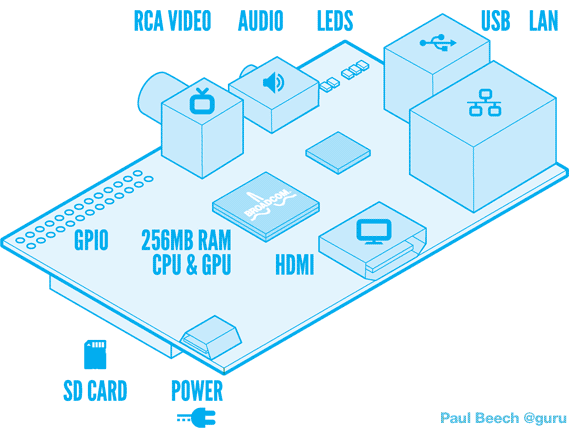
Some work would have to be done to port over Mission Planner to run natively on Linux and use the hardware UART for telemetry(or we could use a USB hub to multiplex the Xbee and joystick). Another advantage is that we can run the Pi off a Lipo and put the entire GCS into a tablet-sized box for easy use!
At the moment I do not have the adequate funds to get a Pi, and it will have to wait till December, but just sharing my idea so that interested people can give more ideas and generally get work started.
Materials needed for a PiStation (list may be missing some items):
Thats about it. May have missed some things, I'll add to the list if I remember. please comment on what your opinion is. Healthy criticism is welcome!
Kabir
 NASA's most expensive "drone" lands successfully.
http://mars.jpl.nasa.gov/msl/multimedia/nasatv/ (Live video)
I'm sitting here in the Pasadena convention center, JPL mission control received telemetry as expected, sensors nominal for landing. Then, after 7 minutes of descent (and a telemetry blackout), the parachute signal was received. Shortly after that, 4 thumbnails from the dust camera and 2 engineering images were sent, one showing the shadow of the vehicle.
Images will be posted on the MSL website as well as news outlets shortly.
RF interference is a big and growing issue with drones. Since we have so many RF devices onboard -- RC, telemetry, wireless video, GPS, to say nothings of accidental RF radiators such PCBs and wiring -- avoiding interference has become something of a necessary black art. The RF Explorer can help. It's open source hardware available from Seeed Studios for as little as $99.
They have a good interview with the creator, Ariel Rocholl, here. Some excerpts:
Interestingly, RF Explorer was born as a diagnose tool for Radio Control airplane pilots. Since a few years now, the RC world is on a big revolution due to all the improvements done in drones, FPV, 2.4GHz spectrum radio link, video links, etc. There is plenty of technology there, in some cases really outstanding achievements.
But something was missing: there were simply no way for a pilot that put $2000 equipment on an RC plane to observe the RF spectrum and detect potential collisions or interferences, most just flied the plane till it started to get control or video link problems, in the hope that not being too late or too far to get it back under control. RF Explorer changed that for good: most pilots just do a careful inspection of the spectrum on different frequencies at the flying field now, as well as the internal plane setup, to proactively detect problems before they put in risk the expensive equipment on board. In many cases, RF Explorer helped to finetune the internal plane in a way that electronics radiate less interference and so the plane get farther distances safer.
Hi, my name is Jordi. I am currently building the first Glowduino prototype, and would like to gauge the interest level in the community. I guess I should tell you what it is.
Glowduino is an Arduino-compatible LED controller board for use on multicopters. It utilizes a TLC5947 to provide constant-current sinks for 8 separate common anode RGB LED strips. In addition, Glowduino can be programmed to react to different sensor inputs or to information from your Ardupilot. For example, you could use this board to control navigation lights on your quadcopter, or control different status lights, etc.
Now here's where I need your help. There are a few things I need to know before I embark on this project. First, are you interested? Second, how much would you be willing to pay for this? Currently I'm thinking maybe in the $40-50 range. Lastly, do I need a USB vendor ID? This will be published as open-source hardware, and uses the FT232RL FTDI chip. If I do need one, is there any way I can get one for a bit less than $2000?
Thanks for reading, now here are some specs and photos.
- Brains: ATMEGA328 running Arduino bootloader (Arduino compatible)
- FT232RL for communication via USB
- TLC5947 for driving the LEDs
- 12V 3A regulated LED power supply
- 24 constant-current sinks
- 6 analog inputs (A0-A5)
- Header for expansion for more outputs (future)
- Prototypes will be from OSH Park, so purple :p (let me know if you know of a better option)
- RoHS Compliant (I think...)
- 4 status LEDs (TX, RX, ON, and L) and 2 buttons (Reset and Mode)
- Comes preprogrammed with several awesome modes!
- Powered from 2S to 6S Lipo
- Small-ish at 2" x 2"
- No mounting holes, sorry (no space...)
- Yeh!
can Ardupilot mega 2.0 incorporate most of the these sensors ?and have a rover as a new drone added on to the list of fascinating things that can be used with your product today or in the near future?

Larry Abramson came out and flew with us one morning, and filed this story. The only downside of it being a radio story is that you can't see Andreas in his bucket-style video goggles!
http://www.npr.org/2012/08/02/157441681/drones-from-war-weapon-to-homemade-toy
Adaptive Flight was contacted by CNN and ask to bring a UAV down to the studio and fly it on live camera while talking about it with the host Don Lemon. So we took a Hornet Micro and headed down to the studio. It was a lot of fun to show off this technology and put in a positive plug for domestic use of UAV's.
William Robinson was the one on camera and I was the one behind the controls of the helicopter. This is a fully functional UAV system that was used in this video, but I was flying it manually because of it being indoors and the hundreds of thousands of dollars of equipment that is all around in the studio. Still, it was a lot of fun and great to see everyone's reaction the first time I took off!
Here is a link to the CNN Video
and here is a link to to Adaptive Flight's website
The Mjolnir UAV platform is a great test platform in scale version.
It's made as a test plane with very large fuselage:
The Strong Fiber glass fuselage will take a lot of beating and rough landings.
It's including a strong Twin Gas motor.
Empty plane 11.5kg.
Max loading 20kg
Can loading 8kg
Motor 50-100cc
Wingspan: 2.61m
Twin stroke engine: 55cc
45-150 km/hour
See more about this great Test UAV
Price: 1995 USD + shipping from China
