I would like to show what we have done here in Namibia in developing Inexpensive UAV systems which we are beginning to actively use in conjunction with Namibian Ministry of Environment and Tourism, tasked with wildlife conservation in Namibia, and also for photography missions for the local quarry mines and Salt mines.


.

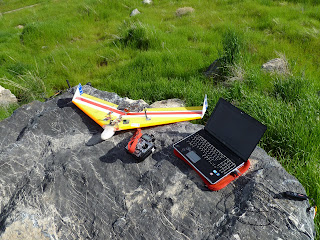
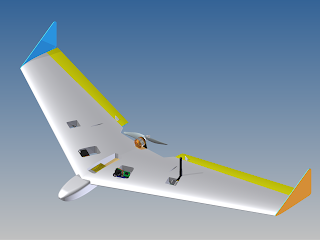
Shown , in order, are three aircraft, GUPPY, fully designed from the ground up and built by me, HORNBILL, built from a semi built kit, the Lanyu-100, and the third, KIWIT, an electric flyer of unconventional wing design.
HORNBILL is fitted with an RF tag tracking system and antenna and flew many autonomous, beyond visual range flights tracking tagged animals, especially Rhino as an aid to the National Parks anti-poaching campaign. The next trial will be with an Infra-Red camera fitted to aid the detection of poachers at night.

Hornbill basic Specifications.
- Wing Span - 2.4meter
- Engine 55cc Twin Boxer.
- Weight 15kg with 3liter gas
- Max TOW - 17Kg
- Endurance 1H 40minute with 0.5 liter spare @ 24m/s
- Min safe speed 14m/s @ 16deg AoA.
- Stall speed 10m/s @ 25deg AoA.
- Max flight speed - 34m/s
it was a lot of fun! See the report: waterberg_report.pdf

GUPPY was designed from the ground up, a full 3D model developed on CAD, and designed to be made from good aircraft grade ply. However, it was built with plain Marine ply in the end, as and exercise in cost reduction. It was designed to carry a hi resolution camera , which was subsequently flown to create geo-referenced imagery for the Quarry miners, as well as for the Salt Works. GUPPY has tremendous STOL performance and can land/takeoff anywhere.


GUPPY Basic Specifications:
- Wing Span - 2.8meter Clark Y 14%
- Wing Chord 600mm +80mm for Junker Flaperon
- 2 Flaperon per wing, each with own servo
- Horizontal stabiliser - 450mm each half span Clark Y 12%
- Horizontal Stab Chord - 220mm
- Each stab half fitted with own servo
- Engine 100cc Twin Boxer. (3W)
- Weight 26kg empty
- Max TOW - 42Kg
- Max Fuel - 8.5liter
- Endurance 5hours with 0.5 liter spare @ 35kg @ 24m/s
- Min safe speed 12m/s @ 20deg AoA.
- Stall speed 10m/s @ 25deg AoA.
- Max flight speed 42 m/s
The electric flyer was actually two Aircraft, PiPiStrello, and KIWIT. Both share wing profile type, Jedelski, and both are V tail. Both are made fully from composite materials.
PiPiStrello has straight wings with dihedral, and was fitted with ailerons, not normal on Jedelski wings – resulting in excessive adverse yaw so was canned…

KIWIT and its prototype flew many flights tool to verify the existence of a Vulture Chick in a nest in a tree out in the desert. We annually undertake a conservation mission where we currently fly in a Cessna 180, spotting Vulture nests in the Sparse Namibian desert regions. When we spot a nest, we fly closer to see if there is a chick, and if so we GPS mark the spot. Often the tree is among a dozen others, so the exact spot is 'close by'..but not easily found when we return in ground vehicles to capture, ring and tag the chick. So we used KIWIT to overfly the nearby area and find the chick again.

See the article in Raptor News - (page 2) Raptor_News.pdf

We have also perfected fully autonomous land and takeoff with KIWIT.
Have a look at these videos for the Auto Launch and land:
https://www.youtube.com/watch?v=dOEVQG9ORuE
https://www.youtube.com/watch?v=exaabnihKhM
Kiwit Basic Specifications:
- Wing Span : 2.4meters
- Weight excluding payload - 3.5Kg
- Max payload capacity - 1Kg
- Endurance - 1hour
- Cruise speed - 14m/s
- Max speed - 20m/s
- Stall speed - 6 m/s
- Takeof in 3meters in still air.
- All composite construction, cabon fibre and glass
And these videos for the flights of GUPPY and HORNBILL:
https://www.youtube.com/watch?v=8iC0jDPDxjc
https://www.youtube.com/watch?v=_3wELMrG3Go
https://www.youtube.com/watch?v=KwQ5QyFnFQI
https://www.youtube.com/watch?v=rdUwaeE-T5c
Have a look at the postings under Aircraft Platforms and Autopilot Hardware for more info.
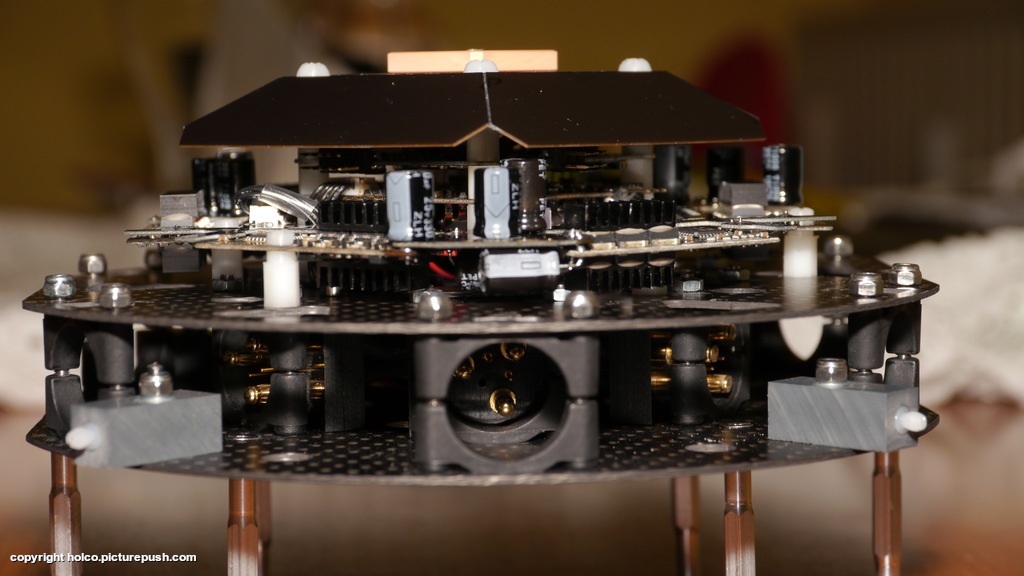
The autopilot fitted to all these aircraft is called the 'NamPilot' and is based on multiple modules, namely:
AUTUPILOT: an AVR processor based module, 8 PWM inputs from RCS, 7 PWM outputs to servos. This module does the full flight stabilization and navigation/guidance for auto flight, and stabilization for manual flight with autostabilization - mostly used when tuning the control loops.
IMU - Also AVR based, with 3 axis Gyro's, accelerometers and a Bosch I2C pressure sensor.
AIRDATA UNIT: Also AVR based, a smaller processor, with another Bosch I2C pressure sensor, and an analogue static pressure sensor ( Freescale) and a Dynamic pressure sensor for airspeed. (Freescale)
MAGNETOMETER: Also a smaller AVR processor, with a Honewell 3 axis magnetomet, configured in a balancing bridge circuit, ie, the null strap in the device is used to balance out the ambient magnetic field in a control loop. This gives VERY accurate performance, with almost no temperature drift at all, the bain of magnetometer performance!

The Ground Control Station - This is a PC based system and can be anything from a simple, reduced functionality Laptop based system, to the one depicted in the PDF files listed below. This system interfaces to a datalink antenna, with optional autotracker for the antenna, tracking theUAV in flight. It also interfaces to a dual video receiver, built into the video RX antenna. The video from the UAV camera is available in real time on the GCS, and can be recorded. A dedicated configurable Payload control panel is on the GPS operator position, allowing control of the UAV stablised camera, steering, setup, etc. All flight plans are prepared on the GCS, with a map of the flight regime, and all flight paths are shown, as well as the track flown. Numerous flight patterns can be selected, figure 8, square, straight line, circle, loiter, point to point flight plan, etc. Aircraft control loop tuning is also done in real time, during flight, from the GCS.
Take a look at these PDF’s for more info:
imu_flyer_full.pdf autop_flyer_full.pdf gcs_flyer_full.pdf


THATS IT:
This is far too much fun for just two people!!