Hackaday has the latest on the cool extreme lifting designs for the HobbyKing competition:
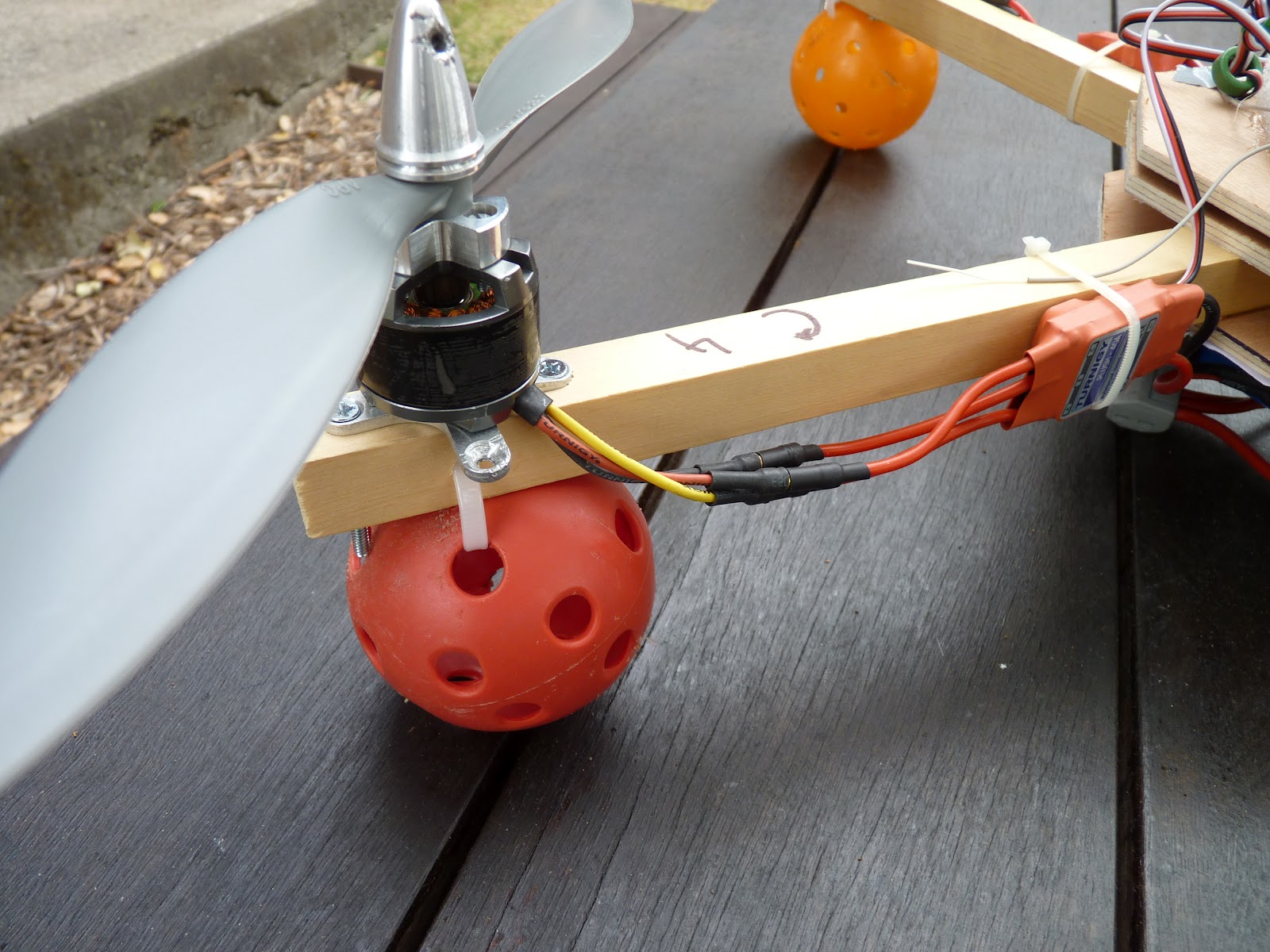
If you have a quadcopter and are looking for a beer delivery device, HobbyKing isputting on a beerlift competition The rules for the HobbyKing beer lift are pretty simple: lift the most beer with a quad/hex/octo copter and win a HobbyKing gift card.
There are 3 classes: Unlimited, which means a vehicle of any size goes, a 700 class for copters with a motor-to-motor diameter of 700 mm or less, and a Disaster class for the coolest crash.
The disaster category, a smaller quad built by [Gabriel Devault] was barely able to lift four cans of Coors Light water, while the current disaster class leader made a few valiant efforts to lift a keg. Protip: if you’re doing a blooper reel, Yakety Sax is definitely the way to go.
We are working in several airplanes adapting them to take ortophotography like professionals, we have already tested and working fine the first prototype based on EasyGlider by multiplex. This is a very good plane that forgives to bad pilots with a big problem it has few space but enough to carry a good battery and the necessary electronics.
For adapt of this plane we have to make the next modifications:
Airframe:
Opening in the airframe a hole just behind of the trailing edge of the wing, to accommodate the camera. Modify the camera trigger to can trigger the camera with a cable. (Fuji XP30). In the beginning we use the Canon IXUS 100IS but it give us some problems with the retractable lens because it clog with the dust in the landings.
Reinforcement of the airframe through a carbon rod in the up and down part of the airframe, to compensate for the weakness created by the hole of the camera.
Opening of a little hole to ballast the tail if it'll necessary set the GC, this hole is protected with a carbon tube for can insert and take out small bullets of lead easily.
Opening of a hole for the Mediatek GPS, just behind of the cabin. And open accommodation for the GPS cable on the border of the cabin. We have to do this because the integrated GPS on APM2 is covered by power wires and connectors.
Reduce the servo hole, cutting and pasting the arms of the semi-airframes.
Adjust the hole removing 2 mm side by side and make anchorage for APM2 with four nylon screws.
Shape two blocks of EPP that hold the battery on the right place, this prevent that the battery move to electronics in a crash breaking all components.
Cover the downside of the airframe with fiberglass tape, to reduce the stress of the elapor and increase the life time of the airframe.
Adaptation of the canopy, cut the wall inside of the canopy for allow close it when all electronics are inside it.
Cover the xbee with heat shrink tube, to protect it and prevent that the xbee won't come off of its base.
Put two net piece in the air inputs of the motor, with the purpose of the prevent that the grit can access to the motor and break it, when the plane landing.
Replace the original connector (Futaba or JR) for others with more pins that allow connect the two ailerons and the air speed sensor, we are use now this:
Wings:
Change the side of the aileron servos to up side, to prevent that the servos could be damaged with stones or shrubs, breaking the gears.
Reinforcement of the leading edge with fiberglass tape.
Structural reinforcement of the wing on its more fragile line just where finish the fiberglass tube. Through insertion of two platens of carbon fiber one near of the wing leading edge and other near of the wing tailing edge.
Instalación of airspeed sensor
Reinforcement of the horizontal stabilizer with a carbon rod.
Electronics:
Motor: Cobra 2814/20 850KV.
Batteries: 2S 5000 Turnigy Hardcase o 3S 2.200 Turnigy.
These are the modifications and adaptations that we have learned after crashing a few planes (Crast test), we look forward to the community of users to give us your comments. Our main doubts about this model are:
The way to cancelled the GPS on the daughter board of APM2, we are cut the path nºx of the GPS.
Tuning the PID, that black box that a few people know.
Synchronization of the clocks of the GPS and camera. For we can georeferencing photos.
So far we have prepared other models being the Easyglider the most evolved, Maja (Bormatec), Minimag (Multiplex) y Ursus (Marek), now we are working on Mentor (multiplex) for carry medium payloads (camera sony nex3).
Sorry, but the system didn't allow us upload more photos, and excuse me if my english is bad.
And thanks to all community and developers by make possible my project.
Tomorrow's a holiday in the US, so I'm going off topic for this bit of fun.
Via Mashable: "Produced by Fluxel Media with beats from musician Andrew “Nostalgia” Hill, the “Dubstep Dispute” video is beautifully constructed eye candy. Complementing the visuals is a remix of Muse’s “Knights of Cydonia.”"
I've been looking at my unused twist grip joystick for a while now thinking about hooking it up to a transmitter via the PPM trainer port.
I might go a step beyond this and get a new 2.4GHz Tx module and add that to the joystick to make it a transmitter.
Fly-Dream make an affordable and reliable 2.4GHz DIY module with three pins for GND,+,PPM in.
I've been able to generate PPM from an Arduino in the past so now it's a matter of hooking the pots in the joystick to the analog pins and the buttons to the digital pins. The pots move over a portion of the total travel in a joystick so my Vref will need to be a bit above the max voltage the pot will register. So if the pot only travels between 0 to half way and I feed the pot +5v then the max output voltage will be 2.5V.
I've also ordered an 8ch 12bit ADC I2C breakout which samples at about 12KHz. This will give me more leg room at reading resolution of 4095. The high resolution reading then goes through expo / trim / end point / sample filtering maths and comes out at a resolution of 1024 per channel. As far as I can tell the PPM output resolution does not need to be any higher than that, nor do I think the timing in an Arduino can get any better than that.
The hat switch can be coded to move the camera tilt servo. Might even pop out the digital hat switch and put a Wii joystick in there for tilt rate control.
With the 8 or more buttons on the joystick I should be able to code it to give me all the PWM levels needed for channel 6 modes on the Arducopter.
JVC and Sony are taking on GoPro with new small HD "action cams". The shape of these will possibly have much better aerodynamics than the GoPro... more in line with Contour's cameras. Notice JVC's is already "quad proof". I'm sure they had quad copter drones in mind. :)
JVC's appears to have more features, but I'm especially interested in Sony's as it's rumored to have image stabilization and a Zeiss lens. Not to mention, it looks really small and sleek. It would require a water proof case (if needed) like the GoPro, where the JVC is bullet proof, well "quad proof" out of the box. I haven't come across any details about whether either camera supports a live analog (SD) output. Post a comment if you know anything about these cameras.
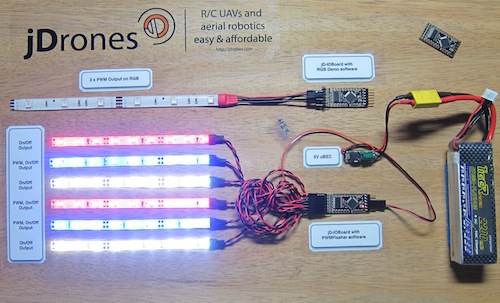
You had some problems on driving LED strips or something else?? Well no problems anymore.... We have seen people making all type of darlington/transistor and similar hacks to drive their LEDs, Sirens and so on but they all need a lot of hacking and they might not be suitable for long term solution.
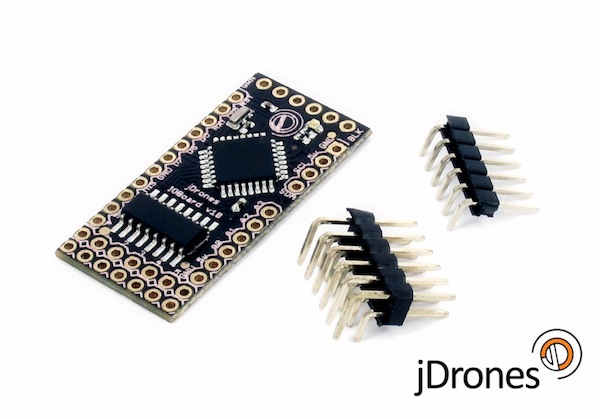
We answered on this call and made fully Arduino compatible called jD-IOBoard that can run Single LEDs, LED Strips, Loudspeakers, Buzzers, Power switches and so on. It's upto your own imagination on what all you can control with this board.
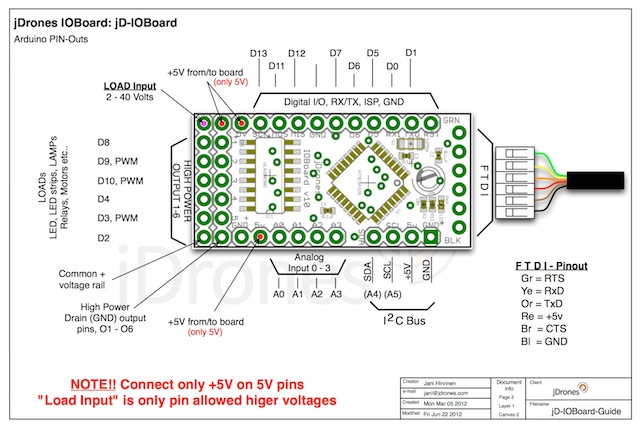
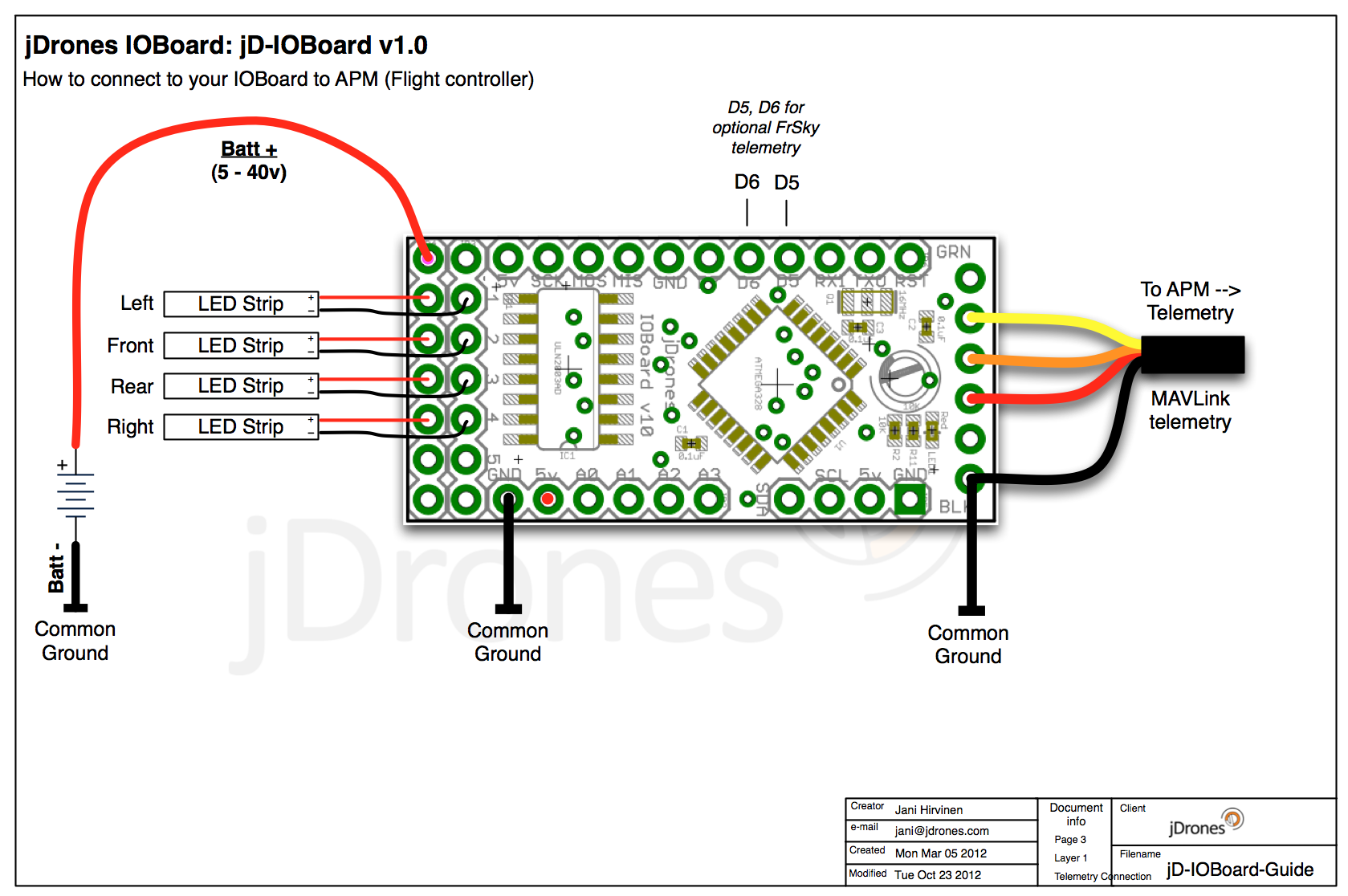
So what does this board actually do?? It has fully Arduino compatible ATMEGA 328 MCU and Darlington array to driver high power outputs. Also I2C pins are exposed and same as many TTL level IO and Analog pins. As you can see from picture above.
Board has:
- 6 x High power outputs, max. 500mAh / 50 Volts
- 4 x Analog inputs (6 if you don't use I2C port)
- I2C port for controlling, listening I2C messages
- 6 x TTL level GPIO pins (8 if you don't use FTDI)
- 1 x FTDI port
3 high power outputs can also be controlled by PWM output while another 3 are just normal "On/Off" outputs
How those Arduino pinouts looks like:
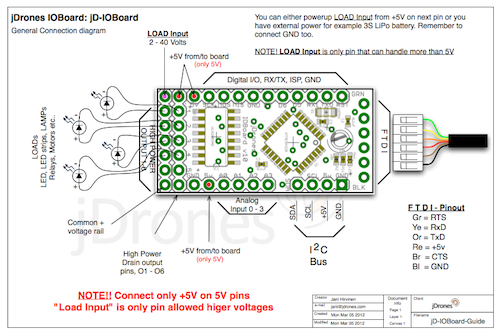
Connecting LED's,Buzzers etc is really simple. Just use one of output pins on end of the board. Below you can see examples on how to connect LEDs or LED Strips on it.
Pictures does not give enough credit for how it works so we made small video to show just few examples on how to use it. There are many other ways to do it but this should give at least some idea what/how to run it. So have fun watching it.
Get yours from jDrones Store: jD-IOBoard and have a blink blink.
Ps. There are some nice features coming to this board shortly...
Today Hobbyking added a stabilisation control board for fixed wing aircraft to their catalogue. This board supports conventional, flying wings (delta) and v-tail aircraft, easily selectable by on-board jumper. Unfortunately for v-tail aircraft an y-cable is needed if you are using 2 servo's.
The board is controlled by an Atmel Mega168PA 8-Bit RISC based micro controller and utilizing a single high precision 3-axis MEMS gyro and independent gyro gain adjustment for tuning aileron, elevator and rudder.
Not includeded are servo leads to connect your receiver to the i86AP Flight Stabilisation control board. You will need 3 of them, don't forget to include in your order.
I had a quick glance at the manual (which can be downloaded here) and it seems that it provides good information how to use this board.
Specifications: Input Voltage: 4v to 6v DC PWM Output: 50Hz, 1020-2020us Gyro scale: +/- 1000dps Gyro sample rate: 1KHz Operating temp: -40° C to 85° C Size: 30mm x 40mm Weight: 8g
Another successful flight to over 100,000 feet with the same APM2 and 3DR radios on board. This picture is the balloon exploding at over 100,000 feet. Total flight was 101 mins this time. The APRS tracker failed this flight but the package was recovered in a 1/2 hr by a citizen calling the phone number on the package !
In about 2 weeks we are preparing to launch the balloon glider combo and fly the glider back by a joystick on APM2 via mavlink.
Today the Association of Unmanned Vehicles International (AUVSI) published a drone Code of Conduct. Here are some excerpts. What do you think?
The emergence of unmanned aircraft systems (UAS) as a resource for a wide variety of public and private applications quite possibly represents one of the most significant advancements to aviation, the scientific community, and public service since the beginning of flight. Rapid advancements in the technology have presented unique challenges and opportunities to the growing UAS industry and to those who support it. The nature of UAS and the environments which they operate, when not managed properly, can and will create issues that need to be addressed. The future of UAS will be linked to the responsible and safe use of these systems. Our industry has an obligation to conduct our operations in a safe manner that minimizes risk and instills confidence in our systems.
Safety
We will not operate UAS in a manner that presents undue risk to persons or property on the surface or in the air.
We will ensure UAS will be piloted by individuals who are properly trained and competent to operate the vehicle or its systems.
We will ensure UAS flights will be conducted only after a thorough assessment of risks associated with the activity. This risks assessment will include, but is not limited to:
Weather conditions relative to the performance capability of the system
Identification of normally anticipated failure modes (lost link, power plant failures, loss of control, etc) and consequences of the failures
Crew fitness for flight operations
Overlying airspace, compliance with aviation regulations as appropriate to the operation, and off‐nominal procedures
Communication, command, control, and payload frequency spectrum requirements
Reliability, performance, and airworthiness to established standards
Professionalism
We will comply with all federal, state, and local laws, ordinances, covenants, and restrictions as they relate to UAS operations.
We will operate our systems as responsible members of the aviation community.
We will be responsive to the needs of the public.
We will cooperate fully with federal, state, and local authorities in response to emergency deployments, mishap investigations, and media relations.
We will establish contingency plans for all anticipated off‐nominal events and share them openly with all appropriate authorities.
Respect
We will respect the rights of other users of the airspace.
We will respect the privacy of individuals.
We will respect the concerns of the public as they relate to unmanned aircraft operations.
We will support improving public awareness and education on the operation of UAS.
Edward Burtynsky, who is famous for his huge landscape and mega-engineering photography, uses drones for aerial photography. From an interview:
Twilley: From the point of view of a photographer, then, it might seem equally interesting that there are now all sorts of new types of photographic systems on the rise—quadcopter-mounted 3D scanners, drones, and even smart ammunition equipped with cameras that can loiter in an area taking aerial photographs. Simply on a technical level, I’m curious about where you see the future of photography going. Do you see a time when you’re not going to be riding in a helicopter over Los Angeles but, instead, piloting a little drone that’s flying around up there and taking photographs for you?
Burtynsky: I’m already doing it.
Twilley: You have a drone?
Burtynsky: Yeah. I use it to go into places where I don’t have any air space. I work with a team. One guy runs the chopper, one guy runs the head, and I take the shutter release and compose. For example, there is no civil aviation space in China, so I was using it there. I used it to shoot the big [Three Gorges] Dam area [shown above], and I used it to photograph agriculture.
So I am already using that technology. It offers new ways of entering into places that you would never have considered going—or that you couldn’t even go to—before.
Congrats to our friends at OpenROV, who hit their Kickstarter target in the first day! You can get the complete kit for $775. Right now it's just teleoperated, but it has a BeagleBone computer board, so there's lots of potential for sensor and autonomy later.
Massimo Banzi, the co-creator of Arduino, gives a great TED talk on the power of open source projects. Gives a nice shout-out to DIY Drones, ArduCopter and MatterNet, which uses ArduCopters to deliver packages in places like Africa.
Hizook, one of my favorite blogs, has a great rant on one of my favorite peeves: UAV videos that show performance only possible with crazy expensive motion capture systems that are only found in a few well-funded university labs:
It also covers other sins of robotic demo videos, such as not being clear what's teleoperated and what's autonomous, speeding up time, tethering and scripting. Check out the whole thing, but here's the start:
Movies and scifi books inspire roboticists to push the envelope, but they've also skewed the public's perception of robot capabilities. This problem is being exacerbated by researchers. In the last three months, I've had to shatter a few dreams: "Your $300 AR.Drone or $150 Ladybird will not be able to perform insane autonomous aerial maneuvers (yet). The UPenn quadrotors rely on a $20k-$50k camera-based (Vicon) motion capture systems, which provide global pose estimation of each UAV at millimeter-accuracies at up to 1kHz (and often uses an external, centralized motion planning computer too)." That this crucial aspect of the videos does not register with intelligent people means that researchers are being disingenuous and violating their duty to the public -- which sucks, because their projects and research are awesome! And this is just the example that happens to be most salient to me at the moment. In this post I'd like to explore some "best practices" for robot videos so that we can quit misleading one another.
It's been a while since I've posted an update on the progress of the AutoQuad flight controller. The event that we've all been waiting for has arrived with ST Micro's announcement and subsequent release of their STM32F4 product line. As expected, the micro-controller is pin for pin compatible with their STM32F2 series which the AQ v6.1 hardware was designed for. This meant it was a drop-in replacement. The most important new feature of the chip is the implementation of ARM's Cortex M4 core with a hardware FPU! This means that we can now do floating point operations in a single clock cycle. All forms of add / subtract / multiply / integer conversion, etc are single clock cycle instructions with the divide and square root instructions taking 14 cycles. This is a significant step forward for math hungry applications like AutoQuad.
As soon as I could get my hands on one (around November I think) I had it on a board working to port my ground Unscented Kalman Filter code to fit into the 168MHz MCU. With some optimizations, it ended up fitting with processing room to spare. The current version leaves ~40% idle time during flight. The filter is interesting because it brings all of the important estimated states and observations under a single mathematical model. This means that each observation can influence any number of state estimates if there is determined to be co-variance between them. The theoretical performance improvements over my old fixed gain techniques is high. 17 states and 16 process noise terms are estimated at 200Hz observed by 13 sensor measurements.
A benefit to using such a filter onboard is that it can adapt to changing variance of sensors and measurements on the fly. This removes the need to do ground based flight calibration simulations which was a drawback to the original fixed gain methods. Once you have a calibrated IMU, it can provide accurate state estimates "out of the box." While this is nice, the biggest improvement is the accuracy of the state estimates it can produce. States like 3D accelerometer bias and 3D rate gyro bias are critical to accurate attitude estimates which is the only way that you can propagate acceleration measurements through velocity and position estimates with any kind of accuracy.
Other than the upgrade of the MCU, the hardware is mostly unchanged from the original v6.1 layout. However, there have been a lot of new features added to the firmware since last year. What I call DVH (dynamic velocity hold) allows the pilot to control the craft's velocity in 3 dimensions while AQ handles everything else. Let go of the sticks and the machine holds position. AQ now speaks mavlink so it can be configured and controlled from any ground station that supports the protocol. A comprehensive parameter set has been established that allows configuration of almost all aspects of operation. Gimbal support and expanded mission capabilities have been added. 1-wire support for pre and post flight communications with ESC32. Too many more to list here.
With the help of Max Levine I created this video to demonstrate the autonomous mission capabilities of the current firmware (version 6.6):
If you use the uBlox LEA-6T as the onboard GPS module, AQ can record raw satellite observations to its uSD card along with the normal flight log. With this data and data from a local base station, you can use post RTK to get extremely accurate position and velocity estimates (~ centimeter accuracy.) In fact, I use the RTK velocity estimates as an absolute data point in scoring the filter's performance in the ground simulations used to tune the variance and noise parameters used by the UKF. Future work might include onboard RTK calculations using a linux based application processor mounted on a daughter board. This would bring the system's performance to an entirely new level.
Here is what the actual flight path looked like of the flight shown in the above video using post processed RTK:
I need to thank the small group of people who have worked very hard to test, write utility software and interfaces, create documentation and generally improve the AQ platform. It is still very far from a finished, polished flight controller, but it has come a long way because of their help.
As with ESC32, I have decided to release the AutoQuad FC firmware under an open source license. It can be found at:
I would also like to invite anyone interested to participate in a public beta test of the system. Sensor calibration, setup and configuration is still a lengthy and sometimes tedious process so I would discourage anyone who thinks they can bolt the board to a frame and start flying as that is not at all what you should expect. I have authorized manufacture and sale by ViaCopter and Flyduino who are taking orders in a few days.
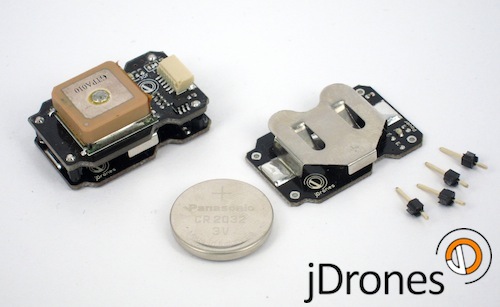
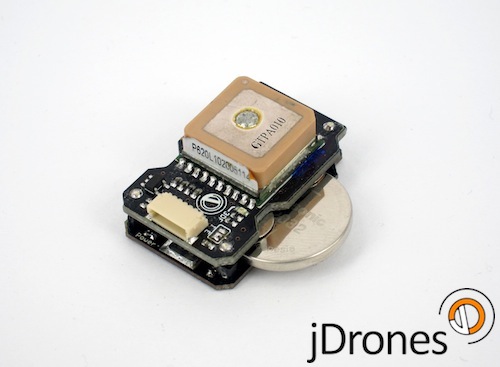
Few weeks ago we introduced our new and improved jD-MediaTEK GPS unit for all ArduCopter, ArduPlane and ArduWhatEver use. We also said that there will be shortly a new battery tray for it. Well here it is.
What does it give and what does it take. It gives to you and your GPS backup battery power for 8-12 months from regular CR2032 3V battery (according GPS module manufacturer). It also gives 2D/3D locks for you in 2-5 seconds in average. On our tests it's usually 2-3 secs until GPS module reports proper satellite lock.
Board has also small charge/keepup circuit that will powerup battery circuit in times when main power is connected.
What it takes: Soldering 4 support pins and one solder jumper. Job that usually takes only 3-4 minutes.
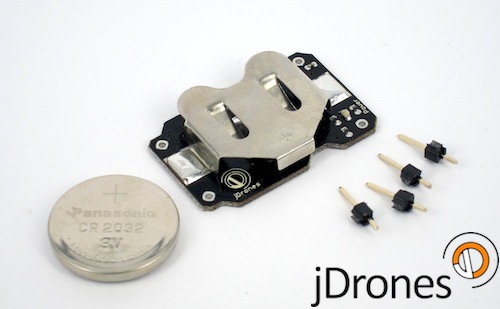
Without GPS module on top it looks like this:
As you can see it uses regular CR2032, 3V battery that you can find from almost every "7-11" shops around the world. This battery will power internal RTC clock for 8-12 months in normal conditions according GPS module manufacturer.
If you ran out of battery later on, don't worry. Battery is really easy to replace. Just slide old battery out sideways and put new one in and off we go again for next 8+ monts.
Get your own battery tray from jDrones or jDrones distributors around the world.
Codebender, a cloud-based IDE for Arduino is coming soon. If you like the look of it, you can back it on Indigogo (28 days left). I backed it at the $150 level, which gets you and Ethernet Arduino, with a special bootloader that lets you program and download code from the Web.
Time to revolutionize the way you develop and hack on your projects. codebender is a platform that helps your next idea come to life. Wether you are a maker, a hardware hacker or an artist, codebender allows you to code on the web, faster and easier, using our awesome web editor. Host your Arduino sketches on the cloud and use our next-gen compiler to build and debug your sketches from your browser. When you are done, upload them to your Arduino, straight from your browser. No installations required. Coming soon.