All Posts (11086)

Sort by
Moderator

Hollywood given the green light

FAA-Puma1.jpg?width=400Its all worryingly simple. 

Write manuals, get an N number for your airframe apply for a COA and the pilot needs a PPL.

What took them so long!

In their applications, the firms said the operators will hold private pilot certificates, keep the UAS within line of sight at all times and restrict flights to the “sterile area” on the set.  In granting the exemption, FAA accepted these safety conditions, adding an inspection of the aircraft before each flight, and prohibiting operations at night. The agency also will issue Certificates of Waiver or Authorization (COAs) that mandate flight rules and timely reports of any accident or incidents.

“The applicants submitted UAS flight manuals with detailed safety procedures that were a key factor in our approval of their requests,” said FAA Administrator Michael Huerta. “We are thoroughly satisfied these operations will not pose a hazard to other aircraft or to people and property on the ground.”

The full press release 

Read more…
Distributor

Testing a small thermal imaging camera

I got my hands on a small thermal imaging camera for testing purposes.

I installed it on my hexacopter and took it out for a flight this evening.

Ttechnical data:

resolution: 384 x 288

50 Hz

8 - 14 um spectral range

analog video out

uncooled sensor

I am looking forward to test the new model (second version), which has double the resolution and false-color

www.diesunddas.co.uk
Read more…

3689617798?profile=original

This post also appears in The Market section of sUAS News.

As the Federal Aviation Administration prepares new guidelines for the use of unmanned aerial systems (UAS) in the U.S. national airspace, startups and aeronautic mainstays are chomping at the bit to start selling drones for commercial ventures, from filming to crop scouting to inspecting oil pipelines.  Some market forecasts like this one from Markets and Markets and this one from Business Insider expect the size of the commercial market for sUAS to grow significantly over the next decade. I believe they are right, but what is up for grabs is, Who will get the lion’s share of the market?  Will it be the startups like Airware and PrecisionHawk or the defense suppliers like Lockheed-Martin Procerus Technologies and AeroVironment?

Read more here:  http://droneanalyst.com/2014/09/25/commercial-uas-market-opportunities/

Read more…

3689617874?profile=originalHi,

i'd like to share my latest development, this is for testing further AntennaTracker code developments.

The current part is an upgrade to my Portable Groundstation, using the initial idea of Ardupilot Antennatracker.

I designed a mechanics for 3D FDM printing. I use Hitec HS5065MG for pitch and MKS DS95i with external precision potmeter.

The total pitch range is 90  degrees, yaw is 380 degrees.

i'll share some sample video soon.

Regards, Adrian

3689617937?profile=original3689617950?profile=original3689617773?profile=original3689617891?profile=original3689617972?profile=original3689617783?profile=original 

Read more…

3689618025?profile=original

These Bormatec MAJA and Cam-FLyer Q will be used for inspection, mapping, aerial images and surveillance at Aarhus University, Denmark at the Danish Centre for Food and Agriculture in Foulum. Aarhus University, Foulum

Both planes have now been assembled and ready for manual flight, waiting for components like GPS, telemetry, autopilot and different sensors ordered from 3DR. The smaller Cam-Flyer Q is more for test setups and to get flight experience with since I only worked with multirotors so far.

I hope that I can learn and get experience from other MAJA users here on DIYdrones.

Read more…

3689617729?profile=original

Mamba UAV-p 370 RTF

3689617697?profile=original

Vibration Isolation, wire routing

3689617824?profile=original

Integrated PDB with twin variable voltage taps for FPV or Auxiliary power

3689617737?profile=original

Pixhawk Flight Controller

3689617854?profile=original

GPS Tray, Isolated 5.8 GHz 600mW FPV Tx

3689617912?profile=original

Sony 600 TVL FPV Flight Camera, X8R, PixHawk, GPS, 915Mhz Telemetry, VAS Bluebeam

Now if we can get the local weather to cooperate we should have allot more flight videos of this new model. Since I have had several requests now to make it weather resistant I may have to name that for a local semi aquatic snake because as you could imagine with all of the exposed conductive points I doubt it will fair all that well in this current salt gas environment. Shortly however I see the skies clearing and at the same time we will have models ready to be documented in their native environment. 

Hopefully the new nose mounted gimbal parts, as well as several other items will also cross the water-jet this week. The ability to turn the arms to change flight characteristics especially to be used to counter act the flight camera position on forward flight was a interesting surprise, several now have asked can we automate it, I quickly remembered where I saw that first(http://diydrones.com/profiles/blogs/iquad-tilt-rotor-quadcopter-v2-flight-testing), maybe I can get IIyaR to help me make a conversion kit ;

Read more…
3D Robotics

3689617548?profile=originalFor those following the Outback Challenge UAV competition, check out the CanberraUAV site, which is doing a good job of daily reports. This is the home team of APM:Plane lead developer Andrew "Tridge" Tridgell, the legendary gentleman on the keys above. They won the last competition and will be the team to watch when they fly later this week.

Today's report:

Today was the first Search and Rescue Challenge flights at the OBC.

It was a fair bit quieter with the high school teams gone, but it did give us all time to chat with the other competitors and make some new friends.

Some people have been asking if there is something more than the “UAV Challenge Live” feed on Facebook and Twitter. There is a live video stream in the competitors tent, which shows the activity at the flight line (where teams takeoff/land their UAVs and put their ground stations). Since the UAVs fly up to 6km away, we don’t actually see much of them except for the takeoff and landing sequence. Other than that, we are reliant on the Facebook feed too!

On to today’s teams:
OpenUAS – This was their 3rd OBC. Their UAV made it to the search area but crashed shortly afterwards.
Condor – Had technical difficulties and elected to go to the back of the queue
Monash UAS – Flew very well and imaged the search area. Unfortunately they could find Joe in the images. They landed successfully back at the airport.
PerthUAV – Imaged most of the search area, but couldn’t find Joe. They landed successfully back at the airport.
Compass UAV – Imaged some of the search area, but couldn’t find Jo. They landed successfully back at the airport.
SwissFang – Crashed part way to the search area.
MelAvio – Had technical difficulties and elected to go to the back of the queue

Tomorrow starts with VAMUdeS.

At this stage, CanberraUAV will likely be flying Thursday afternoon or Friday morning.


Read more…
3D Robotics

3689617635?profile=originalFrom Wired:

If companies like Facebook and Google have their way, everyone in the world will have access to the internet within the next few decades. But while these tech giants seem to have all the money, expertise, and resolve they need to accomplish that goal—vowing to offer internet connections via things like high-altitude balloons and flying drones—Yael Maguire makes one thing clear: it’s going to be a bumpy ride.

“We’re going to have to push the edge of solar technology, battery technology, composite technology,” Maguire, the engineering director of Facebook’s new Connectivity Lab, said on Monday during a talk at the Social Good Summit in New York City, referring to the lab’s work on drones. “There are a whole bunch of challenges.”

Facebook formed its Connectivity Lab earlier this year. Dovetailing with CEO Mark Zuckerberg’s new venture, Internet.org, its goal is to build and launch a fleet of solar-powered drones that can connect the billions of people currently living off the grid to the internet.1 It arrived just a month before Google agreed to acquire Titan Aerospace, a startup that makes its own solar-powered drones, and according to Maguire, such projects are a long way from success. There are substantial operational, technical, and regulatory hurdles these companies with have to overcome before any of their technologies can, well, take flight.

In order to fly its drones for months or years at a time, as it would have to do in order to provide consistent connectivity, Maguire explained, Facebook’s drones will have to fly “above weather, above all airspace,” which is anywhere from 60,000 to 90,000 feet in the air. That puts these drones on tricky regulatory footing, since there are essentially no regulations on aircraft that fly above 60,000 feet in the air. “All the rules exist for satellites, and we’re invested in those. They play a very useful role, but we also have to help pave new ground,” Maguire said.

Facebook and its counterparts will also have to find a way around regulations dictating that there must be one human operator to every drone, which could drastically limit the potential of such an innovation to scale. For proof, Maguire pointed to a recent solar drone demonstration by a British company, which ended after two weeks to give the pilots a break. “It’s like playing a videogame for two weeks straight with no rest,” he said. “We need a regulatory environment that will be open to one pilot perhaps managing 10 or 100 drones. We have to figure these things out.”

Still, despite the obstacles, Maguire said he expects the Connectivity Lab’s drones will be ready to begin testing by next year. Just where that will be Maguire can’t say. The company has also identified 21 locations in Latin America, Asia, and Africa where it would like to deploy its connectivity projects, which Maguire says are likely two to five years away. But Facebook will not be running these projects itself, Maguire warns. It’s actively looking for partners on the ground—be they governments, communities, or local businesses—who will deploy the technology the Connectivity Lab has created.

“We’re hoping we’ll be able make this technology open for other people to use…because we think they have a more scalable model for getting the technology out there,” he says. “It’s going to be an enormous effort. Trying to connect everyone is the problem of our generation.”

Read more…
Developer

cortex-m7-400mhz.jpg?width=700

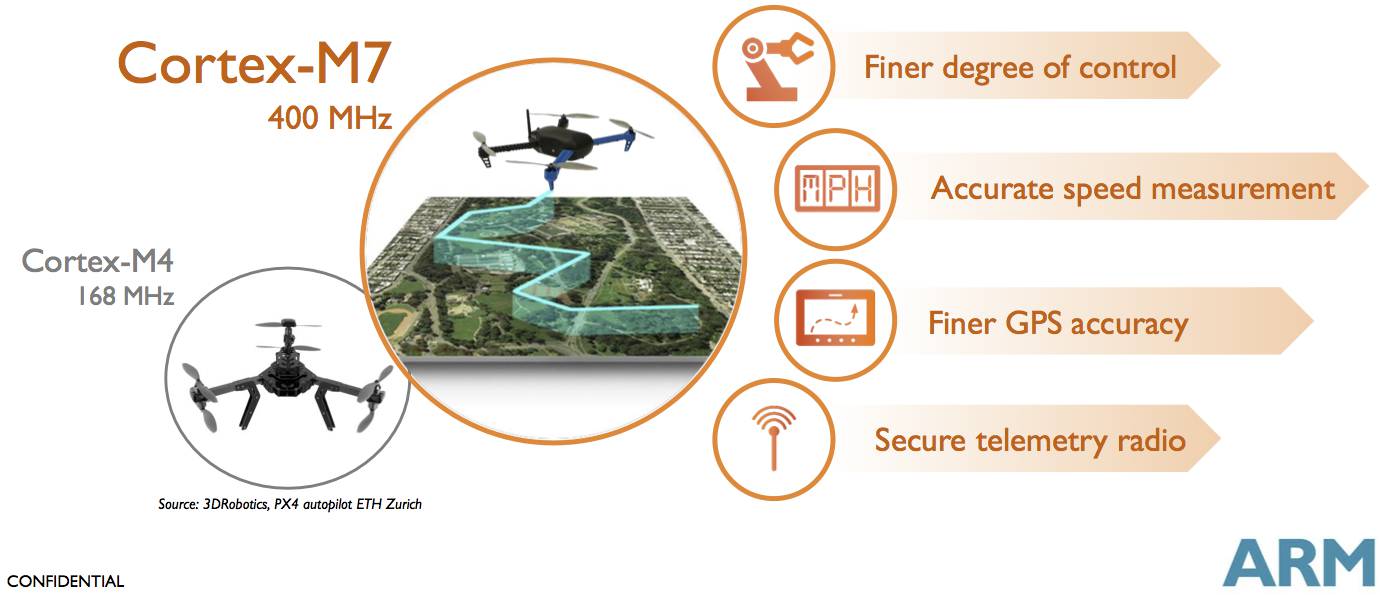
Cross-post from my original G+ plus post, based on a The Register article: ARM just announced a new embedded core, the Cortex M7 with up to 400 MHz clock speed. The CPU is in general faster and has an improved pipeline, the real game changer four our drone applications is however the double precision hardware floating point unit. In particular for global coordinate systems (e.g. using GPS) having double precision available in hardware is quite enabling. Interestingly ARM decided to use 3D Robotics (and the Y6 and Iris graphics) and the PX4 project (which has its origins at ETH Zurich) as use case for how their new micro controller could impact the market.

As a a long-time onboard Linux user we are happy to see more and less expensive Linux single board computers becoming available, but interrupt latency, context switch overhead and I/O will remain challenging topics for all-Linux solutions, and so improvements in the low-cost micro controller domain will remain relevant and interesting.

After all, one of the recent novelties claimed by Apple for their iPhone was the addition of their motion processing co-processor, which turns the current iPhone generations into the same design pattern that we have been using a long-time in research: A low-latency IMU/autopilot coupled with a full-fledged mobile computer, combining the best of both worlds in terms of flexibility and latency.

Read more…

PerthUAV at the 2014 UAV Outback Challenge

3689617609?profile=original

3689617586?profile=original

Today Perth UAV flew at the 2014 UAV Outback Challenge.  Out of the 20 competitors, 15 were cleared to fly.  1 withdrew, 1 postponed, 2 crashed, 3 made it safely around the course and  there are 8 more teams yet to fly over the next two days.

Setup time started really badly when our normally completely reliable RFD900, that had worked on all previous occasions over hundreds of flights, failed to connect.  We swapped to a spare and it came up after much running around and fault finding.

Then our WiFi failed as the ethernet port of the WiFi module came off in my hand!. This left us just with our 4G connection to get thumbnails from the onboard recognition computer down to the ground.

We finally had everything up and running but were told to shut down as about 20 gliders launched.  We ended up restarting everything three or four times as hold were put on and cancelled.

After we got the go-ahead, the Pixhawk executed a perfect automatic launch and flew to height of 200m to start the course.  At this point our on-board recognition computer running Tridge's recog code stopped working leaving us with no recognition!  Fortunately we had a second backup recogniton option that we never expected to use.  Our software genius who designed the imaging system put in a module on the smart camera to upload photos over 4G to a cloud server running the same recognition software that was running on the onboard computer.  

With that, we finished the scan of the search area in 30 minutes and spent a further 25 minutes loitering around in the search area waiting for images to upload and be recognised. The problem was that the images uploaded slowly, with only about 30% of the images uploaded within the competition time.  With a 60 minute time limit almost over, we successfuly executed an auto landing at the 59th minute.

We were given 15 minutes to pack up, but shortly after our competition was over, the cloud recognition server successful identified Joe!  Unfortunately it was too late for us, as our time was up

It's a privilage to be one of the few teams to ever fly the course and return without crashing and even take a (belated) image of Joe.  We are very happy with the way the team performed through all the challenges we had and wish the remaining teams all the best for the next few days.

Read more…

APM/Pixhawk compact GCS build

This is one of our earlier designs, however, we've built this very version for our APM/Pixhawk user clients. Notable differences are the customary rotary flight mode switch and the aerial video/stills specific line-up of the toggle switches. All direct remote camera functions from zoom, focus/shutter, video start/stop, etc. can be implemented by using the very same line of toggles, which include 2-3 position, SP-DP spring loaded and lopsided spring versions.

The direct RC TX in the tray is based on the OpenTX architecture, so installing a third joystick wasn't an issue. The user has the choice of mapping the camera pan-tilt functions on the small extra joystick, or just keeping this function on one of the original sticks with a mode switch.

Of course, this station is only rugged for transport, as the controls are not IP types, but we can still say from experience that a light rain doesn't do it any harm. :-)

Those of you already familiar with our GCS designs know, that we nearly always use Peli cases upside down for a reason. For one thing, the body of the box can act as a sunshade for high nit monitors. Even more important, the control tray should be as shallow and flat as possible to avoid the extra strain on your wrists, when working for more than just a few minutes with a console. This, and the fact that a higher console panel position makes it impossible to use such an upright set properly seated at a field desk, as then your knees wouldn't fit under the desktop...

With this framework we had to modify the original top loader Peli case to achieve an ergonomic fomat by replacing the top handle with a fold-down type under the tray. Although the station is perfectly stable on any flat surface, we have also included a tripod mounting plate right in the COG of the open case.

That handle between the monitors is not ornamental, as nothing really is in our builds. In addition to protecting the monitor panels as a hard internal barrier, because the body of the station is constructed as a single block, you can pull out the whole entrails by this handle after removing only 4 screws. Otherwise you would have to shake it out... :-)

The LCD panels are 7" 1280x800 high nit IPS types, so they are very much sunlight readable even without the natural shade of the recess they're mounted in. We were thinking about mounting matte protectors from 3M, but the high resolution would always suffer, even with the highest quality hazy films. Also, the stock surface of the panel already has a low-reflectance coating, so we've left them glossy.

The current PC hw is an Intel Core i3, so Mission Planner under Win7-8 works straight from the box. Because this motherboard can drive two monitors, you also have the choice of using both screens as an extended desktop with the downlink video in an overlay/window (the frame grabber is already in there). Otherwise you can use one screen for the PC, while displaying the direct video feed on the other, as both LCD controllers have composite and digital inputs.

The original version uses a broadcast quality 10bit TBC for a smooth video feed, but that TBC is way out of production, even though we still stock quite a few of them. The new stations have an SD card based DVR in the same spot on the front panel with an automatic TBC still in the loop inside.

The internal LiFePO4 packs are fully balanced and protected from overcharge, overdischarge and short circuit. At around 300Whs of total capacity the station has a battery endurance of at least 8-10 hours. The internal charger accepts DC voltages between 12V and 30V.

Read more…

Small Electric Helicopter 108km/h Auto Flight

3689617490?profile=original

Another recent accomplishment with the Helicopter version of Arducopter was this full auto speed run which achieved a top speed of 30 m/s or 108 km/h.  This was done using 3.2 which features improvements to the helicopter flight dynamics code, as well as Spline Waypoints which is a general Arducopter feature.  I find the Spline nav really helps helicopter flight as it avoid jerking the helicopter  which is very important at high speeds.  

108 km/h in auto mode is a good accomplishment given that the absolute maximum speed this helicopter is capable of is 140 km/h, based on Retreating Blade Stall.  This performance wasn't a fluke either, as not only do I do 2 back-to-back runs in the video, I did in fact run this mission 10 times while preparing to shoot the video.

For reference this is a relatively small helicopter, a Trex 500, which weighs only 2100g and is 90cm long.

Read more…

This 5-minute short film featuring quadrotors was produced in collaboration between the entertainment company Cirque du Soleil, researchers at ETH Zurich’s Flying Machine Arena, and their spin-off company Verity Studios. Everything you see is real — no CGI, wires, or speed-ups/slow-downs were used in the production of the film.

Read the full article on Robohub

Read more…

Carpe Noctem and Fly the Calm Skies

3689617523?profile=original

With the arrival of the autumnal equinox here in the Pacific Northwest, it triggers, once again, thoughts about how to keep those flying skills on point. As the amount of daylight decreases and the weather shifts to a cooler/wetter pattern, the window of opportunity for outdoor flight is greatly reduced. To that, I say "carpe noctem". Yes, seize the night. Here, in the Pacific Northwest during the fall/winter months, the atmoshpere starts to settle down in the evening, often presenting a dry/calm opportunity for flight. All you need are a few strategic lights for your aircraft and you're good to go. Here's some video of a HooperFly RacerPEX with a RingGo Plasma Edition during the final sunset of Summer. Bring on the darkness.

Read more…

Our latest GCS build, The Beast

GCS build highlights

  • Intel Core i3-i7 PC hardware for Win7-8 or Linux operating systems, 2-328Gb RAM, 60-256GB SSD, Gigabit LAN, 4 external USB 2.0, optional 3.0, WLAN, etc..
  • Dual 10” 1920x1200 600nit IPS panels with low reflectance gloss or matte surfaces
  • 300-460Whs of fully managed LiFePO4 battery, balanced cells, protected against overcharge, overdischarge and short circuit,
  • external charge and power supply from 12-30V DC, optional rugged external AC-DC PS
  • iKey OEM waterproof industrial full size backlit keyboard and touchpad with solid tactile feedback
  • individually sealed customised modular application panels with the required set of controls in ergonomic arrangement, all with IP65-67 level protection, including:
    • 2-3-axis precision joysticks with hall effect or pot sensors
    • round or square pushbuttons (even latching types)
    • 1-3 or even 6 position toggle switches in various configurations including spring return and lopsided spring types
    • rotary switches for flight mode and payload selection
    • slider, lever and rotary pots
    • status and indicator LEDs
  • min. IP67 or MIL-DTL-5015 external connections for RF boxes, antenna trackers and other accessories
  • 2 external USB connectors on top for RF modules (“rabbit ears” for telemetry modems, high power WLAN or 3/4G), 2 panel USB connectors, other external connections optional
  • TBC (Time Base Corrector) on downlink video feed
  • optional solid state SD card based DVR for mission record and debriefing
  • overall protection levels: IP65 open and operating, IP67 closed for transport, full IP67 optional
  • black G10 or carbon fibre panels with white or high visibility yellow labels on all functions


Read more…

Arducopter Flies Gas Powered Helicopter

3689617311?profile=original

Now we're cooking with gas!

I have just completed a project to build a helicopter with a gasoline engine, controlled by Arducopter (of course!)  This helicopter serves as a test bed for future gas heli development work for a client of mine.  The goal was to prove out that it could be done.  Gas engines pose a unique challenge for Arducopter due to the heavy vibration they produce.  But they also present a lot of promise for UAV applications as it can allow heavy payloads, long duration flight, and high speeds.

3689617275?profile=original

The heli is based on a Helix Heli conversion of a Trex 700.  However I stretched it to 800, used many aftermarket upgrades such as from KDE, and machined a number of custom parts myself.  The machine required quite a bit of customization in order to increase frame stiffness which is important for vibration reduction.  The engine is a Zenoah G29RC engine with pull start.  This is an increased displacement 23cc engine, which makes more power but creates more vibration than the G23.  I could have purchased an aftermarket balanced engine, but I wanted to use COTS parts and also prove the Pixhawk can survive with a worst-case engine.  

Last night I performed the first check flights of the new machine and began PID tuning.  This is one segment of that flight where I was working on the PIDs.

Today I finished the PID tuning, and it is flying very well indeed.  After increasing rotor speed to ~1600rpm and tracking in the blades, the vibrations on the Pixhawk are quite good, better than both of my quads:

3689617301?profile=original

I flew it around a bit in Stabilize, and hit 30 m/s without really trying.  It should easily be capable of 40 m/s flight speeds.  I'm hoping for a 10 kg payload capacity. Flight time is currently better than 20 minutes with plenty of reserve on a 630cc tank.  I will probably begin development on a larger fuel tank system on the order of about 2L which should allow for 1 hour of flight time with payload.  Currently the 2S 4400mAH avionics battery lasts for at least an hour, but will be supplemented with an on-board generator.

Later today, I will start working on auto missions and will shoot another video.  

The success of this project opens up an entirely new world of possibilities for affordable UAVs.  It will be possible to perform realistic crop spraying.  Aerial imaging with the best quality cameras available.  And extended flight ranges in a large aircraft with VTOL capability for usage in areas without a prepared landing strip.  Obviously this is not the type machine that would be used anywhere near people. But remote areas, or secured industrial lands would be suitable operational areas.

Read more…

AUAV-X2 ( the revised version of X1 ) is alive

3689617373?profile=original3689617332?profile=original3689617126?profile=original3689617394?profile=original3689617147?profile=original3689617465?profile=original3689617406?profile=originalHi guys,

The new revision - AUAV-X2 is ready. I performed all tests today - flashing bootloaders, flashing firmware, configuration, sensors test, receiver test, airspeed sensor test, servo tests, power tests, log tests, temperature tests, etc. It seems the "IRON" AUAV-X2 performs just fine. More pictures will follow.....

Nest week I'll fulfill all current preorders.

Best regards

Nick

Read more…